






Introduction
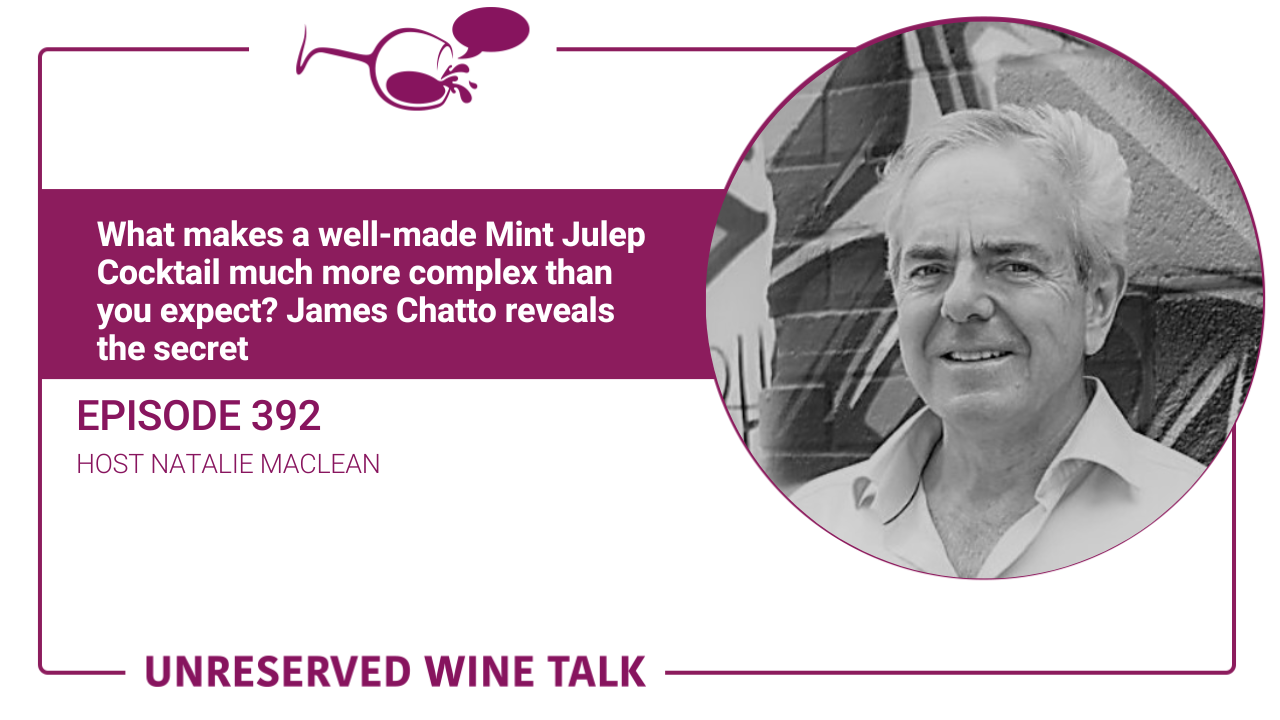
What makes a properly made mint julep much more complex than people expect? How did an Indian revolutionary leader end up creating one of Japan’s most famous curry recipes? How did a recipe collected during a 1930s concert tour in Indonesia become the legendary Queen Mother’s Cake, different from every other chocolate cake you’ve ever had?
In this episode of the Unreserved Wine Talk podcast, I’m chatting with James Chatto, co-author of the terrific new book Acquired Tastes: The Lives and Recipes of Eight Culinary Ambassadors.
You can find the wines we discussed here.
Giveaway
Three of you are going to win a copy of James Chatto’s new book, Acquired Tastes: The Lives and Recipes of Eight Culinary Ambassadors.
How to Win
To qualify, all you have to do is email me at [email protected] and let me know that you’ve posted a review of the podcast.
It takes less than 30 seconds: On your phone, scroll to the bottom here, where the reviews are, and click on “Tap to Rate.”
After that, scroll down a tiny bit more and click on “Write a Review.” That’s it!
I’ll choose three people randomly from those who contact me.
Good luck!
Join me on Instagram, Facebook and YouTube Live Video
Join the live-stream video of this conversation on Wednesday at 7 pm eastern on Instagram Live Video, Facebook Live Video or YouTube Live Video.
I’ll be jumping into the comments as we watch it together so that I can answer your questions in real-time.
I want to hear from you! What’s your opinion of what we’re discussing? What takeaways or tips do you love most from this chat? What questions do you have that we didn’t answer?
Want to know when we go live?
Add this to your calendar:

Highlights
- What makes the mint julep tradition at Oxford both fascinating and deeply complicated?
- Why did a simple rum drink discovered in Cuba become one of America’s most iconic cocktails?
- What hidden history was uncovered behind the luxurious dish Lobster Newberg?
- How did a Bengali revolutionary leave a lasting mark on Japanese curry culture?
- What made Jan Smeterlin’s chocolate cake unforgettable enough to become a royal favorite?
- Why does James believe food is such a powerful and lasting carrier of memory?
- Which story in the book seemed so improbable that James doubted it until the historical evidence confirmed it?
- What personal objects would James choose to display in a museum about his life?
Key Takeaways
- What makes a properly made mint julep much more complex than people expect?
- I love a classic mint julep made with bourbon. You start by taking some mint leaves and a little bit of sugar, and I say an ounce of bourbon. You muddle them all in the bottom of a silver julep cup, and then you fill it up with half full of crushed ice, and you add another couple of ounces of bourbon, and then you fill it up to the top with the crushed ice, and then you plant a little garden of mint sprigs in the top, stick a straw and snip off the straw. So it’s only about two inches above the top. So every time you bend down to get a sip, the first thing you get is mint in your nose, and it’s a delightful drink. It tastes much more interesting than it sounds, but the sugar and the mint and the bourbon all muddled up together and the ice melt is a very important part of it, because it’s a long drink. It’s a drink to savor and enjoy over a period of time, preferably on a very hot day.
- How did an Indian revolutionary leader end up creating one of Japan’s most famous curry recipes?
- Rash Behari after he was not caught for trying to bomb the viceroy. He then tried to instigate a mutiny in the British Indian Army, and that was a disaster. And he had to flee India. He was a lonely gentleman in Tokyo, and the British tracked him down there. And they said to the Japanese government, with whom they had an alliance, you had to arrest this guy and give him back to us, and we’ll put him on trial. And for a while the Japanese were able to prevaricate and say no. They hid him in a little hut beside a restaurant, a bakery, and no one could find him. While he was there, he would tell the Japanese lady who ran the restaurant and her husband that he was so lonely he needed to cook for himself, and they would find spices and he would cook these wonderful Bengali curries. And years later he added that curry to the menu of this restaurant. And people said that this is not like Japanese curry. To this day, that restaurant, long after all of this is over and done with, is called the Nakamuraya Company, and it’s now a huge multi-billion multinational. But they’re all over Japan and they still sell this curry to his original recipe.
- How did a recipe collected during a 1930s concert tour in Indonesia become the legendary Queen Mother’s Cake?
- N: Jan Smeterlin is known for the Queen Mother’s Cake, a dense, moist, intensely flavored cake. What makes it different from every other chocolate cake you’ve ever had?
- J: It’s interesting because it’s very like many chocolate cakes that we’ve all had. It’s very like a flourless chocolate cake that would be made in Passover and any number of houses all over the world like one of Elizabeth David’s flourless chocolate cakes or a torta caprese from Capri. But the way he did it is just great and more chocolatey and more rich and more intense, and there’s a good half inch of very deep chocolate icing on top. And he got the recipe from a Dutch woman in Batavia, Indonesia, when he was doing a concert tour there in the 1930s, and she was part of the Dutch colonial presence there. And she cooked this and served it to him. And he said, I must have the recipe because he loved to collect recipes wherever he went in the world, and she gave it to him. And then back in England, he cooked it for a friend of his, another pianist whose name was Lady Fermoy, and she said, oh my God, this is something that my friend the Queen will love and she adored it. And she asked for a second slice.
About James Chatto
James Chatto read English at New College, Oxford, before becoming an actor and musician; today, he is one of Canada’s best-known writers on the subjects of food and drink. He has written seven books, including A Kitchen in Corfu, the best-selling A Matter of Taste (with Lucy Waverman) and two memoirs, The Man Who Ate Toronto and The Greek for Love. As a journalist, he spent decades as Toronto Life’s restaurant columnist, Senior Editor of the LCBO’s magazine, Food & Drink, and editor of harry magazine; his writing has appeared in dozens of publications in Canada, the U.S. and the U.K. A co-founder of the Canadian Culinary Championship, he is a Chevalier of the Confrérie des Chevaliers du Taste Fromage de France, and a Freeman of Corfu Town. He is a puppetmaker.
Resources
- Connect with James Chatto
- Unreserved Wine Talk
- My Books:
- Wine Witch on Fire: Rising from the Ashes of Divorce,Defamation, and Drinking Too Much
- Audiobook:
- Audible/Amazon in the following countries: Canada, US, UK, Australia (includes New Zealand), France (includes Belgium and Switzerland), Germany (includes Austria), Japan, and Brazil.
- Kobo (includes Chapters/Indigo), AudioBooks, Spotify, Google Play, Libro.fm, and other retailers here.
- Wine Witch on Fire Free Companion Guide for Book Clubs
- Audiobook:
- Unquenchable: A Tipsy Quest for the World’s Best Bargain Wines
- Red, White, and Drunk All Over: A Wine-Soaked Journey from Grape to Glass
- Wine Witch on Fire: Rising from the Ashes of Divorce,Defamation, and Drinking Too Much
- My new class, The 5 Wine & Food Pairing Mistakes That Can Ruin Your Dinner And How To Fix Them Forever
Tag Me on Social
Tag me on social media if you enjoyed the episode:
- @nataliemaclean and @natdecants on Facebook
- @nataliemaclean on Twitter
- @nataliemacleanwine on Instagram
- @nataliemaclean on LinkedIn
- Email Me at [email protected]
Thirsty for more?
- Sign up for my free online wine video class where I’ll walk you through The 5 Wine & Food Pairing Mistakes That Can Ruin Your Dinner (and how to fix them forever!)
- You’ll find my books here, including Unquenchable: A Tipsy Quest for the World’s Best Bargain Wines and Red, White and Drunk All Over: A Wine-Soaked Journey from Grape to Glass.
- The new audio edition of Red, White and Drunk All Over: A Wine-Soaked Journey from Grape to Glass is now available on Amazon.ca, Amazon.com and other country-specific Amazon sites; iTunes.ca, iTunes.com and other country-specific iTunes sites; Audible.ca and Audible.com.
Transcript
Natalie MacLean 00:00:00 What makes a properly made mint julep cocktail much more complex than most people expect. How did an Indian revolutionary leader end up creating one of Japan’s most famous curry recipes? And how did a recipe collected during a 1930s concert tour in Indonesia become the legendary Queen mother’s cake different from every other chocolate cake you’ve probably ever tasted? In today’s episode, you’ll hear the tips and stories that answer those questions. In part two of our chat with James Chatto, co-author of the terrific new book Acquired Tastes The Lives and Recipes of Eight Culinary Ambassadors. By the end of our conversation, you’ll also discover how a simple rum drink discovered in Cuba became one of America’s most iconic cocktails. The hidden history uncovered behind the luxurious dish Lobster Newburg why James believes food is such a powerful and lasting carrier of memory. The story that seemed so improbable James doubted it until historical evidence confirmed it, and the personal objects he would choose to display in a museum about his life.
Natalie MacLean 00:01:19 Do you have a thirst to learn about wine? Do you love stories about wonderfully obsessive people, hauntingly beautiful places, and amusingly awkward social situations? Well, that’s the blend here on the Unreserved Wine Talk podcast.
Natalie MacLean 00:01:36 I’m your host, Natalie MacLean, and each week I share with you unfiltered conversations with celebrities in the wine world, as well as confessions from my own tipsy journey as I write my third book on this subject. I’m so glad you’re here. Now pass me that bottle, please, and let’s get started.
Natalie MacLean 00:02:01 Welcome to episode 391. So what’s new in the drinks world? Well, this week in fur, feathers and fermentation, a California winery has installed owl boxes throughout its vineyards to attract barn owls as natural rodent control, describing them as Mother Nature’s farm worker housing. Each barn owl family can eat up to 3000 rodents a year, which beats almost any synthetic alternative. Meanwhile, in ancient human news, archaeologists working in the Danube riverbank in modern day Hungary recently published findings showing how Roman legions cooled their wine roughly 2000 years ago. Soldiers built ceramic lined pits dug deep into the riverbank clay, channeling cold groundwater around the amphorae to chill them. Romans drank their wine, watered down and chilled, often spiced with honey and herbs, in a preparation called Pascha.
Natalie MacLean 00:03:02 And in modern human news, it might be one of the most expensive failures of restaurant hospitality on record. A 1787 Chateau Lafite, sold by Christie’s auction house in 1985 for £105,000, so almost $200,000 in Canadian currency reportedly turned to vinegar after the billionaire publisher Malcolm Forbes, the head of Forbes magazine, displayed it upright under strong lights at the Forbes Magazine Museum in New York. Drying out the cork that caused it to shrink, allowing oxygen to compromise the wine. The bottle, which had supposedly belonged to Thomas Jefferson, was already a center of controversy. That bottle is now widely accepted to have been an outright fake. It was originally consigned by the notorious German music manager turned wine dealer named Hardy Rosenstock. That is not a made up name, by the way. Subsequent forensic investigations by billionaire collector Bill Koch, who bought other bottles from the same Jefferson cache, revealed that the. Initials had actually been etched into the glass using a modern high speed dentist drill. Malcolm Forbes famously shrugged off the initial investment and the subsequent ruin of the liquid, comparing it to other historical artifacts in their family collection, by stating this wine was more fun to own than the opera glasses Lincoln was holding when he was shot.
Natalie MacLean 00:04:32 And we have those two in your weird but wonderful scientific fact this week. Have you ever wondered about those little glassy crystals that sometimes form at the base of the bottle or inside of the cork? Those crystals are not glass. They are tartrate crystals, sometimes called wine diamonds, and they form when potassium binds with the wine’s natural tartaric acid in cold temperatures below four degrees Celsius. They’re a marker of unfiltered, gentle winemaking, often appearing in high quality wines that skip cold stabilization to preserve flavor. They’re chemically identical to the cream of tartar in your spice cupboard, which means, in theory, you could scoop them out and use them to stabilize an egg white meringue. If you try it, let me know. For your calendar this week, Wednesday, June 3rd has two events on one day. National Egg Day Speaking of meringues and World Cider Day. The cider tradition stretches back to 55 BCE, when invading Roman legions discovered local Celtic tribes by people already pressing and fermenting indigenous apples. To celebrate Paris cider with brunch eggs mixes, sparkling cider, spritz or serve deviled eggs beside a crisp white wine and maybe a meringue.
Natalie MacLean 00:05:55 You could also assemble a blind tasting flight of bone dry and naturally sparkling orchard expressions, or blend a clear cider with fresh ginger beer and a squeeze of lime for a bright, seasonal patio punch. Thursday, June 4th is the double bill of National Cheese Day, a National Cognac Day. Cognac is the grape based brandy from France’s Cognac region, and it carries protected geographic status, with rules that require double distillation in copper pot stills around the town of cognac in southwest France. The brandy must then age a minimum of two years in French oak casks from the Limousin, or truncate forests for the cheese half of your day. Try goat cheese with a Sauvignon blanc, aged cheddar with a Cabernet Franc, or a tiny pour of cognac beside a blue cheese that knows it has presence for cognac itself. Mix a sidecar cocktail with fresh lemon juice and orange liqueur. Elevate a Manhattan by swapping the whiskey for a rich VSOp cognac, or try a side by side neat. Pour a cognac highball also works beautifully. Friday, June 5th is a quadruple feature.
Natalie MacLean 00:07:13 Are you ready? Its National Gingerbread Day, National Veggie Burger Day, World Environment Day, and National Moonshine Day. That would make my relatives happy. Moonshine is the old school term for unaged or minimally aged white spirit, where the legend of the label often matters as much as the liquid. The word moonshine comes from the British term for night work, which fits its deep Appalachian roots. The high proof Corn Spirit fueled the Whiskey Rebellion of 1791, and turned prohibition era bootleggers into folklore icons. Probably a number of them. My relatives. Several early NASCAR drivers were former bootleggers running clear whiskey on the back roads of Virginia and North Carolina. To celebrate, pour something clear and cheeky, or mix up a glass of white lightning lemonade for the patio. Call that a porch pounder. For gingerbread day, mix a few ginger beer cocktails for veggie Burger day, pour lighter reds with plant based patties and for World Environment Day, host a local wine night with fewer kilometers in the glass. Saturday, June 6th covers National Fruit Salad Day and National Bubbly Day, the latter always falling on the first Saturday in June.
Natalie MacLean 00:08:32 Bubbly is a catch all term for sparkling wine, so this one is built for everyone from cava to champagne. For fruit salad, pour Moscato, an off dry Riesling or a sparkling rosé and pretend the fruit bowl was always in the plan. Sunday, June 7th is National Chocolate Ice Cream Day. Try a ruby port for the chocolate. Notes. Drizzle a cream liqueur over a scoop of ice cream or build a stout float. Monday, June 8th gives you World Oceans Day and name your poison day. For oceans, pair sustainable seafood with Muscadet Albano sparkling wine or a sailing coastal gin martini for name your poison day. Go full Dealer’s Choice cocktail night or curate a tasting flight built around your favorite spirit. Tuesday, June 9th wraps up the week with a triple National Strawberry Rhubarb Pie Day, National Rosé Day, and International Dark and Stormy Day. Rosé usually gets its pink color from short skin contact with red grapes, which keeps it fresh, pale, and summer friendly. The Dark and Stormy is the only cocktail in the world whose name and recipe are both trademarked.
Natalie MacLean 00:09:44 Both held by Goslings of Bermuda, the family owned rum producer founded in 1806. The official recipe calls for Gosling’s black seal rum poured over ice into a tall glass of ginger beer with a lime wedge, ideally in that order, so that you get the iconic dark cloud effect for the pie. Try rosé off dry Riesling or sparkling wine for National Rosé Day. Chill a few different styles. Pour them with grilled salmon or tacos. Or run a pink only patio hour for dark and stormy. Stick with the classic dark rum, ginger beer, and lime. Now, I think there should be a new holiday in order of two world records set. Recently, the first was in the town of ten zero in Mexico, when it served the world’s largest batch of guacamole recently at the annual Avocado Festival. The dish weighed in at And £991 of mashed avocado, lime, salt and cilantro. The town happens to be the avocado capital of the world. Smart marketing. And pair that, of course, with the salt rimmed Margarita and Princess Cruises Regal Princess in Cozumel.
Natalie MacLean 00:11:05 They set a world record too, with passengers and crew drinking 3410 margaritas in eight hours, breaking the previous Guinness World Record of 2728. The cocktails used pantaloons organic Blanco tequila. Woo! Back to today’s episode. Three of you will win a copy of James Shadow’s wonderful new book, Acquired Tastes The Lives and Recipes of Eight Culinary Ambassadors. If you’d like to win a copy, please email me and let me know. Hey, I’d like to win. It doesn’t matter where you live, I’ll choose three winners randomly from those who contact me at Natalie at Natalie MacLean dot com. Keep them for yourself or give them as gifts. Speaking of book giveaways, congratulations to Edna Kiyoko from Nairobi, Kenya, who has just won a copy of Tasting Victory The Life and Wines of the World’s Favourite Sommelier by Gela Basile, as well as Rebecca Richardson from Toronto, Ontario, who has won the Cheese Cure, how comp day and Camembert. Fed My Soul by Mike Finnerty. If you’re reading the paperback or e-book or listening to the audiobook of my memoir, Wine Witch on Fire Rising from the Ashes of Divorce, defamation, and Drinking Too Much, a national bestseller and one of Amazon’s best books of the year.
Natalie MacLean 00:12:26 I’d love to hear from you at Natalie at Natalie MacLean dot com. I’ll put a link in the show notes to all retailers worldwide at Natalie MacLean. Com 4392. Okay, on with the show. Up next we have William and the Mint Julep. Now, your chapter on this cocktail traces its origin back to William Trappers, a Southern Carolina rice plantation owner, foreign farmed by 114 enslaved women, men and children. While visiting Oxford University as a tourist in 1845. He right, he presented New College, where you attended with a sum of money whose interest not that you were attending back in 1845. Let me insert things while I’m thinking about them. But anyway, so he presented the college with a sum of money whose interest would pay for the mint juleps to be served to every junior fellow on June 1st, every year in perpetuity. He also gave the college his family recipe. Now, I should say you yourself were a student at New College, Oxford in the mid 70s and drank mint juleps at the very ceremony they founded.
Natalie MacLean 00:13:37 What’s the modern recipe for this cocktail and what does it taste like? James.
James Chatto 00:13:41 I love a mint julep. This is the very classic mint julep made with bourbon. You start by taking some mint leaves and a little bit of sugar, and I say an ounce of bourbon. You muddle them all in the bottom of a silver julep cup, and then you fill it up with half full of crushed ice. You add another couple of ounces of bourbon, and then you fill it up to the top with the crushed ice, and then you plant a little garden of mint sprigs in the top, stick a straw and snip off the straw. So it’s only about two inches above the top. So every time you bend down to get a sip, the first thing you get is mint in your nose, and it’s a delightful drink. It tastes much more interesting than it sounds, but the sugar and the mint and the bourbon all muddled up together and the ice melt is a very important part of it, because it’s a long drink.
James Chatto 00:14:26 It’s a drink to savor and enjoy over a period of time, preferably on a very hot day. And it’s a very cold drink.
Natalie MacLean 00:14:32 Yeah, I slowly dilutes the bourbon. The intensity of the alcohol, the spreads out, the drinks and the muddling. And I’ve seen this sort of dish and the big pestle thing or whatever. So what are you doing with the leaves? You just trying to release their oils?
James Chatto 00:14:47 Yeah, exactly. You’re not trying to crush them. You’re just trying to bruise them. Okay. And get that that mint oil out. Now, some people say at that point you need to take the mint leaves out and other people say, no, you must leave them in. There’s so many arguments about the proper the way julep should be made in Kentucky or Virginia is different, but it’s it’s a fantastic drink now when you make it in great numbers like the Kentucky Derby over that two day race meet, they make 120,000 mint juleps. So they have a shortcut, which is they make a mint flavored syrup to to start with.
James Chatto 00:15:18 And they could just pour in some of that, then some bourbon and some ice and hand it over. And that’s what they do at New College these days too, because in the old days there were 20 undergraduates, but now there were maybe, I don’t know, 200, something like that. And at the ceremony these days, slightly pre-made, but they still do it. It’s wonderful. And when I was there, we had the new college choir, which is one of the most famous choirs in England, and they sang some songs from Porgy and Bess up in the minstrels gallery in this medieval dining hall that we have. And what they didn’t know, and I found out later, was that Porgy and Bess, the librettist, it was a man called DuBose Heyward, and he was, in fact related to William Heyward on his mother’s side. There was a connection. There was always coincidences all over the place.
Natalie MacLean 00:16:02 Terrific. Oh my goodness. Now, this chapter, you include a sidebar quoting historian David wandering on the African-American bartenders whose expertise has been systematically erased from the history of American cocktails.
Natalie MacLean 00:16:15 You’re writing a chapter whose central subject, of course, is a white southern plantation owner who had slaves. How did you decide where to place that background? How did you balance kind of those realities? A very fascinating story with a dark underside, if you will, with the slavery.
James Chatto 00:16:31 Yeah, it’s very pertinent at the moment in the world, I think. And I asked the question, how are they going to do it in future at New College? Right. I believe that the right way of doing it is to give all the information to say, this is what happened. This was tainted money that is sponsoring this event every year. The money was raised on the backs of enslaved men, women and children. Do you have three choices? You can either just abolish the whole event. You can pretend it wasn’t that and just not mention his name or something and just say it’s a cocktail party. Or you can perhaps tell the story and remind people of the role that slavery played in our culture. And I favor that way as somebody who believes that the more light you can shed on a subject, the better.
James Chatto 00:17:15 And as a historian, I think covering stuff up is not the right way through.
Natalie MacLean 00:17:20 It’s going to get out anyway. Most things do.
James Chatto 00:17:24 So tell the truth about it.
Natalie MacLean 00:17:25 Absolutely. Terrific. Now, rear onto another cocktail, the the daiquiri. Lucius Johnson had an extraordinary surgical career you share with us in the book. Specializing in facial reconstruction. Serving in naval hospitals across the globe. Coordinating disaster relief in the Dominican Republic after hurricane. Building the first Naval Mobile Base Hospital at Guantanamo Bay and rising to the rank of rear admiral in the US Navy. Now, he brought the daiquiri cocktail from Cuba to the United States in 1909. Tell us about the cocktail or the man, or both.
James Chatto 00:18:01 Okay. Yeah. He’s a remarkable young man. And when I was doing my research into him, I found that he has an archive in a university in North Carolina. So I went down there and I opened the archive up, and there was an autobiography he’d written, unpublished, unfinished.
Natalie MacLean 00:18:17 Yes.
James Chatto 00:18:17 Very helpful.
James Chatto 00:18:19 And so he entered the Navy right out of medical school and became an assistant surgeon on a boat, a battleship. And every spring, as they think, they used not any more, obviously, but they used to go down to Cuba, to Guantanamo Bay and do their naval exercises in the springtime. And so he was the junior surgeon on this boat. And they’d just had the Spanish-American War had finished only a decade earlier, and some of the young officers decided to go ashore and look at the battlefields where Teddy Roosevelt had charged up the hill at San Juan and won the victory there. And it was all very romantic. And so they landed at this beach called daiquiri, and there was an American Spanish American iron works, a huge iron mine. And they would ship this iron ore back to the States. And they met one of the mining engineers who was a man called Stockton Cox. And he said, oh, it’s such a hot day. Come, we have this hospitality suite here, this little house we call the Casa Grande.
James Chatto 00:19:15 You can get in the shade. I’ll make you a drink. And he made them a cocktail that he’d invented a couple of years earlier. And it was the local rum, which was Bacardi, because they used to be made in Cuba and squeezed lime juice and little stir of sugar and measured in some ice. And he said, no, you just had to leave it for a couple of minutes to let the ice begin to melt and let everything get cold. And that was added to him. That was the original prototype of the dash.
Natalie MacLean 00:19:39 That’s very similar to the mint julep. The recipe seems a little similar, but.
James Chatto 00:19:44 So many drinks are they fall under the daisy category of cocktails, which is a citrus and a spirit and a sweetener. But it’s lime juice, sugar and rum had been the tip of the British Navy already for 150 years. But Jennings Cox, who was quite a sophisticated man and back in the States, he’d been a club man in New York and Philadelphia, and he knew the value of mixing a cocktail just right and letting it sit for a moment.
James Chatto 00:20:09 And he turned this mixture into this fabulous cocktail daiquiri. And he just got the balance exactly right. And thank goodness he wrote down the proportions and how to do it. And that piece of paper survives in the University of Miami archives, which we found it there. And so this young sailor was so happy with this that he bought a couple of bottles of the local rum that they Bacardi and hid them in his duffel bag. And when he got back to Virginia, he went on leave to Washington, D.C., and went into the Army and Navy Club and said, listen, you got to make me this drink I had in Cuba. And he told him how to do it, and he introduced the daiquiri to the rest of the world in that way.
Natalie MacLean 00:20:48 That is fascinating.
James Chatto 00:20:49 It took took off and would have done much better if it hadn’t been for prohibition. You know.
Natalie MacLean 00:20:54 Put it in your sails any time. But I love this line in your book. You say it took only decades for Admiral Johnson’s pristine daiquiri to be twisted into umpteen slushy travesties.
Natalie MacLean 00:21:06 Oh my gosh. So yeah. And he named it after the beach rather than Cox, right?
James Chatto 00:21:12 Yes, because Cox had called it a doctor.
Natalie MacLean 00:21:14 Oh, Cox. He called it a daiquiri. Okay.
James Chatto 00:21:16 Got it. He just thought this is where I made it first. He made it originally by accident because he’d run out of gin, which is what he liked to drink. Okay. And he saw that some of the people who worked for him were drinking the local rum. And to make it slightly less aggressive. They were putting sugar and lime juice into it. So that’s how he came up with the idea. So yeah. So that DAC was named after the beach.
Natalie MacLean 00:21:36 Great, great. Okay, let’s move on to Lobster Newberg. Wendy wrote this chapter about Benjamin Jones. Jordan Wennberg, a Maine captain in the 1850s. These all sound like characters out of a novel, but they’re in your book. He was a slave trader, despite the fact it was a capital offense at the time.
Natalie MacLean 00:21:52 He was complicit in the deaths of hundreds of people. Some say he strolled into New York City’s Delmonico’s Café restaurant one day in 1876, and cooked up the lobster Newburg dish on the spot, using the recipe it found in the Caribbean. Others credit the restaurant’s brilliant chef. As you note, the dish itself is a study in Gilded Age opulence. Tell us about it.
James Chatto 00:22:15 Okay, let’s start with the dish. I’ll tell you what. First of all, what he did. Because he did go in there and he did cook it. And he actually lived at Delmonico’s restaurant. They had nine luxury suites on the third floor of the restaurant. One of them was his home. And when he wasn’t eating downstairs, which was almost every night, he was up there and he had a chafing dish. So he had little spirit lamps under a metal dish, and he’d cook himself dinner. He’d have the food sent up from the kitchens and just experiment, had fun. And he came across this wonderful recipe, and he came down and showed all his cronies come here.
James Chatto 00:22:47 And he beckoned Charles Delmonico over and said, I’ve got a great recipe. You could put this on your menu anytime you want. Call it Weinberg. So you take some cold lobster that was already in the kitchen, ready for a lobster salad had been cooked, and he fried in a little butter just for a moment, just to soften it. Added some salt and pepper, a little bit of nutmeg. Deglaze the pan with a glass of sherry. Then he beat two egg yolks into some heavy cream, and poured that in, and let it all heat up and add them finely stirred a little bit of cayenne pepper. And that’s Lobster Newberg, or as it’s now called, Lobster Weinberg. It’s incredibly rich and decadent and it’s absolutely delicious. And it caught on. Everybody loved it and wanted it. Then there was a falling out that he had with Charles Delmonico, and Delmonico changed the name from Weinberg to Newburgh, just changing over the first three letters. And so Lobster Newburgh as what we know it as today.
James Chatto 00:23:43 And everybody said we’ve never seen a menu with Lobster Wennberg on it. It has always been Lobster Newburgh. And so Wendy, my wife, the great triumph of this book she found in a church register in Connecticut that the ladies of the church had put together a little cookbook, and one of them had known Benjamin Wennberg, and she called it Lobster Wennberg. And this was published just a year after he died. And so we take this as proof.
Natalie MacLean 00:24:11 Yes. Oh, that’s.
James Chatto 00:24:12 Great. But, nobody remembered who Ben Wennberg was. They said he was a sea captain, and he found this recipe in the Caribbean. He wasn’t a sea captain. He never left New York. He was a merchant. And he would hire out a ship broker. Was the name of the profession okay? He wanted to take a ship somewhere and he had a cargo. Then he would arrange that. But for most of the 50s and early 60s, he was doing that in the cargo, was enslaved people kidnapped from Africa and sold, coincidentally, often to Cuba, where they became slaves in the sugar plantations.
James Chatto 00:24:43 Right. And many times his vessels were caught and taken back to America and put on trial in the court, and invariably the case was dismissed. The judge would say, there’s no evidence here. And he got away scot free time after time, because it was in everybody’s best interest to continue this terrible thing, because the New York banks were making a fortune of supplying, lending money to the South and the rice plantations down there. And you think things that corrupt these days, it was just as bad.
Natalie MacLean 00:25:13 Wow. Wow. Okay. Now. Yeah. That just sounds beautiful. That that the dish. And it gives a really a sense of the Gilded Age opulence and that sort of defining luxury. So it also became a dish that Auguste Escoffier considered worthy of inclusion in his 1902 liquid cooling air. So it really became an icon kind of dish. And what did you recommend as a wine pairing for the dish?
James Chatto 00:25:40 I looked at some of the old menus from Delmonico’s from the 1870s that have come down to us, not the daily menu.
James Chatto 00:25:47 Alas, there are very few of those, but for special events they would make these gorgeous hand-painted menus with satin and ribbon and things on them. And there is the thank goodness, how polite and how wonderful. They would always list the wines that were served with these dishes. And Lobster Newburg was used frequently early on in the meal, so it’s often going to be champagne they’re having. But it was also I’ve seen it with with a beautiful morsel of rich white Burgundy. So of course we had to try both. Yes. Of course, yes.
Natalie MacLean 00:26:17 And maybe a few more times after that we did.
James Chatto 00:26:19 What would it be like with it? The Mercer was great because it’s such a rich, wonderful wine and it was a beautiful compliment to the dish. And the champagne had the opposite effect as a contrast. It just cleansed your palate, and it was the dryness and the crispness. And you could go on eating more lobster Newburg if you were drinking champagne with it. We discovered. Yes.
Natalie MacLean 00:26:39 You don’t satiate out as quickly when you’ve got a great wine faring as a classic.
Natalie MacLean 00:26:44 All right. How about Rash Behari Bose and the curry of love and revolution? So just that quick background or Rash Behari Rose, a Bengali revolutionary, journalist and cook. In 1912, he masterminded a failed assassination attempt of Lord Hardinge, the Viceroy of India. Rash threw a bomb at Hardinge from a rooftop dressed as a muslim woman. He then organised the welcome ceremony for Hardinge as he was convalescing, delivered an eloquent speech condemning the attack and was personally thanked by the Viceroy for his patriotism. Now he the dishes famous for. Is Bengali chicken curry, and he sourced free range chickens whose bones yielded a collagen rich, thick stock. So tell us about that dish.
James Chatto 00:27:32 Okay, I’ll just have to go back a little bit to Rash Behari after he was not caught for trying to bomb the viceroy. Yes. He then tried to instigate a mutiny in the British Indian Army, and that was a disaster. And he had to flee India. And he got on a ship for Japan, disguised in an English suit with a copy of the times under his arm.
James Chatto 00:27:53 And he reached Japan, and then spent the rest of his life trying to defeat the British Raj through political and trying to raise money to get guns to give to revolutionaries in India and things like that. He was a lonely gentleman in Tokyo, and the British tracked him down there. And they said to the Japanese government, with whom they had an alliance, you had to arrest this guy and give him back to us and put him on trial, and for a while the Japanese are able to prevarication and say no. But then it came to be that his friends, who were the anti-British unit in the Japanese area, the pan-Asian movement, wanted to get rid of all the colonial powers from Asia. They hid him in a little hut inside a restaurant, a bakery, and no one could find him. And while he was there, he would tell the Japanese lady who ran the restaurant and her husband that he was so lonely he needed to cook for himself, and they would find spices and he would cook these wonderful Bengali curries.
James Chatto 00:28:51 And years later he added that curry to the menu of this restaurant. And people said that this is not like Japanese curry with the Japanese have their own curry, which is based on British curry, which is what they got from their English Royal Navy. So it’s not as sweet and it’s got raisins in it. And to him, as a proper Bengali cook, it was a travesty and also represented the worst kind of British colonialism in a culinary way. To this day, that restaurant, long after all of this is over and done with. It’s called the Nakamura Company as it was then too, and it’s now a huge multi. I’m not a multinational, but they’re all over Japan and they still sell this curry to his original recipe and in pouches too. They sell hundreds of thousands of these curry pouches a year. And you can go there. And my son and his wife, who’s Japanese, went to this restaurant and had this curry, Bose’s own curry that is still cooked and offered there. And it’s it’s served in a very un Japanese way, which is that you put it on top of the rice instead of beside the rice, the way Japanese carriers are.
James Chatto 00:29:55 And that sort of symbolizes the fact that it’s an Indian curry. And Boers brought his own recipe. He sought out the right kind of chickens, the right kind of onions, the right kind of rice. And culinary wise, his story is quite clean cut and direct. Politically, it’s not so easy. He became part of the Imperial Japanese movement, ironically, since he was against the Imperial British movement and he died during World War II. Oh wow.
Natalie MacLean 00:30:22 But that is just, These stories are amazing. And a journalist described the result of the dish as the taste of love and revolution. How would you describe it?
James Chatto 00:30:33 It is that because in the middle of the story I just told you, he married the daughter of the couple who owned the restaurant where he was hiding out. And that’s why it was the love part gets in there. And the revolutionist because of his own past as a freedom fighter. So I was tasked with finding out what a Bengali chicken curry tasted like in the 1880s when he was growing up.
James Chatto 00:30:55 And I went to talk to my friend Hemant Bhagwati, who’s a restaurateur here in Toronto and in Ottawa, too. And he said, oh, I have the recipe for you in my pocket. And he’d just been in Bengal doing research into Anglo-Indian British Raj dishes for a restaurant he was planning to open. I don’t know if he ever did. He’s opened 71 restaurants, but. But there was the recipe for us and it all checked out, and it was exactly the way that Boz had tried to recreate in Japan using strange ingredients and whatever. Another coincidence, we lucked into the actual recipe.
Natalie MacLean 00:31:29 That’s terrific.
James Chatto 00:31:30 We could.
Natalie MacLean 00:31:30 Use. And as far as the dish itself, is it just rich? Is it spicy? Is it?
James Chatto 00:31:35 It’s actually a mug here, Joel, which means it has a slightly looser, more liquidy sauce than one might expect from a curry like that. So it’s got chicken on the bone and potatoes and Panch Faran, which is the great Bengali spice mix of five different seeds, fenugreek and cumin and nigella and black mustard.
James Chatto 00:31:54 And I think fancy. That’s right. So it tastes of all these wonderful spices. And then you can add as much fresh green chillies as you can tolerate. And it can be very hot or not. So. But it’s a simple curry but it’s very delicious.
Natalie MacLean 00:32:08 Sounds great. All right. Jan. Smit, Berlin and the cake that reached the Queen mother. I think we’re getting on to the chocolate cake. So the little background here. Jan was a world class Polish concert pianist and is known for the Queen Mother’s Cake, a dense, moist, intensely flavored cake. The texture is closer to something between a flower less chocolate torte and a very fine dark European confection. It’s one of only two recipes in the book that won, you say, unanimous approval from all of your family members. What makes it different from every other chocolate cake you’ve ever had?
James Chatto 00:32:44 James It’s interesting because it’s very like many chocolate cakes that we’ve all had. It’s very like a flawless chocolate cake that would be made in Passover and any number of houses all over the world.
James Chatto 00:32:56 It’s very like one of Elizabeth David’s flawless chocolate cakes. It’s very like a torta caprese from Capri. But for some reason, the way he did it, it’s just great. And more chocolatey and more rich and more intense, and there’s a good half inch of very deep chocolate icing on top. And he got the recipe from a Dutch woman in Batavia, Indonesia, when he was doing a concert tour there in the 1930s, and she was part of the Dutch colonial presence there. And she cooked this and served it to him. And he said, I must have the recipe because he loved to collect recipes wherever he went in the world, and she gave it to him. And then back in England, he cooked it for a friend of his, another pianist whose name was lady for Moy, and she said, oh my God, this is something that my friend the Queen will love. And she was the Queen and not yet the Queen mother. And so, lady, for my cook the cake for the Queen.
James Chatto 00:33:53 And she adored it. And she asked for a second slice. She said, I can’t believe I did that, but she did. And 20 years later, when the Queen mother, as she then was invited, Jan settle in the pianist back to her house after he’d given a concert in England. She had this cake served to him and said, I understand this was your recipe originally, Mr. Smedley. He was so honoured. And when he was in New York, later doing another series of concerts, some journalists got the idea that the Queen mother was somehow involved. And so he told the story and he cooked the cake for her in the Herald Tribune kitchens. And from then on it became huge. It went viral, as we would say today in the States. And from that recipe in the paper and then to cookbooks by other people like Maida Heater, the great dessert maven of American culture. And this cake spread everywhere. And by the time by the sort of after his death in the 1970s, he died in the 1960s.
James Chatto 00:34:49 It was basically you could find it anywhere you went in America. It was a sort of standard default after dinner cake with raspberries thrown at it, or whipped cream or something like that. And so it became a hugely famous, and it fulfilled our mandate that the recipe had to then become embedded in the culture where it landed. It couldn’t just be floating around on top. And so to this day, I get offered that cake and I see it on restaurant menus, even although the name is different. But that’s the cake that we that came out so dry the first time we got it right in the end.
Natalie MacLean 00:35:21 That’s good. That’s great. Good one to to finish on. Now just a few things as we start to wrap up here. The introduction says A great recipe is like a great idea. It has a tendency to proliferate, to wriggle under or over or through obstacles and encounters until it reaches a welcoming home. In a new culture. Your subjects were all really well known in their own time, primarily for something other than food, and today their culinary legacies have outlasted everything else they did.
Natalie MacLean 00:35:51 You spent your career writing about food. Why is food such a durable carrier of memory, say, compared to politics, business, and other endeavors?
James Chatto 00:35:59 James yeah, I think because we experience food through all our senses and its languages are involved, like music. Everybody can taste food and have the same or their own personal reaction to it. You don’t have to know the language to read it. If it was a book or whatever, and we know how resonant the memory is, aromas and flavors and things like that, they come unbidden back into the conscience or laden with associations. And I think that food is incredibly powerful, whether it’s just for sustenance or whether it’s some work of art from a brilliant chef. Food is a huge part of our lives. We encounter it three times a day. If not.
Natalie MacLean 00:36:36 Yes. Absolutely beautiful. The introduction also mentions the term fake law, which I love to describe food myths that have been repeated so many times online or elsewhere that they’re now treated as fact. You write that the real truth is essentially stranger than fiction.
Natalie MacLean 00:36:52 Which of your eight subjects produced the piece of documented history so improbable that you doubted the primary source until you finally confirmed it?
James Chatto 00:37:01 Well, I guess it was Ben Weinberg, the slave trader, Because if you read about him outside our book, then he’s just this jaunty old sea captain who goes into a restaurant and makes a fabulous dish. But in fact, he was this very sinister and wicked man. He helped Boss Tweed escape the law. He was a criminal and he died a bankrupt. And people at his funeral were astonished to find out that he had a wife and children living in Connecticut, because he’d always pass as a bachelor in New York. So my wife did this incredible about a year of forensic research to uncover, bit by bit, legal document by legal document, the life of Ben Weinberg and to finally put it together. She actually met his great great granddaughter. Oh, really? Oh, she scandalized nothing about.
Natalie MacLean 00:37:46 Oh, really? Oh.
James Chatto 00:37:48 She said, oh, that’s so funny, because he wasn’t really my great great grandfather, but his grandson, my grandfather had an affair with my grandmother.
James Chatto 00:37:56 So I guess there were scoundrels all the way down through this family.
Natalie MacLean 00:38:00 That’s great. Continuing on the family tradition in the Museum of James Chatto, which three objects would be on the central display. James.
James Chatto 00:38:10 Oh boy. I would start definitely with my most precious possession, which is a pair of lapis lazuli cufflinks that my wife gave me on our 30th wedding anniversary, and they’re almost too precious to wear. But I do wear them because they’re beautiful. That would be number one. I’d have to have a puppet because puppets are a big part of my life, and I would choose my oldest puppet, which is a sort of weird brown puppet called Zoltan. And he I used to use him to teach my children to count when they were very small. So the old Tom would represent the puppet kingdom. That’s great. But then the third thing, I guess, maybe a shell or a feather or something, that would just stand for all the wonderful, serendipitous things that the world has dropped in front of me over the years.
Natalie MacLean 00:38:56 Lovely. Lovely, lovely. Not to be too morbid, but which one would you like served at your funeral? Not that we’re planning.
James Chatto 00:39:04 I love this question. I have to think a long and hard about that, Natalie. But since I’m planning to have pizza at my funeral, I think the one I would choose would be a very dry Alsatian mascot. Because it’s such a counterintuitive wine. It smells so perfumed and ethereal, and it’s bone dry and such a great appetite stimulant. And I think you’d need that to have with your pizza. And it would just make you eat all the hungry and eat more pizzas. I think that would be my wife.
Natalie MacLean 00:39:33 And remind everyone attending your funeral that you would truly wear a man of great contradiction. So the wine is perfectly embodiment. And if you can put up a billboard in downtown Toronto, what would it say?
James Chatto 00:39:45 Oh that’s easy. I’d say put away your phone and engage with the world.
Natalie MacLean 00:39:49 And get my book.
James Chatto 00:39:51 Yeah. Buy my book.
Natalie MacLean 00:39:54 It’s a tremendous book, and yet it’s so graceful.
Natalie MacLean 00:39:56 It just goes from one one section to the next effortlessly. How can people best find you in the book online? James.
James Chatto 00:40:04 My online presence is really on Instagram, so if you go to the James Chatto, I had to add the because there is an Instagram account called James Chatto and it turns out it’s a high school kid in the Philippines, right? And we’ve never met. But so the James Chatto will find me and my puppets and my book. Our book.
Natalie MacLean 00:40:23 Excellent. And your book, of course, will be available through all of the online retailers, Amazon chapters, all the places we would expect.
James Chatto 00:40:32 Yes. University of Toronto Press publisher. Luckily. So it’s there in Europe and the States as well.
Natalie MacLean 00:40:37 Sure. Great. Worldwide. That’s terrific. These days, everybody can get whatever they want to read. Wonderful. James, this has been a true pleasure. It’s great to reconnect with you next time. I hope it’s in person over a glass or three of Muscat.
James Chatto 00:40:51 That would be.
Natalie MacLean 00:40:52 Lovely. And thanks again for sharing this. Your journey in the book. It’s marvellous. I highly recommend.
James Chatto 00:40:57 It. Thank you. Natalie. So nice to see you.
Natalie MacLean 00:40:59 Okay. Cheers.
Natalie MacLean 00:41:05 Well, there.
Natalie MacLean 00:41:05 You have it. I hope you enjoyed our.
Natalie MacLean 00:41:07 Chat with James.
Natalie MacLean 00:41:08 Here are my takeaways. Number one.
Natalie MacLean 00:41:10 What makes a properly made mint.
Natalie MacLean 00:41:12 Julep much more complex than many people expect. As James explains, I love a classic mint julep made with bourbon. You start by taking some mint leaves and a little bit of sugar and an ounce of bourbon. You muddle them all in the bottom of a silver julep cup, and then you fill it half full with crushed ice and another couple of ounces of bourbon. Then you top it up with crushed ice, and then you plant a little garden sprig of mint on top, stick a straw in and snip off the straw. So it’s only about two inches above the top. So every time you bend to get a sip, the first thing you get is mint in your nose.
Natalie MacLean 00:41:53 It’s a delightful drink, he says, and I have to agree, it tastes much more interesting than it sounds, but the sugar and the mint and the bourbon all muddled together and the ice slowly melting is a very important part of it, because it’s meant to be a long drink enjoyed over time, preferably on a very hot day, and even more preferably, you’ve got great seats at the Kentucky Derby. Number two how did an Indian revolutionary leader end up creating one of Japan’s most famous curry dishes? James explains that Rash Behari, after he was not caught for trying to bomb the Viceroy of India, he then tried to instigate mutiny in the British Indian Army, and that too was a disaster and he fled to India. He was a lonely gentleman in Tokyo, and the British tracked him down there. They told the Japanese government with whom they had an alliance. You have to arrest this guy and give them back to us and we’ll put him on trial. And for a while, the Japanese were able to prevarication and say no.
Natalie MacLean 00:42:57 They hid them in a little hut beside a restaurant, a bakery, and no one could find him. And while he was there he would tell the Japanese lady who ran the restaurant and her husband that he was so lonely that he needed to cook for himself, and they would go and find spices and he would cook these wonderful Bengali curries. Years later, his curries were added to the menu of the restaurant and people said this isn’t like a Japanese curry. And finally, how did a recipe collected during a 1930s concert tour in Indonesia become the legendary Queen mother’s cake, as James says. Jan Smuts Island is known for the Queen mother’s cake, which is dense and moist and intensely flavored. It’s very like the flawless chocolate cake that would be made at Passover, or like one of the British writers, Elizabeth David’s flourless cakes, or even a torta caprese from Capri. But the way Jan did It was more chocolatey and richer and more intense, and it’s a good half inch of very deep chocolate icing on top.
Natalie MacLean 00:44:02 Oh my gosh, my mouth watering. He got the recipe from a Dutch woman in Batavia, Indonesia, when he was doing a concert tour there in the 1930s, and she was part of the Dutch colonial presence. She cooked it and served it to him, and he said, I have to have this recipe because he collected recipes wherever he went in the world. And then back in England, he cooked it for a friend and another pianist whose name was Lady Fermoy, and she said, oh my God, this is something my friend the Queen will love. And yes, she was right. She adored it and asked for a second slice. If you missed episode 331, go back and have a listen. I chat about how oak and yeast magically transform wine and whiskey. I’ll share a short clip with you now to whet your appetite.
Multiple Speakers 00:44:50 When you’re drinking whiskey. And it’s that beautiful brown color. That’s all from the wood. It is completely clear when it goes into a barrel and it’s brown when it comes out.
Multiple Speakers 00:44:57 So color is part of what changes. And also all those flavors, different spirits have different rules about how they age. So wine goes into new oak, bourbon goes into new oak. Single malt whiskey goes into old oak. It has to have been used for something else. Second fill. So they’ll use a bourbon cask or a port cask or a sherry cask that’ll get the flavor of whatever else has been in it, because the process of aging, as the temperature goes up and down, the pores in the wood open and close so they’ll open the liquid gets drawn into that inside layer of the wood and then gets pushed back out. So there’s this kind of back and forth process, which is why so many of the experimental attempts to accelerate that process use heat to try to cycle it faster. And it’s part of why people buy tradition more than anything else, will have younger American whiskeys than European whiskeys.
Natalie MacLean 00:45:50 You won’t want to miss next week, when we chat with professor Mark Salata, who holds a master’s degree from Yale Divinity School and a PhD from Cambridge University.
Natalie MacLean 00:46:00 He’ll chat with us about the fascinating intersection between wine and religion, based on his new book, wine, Soil, and Salvation in the Hebrew Bible and the New Testament. He’ll join us from England to give you a taste of future guests. We’ll have John Baker on the intriguing backstory of Stalin’s wine cellar. Millie Milliken on artisanal tequila. Nick Fogg on the wines of Japan. Doctor Dave Nutt on wine and health. Ben Hawkins on port and sherry. Global bartending champion Caitlin Stewart on fresh new cocktails. Humorist Marie Chevrier on how to sound wine smart Karen Newman on 40 cocktails to close out any evening. Liz Gabay on rosé. Cristian Westaway on whiskey. And Marisol de la Fuente on the wines of Argentina. Do you have a question for any of our guests? Please let me know. Do you know someone who’d be interested in learning more about the iconic food and drinks that have shaped our taste? Please let them know about this podcast. Email or text them now while you’re thinking about it. It’s easy to find the Unreserved Wine Talk podcast.
Natalie MacLean 00:47:08 Tell them to search for that title or my name Natalie MacLean wine on YouTube, Apple Podcasts, Spotify, their favorite podcast app or they can listen to the show on my website at Natalie MacLean. Com. Email me if you have a SIP tip question, or if you’d like to win one of five drinks books that I have to give away. And yes, those future guests will all be giving away books so you can get a jumpstart now by contacting me for their books. I’d also love to hear your thoughts on this episode, or if you’ve read my book or are listening to it. Email me at Natalie at Natalie MacLean dot com. In the show notes, you’ll find a link to a free online food and wine pairing class with me called the five Wine and Food Pairing Mistakes That Can Ruin Your Dinner and How to Fix Them Forever at Natalie MacLean. And that’s all in the show notes at Natalie MacLean. 392. Thank you for taking the time to join me here. I hope something great is in your glass this week.
Natalie MacLean 00:48:07 Perhaps a mint julep that you made from scratch. You don’t want to miss one juicy episode of this podcast. Especially the secret full bodied bonus episodes that I don’t announce on social media. So subscribe for free now at Natalie MacLean for subscribe! Meet me here next week. Cheers!