






Introduction
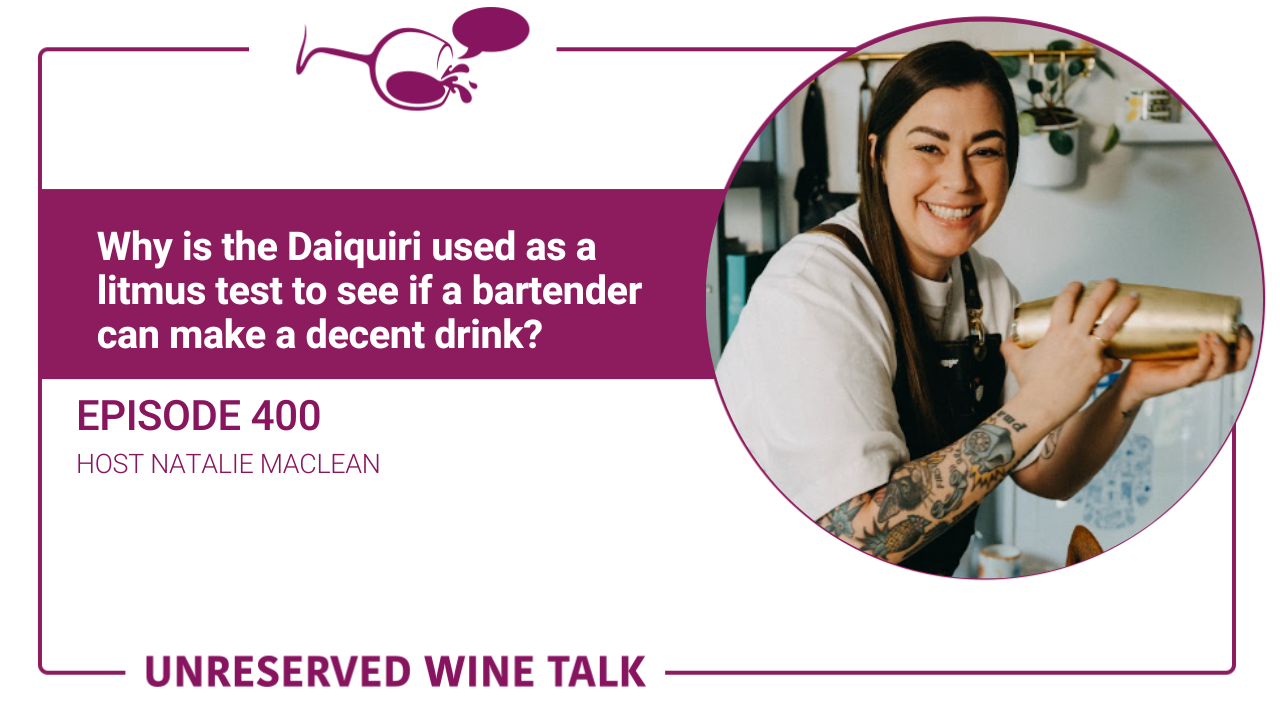
Why is the Daiquiri with just rum, lime and sugar used as a litmus test to see if a bartender is capable of making a decent drink? What is oleo saccharum and why is it a gorgeous way to sweeten sophisticated cocktails? What is tepeche and why do fermenting pineapples make a delicious cocktail?
In this episode of the Unreserved Wine Talk podcast, I’m chatting with Kaitlyn Stewart, author of Three Cheers: Cocktails Three Ways: Classics, Riffs, and Zero-Proof Sips.
You can find the wines we discussed here.
Giveaway
Three of you are going to win a copy of Kaitlyn Stewart’s terrific new book, Three Cheers: Cocktails Three Ways: Classics, Riffs, and Zero-Proof Sips.
How to Win
To qualify, all you have to do is email me at [email protected] and let me know that you’ve posted a review of the podcast.
It takes less than 30 seconds: On your phone, scroll to the bottom here, where the reviews are, and click on “Tap to Rate.”
After that, scroll down a tiny bit more and click on “Write a Review.” That’s it!
I’ll choose two people randomly from those who contact me.
Good luck!
Join me on Instagram, Facebook and YouTube Live Video
Join the live-stream video of this conversation on Wednesday at 7 pm eastern on Instagram Live Video, Facebook Live Video or YouTube Live Video.
I’ll be jumping into the comments as we watch it together so that I can answer your questions in real-time.
I want to hear from you! What’s your opinion of what we’re discussing? What takeaways or tips do you love most from this chat? What questions do you have that we didn’t answer?
Want to know when we go live?
Add this to your calendar:

Highlights
- Why did bartenders once spend 12 minutes shaking a single Ramos Gin Fizz?
- What’s the most unusual vessel Kaitlyn has ever served a cocktail in?
- Why is the Hugo Spritz replacing the Aperol Spritz as one of today’s hottest cocktails?
- What makes Vancouver’s historic Hotel Georgia cocktail so distinctive?
- How did sailors accidentally create one of cocktail history’s most useful ingredients?
- How can you turn pineapple scraps into a naturally fermented drink instead of throwing them away?
- What simple kitchen tool can replace the traditional dry shake for egg white cocktails?
- Why does Kaitlyn believe the classic Daiquiri is the ultimate test of a bartender’s skill?
- How did Kaitlyn create a Negroni that even she enjoys drinking?
- What’s the strangest drink request Kaitlyn has ever received, and why won’t she judge anyone’s order?
- Why is the Margarita still Kaitlyn’s favourite cocktail after more than 20 years behind the bar?
- What questions should you ask when you don’t know what cocktail to order?
- What are Kaitlyn’s three biggest tips for making better cocktails at home?
Key Takeaways
- Why is the Daiquiri with just rum, lime and sugar used as a litmus test to see if a bartender is capable of making a decent drink?
- It’s the concept of a basic cocktail of three ingredients. It’s sugar. It’s a spirit. It’s citrus juice. It’s one of those things where it’s how hard is that to mess up? But you’d be surprised. It’s really all about the balance because, depending on the rum that you’re using for a Daiquiri, everything’s going to be a little bit different. So it has always been one of those litmus tests for bartenders because it’s only three ingredients. But you’ve got to really hone in on that balance. And that’s when you can tell when a bartender is really on it.
- What is oleo saccharum and why is it a gorgeous way to sweeten sophisticated cocktails?
- Oleo saccharum is a concentrated, aromatic syrup made by macerating citrus peels in sugar. Translating from Latin is means “oil-sugar,” the sugar extracts the potent, flavorful essential oils from the peel, creating a rich, intensely citrusy. When I first read about oleo saccharum, when I was looking through old cocktail books because it was something that was used pretty regularly. If we go back to those pirate days with people being on ships for months at a time, packing citrus in sugar was a preservation method because then it wouldn’t go bad. And so when they were packing these fruits in sugar, they noticed that because of the rocking back and forth that this liquidy kind of oily substance was being created and it was super tasty. It was this beautiful sweetener. So it was first used in punches. I remember making it and being like, this is so cool because you kind of just set it and forget it.
- What is tepeche and why do fermenting pineapples make a delicious cocktail?
- Tepache is a traditional, slightly fermented Mexican beverage made from pineapple peels, water, and sweetened with unrefined cane sugar (piloncillo) or brown sugar. Often flavored with cinnamon and cloves, it ferments for just a few days to create a sweet, tangy, and refreshing fizzy drink. Tepache is kind of one of those older ingredients, like oleo saccharum, with the motto waste not, want not. If you’ve got the means, if you’re using the juice or if you’re just slicing the fruit, then you end up throwing away half of the contents. There’s this natural yeast on the outside of pineapples and obviously fermentation has been around for centuries, that it’s one of those things where I’m sure it was a happy accident for somebody at some point. anytime you’re doing any sort of fermenting or using a fermentation technique, you always have to be careful because of temperature. I’ve definitely had ferments explode on me because it has sat in an area where it got too hot.
About Kaitlyn Stewart
Kaitlyn Stewart is an internationally recognized, global bartending champion with over 20 years of hospitality experience. In 2017, she became the first Canadian to win the prestigious title of Diageo’s World Class Bartender of the Year. Beyond the bar, she is an author, recipe developer, consultant, and content creator with nearly a million followers across her Likeable Cocktails social platforms.
Kaitlyn travels extensively to conduct seminars, judge cocktail competitions, and host guest shifts at some of the world’s top bars. She was recently ranked #65 on the Drinks International Bar World 100 most influential people list and recognized as one of the Imbibe 75 “Ones to Watch.” Additionally, she has been a multi-time nominee and short-list finalist for the Tales of the Cocktail Spirited Awards in the categories of International Bar Mentor and Best Broadcast, Podcast, or Social Media Channel.
Resources
- Connect with Kaitlyn Stewart
- Unreserved Wine Talk
- My Books:
- Wine Witch on Fire: Rising from the Ashes of Divorce,Defamation, and Drinking Too Much
- Audiobook:
- Audible/Amazon in the following countries: Canada, US, UK, Australia (includes New Zealand), France (includes Belgium and Switzerland), Germany (includes Austria), Japan, and Brazil.
- Kobo (includes Chapters/Indigo), AudioBooks, Spotify, Google Play, Libro.fm, and other retailers here.
- Wine Witch on Fire Free Companion Guide for Book Clubs
- Audiobook:
- Unquenchable: A Tipsy Quest for the World’s Best Bargain Wines
- Red, White, and Drunk All Over: A Wine-Soaked Journey from Grape to Glass
- Wine Witch on Fire: Rising from the Ashes of Divorce,Defamation, and Drinking Too Much
- My new class, The 5 Wine & Food Pairing Mistakes That Can Ruin Your Dinner And How To Fix Them Forever
Tag Me on Social
Tag me on social media if you enjoyed the episode:
- @nataliemaclean and @natdecants on Facebook
- @nataliemaclean on Twitter
- @nataliemacleanwine on Instagram
- @nataliemaclean on LinkedIn
- Email Me at [email protected]
Thirsty for more?
- Sign up for my free online wine video class where I’ll walk you through The 5 Wine & Food Pairing Mistakes That Can Ruin Your Dinner (and how to fix them forever!)
- You’ll find my books here, including Unquenchable: A Tipsy Quest for the World’s Best Bargain Wines and Red, White and Drunk All Over: A Wine-Soaked Journey from Grape to Glass.
- The new audio edition of Red, White and Drunk All Over: A Wine-Soaked Journey from Grape to Glass is now available on Amazon.ca, Amazon.com and other country-specific Amazon sites; iTunes.ca, iTunes.com and other country-specific iTunes sites; Audible.ca and Audible.com.
Transcript
Natalie MacLean 00:00:00 Why is the daiquiri with just rum, lime and sugar? Used as a litmus test to see if a bartender is capable of making a decent drink. What is oleo saccharum and why is it a gorgeous way to sweeten sophisticated cocktails? What is tepic? And why do fermenting pineapples make a wonderful cocktail? In today’s episode, you’ll hear the stories and tips that answer those questions in part two of our chat with Caitlin Stewart, author of Three Cheers Cocktails Three Ways Classics, riffs and Zero Proof SIPs. You don’t have to have listened to part one from last week before you listen to this one, but if you missed it, go back and have a listen after you finish this one. By the end of our conversation, you’ll also discover why bartenders once spent 12 minutes shaking a single Ramos Gin fizz, the most unusual vessel Caitlin has ever served a cocktail in why the Hugo Spritz is replacing the Aperol Spritz as one of today’s hottest cocktails. What makes Vancouver’s historic Hotel George a cocktail so distinctive? The simple kitchen tool that can replace the traditional dry shake for egg white cocktails.
Natalie MacLean 00:01:18 How Caitlin created a Negroni that she enjoys drinking. The strangest drink request Caitlin has ever received, and why she refuses to judge anyone’s drink order. Why the Margarita is still Caitlin’s favorite cocktail after 20 years behind the bar. The questions to ask when you don’t know which cocktail to order, and Caitlin’s three biggest tips for making better cocktails at home.
Natalie MacLean 00:01:51 Do you have a thirst to learn about wine? Do you love stories about wonderfully obsessive people, hauntingly beautiful places and amusingly awkward social situations. Well, that’s the blend here on the Unreserved Wine Talk podcast. I’m your host, Natalie MacLean, and each week I share with you unfiltered conversations with celebrities in the wine world, as well as confessions from my own tipsy journey as I write my third book on this subject. I’m so glad you’re here. Now pass me that bottle, please, and let’s get started.
Natalie MacLean 00:02:33 400. Yes, 400.
Natalie MacLean 00:02:36 Wow.
Natalie MacLean 00:02:36 I cannot believe we’ve made it to 400 episodes. Now, according to industry stats, more than 90% of podcasts fade or stop between episodes seven and ten.
Natalie MacLean 00:02:49 So thank you for being here with me on this journey. That is truly a labor of love. Weekdays, weeknights, weekends and holidays. And thanks also to my wonderful podcast editors, Alexandra and Paul Stennett. So let’s chat about what 400 means in the drinks world, starting with the ancient Aztec 400 rabbits scale of drunkenness. In Aztec mythology, the Centcom Todo Chin Chin is a pantheon of 400 divine rabbits who love to throw wild, rowdy parties. Bad bunnies indeed. My kind are Warren rabbits. They’re born to Michael, the goddess of agave, the spiky, succulent desert plant that stores the water for fine tequila and mezcal and pate cattle. The god of fermentation, these pesky rabbits each represent a different mood or phase of intoxication. For example, the crying drunk, the angry drunk, the witty drunk, the I’m not watching another episode of Cape Fear Unless you watched the other Bennet sister with me drunk. Oh, wait, that’s not one of them, The Aztecs literally measured how drunk a person was using a rabbit scale.
Natalie MacLean 00:04:06 If you were slightly buzzed, you had a few rabbits. If you were completely drunk, you had reached 400 rabbits. Today, one of the most popular artisanal mezcal in the world is named 400 Conejos, 400 rabbits in honor of this myth. And then there’s the 400 year old grapevine in Maribor, Slovenia grows the Stara tata, which literally means the old vine, which is officially recognized by the Guinness World Book of Records as the oldest living fruit bearing grapevine on earth. It was planted at the end of the Middle Ages and has been growing for more than 400 years. Despite surviving medieval fires, enemy invasions, World War II bombings, it still produces about 35 to 50kg of grapes a year. That results in 25l of wine that is incredibly exclusive and poured into tiny little designer bottles, and given only as protocol gifts to high profile figures like popes and presidents, but not wine writers. All right, what’s new in the drinks world? Well, this week, in fur, feathers, and fermentation, a wild raccoon executed a stealthy late night break in at a boutique liquor store in Virginia, resulting in absolute liquid chaos after the animal climbed the retail display racks.
Natalie MacLean 00:05:33 The heavy handed intruder accidentally shattered 14 premium bottles of spirits and proceeded to lick up the high proof pools from the linoleum floor. You can guess what happened. Store employees arriving in the morning found the masked culprit completely incapacitated by the alcohol, leaving wildlife rescue personnel to gently transport a heavily hungover, stumbling raccoon back to the safety of the local woods where he slept it off back to the safety of the local woods. We hope the little bandit found a quiet spot to sleep it off and learn from his mistakes. Meanwhile, the prestigious Domaine de la Romana Conti estate in Burgundy became the target of a high stakes extortion plot when the owners received a series of chilling anonymous letters. The criminal mastermind threatened to systematically inject lethal poison into the estate’s priceless historic Pinot noir vines, unless a ransom of €1 million was delivered. French detectives staged a midnight sting operation in a local cemetery using a dummy bag of cash. Successfully tackling and arresting the rogue saboteur before any damage could be done to the world’s most expensive vineyard land. Talk about a real life vineyard thriller.
Natalie MacLean 00:06:54 Look for the movie trailer coming soon to you and for your weird but wonderful scientific fact this week. Did you know that the bubbles in a glass of champagne ring like tiny bells when they burst at the surface? Scientists using high speed microphones have recorded the specific frequencies produced by popping bubbles, discovering that smaller bubbles create a higher pitched sound, meaning that you can hear the quality of a sparkling wine just by listening closely to the glass. Actually, that’s a myth. Tiny bubbles do not mean better champagne. It usually means an older champagne because the amount of oxygen decreases over time. So you get smaller bubbles. But isn’t science just deliciously fascinating? And for your calendar this week, July 29th, is National Chicken Wing Day, National Lasagna Day, and Cheese Sacrifice Purchase Day. Buffalo, New York declared the first chicken Wing Day in 1977, fitting for a city that gave the world the sauce for its namesake. Lasagna is older than tomatoes in European cooking, and the word itself didn’t originally mean the dish at all.
Natalie MacLean 00:08:05 It comes from the Greek lassen on or cooking pot, which the Romans borrowed as lasagna before the Italians eventually named the layered dish after the vessel it was baked in. Cheese Sacrifice Purchase Day is one of those odd little holidays that shows up on food calendars every July 29th, but no one is entirely sure what cheese did to deserve that at all. July 30th is National Cheesecake Day, National Chicken and Waffles Day, and National Chili Dog Day. Cheesecake goes back to the ancient Greeks, who served early versions made of pounded cheese, honey and wheat to athletes at the very first Olympic Games in 776 B.C. as a high energy fuel source. Chicken and waffles became strongly tied to the Harlem Supper Club culture, where late night diners could get breakfast and dinner in one plate because choosing felt so unnecessary. In 2026, National Chili Dog Day lands on July 30th because it’s observed on the last Thursday in July. July 31st is National Avocado Day, cotton Candy day, and jump for Jelly Beans Day. Avocados are technically single seeded berries, not vegetables, and the name comes from the Aztec word ahu, meaning testicle, a nod to how the fruit hangs in pairs on the tree.
Natalie MacLean 00:09:31 Cotton candy was once called fairy floss charming, but it’s essentially spun sugar with witness protection. Jelly beans became closely tied to Easter in the 20th century, so this holiday gives them a summer alibi. August 1st is International Albano Day, National Spritz day, National Mead Day, National Muster Day, and National Raspberry Cream Pie Day. Albino is native to the northwest Iberian Peninsula, where Spain’s Arias Baez and Portugal’s Vino Verde make it a crisp, saline and seafood ready wine. National Sports Day grew out of the recent global love affair with bitter, bubbly aperitif cocktails. National Muster Day shares the same first Saturday in August slot as Mead Day. Mead came from fermented honey, water and yeast and is widely considered the oldest alcoholic drink in the world, dating back over 4000 years. Its linguistic source is the word honeymoon, because newlyweds in ancient times were gifted a month’s supply to encourage fertility and good fortune, and getting along with each other with so many fights in that first month. So go full Viking cosplay with a goblet and a hearty skull.
Natalie MacLean 00:10:44 August 2nd is National Ice Cream Sandwich Day. The modern ice cream sandwich is credited to an anonymous street vendor in New York’s Bowery neighborhood in 1899, who sold blocks of vanilla ice cream pressed between thin wafers for a penny to pushcart workers on the run. August 3rd is National Watermelon Day and grabbed some nuts. De watermelon is roughly 92% water, and the Kalahari Desert travelers are said to have used wild watermelons as natural, portable canteens on long treks. Nuts are rich in fat and protein, making them a snack sized pairing machine for drinks that need something salty alongside them. August 4th is National Chocolate Chip Cookie Day, a national white wine day. The chocolate chip cookie was invented in Massachusetts in the 1930s by Ruth Wakefield, meaning one small bakery decision became a global household emergency. White wine doesn’t require white grapes at all, since it can be made from red or black grapes by pressing the juice off the skins immediately. A style known as Blonde Noir. White from black.
Natalie MacLean 00:11:57
Meanwhile, on Citytv’s Breakfast Television, we chatted about how travel costs are climbing, so we’re taking a trip that needs no suitcase. We’re turning our kitchen counter into a world tour, one glass at a time.
Who better to help us than our favourite drinks expert Natalie MacLean, editor Canada’s largest drinks site at nataliemaclean.com.
Thank you for flying with me today! I’ll be your captain and sommelier for this taste bud trip that has no gate changes, nobody has given one person with a scanner god-like authority and no middle seat guy snoring on your shoulder. The only turbulence is deciding which wine to pour first.
Here’s our flight plan. Five stops, five glasses, and you never once leave the kitchen island or patio. We’ll take off in Niagara, then visit Italy and South America, and we land back home in the Okanagan.
Host: What’s pouring first?
KEY: Jackson-Triggs Reserve Sparkling VQA, Niagara Peninsula, Ontario
Fasten your seatbelts as we’re taking off with one of Canada’s most popular bubblies, the Jackson-Triggs Reserve Sparkling. I keep waiting for the day my last name ends up on something this good, and so far, it’s only a parking ticket.
This VQA sparkling from Niagara earns its spot at the start of any celebration because the first drink of any gathering matters the most.
It sets the heightened expectation; it establishes that the host thought about the guests before they arrived. Sparkling wine is the best starter for any occasion: a backyard dinner, a patio birthday, a long lunch, a last-minute gathering.
It was founded back in 1993 by two men whose surnames are right there on the label, Allan Jackson on the winemaking side and Don Triggs on the business side. Within a few years, Allan and Don had built one of the country’s benchmark producers.
There’s a delicate floral note on the nose. Then it’s lively, with fresh citrus and crisp apple on the palate, before finishing with a soft, creamy mousse like the perfect landing on the runway. It’s elegant, it’s affordable, and it makes an ordinary Tuesday feel like a week-long vacation. Wouldn’t this be lovely with departure lounge garlic butter shrimp?
Host: First international stop. Where are we landing?
KEY: Romeo & Juliet Pinot Grigio delle Venezie, Veneto, Ital
Let me direct you to the seat map in front of you as we fly over to Verona, Italy. This is a brand-new wine in the LCBO, and yes, the name is a nod to Romeo and Juliet, Shakespeare’s star-crossed lovers. But your destiny will have a happy ending when you toast with this Pinot Grigio from the delle Venezie, which is Italy’s Pinot Grigio heartland. Just taking a sip will transport to those vineyards and to the city of romantic balconies.
The Romeo & Juliet Pinot Grigio is bright and easygoing, with pear, green apple and a little white peach. There’s a whisper of floral notes and a clean, mineral edge that keeps it fresh right to a dry finish. It’s the kind of white wine you pour on a warm evening without a second thought. Wouldn’t this be perfect with Verona carbonara or linguini and clams?
Host: Next stop, across the Atlantic?
KEY: La Mascota Chardonnay, Mendoza, Argentina
Now we’re touching down in the high-altitude heart of Argentine wine with Mascota Vineyards, a premium wine that’s won many prizes worldwide. The vineyards are in Argentina’s two best regions: Mendoza, at the foothills of the stunning Andes Mountains, in the Uco Valley.
This signature wine arrives in the LCBO this Saturday, just in time for your summer barbecues. BBQ or asado, is a centuries-long tradition in Argentina. I still recall my visit there where I enjoyed an outdoor asada with savoury grilled meats and empanadas.
Mascota Vineyards wines reflect the passion with which they have been made and the singular influence of the Mendoza region. The wines are now in more than 35 countries.
This is La Mascota, and the name is Spanish for the pet, or the mascot. It comes from the Cuyo region, which has most of the vineyards in South America, where the summers are warm and dry against the backdrop of the Andes.
These vineyards sit about three thousand feet up, which is higher than three of our five flights get today. It’s aged nine months in French and American oak, so there’s real craft in the glass here.
This wine opens with beautiful buttery notes and crisp pear, with a lovely note of lemon blossom underneath. The palate is round and generous, and it holds long on the finish. It’s best paired with the ones you love, but wouldn’t this also be wonderful with sunset grilled chicken and corn on the cob?
Host: And staying in South America for stop four?
KEY: Cono Sur Bicicleta Reserva Viognier 2025, Central Valley, Chile
We’re taking a shuttle plane over the mountains to Chile, and to one of the most recognizable labels in the wine world. Cono Sur Bicicleta means bicycle in Spanish. That bike on the label is a tribute to the vineyard workers who ride out among the vines each morning.
It’s also a nod to the winery’s green side, because Cono Sur is a certified B Corp that ships carbon neutral. This modern wine is so tied to that bicycle that it once sponsored the Tour de France and it’s under $12, less than the cost of a bike lock.
Chill it your way and enjoy fresh notes of white peach, apple and orange blossom. It’s aromatic and fresh at the same time, which is a rare trick for a Viognier to pull off. Serve it well chilled and it tastes like an afternoon you didn’t have to book time off for. Wouldn’t this Bicycle Wine be lovely with layover Thai coconut chicken skewers off the grill?
Host: And our final stop, back on home soil?
KEY: Poplar Grove Pinot Gris 2025, Okanagan Valley, British Columbia
We’re coming home to Canada with a comeback story. Poplar Grove is one of the Okanagan’s most loved wineries. The 2024 winter freeze hit BC vineyards hard, and many producers lost much of their crop.
So this 2025 Pinot Gris marks the return of BC-grown wine. Poplar Grove Pinot Gris is exactly the elevated, expressive wine you want to celebrate a homecoming. You can buy this wine directly from the winery at poplargrove.ca.
There’s pear and white peach on the nose, with a whisper of blossom over the top. Then there’s a citrus snap and a clean, polished finish, with just enough texture. Served chilled. It’s refreshing and polished. It’s the kind of white that makes a patio lunch feel like a real arrival. Wouldn’t this be gorgeous next to homecoming seared scallops in brown butter?
Host: Natalie, these suggestions are fantastic! Any final words of wisdom for our viewers?
Thank you for flying with me today where the connections are made and never missed and the layover lasts as long as you want. Safe travels, everyone!
On Instagram, I’m at @NatalieMacLeanWine. Come for the first-class pours at economy prices.
Natalie MacLean 00:17:47 Serve it chilled. It’s refreshing and polished. It’s the kind of white that makes a patio lunch feel like a real arrival. And it would be gorgeous next to homecoming. Seared scallops in brown butter. So thank you for flying with me today where the connections are made and never missed. The layover lasts as long as you want. On Instagram, I’m at Natalie MacLean. Wine. Come for the first class. Pause at economy prices. Back to today’s episode. Three of you will win a copy of Caitlin’s wonderful new book, Three Cheers Cocktails three Ways Classics, riffs and zero proof SIPs. If you’d like to win a copy, please email me and let me know. Hey, I’d like to win. It doesn’t matter where you live, I’ll choose three winners randomly from those who contact me at Natalie at Natalie MacLean dot com. And if you’re reading the paperback or e-book or listening to the audiobook of my memoir, Wine Witch on Fire Rising from the Ashes of Divorce, defamation, and Drinking Too Much, a national bestseller and one of Amazon’s best books of the year.
Natalie MacLean 00:18:42 I’d love to hear from you at Natalie at Natalie MacLean dot com. There’s a terrific free guide for book clubs. I’ll put a link in the show notes to all retailers worldwide at Natalie MacLean 400. Okay. On with the show. Now, the Ramos or Ramos Gin fizz was originally shaken for 12 full minutes by a team, you say, of Shaker boys passing it down the line at Henry Charles Ramos Bar in 1888. What’s the longest you’ve ever made a single drink for a customer? Did it take a long time where there are many steps? Yes, a special occasion.
Kaitlyn Stewart 00:19:22 Honestly, there’s ways around making the Ramos Gin Fizz now that it won’t take you 12 minutes to shake. We found, like, modern techniques to kick that process up a bit, but sometimes you want to be a traditionalist and give it a go. So the Ramos is probably one of those drinks that is taking me the longest to make, just because technically you’re supposed to shake it until you can’t hear the ice shake anymore within your tin.
Kaitlyn Stewart 00:19:44 And so that’s why he had a group of Shaker boys anyway. And if you go down to New Orleans and you go to Sazerac Bar, or you go to the Carousel Bar and you ask for a Ramos, they’re still going to make it the traditional way, because it’s one of those more New Orleans cocktails that they’re famous for. But yeah, I would say that the Ramos is definitely one of those ones that this is going to take some effort. Now there’s other drinks. There’s other drinks that you can make that may take a long time in the prep stage, but not necessarily in the execution. So if you’re making something like a milk punch where you need to clarify your cocktail using milk, that usually takes a few hours and you would make that ahead of time.
Natalie MacLean 00:20:19 But yeah. Okay. Yeah. Okay. Now the Cantu rito is served in unglazed clay cups in Unesco because the alkalinity of the clay neutralizes the citric acid, and the cups are smashed on the ground after to return them to the earth.
Natalie MacLean 00:20:35 Have you ever served a drink in a vessel that was Unique.
Kaitlyn Stewart 00:20:39 Oh, yeah. Definitely. Gosh, there’s so much interesting glassware out there these days now. And I’ve definitely used traditional cancer ethos as as vessels. It’s fun when you can kind of go down to Alaska or go to Guadalajara and collect them from the source. And I have a few, but I’ve served drinks in juice boxes. So I’ve taken a traditional unripe apple juice box and emptied the contents, and then been able to refill it and have a fun take on a kid slash adult style drink from nostalgia steak. Trying to think if there was anything else that I’ve. I’ve used many different mediums, whether it’s a hand-carved wooden vessel, hand-blown glass, if it holds liquid, you can serve it in it. That’s great. That much awesome.
Natalie MacLean 00:21:22 The aperitif spritz exists because Austrian visitors to northern Italy in the 1800s splashed soda water into the local wines to make them lighter. What modern spritz variation do you think will be in cocktail books, say, 50 years from now? Or you can even say what’s newly trending now.
Natalie MacLean 00:21:40 If you don’t have a prediction, totally.
Kaitlyn Stewart 00:21:42 You know, the spritz is one of those drinks where again, come the summertime, come anytime the sun pops out, everybody’s ready for spritz weather. And I feel like the last couple of years, obviously the Aperol Spritz reigned supreme, but the the Hugo Spritz has definitely jumped in there as well. And the Hugo Spritz is made with Saint Germain and elderflower liqueur, so it still got that kind of lightness. It’s just not as bitter as a Aperol Spritz. It’s got a bit of fresh mint and all that good stuff, but I think you can pretty much spritz anything. So I think more different Amoros like Na or Amaro Montenegro spritzing those is super easy for me. I love using Lambrusco as my spritz base to almost make a spritz sangria, if you will, because it’s.
Natalie MacLean 00:22:28 The red sparkling wine from Italy.
Kaitlyn Stewart 00:22:30 Yeah, exactly. Yeah. So that’s that’s one of my favorites. So I feel like the Lambrusco Spritz is on the uptick as well. But yeah, the Hugo Spritz is, I think, the most popular one at the moment, at least in my findings.
Natalie MacLean 00:22:42 Now we’re current, so that’s good. There we go. Now the Hotel Georgia, your hometown drink from the 1940s. Vancouver gets gin, augite, lemon, orange blossom water and egg white. What does it taste like?
Kaitlyn Stewart 00:22:56 So think of a gin sour. But with the jar is going to give it a little bit more of a richer, creamier taste to it. Now, typically augite is made from almonds, but you can now make that from any type of nut or seed. So you can do a pumpkin seed or you can do sesame, you can do pistachio or macadamia. But the Hotel Georgia itself, it’s got this pretty traditional gin sour base. And then with the augite. And just because there already is orange blossom water in all that, it just kind of gives it this kind of slightly floral edge to it. But it’s just it’s such a tasty drink. And I know some people get a little bit timid when it comes to egg whites and cocktails, but that’s all about the texture because you want that texture to be rich and creamy and have this nice body to it.
Kaitlyn Stewart 00:23:39 But it’s a delicious drink and I don’t think it’s ordered nearly enough.
Natalie MacLean 00:23:43 All right. Well, okay, so now you call oleo. Secondly, Charles Latin for oil, sugar, a lush, oily sugar syrup that’s perfect for adding more flavor to your favorite cocktail. Tell me about the first time you used it and realized that this centuries old technique was really magical.
Kaitlyn Stewart 00:24:01 Yeah. You know, when I first read about the oleo saccharum or oleo saccharum, depending on where you are, how you say it, when I was looking through old cocktail books because it was something that was used pretty regularly, if we go back to kind of those pirate days of people being on ships for months at a time, packing citrus in sugar was a preservation method because then it wouldn’t go bad. And so when they were packing these fruits in sugar, they noticed that because of the rubbing back and forth that this liquidy, kind of oily substance was being created and it was super tasty. So it was this beautiful sweetener. So it was first used in punches, and punches were one of those things where it was like, whatever we have or thrown in a bowl and hopefully it tastes okay because the spirits weren’t tasting great back then.
Kaitlyn Stewart 00:24:47 So I first discovered it when I was reading old recipe books, and I saw that an olio was being made, and I remember making it and being like, this is so cool, because you kind of just set it and forget it, and you put it into a container and you put it into a Ziploc bag, and you leave it alone for a couple of hours, and you watch this natural kind of osmosis happen where this liquid gold is coming out of these peels. So, yeah, I think I was a fairly young bartender when that happened. And I was like, oh, the old techniques are definitely there’s still some use in there, right?
Natalie MacLean 00:25:17 Like, yeah, no, that’s great reason. It’s fascinating. Now you teach readers to make the fermented pineapple drink by leaving rinds and core in water with sugar, lime, cinnamon, cloves, star anise and nutmeg for 48 hours. Has that always worked out for you or did you have to perfect it over time?
Kaitlyn Stewart 00:25:35 Yeah. So Apache is again, it’s one of those older things, like an olio sacrum where it’s waste.
Kaitlyn Stewart 00:25:41 Not what? Not right. If you’ve got the means, if you’re using the juice or if you’re just slicing the fruit, then you’re you end up throwing away half of the contents. So there’s this natural yeast on the outside of pineapples. And so obviously fermentation has been around for centuries, that it’s one of those things where it’s like, I’m sure it was a happy accident for somebody at some point. But yeah, you have to be careful anytime you’re doing any sort of fermenting or using a fermentation technique, you always have to be careful because of temperature changes things a lot. I’ve definitely had ferment explode on me because it sat in an area where it got too hot, and so therefore it starts to bubble away too quickly and you don’t have a chance to burp your vessel and all that, or it just doesn’t take at all because there wasn’t enough, like natural yeast. But yeah, it’s one of those things where I love making kombucha and like topaz and different things like that. Because like I said, it’s the most natural thing, and to be able to get so much flavor out of something that’s seen as like a byproduct or a waste.
Kaitlyn Stewart 00:26:38 I love that because it’s a waste, not whatnot.
Natalie MacLean 00:26:40 Sure. And now you suggest using a milk frother instead of dry shaking for egg white drinks. Where did that hack come from? And what did the old school bartender say when you start using kitchen tools?
Kaitlyn Stewart 00:26:54 Well, like I said, with the Ramos Gin fizz, obviously there’s traditional methods, but it’s like you’re not reinventing the wheel. You’re just making improvements on it. Sure. So where you can cut corners, it helps. So if you’re in a busy service and you don’t have time to physically dry, shake and then add ice again and then shake again. So it’s a nice I used to do it a lot with a milkshake machine, so I could literally just put it onto my milkshake machine, leave it, do something else, come back to it, and then continue on building out the drink. But I feel like these little techniques that I kind of pop up, this industry is such a great place to share knowledge and share ideas.
Kaitlyn Stewart 00:27:28 So we everybody ends up sharing these little techniques with each other, and we all build upon them and make them even easier for ourselves. So the milk frother is one of those things where it’s like all you’re doing when you’re dry shaking is trying to aerate the egg whites. And what a better way to try to aerate something than using a frother, as you would with milk. And it just makes it that much easier.
Natalie MacLean 00:27:47 Makes sense to me.
Kaitlyn Stewart 00:27:48 Yeah.
Natalie MacLean 00:27:49 Now, your cedar smoked rye recipe involves flaming cedar chips with a kitchen torch and trapping the smoke under a jar before pouring rye whiskey in, which sounds amazing. What does? Did that ever go wrong? Like the ferments? Have you had different things happen?
Kaitlyn Stewart 00:28:07 I’ve been pretty lucky. I have smoked myself out once or twice. Okay, I think you have. Proper ventilation is always good to drink. Anything like that. Yeah, but.
Natalie MacLean 00:28:16 The fire department coming in because it set off the alarms.
Kaitlyn Stewart 00:28:19 Right? Exactly, exactly. And like I said, there’s that’s an easy way to do it at home without having to really buy any expensive tools on top of what you already have.
Kaitlyn Stewart 00:28:28 There’s also things called like a smoking gun where you can put the little wood chips on the top and you’ve got the long kind of funnel tube that kind of concentrates the smoke, which is great. But yeah, the smoke ethers have a really a lot of obviously aroma. So that aroma is just being trapped in the actual booze itself. And it gives it, it doesn’t overpower the alcohol, but it just gives it a little bit more depth to whatever you’re making. And for that particular cocktail, that was my Manhattan variation. I called the Kumbaya because it was it reminded me of sitting around a fire pit on the beach singing Kumbaya. So it’s got a little roast roasted marshmallow as the garnish on that. And then the cedar smoke and the it was all like those memories of sitting on a beach in Tofino and a delicious cocktail.
Natalie MacLean 00:29:09 That sounds wonderful. And you described the regal shake as shaking a cocktail with a piece of citrus peel for a touch of bitterness and citrus oils, without adding to the volume of the drink.
Natalie MacLean 00:29:20 Are there other professional secrets that home bartenders can use like that?
Kaitlyn Stewart 00:29:24 Oh yeah, try to think if there’s some fun tidbits. The Regal Shake is a good one. I’ve also done where you can actually take the spring from your hawthorn, a strainer like off the strainer itself, and throw that into your shaker tin if you want to kind of aerate or whip something up. So if you’re making a whipped cream for a specialty coffee, or if you’re shaking something with egg whites, it really helps add that extra bit of bounce and volume. That’s like a fun little side hack if you don’t have a milk frother. And you can also use flavored ice if you want to, like, really shake things up. All the pun intended using a flavored ice. Because like I said, you do get some of that melt, obviously off the ice for your dilution. So if you’re you want to make, say like coconut water ice cubes and then shake your daiquiri with, that’s gonna give off a little bit of that flavor from when you’re shaking.
Kaitlyn Stewart 00:30:12 Right.
Natalie MacLean 00:30:12 That’s great, I love that. Speaking of daiquiris, you read that the the daiquiri with just rum, lime and sugar is used as a litmus test to see if a bartender is capable of making a decent drink. Has a bartender ever failed your daiquiri test, or have most you run into Been able to do it.
Kaitlyn Stewart 00:30:30 Listen, I feel like it’s one of those. It’s the concept of a basic cocktail of being three ingredients, right? It’s sugar, it’s spirit, it’s citrus juice. It’s one of those things where it’s like, how hard is that to mess up? But you’d be surprised that the balance. Right? It’s really all about the balance because depending on the rum that you’re using for a daiquiri, like if I’m using something like Rey and Nephew, which is an over proof rum, then I need to adjust the other elements to that rum. If I’m using like an aged rum versus a barrel style rum, everything’s going to be a little bit different. So it has always been one of those like litmus tests for bartenders because, hey, it’s only three ingredients.
Kaitlyn Stewart 00:31:07 It shouldn’t be too hard to mess up. But you you’ve got to really hone in on that balance. And that’s when you can tell when a bartender is really on it. You can tell that their balance is right. Everything is tasting the way that it should. It’s not too hot on the palate. It’s not too sweet, it’s not too, too acidic. But because it’s a three ingredient drink. It’s one of those ones where you can be like, hey, you shouldn’t miss this one up. So if you do, then we got some more training to do.
Natalie MacLean 00:31:34 Yep. And then you call the Negroni boozy, bitter and bold and a drink that you either love or hate. Tell me about the most stubborn Negroni hater you converted. What did. How did you. Or if you did?
Kaitlyn Stewart 00:31:47 It might be myself. To be honest, I. Okay, I am not personally a Negroni drinker. I can tell when a when one has been made well and one it’s been not made well.
Kaitlyn Stewart 00:31:57 But for me personally, it’s not the first drink that I’m going to have. So if you can put a Negroni in front of me that you put your own little twist on and I go back for that second or third sip, then I’m like, all right, you’ve converted me. Job well done. So even in the book, my version of the Negroni I call the high and Dry. For me, that’s a little bit more on the lighter side, because it does have that kind of spritz element, because I add a little bit of cava into the actual build itself, and I swap out what do I swap out the sweet vermouth for Saint Germain. So elderflower. So it gives it a little bit more of that lighter approach. I call it a Negroni with training wheels, but I think I might be my toughest customer when it comes to.
Natalie MacLean 00:32:37 Well, that’s a good thing. Quality assurance.
Kaitlyn Stewart 00:32:40 Right. Exactly.
Natalie MacLean 00:32:41 With you. Has there ever been a request for a cocktail that a customer made that kind of made you groan inwardly, or what? Have there been any odd requests? Maybe you didn’t groan, but something that was really strange that a customer requested.
Kaitlyn Stewart 00:32:55 You know what? I’m sure I’ve had several odd requests over the years, but I am like, this is going to be the most diplomatic answer you’ve ever heard. I want people to drink what they want to drink if you like it. Who am I to say that’s wrong? Because you’re the one drinking it right? I might be able to offer up some sort of suggestion to maybe make it a little bit better, or just to tweak it slightly, but I am. Somebody says they want to drink, I don’t know, gin and milk. Then who am I to say no? But like I will often maybe ask a second or a third question. If I think something’s a little bit off, I’ll be like, okay, did you mean to say this or did you mean to say that? And I always want to double check and want to make sure, but it’s one of those things where I’m like, hey, I’m here to be the facilitator, not to be the hater on what you like to drink because, you know, at the end of the day, you’re the one drinking it.
Kaitlyn Stewart 00:33:46 And if you’re enjoying it, hey, to each their own.
Natalie MacLean 00:33:50 That’s very open to it.
Kaitlyn Stewart 00:33:52 That’s my diplomatic answer.
Natalie MacLean 00:33:54 Yeah. I don’t know if I was working as a bartender. I’m not sure I could do white zinfandel, but that’s why I’m not a bartender. Right?
Kaitlyn Stewart 00:34:02 Listen, I like a drink called a Cali mucho and a Cali mucho is red wine and coca cola. And I feel like most, most wine snobs or anybody out there would probably be like, what is that? And I’d be like, listen, if you’ve never had it, you should try it, because it’s actually delicious and it’s like a it’s a drink that that came out of out of. No out of Spain. Okay. Yeah. Out of a cider region of Spain. And it was like a really it’s not nothing fancy, it’s really cheap. It used the cheapest red wine you got and you mix with Coca-Cola and there you go. And I’m sure I approved. Oh I’m sure. Yeah.
Natalie MacLean 00:34:33 There were stories back in the 80s when the rise of the Asian market, I think it was especially China, but they were pouring coke into first growth Bordeaux, which retails for $500 a bottle.
Natalie MacLean 00:34:44 So that’s probably when you get the sort of kind of reaction from wine lovers. But if you’re talking about a cheap red wine and go for it.
Kaitlyn Stewart 00:34:52 Exactly. So I used to.
Natalie MacLean 00:34:53 Get to a first Bordeaux.
Kaitlyn Stewart 00:34:55 I used to have a regular when I this is years ago at a restaurant I worked at. He would order Louie Tray, which is a very expensive cognac. I’m talking about probably $500 an ounce. And he used to order Louis tray to be flambe made into his Bananas Foster tableside. I was like it went from a it went from a $15 dessert to a $600 dessert. Just like that.
Natalie MacLean 00:35:18 That is incredible. I guess he had a trust fund or something.
Kaitlyn Stewart 00:35:21 That was one of those things. Just because you can doesn’t mean you should. But hey, go for it. All the power to you.
Natalie MacLean 00:35:28 Wow. You write that you’ve never in 20 years behind the bar had anyone order a zombie. Why do bartenders put drinks on the menus that people don’t order? Are they just there for placeholders?
Kaitlyn Stewart 00:35:41 Sometimes they are.
Kaitlyn Stewart 00:35:42 It depends on where you are. It’s like a zombie is a pretty classic tiki cocktail. So if you are, I would say maybe in like, the tropics in Hawaii or somewhere where like, the tiki culture is like very strong. Which by.
Natalie MacLean 00:35:54 The way.
Kaitlyn Stewart 00:35:54 Oh gosh, it’s a mix of rums and allspice. And for shot it for the classic zombie. It’s a very particular three rum blend, which I can’t even get my hands on here where I live. So if I was going to try to make a classic zombie, I probably couldn’t. But yeah, it’s one of those ones where it’s like the alcohol content in it is rather high. So when you do order one, it’s usually like a one, maybe two max. That’s all you can have. Because like I said, it’s pretty boozy. It’s pretty impactful. So you’re on a different level if you’re drinking zombies all night long, that’s for sure.
Natalie MacLean 00:36:32 Yeah. Might be night of the Living Dead or whatever. I mean, what’s your favorite drink? I get asked this what’s your favorite wine’s tough one, but do you have one lately that you’ve been enjoying?
Kaitlyn Stewart 00:36:41 Honestly, I will drink a margarita any day of the week in any style.
Kaitlyn Stewart 00:36:47 Obviously I have my preferred build on it, but I will drink it on the rocks. I’ll drink it blended. I will drink it on a beach. I’ll drink it in a fancy restaurant. I love a margarita.
Natalie MacLean 00:36:57 What do you love about it?
Kaitlyn Stewart 00:36:58 I think I personally love citrus forward cocktails to begin with, but for me it’s just the balance. I love tequila and I just I think it’s just such a fresh, delicious spirit that it makes for a really great base for any drink. But yeah, there’s just something about a margarita where it’s like you got the saltiness, you’ve got the sweet and sour, but then you’ve got this nice punch of tequila. For me, it’s just like this perfect little combination of ingredients all coming together.
Natalie MacLean 00:37:22 And what’s your preferred build?
Kaitlyn Stewart 00:37:24 I like a blanco using a blanco tequila, a bit of Cointreau or orange liqueur. Just a touch of a simple syrup, preferably like a vanilla bean. Simple syrup, obviously lime juice. But depending on the tequila that I’m using, whether it’s like a little bit higher proof or not so that my ratios kind of change.
Kaitlyn Stewart 00:37:41 But I like to keep it pretty simple. That’s it. I’m into it. Yeah, that’s that’s great.
Natalie MacLean 00:37:48 What are 2 or 3 questions that a customer can ask of a bartender when they’re not really sure what they want, but they’d like to try something new? How can they ask questions in a way that as a bartender, you’ll help them find something that they’ll love?
Kaitlyn Stewart 00:38:03 Yeah. You know what? It should be the other way around. If you’re at a bar. If you’re at a bar and you’re you’re chatting with a good bartender, they should be the ones asking you the questions. Because if you’re like, hey, I really am not sure what I feel like, but I like this. So if you have maybe 1 or 2 drinks in mind that you’re like, I like a Cosmo and I like a spritz, but I don’t want either. Maybe there’s something in the middle. Hopefully you’ll have a bartender kind of come back to you and say, okay, what kind of base spirit do you like? Are you a fan of vodka? Are you a fan of gin? And what don’t you like? Because maybe that person absolutely hate Campari.
Kaitlyn Stewart 00:38:37 So don’t give me anything with Campari. So there should be, like, a little bit of a conversation that way, if you like I said. Not all bartenders are going to play, but at the same time, they should. We’re in the business of hospitality, so it’s part of being hospitable. But I think it’s okay to be very forward with what you like and what you don’t like. So if you’re at a bar and you’re asking a bartender, I really want to drink. But you know what? I don’t like gin and I don’t like Campari. And I’m looking for something fresh and a little bit on the fruity side. It’s good to have some of those descriptor words to lead with, I would say.
Natalie MacLean 00:39:04 And who’s the most interesting customer you’ve ever served? You don’t have to name names, but an interesting, odd, funny celebrity. Whatever.
Kaitlyn Stewart 00:39:14 Customer, I have some stories.
Natalie MacLean 00:39:15 I build a team.
Kaitlyn Stewart 00:39:18 Vancouver is an interesting place to work because we’re kind of known as Hollywood North at times, because there’s a lot of things that film up here.
Kaitlyn Stewart 00:39:25 There was one night that I was working and I was serving Anjelica Huston, and that was like one of those things where it’s like, I grew up watching all of her movies, like Witches and Addams Family and everything else in between, and she was lovely, and she was drinking some Canadian whiskey, and I think I got her to start quoting lines from the movie witches, and that was like, never in my life. And I think that would be on my bucket list. But it’s always entertaining to see people, especially that you admire with their guard down because they’re just wanting to have a nice drink and everybody talks to the bartender. That’s excellent. I’ve come across some interesting people for sure along my 20 years of doing it.
Natalie MacLean 00:40:00 And are you the secret keeper for a lot of people? Do they tell you their stories or their woes or ask you for advice?
Kaitlyn Stewart 00:40:07 Sometimes, especially on a night where it’s maybe not as busy behind the bar, you get to chatting with people, and maybe after that second cocktail they open up a little bit more than maybe they anticipated.
Kaitlyn Stewart 00:40:17 But yeah, I think as a bartender you’re always listening, whether or not you’re in on the conversation. Like you’ve always got your ear to what’s happening around you. So whether you think the bartender is paying attention or not, secretly we’re always paying attention.
Natalie MacLean 00:40:31 Okay. Very. Be on our guard. I suspect that’s true. Is there anything you’ve learned since publishing the book that you’d either add to a new edition, or that might be the basis for your next book? Yeah.
Kaitlyn Stewart 00:40:44 I feel like people are more and more interested in learning new skills and challenging themselves. So I think if I do another book or the next edition or what have you. I think I would like to put some more challenging like techniques and recipes in there because yeah, I’ve learned now over these last few years, and especially putting the book out, that when people really like the world of cocktails, they love it and they are willing to go like, all in. So they’re willing to try the interesting technique that you’re like, I’m just going to put this out here, like on social media and see if somebody does it, and then you get an influx of people being like, I tried this, I tried it, and you’re like, oh, okay.
Kaitlyn Stewart 00:41:18 Didn’t expect anybody to try that, but that’s amazing. So that’s great I think. Yeah, putting a bit more of a challenge out there I think will be the next goal.
Natalie MacLean 00:41:25 Yeah. That would make a logical next step. They start with this book and then they graduate to your next working up. Exactly. And what’s the most useful cocktail gadget you’ve ever come across? One that we might want to have at home.
Kaitlyn Stewart 00:41:37 It’s pretty basic, but the jigger. Yeah, I’m a big fan of just looking at my collection over here to the side I’m a big fan of, especially if you’re first starting off making cocktails. And if you’re not super confident in like you’re pouring in your measurements, it’s always good to measure your drinks. Because I feel like cocktails are a lot like baking, where measurements matter. If you’ve got a little bit too much of this or a little bit too little of that, it makes a big difference on the final result. So measurements matters. So I always have a jigger close by because yeah, I like to measure it out, make sure it’s perfect every time and consistent.
Kaitlyn Stewart 00:42:10 So it’s good for consistency. That’s great because you can use anything as a shaker. You can use a protein shaker. You can use a mason jar. You can use whatever, anything that closes with a lid. Right. So I think the jigger is the most important.
Natalie MacLean 00:42:21 Cool. Just a few quick questions. Now, if you could put up a billboard in downtown Vancouver, what would you put on it?
Kaitlyn Stewart 00:42:28 Oh, gosh. I would probably put on it by my book.
Natalie MacLean 00:42:33 But fair enough. Yes.
Kaitlyn Stewart 00:42:36 Okay. Books on sale. Three cheers. Three cheers. Drink what you like. Have fun with it. Yeah, I don’t know. Yeah. Probably some shameless self-promotion. How about that?
Natalie MacLean 00:42:46 Of course. Your publisher will be very pleased with you. Okay. Yes. Oh, I take advantage of the free advertising space as well. Now, of all the things we’ve talked about, what do you think are the three most important takeaways? Maybe beyond drink what you like or whatever.
Natalie MacLean 00:43:01 But like when it comes to cocktails, what would you advise listeners?
Kaitlyn Stewart 00:43:07 I would say you don’t have to go expensive when it comes to ingredients, okay. But when you’re making a drink, you should be using ingredients that you would drink on their own. So don’t buy the cheapest of the cheap vodka out there, or whatever the case may be, because if you’re drinking it by itself and if you’re going, oh, this is disgusting, then it’s probably not going to taste the best in a drink either. But it doesn’t have to go exactly. It doesn’t mean you have to go full tilt and buy $100 bottle of something, but you should use ingredients that you would enjoy on their own. Fresh is always best, so especially when you’re using juices and cocktails. If you can freshly squeeze your lemon and your lime juice, then absolutely do that before buying store bought off the shelf pasteurized stuff. Because when you freshly squeezed, you’re not just getting the juice, but you’re getting a little bit of the oils off of the peel.
Kaitlyn Stewart 00:43:54 You’re getting a bit of that pith, you’re getting a lot more nuance and that fresh flavor. And I would say, keep it simple. You can always build out. So if you start with a simple, basic recipe like a sour, like we were talking earlier, those three ingredients spirit, sugar and citrus start there and then build out from it because you can always add to something you can never take away. So yeah, that makes sense. Always fresh. Keep it simple.
Natalie MacLean 00:44:19 That’s excellent advice I love that. Now as we wrap up here Caitlin. Is there anything we haven’t covered that you wanted to mention?
Kaitlyn Stewart 00:44:26 If you want to learn more about cocktails and interesting techniques, you can always follow me on my social platforms under likable cocktails. I’m always posting videos on Instagram and on TikTok and YouTube. And yeah, you kind of get step by step instructions. So if you’re keen and interested and want to kind of up your game, then go ahead and give me a follow. And yeah, get yourself a copy of Three Cheers because then you’ll have one right there at your fingertips two.
Natalie MacLean 00:44:48 And so three cheers. It’s available on all the major bookstore websites.
Kaitlyn Stewart 00:44:53 Your books.
Natalie MacLean 00:44:54 Are.
Kaitlyn Stewart 00:44:54 Sold.
Natalie MacLean 00:44:54 Okay, cool. That is great. Caitlin, thank you so much. I really appreciate your time. This has been wonderful. You’ve really I feel far more educated now and on cocktails and motivated to try one of yours to not just look at the pictures, but actually make a drink. Thank you. And I hope next time we can have a cocktail in person.
Kaitlyn Stewart 00:45:14 Absolutely. Would love that. Thank you for having me on.
Natalie MacLean 00:45:17 All right. Cheers. Well, there you have it. I hope you enjoyed our chat with Caitlin. Here are my takeaways.
Natalie MacLean 00:45:27 Number one, why is daiquiri.
Natalie MacLean 00:45:29 With just rum, lime, and sugar used as a litmus test to see if a bartender is capable of making a decent drink? As Caitlin explains, it’s the concept of a basic cocktail with just three ingredients a sugar, a spirit, and citrus. It’s one of those things where you think, how hard could this be to mess up? But she says, you’d be surprised.
Natalie MacLean 00:45:53 It’s all about balance, and depending on the rum you’re using for the daiquiri, that balance in those ratios are going to be a little bit different. And when a bartender gets it right, you know you’ve got a good one. Both a drink and the bartender. Number two what is oleo saccharum and why is it a gorgeous way to sweeten sophisticated cocktails? Caitlin says it’s a concentrated, aromatic syrup made by macerated citrus peels in sugar. It translating it from Latin. It means oil, sugar. The sugar extracts the potent, flavorful essential oils from the peel, creating a rich, intensely citrusy flavor. When she first read about oleo saccharum, she was looking through old cocktail books because it used to be used regularly. And if you go back to those pirate days with everyone being on ships for months at a time, packing citrus and sugar was a preservation method, so it wouldn’t go bad. And they noticed that because of the rocking back and forth of the ship, this liquidy kind of oily substance was created and it was super tasty.
Natalie MacLean 00:46:59 Not to mention the pleasant buzz. So there was this beautiful sweetener. It was first used in punches, and though ever since it’s been used also in cocktails. And number three what is tips and why do fermenting pineapples make a delicious cocktail? Tips, Caitlin says, is a traditional, slightly fermented Mexican beverage made from pineapple peels, water and sweetened with unrefined cane sugar or brown sugar, often flavored with cinnamon and cloves. If ferments for just a few days to create a sweet, tangy, and refreshing fizzy drink, it’s one of those older ingredients, Caitlin says, where the motto is waste not, want not. So if you’re using the juice, or if you’re just slicing fruit, then you end up throwing away a lot of contents, she says. There’s this natural yeast on the outside of pineapples, and so fermentation has been around for centuries, and it’s one of those things that was just a happy accident for somebody at some point. She does have a cautionary note. Anytime you’re experimenting with fermentation or using a fermentation technique, you have to be careful.
Natalie MacLean 00:48:05 She’s had a few ferments explode on her because it’s set in an area where it got a little too hot. If you missed episode 159, go back and take a listen. I chat about the cosmopolitan cocktails on the TV show sex in the city, champagne and Whiskey, women with Mallory O’Meara and her book Girly Drinks. I’ll share a short clip with you now to whet your appetite. The signature drink of sex in the city was The Cosmopolitan. How did that happen.
Mallory O’Meara 00:48:33 Up until that point? Besides Julia Child drinking wine, there weren’t many women drinking on TV. Carrie Bradshaw orders a Cosmo. Here was this very feminine drink. It’s in a martini glass, but it’s pink. A lot of girls couldn’t afford Louboutins or a coach purse, but women could afford to order a Cosmo. So women wanted to be like Carrie. They wanted to feel literally cosmopolitan. And all of a sudden, the drink swept the nation like wildfire. And it really became the first cocktail that women were influenced from the media to order and people still drink it today.
Natalie MacLean 00:49:16 You won’t want to miss next week when we chat with Marisol de la Fuente, the wine expert for Argentina’s Canal de la Equidad, where she presents a different segment every week in a simple and entertaining manner. She’ll join us from her home in Buenos Aires. Do you know someone who be interested in learning more about iconic cocktails in the stories behind them? Please let them know about this podcast, email or text them now while you’re thinking about it, it’s easy to find the Unreserved Wine Talk podcast. Just tell them to search for that title or my name Natalie MacLean wine on YouTube, Apple Podcasts, Spotify, their favorite podcast app or they can listen to the show on my website at Natalie MacLean. Forward slash podcast. Email me if you have a tip, question, or would like to win one of seven drinks books I Have to give away. In the show notes, you’ll find a link to take a free online food and wine pairing class with me, called the Five Food and wine pairing Mistakes that can Ruin your dinner and how to fix them forever at Natalie MacLean.
Natalie MacLean 00:50:11 Com class. And that’s all in the show notes at Natalie MacLean 400 400. Woohoo! Thank you for taking the time to join me here. I hope something great is in your glass this week. Perhaps a daiquiri made with the perfect balance of those three ingredients.
Natalie MacLean 00:50:37 You don’t want to miss one juicy episode of this podcast, especially the secret full bodied bonus episodes that I don’t announce on social media. So subscribe for free now at Natalie MacLean dot com. Forward. Meet me here next week. Cheers.