






Introduction
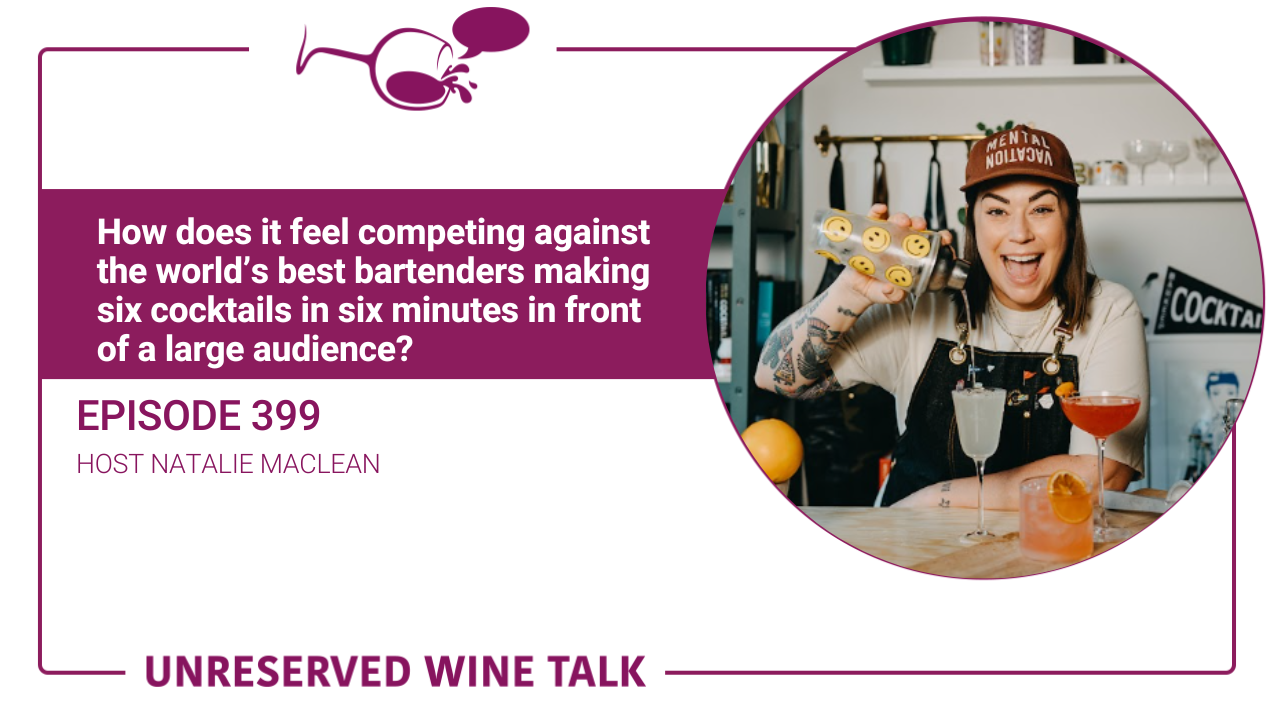
How does it feel competing against the world’s best bartenders making six cocktails in six minutes in front of a large audience? How can bartending become a form of storytelling instead of simply making drinks? How did the Mojito begin as a 16th-century medical remedy?
In this episode of the Unreserved Wine Talk podcast, I’m chatting with Kaitlyn Stewart, the first Canadian to win the prestigious title of World Class Bartender of the Year and author of the book, Three Cheers: Cocktails Three Ways: Classics, Riffs, and Zero-Proof Sips.
You can find the wines we discussed here.
Giveaway
Three of you are going to win a copy of Kaitlyn Stewart’s terrific new book, Three Cheers: Cocktails Three Ways: Classics, Riffs, and Zero-Proof Sips.
How to Win
To qualify, all you have to do is email me at [email protected] and let me know that you’ve posted a review of the podcast.
It takes less than 30 seconds: On your phone, scroll to the bottom here, where the reviews are, and click on “Tap to Rate.”
After that, scroll down a tiny bit more and click on “Write a Review.” That’s it!
I’ll choose two people randomly from those who contact me.
Good luck!
Join me on Instagram, Facebook and YouTube Live Video
Join the live-stream video of this conversation on Wednesday at 7 pm eastern on Instagram Live Video, Facebook Live Video or YouTube Live Video.
I’ll be jumping into the comments as we watch it together so that I can answer your questions in real-time.
I want to hear from you! What’s your opinion of what we’re discussing? What takeaways or tips do you love most from this chat? What questions do you have that we didn’t answer?
Want to know when we go live?
Add this to your calendar:

Highlights
- How did growing up in her parents’ restaurant shape Kaitlyn’s career in hospitality?
- How did a mentor show Kaitlyn that bartending could combine storytelling, creativity, and performance?
- What was it like competing to make six cocktails in six minutes inside a Mexican wrestling ring?
- How did Kaitlyn become the first Canadian to win World Class Bartender of the Year?
- Why does Kaitlyn believe the world’s greatest cocktails have stood the test of time?
- Why did Kaitlyn design her cocktail book with classic, modern, and alcohol-free versions of every drink?
- How does the Manhattan cocktail secretly contain New York City’s 212 area code?
- Which classic cocktail has the strangest origin story?
- How did the Mojito begin as a medical remedy more than 400 years ago?
- What inspired the invention of the now-famous Espresso Martini?
Key Takeaways
- How does it feel competing against the world’s best bartenders making six cocktails in six minutes in front of a large audience?
- That whole competition was fantastic and that particular round was six drinks in six minutes, you know, high stakes. The energy in the room was going and everybody was enjoying and having a good time. But the total of that competition, I probably did like 75 different drinks from start to finish with a bunch of different challenges. With a competition like that, you have to win your country first. So I had to compete in Canada so I could then go on to represent Canada against all of the other country winners. And every year it changes. So every year it’s in a different location. The year that I did it, the finals were in Mexico City, actually just this last year, the finals were in Canada for the first time in Toronto. But we’ve been to Brazil. We’ve been to China. We’ve been all over the world, Australia and yeah, that adrenaline is going. So being on stage and having to perform in front of people but while making drinks, I was like, all right, I got this like, let’s go. This is fun.
- How can bartending become a form of storytelling instead of simply making drinks?
- When I was younger, I did a lot of acting and stage work in front of the camera, and I was really interested in learning what was happening behind the camera and going to school. And it’s expensive and you have to pay for tuition. And so I worked at different bars and restaurants because tips are great. I fell in love with the hospitality aspect. When I moved back to Vancouver, I worked at a place called Boulevard at the Sutton Place Hotel. And that’s when I first met my real bar mentor, a man by the name of Justin Taylor. And he showed me this entire other world of bartending that I never knew existed, which was competition bartending. And he showed me that I could put my passion for the film, TV world into bartending by telling stories and taking people through experiences, not just serving a cocktail.
- How did the Mojito begin as a 16th-century medical remedy?
- N: The mojito’s roots traced back to the 16th century, when it was called the El Drac and made with aguardiente, a cane spirit that predates rum. So tell us who Sir Francis Drake was and how this cocktail came to be named after a privateer.
- K: He was a famous explorer and he settled in Cuba in the 1580s. And he was known as a rogue pirate of sorts and his crew, came down with scurvy. And so the locals there were making him a concoction of their local spirit with a bunch of lime juice because lime, a citrus juice, was supposed to help with scurvy. And so they were making him and his crew this drink, basically as a scurvy cure and that’s kind of how it came to be.
About Kaitlyn Stewart
Kaitlyn Stewart is an internationally recognized, global bartending champion with over 20 years of hospitality experience. In 2017, she became the first Canadian to win the prestigious title of Diageo’s World Class Bartender of the Year. Beyond the bar, she is an author, recipe developer, consultant, and content creator with nearly a million followers across her Likeable Cocktails social platforms.
Kaitlyn travels extensively to conduct seminars, judge cocktail competitions, and host guest shifts at some of the world’s top bars. She was recently ranked #65 on the Drinks International Bar World 100 most influential people list and recognized as one of the Imbibe 75 “Ones to Watch.” Additionally, she has been a multi-time nominee and short-list finalist for the Tales of the Cocktail Spirited Awards in the categories of International Bar Mentor and Best Broadcast, Podcast, or Social Media Channel.
Resources
- Connect with Kaitlyn Stewart
- Unreserved Wine Talk Episode 111: Ontario Icewine: How to Drink It, Pair It and Love It with Karen King
- My Books:
- Wine Witch on Fire: Rising from the Ashes of Divorce,Defamation, and Drinking Too Much
- Audiobook:
- Audible/Amazon in the following countries: Canada, US, UK, Australia (includes New Zealand), France (includes Belgium and Switzerland), Germany (includes Austria), Japan, and Brazil.
- Kobo (includes Chapters/Indigo), AudioBooks, Spotify, Google Play, Libro.fm, and other retailers here.
- Wine Witch on Fire Free Companion Guide for Book Clubs
- Audiobook:
- Unquenchable: A Tipsy Quest for the World’s Best Bargain Wines
- Red, White, and Drunk All Over: A Wine-Soaked Journey from Grape to Glass
- Wine Witch on Fire: Rising from the Ashes of Divorce,Defamation, and Drinking Too Much
- My new class, The 5 Wine & Food Pairing Mistakes That Can Ruin Your Dinner And How To Fix Them Forever
Tag Me on Social
Tag me on social media if you enjoyed the episode:
- @nataliemaclean and @natdecants on Facebook
- @nataliemaclean on Twitter
- @nataliemacleanwine on Instagram
- @nataliemaclean on LinkedIn
- Email Me at [email protected]
Thirsty for more?
- Sign up for my free online wine video class where I’ll walk you through The 5 Wine & Food Pairing Mistakes That Can Ruin Your Dinner (and how to fix them forever!)
- You’ll find my books here, including Unquenchable: A Tipsy Quest for the World’s Best Bargain Wines and Red, White and Drunk All Over: A Wine-Soaked Journey from Grape to Glass.
- The new audio edition of Red, White and Drunk All Over: A Wine-Soaked Journey from Grape to Glass is now available on Amazon.ca, Amazon.com and other country-specific Amazon sites; iTunes.ca, iTunes.com and other country-specific iTunes sites; Audible.ca and Audible.com.
Transcript
Natalie McLean 00:00:00 How does it feel competing against the world’s best bartenders, making six cocktails in six minutes in front of a large audience. How can bartending become a form of storytelling rather than simply just making drinks? And how did the mojito began as a 16th century medical remedy? In today’s episode, you’ll hear the stories and tips that answer those questions in our chat with Kaitlyn Stewart, the first Canadian to win the prestigious title of World Class Bartender of the year and the author of the book Three Cheers Cocktails Three Ways Classics, Riffs, and Zero Proof Sips. By the end of our conversation, you’ll also discover how growing up in her parent’s restaurant shaped Kaitlyn’s career in hospitality. How she became the first Canadian to win the World Class Bartender of the year. Why Kaitlyn believes the world’s greatest cocktails have stood the test of time. Why she designed her cocktail book with classic, modern and alcohol free versions of every drink. How the Manhattan cocktail secretly contains New York City’s 212 area code. Which classic cocktail has the strangest origin story. And what inspired the invention of the now famous Espresso Martini.
Natalie MacLean 00:01:19 Do you have a thirst to learn about wine? Do you love stories about wonderfully obsessive people, hauntingly beautiful places, and amusingly awkward social situations? That’s the blend here on the Unreserved Wine Talk podcast. I’m your host, Natalie MacLean, and each week I share with you unfiltered conversations with celebrities in the wine world, as well as confessions from my own tipsy journey as I write my third book on this subject. I’m so glad you’re here. Now pass me that bottle, please, and let’s get started.
Natalie McLean 00:01:59 Welcome to episode 399. So what’s new in the drinks world this week? In fur, feathers and fermentation. A cargo truck carrying thousands of cans of hard seltzer tipped over on the highway in Texas, creating a fizzy, fruity smelling puddle – well, probably more than a puddle – that attracted every bee in the county. Traffic was stopped for hours, not because of the mess, but because the local beekeepers had to be called in to safely relocate an intoxicated swarm. Can you imagine the buzz about this roadside party? Meanwhile, a bartender in Tokyo created a cocktail that uses a magnetic stirrer hidden inside the glass to keep the drink constantly swirling, creating a mesmerizing miniature whirlpool effect on the top of the drink. Patrons are reportedly staring at their drinks for so long that the ice melts before they even take their first sip, prompting the bar to set a strict 15 minute drinking time limit. Hashtag hypnotised at happy hour.
Natalie McLean 00:03:16 And for your weird but wonderful scientific fact. Yeast can produce isoamyl acetate during fermentation, the banana scented ester behind some wheat beer aromas. I’ve also noticed this smell in some wines, especially Beaujolais and wines using carbonic maceration, where whole bunches of grapes are fermented from the inside out in a sealed carbon dioxide rich environment, rather than being crushed first. This oxygen free intracellular fermentation creates highly aromatic, fruit forward wines with very soft tannins that are meant to be drunk young. The wine, not the person. Sometimes that banana note in your glass is not fruit. It’s yeast being theatrical.
Natalie McLean 00:03:51 For your calendar this week, July 22nd is National Mango Day and National Peanut Fudge Day. Mango is often called the King of fruits and is native to South Asia. First cultivated in India more than 5000 years ago, where the mango tree is still seen as a sacred symbol of love and fertility. Panoche is a brown sugar fudge made with milk, butter and vanilla – essentially caramel that got a promotion – with no chocolate involved. July 23rd is National Vanilla Ice Cream day, National Peanut Butter and Chocolate day, National Refreshment day, National Sprinkle day, National Shiraz day, and Picnic Table day all landing on the fourth Thursday of July. Vanilla has become shorthand for plain, which feels really unfair given it comes from a gorgeous orchid and has done nothing wrong. Peanut butter and chocolate work as a pairing because fat, salt, and cocoa all know how to behave in a party. Refreshment Day was founded in 2015 by the Traveler Beer Company specifically to celebrate the coldest drinks that rescue us from peak summer heat. Sprinkles or jimmies are believed to have started in the Netherland as a topping for buttered bread, long before they landed on ice cream. Shiraz is the name Australia uses for the Syrah grape. July 24th is National Tequila Day and National Drive Thru Day. Do not do those at the same time. To legally be called tequila, the spirit must be produced in specific regions of Mexico, mainly Jalisco, and distilled from at least 51% blue agave, with purists always looking for bottles marked with 100% agave. Mexico aligned its official National Tequila Day with July 24th in 2026 to match the customary international date. The drive thru concept traces back to Jack In The Box, which opened the first drive thru restaurant in San Diego in 1951. With no indoor seating and an intercom that must have felt like science fiction with fries at the time.
Natalie McLean 00:06:01 July 25th is National Wine and Cheese Day, National Hot Fudge Sundae Day, and National Culinary Men’s Day. Wine and cheese are a genuine biochemical match, since the fat and protein in the cheese coat the mouth and soften the tannin and acidity in wine. The Hot Fudge Sundae became a soda fountain classic because someone looked at plain ice cream and decided it needed a little theatre. July 26th is National Coffee Milkshake Day, National Bagel Fest Day, and World Tofu Day. Milkshakes were originally alcoholic when the term first appeared in print in 1885. A milkshake was an eggnog style tonic made with creme eggs and a healthy pour of whiskey, served as both a treat and as medicine. Bagel Fest started in Mattoon, Illinois, once dubbed the Bagel Capital of the world after a major bagel plant opened there. Tofu has been made in China for roughly 2000 years and still absorbs flavour better than most dinner guests absorb hints to leave at the end of a long evening. July 27th is National Scotch Day, National Creme Brulée Day, and National Chicken Finger Day. By Scottish law. Scotch whisky must be aged in oak casks in Scotland for a minimum of three years, and the spelling whiskey without the E is legally protected for spirits made there, though Canadian Scotch also uses the same spelling, whereas the Irish and the Americans use whiskey with an E. Creme brulée’s whole drama lives in the burnt sugar top using a miniature blowtorch. Dessert’s version of a tiny glass ceiling that I love to crack.
Natalie McLean 00:07:46 July 28th is National Milk Chocolate Day, National Hamburger Day, and National Crawfish Day. Milk chocolate was invented in 1875 by the Swiss confectioner Daniel Peter, who spent eight years figuring out how to remove moisture from milk so it wouldn’t spoil when mixed with cocoa butter. The hamburger’s true origin is disputed, which feels fitting for a food that everyone now personalizes beyond recognition. And crawfish are central to Louisiana’s style boils, where the seasoning is never a suggestion.
Natalie McLean 00:08:16 Recently on CTV’s The Social, we chatted about the key landscapes that shape Canadian wine regions and wines. This is my favourite kind of geography lesson because the map is in the glass. Canada makes extraordinary wine because we have an extraordinary land, from volcanic slopes and ocean vineyards to glacial lake beds and coastal fog. Every bottle that we talk about during this segment is an expression of where it was grown. So let’s raise our glass to this country, because what we’re tasting today is Canada itself. First up, we have Bask Reserve Simply White VQA from Niagara. It’s Canada’s most popular wine with zero grams of sugar per glass, and it’s the third most popular wine in the country, of all the wines. It’s aromatic and fresh, with notes of green apple and citrus, giving it a crisp finish. This is a new wine for Bask in their reserve VQA line, made from 100% locally grown Ontario grapes. And it’s proof that zero sugar doesn’t mean zero pleasure. It’s ideal for that quintessential Canadian entertaining moment when you say on the phone, oh, just a few people, and then you end up moving chairs out of three rooms to the patio. It’s just under $17, so it’s an everyday wine with premium taste. It would be amazing with light lemon pasta.
Natalie McLean 00:09:30 So how does Niagara Landscape show up in this wine? This wine is grown on Ontario’s Niagara Peninsula, where orchards of peaches and cherries bloom. Lake Ontario moderates the temperature, creating a long, warm growing season for both trees and vines, creating some of Canada’s finest wines. Lake Ontario’s moderating effect and the protective elevation of the Niagara Escarpment slow grape ripening. This preserves the racy acidity that gives Bask its crisp, lively character. It really does taste alive in the glass, even though it has zero sugar.
Natalie McLean 00:10:10 Next up, we have Magnetic Hill’s the OC Osceola by the Sea from around the Moncton region of New Brunswick. This winery is named for the most popular tourist attraction in Canada, after the Niagara Falls and the Rockies. Magnetic Hill is a natural gravity hill that makes cars appear to roll uphill on their own. This wine just won double gold at the All-Canadian Wine Championships. That’s the wine world’s way of saying we checked twice. And yes, it is definitely fabulous. It’s just over $20, which is extraordinary value for a double gold medal wine with this kind of coastal character. It tastes like a sunny summer day by the water, which is perfect because when you stand in their vineyard, you’re looking at the lobster boats along the shore. It would be sensational with steamed lobster. What grows together goes together. Visiting this winery is a must. You can watch ballet by the ocean, enjoy a four course meal on the ocean floor at low tide, and stay in their beautifully restored 1867 guest house. And what makes the landscape in New Brunswick unique, from a winemaking perspective, is the Northumberland Strait has the warmest beaches in Canada and the warmest ocean water north of the Carolinas. It moderates temperatures in New Brunswick’s vineyards. It creates cooling breezes in the summer, which slow grape ripening and create those fresh tropical fruit flavours, while also providing protective warmth in the winter. The vineyards around the Moncton area are elevated and planted on ancient sandy soils, which are similar to classic European vineyards. Magnetic Hill’s The OC Osceola by the Sea is now in Lcbo stores. And of course, with all of these Canadian wines, if you’re in Canada, you can order them directly from the winery and they’ll ship them to your doorstep.
Natalie McLean 00:11:49 Next up, we have the Henry of Pelham Three of Hearts Rosé, made sustainably by the three Speck brothers on the Niagara Bench. Lake Ontario’s moderating effect means a long, gradual ripening season, so the fruit develops beautifully while keeping its freshness. And that’s why it has such a light, refined colour and crisp finish. On the nose, it has white peach and strawberry. At just under $20, this is a steal for a wine that just earned 94 points from the Global Fine Wine Challenge. I have ordered pizza specifically because of this wine. Wouldn’t it be great on the patio with mushroom bruschetta or grilled peaches and brie? And what’s different about the landscape with this one? The limestone and clay soils of the Niagara Escarpment were once the bottom of an ancient glacial lake. They limit grape vine yields, which gives the fruit beautiful concentration of flavour and a delicate pink color. The landscape is tailor made for elegant rosé. Wildlife corridors are preserved through vineyards here. So you’re drinking something that comes from a landscape that’s cared for like a garden.
Natalie McLean 00:13:19 And next, we have Benjamin Bridge Nova 7 from Nova Scotia. The first release of this wine, Nova 7, in 2007, sold out in a matter of hours. That’s not a launch. That’s a provincewide ceilidh or a kitchen party, as my Nova Scotia relatives call it in Gaelic. The winery now makes more of Nova 7 so that it’s available year round and across the country. The winemaker uses indigenous wild yeast rather than commercial strains, and this translates the vineyard’s distinct ecosystem into the bottle. It’s just under $26, and it’s Nova Scotia’s best selling wine. Yes, please. It would be spectacular with pan seared scallops or spicy cuisine. And how does Nova Scotia’s coastal influences shape the vineyards here? Nova Scotia’s Atlantic coastline is crisp, cool and dramatic, just like its wines and its people. The Gaspereau Valley sits inland, close to the Bay of Fundy, which has the highest tides in the world. The sheer volume of water moving in and out of the bay each day could fill the Grand Canyon twice a day. This massive movement of air regulates vineyard temperatures by acting as a natural air conditioner in the summer, and a thermal heater in the winter, extending the growing season. The cool Atlantic climate also slows ripening gradually and naturally, which preserves the delicate orange blossom, mandarin and lychee aromas in this wine and keeps the effervescence gentle.
Natalie McLean 00:14:47 We’re finishing big with the gorgeous Volcanic Hills Lava Red. Part of the landscape is the human terroir. Three generations have honed their expertise on this vineyard to create a wine that expresses both the land and their perseverance. Volcanic Hills Lava Red has aromas of ripe, dark plum and baking spice. It’s finished with a splash of ice wine from grapes harvested frozen in the depths of winter. That’s a fine wine flex that’s 100% Canadian. At $30, you’re getting a premium production wine with smooth tannins, a long finish, and a total crowd pleaser. It would be incroyable with pepperoni pizza drizzled in hot honey. And what are some of the definitive features of the landscape there? The Okanagan Valley is one of Canada’s warmest and driest wine regions, surrounded by lakes, forests and Mount Boucherie, an extinct volcano that has shaped West Kelowna for millions of years. These ancient volcanic soils drain water quickly, so the vines have to work harder here for water and nutrients, and that concentrates the fruit flavour. The Okanagan’s extreme day to night temperature swings ensure the grapes develop a perfect balance between ripe fruit and a refreshing acidity. It also has the most summer daylight hours of any wine region in the world, which creates rich, balanced reds.And I’ll raise my glass to that. I was also on CTV’s Your Morning several times chatting about these wines.
Natalie McLean 00:16:08 Back to today’s episode. Three of you will win a copy of Kaitlyn’s wonderful new book, Three Cheers Cocktails Three Ways: Classics, Riffs, and Zero Proof Sips. If you’d like to win a copy, please email me and let me know you’d like to win. It doesn’t matter where you live. I’ll choose three winners randomly from those who contact me at [email protected]. Keep them for yourself or give them as gifts. If you’re reading the paperback or e-book or listening to the audiobook of my memoir Wine Witch On Fire: Rising from the Ashes of Divorce, Defamation, and Drinking Too Much, a national bestseller and one of Amazon’s best books of the year, I’d love to hear from you at [email protected]. There’s a terrific free guide for book clubs. I’ll put a link in the show notes to all retailers worldwide at nataliemaclean.com/ 399. Okay, on with the show.
Natalie MacLean 00:17:11 Kaitlyn Stewart is an internationally recognized global bartending champion with over 20 years of hospitality experience. In 2017, she became the first Canadian to win the prestigious title of Diageo World Class bartender of the year. Beyond the bar, she is an author, a recipe developer, a consultant, and a content creator with nearly a million followers across her Likable Cocktail social platforms. Kaitlyn travels extensively to conduct seminars, judge cocktail competitions, and host guest shifts at some of the world’s top bars. She was recently ranked 65 on the Drinks International Bar World 100 Most Influential People list and recognized as one of Imbibe’s 75 Ones to Watch. She has also been a multi-time nominee and shortlist finalist for the Tales of the Cocktail Spirited Awards in the categories of International Bar Mentor and Best Broadcast Podcast or Social Media Channel. And she joins us now from her home in Vancouver. Welcome, Kaitlyn. We’re so glad to have you here with us.
Kaitlyn Stewart 00:18:18 Thank you so much. I’m happy to be here. Happy to have a chat with you today.
Natalie McLean 00:18:22 So let’s jump into it. You write in your book that your mom and dad met working at a restaurant and practically raised you and your sister in booth 17. So what was this? It was obviously in a restaurant somewhere. But was it in Vancouver?
Kaitlyn Stewart 00:18:37 Yes. It was. You know what. My parents met while working at, like, a Canadian or West Coast Canadian establishment called The Keg, which is a steakhouse. And my dad started working there probably when he was about 18 or 19 years old and worked his way up through the ranks of dishwasher to manager to all of the things. And my mom was working there as a hostess at a different Keg than where my dad was at. But they happened to cross paths and meet each other, and the rest is history, where they met at the Keg. And that’s where my sister and I spent many of our formidable years growing up. And I’m pretty sure my first solid meal was a steak.
Natalie McLean 00:19:14 So you’re well fed?
Kaitlyn Stewart 00:19:15 Yes, exactly, exactly. But it was kind of cool because my parents came from hospitality and then I just fell into it myself, which is great.
Natalie McLean 00:19:22 Yes, it runs in the family. You actually, though, took a detour. You studied film and television at university while bartending and teaching dance. We have that in common, by the way. Walk me through the actual day that you stopped seeing bartending just as a side hustle or a way to pay for university and you thought this could be a career?
Kaitlyn Stewart 00:19:40 Yes. You know what? I loved going to school for film and television. When I was younger, I did a lot of acting and stage work in front of the camera, and I was really interested about learning what was happening behind the camera. And, obviously, going to school – it’s expensive – and you got to pay for tuition and all that. And so I worked at different bars and restaurants because tips are great, and there was a good way to make some money pretty quick. And I kind of fell in love with the whole hospitality aspect of it. Obviously seeing my parents go through it my entire life, they never nudged me about getting that quote unquote real job or do something that you’re studying. I went to university in Toronto, and when I moved back to Vancouver, I worked at a place called Boulevard at the Sutton Place Hotel. That’s when I first met my real bar mentor, a man by the name of Justin Taylor. And he kind of showed me this entire other world of bartending that I never knew existed, which was competition bartending. And he showed me that I could put my passion of that film TV world into bartending by telling stories and taking people through experiences, not just serving a cocktail. So it was then when I met Justin, where I was like, oh, this is an interesting side. I can put both of my passions together and still do what I love. This is cool. It was probably then where I figured I was like, oh, I can make this a career. I can travel the world. All right, let’s stick with this.
Natalie McLean 00:20:57 Sign me up.
Kaitlyn Stewart 00:20:58 Yeah, exactly.
Natalie McLean 00:20:59 And it’s very much a performance art because at the World Bartending Competition, which you won, you had to make six classic cocktails in six minutes inside a Mexican wrestling ring in front of 300 roaring fans. Yes. And you were wearing a tiger mask as well.
Kaitlyn Stewart 00:21:15 I put my Lucha Libre Tiger mask on at the very end, thankfully, because I think that would have impeded me a little bit. But yeah, that whole competition was fantastic. That particular round was six drinks in six minutes. High stakes. The energy in the room was going and everybody was enjoying and have a good time. But the total of that competition, I probably did 75 different drinks from start to finish with a bunch of different challenges. With a competition like that, you have to win your country first. So I had to compete in Canada so I could then go on to represent Canada against all of the other country winners. And every year it changes. So every year it’s in a different location. So the year that I did it, the finals were in Mexico City, actually just this last year, the finals were in Canada for the first time. In Toronto. But we’ve been to Brazil, we’ve been to China, we’ve been all over the world, Australia. And yeah, that adrenaline is going. So being on stage and having to perform in front of people. But while making drinks, I was like, all right, I got this. Let’s go. This is fun. The energy in the room kept me going.
Natalie McLean 00:22:14 That’s excellent. And so did they throw you into a Mexican wrestling ring just to, I don’t know, up the stakes or make it more visually interesting.
Kaitlyn Stewart 00:22:21 Definitely. There’s always a little bit of like, you want to bring some of the culture in to every finals. So being in Mexico City and being that the luchador is like this popular kind of mainstay for the Mexican culture there. They’re like, this would be fun. Let’s wheel a bar into the middle of this Mexican wrestling ring. And pressure. Now you got to make drinks in front of a bunch of fans who are, like, holding up signs and wearing masks themselves. And yeah, well, it’s hard to describe the energy, but it was one of those things where I’m like, when I first started bartending 20 years ago, I never imagined that this is what I would be doing.
Natalie McLean 00:22:56 That’s great. Oh my goodness. So after being named the world’s best bartender in Mexico City, what was the first thing your mom said when you walked in the door when you got back?
Kaitlyn Stewart 00:23:06 Oh, gosh. I think both of my parents, having been in hospitality their whole lives to just look at me and was, look at you, look at where you can take this. Not in a million years would I ever imagine our kid is traveling the world getting to make drinks for people? It’s something that never really crossed their mind either. When you get into owning and running restaurants, you’re not thinking about being whisked off to places and making drinks for people all over the place. They’re the most supportive, proud parents you could ever ask for. So they were pretty stoked. And my mom doesn’t drink. As a non drinker, it’s really fun because she gets to watch the kind of like the glitz and glamour and the fun of it all. And then my dad gets to taste the drinks and yeah, the combination sounds good.
Natalie McLean 00:23:47 That is great. So the judges described your performance as showing ingredients brought together in ways that they’d never seen before. Which of those ingredient pairings have you continued to use in your bar menus?
Kaitlyn Stewart 00:23:59 Oh, you know what? I’m a traditionalist when it comes to cocktail making. I love the classics because I think they’re classics for a reason. They’ve withstood the test of time, but it’s really fun to bring in. I would say, like your own local terroir to things. So when I was going through it, I was obviously using a lot of Canadian stuff, but a lot of local Vancouver stuff. I had been very fortunate through my years of working in restaurants to develop really good relationships with certain foragers and local artisans here in Vancouver, and I was able to bring in some of those ingredients of what we find here on the Pacific Northwest, whether it’s candy cat mushrooms, which when you actually infuse them into spirits, they kind of taste a little bit like maple syrup or spruce tips that that I’ve forged myself in the park. So for me, it’s like honouring that classic, but also bringing in that local kind of flair to it, which I still really love and enjoy doing, even this many years later. I think it’s interesting. It’s fun to show off where you’re from and the flavours of your city.
Natalie McLean 00:24:54 Absolutely. No, that’s a great way to do it. Now let’s talk about Three Cheers. The book, which is wonderful. Tell us in a nutshell what the book is about. Cocktails obviously and presenting them three ways. But how is it different from other cocktail books?
Kaitlyn Stewart 00:25:09 So I had the idea for this book for many years and I didn’t really know how to bring it to life. And when I met Stephanie, who was my book agent, she helped guide me, put it into the proper direction to see it get out there into the world. But for me, as I said, classics were really important. When I first started bartending all those years ago, I was actually a sober bartender for about four years, so I didn’t drink. So for me, learning the classics was like super fundamental because I could I could follow a recipe to the T. I could taste all of my sub ingredients, like my juices and my syrups and whatnot, but I knew if I follow that recipe, the drink was going to turn out good. So for me, that was always my foundation. So when I was thinking about Three Cheers, I was like, I still want to honour this foundation, but then I want to show my version of what this classic could be. But then again, I have so many people in my life that don’t drink that. I wanted to keep this as inclusive as possible. And when I started bartending 20 years ago, there was no such thing as a non-alcoholic gin or a non-alcoholic aperitif. And what we were having was like a Virgin Caesar or Virgin Bloody Mary or a Pina Colada without the alcohol. And so for me it was really important to showcase if you just put like a little bit of effort in, you can also make a really great nonalcoholic, old fashioned Negroni Daiquiri. So I wanted the layout of the book. When you open it up, you open to that recipe of a Paloma and you’ve got all three recipes side by side, giving them equal showing, saying not one is more important than the other. Everybody’s on equal footing here. So even if you are a drinker, but you just don’t feel like drinking that day, go ahead and choose that non-alcoholic one, because that is going to be just as good as the classic or my variation of it. For me, I’m a big champion of inclusion in any and every way. So I don’t want somebody who doesn’t drink to think that they are just an afterthought, or they’ll just have a juice and soda. It’s like, no, you can make you something delicious, just as delicious. Even more delicious.
Natalie McLean 00:26:54 Absolutely. And now, in the wine world, when they take out alcohol, they’re often adding sugar or something else to make up for the lack of either body or taste or flavour or whatever. Is that happening in cocktails, too? Do you have to add a lot of sugar or other things to make up for the alcohol?
Kaitlyn Stewart 00:27:09 You don’t necessarily have to add a lot of sugar, although especially when you are de-alcoholizing anything. What you’re missing is kind of that, like I want to say like that burn almost, right. That mouthfeel, that body. So there’s other ways to bring it in there. So I love to use tea for an example. If you’re over steeping a tea you’re going to get that really nice tannic nature, that kind of the drying of the palate. There are ways around it to find other ingredients without having to, like, overload something with sugar. But obviously body is always important in a cocktail. But again, you can find that with many different things without having to up the sugar level on it.
Natalie McLean 00:27:45 Good to know. Okay. What was the most difficult part of writing the book?
Kaitlyn Stewart 00:27:49 Oh, you know what? I’ve been writing recipes and drink recipes for a long time, so I found that part to be pretty easy, because that’s what I do for my everyday kind of job in life. But I really wanted to put an emphasis on making these recipes as accessible as possible, so I could go off in some crazy, wild, interesting, unique cocktail. But who’s going to make it? If you need 17 different specialty ingredients and three days to make something, I really wanted to make sure that this book was, again, that inclusivity was there, that it was accessible for all. I don’t want this just to sit on the shelf and not be used. I want you to be able to open it up and be like, oh, okay. yeah, that’s easy enough. I can make this and this. So for me, it was really about paring down the recipes a little bit just to make sure that they were that accessible recipe. That and probably just the consistency of writing, making sure that everything was the same from page to page, and how I spoke about building the cocktail and how I spoke about or how I wrote out certain things, especially being Canadian. I like to add a lot of extra U, in colour and all that kind of stuff. So I had to make sure that my editor and I were on the same page when it came to making sure all the spelling was correct, and everything kind of followed the same cadence. But yeah, it was a fun process. It was really interesting.
Natalie McLean 00:29:05 Oh, good. Now, the Manhattan Classic cocktail follows the 212 rule. Two parts rye, one part sweet vermouth, two dashes of bitters. Two one two is the actual area code, phone code of Manhattan. So it was that the classic way to make it, or did you just come up with two, one, two?
Kaitlyn Stewart 00:29:25 That’s the story of the Manhattan. So it’s always been the two one two. And I think that’s how it got its name, the Manhattan, because of those measurements.
Natalie McLean 00:29:39 Sure.
Kaitlyn Stewart 00:29:40 When diving into the the history of all the classics that I picked for the book, it was really fun learning those little extra tidbits of information, because I feel like people like to know that stuff, whether you’re reading it in a book or sitting across from a bartender at a bar or restaurant and they say, hey, did you know that the Manhattan is because of the two one two? And it’s a fun little tidbit. But yeah, it’s two one two because of the recipe and named aptly for the Manhattan.
Natalie McLean 00:29:59 Yes, people love those little backstories. It really makes it memorable. Now the Knickerbocker cocktail is named after the short pants the Dutch settlers wore in New York. Of all the cocktails in your book, which has the most strange origin story behind its name?
Kaitlyn Stewart 00:30:14 I feel like there’s a few that have interesting ones where I couldn’t necessarily find the origin of the name. I was still kind of like why is it called a sex on the beach? What? Where did that come from? That was the name that they picked for that. Because it’s just like it’s, you know, you can figure out that it’s a cocktail from the late 80s. And fresh juice was finally introduced to drinks. But it’s I wonder, I guess maybe it’s, oh, you like it so much that maybe that’s what you want to do after you have a few. I don’t know, but yeah. I’m trying to think if there’s another that have a fun, interesting, unique story, but they all have their own little history to them, whether it’s a naked and famous or a Joaquin Simo.
Natalie McLean 00:30:56 Joaquin Simo? What’s that?
Kaitlyn Stewart 00:30:57 Joaquin. So he’s a bartender
Natalie McLean 00:31:01 OK.
Kaitlyn Stewart 00:31:03 He’s the creator of a drink called The Naked and Famous. And there’s. Which is another…
Natalie McLean 00:31:03 Why did he name it that?
Kaitlyn Stewart 00:31:04 Because I think he drank too many of them and then wanted to get. Just kidding. I’m just kidding. That is a great question. I got to ask Joaquin. I was actually just with him last week. But there’s so many drinks like that where you have the last word or the Corpse Reviver Number Two, and they all have kind of these old wives tales to them where with, especially with the Corpse Reviver. It’s meant to be drank as a hangover cure and revive you from the dead from the night before. But if you actually look at the ingredients, you’re like, that would put me in the grave because it is a strong drink, Sometimes it just don’t match up.
Natalie McLean 00:31:37 No, I love it. Now, the Mojitos roots trace back to the 16th century, when it was called the El Dracque and made with – oh, boy. you’re going to have to help me – Argent, a cane spirit that predates rum. So tell us who Sir Francis Drake was and how this cocktail came to be named after a privateer.
Kaitlyn Stewart 00:31:56 He was like a famous explorer, and he settled in Cuba and around like the 19 sorry, the 1580s, 1585. And he was known as like a rogue pirate of sorts. And his crew, I believe, came down with scurvy. And so the locals there were making him a concoction of their local spirit with a bunch of lime juice, because lime citrus juice was supposed to help with scurvy. And so they were making him and his crew this drink basically as a scurvy cure. And yeah, so that’s kind of how it came to be. And then now obviously you’re adding in sugar. And as you go down. drinks evolve over the years for accessibility of ingredients and all that. But yeah, it was actually a scurvy cure for this explorer and fascinating crew of pirates.
Natalie McLean 00:32:46 And I think that’s why British sailors often became known as limeys, because they were eating the limes to stave off the scurvy.
Kaitlyn Stewart 00:32:53 Exactly.
Natalie McLean 00:32:54 Now, the espresso Martini was reportedly born when a top model walked into a Soho brasserie in London and asked the bartender there, Dick Bradshell to make her something, quote, to wake me up and mess me up.
Kaitlyn Stewart 00:33:09 It’s a nice way to put it.
Natalie McLean 00:33:11 Was it the up down of the espresso is caffeine and then the down parts the alcohol? What was she getting at there?
Kaitlyn Stewart 00:33:18 I think she was getting at just that, though something that’s going to wake me up and get me going. So it’s not just a shot of espresso. She still wants the after effects of maybe a little bit of alcohol. But Dick Bradshell is one of those, like, he was one of those great bartenders who known for a few modern day classic cocktails and the espresso martini being probably the most popular one. But for him, it was like they had a coffee machine right next to his station at the bar he was at. And it was an easy. I got the espresso, let’s put it in here. Let’s add a little bit of vodka, let’s add a bit of sugar, a little coffee liqueur, and away you go. And again, it’s one of those modern day, technically a modern day classic cocktail because it’s from the 80’s. Listen, it’s never not popular so it’ll definitely pick you up, especially if you’re using caffeinated espresso. And if you’re having a couple of them late at night. And because they’re so easy to drink, it will tend to mess you up.
Natalie McLean 00:34:11 And how did you put your own twist on that one?
Kaitlyn Stewart 00:34:14 Oh, I think for that one, I personally I don’t drink a ton of espresso martinis, especially after 4 p.m., because I can be very sensitive caffeine. But I often like to make my espresso martinis with tequila. So instead of using vodka as the base. So I went with more of a Mexican coffee situation. So I have a bit of tequila, some ancho chili liqueur which gives it a little bit of spice and heat, some chocolate bitters in there because coffee and chocolate always works really nice. But giving it a little bit more of that kind of flavourful kick versus just the alcoholic kind of kick that you’re going to get from it. But yeah, it’s fun to kind of like you said use these recipes just as a base and like a springboard to get creative with.
Natalie McLean 00:34:54 Sure.
Natalie MacLean 00:35:00 There you have it. I hope you enjoyed. Our chat with Kaitlyn. Here are my takeaways. Number one. How does it feel competing against the world’s best bartenders, making six cocktails in six minutes in front of a large audience? I just get butterflies reading that question. So as Kaitlyn says, the whole competition was fantastic in that particular round had the six strings in six minutes. So it’s very high stakes and the energy in the room was really pounding and pumping. And everyone was having a good time. In the complete competition, she says she made 75 different drinks from start to finish with various different challenges posed in the creation of each. With a competition like this, you have to win your country first. So she competed in Canada and then went on to represent the country with other country winners. Every year it’s a different location. So she’s been to Mexico City. The finals were the first time this year in Canada. She’s been to Brazil, China, and Australia. But she says no matter where you are, the adrenaline is pumping. And having to perform in front of a lot of people while making tricky drinks, she said, all right, I’ve got this. Let’s go. What a great attitude.
Natalie MacLean 00:36:17 Number two, how can bartending become a form of storytelling instead of simply making drinks? Kaitlyn says when she was younger, she did a lot of acting and stage work in front of the camera. And she was interested in learning what was happening behind the camera and went to school for that. It was expensive to pay for tuition, so she worked at different bars and restaurants because the tips were great. She fell in love with the hospitality industry when she moved back to Vancouver. She worked at Boulevard at the Sutton Place Hotel and met her first bar mentor, Justin Taylor. He showed her this entire world of bartending that she never knew existed, which was competition bartending. And he showed her how she could put her passion for film and TV and storytelling into bartending by telling stories through drinks and taking her customers through experiences rather than just serving them cocktails.
Natalie MacLean 00:37:26 And number three. How did the mojito begin as a 16th century medical remedy? So the mojitos roots are traced back to that time when it was called El Drac and made with a cane spirit that predates rum. So it started with Sir Francis Drake. As Kaitlyn explains, he was a famous explorer who settled in Cuba in the 1580s, and he was known as a rogue pirate of sorts. And his crew came down with scurvy, so the locals were making him a concoction of their local spirit with lime juice, because lime citrus helps with scurvy. And he and his crew liked this drink so much, it became one of their favourites, not just as a scurvy cure. That’s also, by the way, how the Brits get the nickname Limeys. Those who work on ships.
Natalie McLean 00:38:01 If you missed episode 111, go back and have a listen. A chat about pairing ice wine cocktails with chili chips and Karen King. I will share a short clip with you now to whet your appetite.
Karen King 00:38:22 We decided to pair it. A game with spicy appetizers, things like tortilla chips or anything that has a little spicy chili heat. Kind of a flavour to it so that people could taste it and see how it pairs because it has a big initial impact of complex fruit. Then it goes through that caramelized flavour and then it gets into its acidity. And usually, at the end, there’s another kind of fruit note. In this case it’s orange, tangerine, grapefruit note. So I’m going to have you taste it straight up first, just so you can notice the last notes. And you really have to pay attention for this.
Natalie MacLean 00:39:02 I’m loving that. I don’t think it needs anything.
Karen King 00:39:05 You mean food?
Natalie MacLean 00:39:08 Yes. Just pair it with more of this.
Natalie McLean 00:39:16 You won’t want to miss next week when we continue our chat with Kaitlyn to give you a taste of future guests, we’ll have John Baker with the intriguing backstory of Stalin’s secret wine cellar, now worth millions of dollars. Emily Milliken on artisanal tequila. Nick Fogg on the wines of Japan. Dr. Dave Nutt on wine and health. Humorist Marie Chevrier on how to sound wine smart. Garrett Newman on 40 cocktails to close out any evening. Liz Gabay on Rosé. Cristian Restrepo on whiskey. And Marisol de la Fuente on the wines of Argentina. Do you have a question for any of our guests? Please let me know. Do you know someone who would be interested in learning more about iconic cocktails in the stories behind them? Please let them know about this podcast. Email or text them now while you’re thinking about it. It’s really easy to find the Unreserved Wine Talk podcast. Just tell them to search for that title or my name Natalie MacLean Wine on YouTube, Apple Podcasts, Spotify, their favorite podcast app or they can listen to the show on my website at nataliemaclean.com/podcast.
Natalie McLean 00:40:22 Email me if you have a sip, tip, question, or if you’d like to win one of seven drink books I have to give away. I’d also love to hear your thoughts on this episode, or if you’ve read my book or are listening to it, email me at [email protected]. In the show notes, you’ll also find a link to take a free online food and wine pairing glass with me called The Five Wine and Food Pairing Mistakes That Can Ruin Your Dinner And How To Fix Them Forever at nataliemaclean.com/class. And that’s all in the show notes at nataliamaclean.com/399. Thank you for taking the time to join me here. I hope something great is in your glass this week. Perhaps a classic cocktail like the Manhattan. Just dial. Two. One, two.
Natalie MacLean 00:41:03 You don’t want to miss one juicy episode of this podcast, especially the secret full bodied bonus episodes that I don’t announce on social media. So subscribe for free now at nataliemaclean.com/subscribe. Meet me here next week. Cheers!