






Introduction
What can your first experiences with alcohol tell you about the relationship you’ll have with it later in life? Are we fighting with our own biology when it comes to alcohol? Why is moderation impossible for some people?
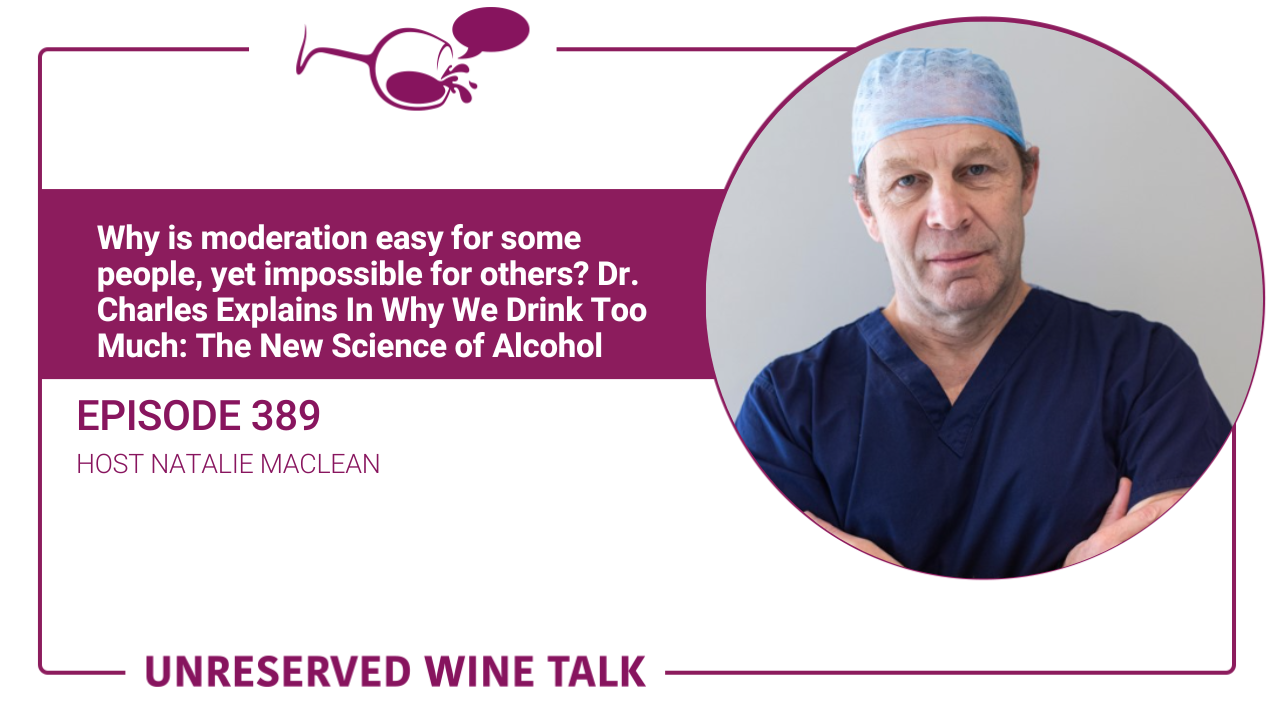
In this episode of the Unreserved Wine Talk podcast, I’m chatting with Dr. Charles Knowles, author of Why We Drink Too Much: The New Science of Alcohol.
You can find the wines we discussed here.
Giveaway
Three of you are going to win a copy of Charles Knowles’ new book, Why We Drink Too Much: The New Science of Alcohol.
How to Win
To qualify, all you have to do is email me at [email protected] and let me know that you’ve posted a review of the podcast.
It takes less than 30 seconds: On your phone, scroll to the bottom here, where the reviews are, and click on “Tap to Rate.”
After that, scroll down a tiny bit more and click on “Write a Review.” That’s it!
I’ll choose three people randomly from those who contact me.
Good luck!
Join me on Instagram, Facebook and YouTube Live Video
Join the live-stream video of this conversation on Wednesday at 7 pm eastern on Instagram Live Video, Facebook Live Video or YouTube Live Video.
I’ll be jumping into the comments as we watch it together so that I can answer your questions in real-time.
I want to hear from you! What’s your opinion of what we’re discussing? What takeaways or tips do you love most from this chat? What questions do you have that we didn’t answer?
Want to know when we go live?
Add this to your calendar:

Highlights
- How did Charles’ initial attempt at a memoir expand to explore the science behind why we drink alcohol?
- Why did Charles feel it was essential to present alcohol research without oversimplifying?
- Why does he reject both anti-alcohol evangelism?
- What can early experiences with alcohol reveal about future risk of developing a problematic relationship with it?
- How does alcohol act as a social lubricant for some people?
- What’s the connection between human evolution and alcohol as the world’s oldest and most widely used drug?
- What was alcohol’s role in early human societies?
- What distinguishes alcohol dependence from gray area drinking?
- Which aspects of drinking increase the risk of developing a problematic relationship with alcohol?
- Why does the brain’s reward system prioritize alcohol over other needs?
- What is the default mode network, and why does alcohol’s ability to quiet repetitive negative thinking make it so reinforcing?
Key Takeaways
- What can your first experiences with alcohol tell you about the relationship you might have with it later in life?
- People can go back and look at their own early experiences with alcohol as a barometer of how that relationship is going to be, because having been alcohol naive to that point and drinking what for a small 13 year old was quite a lot of alcohol. I absolutely loved it from that first moment. No one had to force me to drink that stein of lager. As soon as the effect hit my brain I wanted more of it. And I think that’s a recurring theme that you see among people that have problems later in life and is covered by science. There’s good scientific evidence that there are early indicators of that enthusiasm and being someone who can drink a lot quickly as a teenager is not a good omen as you go on further in life.
- Are we fighting with our own biology when it comes to alcohol?
- We are fighting our own biology with alcohol. 10 million years ago, of course, could be argued was through nutritional necessity and that’s why there was evolutionary pressure to gain the gene modifications that we required to metabolize alcohol safely at a point where the chimpanzee separates from the orangutan. But the deliberate production of alcohol goes back 15,000 years, and roughly coincides with when we started living in groups, what one might say is early civilization. And I think it more than a coincidence that our production of alcohol coincides with that because living in groups requires us to live and cooperate with other human beings. people talk about social fitness and alcohol’s ability to enable social interactions, which everyone knows to this date and many, many people use alcohol for.
- Why is moderation impossible for some people?
- Moderation is possible for a great many people without huge difficulty. It’s certainly impossible for anyone who’s developed alcohol dependence. I mean, that’s my view, it’s a view that isn’t shared by everyone, but would be shared by most people with any medical, or by psychiatrists and people work in the space. That if our addiction has developed in the form of alcohol dependence, you can never safely drink again, any amount. And that was my personal experience of it. And it took me seven years to stop. any return to alcohol was doomed. I mean, I tried that, and I’ve met hundreds of other people who have tried it, and the scientific literature bears that out. And that’s because there are different processes at play in someone who is dependent on alcohol from the much wider group of people, which include the gray area.
About Charles Knowles
Charles Knowles is Professor of Surgery at Queen Mary University of London and a colorectal surgeon. He is author of the book “Why We Drink Too Much: The New Science of Alcohol” which was published by Macmillan in the UK, Commonwealth, US and Canada in January 2026. The book entwines his own journey with an understanding of the effects of alcohol in the body and brain, and how this informs rational approaches to stopping or moderating consumption.
Resources
- Connect with Charles Knowles
- Unreserved Wine Talk | Episode 300: How Wine Fosters Creativity, Trust and Sociability with Edward Slingerland, Author of Drunk: How We Sipped, Danced, and Stumbled Our Way to Civilization
- My Books:
- Wine Witch on Fire: Rising from the Ashes of Divorce,Defamation, and Drinking Too Much
- Audiobook:
- Audible/Amazon in the following countries: Canada, US, UK, Australia (includes New Zealand), France (includes Belgium and Switzerland), Germany (includes Austria), Japan, and Brazil.
- Kobo (includes Chapters/Indigo), AudioBooks, Spotify, Google Play, Libro.fm, and other retailers here.
- Wine Witch on Fire Free Companion Guide for Book Clubs
- Audiobook:
- Unquenchable: A Tipsy Quest for the World’s Best Bargain Wines
- Red, White, and Drunk All Over: A Wine-Soaked Journey from Grape to Glass
- Wine Witch on Fire: Rising from the Ashes of Divorce,Defamation, and Drinking Too Much
- My new class, The 5 Wine & Food Pairing Mistakes That Can Ruin Your Dinner And How To Fix Them Forever
Tag Me on Social
Tag me on social media if you enjoyed the episode:
- @nataliemaclean and @natdecants on Facebook
- @nataliemaclean on Twitter
- @nataliemacleanwine on Instagram
- @nataliemaclean on LinkedIn
- Email Me at [email protected]
Thirsty for more?
- Sign up for my free online wine video class where I’ll walk you through The 5 Wine & Food Pairing Mistakes That Can Ruin Your Dinner (and how to fix them forever!)
- You’ll find my books here, including Unquenchable: A Tipsy Quest for the World’s Best Bargain Wines and Red, White and Drunk All Over: A Wine-Soaked Journey from Grape to Glass.
- The new audio edition of Red, White and Drunk All Over: A Wine-Soaked Journey from Grape to Glass is now available on Amazon.ca, Amazon.com and other country-specific Amazon sites; iTunes.ca, iTunes.com and other country-specific iTunes sites; Audible.ca and Audible.com.
Transcript
Natalie MacLean 00:00:00 What can your first experiences with alcohol tell you about the relationship you’ll have with it later in life? Are we fighting with our own biology when it comes to drinking alcohol? And why is moderation impossible for some people and yet easy for others? In today’s episode, you’ll hear the stories and tips that answer those questions in our chat with Doctor Charles Knowles, author of the terrific new book Why We Drink Too Much: The New Science of Alcohol. By the end of our conversation, you’ll also discover how Charles’s initial attempt at a memoir expanded to explore the science behind why we drink alcohol. Why he felt it was essential to present alcohol research without oversimplifying it. Why he rejects both anti alcohol evangelism and the uncritical celebration of alcohol. How alcohol acts as a social lubricant for some people. What distinguishes alcohol dependence from grey area drinking. Which aspects of drinking increase the risk of developing a problematic relationship with alcohol, while the brain’s reward system prioritizes alcohol over other needs like nutrition. What the default mode network is and why. Alcohol’s ability to quiet repetitive negative thinking reinforces it.
Natalie MacLean 00:01:31 Do you have a thirst to learn about wine? Do you love stories about wonderfully obsessive people, hauntingly beautiful places, and amusingly awkward social situations? Well, that’s the blend here on the Unreserved Wine Talk podcast. I’m your host, Natalie MacLean, and each week I share with you unfiltered conversations with celebrities in the wine world, as well as confessions from my own tipsy journey as I write my third book on this subject. I’m so glad you’re here. Now pass me that bottle, please, and let’s get started.
Natalie MacLean 00:02:13 Welcome to episode 389. \On CHCH Morning Live, we chatted about Side Launch Brewing Company in Collingwood, Ontario, named for that town’s proud shipbuilding history, where they side launched ships due to the narrow harbour of the Georgian Bay. Side Launch has built a loyal following with its North Bound Lager. Now they’ve launched ready to drink cocktails, including the Lemon Berry Mist sparkling cocktail, made with real lemon and raspberry juice and 100% Canadian gin. It’s gluten free, not too sweet and has only 5% alcohol, so it’s very refreshing. Pour this over iced to enjoy the bright lemon zest and fresh raspberry flavors. It’s light, flavorful, and the kind of summer sipper that makes a Tuesday feel like a long weekend. This one is especially nice on a sunny patio, and you can see how many Canadian icons you can spot on their new labels.
Natalie MacLean 00:02:50 Coming up on City TV’s Breakfast Television, CTV’s Your Morning, CTV’s Cp24 Breakfast Show and CTV’s The Social, we’ll be chatting about great wines, spirits, cocktails, beer and ciders and RTDs for Father’s Day, FIFA World Cup, Canada Day and summer sipping. Got a brand do you think I should feature? Let me know at [email protected]
Natalie MacLean 00:03:37 What’s new in the drinks world? Well, this weekend, Fur, Feathers and Fermentation. A winery in Tuscany revealed that they’ve started using trained falcons to deliver wine glasses to guests in remote vineyard locations, a service they call vino from above. No word on whether those wine glasses are filled. I doubt it, but you never know. Meanwhile, a group of researchers at the University of Adelaide in Australia just announced that they have successfully trained a domestic honeybee colony to detect cork taint in wine with 98% accuracy, outperforming many professional human tasters. And finally, a distillery in Kentucky reported that a local squirrel has become a viral sensation for inspecting the oak staves of barrels, earning the nickname the Master Cooper. In human news, in London, England, a record was set on April 30th, 2026 for the most expensive cocktail ever sold. A $25,000 martini that included a diamond olive and was stirred with a 2000 year old Roman glass rod. In Tokyo, Japan, a bar opened that only serves drinks at exactly zero degrees Celsius using liquid nitrogen mist to ensure no cocktail ever warms up while being consumed. In a study from the University of Oxford, it was found that drinking wine from heavier glass makes people perceive the liquid as being 20% more expensive than it actually is.
Natalie MacLean 00:05;17 Now for your drinks calendar, get ready to loosen your belt and polish your glass. It’s a deliciously full week. Starting with May 13th World Cocktail Day. The first known printed definition of a cocktail, published in 1806, was in a New York newspaper. It described the drink as a stimulating liqueur of spirits, sugar, water and bitters.. Take the 1806 challenge and build a four ingredient cocktail with an unexpected base, like an aged tequila or a smoky mezcal. A Name that Garnish Quiz adds a party element. May 13th is also National Fruit Cocktail Day. The canned version was standardized in California in the late 1930s as a way to use surplus or bruised orchard fruit. The classic five fruit blend was designed for soldiers in the Second World War. Macerate fresh fruit in brandy overnight and spoon it over Champagne. Skewer fruit on a cocktail pick and drop them into Prosecco. It’s also National Apple Pie Day, and the first recorded apple pie recipe came from England in 1381 and called for figs, raisins and pears, but no blackbirds, and with no sugar because it was too expensive. The dish became a symbol of American pride much later. Try a liquid lattice apple pie martini with apple cider, vanilla vodka, butterscotch liqueur, and a graham cracker rim dusted with cinnamon. It is also international. Hummus day. Pair classic hummus with a crisp Rosé. Try beet hummus with sparkling wine or build a dips of the world board.
Natalie MacLean 00:06:54 May 14th is National Buttermilk Biscuit Day. The word biscuit comes from the Latin bis coctus, meaning twice cooked. Even though southern American biscuits aren’t twice baked, biscuits became popular as a cheap, filling bread in the pre-Civil War South. Older versions were baked twice for durability and were tougher than the fluffy buttermilk style we know today. Infuse bourbon with a crumbled biscuit overnight, strain it, and stir with maple syrup. May 14th is national Brioche day. Brioche is a French enriched bread made with eggs and butter. Serve it with mimosas. Use brioche buns for tiny lobster rolls and pour Chardonnay. Alongside May 15th is National Chocolate Chip day. Ruth Graves Wakefield invented the chocolate chip cookie at the Toll House Inn in Massachusetts in 1938. She’d run out of bakers chocolate and broke up a bar of semi-sweet, assuming it would melt into the dough. It did not, and the chip was born in her honour. Pour Sherry over chocolate chip ice cream. May 15th is National Pisco Day. Chile and Peru both claim pisco, the high alcohol amber, to clear grape brandy as their own. And the dispute is so heated that each country has legal protections for the name. So why not hold a side by side tasting of Chilean and Peruvian pisco?
Natalie MacLean 00:08:525 May 15th is also National Pizza Party Day. This one always falls on the third Friday in May. Pair pepperoni pizza with Lambrusco. Serve mushroom pizza with Pinot noir. May 16th is National Mimosa Day. The mimosa is widely credited to Frank Meyer at the Hotel Ritz in Paris around 1925. It’s named after the mimosa tenuiflora plant, whose bright yellow flowers match the colour of the cocktail. Set up a mimosa bar with juices beyond orange like guava, blood orange, pomegranate or peach. Swap the juice for fresh strawberry puree. Top each glass with a splash of elderflower liqueur. For an herbal twist, drop in a sprig of time or rosemary into the flute. May 16th is also World Chartreuse day. Chartreuse has been made by the Carthusian monks in the French Alps since 1737. The recipe uses 130 botanicals, and only two living monks know it at any given time. Sip green chartreuse over ice and try to identify the herbs. Revive the Last Word, an equal parts cocktail from 1916, made with gin, lime, maraschino, and chartreuse. May 16th is also World Whiskey Day. The word whiskey comes from the Gaelic uisce beatha, which means water of life. World Whiskey Day falls on the third Saturday in May. So why not host a regional flight that compares Scot, Irish, Japanese and Canadian whiskies? Run an ice experiment by trying the same whiskey? Three ways neat with a single drop of water and over a giant clear ice cube. And it’s also National Barbecue Day. Pair ribs with Zinfandel or Shiraz. Try grilled vegetables with a Cabernet franc, or mix a smoky Caesar for your table. And it’s also National Coquille Saint Jacques Day. This dish is the French name for the great scallop, and refers to the classic French dish of scallops poached in white wine, nestled in a creamy mushroom sauce and topped with mashed potatoes or breadcrumbs, the scallop shell is the symbol of Saint James. Pair scallops with a buttery Chardonnay.
Natalie MacLean 00:10:38 May 17th is National Pinot Grigio day. Pinot Grigio is genetically the same grape as Pinot Gris. The style changes dramatically based on where it’s grown. Italian versions are lean and crisp, while Alsatian Pinot Gris tends to be richer and more aromatic. Run a two country blind tasting. May 17th is also National Cherry Cobbler Day, and the word cobbler refers to the desserts lumpy crust, which was thought to resemble a cobblestone street. Top warm cherry cobbler with a splash of kirsch. May 17th is National Walnut Day, and walnuts are the oldest tree food known to humans, with evidence dating back to 7000 BC. They were once called Persian walnuts because they traveled the Silk Road. P0ur a glass of nocino, a sticky, dark green Italian walnut liqueur, over a single large ice cube. May 18th is national cheese souffle de souffle. The word comes from the French verb souffle, meaning to puff up or to blow. The dish dates to early 18th century France and is famously fragile. Peri soufflé with champagne since the bubbles cut through the richness.
Natalie MacLean 00:11:53 And finally, May 19th is National Devil Foods Cake Day. Devil Food Cake first appeared in American cookbooks around 1905. It earned its nickname as the sinfully rich opposite of Angel Food Cake. The deep color originally comes from a chemical reaction between cocoa powder and baking soda. Pour a glass of Ruby Port, and you’re ready to go.
Natalie MacLean 00:12:13 Back to today’s episode. Three of you will win a copy of Doctor Charles Knowles’ terrific new book, Why We Drink Too Much: The New Science of Alcohol. If you’d like to win a copy, please email me and let me know you’d like to win. It doesn’t matter where you live, I’ll choose three winners randomly from those who contact me at [email protected]. Keep them for yourself or give them as gifts. If you’re reading the paperback, e-book or listening to the audiobook of my memoir, Wine Witch on Fire: Rising from the Ashes of Divorce, Defamation and Drinking Too Much, a national bestseller and one of Amazon’s best books of the year, I’d love to hear from you at [email protected]. I’ll put a link in the show notes to all retailers worldwide at nataliemaclean.com/389.
Natalie MacLean 00:12:51 And just a quick note about today’s episode. Although we cover several health related aspects of alcohol and our guest is a doctor, this is not meant to be medical advice. If you have questions about alcohol and health, please consult with your own doctor or health care provider. Okay, on with the show. Charles Knowles is professor of surgery at Queen Mary University in London, England, and a colorectal surgeon. He has just published his new book, Why We Drink Too Much: The New Science of Alcohol with Macmillan. It entwines his own journey with an understanding of the effects of alcohol on the body and brain, and how this informs rational approaches to stopping or moderating consumption. He joins us now from his home in London. Charles, we’re so glad you could be here with us.
Dr. Charles Knowles 00:13:49 Thank you. t’s a pleasure to be on your show. I’m in my office, actually, at the university.
Natalie MacLean 00:13:54 There you go. Work never stops. All right. Now, as I mentioned, you are a Professor of surgery, Chief Academic Officer at the Cleveland Clinic in London, author of 300 papers. This is your first sort of popular science book, if you will, for a more mainstream audience. What finally convinced you that this was the story you needed to write, and that you were the one to write it?
Dr. Charles Knowles 00:14:17 It was a sort of circuitous route to writing this. It started with many people saying, you should write a memoir. And I mean, that came really by storytelling and various things, and particularly in the music side of things, which I’m involved in. And my producer Nick Tauber, who produced Thin Lizzy and other people. It was his idea, first off. And I wrote a memoir. And I guess I’m really not that interesting because literary agents said you’ll never get a memoir published. You need to be a major celebrity. But they did comment that what I wrote about alcohol and my relationship with it was interesting. And so not being one to be beaten. I then thought I’d write a book on alcohol. And that book started out from the why me perspective. You know, why I – out of all of my peer group and other people who started drinking like me as a teenager – did I come to have the problems I had? But as I started writing it, I realized that any reasonable approach to that subject had to start to understand why humans drink alcohol at all. I can tell you that once I got involved in that, there were many periods where I regretted starting doing it at all because it’s incredibly complicated subject.
Natalie MacLean 00:15:36 And yet you make it so relatable, I guess because your own story is interwoven with the science. I think that really brings it alive.
Dr. Charles Knowles 00:15:43 Yes. I mean, interestingly, having criticized the memoirs, the publishers of the adventure book wanted a lot of the memoir put back in. So it went out and then it came back in again to try and carry the science along, as you say.
Natalie MacLean 00:15:57 Well, I think it’s in that category, if you will, of memoir plus. So you learn something. In your case, of course, it’s the science, it’s the alcohol. I just think the two together really work. Now, your scientific training gave you a particular lens, of course, in writing and researching. What did being a clinical researcher allow you to see about alcohol and addiction that perhaps memoir writers, many of whom have talked about their struggles with alcohol, who don’t have your background, tend to miss in their writing.
Dr. Charles Knowles 00:16:26 One of the things I wanted to do with the book, having read many others in the sort of popular domain, was to make sure it was right. I mean, as writers, we can be in a subject that’s quite esoteric and brings in areas of sociology, psychology, neuroscience, medicine, and history. Because there are a lot of books out there that I think, in an attempt to make them relatable and possibly easy to read, have dumbed down the science to a point where actually it’s become factually wrong. I don’t believe – or at least I set out, I hope in the book that by simplifying anything – it is actually wrong. It is in as much as we know about it correct. And that was an important factor in the style of the book. One of the other things was that there are, of course, other writers who have approached this from a prior hypothesis. There are many anti alcohol writers who are evangelical, for instance, about people’s drinking habits, who have approached the science from the point of view of using it to show that they’re right rather than showing what it actually shows. I didn’t want to make that mistake. And for your viewers, I’m not an anti alcohol. I’m very happy to sit with my friends while they’re drinking and to go to pubs. And I have no desire to evangelize the drinking population. It’s up to individuals to look at their relationship with alcohol and how that’s working out for them.
Natalie MacLean 00:18:01 Sure. Now, for a man whose entire professional life is built around precision and rigour, was there something deeply uncomfortable about writing in the first person and putting your own vulnerabilities on the page for your family and colleagues, and eventually the public to read?
Dr. Charles Knowles 00:18:20 I think it was really important to write it in the first person to avoid, you know, as a doctor, being the sort of view people you and your problems. I think it does make it more relatable when you’re writing in the first person. I don’t think I had any problem with any personal vulnerabilities in this. I was more concerned about the effect it would have on my family and particularly my wife. And of course, in the end, she ended up contributing to the book. So I brought her on the journey with me.
Natalie MacLean 00:18:50 That’s a smart strategy. So you opened the book in Munich, you are a 13 year old on a school trip quickly drinking a full litre stein of German lager before teachers found you and pulled you out. You recently went back and found that exact table. Sort of a full circle moment. Describe that.
Dr. Charles Knowles 00:19:08 Yeah. It was it was sort of interesting to pause and think that’s where something started that in many ways shaped the next 30 years of my life. I mean, you could argue it’s shaped now with the book or nearly all of my life. The other thing that came from that and is covered in the chapter about learning to drink is I think people can go back and look at their own early experiences with alcohol is a barometer of how that relationship is going to be. Because, you know, having been alcohol naive to that point and drinking what for a small 13 year old was quite a lot of alcohol, I absolutely loved it from that first moment. No one had to force me to drink that stein of lager as soon as the effect hit my brain. I wanted more of it and I think that’s a recurring theme that you see among people who have problems later in life and is covered by science. Good scientific evidence that there are early indicators of that enthusiasm. And being someone who can drink a lot and quickly as a teenager is not a good omen as you go on further in life.
Natalie MacLean 00:20:22 Oh, sure. Yes. You describe it as quite meaningful to revisit the place where you started something. Now, many later life problem drinkers who didn’t start when they were that young describe their first encounter with alcohol is feeling like coming home, like it’s really them. What did that stein as a 13 year old feel like you compared to perhaps what other boys might have been experiencing?
Dr. Charles Knowles 00:20:47 I wouldn’t reference the 13 year old period for this, but more the 17 year old period when I started drinking regularly. I mean I started drinking on and off younger than that, but I probably started drinking regularly 17 and socializing with alcohol, and that really was a lights on moment. So I was at boarding school at the time. I hadn’t had a particularly easy time at boarding school. There was bullying and I was a fairly studious, not particularly popular teenager. What in the day would be described as a nerd, perhaps? And that all changed with alcohol. Seemingly instantaneously, I went from being not a complete social outcast, but not being one of the boys to being the center of the party as a result of the enabling effects of alcohol. And I think that’s a really important thing because it’s positively reinforcing, of course, of that behaviour. And very strongly so and, you know, it is a general heuristic that things earlier on in life that are positively reinforcing much more likely to be influential and memorized and harder to change as you go on later in life.
Natalie MacLean 00:22:03 And they’re so deeply emotionally rooted, those kinds of experiences. Researchers call it abandonment and bereavement, especially a boarding school. It really does become deeply implanted. So you mentioned that by your early 30s, when you were married, you already knew you had a serious problem long before your first Alcoholics Anonymous AA meeting. What was the internal conversation like? How did you know? Was it just a sense, or was it like, oh gosh, I’m up to this amount of drinking now or…
Dr. Charles Knowles 00:22:31 Yes, it wasn’t entirely due to the the amount consumed. I mean, even at that stage, you know, amongst the people I hung out with. I wasn’t an outlier from the amount of alcohol consumed, nor from sort of crazy behaviour. But I was an outlier from the point of view of getting up in the morning on a Saturday and wanting a drink in the fridge and of my own mental health, which I knew was deteriorating. Even by that stage, being married, I had a daughter who was one. I had an important job. The anxiety was well established around my drinking, and I guess I knew because, you know, I was a doctor and to some extent we all know something, but I think everyone knows something of the sort of checklists of are you an alcoholic type of things that are used to lie in doctors surgeries. It was not lost on me that I was starting to tick off any remaining boxes that were unticked at the time. So as I looked at that sort of bottle of wine in the fridge in the morning, I realized I definitely had a major problem because obviously, one of the ticks that many people very commonly talk about is drinking in the morning.
Natalie MacLean 00:23:50 Interesting. I hadn’t heard that one before, but it’s a good thing to be cognizant of. So now you argue that alcohol is the world’s longest serving and most popular drug. The book traces our ability to metabolize alcohol back 10 million years to hominid ancestors eating fermented fruit from the forest floor. If this drive is older, then the species itself is the modern project of moderation, kind of fighting our own biology.
Dr. Charles Knowles 00:24:18 Certainly we are fighting our own biology with alcohol. 10 million years ago it could be argued it was through nutritional necessity, and that’s why there was evolutionary pressure to gain the gene modifications that were required to metabolize alcohol safely at a point where the chimpanzee separates from the orangutan. But, the deliberate production of alcohol, which is possibly more relevant, goes back 15,000 years, roughly coincides with when we started living in groups. What one might say is early civilization. That’s a term, and I think more than a coincidence, that our production, deliberate production of alcohol coincides with that, because living in groups requires us to live and cooperate with other human beings. And people talk about social fitness and the alcohol’s ability to enable social interactions, which everyone knows to this date and many people use alcohol for, as I did. In the brain, alcohol has fundamental effects as a primary reward, and it affects, as you noted in your introduction, many neurotransmitter systems that mimic the effects of many other highly addictive drugs. And that’s fundamental biology. And perhaps we could get on to it. Maybe I want to give a long answer now, but, you know, there are aspects of ancient biology here in relation to the reward system and survival that make this particularly challenging to change behaviour, particularly when addictions developed.
Natalie MacLean 00:26:02 Talk more about that because I’m wondering if the whole idea of trying to get everyone to moderate drinking is doomed to failure if it’s in our genes to want this kind of reward system and alcohol gives it to us.
Dr. Charles Knowles 00:26:18 Moderation, I think, is possible for a great many people without huge difficulty. It’s impossible for anyone who has developed alcohol dependence. That’s my view. It’s a view that isn’t shared by everyone, but would be shared by psychiatrists and people working in the space that if addiction has developed in the form of alcohol dependence, you can never safely drink again, any amount. And that was my personal experience of it. It took me seven years to stop and any return to alcohol was doomed. I mean, I tried that and I’ve met hundreds of other people who have tried it. And the scientific literature bears that out. And that’s because there are different processes at play in someone who is dependent on alcohol from the much wider group of people, which includes the gray area. So for context, for the viewers, alcohol dependence, a sort of medical definition, what used to be called alcoholism that affects between 2 to 3% of most Western populations, whereas grey area drinking – most people would agree, although it’s ill defined – that’s more like 20% of the population. And then there’s another 50% of the population who consume some alcohol and who would be regarded as basically neutral around it. That means they could take it or leave it. And if you ask them to moderate, they would have no difficulty at all. And there’s slightly different drivers.
Natalie MacLean 00:27:47 What about the grey drinkers? Is there a quantity that they’re drinking?
Dr. Charles Knowles 00:27:50 No. Nothing to do really with the amount consumed. So grey area drinking doesn’t have an exact definition, although I’ve tried to place a definition on it in the book for the first time. I would define it as someone who relies on alcohol in a way that makes them concerned about the amount they’re consuming and also their ability to change that. And that brings in really two aspects. It brings in something that is defined by the World Health Organization as hazardous alcohol use. So that’s the idea that someone recognizes they’re consuming alcohol in a way that poses a risk to them, even though those harms have not actually happened. So examples of this are: I come to work hungover. People have commented on it, but I haven’t lost my job yet. I got in the car after drinking too much, but the police didn’t catch me and I didn’t have an accident yet. I’m overweight. I think I’m unfit, but I haven’t had a heart attack or developed diabetes yet. So these are examples of the yet. And many people in the grey area community are worried about those things, or lesser things like their appearance or their sleep pattern, levels of anxiety, etc. but the definite harms that characterize alcohol dependence and continued compulsion to drink aren’t there. The second aspect of it is what I call and define for the first time, something called alcohol reliance. So to distinguish it from dependence, because the question I was always getting was, well I don’t think I’m alcohol dependent. And actually they’re right. They’re not alcohol dependent because they don’t meet the criteria for alcohol dependence. But there isn’t a term that describes my relationship, because every time I try stopping, I find it difficult. And that’s because people come to rely on alcohol in certain contexts. Common ones are like, I need a drink after work to relax. I rely on a drink to socialize. And you can make a list of these.
Dr. Charles Knowles 00:29:57 If you ask people who see themselves as grey area drinkers, they’ll tick off many of that list. But they’re not people who ever seen a doctor for their relationship with alcohol. And so I think those two things – hazardous alcohol use and reliance – roughly equate with grey area drinking. But even within the grey area, of course, there are lighter and darker shades of grey.
Natalie MacLean 00:30:19 Sure. Well Fascinating. Now, when you say fermentation predates the toilet by several thousand years, what does that reveal about priorities of early human civilization? Was it first? I mean, you’ve also got the sort of what is it called, bread first or beer first? Edward Slingerland. We settled down, but we first learned how to make alcohol. And the toilet came several thousand years later.
Dr. Charles Knowles 00:30:45 I did not know about the bread and beer, and Edward Slinger could have taught me something. I guess it was a bit of a joke in the book really because I’m a colorectal surgeon. You know, I’m someone who works at the lower end of the market that toilets are obviously something that we joke about. But actually, yes, the first toilets in Mesopotamia do predate the first evidence of the production of alcohol. And again, it comes back to a theme that runs through the book and is quite complex. But the basic core thesis of this – which I don’t think anyone else has is raised before – is that social fitness is required for survival or was required for survival. So in today’s world, we think of social fitness as the number of Instagram followers and how popular you are at school and the number of likes you get on a Facebook post and things. But you can think back that social fitness, when we first lived in communities together, had a role in survival from the point of view of protection, that you needed to protect yourselves as a group. Cooperative behaviour or reciprocal behaviour in the sense of hunting a mammoth or something required more than one person, often in cooking and looking after children. All of those things for the survival of the species require cooperation. And then finally there’s what’s sometimes euphemistically called romantic desirability, but is about passing on the gene through mating. In the modern world, you can quite easily see how alcohol fulfils many of those functions. Dutch courage is an example of we feel braver when we’ve drunk alcohol. The convivial atmosphere of friends, family, and other things is all about this reciprocal behaviour. And of course, we falsely believe that we’re more attractive after we’ve been drinking or the other person is more attracted after drinking. The problem is that it’s easy to say that, but actually, deep in our brains we may well be working to the historic script. So, despite the fact that this seems a crazy notion now, the brain after drinking alcohol is working to the script. Well I still need this for survival because that’s how the brain circuitry works. When you change those neurotransmitters with alcohol, they become rewarding and those sort of survival driven behaviours. And there are psychologists like Alfred Adler, for instance, from Vienna. But I mean, others like Jung have touched on it. If you come to falsely believe what Adler called a fictive survival signal that is helpful for survival, it will be incredibly difficult to change that behavior because it overrides other, more rational parts of our newer brain. This ancient biology.
Natalie MacLean 00:33:45 Wow. The ancient biology. That’s fascinating. So perhaps it’s generation after generation thinking they need alcohol to fit in with the tribe. And here we are out at our wine bar thinking it’s my biology kicking in.
Dr. Charles Knowles 00:33:58 And it may not just be that psychological aspect. I mean, you talk about generation after generation. It may be inherited by epigenetic changes. And this is the sort of work that came out of the Dutch starvation, the Dutch famine, that people who were starved by the Nazi blockade of Amsterdam in 1944. The parents had children who became obese, and that’s because the stimulus to eat food when you’re starving was carried to their offspring.
Natalie MacLean 00:34:30 That’s amazing. I hadn’t heard that before. Wow. Just one generation.
Dr. Charles Knowles 00:34:33 This is a prevailing theory in obesity.
Natalie MacLean 00:34:36 Wow. Okay. You also note the vervet species of monkeys on the island of St. Kitts are memorable. They have access to fermented sugar cane and self sort into teetotallers, moderate drinkers, and 5% who drink strong spirits in preference to sweet drinks and show a dependency behaviour. Can you describe what researchers observed on that island in concrete detail? Is it reflective of the human population? There’s always going to be 5%, or do those splits reflect in other in humans and other species?
Dr. Charles Knowles 00:35:09 Well, I’m sure they do. A fruit fly has 95% of our genome. A mouse has 99% of it. Vervet monkeys are pretty close to the human species in terms of our biology. The vervet monkey steals drinks from tourists. So anyone who’s been to the island of St. Kitts and left their cocktail while they have a snooze by the pool will find it gone. Because these monkeys go round and they drink rum and other things. And it is interesting and a scientific observation that there are a subgroup of vervet monkeys that are used now in alcohol scientific studies because of their development of addiction to alcohol. So this isn’t just some crazy observation. This is a well-studied scientific phenomenon that very much resemble alcohol dependence in humans. And similarly, interestingly, there are about 20% of vervet monkeys who are quite enthusiastic about alcohol but don’t develop full blown dependence very much like the proportion we have of grey area drinkers. There’s similarly a small proportion who won’t touch alcohol at all, very much like humans because of intolerance. And the vervet monkey is by no means alone here. Darwin described this in The Descent of Man, how animals drank alcohol. And we know that elephants drink to drunkenness. there’s a whole variety of species, but perhaps best studied in this is mice. So you can recreate human behaviour in mice by either natural breeding or deliberate genetic manipulation. And you can produce a mouse that is a mouse drinking champion. You can produce a mouse that won’t touch alcohol at all, and all sorts of mice in between. The mouse drinking champion will prefer alcohol to food. It can drink more than other mice, shows drunkenness behaviours and compulsion in some genetic variants of mice. And actually you can show this in fruit flies as well. Remarkably, and though quite how you tell when a fruit flies drunk is something I’ve never actually observed.
Dr. Charles Knowles 00:37:21 I haven’t ever seen a drunk mouse personally. But what this tells us, the important point about this is that it tells us that this is not about some people would, coming back to bad science, this is not about advertising or the government not putting enough controls on. I think the government and the alcohol industry are culpable of some things, and they’ve had a pretty easy ride on this. But this isn’t about this. Alcohol long predates Logie Baird and the television. We didn’t need adverts to create this problem. And the fact that alcoholic drink comes back to this point, that alcohol is fundamentally rewarding and is a behaviour that animals as well as us will repeat. And it is fundamentally rewarding principally because of the positive effects of alcohol, which are the psycho stimulatory and relaxant effects that most people find are fun and also result in relation to social interaction in a positive outcome, particularly at least until they don’t later on in life.
Natalie MacLean 00:38:29 Taken to excess. You describe alcohol as the primary reward that simultaneously produces stimulatory effects of cocaine through dopamine, the relaxation of opioids through endorphins, and the sedation of Valium through GABA. When wine lovers swirl and sip their first glass of Burgundy, walk us through what’s happening inside of the brain in just those first few minutes. Are they all happening at once or some kind of layered experience?
Dr. Charles Knowles 00:38:59 Nothing much will happen in the first few minutes. The alcohol has to reach the stomach. And really, for significant alcohol, some of it needs to reach the small bowel because the stomach isn’t very good at absorbing it. Most people start to feel the effects of a glass of wine after 10 to 15 minutes. But that doesn’t mean, of course, that you won’t think you’re feeling the effects of it. And that comes to another point here that once you’ve learned to drink the sort of smell and other aspects, what we call reward cues of alcohol, which can be as small as entering the bar before you’ve even had a drink and seeing the drink. Those are a further problem in some people with their drinking behaviour. This is particularly an addicted drinker’s particular problem. And we call that reward cues. And it’s linked to the ancient biology and craving. But assuming we don’t have that phenomenon, after about 15 minutes, some alcohol starts to be absorbed through the stomach and that alcohol goes via the liver in the most part into the general circulation, and then very rapidly gets to anywhere that the general circulation supplies, which has a blood supply. And that’s basically the whole body other than cartilage. Then the brain has a very high blood flow. So it gets to the brain very quickly. And it alcohol being unique as a chemical almost in being soluble in fat and water, crosses what’s called the blood brain barrier very quickly and effectively. And it then gets to our brain cells via the circulation through the brain. And we’re still exploring exactly what happens there. But I think the simple points are that it’s absorbed into cells, and that it then affects the connections between cells and their ability to connect to each other by these neurotransmitters, which are the sort of chemical switches the neurotransmitters release from one side of the chemical switch, lands on the other side, and turns that nerve on or off in roughly equal balance, because otherwise we’d have uncontrolled brain activity, which happens a bit in epilepsy.
Dr. Charles Knowles 00:41:04 By drinking alcohol, you’re changing the balance of some of those neurotransmitters in certain areas of the brain. Reward is one aspect of that. But as the level of alcohol goes up, the sort of brain wide effect is on the suppression of brain activity by GABA and by glutamate, which of course leads to the really the downsides of alcohol in simple terms, which are increasing sedation, drowsiness, clumsiness, and eventually loss of consciousness. And if you carry on drinking, stopping breathing.
Natalie MacLean 00:41:39 Now, the James Olds rat experiment showed that rats ignored food to press a lever that stimulated their reward centre. What does that tell us about the reward system? It can override almost any other drive, right? I mean, they’ve proven it like the rats or the mice. They’ll go for the alcohol or the reward, even to the extent of starving themselves.
Dr. Charles Knowles 00:42:02 Starving themselves, particularly seen in the experiments that they do with cocaine and methamphetamine and things in mice. They stuck a needle into the brain to direct the stimuli. It was actually a serendipitous discovery because they went to an area of the brain they weren’t intending to. But after that, this was sort of the first discovery of the reward system. And as you say, the rat would press a lever to have this electrical stimulation delivered at the expense of everything else. And the reward pathway is there to serve a very important function in survival, at least it was in humans. It doesn’t serve a helpful function now, and it’s no more evident than in the field of addiction. But the general idea is that you need a deep, fundamental area of the brain in any animal species that can allow you to very rapidly detect things that you need for your survival, and to get you away from things that threaten your survival. An example of this is being able to spot a brightly coloured set of bananas in the jungle before someone else eats them, and to spot a brightly coloured snake or spider in the jungle before it bites you. And that needs to be done without any consideration of other things or interference from other brain processes. So, you need to be able to be in immediate, almost instinctive one might say reaction to that in both circumstances. And that’s what the reward pathway does. It’s wired in a way to take precedence over everything else.
Dr. Charles Knowles 00:43:33 So let’s take a bee for example. A bee has a reward system. That reward system enables it to see the brightly colored petals of the flower, and through seeing those, takes it to the pollen on the stamen of the flower, which it requires for its survival. A bee does not think hang on I’ll come back when the weather is better or when I’ve finished watching my favourite television program or when the flowers turned to a different colour. It needs to find that pollen to survive for another day. And the problem is that we’re left with this system deep within our brains, this ancient biology that once served us very well when we were a chimpanzee or earlier on in the evolutionary pathway, but now serves no useful function because in society we’re not expected to do things in that sort of rash and impulsive manner is often very hazardous. And that’s true of taking drugs or misusing alcohol.
Natalie MacLean 00:44:40 Right. And you described a default mode network that acts like a washing machine of thoughts. And you argue that it can pull out the dirty clothes to torment a drinker during a hangover. Maybe you could give us an example, like what’s happening in that network that alcohol seems to silence.
Dr. Charles Knowles 00:44:58 I’ll do my best with it. So the default mode network is at what’s called a deep brain network. And it’s an example of a lot of. It’s not one single area that you can put your finger on. It’s bits of lots of areas. And we’ve only been able to study this since we’ve had modern neuro-imaging methods like functional MRI. And the default mode network can be thought of as the sort of daydreaming area of the brain. So whereas we’ve got areas of the brain that light up when you make a fist or, or walk or speak or hear things, this is an area that sort of is to do with more general thinking. And within that general thinking, there are various introspective aspects of it. So it’s the area of the brain that compares ourselves with other human beings that gives us a sense of self-worth. So self-esteem is tied in with this area with memory, particularly emotional memory and connected to areas like the amygdala, which is sort of an extended part of the network. And so this is an area that we know is disturbed. It’s not sort of whether it’s on or off more than things, but it’s changed. So we say in conditions like attention deficit hyperactivity disorder, it’s changed with self-esteem, changed with other neuro-developmental things and changed in addiction. It is the sort of area that, left to its own devices, is probably responsible for the sort of rumination that happens to many people who have neurotic tendencies as I do. So experiencing negative feelings, thinking about things over and over again. And we talk about the default mode network in the context of the neurobiology of self. It’s sort of what makes us ourselves and in common with ADHD is probably responsible for that washing machine brain that humans have.
Natalie MacLean 00:47:02 Going over and over things.
Dr. Charles Knowles 00:47:04 Yes. over and over again, which I experienced. And of course, the relation to alcohol of this is that people discover very rapidly that alcohol can suppress that washing machine brain. And so this becomes what we call a negatively reinforcing stimulus that by removing an unpleasant state, it makes you more likely to repeat the behaviour. And I think – and I don’t write this outright in the book because I can’t prove it – but I think experience would tell me in meeting hundreds of thousands of people that people who only drink for fun very rarely, if ever, develop significant problems with alcohol dependence, at least from the point of view of addiction.
Natalie MacLean 00:47:55 Okay.
Dr. Charles Knowles 00:47:56 They might become overweight and develop liver disease and other things like that. People who drink not just for fun but drink to self-medicate to this negative reinforcement for a variety of reasons. Because they require it for social interaction. They require it because they’re bored. They require it to suppress this rumination in the brain or relieve anxiety and depression when that’s added in the mix. That is one of the fundamental drivers of increased risk towards a problematic relationship with alcohol.
Natalie MacLean 00:48:32 That makes so much sense. And so you’ve got the positive rewards of being social, and then you’ve got the negative positive rewards of dampening what’s negative. Wow. That’s powerful.
Dr. Charles Knowles 00:48:42 But if you really need and believe deep in your brain that you need social interaction for survival, you’ve got that as well. And of course, many of the conditions that are most strongly associated with alcohol have it all. So if you have ADHD or high functioning autistic spectrum disorder, you not only have a problem with social interaction, but you have a problem with this rumination. You have depressive feelings, possible anxiety because it overlaps with neurotic personality type. So you’ve got many of these things in one place. And it’s no surprise that disorders that are associated with those things like bipolar disorder, schizophrenia, post-traumatic stress disorder, and ADHD are those that are most strongly associated with the development of alcohol dependence.
Natalie MacLean 00:49:37 Well, there you have it. I hope you enjoyed our chat with Charles. Here are my takeaways. Number one. What can your first experiences with alcohol tell you about the relationship you might have with it later in life. As Charles explains, people go back and look at their own early experiences as a barometer of what that relationship is going to be like with alcohol when they were first naive about it. For him, as a 13 year old boy, he absolutely loved it from the get go. No one had to force him to drink that whole stein of lager, and as soon as the effect hit his brain, he wanted more of it. It’s a recurring theme, he says. When you talk to people who have problems later in life and is covered by science. Early indicators of that kind of enthusiasm and tolerance for people who can especially drink a lot quickly does not always bode well further in life.
Natalie MacLean 00:50:40 Number two. Are we fighting our own biology when it comes to alcohol? Charles says we are. 10 million years ago, of course, it could be argued that it was through nutritional necessity that we were consuming alcohol to get necessary calories. But then there was an evolutionary pressure to develop gene modifications required to metabolize alcohol safely at the point where chimpanzees separate from the orangutan. But the deliberate production of alcohol goes back 15,000 years and roughly coincides with when we started living in groups in early civilization. He thinks it’s more than a coincidence that our production of alcohol coincides with living in groups that required us to be cooperative and socialize with other human beings. People talk a lot about social fitness and alcohol’s ability to enable social interactions, and that is what many people use alcohol for.
Natalie MacLean 00:51:22 And finally, why is moderation impossible for some people and yet easy for others. Charles says it’s impossible for anyone who has developed alcohol dependence. In his view, if the addiction has developed in the form of alcohol dependence, you can never safely drink again in any amount. That was his personal experience of it, and it took him seven years to stop and any return to alcohol was doomed. He said he had met hundreds of other people who’ve tried it, and the scientific literature bears it out. And that’s because there are different processes at work in someone who is dependent on alcohol from the much wider group of people, including those who he considers gray area drinkers.
Natalie MacLean 00:52:16 If you missed episode 300, go back and have a listen. I chat about how wine fosters creativity, trust, and sociability with Edward Slingerland, the author of Drunk: How We Sipped, Danced, and Stumbled Our Way to Civilization. I’ll share a short clip with you now to whet your appetite.
Edward Slingerland 00:52:30 I think that alcohol is a tool we’ve invented when we need to temporarily turn it back down a few notches and get a little bit back to being more like a 4 or 5 year old in terms of our creativity and trusting in sociality. So that’s one of the main effects. It’s really just depressing the function of the prefrontal cortex and stimulating these pro-social chemicals in our body. Serotonin, endorphin. These things that make us feel expansive and feel good about ourselves and more kindly disposed to other people.
Natalie MacLean 00:53:10 You won’t want to miss next week when we continue our chat with Charles to give you a taste of future guests, we’ll have Millie Milliken on artisanal tequila, Nick Fogg on the Wines of Japan, Professor Mark Scarlatti on the intersection of wine and religion, Doctor Dave Nutt on wine and health, Ben Hawkins on Port and Sherry, Global bartending champion Caitlin Stewart on fresh new cocktails, Humorist Maurice Chevrier on how to sound wine smart, Cara Newman on 40 cocktails to close out any evening. James Chatto on the iconic recipes and drinks that have shaped our taste, Liz Gabay on Rosé, Christiane Rester on Sake, and Marisol de la Fuente on the wines of Argentina.
Natalie MacLean 00:53:56 Do you have a question for any of our guests? Please let me know. Do you know someone who would be interested in learning more about the science of alcohol and consumption? Please let them know about this podcast. Email or text them now while you’re thinking about it. It’s easy to find the Unreserved Wine Talk podcast. Just tell them to search for that title or my name Natalie MacLean Wine on Apple Podcasts, Spotify, their favourite podcast app, or they can listen to the show on my website at nataliemaclean.com or email me if you have a sip, tip, question, or would like to win one of seven drinks books I have to give away. And yes, those future guests will also be giving away books so you can get a jumpstart by contacting me now.
Natalie MacLean 00:54:29 I’d also love to hear your thoughts on this episode, or if you’ve read my book or are listening to it. Email me at [email protected]. In the show notes, you’ll also find a link to dig a free online food and wine pairing class with me called The Five Wine and Food Pairing Mistakes That Can Ruin Your Dinner and How to Fix Them Forever at Natalie MacLean. And that is all in the show notes at nataliemaclean.com/389. Thank you for taking the time to join me here. I hope something great is in your glass this week. Perhaps a wine that you enjoy with effortless moderation. You don’t want to miss one juicy episode of this podcast, especially the secret full bodied bonus episodes that I don’t announce on social media. So subscribe for free now at nataliemaclean.com/subscribe. Meet me here next week. Cheers!