






Introduction
What’s the difference between drinking for pleasure and drinking for relief? How does your body’s early reaction to alcohol predict your long-term risk of developing alcohol dependence? How do some people drink heavily for years without developing the same dependence that others struggle to escape?
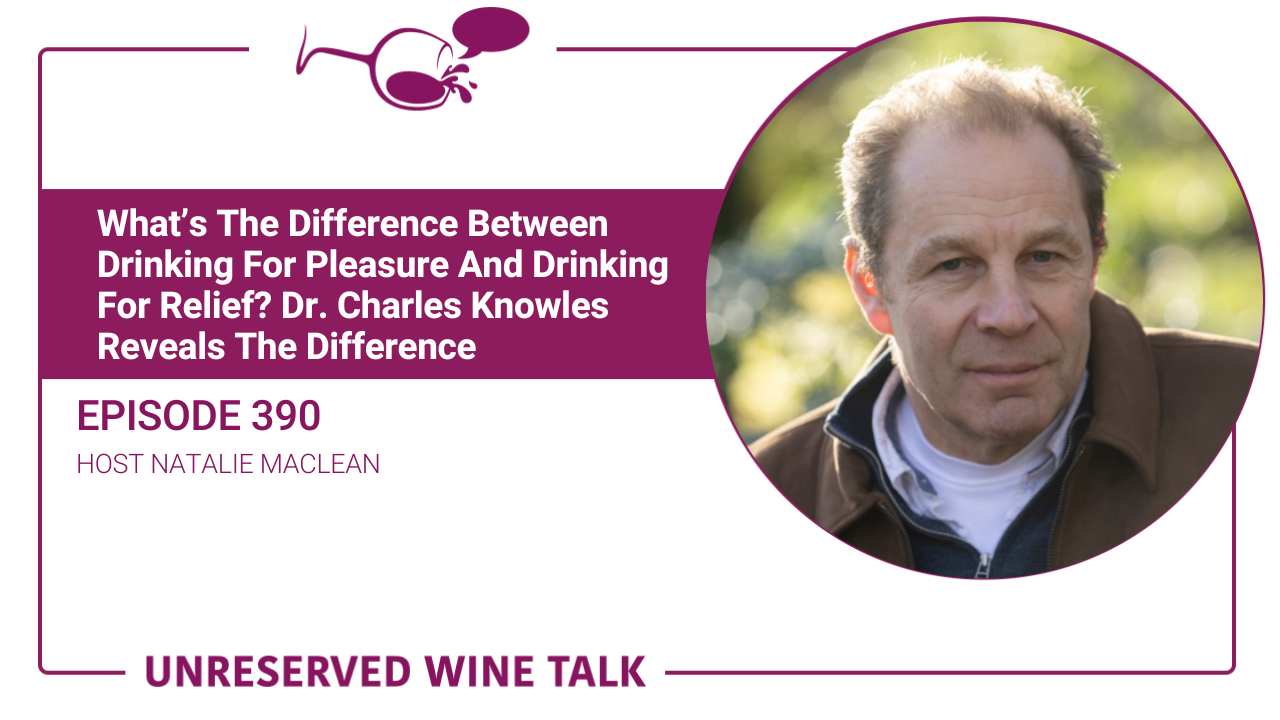
In this episode of the Unreserved Wine Talk podcast, I’m chatting with Dr. Charles Knowles, author of Why We Drink Too Much: The New Science of Alcohol.
You can find the wines we discussed here.
Giveaway
Three of you are going to win a copy of Charles Knowles’ new book, Why We Drink Too Much: The Impact of Alcohol on Our Bodies and Culture.
How to Win
To qualify, all you have to do is email me at [email protected] and let me know that you’ve posted a review of the podcast.
It takes less than 30 seconds: On your phone, scroll to the bottom here, where the reviews are, and click on “Tap to Rate.”
After that, scroll down a tiny bit more and click on “Write a Review.” That’s it!
I’ll choose three people randomly from those who contact me.
Good luck!
Join me on Instagram, Facebook and YouTube Live Video
Join the live-stream video of this conversation on Wednesday at 7 pm eastern on Instagram Live Video, Facebook Live Video or YouTube Live Video.
I’ll be jumping into the comments as we watch it together so that I can answer your questions in real-time.
I want to hear from you! What’s your opinion of what we’re discussing? What takeaways or tips do you love most from this chat? What questions do you have that we didn’t answer?
Want to know when we go live?
Add this to your calendar:

Highlights
- When does alcohol shift from a social choice into biological dependence?
- Why can people with alcohol dependence end up drinking more for relief than for pleasure?
- How do certain environments become powerful craving cues?
- Why is being able to drink heavily without hangovers considered a major risk factor?
- Why do some people experience alcohol as intensely stimulating rather than merely relaxing?
- How did long-term studies of teenagers predict future alcoholism?
- Why is there still no meaningful genetic test for alcohol dependence?
- What behavioral signs can reveal a heightened vulnerability to problematic drinking?
- Why does alcohol dependence often appear in highly driven professions?
- Why does Charles believe that people with alcohol dependence can never safely return to drinking?
- What convinced Charles that he could never drink again?
- Why does Charles believe recovery depends on changing thinking patterns?
Key Takeaways
- What’s the difference between drinking for pleasure and drinking for relief?
- Addiction really has two aspects to it. One is that pure addiction of the deep desire to have something because of reward. And the other is relief. And when you cross the line as I did into alcohol dependence when you’re drinking for relief. You’ve carried that negative reinforcement that you may have started because you had ADHD and because you were bored or unhappy or other things, now into a thing where changes in your brain lead to such an unpleasant feeling when you stop drinking that you need more alcohol to relieve that. Once that is established, as it was, and you asked me about this earlier, that’s my early 30s, standing in front of the fridge. That was the first real indicator that I had crossed the line. I’m afraid my personal opinion on this, I think borne out by others, is once that line is crossed, the end is inevitable.
- How does your body’s early reaction to alcohol predict your long-term risk of developing alcohol dependence?
- There are a group of people who are properly intolerant to alcohol who will almost never develop a problem with alcohol because it’s a deeply unpleasant experience to drink. Then there’s probably a group of about 10% of the population who really don’t like drinking, they just don’t like the experience. And the other end of the spectrum, there are people who are highly tolerant of it, as I was, who can drink a lot without falling over. In all the years I drank, I can always make it home. You know, I never had injuries and things from it. Then the second aspect of this is alcohol related stimulation. And this is where some of the other mice experiments come in, our drinking champion mouse. So whereas some people are slowed by alcohol and sort of sit in the corner looking a bit miserable. Other people are highly stimulated by alcohol and makes you more likely to be preferring to drink and puts you in a high risk. And there are cohort studies like the San Diego cohort study ran for 35 years that took teenagers who were alcohol naive, gave them a measured amount of alcohol, and looked at how stimulated they were and how they felt, and the ones that were most stimulated and had the most subjective pleasure from the experience went on to have the highest risk 30 years later of being alcoholic.
- How do some people drink heavily for years without developing the same dependence that others struggle to escape?
- People who had problems with alcohol were constantly fidgeting and tapping their feet and I think probably what he was observing was the overlap with ADHD and hyperactivity. I see it in AA meetings all the time, the people tapping and things, and a sort of intensity of approach to the drink are sort of things that you can look at now. Over and above that, the amount consumed and regularity of consumption has a weak correlation with that. Obviously people who drink very little are at very little risk of developing a problem. The opposite is not, however, true that people who drink a lot are roughly dispersed across the spectrum. So drinking a lot does not equate well with dependence. There are many people who drink a lot, who are completely neutral around alcohol. And in fact, I met many of them. I know people who can drink six months of the year and not drink other six months of the year, and these would drink with the best of them. That was not my experience. I drank much less than these people but I found it very difficult to stop.
About Charles Knowles
Charles Knowles is Professor of Surgery at Queen Mary University of London and a colorectal surgeon. He is author of the book “Why We Drink Too Much: The New Science of Alcohol” which was published by Macmillan in the UK, Commonwealth, US and Canada in January 2026. The book entwines his own journey with an understanding of the effects of alcohol in the body and brain, and how this informs rational approaches to stopping or moderating consumption.
Resources
- Connect with Charles Knowles
- Unreserved Wine Talk | Episode 267: How to Savour Wine Over Time with Molly Watts of the Alcohol Minimalist Podcast
- My Books:
- Wine Witch on Fire: Rising from the Ashes of Divorce,Defamation, and Drinking Too Much
- Audiobook:
- Audible/Amazon in the following countries: Canada, US, UK, Australia (includes New Zealand), France (includes Belgium and Switzerland), Germany (includes Austria), Japan, and Brazil.
- Kobo (includes Chapters/Indigo), AudioBooks, Spotify, Google Play, Libro.fm, and other retailers here.
- Wine Witch on Fire Free Companion Guide for Book Clubs
- Audiobook:
- Unquenchable: A Tipsy Quest for the World’s Best Bargain Wines
- Red, White, and Drunk All Over: A Wine-Soaked Journey from Grape to Glass
- Wine Witch on Fire: Rising from the Ashes of Divorce,Defamation, and Drinking Too Much
- My new class, The 5 Wine & Food Pairing Mistakes That Can Ruin Your Dinner And How To Fix Them Forever
Tag Me on Social
Tag me on social media if you enjoyed the episode:
- @nataliemaclean and @natdecants on Facebook
- @nataliemaclean on Twitter
- @nataliemacleanwine on Instagram
- @nataliemaclean on LinkedIn
- Email Me at [email protected]
Thirsty for more?
- Sign up for my free online wine video class where I’ll walk you through The 5 Wine & Food Pairing Mistakes That Can Ruin Your Dinner (and how to fix them forever!)
- You’ll find my books here, including Unquenchable: A Tipsy Quest for the World’s Best Bargain Wines and Red, White and Drunk All Over: A Wine-Soaked Journey from Grape to Glass.
- The new audio edition of Red, White and Drunk All Over: A Wine-Soaked Journey from Grape to Glass is now available on Amazon.ca, Amazon.com and other country-specific Amazon sites; iTunes.ca, iTunes.com and other country-specific iTunes sites; Audible.ca and Audible.com.
Transcript
Natalie MacLean 00:00:00 What’s the difference between drinking for pleasure and drinking for relief? How does your body’s early reaction to alcohol predict your long term risk of developing alcohol dependence? And how do some people drink heavily for years without developing the same dependence that others struggle to escape? In today’s episode, you’ll hear the stories and tips that answer those questions in part two of our chat with Doctor Charles Knowles, author of the terrific new book Why We Drink Too Much: The New Science of Alcohol. By the end of our conversation, you’ll also discover when alcohol shifts from a social choice into biological dependence. How certain environments become powerful, craving cues. Why being able to drink heavily without hangovers is considered a major risk factor. Why some people experience alcohol as intensely stimulating rather than merely relaxing. Why there’s still no meaningful genetic test for alcohol dependence. Why alcohol dependence often appears in people who have highly driven professions. Why Charles believes that people with alcohol dependence can never safely return to drinking. What convinced Charles that he should not drink again. And why Charles believes recovery depends on changing thinking patterns.
Natalie MacLean 00:01:30 Do you have a thirst to learn about wine? Do you love stories about wonderfully obsessive people, hauntingly beautiful places, and amusingly awkward social situations? Well, that’s the blend here on the Unreserved Wine Talk podcast. I’m your host, Natalie MacLean, and each week I share with you unfiltered conversations with celebrities in the wine world, as well as confessions from my own tipsy journey as I write my third book on this subject. I’m so glad you’re here. Now pass me that bottle, please, and let’s get started.
Natalie MacLean 00:02:12 Welcome to episode 390. Coming up on City TV’s Breakfast Television. CTV’s Your Morning, CTV’s CP 24 Breakfast Show, and CTV’s The Social, we’ll be chatting about great wines, spirits, cocktails, beer, cider and RTDs – ready to drink cocktails – for Father’s Day, FIFA World Cup, Canada Day, and summer sipping. Got a brand you think I should feature? Let me know at [email protected]. So what’s new in the drinks world? Well, this week in fur, feathers and fermentation, Cuvaison Winery in Los Carneros, California, is now offering the Wine Tales Trail, a self-guided, dog friendly vineyard. Walk through its Carneros estate with QR code stops along the way, explaining the history of the vines and the winemaking. Dogs and their humans check in at the concierge for a map and brief orientation, then loop through the rows together, returning to the estate for a seated tasting of current releases while the pup grazes on a custom bark-cuterie board. Back in synthetic news, an Australian tech startup has successfully trained a fleet of Somm-Bots, miniature autonomous drones, to fly through vineyards and sniff out smoke tank molecules in real time, delivering a chemical map to the winemakers smartphone within minutes.
Natalie MacLean 00:03:38 And here’s your weird but wonderful scientific fact. The four most famous Pinot grapes: Pinot Noir, Pinot Gris, Pinot Blanc and Pinot Meunier are all genetically identical except for spontaneous mutations in the gene that controls the grape skin colour. They are the same grape variety, just dressed up differently. Pinot Noir is the original and somewhere over the past nine centuries in Burgundy, single bud mutations changed how the skin produces pigment, giving us the pink gray skin of Pinot Gris, the pale skin of Pinot Blanc, and the fuzzy, white coated skin of Pinot Meunier. So the next time someone tells you they like Pinot Gris but not Pinot Noir, you can gently know that they’re just really disagreeing about fashion.
Natalie MacLean 00:04:33 For your calendar this week. May 20th is National Quiche Lorraine Day. This started as a savory tart from the Lorraine region of France, and the original versions didn’t always include cheese. The dish has roots in the medieval German kingdom of Lotharingia, which the French later named Lorraine. The word quiche comes from the German kuchen, meaning cake. Celebrate with a crunchy white wine and a slice of quiche. Pair it with a dry, nutty sherry. Since the oxidized notes play perfectly with the richness of the egg custard and the saltiness of Gruyere, try a brunch style martini using vodka infused with black pepper and a drop of liquid smoke to mimic the bacon. It’s also Pick Strawberries day. Strawberries were prized in ancient Rome, more for medicinal use than dessert. Muddle fresh strawberries into a glass of dry Rosé with a splash of soda. And it’s World Bee Day. Bees are responsible for pollinating roughly one third of the food we eat, including ingredients used in wine, cocktails, and spirits. Celebrate with honey based cocktails. Run a tasting of different local honeys like their rare vintages, or, of course, have your favorite mead. Freeze edible flowers into ice cubes.
Natalie MacLean 00:05:52 May 21st is International Chardonnay Day. Chardonnay is known as the winemakers grape because it’s a relatively neutral canvas that takes on the character of its environment. Buttery vanilla flavours come from oak aging, crisp green apple flavours come from stainless steel fermentation. It’s one of the world’s most planted wine grapes because it adapts to nearly every climate. Host a Chardonnay flight with one oak, one unlocked and one sparkling blanc de blanc, which means white wine from white grapes. Watch friendships develop tiny fractures over oak preferences. If you have the kind of friends I do, pair Chardonnay with popcorn and call it film terroir. National Strawberries and Cream Day. The pairing got its posh reputation thanks to Wimbledon, the big tennis match in the UK, where it’s been served since the tournament’s early days. The combination is also said to date back to the court of Cardinal Thomas Wolsey in the early 1500s, where Thomas reportedly served it at lavish banquets at Hampton Court. Celebrate with strawberry mimosas, make a strawberry daiquiri, and call it dessert with benefits. Build a Wimbledon style cup using sparkling wine, strawberry puree and a curl of cucumber. It’s also International Tea Day. The United Nations officially recognised this day in 2019 to honour tea’s role as the second most consumed beverage on Earth after water. Up level with a strong Earl grey and gin and lemon for a tea cocktail with attitude. Build a chilled green tea spritz with elderflower and Prosecco. May 21st is also National Waitstaff Day. The modern restaurant tipping tradition spread widely in North America in the late 1800s, after wealthy travelers brought the custom back from Europe. Pair wines with foods servers secretly eat after shifts like fries and spaghetti. That’s called the family meal. Well, actually, the family meal is before the shift, but you get my drift. May 22nd is World Paloma Day. The Paloma was born in the mid-20th century Mexico, when grapefruit soda became widely available, but nobody really knows who invented it. The name means dove in Spanish. It’s often considered the national drink of Mexico. Even more popular at home than the margarita. Mixed tequila with fresh grapefruit juice, lime, and a splash of soda over ice with a salted rim for something bolder. Swap in a mezcal and add a few drops of habanero bitters.
Natalie MacLean 00:08:36 May 22nd is also National Vanilla Pudding Day. In medieval times, pudding wasn’t always a dessert. It often meant a savory, sausage like dish. Vanilla is one of the world’s most widely used flavouring ingredients. The creamy, sweet version we know today didn’t become a household staple until the mid 1800s, when instant custard powder was invented in England. It’s also National Craft Distillery Day. The craft distilling movement exploded over the past two decades as smaller producers experimented with local grains, botanicals, and unconventional aging methods. Taste spirits neat while pretending to detect notes of cedar, caramel or unresolved ambition. Pair cocktails with regional snacks. May 23rd is National Taffy Day. Saltwater taffy doesn’t contain seawater, despite generations of tourists happily believing otherwise. It was invented by accident in Atlantic City in the 1880s, when a candy shop got flooded during a storm and the owner sold his saltwater taffy as a joke. The name stuck. Taffy pulling has also become popular in North America as a social candy making activity. Pair saltwater taffy with a coastal cocktail. Make a salted caramel Old fashioned with bourbon, salted caramel syrup, and orange bitters. May 24th is National Escargot Day. Escargot is the classic French dish that became a symbol of fancy dining far beyond France. The French consume an estimated 30,000 tons of snails per year. Whoa! Snails have been on the human menu since prehistoric times, and the Romans farmed them in special enclosures called Cattleya, fattening them on milk and wine. Because snails are naturally lean, they’re traditionally drowned in garlic butter, which is what we’re really celebrating today. Pour a Chablis or a Muscadet, both French classic whites that handle garlic butter without flinching. You can also try a French 75, which is gin, lemon, sugar and Champagne for another great match.
Natalie MacLean 00:10:41 It’s also asparagus day. Asparagus is famously tricky to pair with wine because it contains a sulfur compound that can make wine taste either tinny or sweet. Reach for a Sauvignon Blanc with bright herbal notes since the grape and the spear share a flavour family. Dry sherry, like a Fino, also works, especially with grilled asparagus. May 25th is National Wine Day. Do we really need a day for this? I say every day. But why not? Unlike National Drink Wine Day on February 18th, which focuses on the act of drinking, National Wine Day celebrates the entire industry from soil to cellar. Wine has been around for at least 8000 years. The oldest known winery was discovered in a cave in Armenia and dated roughly 4100 BCE. May 26th is National Blueberry Cheesecake Day. Cheesecake dates back to ancient Greece, where it was reportedly served to athletes at the first Olympic Games in 776 BCE as an energy food. That must have been messy. You can see the runners these days using those little syrups tied into their belts. But I can’t imagine athletes, you know, carrying their slice of cheesecake on a plate and the fork. Anyway, Blueberries are one of the few fruits native to North America. They were once called star berries because of the blossom shape on the fruit. Shake up a blueberry lemon drop with vodka, fresh strawberries, lemon juice, and a splash of simple syrup.
Natalie MacLean 00:12:01 May 26th is World Aperitivo Day, and the word aperitivo comes from the Latin a priori meaning to open. The tradition is designed to open your appetite before dinner, typically using bitter spirits that trigger the digestive system. Set out three Italian bitters – one sweet orange, one herbal, one dark – alongside a bottle of Prosecco and a siphon of soda water. Let guests build their own opening act drink. Master the classic ratio for any aperitivo spritz three part sparkling wine, two parts bitter liqueur, and one part soda water.
Natalie MacLean 00:12:47 Back to today’s episode. Three of you will win a copy of Doctor Charles Knowles’ terrific new book, Why We Drink Too Much: The New Science of Alcohol. If you’d like to win a copy, please email me and let me know. You’d like to win. Doesn’t matter where you live, I’ll choose three winners randomly from those who contact me at [email protected]. Keep them for yourself or give them as gifts. If you’re reading the paperback or e-book or listening to the audiobook of my memoir, Wine Witch on Fire: Rising from the Ashes of Divorce, Defamation, and Drinking Too Much, a national bestseller and one of Amazon’s best books of the year, I’d love to hear from you at [email protected]. I’ll put a link in the show notes to all retailers worldwide at [email protected]/390.
Natalie MacLean 00:13:30 Just a quick note about today’s episode. Although we cover several health related aspects of alcohol and our guest is a doctor. This is not meant to be medical advice if you have questions about alcohol and health, please consult with your own doctor or health care provider. Okay, on with the show.
Natalie MacLean 00:13:54 Now you talk about experience dependent neuroplasticity, how the brain subtly changes the strength of connections between nerves so that we learn to drink just like we learn to ride a bike at one point. Does the learning tip over from social choice to something more biologically compulsive, or is it just different for everybody, or is there some sort of benchmark?
Dr. Charles Knowles 00:14:15 Okay, probably, although imperfectly studied, everyone develops these changes with alcohol. It’s really a question of when you pass a threshold of them becoming important. So when we drink, connections will change in the brain subtly. The more that behaviour is repeated, the more those changes will occur and be embedded. And what the brain is really doing is trying to resist injury. So getting drunk is a risk of injury. If you think about it, our brain doesn’t want us to be sedated, clumsy, put ourselves at risk. So it’s trying to oppose those changes by making subtle changes to our neurotransmitters to try and keep us more alert in the face of alcohol.
Natalie MacLean 00:15:02 Is that called tolerance? Developing tolerance?
Dr. Charles Knowles 00:15:05 That is part of the factor in developing tolerance. The liver is the other part of developing tolerance because it too changes with time. But the problem with these changes, it’s several fold. But one problem with these changes is that, of course, when the alcohol leaves the body, we can be left in that hyper stimulated state. And over time, it is thought that hyper stimulated state which induces cortisol production and therefore stress and anxiety gradually becomes embedded. It’s this cycling of neurotransmitters that leads to more fundamental changes that underpin withdrawal phenomena in particular. And so addiction really has two aspects to it. One is that pure addiction of the deep desire to have something because of reward. And the other is relief. And really, you cross the line, as I did, into alcohol dependence when you’re drinking for relief. You’ve really carried that negative reinforcement that you may have started because you had ADHD and because you were bored or unhappy or other things into a thing where changes in your brain lead to such an unpleasant feeling when you stop drinking that you need more alcohol to relieve that as well. And once that is established as it was, and you asked me about this earlier, that’s my early 30s standing in front of the fridge. And that was the first real indicator that I had crossed the line. I knew I had crossed the line then, and I’m afraid my personal opinion on this, I think borne out by others, is once that lines crossed, the end is inevitable.
Natalie MacLean 00:16:53 Interesting. Wow. Fascinating. Now you used the concept of cells that fire together, wire together. Donald Webb’s theory to explain how early drinking experience cast a long shadow in your own life. Was there a sensory clue, a smell, a sound, a setting that became wired to that craving for you?
Dr. Charles Knowles 00:17:10 I think for me, certainly in the latter part of my. The problem is that this was confounded by the obsession to drink from withdrawal of the previous drink. Now, I’ve reached the stage where I used to think about drinking all day, but I was slightly beyond that. But certainly the phenomenon of getting into the pub, the lift as you got into the pub, or the the first sip of drink. Those were very real phenomena for me. But if I wind right back, I look back with the benefit of hindsight, I was different from my early 20s. So when other people got up in the morning groaning with a hangover, I would be up bright and early and getting another beer out of the fridge. I didn’t get hangovers like other people, and I had a very high tolerance for alcohol from the start. And being able to drink other people under the table is not an advantage when it comes to problems later in life. It is shown to be a disadvantage.
Natalie MacLean 00:18:13 Sure. Well, now you use the phrase drinking companion phenotype to describe people who are genetically primed to feel more reward from every sip than the average person. What does it feel like to be one of those people compared to someone who finds a single glass of wine simply makes them mildly relaxed or sleepy? Is it just more powerful surges of that dopamine and the other neurotransmitters?
Dr. Charles Knowles 00:18:37 Yes. This has been very well studied in mice and it’s been studied in humans. And it relates to alcohol sensitivity and stimulation. You can look at alcohol sensitivity from various aspects. One aspect of it is intolerance. So there are a group of people who are properly intolerant to alcohol who have Asian flushing syndrome, who will almost never, ever develop a problem with alcohol because it’s a deeply unpleasant experience to drink. Then there’s probably a group of about 10% of the population who really don’t like drinking, who makes them feel a bit sick, and they just don’t like the experience. And the other end of the spectrum, there are people who are highly tolerant of it, as I was, who can drink a lot without falling over in all the years I drank. I can always make it home. I never had injuries and things from it. And then the second aspect of this is alcohol related stimulation. This is where some of the other mice experiments come in. Our drinking champion mouse. So whereas some people are slowed by alcohol and sit in the corner looking a bit miserable, other people are highly stimulated by alcohol. That can be replicated in mice and it makes you more likely to be preferring to drink and puts you in a high risk. And there are cohort studies, like the San Diego cohort study ran for 35 years, that took teenagers who were alcohol naive, gave them a measured amount of alcohol, and looked at how stimulated they were and how they felt. The ones that were most stimulated and had the most subjective pleasure from the experience went on to have the highest risk, 30 years later, of being alcoholic. Funnily enough, and quite ironically, I did that experiment at school.
Natalie MacLean 00:20:30 Oh, okay.
Dr. Charles Knowles 00:20:31 And I only remembered about this really when I was writing the book.
Natalie MacLean 00:20:35 Oh, really?
Dr. Charles Knowles 00:20:35 That these people had come into our school to do this experiment, and I must have been 17 or 18 at the time. I remember it because we were given vodkas to drink. It was at noon, and lots of people really didn’t want to drink the vodka. And what some of them drank one vodka and thought, nuts, I don’t feel good. So I ended up drinking several other people’s vodka. And the moral of this story is do experiments in mice because humans are unreliable. But it does paint a picture of how early on those differences were there and how this is rooted in biology.
Natalie MacLean 00:21:13 Biology because you say twin and adoption studies show that about 50% of the risk for developing alcohol dependence is genetic. You write that finding the relevant genes is like looking for thousands of needles in a haystack, some of which look very much like hay. For the ordinary person who wants to understand their own risk without genetic testing, what are the most revealing questions they can ask themselves? I’ve pointed out some already. Can you control if you stop? Are you relying? Are you drinking to relieve? Is there anything else you’d add to that or we covered it.
Dr. Charles Knowles 00:21:44 The first to be clear is that there is no genetic testing that will help you.
Natalie MacLean 00:21:48 Okay.
Dr. Charles Knowles 00:21:48 The only genetic tests that we have are for alcohol intolerance are not for increased alcohol risk, okay. And that’s because of the complexity of it. I dare say that one day on things like 23 and me and other large ancestry sites, the risk of developing this will be from a polygenic perspective of looking across hundreds of areas of the genome. Be able to give you a small percentage change in risk, but we’re not going to be able to get to a test where there’s one gene. We know there isn’t. So we are left with looking at nevertheless, of course, if you have an alcoholic parent. Our risk with an alcoholic parent is 4 to 10 times that of a person who doesn’t have an alcoholic parent. Based on historic studies of alcoholism starting in the 1960s.
Natalie MacLean 00:22:38 Okay.
Dr. Charles Knowles 00:22:38 And that’s been replicable across all studies. So that’s one risk factor to think about even if we can’t find the genes. Early age of onset of drinking is another risk factor. Although that’s tied up in a number of other confounding things, perhaps in the environment, at home, etc., but it’s independent of whether you have a parent as having an identical twin who is alcoholic is a very high risk factor because of the obviously having identical genome. And then we’re into behaviour, and I think we’ve covered some of these. I like to think, and I am overstepping the science here, that if I walk in a bar, I can see or spot the people who aren’t there for the fun.
Natalie MacLean 00:23:26 What would you be looking for? Are they just maybe on their own or they’re just…
Dr. Charles Knowles 00:23:30 It is a sort of nervous disposition.
Natalie MacLean 00:23:31 Okay.
Dr. Charles Knowles 00:23:31 Actually, the French doctor who discovered baclofen as a treatment for alcohol dependence.
Natalie MacLean 00:23:39 What is the treatment?
Dr. Charles Knowles 00:23:40 Baclofen. It’s only licensed in France. It’s not licensed anywhere else, although people do use it in other places. It’s a drug that was developed for restless leg syndrome. And the thing he observed in himself and others was that people who had problems with alcohol constantly fidgeting and tapping their feet, and I think probably what he was observing was that the overlap with ADHD and hyperactivity.
Natalie MacLean 00:24:05 Interesting,
Dr. Charles Knowles 00:24:06 But that sort of nervous disposition, now I see it in AA meetings all the time for people tapping and a sort of intensity of approach to the drink are sort of things that you can look at. Now, over and above that the amount consumed and regularity of consumption has a weak correlation with that. And obviously people who drink very little are at very little risk of developing a problem. The opposite is not, however, true that people who drink a lot are roughly dispersed across the spectrum. Drinking a lot does not equate well with dependence. There are many people who drink a lot who are completely neutral around alcohol. And in fact, I met many of them, even in the music industry. People who can drink on tour and then just stop when they come home.
Natalie MacLean 00:24:56 Wow.
Dr. Charles Knowles 00:24:56 Despite really going full on tour, I know people who can drink six months of the year and not drink other six months of the year. And these would drink with the best of them. And that was not my experience. I drank really, on the face of it, much less than these people. But I found it very difficult to stop. And so consumption is not a great marker of it. I think later on in the spectrum of it. If you are starting to experience harms from drinking or even hazards. Worries about harms and you then can’t modify that relationship. I think that’s when most people start to think maybe I have a problem.
Natalie MacLean 00:25:38 Okay.
Dr. Charles Knowles 00:25:39 And obviously the greater those harms become and the more obvious they are. If you’re at the time when everyone’s telling you need to stop, including the police, a judge, your doctor, your wife, and then you can’t stop that. We’re into alcohol dependence.
Natalie MacLean 00:25:56 Yes. I was thinking then the undertaker. It’s too late. So you mentioned the fading effect bias, our tendency to inflate the pros and easily forget the cons of a night of drinking. How does this cognitive quirk make it so hard for gray area drinkers to get an honest read on their behaviour?
Dr. Charles Knowles 00:26:15 You’ve said it quite accurately. It sort of ties in with choice. So obviously to a greater or lesser extent, all of us choose whether we want to have a drink or not. It doesn’t just make our way into our body on its own. We have to go out, purchase it, put it in a glass, raise it to the mouth. So there is a choice element in this. Now that choice can become eroded to a point where you have dependence, and that resisting that choice becomes very difficult. But in the gray area, there are several things that act against us in making a rational choice. The first is that we’re not very good at making rational choices even as humans. And this comes back to the work of people like Daniel Kahneman, Thinking Fast and Slow. We don’t tend to use logical reasoning very often. We’re lazy, basically. Most of the decisions we make in life are not subject to any great logical rationale and the sort of thinking that underpins. Shall I have a drink before getting in the car before going home? I’m a good driver. My mates do it. I’ve only had one drink. Police don’t come in this area, etcetera is the sort of crazy lack of rationale that most humans exert. And we’ve all been there. And so we’re up against it here, because that system two thinking that Daniel Kahneman talks about, which is this sort of rather more impulsive, instinctive hunch thinking, is extremely prone to bias and bias from experience. One of the aspects of that bias is what you touch on a fading effect bias. So in making decisions in the future and looking at our past memories, we have a tendency to favour the positives rather than the negatives in making future decisions. And that’s the fading effect bias. There are other aspects to that bias, and that’s the crux of it.
Natalie MacLean 00:28:13 Now let’s talk about your own life a bit more. You write at the peak of your drinking. You’re consuming roughly ten times the recommended weekly limit. A 2012 survey in the Journal of Archives of Surgery found that 14% of male surgeons and 25% of female surgeons in the US showed some degree of alcohol use disorder, far above the adult population. Why do you think the rates for doctors in general, and women specifically in surgery, are much higher than the population? Is it just the immense pressure and hours of the job?
Dr. Charles Knowles 00:28:46 I think it’s a number of things, and this comes back to a point I’ve already made about amount consumed versus risk of alcohol use disorder.
Natalie MacLean 00:28:55 Okay.
Dr. Charles Knowles 00:28:56 Actually industries like construction and the entertainment industry on average drink far more than doctors do. But doctors have this much higher level of risk of developing dependence and problems with alcohol. And there are various things that are attributed to that. And there are papers written on burnout, on the stress of the job, particularly on the threat of failure, and of shame and other aspects. But I do think there’s something more in this. I think surgery selects for a group of people who are more like me. So people who are driven in a way and are possibly have more of some of the risk factors earlier on in terms of being at risk in later life. It’s to do with personality traits, some of which are linked to a higher risk of substance misuse. Maybe the precious boarding school – it was for me – could be tied in to this. Carrie Cunningham, for instance, who is an academic surgeon in the US, amazing surgeon, amazing academic and she encountered this problem. And her address to the Academic Surgical Society is harrowing to watch. It really is. This was a woman who played Wimbledon four times.
Natalie MacLean 00:30:13 Wow.
Dr. Charles Knowles 00:30:13 When she was a teenager, someone driven at everything she did. Somewhat highly successful at everything she did. And I think that phenotype is at higher risk than the happy go lucky type of person.
Natalie MacLean 00:30:28 Fascinating. Wow. There is something paradoxical, though, about a profession built on precision, like surgery is, and the absolute sanctity of the body being so overrepresented in alcohol dependence. Do you think medicine, the culture of medicine, actively enables heavy drinking in ways that other high pressure professions don’t?
Dr. Charles Knowles 00:30:50 Yeah, my generation of doctors were introduced to a culture of drinking, certainly in the UK. At university, at Cambridge, then at medical school in London, there was a culture of heavy alcohol use. When I first started as a junior doctor, we had a phone extension in the local pub, so you didn’t have to leave to answer your bleep. There was a social club within the hospital where consultants drank at lunchtime.
Natalie MacLean 00:31:19 Wow. Wow.
Dr. Charles Knowles 00:31:21 This culture that’s changed. Let’s be clear. This has very much changed. But it’s no great surprise that many of us, having been introduced to that culture, went on to continue it. And then, of course, you reach a point for people like myself where you no longer have much of a choice in it. It was fun for a while, while everyone was having fun doing it, and it was very good. But by the time you get to 40 and you’re a consultant in the 2000’s when it’s no longer acceptable and you’ve got a problem, then you know you’re on your own. And the problem is, of course, in the medical profession, you can’t really talk about it. One of the purposes of my book, and possibly the most rewarding purpose of it, has been to raise my head above the parapet and come out as a senior and quite successful surgeon and say, this happened to me. And since I’ve written that book, I’ve had numerous letters from other doctors, including very senior doctors, saying I’ve been in exactly the same predicament. Never been able to talk about it.
Natalie MacLean 00:32:28 That’s great. So pleased that you’ve published this book. That’s got to be one of the most rewarding aspects of publishing the book. It gives me goosebumps. Yes, absolutely. My own memoir is about drinking too much in the alcohol industry, where we don’t talk about it either because everybody is supposed to maintain this professional decorum and we just drink for enjoyment.
Dr. Charles Knowles 00:32:49 Well, it’s interesting to give you some perspective on this. Some of the letters I’ve received have been handwritten letters posted because those people still fear sending an email.
Natalie MacLean 00:32:59 Wow. Yeah. The shame and stigma and. Yeah. Wow. So your son’s christening in 2005 became a turning point. You got drunk and had a stand up argument with Annie’s father. That week, you went to your first AA meeting. Can you describe what that felt like?
Dr. Charles Knowles 00:33:18 The game was up long before this christening. This was just the coup de gras really in the situation. And really at that time, the only thing I knew was AA, really one of the only things that anyone knew. And I knew I was an alcoholic. And so I rang the helpline and two very nice guys took me to my first meeting at Toynbee Hall in the East End of London. One of them I still know today. I really I thought it was good. I’m not someone who was anti. Lots of people come to AA and hate it. Some of them stick it out and then they think it’s the best thing that ever happened to them. Others walk away from it and I’m not here to advertise AA to be clear. That’s a tradition in AA attraction, not advertisement. But certainly I’ve always found it very helpful. I went to it and I got it in the sense of it wasn’t that I went there and thought, that isn’t me. So I did think I was that bad. And I did think I was amongst people who had the same problem, albeit from all sorts of different walks of life. But the problem was, I just didn’t really get it or at least I stopped for a bit and then was gradually persuaded to restart. And this is the nature of the beast.
Dr. Charles Knowles 00:34:38 There are people who get it first time, but for most of us, the stopping drinking is not the sort of a blaze of glory that is on Leaving Las Vegas or something.
Natalie MacLean 00:34:51 Right, right.
Dr. Charles Knowles 00:34:52 The glamorized. It requires getting sick and tired of being sick and tired. And so for me, it took seven years going back and forth from AA, variably investing the time and energy. Now, I didn’t ever fully work the 12 step program, and maybe I just needed to descend lower, which eventually I got to in Florida.
Natalie MacLean 00:35:15 And what happened there, in Florida?
Dr. Charles Knowles 00:35:17 So I’d mostly been off drinking. And this is a point about why I say you can never safely drink again if you’re alcohol dependent is because you can spend a year not drinking and getting better, but within three days of drinking, it’ll be back on you as it was always on me. And there were a number of other factors. I’d been using running as a antidote to drinking, as well as AA meetings and a mixture of elite running well near elite running or shall we say, crazy running and occasional AA meetings was keeping me on the straight and narrow. I then got injured out of running, became depressed. A number of other things. Thought a holiday in Florida with the family would be the saving grace would be with my wife. I have a few drinks. It’ll be fine, we thought. No, it wasn’t fine and started drinking the day before we got to the airport, and within about three days into the holiday, I was suicidal.
Natalie MacLean 00:36:19 Wow.
Dr. Charles Knowles 00:36:19 And yeah, it was not good at all.
Dr. Charles Knowles 00:36:22 The day after that was the last drink. I woke up kneeling on the floor of a bedroom in my friend’s house in Florida, praying to any God that would listen. Withdrawing from alcohol. And this thought. And it wasn’t that it hadn’t happened before. The night before wasn’t any worse than some other nights before. But I just knew I could never drink again. I just did not have one more episode of this left in me. And that was ten years ago, and I haven’t had a drink again.
Natalie MacLean 00:36:53 Congratulations.
Dr. Charles Knowles 00:36:55 And I hear from lots of people. It’s not the car crash or the being sent to prison. It’s for most people, just it comes a point where the pain of carrying on is greater than the pain of stopping.
Natalie MacLean 00:37:09 Well, now the medical establishment prefers the word alcohol use disorder. It’s a clinical term that conveys a spectrum without a stigma. You use the word alcoholic deliberately instead. Does the clinical language help people? Or does the bureaucratic precision of alcohol use disorder, which I find clumsy, but anyway, allows a comfortable distance from what is fundamentally a very raw human condition.
Dr. Charles Knowles 00:37:33 To be clear, I don’t have a strong feeling on this. I think people need to use a term for themselves that they feel happy with and they don’t feel is shameful or negative in any way. I personally like the term alcoholic because it says what’s in the tin and everyone knows what it is. So if I’m asked the sort of I’ll go on, have a drink, I’ll say, no, I’m an alcoholic, which does tend to stop the any further request. And the alternative to that is no, sorry, I’ve got a severe alcohol use disorder or a mild alcohol use disorder. Doesn’t quite have the connotation of this. And so that’s my personal preference. One important thing here, however, is that alcohol use disorder is not synonymous with alcoholic.
Natalie MacLean 00:38:19 Oh, okay.
Dr. Charles Knowles 00:38:20 Alcoholism is synonymous with alcohol dependence, which is the World Health Organization definition. And that is just about synonymous with severe alcohol use disorder. So that category within it, but mild and moderate alcohol use disorder are not the same thing. And so one of the problems we’ve got at the moment is people using these interchangeably.
Natalie MacLean 00:38:42 All right. That’s good to know.
Dr. Charles Knowles 00:38:44 That’s why I tried to be clear in the book when I’m talking about alcoholism, when I’m talking about alcohol use disorder. It’s probably one of the things that’s muddled the genetics.
Natalie MacLean 00:38:53 Okay.
Dr. Charles Knowles 00:38:54 Because the findings in alcoholism are not the same findings necessarily is in alcohol use disorder.
Natalie MacLean 00:39:00 Okay. Good to clarify that. Now, your book ends with what you describe as a 12 principle blueprint for reclaiming your choice around alcohol. Which of those principles tends to make the biggest difference in people’s lives?
Dr. Charles Knowles 00:39:14 That’s putting me on the spot.
Natalie MacLean 00:39:16 Maybe you need all 12. You definitely need to buy the book.
Dr. Charles Knowles 00:39:18 You definitely don’t need all 12. I will focus on one for now. Is the one size doesn’t fit all.
Natalie MacLean 00:39:24 Okay.
Dr. Charles Knowles 00:39:24 If someone comes up to you and they tell you I know what the solution is for a problem like you, it’s x, y, and z. Give them a wide berth because there is no unifying solution to this problem. There are scientific themes that underpin all successful approaches across the spectrum of this, which I allude to in the book, but I think there isn’t a single size fits all. Over and above that, possibly number two is that the problem is in your head, not the glass. And this ties in with the idea that this is a thinking disorder. We got into it by learning to drink. We can’t unlearn it because it’s learned, it’s memorized. And so any solution to this that has any credibility has got to focus on thinking, because you can’t unlearn it anymore. And you can unlearn to ride a bike. Now, if you go about ten years later, you still know how to ride a bike. So this does require different thinking approaches and that is to cognitive approach. In just the same way as we learn to drink, we need to learn other things to approach that. Those are probably two. If I’m allowed to mention some others, I think one of the second major themes of this is very difficult to address any significant problem with alcohol alone.
Natalie MacLean 00:40:45 Right.
Dr. Charles Knowles 00:40:45 So this is not something to fight alone. There’s a power of community in this. And most successful approaches involve a community based approach.
Natalie MacLean 00:40:55 That makes sense.
Dr. Charles Knowles 00:40:55 I’ll stop there before I end up reading out all 12.
Natalie MacLean 00:40:59 But you do argue self-compassion as a core ingredient in sustainable recovery, in contrast to the shame driven model underlying so much of conventional treatment. So what does self-compassion look like? In a very concrete moment, when someone is standing in front of an open bottle that they promised themselves they wouldn’t open, what does self-compassion mean? Is it just thinking of treating yourself well in a better way, that it’s not the reward in the bottle.
Dr. Charles Knowles 00:41:24 Yeah, that conflates a number of things. It is very important to not go into the blame game here from two aspects really. One is that you don’t want to be blaming yourself very often, as my book is Why We Drink Too Much. So the whole book is focusing on why humans drink and why we drink too much. And when I first went to AA meetings, I thought I had no legitimate reason to be there in the sense that I was totally. This was my own fault. I drank my way to this. My own behaviour had got me here. I hadn’t suffered abuse as a child. I came from a good background. Went to a good school. All of those sort of things. Had a good job. Had a nice wife, etc. This was all my own making. And years on now of writing the book, there are a good number of reasons why I’ve got this problem, not least a diagnosis of ADHD, a neurotic personality trait, the problems at boarding school, etc. and my job and various other things. And so I think that we don’t want to get into the self blame game. On the other hand, I also don’t think it’s helpful to go blaming a lot of other people. They might be to blame, but that actually won’t help solve the problem. So berating the government for not doing something about alcohol labelling or minimum pricing, or berating the fact that the pub was open too late, or that the alcohol industry had it too easy. They’re cheap shots
Dr. Charles Knowles 00:42:54 There a vogue narrative, but actually don’t help the individual get better and similarly holding resentments against other people for what’s happened in the past may well be valid, but it doesn’t actually help. And this all comes back to this change in thinking and looking really forwards rather than backwards. And I think it’s worth pointing out here that sort of why me aspect, which is much of my book is about, is not actually necessary to do at all. Some people may have read A.A. Gill’s book, Poor Me. A the beginning of that book, he makes this beautiful analogy, but far better than I could ever write. But then he’s a fantastic writer where he talks about someone who’s stranded at sea, floating in the ocean, being visited by two boats for rescue, and the people come up to him and one boat will rescue him and the other will tell him how he got there. He got to pick the boat that rescues you.
Natalie MacLean 00:43:51 All right.
Dr. Charles Knowles 00:43:51 I’m sorry I haven’t done A.A. Gill any justice.
Natalie MacLean 00:43:54 He’s a marvellous writer, too.
Dr. Charles Knowles 00:43:56 But that is an important point. I don’t think it’s actually necessary to study this at all. What’s much more important is looking forwards rather than backwards about what a positive future can hold rather than a negative past. And we certainly don’t want to be the King Lear in this. Who is it? Who can tell me who I am? Or a shadow of your former self? You can’t become a non drinking persona. You have to become a new person. You mustn’t be defined by what you’re not anymore.
Natalie MacLean 00:44:26 Wow. Those are great words to wrap up on from King Lear to your own journey. Is there anything we haven’t covered, Charles, that you’d like to mention before we wrap up?
Dr. Charles Knowles 00:44:37 To reinforce, I’m not. This is an alcohol and food, drinking food thing, and I’m not a zealot about alcohol. And I do think maybe one thing we haven’t covered is I have said I don’t support this sort of anti-corporate and anti-government narrative as being helpful. I do think that we’re under informed.
Natalie MacLean 00:44:56 Okay.
Dr. Charles Knowles 00:44:57 On the health risk, particularly of alcohol, and I think we should be afforded more health information on it in the way that we have been with smoking and other things. That are hazardous, and that would be my only thing there. So I think people who are watching this and want to look at their own relationship with alcohol should come to understand what those risks are there in my book or in many other places, and then have a look at it. Think, how much am I consuming? What are the consequences of that consumption? And if I wanted to stop, how much control have I really got of this? And I think that guides this where you need to go in terms of changing something if you want to change it.
Natalie MacLean 00:45:39 Great. Where can people best find you and the book online?
Dr. Charles Knowles 00:45:44 The book is available at all good bookstores.
Natalie MacLean 00:45:46 Okay.
Dr. Charles Knowles 00:45:47 I think in Canada, US and the UK, it’s available at Amazon and all the usual online places. And my website is CharlesKnowlesAuthor.com. One thing I would say about the website, which isn’t anywhere else, is I’m doing this sort of paper of the month thing. Every month I look at the scientific literature and I pick a high impact paper in the science, and I debunk that into a short thing that summarizes it for public consumption.
Natalie MacLean 00:46:19 Oh, interesting.
Dr. Charles Knowles 00:46:20 So it might be something on genetics from nature or it might be something from the Lancet on some population study. But every month there’ll be a new entry on there and lots of Q&A on my website as well.
Natalie MacLean 00:46:34 Terrific for people who want to dive deeper, but they should get your book for sure. Why We Drink Too Much. It’s been a pleasure, Charles, talking to you. Thank you so much. You have this deep, rich scientific background for putting it into terms that we can understand and ask questions of ourselves, those of us who do like a glass or two or more.
Dr. Charles Knowles 00:46:54 Thank you. Absolutely. It’s been a pleasure.
Natalie MacLean 00:46:55 Okay. Cheers.
Natalie MacLean 00:47:03 There you have it. I hope you enjoyed our chat with Charles.Here are my takeaways. Number one. What’s the difference between drinking for pleasure and drinking for relief? As Charles explains, addiction really has two aspects to it. One is that pure addiction of the deep desire to have something because of the reward, and the other is relief. And when you cross the line, as he explains, as he did into alcohol dependence, you’re really drinking for relief. You’ve carried that negative reinforcement that you may have started because you had ADHD or because you were bored or unhappy or other things, he explains. And now the changes in your brain lead to such unpleasant feelings when you stop drinking you need more alcohol to relieve that. Once that’s established, he says, it’s a real indicator that we’ve crossed a line. And it’s his personal opinion borne out by others in research. He says that once that line is crossed, the end is inevitable, which sounds very doomsday. But he is seriously advocating reconsidering choices at that point.
Natalie MacLean 00:46:53 Number two, how does your body’s early reaction to alcohol predict your long term risk of developing alcohol dependence? As Charles explains, there is a group of people who are intolerant to alcohol and will never develop a problem with it because it’s a deeply unpleasant experience to drink. Then there’s another group, he estimates 10% of the population, who just don’t like drinking. They just don’t like the experience or the taste. And then we have the other end of the spectrum. Those people who are highly tolerant of it as he was and who can drink a lot without falling over. As he explained in all the years he drank, he could always make it home, keep his job, pick up his kids. He never had injuries. Then the second aspect of this is alcohol related stimulation. This is where in mice experiments they had a drinking champion mouse, where some people are slowed by alcohol and sit in a corner kind of looking miserable, he says other people are highly stimulated by it, so you’re probably likely to prefer the drink if you are stimulated by it. There are also studies, like the San Diego Cohort Study, that ran for 35 years and took teenagers who were alcohol naive, gave them a measured amount of alcohol, looked at how stimulated they were, how they felt, and the ones who were most stimulated and had the most subjective pleasure from the experience went on to have the highest risk, 30 years later, of being alcoholic.
Natalie MacLean 00:49:01 And finally, how do some people drink heavily for years without developing the same dependence that others struggle to escape? Charles says that people who have problems with alcohol are often constantly fidgeting, tapping their feet, and he thinks there may be some overlap with ADHD and hyperactivity. He sees it in AA, Alcoholics Anonymous, meetings frequently, where people are tapping and fidgeting. Beyond this, the amount and regularity of alcohol consumption has a weak correlation. People who drink very little, of course, are at very little risk of developing a problem that those who drink a lot are roughly dispersed across a spectrum. Drinking a lot does not equate perfectly with dependency, he says. There are many people who do drink a lot but are completely neutral around alcohol. They can drink six months of the year and not drink for another six months or longer. That was not his experience. He drank less than these people but found it incredibly difficult to stop.
Natalie MacLean 00:50:41 If you missed episode 267, go back and take a listen. I chat about how to savour wine over time with Molly Watts of the Alcohol Minimalist Podcast. I’ll share a short clip with you now to whet your appetite.
Molly Watts 00:51:04 You’re doing exactly what I talk to people all about here all the time is we got to figure out the why behind why we’re drinking. So many people, and I’m sure you had this thought for a long time was, well, I just really like wine. Then you realize that this idea that you really loved it, you didn’t love what was happening as a result of over drinking.
Natalie MacLean 00:51:24 I compare it to there’s a reason we don’t eat an entire chocolate cake, even though we may feel like doing that sometimes. Not only is it not good for us, not healthy for us, but in the end, it doesn’t even taste good. We’re just doing it to numb drown those feelings. Whereas I’ve been in beautiful settings, restaurants where you get just the right serving of the cake and it’s wonderful. You slow down, you savour it. And there’s a reason that wine isn’t served in shooter glasses and you just knock it back. It is meant to be the drink of conversation, to be savoured for its sensory pleasures over dinner with friends.
Natalie MacLean 00:52:08 You won’t want to miss next week, when we chat with James Chatto on the iconic foods and drinks that have shaped our taste. And to give you a taste of future guests. We’ll have Millie Milliken on artisanal tequila, Nick Fogg on the Wines of Japan, Professor Mark Salata on the intersection of wine and religion, Doctor Dave Nutt on wine and health, Ben Hawkins on Port and Sherry. Bartending champion Caitlin Stewart on fresh new cocktails. Humorist Maurice Chevrier on how to sound wine smart. Kara Newman on 40 cocktails to close out any evening. Liz Gabay on Rosé, Christiane on Sake. And Marisol de la Fuente on the wines of Argentina.
Natalie MacLean 00:52:54 Do you have a question for any of those guests? Please let me know. Do you know someone who would be interested in learning more about the science of alcohol and consumption? Please let them know about this podcast. Email them or text them now while you’re thinking about it, it’s easy to find the Unreserved Wine Talk podcast. Just tell them to search for that title or my name Natalie MacLean Wine on Apple Podcasts, Spotify, their favourite podcast app, or they can listen to the show on my website nataliemaclean.com/podcast. Email me if you have a sip, tip, question, or if you’d like to win one of seven drinks books I have to give away. And yes, those future guests will also be giving away books so you can get a jump now on contacting me about any of those books that might be of interest.
Natalie MacLean 00:53:37 I’d also love to hear your thoughts on this episode, or if you’ve read my book or are listening to it. Email me at [email protected]. In the show notes, you’ll find a link to take a free online food and wine pairing class with me, called The Five Wine and Food Pairing Mistakes That Can Ruin Your Dinner and How to Fix Them Forever at nataliemaclean.com/class. And that’s all in the show notes at nataliemaclean.com/390. Thank you for taking the time to join me here. I hope something great is in your glass this week. Perhaps a wine that you enjoy for pure pleasure. You don’t want to miss one juicy episode of this podcast, especially the secret full bodied bonus episodes that I don’t announce on social media. So subscribe for free now at nataliemaclean.com/subscribe. Meet me here next week. Cheers!