






Introduction
Why do some wine and cheese pairings taste better together than either one alone? Why do some wines collapse when paired with certain cheeses? What will surprise you about cheese that’s similar to wine?
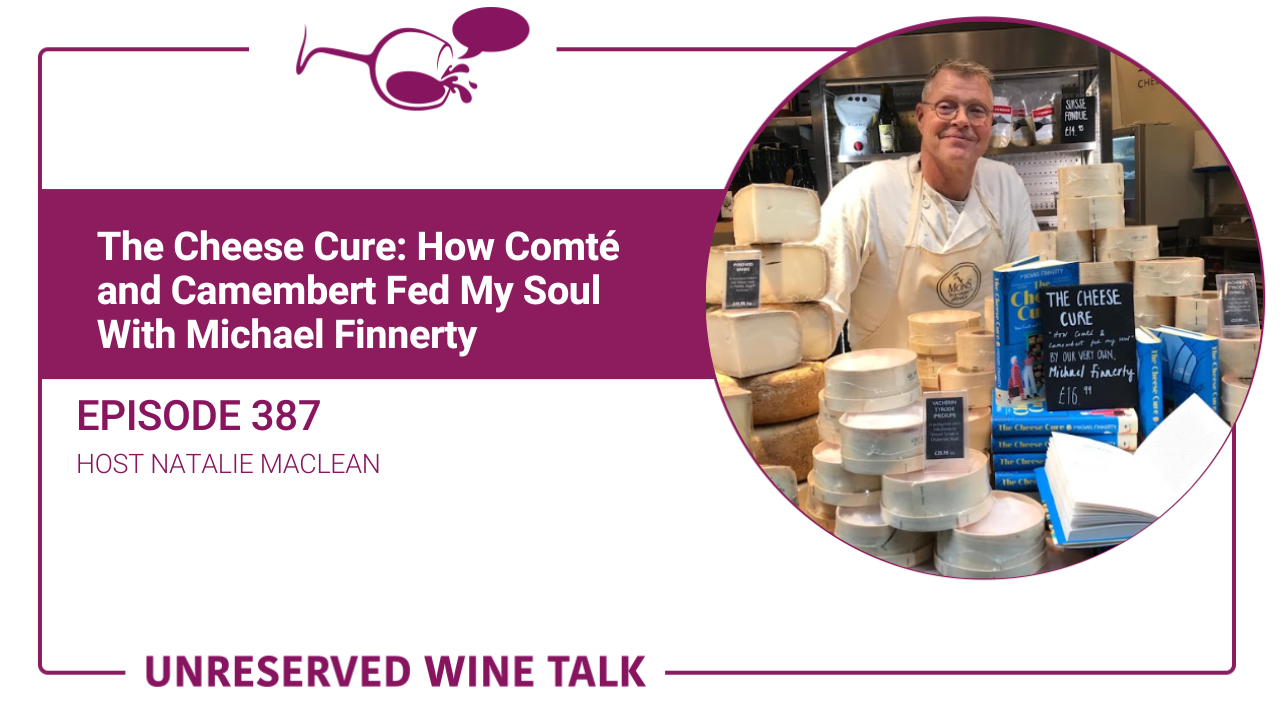
In this episode of the Unreserved Wine Talk podcast, I’m chatting with Michael Finnerty, author of the terrific new book The Cheese Cure: How Comté and Camembert Fed My Soul.
You can find the wines we discussed here.
Giveaway
Three of you are going to win a copy of Michael Finnerty’s new book, The Cheese Cure: How Comté and Camembert Fed My Soul.
How to Win
To qualify, all you have to do is email me at [email protected] and let me know that you’ve posted a review of the podcast.
It takes less than 30 seconds: On your phone, scroll to the bottom here, where the reviews are, and click on “Tap to Rate.”
After that, scroll down a tiny bit more and click on “Write a Review.” That’s it!
I’ll choose two people randomly from those who contact me.
Good luck!
Join me on Instagram, Facebook and YouTube Live Video
Join the live-stream video of this conversation on Wednesday at 7 pm eastern on Instagram Live Video, Facebook Live Video or YouTube Live Video.
I’ll be jumping into the comments as we watch it together so that I can answer your questions in real-time.
I want to hear from you! What’s your opinion of what we’re discussing? What takeaways or tips do you love most from this chat? What questions do you have that we didn’t answer?
Want to know when we go live?
Add this to your calendar:

Highlights
- Why do some wine and cheese pairings taste better together than alone?
- Why did a natural red wine collapse when paired with Camembert?
- How do acidity and bubbles transform rich cheese?
- How does cheese age differently from wine?
- Why do tyrosine crystals in aged cheese create both crunch and pleasure?
- Why can older cheeses develop surprising flavors like rum and raisin rather than simply becoming sharper or saltier?
- How do cheese appellations work, and why are names like Roquefort or Parmigiano legally tied to place?
- What is the difference between a cheesemonger and an affineur?
- How did Michael Finnerty’s midlife pivot from journalism to selling cheese begin?
- Why did selling cheese feel more meaningful to Michael than covering wars, elections, and other major news events?
- What makes Borough Market special beyond the food itself?
Key Takeaways
- Why do some wine and cheese pairings taste better together than either one alone?
- I had tasted a medium bodied wine with some nice minerality that also had some savoury notes and some citrusy notes and maybe a little bit of peach. As I said, a little bit of acidity, but not too round. And it what happened was when you paired it up with the Ossau-Iraty, which is quite, a higher fat cheese, because sheep’s milk has a higher fat content and can be quite sweet, sort of butterscotchy, biscuity. The two of them paired together, one lifted the other. And it wasn’t just me who thought so. People in the audience were really impressed. It was just that perfect example of how when you hit a pairing right, when you’re spot on, the wine is improved and the cheese improved. Both are lifted.
- Why do some wines collapse when paired with certain cheeses?
- So we were tasting a red. I can’t remember the name of the red, it was one of those cheeky names that you get from natural wines. It was bright and fruity. And then we had some Camembert. And Camembert is a big cheese and it’s a hard cheese to pair. It’s more pungent than Brie. For me, it has a real garlicky side to it. It’s always going to depend on where it is on its little journey in life. which is much shorter, obviously, than a bottle of wine’s. But when you get a Camembert that starts to get riper, it is going to have a quite a punch and quite a garlicky taste. With this natural red and Camembert, both started to taste not very nice to be honest.
- What else do you think wine and cheese share that might surprise us?
- First of all, if people didn’t realize that cheeses have appellations as well, which are granted based on applications that are made to a central authority. That comes with what the French call a cahier des charges, so kind of a manual on how to make the cheese. The first one having been in 1925, now there’s loads of appellations. And they’re not just French cheeses. Of course, things like Parmigiano are appellations as are raclette in Switzerland. You’ll get some cheeses that like, for instance, Brie. Those are going to be loads of Brie, but there’s only one Brie de Meaux, which is the appellation.
About Michael Finnerty
Michael Finnerty is a cheesemonger, journalist, and author based in both London, UK, and Montreal. After almost 30 years of success and acclaim working for the CBC, BBC, and The Guardian, he found joy and a new life selling cheese at London’s iconic Borough Market. Mike has a weekly column on Pénélope on Radio-Canada, works part-time at Global Montreal, but for most of the year, you can find him slinging cheese with the other mongers. Critically acclaimed, The Cheese Cure is his first book.
Resources
- Connect with Michael Finnerty
- Unreserved Wine Talk | Episode 92: Pairing Wine and Cheese Pairings Like a Pro with Laura Werlin
- My Books:
- Wine Witch on Fire: Rising from the Ashes of Divorce,Defamation, and Drinking Too Much
- Audiobook:
- Audible/Amazon in the following countries: Canada, US, UK, Australia (includes New Zealand), France (includes Belgium and Switzerland), Germany (includes Austria), Japan, and Brazil.
- Kobo (includes Chapters/Indigo), AudioBooks, Spotify, Google Play, Libro.fm, and other retailers here.
- Wine Witch on Fire Free Companion Guide for Book Clubs
- Audiobook:
- Unquenchable: A Tipsy Quest for the World’s Best Bargain Wines
- Red, White, and Drunk All Over: A Wine-Soaked Journey from Grape to Glass
- Wine Witch on Fire: Rising from the Ashes of Divorce,Defamation, and Drinking Too Much
- My new class, The 5 Wine & Food Pairing Mistakes That Can Ruin Your Dinner And How To Fix Them Forever
Tag Me on Social
Tag me on social media if you enjoyed the episode:
- @nataliemaclean and @natdecants on Facebook
- @nataliemaclean on Twitter
- @nataliemacleanwine on Instagram
- @nataliemaclean on LinkedIn
- Email Me at [email protected]
Thirsty for more?
- Sign up for my free online wine video class where I’ll walk you through The 5 Wine & Food Pairing Mistakes That Can Ruin Your Dinner (and how to fix them forever!)
- You’ll find my books here, including Unquenchable: A Tipsy Quest for the World’s Best Bargain Wines and Red, White and Drunk All Over: A Wine-Soaked Journey from Grape to Glass.
- The new audio edition of Red, White and Drunk All Over: A Wine-Soaked Journey from Grape to Glass is now available on Amazon.ca, Amazon.com and other country-specific Amazon sites; iTunes.ca, iTunes.com and other country-specific iTunes sites; Audible.ca and Audible.com.
Transcript
Natalie MacLean 00:00:00 Why do some wine and cheese pairings taste better together than either one alone? Why do some wines collapse when paired with certain cheeses? And what will surprise you about cheese in the way that it’s similar to wine? In today’s episode, you’ll hear the stories and tips that answer those questions in our chat with Michael Finnerty, author of the terrific new book The Cheese Cure: How Comté and Camembert Fed My Soul. By the end of our conversation, you’ll also discover how acidity and bubbles transform rich cheese. How cheese ages differently from wine. Why tyrosine crystals in aged cheese create both crunch and pleasure. Why older cheeses can develop surprising flavours like rum and raisin, rather than simply becoming sharper or saltier. The difference between a cheese monger and an affineur. How Michael’s midlife pivot from journalism to selling cheese began. Why selling cheese felt more meaningful to Michael than covering wars, elections and other major news events. And what makes London’s Borough Market special, beyond the food itself?
Natalie MacLean 00:01:21 Do you have a thirst to learn about wine? Do you love stories about wonderfully obsessive people, hauntingly beautiful places, and amusingly awkward social situations? Well, that’s the blend here on the Unreserved Wine Talk podcast. I’m your host, Natalie MacLean, and each week I share with you unfiltered conversations with celebrities in the wine world, as well as confessions from my own tipsy journey as I write my third book on this subject. I’m so glad you’re here. Now pass me that bottle, please, and let’s get started.
Natalie MacLean 00:02:03 Welcome to episode 387. All right, so what’s new in the drinks world? Well, a craft distillery in Scotland released a whisky matured in barrels that previously held hot sauce. And early tasters say the finish carries a faint, smoky heat that sneaks up on you rather than shouts. A collector in London set a new but strange record on April 16th by successfully sabring a bottle of Champagne, using nothing but a frozen baguette during a charity gala. Toronto’s Bar Raval and Vancouver’s Botanist Bar are observing a pivot toward hyper sustainable spirits, specifically those using upcycled fruit waste. I’m all for recycling, sustainability and so on, but I just don’t know how I’d feel about my cocktail having upcycled fruit waste. An eccentric collector in Bordeaux has reportedly completed a ten year project to build a full sized replica of the Eiffel Tower using nothing but empty wine crates, standing nearly three storeys tall in his backyard. The structure uses crates from every first growth chateau, arranged chronologically by vintage. The local city council is currently debating whether the structure constitutes a sculpture or an unlicensed storage facility, but for now it remains the world’s largest game of Jenga.
Natalie MacLean 00:03:34 And in the Science Corner. Did you know that yeast cells produce tiny amounts of glycerol as a byproduct of fermentation, and that glycerol is one of the primary reasons that wine feels round and smooth on your palate, rather than thin and sharp. Glycerol is technically a type of alcohol, a sugar alcohol, but it almost has no ethanol content and contributes no perceptible flavour on its own. What it does do is add viscosity and a subtle sweetness that softens acidity and tannin. Winemakers in warmer climates, where grapes ripen fully before harvest, tend to produce wines with higher glycerol levels. Naturally, this is one of the reasons that big ripe reds from Australia, California or the Okanagan can feel plusher than a cool climate Burgundy at the same level of alcohol. The yeast just made more glycerol in the heat.
Natalie MacLean 00:04:30 And one more scientific fact to thrill your inner nerd. There is a winemaking process called Flash Détenté, where grapes are heated to about 85°C then immediately sent into a vacuum chamber. This causes the grape skins to explode from the inside out. That sounds like implode, but whatever. Well, that sounds violent. The science is fascinating. It instantly extracts deep color and soft tannins without the need for weeks of maceration. The process of soaking grape skins in grape juice. It’s essentially instant aging through the power of a scientific pup, though the jury is still out on the quality of these wines versus those that undergo a traditional maceration. I also wonder if they have the same aging potential.
Natalie MacLean 00:05:22 For your food and drink calendar. This week, April 29th, is National Shrimp Scampi Day. This dish started as a Venetian preparation for scampi, the Italian word for langoustines. But when Italian immigrants arrived in the U.S. and didn’t find those crustaceans on the menu, they substituted shrimp and kept the name anyway. It’s one of the more successful rebranding in culinary history. To celebrate, try a scampi spritz by infusing dry vermouth with lemon zest and garlic for a savory pre-dinner sipper, or pair the dish with a bone dry, saline Vermentino to mimic the salt air of the Mediterranean coast. April 30th is both National Raisin Day and National Bubble Tea Day. It takes roughly four tons of fresh grapes to produce just one ton of raisins, which means your snack is essentially a concentrated vineyard in a tiny little box. Celebrate by pouring an aged Sherry, which is the ultimate liquid raisin, or mix a raisin infused rye whiskey into a Manhattan for a deep, oxidized twist on a classic. On the bubble tea side, the holiday is less about a single drink than an entire texture hobby, than an entire textual hobby, a community built around the particular joy of chewing on your beverage. Celebrate with a taro spiked milk tea mocktail, a black tea highball with tapioca pearls on the side, or a bubble tea inspired cocktail shaker race if you want your evening to feel like a chemistry lab with better shoes.
Natalie MacLean 00:06:58 May 1st brings International Sauvignon Blanc Day, held every year on the first Friday of May, and it was launched in 2010 by the New Zealand Wine Council. What most people don’t know is that Sauvignon Blanc is one of the two parent grapes of Cabernet Sauvignon, having crossed with Cabernet Franc sometime in 18th century Bordeaux. Celebrate with a blind tasting of Old World versus New World expressions. To see if you’re a Loire minerality person or a New Zealand tropical fruit person, pair them with goat cheese and fresh herbs, or try a backyard spritz built on citrus and fresh herbs. Saturday, May 2nd is the 152nd Kentucky Derby in Louisville. The Mint Julep has been the official drink of the race since the 1930s. Churchill Downs pours approximately 120,000 of them over Derby weekend, which requires 10,000 bottles of Woodford Reserve, 1,000 pounds of fresh mint and 60,000 pounds of crushed ice, roughly the weight of five adult African elephants deployed entirely in the service of keeping bourbon cold. The event’s official bourbon has been Woodford Reserve for years, an arrangement that costs Woodford’s parent company, Brown-Forman, a considerable sum in sponsorship fees to celebrate. Make your own mint julep, two ounces of bourbon – or a Canadian whiskey that’s made in the bourbon style – fresh mint, simple syrup, crushed ice, a sprig on top, and an imaginary bet on the horse with the best name. Go Flicker. Okay, that’s probably not the best imaginary name.
Natalie MacLean 00:08:46 May 3rd is International Baga day. Baga is Portugal’s sturdy red grape native to the region, and it tends to make wines with grip, nerve, and zero interest in being ignored. It’s tannic, high acid, and wildly food friendly once you give it a chance. Celebrate with a Portuguese red flight and a charcuterie board that leans smoky and salty, or a bring-th- weird-bottle dinner where everyone has to explain what they poured without sounding like they copied the back label. May 4th is National Candied Orange Peel Day. Candied orange peels were originally a luxury item in the 14th century, used as both a sweet treat and a digestive aid, so you’re basically participating in a medieval wellness trend. Garnish your drink with an oversized house-made candied peel or stir up an old Fashioned using orange peel infused simple syrup for a sticky, nostalgic aroma.
Natalie MacLean 00:09:39 It’s also, of course, a Star Wars Day. May the 4th. May the force be with you. Which means a galactic cocktail menu is technically mandatory for anyone who owns a lightsaber or a strong opinion about the prequel trilogy. May the 5th is Cinco de Mayo, the best known drinks holiday in this entire week and also one of the most misidentified. It marks Mexico’s 1862 victory over the French army at the Battle of Puebla, not Mexico’s Independence Day, which is September 16th. That clarification saves at least one group chat argument every year. Skip the standard margarita and build a botanica tequila, lime and cola stirred with the same knife used to cut limes for the crowd. A spicy, maquiladora style beer works beautifully, and a margarita station with absurdly specific salt options. Smoked Chile Hibiscus black lava is an instant conversation starter for the friend who treats rim salts like a personal manifesto.
Natalie MacLean 00:10:01 All right. Coming up next week, I am doing a… what do you call when you do… not a triple header is for three, but a four header, I don’t know. So I’m talking about Mother’s Day on four TV shows next week. So I’m going to share a couple of those with you now because Sunday, May 9th is Mother’s Day. Make a calendar note. And whether you were raised by a mother or another remarkable woman who shaped your life, you may be looking for a gift that goes beyond the usual flowers and chocolates. Well, on CTV’s CP24 Breakfast Show, we’ve got you covered. We’re pairing books and bottles for a thoughtful gift she’ll remember. Now, if mom says she doesn’t want a gift for Mother’s Day, she is testing you. It is a trap. Buy her a book and a bottle. Or safer yet, buy all of the wines I’m going to recommend. They’re perfect for both Mother’s Day hosting and gifting. Why books and bottles? Well, every great mom is a storyteller and every great wine has a story to tell. So I’ve matched each bottle with a book that mom will love. Sometimes by the country, sometimes by the author, and sometimes just by the spirit of the page itself.
Natalie MacLean 00:11:49 And here’s a thoughtful packaging tip. Wrap the book and bottle together in a beautiful linen tea towel tied with twine. It’s reusable, it’s pretty, and it doubles as a kitchen gift. Mom wins twice. My first pairing is the Bottega Il Vino del Poeti Venezia DOC Supmante Rosé from Veneto, Italy. We’re pairing this bottle with Eat, Pray, Love by Elizabeth Gilbert. The book is a celebration of la dolce vita, the Italian good life, especially through food and drink. Now the wine’s name, Il Vino del Poeti means the wine of poets, a tribute to artists who express the joy of life. Much like Elizabeth finds her spark again over a perfect meal. Crafted by Bottega, a family winery with four centuries of history. This Rosé is one of Italy’s most iconic sparkling wines. They have been making wine before Jane Austen was making sentences. The colour alone is visual poetry, a delicate blush pink with a fine, persistent stream of bubbles. On the nose you’ll find cherry, raspberry and wild blackberry, followed by a soft floral whisper. And because it’s a brut, it remains dry and sophisticated, never cloying. It’s exactly what you want in your glass when you’re reading about a life changing afternoon in an Italian café. Just imagine how magical this wine would be paired with grilled octopus or fresh caprese salad.
Natalie MacLean 00:13:015 Next up, we have the gorgeous Villa Maria Private Bin Sauvignon Blanc from Marlborough, New Zealand, and it pairs beautifully with The Luminaries by Eleanor Catton, the Booker Prize winning novel set in 1860s New Zealand. The combination captures a spring moment of relaxation, reflection, and connection. This wine is the elegant extra and what mum deserves on her special day. Villa Maria is one of New Zealand’s most respected wineries, and Marlborough is the Sauvignon Blanc capital of the world. The 2025 vintage of this wine just won a gold medal at the Concours Mondial de Brussels. That’s like winning the Sauvignon Blanc Olympics. This is classic Marlborough style, bursting with lime zest, lemongrass, grapefruit and a hint of passionfruit. It’s bright, it’s vibrant, and it finishes with a crisp snap that wakes up every taste bud like opening a window to a spring afternoon after a long, dreary winter. How dreamy this would be with seared scallops and capers.
Natalie MacLean 00:14:24 Next up, we have two classics, Anne of Green Gables by Lucy Maud Montgomery and Beach Glass White by Sprucewoods Shores Winery. They are both unmistakably Canadian, and both reveal their charm in layers, the way Anne uncovers her family, one chapter at a time. Beach Glass is made at Ontario’s only beachfront winery, and named for those smooth, sea tumbled pieces you’ll find on the beaches of Lake Erie North shore. The wine is a blend that leads with Riesling for a bright top note then folds in Pinot Grigio for its softer pear and melon side. Like mom’s best advice, it shines in the sun and reveals its polish with a little time. In other words, she was right. You’ll smell clean, fresh aromas of grapefruit, lemon curd and a cool whisper of sea spray on warm stone. On the palate, it’s layered like a fresh Canadian spring morning crisp at the start, sunny in the middle with a soft mineral breeze on the finish. It tastes like optimism, but with structure this it would be wonderful with a citrus glazed salmon warm off the grill.
Natalie MacLean 00:15:33 And for our final pairings we have French Bloom. The first is French Bloom Le Blanc, which appears beautifully with My Life in France by Julia Child. A joyful memoir. Julia found her calling in France, learning to cook with curiosity and zero pretension. French Bloom Le Blanc carries that same joie de vivre. Both the book and the bottle are deeply rooted in France, and both are perfect for elevated, mindful living. French Bloom is an alcohol free sparkling wine created by founders Constance Jablonski and Maggie Frerejean-Taittinger. It’s crafted from organic Chardonnay grapes grown in Limoux in the south of France, and was named the world’s best alcohol free sparkling wine for the past three years at the World Sparkling Wine Competition. It’s also just been named the official non-alcoholic sparkling wine for Formula One for the next decade. Most remarkably, it’s matured in new French oak barrels, which is almost unheard of in the alcohol free world. It opens with a lovely citrus zest and crisp pear on the nose, and then comes in with a creamy, silky texture which rolls across the palate with hints of honey and beeswax. It finishes with that elegant saline note you’d expect from a fine French sparkling wine. How elegant this would be with fresh oysters and a squeeze of lemon.
Natalie MacLean 00:16:58 I also have French Bloom La Rosé, a blend of organic Chardonnay and Pinot Noir. Like Le Blanc, it is also certified organic, vegan and halal, with no added sugars, sulfites or preservatives, and just 19 calories per glass. 19 calories is basically a rounding error. You’ll burn more than that just getting up and going over to the chiller ice bucket to pour yourself another glass. Mum can enjoy this celebratory pour at brunch or dinner or both. On the nose, you’ll pick up wild strawberries and rose petals first, then white peach and a pop of red currant. The bubbles dance lightly across the palate, finishing soft, silky and refreshing. Wouldn’t this sing alongside a bowl of chilled gazpacho swirled with basil oil? So here’s to the quiet magic of a glass and a page into the woman who taught us how to appreciate both.
Natalie MacLean 00:18:03 Also talked about Mother’s Day wines on City TV’s Breakfast Television. Completely different approach, though. This time Mother’s Day is coming up. And whether you are raised by a mom or by another special woman who shared her wisdom along the way, we all know that she isn’t just a parent, she’s a one woman superhero squad. Yes. So today, we’re toasting her invisible talents with five drinks that match her superpowers sip for sip. Mom’s powers truly are supernatural. Faster than a speeding text chat. Gifted with supersonic hearing that detects a cookie jar opening downstairs and able to glide past a sulky teenager in a single bound. Every one of her superpowers deserves a drink and a Marvel movie. We’re kicking it off with Smirnoff Ice Lite Original made in Quebec for our time traveler mom. She can stretch a 30 minute dinner into a three hour conversation, turn a five minute hug into a full soul reset, and remember exactly when you last called grandma. Smirnoff Ice Lite has that same time bending magic with its gentle fizz and just 4% alcohol that makes the evening linger longer. The lite version keeps all of the refreshment, but with a third fewer calories. On the nose, you get bright lemon and lime the kind of zest that spritz up a sunny afternoon. This sip is crisp, fizzy, and refreshing. It’d be lovely with crispy fish tacos on a warm patio. And I should note that all of the drinks were tasting today are available in the LCBO.
Natalie MacLean 00:19:21 Next up is oyster Bay Pinot Grigio from Hawke’s Bay, New Zealand to toast mom, the finder of lost things. In 30 seconds, she can locate a single sock under Mount Laundry, the TV remote that vanished into the sofa cushions, and the truth in a teenager’s story. Oyster Bay has its own kind of finder energy. Their winemakers go vineyard parcel by parcel, picking out the freshest, purest fruit flavours and bottling them before a single note gets lost on its way from vine to glass. What makes Oyster Bay stand out is the regional designation on every label. Well, many New Zealand brands blend fruit from across the country. Oyster Bay tells you exactly where each wine comes from. This Pinot Grigio is 100% Hawke’s Bay, captured in their state of the art facility in the heart of the region. It’s the boutique craftsmanship of a small estate paired with the reach of a global producer. This wine pours pale gold with a hint of green on the nose, its crisp pear, white peach and a whisper of lemon blossom. The palate is refreshing, with a citrus edge and a firm backbone, which is exactly why mum loves it so much. It’s the wine that turns a quick supper into a whole evening, and it would be brilliant with a creamy lemon linguine with sweet dungeness crab.
Natalie MacLean 00:20:48 For our third wine, we’re heading to the south of France with Gerard Bertrand’s Gris Blanc Rosé. Our wine for mum, the heart healer. She has this quiet magic where one hug, one cup of tea, one perfectly timed snack can make everything better. This Rosé has that same gentle comfort. Gerard Bertrand was a professional rugby player before taking over his vineyard at age 22. Today, he runs more than a dozen estates across the Languedoc, and he’s a leading voice in biodynamic wine, making the highest level of caring for Mother Earth. This wine pours pale petal pink, light as a blush. The aromas open with white peach, pink grapefruit and a soft floral lift on the palate. You get fresh strawberry, red currant and a citrus zip that finishes dry and refreshing. It’s a glass of sunshine that softens the edges of any day, and it would be irresistible. Next to grilled rosemary lamb skewers charred and dripping in olive oil.
Natalie MacLean 00:22:03 And finally, we’re coming home again with Joie Farm’s En Famille Chardonnay from BC’s Okanagan Valley for the amazing memory, mom. She remembers every milestone, your favourite meals, and that one thing you said in 2009 that you conveniently forgot. This Chardonnay holds memories in the same way you’ll always remember where you were the first time you tasted it. It’s so good. Joie Farm En Famille is French for joy with family, which makes this a beautiful Mother’s Day wine. The fruit comes from the Kavita and Seacrest Mountain vineyards. Kavita sits on the Skaha Bench sub-appellation, one of BC’s newest and most exciting additions to the wine map. Winemaker Richard Charnock does ambient ferments, which means no commercial yeasts and no shortcuts. He lets the land and the grapes do the work, the opposite of helicopter parenting. His methods have paid off. The 2022 vintage took silver at the Chardonnay du Monde, the world’s largest Chardonnay competition. His mother is so proud of him. On the nose, you get lemon curd, white peach, ripe mango and a soft hint of creme brulée. The palate carries citrus and stone fruit into custard and tropical notes, with a fine mineral thread, and about 20% new oak supporting the fruit rather than smothering it. The finish is long, elegant, and built to age. This is the Chardonnay that converts the ABC crowd – anything but chardonnay away with you. They arrived skeptical. They left converted. And this Chardonnay would be heavenly paired with pan seared scallops in a brown butter lemon sauce.
Natalie MacLean 00:23:49 I also have the Joie Farm Pinot Noir, a gorgeous red now also available in Ontario. Of course, you can order these wines from the winery itself, and you lucky ducks are in BC and have these wines on your shelves all the time. This is a generous fruit forward Pinot with a round, silky smooth texture. And this is the wine you want to drink tonight even before dinner is on the table, possibly even before you’ve decided what dinner will be. Or maybe you just decide to skip dinner and drink this wine. Elegant and expressive, this Pinot opens with bright cherry raspberry jam and a touch of cinnamon lifted by notes of small, little tiny violets. This would be divine with Pacific Coast cedar plank salmon.
Natalie MacLean 00:24:36 So here’s to mum, the only superhero who works without a cape or a vacation, but who always saves the day. On Instagram, I’m at Natalie MacLean Wine. Come for the drinks. Stay for the heroic pairings. Back to today’s episode. Congratulations to Carol Cross from Ontario who has won a copy of Pressing Matters. I still have one copy left to give away, and three of you will win a copy of Michael Finnerty’s terrific new book, The Cheese Cure: How Comté and Camembert Fed My Soul. If you’d like to win a copy, please email me and let me know who you’d like to win. It doesn’t matter where you live, I’ll choose four winners randomly from those who contact me at [email protected]. Keep them for yourself or give them as gifts. If you’re reading the paperback or e-book or listening to the audiobook of my memoir, Wine Witch on Fire: Rising From The Ashes of Divorce, Defamation, and Drinking Too Much, a national bestseller and one of Amazon’s Best Books of the year, I’d love to hear from you at [email protected]. I’ll put a link in the show notes to all retailers worldwide at nataliemaclean.com/387. Okay, on with the show.
Natalie MacLean 00:25:54 Michael Finnerty is a cheese monger, journalist and author based in London, England and Montreal. After almost 30 years of a successful career with the CBC, BBC and The Guardian, he found joy and a new life selling cheese at London’s iconic Borough Market. Michael also has a weekly column on Penelope on Radio Canada, works part time at Global Montreal, but for most of the year you can find him slinging cheese with the other mongers. His critically acclaimed book, The Cheese Cure, is his first book and he joins us now from his home in Montreal. Welcome, Michael. We’re so glad to have you here with us.
Michael Finnerty 00:26:33 Hi, Nathalie. It’s great to be with you. And thanks very much for inviting me.
Natalie MacLean 00:26:38 My pleasure. Before we dive into your book, let’s start with some of your more memorable wine and cheese moments. Maybe tell us about the tasting you did with the UK author and TV personality Ali Smith.
Michael Finnerty 00:26:51 Yeah. Olly Smith, who is a big booster of the book, is also represented by my agent in the U.K.. He thought it would be a great idea if we did an event together where we invited people to taste through some cheeses paired with some wines. So I chose the cheeses and he chose the wines to go with them, and it was fantastic. He’s a performer. It was a terrific night. People had a great time. It was in an old bookshop on Piccadilly in London. For a sheep cheese that I had chosen, which is called Ossau-Iraty, which may be one of the, if not the oldest, one of the oldest cheeses made in Europe, he chose a Chardonnay called Neudorf Home block Chardonnay.
Natalie MacLean 00:27:38 From New Zealand.
Michael Finnerty 00:27:40 From New Zealand. Yeah, from New Zealand. Up front, I’m going to say I bow down to all of those of you who are wine experts and drinkers. I am certainly not as well-informed as probably most of you on wines, but for me, I had tasted a medium bodied wine with some nice minerality that also had some savoury notes and some citrusy notes and maybe a little bit of peach. And that what’s happened was when you paired it up with the Ossau-Iraty, which is quite a higher fat cheese, because sheep’s milk has a higher fat content and can be quite sweet, sort of butterscotch biscuits. Why the two of them paired together? Well, just lifted one, lifted the other. And it wasn’t just me who thought so. People in the audience were really impressed. My agent was like, I can’t believe how delicious this is. And it was like just that perfect example of how when you hit a pairing right, when you’re spot on, the wine is improved and the cheese improved. Both are lifted.
Natalie MacLean 00:28:45 Yes. New cloud of sensuality. They kind of meet together and neither one could really do it for you as much as the combination.
Michael Finnerty 00:28:54 Absolutely. And when it when you get it right it tends to be a surprise even though you know it can happen. And I also always think it’s one of those ephemeral things that this will never happen again. You’ll have good pairings again, but you’ll never get quite this pairing because on one hand, the wine probably won’t be exactly the same the next time you have it, and definitely the cheese won’t be.
Natalie MacLean 00:29:17 That’s true. And had you coordinated in advance? Seize life in all its possible combinations. But had you coordinated with Olly, did you know which wine he was bringing? Did he know what cheese you were selecting?
Michael Finnerty 00:29:30 He knew what cheese I was selecting. And then he went to the pairings. Okay, probably that’s the best way to do it, because I think he’s smarter than I am.
Natalie MacLean 00:29:41 Well, I always start with the wine first because I’m an earrings first kind of woman and then the outfit can follow. But it’s all about priorities no matter where you’re at. Now you also had a staff pairing tasting evening where you had a red wine and you were enjoying it until you paired it with Camembert. What happened?
Michael Finnerty 00:30:02 So what happened was, so this was a staff tasting, and we were tasting with the representative of the company that sells a lot of our wines. To set ourselves apart from other wine merchants on the High Street where our shop is based, but also in Borough Market, we go for a selection of organic and biodynamic and natural wines so as to have a thing. So we were tasting a red. It was, I can’t remember the name of the red. It was one of those cheeky names that you get from natural wines. And it was bright and fruity. And then we had some Camembert and Camembert is a big cheese and it’s a hard cheese to pair.
Natalie MacLean 00:30:51 It’s really flavourful, like I – because I don’t know anything next to you when it comes to cheeses – I always think of Camembert, Brie. I always think, oh, they’re all creamy and soft, but Camembert is really quite flavourful and pungent of the soft cheeses.
Michael Finnerty 00:31:08 For me, it’s more pungent than Brie. It has a real garlicky side to it. It’s always going to depend on how long where it is on its on its little journey in life, which is much shorter, obviously, than a bottle of wines. But when you get a Camembert that starts to get riper, it is going to have quite a punch and quite a garlicky taste. And what happened was that we were tasting the wine there after we spoke, after we tasted the cheese and something just started to be. It didn’t taste the same. And I guess kind of the same but negative way of what I just said about the Ossau-Iraty and the Chardonnay with this natural red and Camembert both started to taste not very nice, to be honest. And she said, okay, wow, that has made the wine go mouse, I hadn’t heard the term before. My wine knowledge, as I’ve said, is not as advanced. And apparently mouse is more of a recent taste flaw and more associated with natural wines, organic wines, biodynamic wines. It gives you a taste of kind of a guinea pig cage or a wet tortilla chip. Yeah, not so nice. Okay, we can all agree that’s not what we want in wine. And we all came to the conclusion, and I’d be interested to know what your folks think about this, but we all came to the conclusion that Camembert and wine, maybe not the best combination. And maybe what’s best with Camembert is like an ale or a slightly bitter cider so that you don’t have. It’s just it’s something is rubbing it the wrong way in terms of the grapes and the wine.
Natalie MacLean 00:33:02 Yeah. And I would say especially a fruity young wine, natural wine that has sometimes foxy or really funky flavours might just be a really bad match. I’m almost thinking for creamy. Maybe it’s too stereotypical, but creamy, I would veer toward bright, white, acidic wines that cut through the richness at least.
Michael Finnerty 00:33:24 Absolutely bubbles, too. One of the classic combinations with Brie is Champagne.
Natalie MacLean 00:33:31 Oh, yeah. That would be great.
Michael Finnerty 00:33:31 Because the bubbles and the acidity cut through the creaminess.
Natalie MacLean 00:33:35 Yes. absolutely. So you just mentioned something interesting. Cheese has a shorter age ability or trajectory than wine, so I know it’ll vary widely depending on the cheese.And of course, fresh cheeses like goat cheese or whatever you want to serve fresh and young, just like some wines like Beaujolais. But how old can the longest live cheeses go for? What is their life?
Michael Finnerty 00:34:01 Clearly, a Camembert is not a cheese that you will ever eat aged. When we talk about an aged Camembert or a mature Camembert, it’s not going to be more than a couple a few months maximum. But if you have an alpine cheese, then you’re going to start to get into some significant aging. We tend to sell the alpine cow’s milk cheeses around 18 to 24 months. We think that’s a really nice age, where you get a combination of the kind of moisture you like in the taste versus as cheese starts to age, people think that it develops salt crystals. Those are actually tyrosine crystals and they give it a bit of a crunch.
Natalie MacLean 00:34:45 What are they? Are they like calcium or what are they or salts?
Michael Finnerty 00:34:49 What happens with the fats in the milk as the cheese ages, as they break down into an amino acid and form these tyrosine crystals. So it’s not salt. It actually is supposed to give you a dopamine hit, amongst other things. Yeah. Which I guess, it matches up with the slightly addictive quality that you get in good wines too, right? Like cheese is hard to stop eating when it’s good. It’s good.
Natalie MacLean 00:35:15 Yes.
Michael Finnerty 00:35:15 So yes. So then you can get a cheese that will be 24 months. We sell counties as well, up to 36 months. You’ll get Parmigiano that are even older than that. Once you start getting past sort of three years, four years, it’s going to be quite. Some cheddar’s, by the way, are going to be that old as well. But hey’re going to tense up, they’ll lose their moisture and they’ll be more or less they’ll be less give in the mouth that’s for sure. But you might also get some really unexpected flavours. The flavour definitely changes over time.
Natalie MacLean 00:35:50 Into more negative flavours as it gets too old?
Michael Finnerty 00:35:54 It’s a balance. Like for instance, with Comté, if you’re tasting an 18 to 24 month old Comté, you’re going to get some of those nice, sweet, nutty notes. And then as you get into 36 month Comté, it starts to have, for me anyway, a really kind of rum and raisin vibe. I don’t know quite why that’s happening. I mean, there are just endless mysteries with cheese. Why is a cheese doing a certain thing? You can always give it a stab. You can try to figure out why it’s doing it, but it’s it’s often just a marvellous mystery.
Natalie MacLean 00:36:27 Yes. And a delicious one. So sometimes it doesn’t need to be picked apart. But that’s fascinating because there’s trajectories, of course, for wine as well. And there’s some similarities in that the fruit goes from fresh to more ripened, to stewy to prune to, you know, that kind of trajectory. As we know, wine and cheese both start as natural liquids before they’re fermented. They’re aged into a dizzying range of styles and flavours. Beyond those obvious parallels, what else do you think wine and cheese share that might surprise us?
Michael Finnerty 00:37:00 A lot of things. To be fair, I think that when we. First of all, if people didn’t realize cheeses have appellations as well, appellation which are granted based on applications that are made to a central authority that come with what the French are. So kind of a manual on how to make the cheese. The first one having been Roquefort in 1925. Now there’s loads of appellations, and they’re not just French cheeses. Of course, things like Parmigiano are appellations, as are Raclette in Switzerland.
Natalie MacLean 00:37:39 So does that mean only that appellation can use that name, like Parmigiano should only be from that place. There shouldn’t be a California Parmigiano, so to speak.
Michael Finnerty 00:37:48 Exactly. You’ll get some cheeses that like, for instance, Brie. Those are going to be loads of bries, but there’s only one Brie more, which is the appellation. And same with cheddar because cheddar is so widespread that by the time they started coming up with the appellation, there was no, by the way, appellation in English designated origin controller. So when they were starting to think about what to do with, for instance, cheddar, it was just decided there was way too many people were making it. You couldn’t suddenly say only this right type of cheese, Cheddar.
Natalie MacLean 00:38:27 It’s the old tissue Kleenex dilemma. They didn’t protect it soon enough.
Michael Finnerty 00:38:33 Yes, exactly. So there’s that with wine and cheese. There’s also the question of terroir, which very much affects a cheese where it comes from. It’s also included in the appellation. So for instance, Roquefort will only be from sheep milk from sheep who are raised in this one part of the Aveyron in France. Another similarity that maybe people don’t think about as much is that milk has different varieties, in the same way that grapes have different varieties because they come from different cows. Certain cheeses I’m thinking of so far where the the milk has to be one of Montbéliard is one of the milks. That’s a type of cow, a variety of cow. So that’s stipulated in the Cahiers des Charge how that cheese made that the milk must come from this cow, which is eating in a certain place. So the milk has the flavours of that place, that terroir and what grows there. Different cows supply different types of milk. Some is has higher fat, some has different tastes.
Natalie MacLean 00:39:38 I never thought about the differences of different breeds of cattle. I know sheep and goat and cow all produce very different cheeses. But you’re right. Different types, different breeds of cattle. And of course, what they’re feeding on, whether that meadow has a lot of flowers or types of grasses or whatever, is also part of the terroir of the cheese.
Michael Finnerty 00:40:01 The cheeses will also have a category called el page. El page mean you see the word help in el page. It means that the cows or whatever animal they’re making cheese from are grazing at higher elevations. And when you’re grazing at higher elevations, obviously the different plants and grasses that are there, there’s a greater variety. There’s different things than you would see down in the valley. And so you’ll get a different quality of milk and different tastes.
Natalie MacLean 00:40:33 Again, another parallel because we talk about high altitude wines. Like when they’re planted higher, they get a different kind of disposition to the sun. Wow. I didn’t know that.
Michael Finnerty 00:40:44 There are so many things that match up. And there’s this world of knowledge about cheese, which I believe is the case with wine, that I almost feel that I can. I could never finish learning about cheese.
Natalie MacLean 00:40:59 Exactly, exactly the way I feel about wine. I always feel like a beginner, but still interested.
Michael Finnerty 00:41:05 Absolutely.
Natalie MacLean 00:41:06 And are there any surprising differences that might not occur to us?
Michael Finnerty 00:41:11 I mean, I suppose one of the big differences is that cheese is high protein. It’s not really surprising, is it? I don’t know if it’s a foodstuff. So it will nourish you. It will happen.
Natalie MacLean 00:41:25 So there is real nutrition.
Michael Finnerty 00:41:27 Absolutely. And good nutrition. And the kind of it’s good for your bones. It’s got high protein. The other surprising difference with cheese is how broad the range of acceptable tastes is. Correct me if I’m wrong, but I don’t think that’s the case with wine. There are going to be some tastes in wine that that you’re going to think that is not nice to drink thank you very much. And no thank you. But, if you think of cheese, there are some cheeses that taste farm-y, like farm
Natalie MacLean 00:42:04 Yes. euphemistically.
Michael Finnerty 00:42:06 sSme people will say, and there are some that taste like those parts of your body that are maybe not as carefully washed as they maybe as maybe should be. And that’s because they share the same bacteria. And so I think that is quite an important difference. We can talk about that more about why people are drawn to those tastes. But for me that’s a quite a big difference between wine and cheese in that you wouldn’t want your wine to taste like that.
Natalie MacLean 00:42:38 I think it’s the old British saying up to a point. So we will have wines say in Burgundy that are affected by Brettanomyces or Brett, which can get that barnyard smell. But if the wine was overtaken by that barnyard smell, we would say it’s faulted. Just like we would say like we have the flavour and aroma wheels, as I’m sure you do for cheese. But I think that many we slip into the faulted category far more easily than it sounds than cheese like when it comes to wet dog and tortilla chips, which wet tortilla chips, I can’t get out of my head.
Natalie MacLean 00:43:25 On the side of guinea pig. Yeah, so that’s great, I love those. The similarities and differences is really illuminating. Can we also talk about the difference between a cheese monger and an affineur, if I’m saying it correctly? Affineur? Yes. Is it correct? It’s like the relationship between a high end wine merchant and a cellar master. One’s kind of raising or sculpting the product. The other is really focused on selling it.
Michael Finnerty 00:43:49 I think that’s mostly it. I love the word affineur, by the way. And the closest translation that exists in English is mature which is a lot of hours, but it’s not at all the same translation because it’s actually quite a simple French word to understand whether you know French or not, because it comes from the word fine, which is fine. So if you and the verb affiner. So if you’re in the, as a verb, making something finer. So that’s what it is an affineur. So you’re making this cheese taste better. Basically you’re making it you’re bringing it up to its potential. Yeah exactly. Whereas a mature you’re maturing it which is not quite the same. It doesn’t have that same idea of of bringing it up. So a cheese monger is meant to do. I think a little bit of the affineur job. And so we will we have direct contact with the cheeses at point of sale. So we’re at a point of sale I would say, although some of my colleagues are more on the affineur side. If they’re back in the caves we have caves. So they would maybe have more of that side to the job to them, but then they might call themselves affineur, you know, or you might want to call them that. Cheese monger is definitely one of those great British words. And there’s a fishmonger. There are mongers. I mean, it has that sense of of selling them. Of cutting them, of preparing them. Of making them look their best. So it’s a it’s a bit of one and a bit of the other. And it’s certainly one of the big jobs, even at the borough market stall is to ensure that the cheeses are at their very best. And to think every morning as you take them out, get them up from their beds in the morning and take them out. To be displayed is to think, what can I do to make you better today?
Natalie MacLean 00:45:38 I love that. So maybe we can finally now move on to your book. Tell us in a nutshell what the Cheese Cure is about. It’s your story, but it’s got cheese in it. It’s got all kinds of really delicious information. So how would you describe it? You’ve got the book there.
Michael Finnerty 00:45:55 This is the UK edition. It’s pretty. This is the Canadian and American edition. The book is about my later in life pivot from a career in journalism which I loved, and instead of going into retirement, or I’m still a bit young to go into retirement, although I mind. I decided to go into to cheese. It just it sort of chose me while I was on a sabbatical. So the the book is about how I took a break from doing my job as an early morning radio show presenter and my radio show host on the CBC in Canada. Before that, I had worked for the BBC and The Guardian. It was a lot the job, after several decades of doing it, and it had sort of eaten my life, that job, and I felt that I needed a change, a break. It started off as a sabbatical. I asked my bosses if I could have six months off unpaid, and I got them. And off I went to London where I did used to live. I used to work in London for the BBC and the Guardian. I decided I couldn’t just hang out for six months. I had to do something. I’m that kind of person that likes to be doing something. And I love borough markets, have always loved Borough Market. They were advertising for a cheese monger. I thought, what is a cheese monger? So I applied for the job and got it. And the book is that story. So it tells the story of me having taken that journey. And it is also very cheesy. So throughout the entire book, we spent a lot of time with the cheeses and a lot of time with the cheese mongers. It’s meant to be uplifting. It’s meant to be fun.
Natalie MacLean 00:47:58 It is, it is. It’s beautifully written. And I mean, there’s your story, which is terrific. A lot of people will relate to that mid-life shift or pivot. But also if you want to learn about cheese, all these little cheesy goodness bits of those little crystals are little nuggets are woven in between. So it’s terrific. I highly recommend it. What is the most surprising insight that you discovered while writing the book?
Michael Finnerty 00:48:27 So look, the book is, on one hand, this personal journey. So there were a lot of surprising insights to me when I discovered that my life wasn’t exactly where I wanted it to be at that point. And I think these things are things that sometimes we don’t grasp in the day to day because we have things to do. We have families. We have obligations. The wheel keeps turning. Weeks turn into month turn into years. And how often do we really take stock. That’s a big theme in the book. And so an insight to me, a big insight to me was that we take stock of wine, we take stock of cheese on a regular basis. We taste it. In wine, you will taste it from the barrel. You’ll also taste it if you’re selling it. And cheese will stick a cheese iron into the cheese and pull out a cylinder and taste it. But how often do we really do that in our own lives? To extend the metaphor, do we sit down and say, well, how am I tasting right now? Am I tasting delicious or am I a little bit sour, a little bit bitter, a little bit bland, a little too boring.
Natalie MacLean 00:49:46 Too long in the cave.
Michael Finnerty 00:49:47 Too long in the cave. Too long cut from the wheel, all that sort of thing. So I would say on the personal end, there’s that. And then on the cheese end, my goodness, the insights. Which were all a result of the book. But also later on when I was working on. So each chapter has a little bit about a specific cheese at the end of it. And so I did a lot of research and I could not I should have known but the history of cheese to me is fascinating. And how long it goes back and the role that it played. And I’ll give you a for instance. There’s a blue cheese called Fourme d’Ambert, which I found a quote for, which came from a general talking about an army and how an army was more effective if they had a piece of Fourme d’Ambert in their satchel.
Natalie MacLean 00:50:42 Ha ha. That’s great, I love it. Yes, again, the parallels with wine. It’s a great way to structure the book and to learn more about wine or sorry, cheese. What was the most difficult part about writing the book? What was the greatest challenge?
Michael Finnerty 00:51:00 One of the greatest challenges was finding the time because I was working throughout, working and I didn’t quit my broadcasting job either. Writing takes time. It takes focus. You have to have the right environment. I think you have to be patient with yourself. Writing takes a while. I didn’t realize any of this, so that was a bit of a surprise. And I suppose the other big challenge was having not written anything before. I was a neophyte to the whole idea of narrative structure. Even though I’ve spent my whole life telling stories in journalism, I think intuitively knew how to tell a story. But I had a great session in a week. There was a writing foundation that allows you to go into the English countryside for a week with a bunch of people who have a manuscript that they’re kind of working on, and we all sat around and read each other’s stuff, and it was so eye opening. And it really got me over a hurdle of wondering what I would do with all these notes that I’d made.
Natalie MacLean 00:52:09 That’s great. Now, going back to your journalism career, you were in New York immediately after 9 / 11 and covered elections in Russia. Having witnessed these major world events, what made serving cheese at Borough Market feel significant to you?
Michael Finnerty 00:52:26 It’s a good question because I think that people are there. There are people. I have people in my orbit who are thinking, why did you do this? And why is this the next act in your career? And I suppose because, you know, those events are big events. And having been in Manhattan in the days after 9 /11, that will stay with me forever. And that was important work. But if we really focus on what makes the world a better place, cheese makes the world a better place. It does make the world a better place. It feeds you. It delights you. And when you sell it, you delight others. And I have taken a lot of enjoyment and my own personal delight from helping people discover cheese and my interactions at the cheese store, compared to my interactions in the journalism world, are 98% positive. Whereas as a journalist, you are sort of a monger of misery. A lot of the time, I mean, there is such a thing as good news, of course, and things that are making a positive impact in the world. But let’s face it, a lot of the time we’re talking about war. Certainly right now we’re talking about war. We’re talking about difficulties and how to overcome them. Political difficulties, in business and in tech, whatever. And that’s it. Cheese is about making you happy and making your taste buds surprised and explode. If you have a great cheese, you feel like you’re almost elevating. And I think the same is true of wine. And so that’s a fun business to be in.
Natalie MacLean 00:54:23 Yes it is
Michael Finnerty 00:54:23 That gave me a lot of joy.
Natalie MacLean 00:54:25 Absolutely I can I so resonate with you because I used to feel guilty. I wasn’t, you know, doing missionary work somewhere, and I thought, oh, I’m helping the helpless rich find their next Bordeaux. But, you know, I mean, we all work hard in whatever it is we do, but it comes down to those moments when we start to reconnect with others, with ourselves, with pleasure. And just the I don’t know what life’s about.
Michael Finnerty 00:54:55 Otherwise, around a glass of wine, around a cheese board, we’re all experiencing something that is positive. That is making us happy. And yes, I mean, if there aren’t these sorts of moments in life, what’s it about?
Natalie MacLean 00:55:09 Yes, exactly. Exactly. And now you also describe the toll of morning radio, which you alluded to. Waking up at 3 a.m., are eating lunch at 8:30 in the morning and then having to go from extrovert to introvert by mid-morning, or the collapse into back into introvert. What kind of fatigue eating did you do in those days before you entered the wonderful world of cheese?
Michael Finnerty 00:55:34 It was not a thing I am proud of. Let’s say it’s a start. And it took me a while to kind of get on top of it. When you were tired, when you were exhausted, if you were watching this or listening to this, and you have the type of job where you are working night shifts or difficult hours, you’ll know that you get the sense of being worn down and fatigued. People who have a new child, I’m sure, feel the same as well. And you’re looking for compensation, and the compensation is what was for me in the fridge. So I would open up the fridge and I would just like what is there. And instead of having one of a certain thing, I would say I should probably finish this package.
Natalie MacLean 00:56:21 Why not.
Michael Finnerty 00:56:22 Otherwise, it will go bad.
Natalie MacLean 00:56:25 That’a right. Yes.
Michael Finnerty 00:56:27 Exactly. Yeah. So, one thing leads to the other. I think I was. What I wasn’t doing in those not so great years as I wasn’t clearly preparing something to eat. I was sort of just.
Multiple Speakers7 00:56:41 What was there.The body has got to…
Michael Finnerty 00:56:43 What’s going to make me feel better?
Natalie MacLean 00:56:49 Now, you grew up in Canada with industrial produced blocks of bright orange cheese wrapped in heavy plastic. Individually wrapped slices for hamburgers and Cheez Whiz, as you say. How does that childhood memory inform how you interact with cheese skeptics today?
Michael Finnerty 00:57:06 So yeah, I mean, coming from my experience growing up. So I was born in the late 60s, Gen X, the cheeses that we had available to us where I grew up, which was mostly in London, Ontario, were those kinds of cheeses. So I am not in a position to look down on anybody’s cheese choices, which I think is important when you’re mongering, when you’re trying to suggest what a person might enjoy or when you have a skeptic in front of you who is looking at these sort of very strange, moldy cheeses thinking what’s that? And I can I guess I can put myself in their shoes quite easily. And I also feel that having made that journey myself, I get a lot of enjoyment out of seeing other people start off on that journey, because I know that they too will end up. And it’s surprising and a very cool place, which is a place of like discovery of tastes you didn’t know existed and you didn’t know you enjoyed.
Natalie MacLean 00:58:20 Sure, sure. Yes. Resonating again with your answer. Now, Borough Market is London’s most renowned food market, located near London Bridge. Operating for more than a thousand years, it spread out over 4.5 acres or 200,000ft². You describe – I love this – you describe Borough Market at dawn as a stage without the lights or actors, the decor in shadows with something slightly sinister about it. Can you remember that first morning when you arrived? Say, before sunrise at Borough Market what it was like.
Michael Finnerty 00:58:53 The market is sometimes a spooky place. And I think one of the things that really strikes me about the market is how radically different it is through the course of the day. In the middle of the night, if you’re walking around Borough Market, there is something slightly fabulous and romantic about it, but also something sinister. If, for instance, if you saw the latest Bridget Jones movie, there’s a scene where she is courting the younger suitor in that film, and that’s all filmed at Borough Market at night. So if you want to get an idea of what it looks like at night, which is to say that it can, it can look great, but it can also be that place where it’s dark, you hear chains being unlocked and dropped to the ground and people straining to put things in place. And forklifts going around and it can be a tough place. So when you go in the morning, it’s a blank canvas. So you’re starting from that place of slightly sinister, dark, looming kind of mood that turns into. And what you end up drawing by with cheeses or whatever product you’re selling is this is this cornucopia of food that is meant to appeal and delight. And so the transformation from one to the other. It’s so extreme that you never get tired of it.
Natalie MacLean 01:00:30 Wow. What’s your favourite part of the market like? What do you love about being there? I mean, you love selling cheeses, but why in that place?
Michael Finnerty 01:00:39 I’m not going to say there isn’t a sense of pride because there is. It’s a pride working at Borough Market. You think, I work here. And when you see it in movies, for instance, or in photographs, you think, that’s where I and my colleagues work. But the thing I like the best about it. I had a feeling that this was going to be true, but I don’t think I realized to what extent. But it’s the sense of camaraderie with the other people who work at the market. We get along well, like really well, and we work together very well. And in some senses, I suppose we’re in competition because you want people to come to my stall and and sometimes the person who owns the Italian cheese and ham store next door, whose name is Phil, will say to me, my that’s a hubristic display of cheese. So he’ll need less. He will have a laugh at us and needle us. But but he wants us to have customers and we want him to have customers. And I love seeing my fellow colleagues. I will always go when I open up the the stall next door to Phil’s stall and his daughters often there, and I will always have a chat with her. We’ll have a hug. We’ll have a chat. We’ll find out how last night was. And it feels great. I mean, in a way that and I know it all workers have a sense of camaraderie. There’s also a sense of rivalry. I feel that in the food business, I don’t feel that rivalry as much as I do in journalism, not by a long shot.
Natalie MacLean 01:02:10 Oh, interesting to compare the two.
Michael Finnerty 01:02:13 And there’s wine merchants as well at the market. I love them and they always give me free wine. So. And I give them free cheese.
Natalie MacLean 01:02:21 They love you too then. That’s great.
Natalie MacLean 01:02:23 Well there you have it. I hope you enjoyed our chat with Michael. Here are my takeaways. Number one. Why do some wine and cheese pairings taste better together than either one does alone. As Michael explained, he tasted a medium bodied wine with some nice minerality that also had some savory and citrus notes and a little bit of peach. It had some acidity, but not too much. And this was paired with Ossau-Iraty, which is quite a higher fat cheese because sheep’s milk has a higher fat content and it can be quite sweet. Sort of butterscotch biscotti. Sounds so good, but with the two of them paired together, one lifted the other. Everyone in the audience was so impressed. It was just a perfect example of when you hit the pairing right. The wine and the cheese are both improved and lifted.
Natalie MacLean 01:03:20 Number two. Why do some wines collapse when paired with certain cheeses. Michael recounts the time when he was tasting a red. It was a natural wine, bright and fruity. And then they had the Camembert. Camembert is a big cheese and it’s very hard to pair with wine. It’s more pungent than Brie and it has a real garlicky side to it, he says. And it always depends on where it is on its journey in life as it ages. When Camembert gets really ripe, it’s going to have quite a punch, quite a garlicky taste. Garlic is always tough on wine, so this combination was kind of a disaster. A
Natalie MacLean 01:04:02 And finally, what else about wine and cheese might surprise us. As Michael says, a lot of people don’t realize that cheeses have appellations just like wines do, and they’re based and regulated by a central authority. That comes from what the French call the Cahiers des Charge, sort of a manual on how to make cheese. The first one was granted in 1925, and now there’s loads of appellations, and not just for French cheeses. Italians and the Swiss have it for Parmigiano and Raclette. You’ll get some cheeses, for instance, like Brie. There’s lots of Bries on the market, but there is only one Brie de Meaux, which is an appellation. So if you missed episode 92, go back and take a listen. I chat about pairing wine and cheese like a pro with author Laura Werlin. I’ll share a short clip with you now to whet your appetite.
Laura Werlin 01:04:56 What you’re looking for, ideally when you are pairing is one of three things. The way I define them is that you have what I call Switzerland. So you have this neutral pairing and you have the cheese and you have the wine and you have them together and they’re fine, you know, they taste fine. Nothing wrong. They play well on the sandbox together. And then you have what I call the Titanic. So as we all know, that didn’t end very well. So you have the cheese and you have the wine, and together they make these other flavours that you kind of wish you hadn’t had. Luckily, that doesn’t happen very often.
Natalie MacLean 01:05:31 What are the bad flavours? Just the clashing. Or are there…
Laura Werlin 01:05:34 Well, it can be, for instance, soapy. So the same kind of cheese that you’re eating, the soft ripened cheese. With that kind of cheese. The rind is the first thing that starts to deteriorate when it’s going downhill. So you will taste that and taste it with wine. And at first it might taste fine, but then all of a sudden it kind of goes south.
Natalie MacLean 01:06:00 You won’t want to miss next week when we continue our chat with Michael. And to give you a taste of future guests, we’ll have professor Mark Scarlatti on the intersection of wine and religion, Doctor David Nutt on wine and health, Ben Hawkins on Port and Sherry. Global bartending champion Caitlin Stewart on fresh new cocktails. Humorist Marise Chevrier on how to sound wine smart. Kara Newman on 40 cocktails to close any evening. James Chatto on the iconic recipes and drinks that have shaped our taste. Liz Gabbay on Rosé. Christiane Westray on Sake Doctor Charles Knowles on why we drink too much and Marisol de la Fuente on the wines of Argentina. Do you have a question for any of our guests? Please let me know. Do you have a suggestion for a guest I should have on this show? I want to hear from you. Do you know someone who would be interested in learning more about buying and enjoying cheese? Please let them know about this podcast. Email them or text them now while you’re thinking about it.
Natalie MacLean 01:07:03 It’s easy to find the Unreserved Wine Talk podcast. Just tell them to search for that title or my name Natalie MacLean Wine on Apple Podcasts, Spotify, their favourite podcast app, or they can listen to the show on my website at nataliemaclean.com/podcast. Email me if you have a sip, tip, question, or if you’d like to win one of seven drinks books that I have to give away. I’d also love to hear your thoughts on this episode, or if you’ve read my book or are listening to it. Email me at [email protected]. In the show notes, you’ll also find a link to take a free online food and wine pairing class with me, called The Five Wine and Food Pairing Mistakes That Can Ruin Your Dinner and How to Fix Them Forever at nataliemaclean.com/class. And that’s all in the show notes at nataliemaclean.com/387. Thank you for taking the time to join me here. I hope something great is in your glass this week. Perhaps a wine that pairs beautifully with your favorite cheese?
Natalie MacLean 01:08:09 You don’t want to miss one juicy episode of this podcast, especially the secret full bodied bonus episodes that I don’t announce on social media. So subscribe for free now at nataliemaclean.com/subscribe. Meet me here next week. Cheers!