






Introduction
France has Champagne. Italy has Prosecco. Spain has Cava. So what’s the new Canadian sparkling wine style that’s just launched? Will Canadians remain loyal to domestic wines once American wines return to store shelves? Is the wine industry making a costly mistake by assuming young drinkers will turn to wine as their incomes grow? How could boxed wine change the way you think about buying and enjoying wine at home?
In this episode of the Unreserved Wine Talk podcast, I’m chatting with John Boynton, CEO of Arterra Wines Canada.
You can find the wines we discussed here.
Join me on Instagram, Facebook and YouTube Live Video
Join the live-stream video of this conversation on Wednesday at 7 pm eastern on Instagram Live Video, Facebook Live Video or YouTube Live Video.
I’ll be jumping into the comments as we watch it together so that I can answer your questions in real-time.
I want to hear from you! What’s your opinion of what we’re discussing? What takeaways or tips do you love most from this chat? What questions do you have that we didn’t answer?
Want to know when we go live?
Add this to your calendar:

Highlights
- How can boxed wine overcome its reputation for being cheap and become a practical choice for everyday drinking?
- Why does John believe large-format wine offers one of the best values in the alcohol category?
If Friday nights are increasingly spent at home, how can wine become more relevant to the people sharing that occasion? - Is the idea of one bottle for everyone becoming a poor strategy for the wine industry?
- What does Arterra’s consumer data reveal about whether younger drinkers will naturally start drinking more wine as their incomes rise?
- How many Canadian wine drinkers are likely to stick with Canadian wine once American wines fully return to shelves?
- What can the wine industry learn from the decline of newspapers?
- Could greater scale help Canadian wineries compete on price and export more wine internationally?
- Does Canada have the potential to become a major sparkling wine producer?
- What makes Fracette distinctly Canadian compared with other styles of sparkling wine?
- Why does John want Canadians to stop saving sparkling wine for special occasions?
Key Takeaways
- France has Champagne. Italy has Prosecco. Spain has Cava. So what’s the new Canadian sparkling wine style that’s just launched?
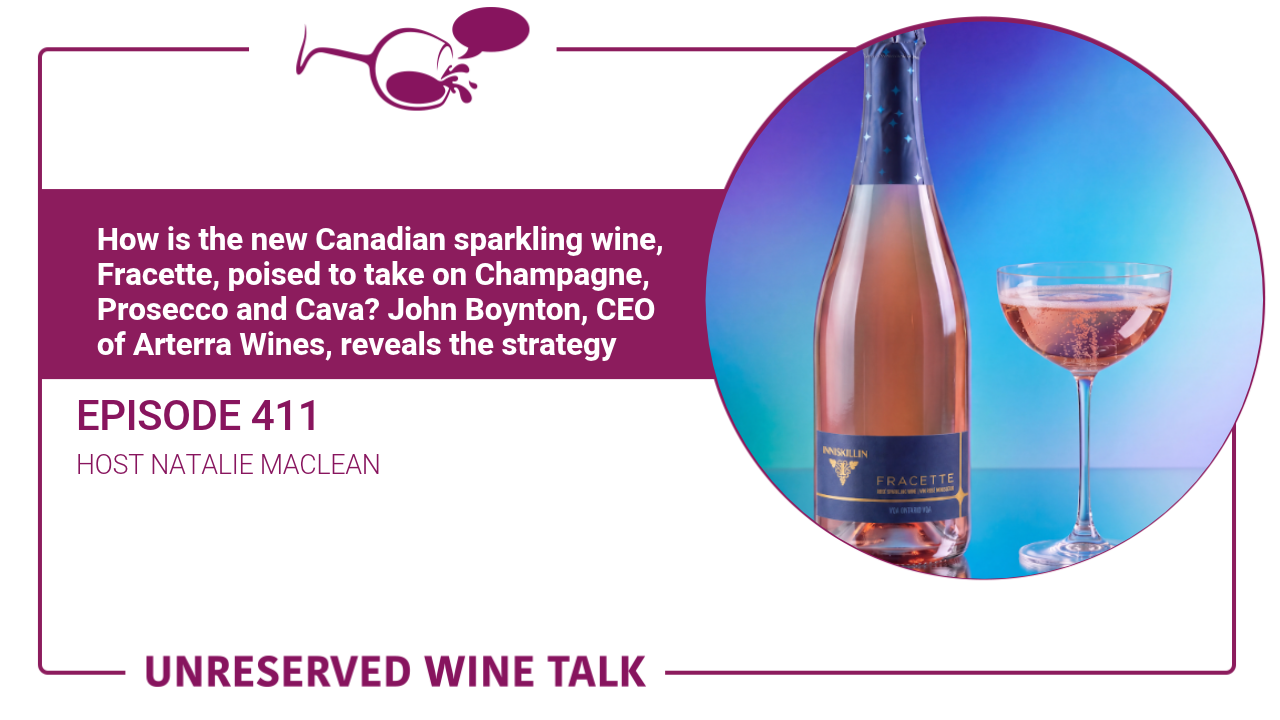
- Now Canada has Fracette. John Boynton Canada should be a major exporter of sparkling wine given that it’s a cool, wet climate. Yeah, but we’re not. Frechette is a sparkling wine that on the second fermentation, we use icewine, right instead of sugar. So more natural fruit sweetness. There’s a very distinct taste that will make this Canadian sparkling Fracette, a category Fracette, into a fairly recognized thing, hopefully globally. So we’re starting here in Canada. There are three in in Ontario, three producers in Ontario, Arterra being the largest. It’ll move to the Western Canada and the Okanagan next year. Once we’ve got full Canadian distribution, then we’ll start working together on exporting the Fracette concept first and then the individual products and brands and SKUs a second.
- Will Canadians remain loyal to domestic wines once American wines return to store shelves? How durable is the buy in Canada shift?
- We’re the only company that runs a national panel on how Canadians feel about US wine returning to the shelf, and we’ve shared this with some of the liquor boards and some of the governments around the country that have asked us, And we have really great partners like Delicato and Constellation Brands that will be working with on those. But a couple of really important points is that, at least leading up to the trade deal anyway, more and more consumers in Canada are warming up to returning to us, the majority. And I think that would surprise a lot of people because people like what they like and they want what they want. And once you like something and it’s removed, you’re a little bit resentful. But over time you start to pine for it. And that’s what’s going on. Somewhere around 15% of Canadians though, will not return, and they feel very fierce about it. They’re very fierce and loyal to… locally in Canada. They don’t care if they liked it or not, but it’s not as big a number as you would have thought it would have been.
- Is the wine industry making a costly mistake by assuming young drinkers will turn to wine as their incomes grow?
- We have a national data lake and we also have a recurring national consumer panel for wine specifically. I think we’re the only ones in Canada that have both of those. And we talked about the penetration being the same and the occasions in the usage per occasion, that’s off. But the other thing that’s really interesting is that consumption does grow as your personal income grows, and that’s alcohol in general. But it doesn’t necessarily mean wine consumption grows as income grows. And the challenge for the wine industry is the category does. But we’re not. And that’s the penny drop that if we don’t become relevant a little earlier on with products that are more relevant for them for their occasions, not our occasions, then as they get more income, they’re not going to start spending just randomly with you. So it’s good news for the alcohol category. It’s not so great news for the wine category. And we need to do something about that.
- How could boxed wine change the way you think about buying and enjoying wine at home?
- N: I still find it surprising that this sleek box holds the equivalent of five bottles. So it’s got the volume without a lot of packaging. It’s all recyclable and all that. But you’re right, people hesitate to open a bottle of wine if they think, oh, I don’t want to be forced to finish it. And it’s not going to taste as good the next day. But this… the bag inside automatically collapses as you sealed, as you pour out of the spigot, so it stays fresh.
- J: And that much wine might scare some people. You might go, why would you buy that? How many people are we going to have to over? But the thing about that freshness is that it lasts for six weeks. Think how long six weeks is with a product that stays fresh. So it’s convenient. It’s easy. You can put it in your fridge or your cupboard. But that six weeks thing is really important. And that’s good for if it’s just the two of you or even one of you. And it’s good if suddenly a whole bunch of people come over. It serves many occasions.
About John Boynton
John Boynton is the President of Arterra Wines Canada. He oversees the domestic and international sales, marketing and operations of Canada’s leading wine company.
John joined the company in 2022 from NordStar (parent company of Torstar) where he held the role of Vice Chair and President of Digital. He was previously the President and CEO of Torstar and Publisher of The Toronto Star.
John is an experienced CEO with a proven track record of helping companies transform and grow – successfully turning strategy into action. He leads his teams in a way that aligns to our purpose and values, focusing on teamwork and collaboration.
Throughout his 35-year career, John has worked in Sales, Marketing and Operations – for many different industries. He has experience in building both customer and direct-to-consumer relationships as well as in mobile, digital, data and ecommerce.
A Canadian, John has lived and worked in Canada, the US and Europe.
Resources
- Mentioned in the Episode
- Unreserved Wine Talk
- My Books:
- Wine Witch on Fire: Rising from the Ashes of Divorce,Defamation, and Drinking Too Much
- Audiobook:
- Audible/Amazon in the following countries: Canada, US, UK, Australia (includes New Zealand), France (includes Belgium and Switzerland), Germany (includes Austria), Japan, and Brazil.
- Kobo (includes Chapters/Indigo), AudioBooks, Spotify, Google Play, Libro.fm, and other retailers here.
- Wine Witch on Fire Free Companion Guide for Book Clubs
- Audiobook:
- Unquenchable: A Tipsy Quest for the World’s Best Bargain Wines
- Red, White, and Drunk All Over: A Wine-Soaked Journey from Grape to Glass
- Wine Witch on Fire: Rising from the Ashes of Divorce,Defamation, and Drinking Too Much
- My new class, The 5 Wine & Food Pairing Mistakes That Can Ruin Your Dinner And How To Fix Them Forever
Tag Me on Social
Tag me on social media if you enjoyed the episode:
- @nataliemaclean and @natdecants on Facebook
- @nataliemaclean on Twitter
- @nataliemacleanwine on Instagram
- @nataliemaclean on LinkedIn
- Email Me at [email protected]
Thirsty for more?
- Sign up for my free online wine video class where I’ll walk you through The 5 Wine & Food Pairing Mistakes That Can Ruin Your Dinner (and how to fix them forever!)
- You’ll find my books here, including Unquenchable: A Tipsy Quest for the World’s Best Bargain Wines and Red, White and Drunk All Over: A Wine-Soaked Journey from Grape to Glass.
- The new audio edition of Red, White and Drunk All Over: A Wine-Soaked Journey from Grape to Glass is now available on Amazon.ca, Amazon.com and other country-specific Amazon sites; iTunes.ca, iTunes.com and other country-specific iTunes sites; Audible.ca and Audible.com.
Transcript
Natalie MacLean 00:00:00 France has champagne. Italy has prosecco. Spain has cava. So what’s the new Canadian sparkling wine style that has just launched? Will Canadians remain loyal to domestic wines once American wines return to store shelves? Is the wine industry making a costly mistake by assuming young drinkers will turn to wine as their incomes grow? And how can boxed wine change the way you think about buying and enjoying wine at home? In today’s episode, you’ll hear the stories and tips that answer those questions. In part two of our chat with John Boynton, CEO of Artery Wines Canada. You don’t need to have listened to part one first before listening to this one, but if you missed it, go back to last week’s episode. After you finish this one by the end of our conversation, you’ll also discover why John believes large format wine offers one of the best values in the alcohol category. How wine can become more relevant to people who increasingly spend Friday nights at home. Why? The idea of one bottle for everyone is a poor strategy for the wine industry.
Natalie MacLean 00:01:02 What the wine industry can learn from the decline of newspapers. Whether greater scale can help Canadian wineries compete on price and export more wine internationally. Whether Canada has the potential to become a major sparkling wine producer. What makes a facet distinctly Canadian compared to other styles of sparkling wine, and why John wants Canadians to stop saving sparkling wine for special occasions. Okay, on with the show. Do you have.
Natalie MacLean 00:01:40 A thirst to learn about wine? Do you love stories about wonderfully obsessive people, hauntingly beautiful places, and amusingly awkward social situations? Oh, that’s the blend here on the Unreserved Wine Talk podcast. I’m your host, Natalie MacLean. And each week I share with you unfiltered conversations with celebrities in the wine world, as well as confessions from my own tipsy journey as I write my third book on this subject. I’m so glad you’re here. Now pass me that bottle, please, and let’s get started.
Natalie MacLean 00:02:21 Now, you could have called this a category in retreat.
Natalie MacLean 00:02:24 Wine.
Natalie MacLean 00:02:25 But you framed it as a category that needs to meet people at home.
Natalie MacLean 00:02:29 What do you mean by that? Just because people aren’t getting out, we need to create home based occasions, which of course has come over October. But maybe dig into that a little bit more. What? We need to meet people at home.
John Boynton 00:02:42 Yeah, there’s so many occasions. So we segment the market by occasion. There are a lot of occasions, of course, when you go out, like we talk about pre-party or going to a restaurant like I talked about with other couples, but there’s many more segments that are actually in your home and understanding all of those specific occasions and then understanding again the needs of those occasions and finding products and opportunities where wine has a lower market share or is in decline, in finding something that’s more relevant for those occasions.
Natalie MacLean 00:03:11 And can you give us an example of one?
John Boynton 00:03:13 Yeah, sure. A product size, for example, in terms of large format would be one.
Natalie MacLean 00:03:19 So how did you get people or how are you attempting to get people away from thinking, oh, box wine is always cheap?
John Boynton 00:03:26 Right.
John Boynton 00:03:26 And so part of that is the brands. You got to make sure that some very well trusted brands are in that format. And part of it is you’ve got to go back to the occasion. Why do you have a large format? And for some occasions it’s about affordability. For other occasions it’s about freshness. In other occasions it’s about not wasting. You don’t want to open a bottle and waste a little bit because you didn’t finish it. so there are different occasions where this product plays a very different role for each of those.
Natalie MacLean 00:03:55 Yeah. No, that makes a lot of sense because I’ve surprised. Like, I still find it surprising that this sleek box holds the equivalent of five bottles. So it’s it’s got the volume without, you know, a lot of packaging. It’s all recyclable and all that. But you’re right, people hesitate to open a bottle of wine if they think, oh, I don’t want to be forced to finish it. And yet it’s not going to taste as good the next day.
Natalie MacLean 00:04:19 But this the bag inside automatically collapses as you sealed. Yeah, exactly as you pour out of the spigot so it stays fresh.
John Boynton 00:04:28 And that much mine might scare some people, right? That much wine? You might go. Why would you buy that? How many people are we going to have to over? But the thing about that freshness is that it lasts for six weeks.
Natalie MacLean 00:04:39 Yes.
John Boynton 00:04:40 If at last think how long six weeks is with a with a product that stays fresh. So it’s convenient. It’s easy. You can put it in your fridge or your cupboard. But that’s six weeks. Thing is really important. And that’s good for if it’s just the two of you or even one of you or and it’s good if suddenly a whole bunch of people come over, it serves many occasions specifically.
Natalie MacLean 00:05:01 We’ve got a house poor already in your fridge or on your counter, and you can just open the spigot. You’re ready.
John Boynton 00:05:06 To go. You’re not coming home with a whole case, right? And and again, even if the five people that come over and come over October, if they don’t drink it all, you still got six weeks.
John Boynton 00:05:15 I think people forget the other thing that just remembering about the economy and where people’s heads are at right now with inflation, etc., I think one of the things our industry could do a much better job, or Tara specifically as well, is hyperinflation, grocery, gas prices, etc. etc. it’s getting really tight and a whole a very large percent of people now more than 50 are even having trouble balancing their monthly budget. Forget the word affordability crisis like we’re past that. And people have a choice then of what are they going to do if they even have a couple of bucks left and they’re after groceries and gas? Large format again, is so much superior to everything else in the in the alcohol beverage category. Because when you boil that down and you could do the quick math, that one you held in your hand. The Jackson trades proprietary selection, the cab stove that’s under two bucks a serving and well, what beer or spirit or RTD or anything are you going to get for under $2 a serving that lasts six weeks? This is the single best value.
John Boynton 00:06:20 If I was anybody out there now and this isn’t a sales pitch, but really think about your dollar per serving when you’re going to the liquor store or the grocery store that is single handedly the best thing you can do to stretch your dollar.
Natalie MacLean 00:06:31 Oh, that’s true. And it’s also great for if you’re going camping and someone else can schlep it. It’s not going to break by the pool. I know we’re past the summer season, but it’s kind of durable that way. It is. Throw it into your pickleball bag.
John Boynton 00:06:44 Yeah, yeah. And for those that are care that has a lower carbon footprint, right? It’s not glass. It’s true. Recycled cardboard. Yes. It’s very recyclable.
Natalie MacLean 00:06:52 And glass isn’t as much. So five bottles in the box. All right. The larger format. Very good.
John Boynton 00:06:59 Okay. You got it.
Natalie MacLean 00:07:00 Let’s try. So Friday night used to be social. Meaning going out. Now it’s often at home watching TV or whatever. How do you, as a wine company, take Friday night back as something more social with wine as a part of it?
John Boynton 00:07:16 Yeah, I think it has to be more accessible.
John Boynton 00:07:18 It has to be more affordable right now and more affordable than the alternatives. Not more affordable because of wine, but more affordable than all the choices people have these days. And there are many different kinds of. If you just take Friday night and Netflix, for example, there is the family that could be doing it. There could be a couple. There could be one person. There could be a couple where one has to get up the next day and, I don’t know, workout or play tennis or do whatever and is watching things. There could be a couple where one would like a drink, but the other doesn’t. There could be a couple that’s watching what they’re eating. All of those things are different subsegments of that occasion and recognizing that people are not homogenous. And I think the problem with wine is they put people in a couple of buckets. You’re a premium wine or you’re a an everyday wine user. That’s not very clever. And so getting ready down to more of the personal level and who you’re talking to specifically, that means you need to have certain products for certain people.
John Boynton 00:08:15 I think one of the things that we as an industry need to work on a lot is the fact that we need several products for a group, and marketing to a person is a lot easier than marketing to a group. The thing about window is it’s often a group. It’s often two or more people, and if it’s two or more people, then you got to recognize someone’s driving, someone’s not drinking, someone doesn’t want sugar, someone’s looking for value. Someone only wants white. So you’ve got to recognize that that the unidimensional nature of one bottle for all people is that that’s a very terrible relevancy strategy. So I think we just got to work harder at that and figure out the right products for the right groups.
Natalie MacLean 00:08:53 Seems like you’re on the right track. okay. So you have household panel data. Research data. Most of us only read about second hand. What’s the widest gap between about the headlines for young drinkers and what you actually see in the numbers now, maybe we’ve already covered all of that, but is there anything else that you’re seeing?
John Boynton 00:09:12 Yeah, we do have a we have a national data lake.
John Boynton 00:09:14 And we also have a recurring national consumer panel for wine specifically. I think we’re the only ones in Canada that have both of those. And we talked about the penetration be the same and the occasions that in the usage occasion that’s off. But the other thing that’s really interesting is that consumption does grow as your personal income grows, and that’s alcohol in general. But it doesn’t necessarily mean wine consumption grows as income grows. And the challenge for the wine industry is the category does. But we’re not. And that’s the penny drop that if we don’t become relevant a little earlier on with products that are more relevant for them for their occasions, not our occasions, then as they get more income, they’re not going to. They’re not going to start spending just randomly with you.
Natalie MacLean 00:09:58 It’s fascinating.
John Boynton 00:09:59 So it’s good news for the alcohol category. It’s not so great news for the wine category. And we need to do something about that.
Natalie MacLean 00:10:05 Lots of opportunity there. So every Canadian producer is quietly wondering the same thing once American wine comes back to the shelves.
Natalie MacLean 00:10:12 How durable is the buy in Canada shift?
John Boynton 00:10:15 Again, we’re the only company that runs a national panel on how Canadians feel about US wine returning to the shelf, and we’ve shared this with some of the liquor boards and some of the governments around the country that have asked us, and there’s some deep insights there that I’m not going to share, because they’re actually competitive weapons for when it comes back. And we have really great partners like Dell and Constellation Brands that will be working with on those. But a couple of really important points is that at least leading up to the trade deal anyway. And so it might be different now. More and more consumers in Canada are warming up to returning to US wine the majority. And I think that would surprise a lot of people, because people like what they like and they want what they want. And once you like something and it’s removed, you’re a little bit resentful. But B over time you start to pine for it. And and that’s what’s going on. Somewhere around 15% of Canadians, though, will not return.
John Boynton 00:11:12 And they feel very fierce about it. They’re very fierce and loyal to to locally and in Canada. They’ve there done. They don’t care if they liked it or not, but it’s not as big a number as you would have thought it would have been.
Natalie MacLean 00:11:23 Wow.
John Boynton 00:11:24 Mine has already come back on the shelf in parts of British Columbia and Alberta, and already two thirds of the category for us wine has come back, and that was in the first almost four months. So you get a big bump and then it’ll take a little longer for people to get comfortable again, assuming there’s a trade deal and we’re friends with our our great American neighbors and it all works out. But somewhere between the two thirds and the 15% is where it’ll slowly start and build towards. And I think the good news for so that’s good for all of all the US California wine companies. Not their fault what’s going on in the trade war. But I think it’s also good for Canadian producers as well, to know that there’s at least minimum 15% stickiness.
John Boynton 00:12:03 It’s not a bigger you probably thought it was a bigger number.
Natalie MacLean 00:12:06 I would have.
John Boynton 00:12:07 Yeah people do. And I really hope that there are Canadian wineries out there hoping and praying that it will be a bigger number, because hoping to break is not a great strategy.
Natalie MacLean 00:12:15 That’s true. I think Prime Minister Kearney said something like that. Nostalgia. We have to live with the world as it is. That’s correct. But yeah, but some some data came out now. Maybe it pre-dated your panel data and yours is more up to date, but where a lot of Canadians would not buy American alcohol. But then again, there’s also the difference between what they say and what they actually do at the cash register sometimes. You know, that’s true.
John Boynton 00:12:40 But pulling Canadians who don’t who didn’t drink California wine to begin with is sort of nonsense.
Natalie MacLean 00:12:45 Yeah, right. Okay.
John Boynton 00:12:46 Well, there you go. So our panel specifically, it’s the way the people we poll are people that did drink us wine before the ban.
John Boynton 00:12:55 So it’s very relevant.
Natalie MacLean 00:12:56 Good to know. That makes sense then. So you ran Torstar, and we’re the publisher of the Toronto Star before this. And newspapers were told that product was in permanent decline. And now wine. Here’s the same thing. What’s carried over? What did you learn, if anything, from the news business that you’re bringing to wine?
John Boynton 00:13:13 Yeah. You see a pattern there?
Natalie MacLean 00:13:15 I do. You’re coming to the.
John Boynton 00:13:17 I didn’t cause the decline or something.
Natalie MacLean 00:13:18 You didn’t.
John Boynton 00:13:19 Call it. Okay.
Natalie MacLean 00:13:20 Blame John hashtag.
John Boynton 00:13:22 No no.
Natalie MacLean 00:13:23 No no.
John Boynton 00:13:25 Yeah, it is what I do for a living. So that’s the connector there. And there are a couple of if I think about it, there are a couple of things that are similar in the patterns that I see. One is the need for relevance starting to get to into your own stuff. And then you start to become irrelevant for your audience or your consumer, whichever one it is for those two industries. The business model, we tend to still be investing in holding on to assets and expenses and structures that are associated with the market, looking backwards, not looking forwards.
John Boynton 00:13:55 And so the business models need to change what I call asset mix, or your mix of your products is always going to be in arrears in these industries that are facing tough headwinds. And it’s they’re just so slow to change that even while they’re changing, they’re already behind again and they never really get out of it. And so in both those industries, the mix of your asset has to change ahead of the curve, not behind the curve, or you’ll never, ever catch up. And it gets frustrating for people. And it’s probably the last is that both industries were very subscale. There are many players all too small, all don’t have scale, all are going to be what catalyzes growth and and exports etc.. So inevitably in both those industries, two two things happen. One is unfortunate that a lot of companies will go under. When you have two fragmented, a volume and volume is challenged. And the second thing is you’ll have a lot of consolidation. There’ll be a lot of acquisitions and mergers, and it will start to accelerate as time goes on.
John Boynton 00:14:56 But what that’ll do is inevitably fix the problem of scale, and that the industry is super subscale. And what scale will do then is it will allow for a better cost, a competitive cost to compete and match consumers where they are on the financial side. And the lower cost will also allow companies then to focus more on exporting a product. And there’s a lot of product coming into Canada. There’s not nearly enough going out. And so all the Canadian at least Canadian wineries, but I can probably speak globally. All the wineries need to get far more scale to get a better unit cost, to be able to compete more and be able to provide more value. Those are things very similar in both of those industries. It may seem like completely different, unrelated, but the challenges sometimes you’d be surprised. They’re often the same.
Natalie MacLean 00:15:41 Sure, there’s often core fundamentals in terms of economies of scale. Do you think that’s a risk to the wine industry scaling up? Yes, it makes sense. Exports. But it’s also a business where you like small is good artisanal, or are they just different market niches? And you still have your boutique wines here, but then you have your bigger scale wines to carry the business?
John Boynton 00:16:06 Yeah, certainly there’s like a luxury business is different than a food and beverage business, and certainly wines under $15, a lot more like food and beverage and need to scale materially.
John Boynton 00:16:16 And the higher you go in price point, the more it goes from premium to luxury, as everybody knows. And so the more care needs to be taken to the product and the story and the experience. But in tomorrow’s world, it’ll be very hard to compete for a lot of the long tail.
Natalie MacLean 00:16:31 There are so many different factors to consider. We’ve talked about the different wines. Let’s talk about Fresh Set because your newest innovation and we have three of them here. We have Enniskillen Fresh Set rosé.
John Boynton 00:16:48 Rosé.
Natalie MacLean 00:16:49 Which is beautiful. And the Saint leaf reset. And then we also have Q. So tell us how these came about. I’ll make the quick analogy. Champagne. France has champagne. Italy has prosecco. Spain has cava. And now Canada has first.
John Boynton 00:17:06 What’s common about sparkling wine geographies and climates? They’re generally a cool, wet climate product, right? Yes. Ta da! Canada. What are we. Hey. And so we have been making some very, very good sparkling wine. But you couldn’t really describe what a Canadian sparkling wine was, could you, not?
Natalie MacLean 00:17:29 To differentiate it.
John Boynton 00:17:30 It’s just everybody’s doing their own thing. And so therein is the opportunity. And Canada should be a major exporter of sparkling wine, given that it’s a cool, wet climate. But we’re not. Because again, it’s a very disaggregated industry with a very long tail and very subscale. So this is one way to bring some scale to sparkling wine and put Canada on the map, as you said, just like the other two categories. And I think there’s a there’s lots of room for many more categories, even from other countries. But this is our version. We started with the notion of Enniskillen, and Enniskillen is one of the top 50 most recognized brands in wine brands in the world. Right. So it’s there. We’re on the map Canada. And and it’s known almost exclusively for its ice wine outside of the borders, although inside of Canada, obviously it has a full lineup of premium wine that people enjoy.
Natalie MacLean 00:18:22 And that’s because Enniskillen originally put Canada on the wine map back in 1991, winning at Expo up against thousands of wines.
Natalie MacLean 00:18:31 It won. It was like, who’s this?
John Boynton 00:18:33 It was a famous point in time for sure. For sure that put cam in the map. Well, here we go again. And Frechette is a sparkling wine that on the second fermentation we use ice wine, right. Instead of sugar.
Natalie MacLean 00:18:47 Because the sugar champagne everybody else uses sugar. We’re using ice wine. So more natural fruit sweetness. Yeah.
John Boynton 00:18:53 That’s correct. And you would think I know where everybody’s going to go right now as they’re listening to this. They’re going to go, oh, it’s going to be super sweet. But it’s actually not it’s actually not super sweet. It’s it has the flavor of ice wine without all the, the heavy sweetness of it. Actually, there is a very distinct taste and it’s very subtle, but there’s a very distinct taste that will make this Canadian sparkling for shet, a category for shet, into a fairly recognized thing, hopefully globally. So we’re starting here in Canada. There are three in in Ontario, three producers in Ontario, Altera being the largest.
John Boynton 00:19:28 It’ll move to the Western Canada and the Okanagan. And next year we had a problem with our grapes and the freeze. So when that comes back, we’ll get back to that. Once we’ve got full Canadian distribution, then we’ll start working together on exporting the Frechette concept first and then the individual products and brands and SKUs a second.
Natalie MacLean 00:19:46 I think it’s a brilliant idea. The whole sweetness thing is something I’ve had to talk to people about. But just because champagne adds sugar as well, it’s not sweet. Or at least most styles are not sweet. But you need something to kickstart the second fermentation, whether it’s in the bottle or in the vat, because the yeast actually eats all the sugar and it comes out dry. So not to worry for people who want a dry sparkling. So how would you position? You’ve got three facets. How would you position Enniskillen? Is it the special occasion? One of the three.
John Boynton 00:20:16 Enniskillen for sure is a premium and luxury brand. And so the rosé is really more for a specific occasions that are more memorable, memorable occasions or date nights and engagement a birthday, some special dinner.
John Boynton 00:20:30 So it’s up there in the the occasion demands a sparkling wine. Q, on the other hand, is a bottle that you’ll have on hand for really anything any planned gatherings. It can be impromptu get togethers or whatever. Saintly is more of an everyday drinking, sparkling. And this here’s the really important thing about saintly. Saintly is that first bottle you open every time. And I think the problem with sparkling is that people have this impression of high end sparkling. That’s really just special moments. And that’s what Enniskillen for Shad rosé is for. But the way we’re marketing saintly and the way we’re positioning that is it’s it runs across all locations and it’s the first bottle open, saintly first. Everybody have a glass and then you move on to whatever else you want. But the first drink, always of the night, is sparkling. And I think that’s a big change, because sparkling wine in Canada is so under penetrated relative to the United States, or definitely anywhere else in the world like Europe, etc.. So Canadians don’t drink a lot.
John Boynton 00:21:34 It’s because we don’t think of it as that first bottle.
Natalie MacLean 00:21:37 No, that’s true. And we also think of Freesat as our you’re saying Frechette with a CHRU.
John Boynton 00:21:44 Yeah. But you can say for jet either way.
Natalie MacLean 00:21:46 Yeah I know it rhymes with cassette. That’s what I was told. Remember? So this though. Okay, so entry level champagne is at least $6,070 these days. Non vintage entry level. This is 34.95. And it’s beautiful I love it I’m biased toward this one. And then this one. The queue I think it’s 2695 around there. Yep something like that. Okay. And this one it’s the Saint Louis 2395.
John Boynton 00:22:15 Yeah. So again you can see how one is the first bottle every night and the other comes up to that special occasion. So you might have it there but only pull it out at that time versus the, the Saint Louis, which you’ll just have it, you should have in your fridge like always one. And you want to take your Friday night example with Netflix.
John Boynton 00:22:32 Your first drink is sparkling.
Natalie MacLean 00:22:34 Sure. Yeah, yeah, kick it off that way. And yet still, they’re all incredibly affordable compared to champagne. I just I find the quality is excellent. Do some blind tastings and there’s just no way that champagne is three times better than these. I think they hold their own.
John Boynton 00:22:52 We had a big event in Toronto, and we were serving Frechette at the event, and it was the belle of the ball. People were raving about it. And you know, when you finally get liquid to lips and people try it for the first time and again, kind of like bask, right? They have this impression in their head of what it’s going to be, and then they taste it. And that moment and when you look at their face and they go, oh, wow. And the the amount of oh wows that night was, was spectacular. We I think we nailed it.
Natalie MacLean 00:23:19 Excellent. And do you have any favorite pairings for any of these.
John Boynton 00:23:22 particularly I’m impartial to the Enniskillen project and I like having it actually.
John Boynton 00:23:28 So my, my wife and daughter will have it before dinner, but I kind of like it after dinner. Just around the dessert time.
Natalie MacLean 00:23:35 Okay.
John Boynton 00:23:35 So she’ll have there. They’ll have one before and then I’ll have it. I’ll have something before instead of that, but I’ll actually have it at dessert. But that’s just me. I’m a little weird.
Natalie MacLean 00:23:44 To each his own.
John Boynton 00:23:45 And yeah, that’s right.
Natalie MacLean 00:23:46 Obviously they can be with the full lineup you have here. This is fantastic, John. What are you going to be toasting to for come over October? Is there a special moment or occasion or particular people or memories like what’s what will you be toasting to for come over October?
John Boynton 00:24:02 Not to get a little sappy, but I think whether it’s my friends or family or immediate family or my extended family, two things have become increasingly important is happiness and health. And if you don’t have happiness, everything is tough. And if you don’t have the health, everything is a lot tougher. I’m gonna toast to more of those things because I think they’re assumed and we shouldn’t be assuming.
John Boynton 00:24:23 And so I think they mean more.
Natalie MacLean 00:24:25 Absolutely. I’ll be toasting to that health reunion and to that aunt and uncle. I got a chance to spend some more time with. Lucky you it was. And to hear their stories one more time. Now, as we wrap up, is there anything we haven’t covered that you wanted to mention about anything that we’ve talked about?
John Boynton 00:24:42 I think you’ve covered a lot of ground here in a short period of time. So.
Natalie MacLean 00:24:46 Yeah. Yeah. No. We can keep going. Because why makes you linger longer? Right.
John Boynton 00:24:50 There you go.
Natalie MacLean 00:24:52 Now, I believe you have a glass of the Enniskillen reset. Fresh air, I do. Okay. I’m pouring mine right now, and maybe we’ll toast John, even though we’re doing this digitally. Yeah. Next time in person, I would say here’s to open doors, open bottles and open hearts. I raise my glass to you and what your team is doing at our Tara.
John Boynton 00:25:17 Here’s to saying yes to the invite.
John Boynton 00:25:19 Yes to getting together with friends as come a worked over.
Natalie MacLean 00:25:22 All right. Cheers to that.
John Boynton 00:25:23 Cheers. That’s good. Yummy.
Natalie MacLean 00:25:28 Oh my gosh. Wow. It isn’t too early. It’s really good. It’s so refreshing. Beautiful strawberry notes.
John Boynton 00:25:35 And I.
Natalie MacLean 00:25:36 Love it. Wow. Okay, maybe we’ll have to stay a little longer off camera and just finish. Finish this. Anyway, thank you, John, for your time. I really appreciate it. Great insights. Fascinating. Okay. All right.
John Boynton 00:25:49 Thank you. This was a lot of fun.
Natalie MacLean 00:25:51 All right. Cheers.
John Boynton 00:25:52 Cheers.
Natalie MacLean 00:25:58 Well, there you have it. I hope you enjoyed our chat with John. Here are my takeaways. France has champagne, Italy has prosecco, Spain has cava. So what is the new Canadian sparkling wine style that’s just launched? Well, Canada now has Brexit. As John explains, Canada should be a major exporter of sparkling wine given its cool, damp climate. Yet we’re not for set. Sparkling wine uses ice wine to kickstart that second fermentation instead of sugar, as champagne does, and other bubbles.
Natalie MacLean 00:26:30 So it has more natural sweetness. As John says, there’s a very distinct taste that will make this Canadian sparkling for set, a category that becomes a recognised thing globally. So as he explains, we’re starting here in Canada. There are three producers in Ontario right now. Are Tara being the largest. This style will move to Western Canada and the Okanagan next year. Once they have full Canadian distribution, they’ll start working together on exporting the first concept first and then individual products and brands second. Number two. Will Canadians remain loyal to domestic wines once American wines return to store shelves? How durable is that buy in Canada shift? John says. Our Terra is the only company that runs a national panel of research data on how Canadians feel about U.S. wine returning to the shelf, and they’ve shared some of that with the liquor boards and governments across the country. More and more consumers in Canada are warming up to returning to the US, the majority says. He notes that would surprise a lot of people, but consumers like what they like and they want what they want.
Natalie MacLean 00:27:44 And once you have something and it’s removed, you’re a bit resentful. But over time you start to pine for it. And that’s what’s going on in the market. About 15% of Canadians will not return to US products. They’re fierce and loyal to local now in Canada. They don’t care if they liked the U.S. product or not, but that percentage is not as big as you think it would have been. And as he notes, a lot of the research that’s been reported in the media, mainstream media was based on asking all Canadians if they would drink US wines once it returns. But his panel data asked those who used to drink US wines and that’s a more relevant set. Are they going to return to a US product? Number three is the wine industry making a costly mistake by assuming young drinkers will return to wine as their incomes grow? John notes that a really interesting finding in his consumer data is that generally alcohol consumption grows as your personal income grows, but that doesn’t apply to wine consumption. And that’s the challenge for the wine industry as a category.
Natalie MacLean 00:28:57 He believes if the wine industry doesn’t become relevant earlier on with young drinkers and more relevant to their occasions, not another generation’s occasions, then as they increase their income, they’re not just going to start spending it on wine all of a sudden. And for how can boxed wine change the way you think about buying and enjoying wine at home? I still find it personally surprising that the sleek box holds the equivalent of five bottles. You’d never guess it. Just looking at it, it’s got that volume of wine without a lot of packaging. It’s recyclable. And the upside is that with an open bottle of wine, they think, oh, I don’t want to be forced to finish it, but it’s not going to taste as good the next day. But with the bag that collapses inside the box as you drain off more wine, you’ve got an air tight kind of environment that keeps the wine fresh. And as John points out, that freshness lasts for six weeks. So it’s convenient. It’s easy. You can put it in your fridge or your cupboard.
Natalie MacLean 00:30:04 It works if there’s just two of you enjoying wine for the evening, or if you’ve got a larger group or people drop in, it serves a lot of occasions. If you missed episode 204, go back and take a listen. I chat about Canadian wines, grapes and styles with James Atkinson. I’ll share a short clip with you now to whet your appetite.
Natalie MacLean 00:31:18 Email or text them now while you’re thinking about it, it’s easy to find the Unreserved Wine Talk podcast. Just tell them to search for that title or my name Natalie MacLean wine on YouTube, Apple Podcasts, Spotify, or their favorite podcast app. Or they can listen to the show on my website at Natalie MacLean or. Email me if you have a tip, question, or if you’d like to win one of six drinks books that I have to give away. I’d also love to hear your thoughts on this episode, or if you’ve read my book or listening to it. Email me at Natalie at Natalie MacLean dot com. You won’t want to miss next week when we continue our chat with author Karen Newman. Thank you for taking the time to join me here. I hope something great is in your glass this week. Perhaps a crisp, zesty, fresh set. You don’t want to miss one juicy episode of this podcast, especially the secret full bodied bonus episodes that I don’t announce on social media. So subscribe for free now at Natalie MacLean.
Natalie MacLean 00:32:28 Meet me here next week. Cheers!