






Introduction
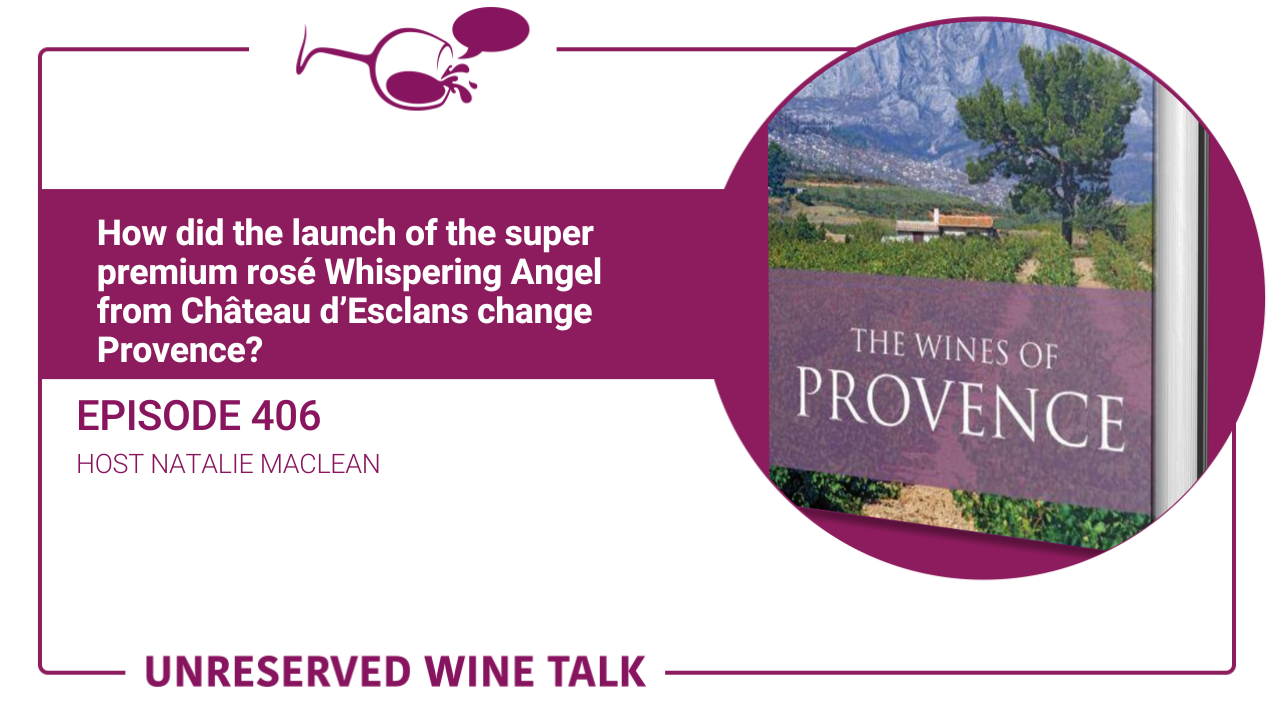
How did Sacha Lichine’s launch of Garrus and Whispering Angel from Château d’Esclans, which now exceeds 10 million bottles a year change Provence? What happens to a wine region when historic family estates are increasingly bought by wealthy outsiders and corporations? How can classifying wine by colour get in the way of understanding what’s actually in the glass?
In this episode of the Unreserved Wine Talk podcast, I’m chatting with Liz Gabay and Ben Bernheim.
You can find the wines we discussed here.
Giveaway
Two of you are going to win a copy of Liz Gabay and Ben Bernheim’s terrific book, Rosés of Southern France.
How to Win
To qualify, all you have to do is email me at [email protected] and let me know that you’ve posted a review of the podcast.
It takes less than 30 seconds: On your phone, scroll to the bottom here, where the reviews are, and click on “Tap to Rate.”
After that, scroll down a tiny bit more and click on “Write a Review.” That’s it!
I’ll choose two people randomly from those who contact me.
Good luck!
Join me on Instagram, Facebook and YouTube Live Video
Join the live-stream video of this conversation on Wednesday at 7 pm eastern on Instagram Live Video, Facebook Live Video or YouTube Live Video.
I’ll be jumping into the comments as we watch it together so that I can answer your questions in real-time.
I want to hear from you! What’s your opinion of what we’re discussing? What takeaways or tips do you love most from this chat? What questions do you have that we didn’t answer?
Want to know when we go live?
Add this to your calendar:

Highlights
- How did Liz and Ben end up working on Kylie Minogue’s Rosé?
- How involved are celebrities in the wines that carry their names?
- What happens to a wine region when historic family estates are increasingly bought by celebrities, corporations, and wealthy outsiders?
- How did Garrus and Whispering Angel prove that consumers would pay serious money for Provence Rosé?
- Why do Liz and Ben push back against the idea that expensive, oak-aged Rosé is not real Rosé?
- How can classifying wines by colour get in the way of understanding what is in the glass?
- Where is the line between dark Rosé, a chilled red, and the emerging category sometimes called blouge?
- Could Provence’s future lie in fresh, chilled reds that blur the traditional boundaries between red and Rosé?
- Why should winemakers worry less about categories and focus more on making the best wine they can?
- Can fine Rosé really age for decades and what happens to its flavours as it gets older?
Key Takeaways
- Sacha Lichine’s 2007 launch of Garrus from Château d’Esclans, which is, of course, Whispering Angel, now exceeds 10 million bottles a year. How has that changed Provence?
- L: So when Garrus was first launched at €80 a bottle, there was feeling of idiot, who’s going to buy Rosé at €80 a bottle. But he was a really smart guy. He didn’t make very much. He sold out within the first year to the yachting crowd. The yachting crowd will buy anything that’s expensive.
- B: But they did have to redesign the fridges on the yachts to fit magnums.
- L: He hosted parties up and down the coast, and it gave that boost of confidence that it was possible. He made Rosé as if it was a Burgundian white, and nobody had ever actually spent that amount…there were producers in Provence making great oak Rosé a decade before Sacha Lichine. But they didn’t have the money and the marketing and the vision.
- What happens to a wine region when historic family estates are increasingly bought by wealthy outsiders and corporations?
- L: I had pitched an article about outside ownership of Provence Estates. And when I pitched the article, I thought maybe there are 20 estates that I can talk about. And I think my document of outside ownership of Provence Estates is now… I’m onto page five, double sided, because there is a vast amount of outside ownership, whether it’s Champagne, Bordeaux, Burgundy, American, Italians… there are quite a few of the wealthiest people in France have an estate, and it just goes on and on and on. There are some estates which are still family-owned who are now talking about maybe they should form an association of estates that are still in the same hands. Fourth generation. And the important thing about that, it’s not just whether you’re jealous of ownership or something, but if it’s a family estate, there is some continuity in style. this is classic, same estate for 200 years. You sell the estate to a big house and everything changes. And that is, I think, a major problem, maybe not just Provence, in many places.
- How can classifying wine by colour get in the way of understanding what’s actually in the glass?
- L: One thing I have really disliked for the past ten years is this idea that we have white wine, orange wine, Rosé wine, dark Rosé wine, light red wine… Why are we obsessed with this definition by color? It doesn’t mean anything. You can have sweet Rosé, dry Rosé.. you can have very tannic reds. Light reds. We should be looking at style and taste, not always color.
- B: And it’s this continuum where the darkest Rosé is not necessarily lighter than the lightest red and there’s so much overlap. And Château d’Esclans top wine, Garrus the most expensive one, It’s 50% white grapes. And a snob might say, well, it’s not a Rosé then, because Rosé is made from red grapes. Is it a blouge because it’s a mix of red grapes and white grapes? A lot of our favorite rosés are very, very dark and mostly white grapes.
About Elizabeth Gabay MW & Ben Bernheim
Elizabeth Gabay MW entered the wine trade in 1986, founding Elizabeth Gabay & Partners. She became a Master of Wine in 1998. She has lived in south-eastern France since 2002, and is currently based in the Provence-Alpes-Côte d’Azur region. Since 2020 she has been working with her son Ben Bernheim. They write for numerous magazines with a global readership, largely, but not only, about rosé and are regular speakers at wine fairs and competitions. Elizabeth is the author of Rosé: Understanding The Pink Wine Revolution in the Classic Wine Library series, and Rosés of Southern France, which she co-authored with Ben Bernheim. Gabay and Bernheim make their own wine in Slovakia, in partnership with Vladimir Magula and have consulted with other producers on rosé, including Kylie Minogue. Together they organise a rosé writing competition and trade events, including their Fine Rosé Day.
Resources
- Connect with Liz Gabay & Ben Bernheim
- Unreserved Wine Talk
- My Books:
- Wine Witch on Fire: Rising from the Ashes of Divorce,Defamation, and Drinking Too Much
- Audiobook:
- Audible/Amazon in the following countries: Canada, US, UK, Australia (includes New Zealand), France (includes Belgium and Switzerland), Germany (includes Austria), Japan, and Brazil.
- Kobo (includes Chapters/Indigo), AudioBooks, Spotify, Google Play, Libro.fm, and other retailers here.
- Wine Witch on Fire Free Companion Guide for Book Clubs
- Audiobook:
- Unquenchable: A Tipsy Quest for the World’s Best Bargain Wines
- Red, White, and Drunk All Over: A Wine-Soaked Journey from Grape to Glass
- Wine Witch on Fire: Rising from the Ashes of Divorce,Defamation, and Drinking Too Much
- My new class, The 5 Wine & Food Pairing Mistakes That Can Ruin Your Dinner And How To Fix Them Forever
Tag Me on Social
Tag me on social media if you enjoyed the episode:
- @nataliemaclean and @natdecants on Facebook
- @nataliemaclean on Twitter
- @nataliemacleanwine on Instagram
- @nataliemaclean on LinkedIn
- Email Me at [email protected]
Thirsty for more?
- Sign up for my free online wine video class where I’ll walk you through The 5 Wine & Food Pairing Mistakes That Can Ruin Your Dinner (and how to fix them forever!)
- You’ll find my books here, including Unquenchable: A Tipsy Quest for the World’s Best Bargain Wines and Red, White and Drunk All Over: A Wine-Soaked Journey from Grape to Glass.
- The new audio edition of Red, White and Drunk All Over: A Wine-Soaked Journey from Grape to Glass is now available on Amazon.ca, Amazon.com and other country-specific Amazon sites; iTunes.ca, iTunes.com and other country-specific iTunes sites; Audible.ca and Audible.com.
Transcript