






Introduction
How do our personal memories shape the aromas we recognize in wine? What incredible Argentine wines are people missing when they focus only on Malbec? Why do food and wines from the same region often pair beautifully even when they break the usual rules?
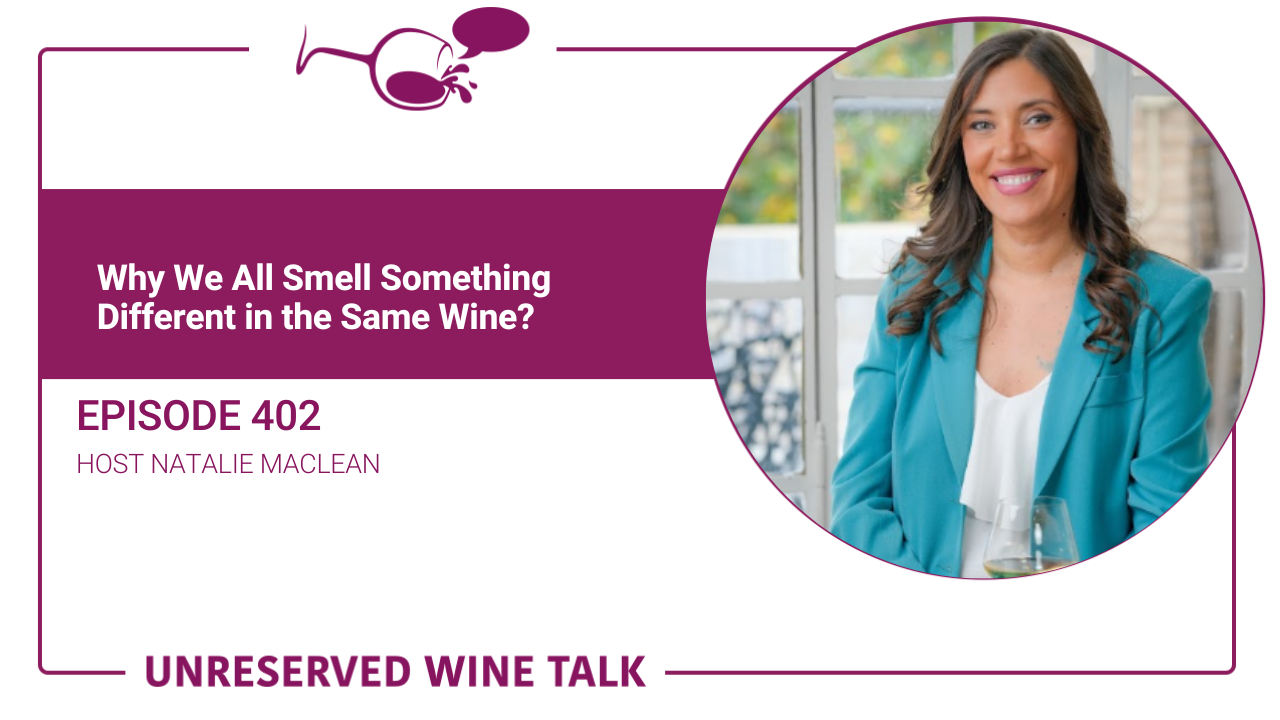
In this episode of the Unreserved Wine Talk podcast, I’m chatting with Marisol de la Fuente.
You can find the wines we discussed here.
Join me on Instagram, Facebook and YouTube Live Video
Join the live-stream video of this conversation on Wednesday at 7 pm eastern on Instagram Live Video, Facebook Live Video or YouTube Live Video.
I’ll be jumping into the comments as we watch it together so that I can answer your questions in real-time.
I want to hear from you! What’s your opinion of what we’re discussing? What takeaways or tips do you love most from this chat? What questions do you have that we didn’t answer?
Want to know when we go live?
Add this to your calendar:

Highlights
- How did a student’s memory of his grandmother help Marisol explain aroma in wine tasting?
- Why might an old wine remind someone of sushi?
- Why does Torrontés pair unexpectedly well with Argentine empanadas?
- How can molecular pairing create surprising matches like white chocolate with caviar?
- Why does Marisol say wine changes with age rather than automatically improving?
- What is the biggest misconception people have about aging wine?
- Why does Marisol believe Argentina is known too narrowly for Malbec?
- What does Argentina need to do better to show the world its full range of wines?
- How did winning Wine Communicator of the Year change Marisol’s place in the global wine conversation?
- Why does Marisol believe wine communication should never feel too solemn?
- What childhood comfort food would Marisol pair with white wine today?
- Why does Marisol believe constant study and research matter most in wine communication?
Key Takeaways
- How do our personal memories shape the aromas we recognize in wine?
- N: You said another student said this wine smelled like sushi. So what did that mean?
- M: It’s amazing because it was a very old wine, 15 years old and of course, we know that there are some smells that are connected with age and we have some balsamic aromas there. So I remember I asked this person, okay, do you use a lot of soy sauce on your sushi. Yes, I love it. I love sushi in a bowl full of soy sauce. And of course, it was the balsamic part, the smell that this person connected with the sushi. And in his or her mind, okay, this smell is something that I know, but I can’t describe what. So I feel that when I am eating sushi. It’s very interesting how our minds work.
- What incredible Argentine wines are people missing when they focus only on Malbec?
- N: When it comes to Argentina, it’s the seventh largest wine producer globally, the 10th largest exporter in the world, selling to over 100 markets. What’s the single biggest misconception about Argentine wine that you like to correct when you’re talking to people from other countries?
- M: We only produce Malbec. It’s a misconception, but at the same time, it’s a reality because a huge part of our expectations are Malbec, because it’s the grape variety that no one else has. It’s tricky because everyone wants to import something different because they already have Cabernet Sauvignon and Cabernet Franc or Merlot or Chardonnay. So Argentina is Malbec. That for me is a misconception because we have great wines in all the grape varieties and also we have amazing blends.
- Why do food and wines from the same region often pair beautifully even when they break the usual rules?
- N: Now let’s go back to Torrontés. You paired it with empanadas. And you said it should not work because meat should ask for a more powerful wine and yet it worked perfectly. Why did it work?
- M: It’s what we call regional pairing. The two products are from the same place. Elements that are from that place in general work together. We have some rules about wine pairing but sometimes when we are talking about regional pairings, that rule is like, this is not like in the rule, but it’s working perfectly well. And well, that is the case of Torrontés and meat empanadas, because that is something very typical in the north of Argentina, where the Torrontés is the main grape variety.
- N: What grows together goes together.
About Marisol de la Fuente
Marisol de la Fuente is an international sommelier, graduated from the Argentine School of Sommeliers, a bartender trained at the International Center of Cocktail Arts, and a journalist. She communicates about the world of wine and beverages to bring it closer to consumers.
She is a columnist on Canal de la Ciudad, where she presents a different segment every week in a simple and entertaining manner. On Vinimos, her wine podcast, she answers the most common consumer questions alongside Ariel Torres, journalist at La Nación.
She teaches her course “El vino, sin vueltas” in a live online format and also works as an instructor in the sommelier programs.
Beyond her passion for wine, she has 25 years of experience in marketing, communication, and PR in multinational companies, and she is a Digital Marketing lecturer and consultant for companies in the wine and beverage industry.
Resources
- Connect with Marisol de la Fuente
- Unreserved Wine Talk
- My Books:
- Wine Witch on Fire: Rising from the Ashes of Divorce,Defamation, and Drinking Too Much
- Audiobook:
- Audible/Amazon in the following countries: Canada, US, UK, Australia (includes New Zealand), France (includes Belgium and Switzerland), Germany (includes Austria), Japan, and Brazil.
- Kobo (includes Chapters/Indigo), AudioBooks, Spotify, Google Play, Libro.fm, and other retailers here.
- Wine Witch on Fire Free Companion Guide for Book Clubs
- Audiobook:
- Unquenchable: A Tipsy Quest for the World’s Best Bargain Wines
- Red, White, and Drunk All Over: A Wine-Soaked Journey from Grape to Glass
- Wine Witch on Fire: Rising from the Ashes of Divorce,Defamation, and Drinking Too Much
- My new class, The 5 Wine & Food Pairing Mistakes That Can Ruin Your Dinner And How To Fix Them Forever
Tag Me on Social
Tag me on social media if you enjoyed the episode:
- @nataliemaclean and @natdecants on Facebook
- @nataliemaclean on Twitter
- @nataliemacleanwine on Instagram
- @nataliemaclean on LinkedIn
- Email Me at [email protected]
Thirsty for more?
- Sign up for my free online wine video class where I’ll walk you through The 5 Wine & Food Pairing Mistakes That Can Ruin Your Dinner (and how to fix them forever!)
- You’ll find my books here, including Unquenchable: A Tipsy Quest for the World’s Best Bargain Wines and Red, White and Drunk All Over: A Wine-Soaked Journey from Grape to Glass.
- The new audio edition of Red, White and Drunk All Over: A Wine-Soaked Journey from Grape to Glass is now available on Amazon.ca, Amazon.com and other country-specific Amazon sites; iTunes.ca, iTunes.com and other country-specific iTunes sites; Audible.ca and Audible.com.
Transcript
Natalie MacLean 00:00:00 How do our personal memories shape the aromas we recognize in wine? What incredible Argentine wines are we missing if we only focus on Malbec? And why do food and wines from the same region often pair beautifully, even when they break the usual rules? In today’s episode, you’ll hear the stories and tips that answer those questions in part two of our chat with Marisol de la Fuente. If you missed part one from last week, go back and have a listen after you finish this one. By the end of our conversation, you’ll also discover how a student’s memory of his grandmother helped Marisol explain aroma in wine tasting, how molecular pairing can create surprising matches like white chocolate with caviar. Why Marisol says wine changes with age rather than automatically improving. The biggest misconception people have about aging wine what Argentina needs to do better to show the world its full range of wines. How Marisol believes wine communication should never feel too solemn. The childhood Comfort food. Marisol would pair with white wine today. And why? Marisol believes constant study and research matter most in wine communication.
Natalie MacLean 00:01:14 Do you have a thirst to learn about wine? Do you love stories about wonderfully obsessive people, hauntingly beautiful places, and amusingly awkward social situations? Well, that’s the blend here on the Unreserved Wine Talk podcast. I’m your host, Natalie MacLean, and each week I share with you unfiltered conversations with celebrities in the wine world, as well as confessions from my own tipsy journey as I write my third book on this subject. I’m so glad you’re here. Now pass me that bottle, please, and let’s get started.
Natalie MacLean 00:01:56 What’s new in the drinks world this week? In fur, feathers, and fermentation, I’m nominating the Central American Fruit bat as the world’s most dependable designated driver. While human drivers lose all coordination when drunk, Central American fruit bats are the ultimate designated drivers of the mammal world. Despite a diet rich in fermenting tropical fruits like mangoes and wild figs. In laboratory testing, researchers fed these bats alcohol until their blood alcohol content reached a staggering 0.3%, nearly four times the legal driving limit for humans.
Natalie MacLean 00:02:35 Remarkably, when challenged to fly through a complex obstacle course of hanging chains, the intoxicated bats navigated flawlessly, never crashed, and recorded echolocation calls that were completely indistinguishable from their sober counterparts. For some weird reason, this calls to mind my favorite phrase from the old Batman series leaping Leopards. Batman. This situation is changing its spots. Anyway, in synthetic news, McNamara Distillery in Sweden is now blending single malt whisky entirely via an artificial intelligence algorithm developed in partnership with Microsoft to analyze sales metrics and customer preferences for machine generated flavor profile. I’m not sure how I feel about that. I do understand the need for profits and to be responsive to consumers, but I wonder if we’re losing something there and a small craft brewery in Oregon mixed up their hop delivery with a shipment of edible glitter meant for a local bakery resulted in a sparkling IPA that shimmers like a disco ball when poured. The mistake proved so popular that customers are now petitioning the brewery to make the glitter beer a permanent menu item, much to the exhaustion of the brewmaster, who has to clean out the sparkly vats and the little sparkles that get caught in his beard.
Natalie MacLean 00:04:03 And for your weird but wonderful scientific fact of the week. Champagne bubbles often start from tiny cellulose fibers stuck to the inside of the glass. So part of the magic is terroir, and part of it is lint with ambition. Drink science remains humbling, mostly because the glassware knows more than we do. And for your calendar this week, August 12th, is National Gooey Butter Cake Day. This Saint Louis specialty may have started as a 1930s bakery mistake, when the proportions of butter and flour reportedly got swapped, but customers ate the evidence and have loved it ever since. It’s also national. Julien Fry’s De Julien is a French knife technique for cutting food into long, thin Matchsticks, also known as shoestring fries. The oldest written reference to the cut appears in the 1722 edition of Francois Marcello’s cookbook Le Casino Royale a bourgeois, and it’s afternoon tea week. It’s a week long observance, so you can stretch the fun past one cup. August 13th is National Prosecco Day. Prosecco is named after the village of Prosecco near Trieste in northeastern Italy, which is part of why the name feels so tied to place.
Natalie MacLean 00:05:23 True Prosecco comes from the Veneto and Friuli Venezia Giulia regions and is based on the Galera grape, although up to 15% of certain other permitted varieties can join the party. It earned official Doc designation in 2009. Unlike champagne, which ferments in individual bottles, Prosecco ferments in large stainless steel tanks using the matte method, which keeps it fresh and affordable Since August 13th is also International Left Handers day. Try a southpaw paw and open and paw using only your left hand. That’s good for your brain to try brushing your teeth that way though. Never before a glass of wine. And finally, August 13th is also National Filet Mignon Day. Filet mignon comes from the smaller end of the beef tenderloin. Its French name means cute or dainty filet, which is an unexpectedly delicate name for an expensive piece of cow. August 14th is National Creamsicle Day. The creamsicle grew from the upcycle, invented by accident in 1905 by 11 year old Frank Epperson. He left a glass of soda water powder with a stirring stick out on his porch overnight during a freeze.
Natalie MacLean 00:06:37 Decades later, vanilla ice cream was added to the core, giving us the orange wrapped around vanilla treat we know today. August 15th is National Lemon Meringue Day. Lemon custards have ancient roots, and meringue itself was perfected in the 17th century. The modern lemon meringue pie arrived in the 19th century, perfected by Elizabeth Goodfellow, a Philadelphia pastry shop owner. She ran America’s first cooking school and invented the fluffy meringue topping to use the leftover egg whites from her lemon curd. August 16th is National Rum Day. Rum developed in the Caribbean sugar trade during the 1600s, when people discovered that molasses could be fermented and distilled. It’s woven through naval history, too. From 1655 until 1970, British Royal Navy sailors received a daily rum ration, known as a tot, to curb drunkenness on deck. Vice Admiral Edward Vernon ordered the rum cut with water and lime juice, which accidentally created grog, an early ancestor of the modern daiquiri. It’s also National Bratwurst Day. Nuremberg has written documentation of bratwurst dating to 1313, while Thuringia in south central Germany has its own claim based on a 1404 document.
Natalie MacLean 00:07:56 The sausage has been causing paperwork for centuries. August 17th is National Pineapple Juice Day. This is one of the newer food holidays. Dole Packaged Foods and National Day Calendar created it in 2023 after a public petition campaign. The people wanted their National Pineapple Juice Day and they could not be ignored. It’s also National Vanilla Custard Day. Custard dates back to ancient Rome, where cooks discovered that eggs could bind liquids together. Those early Roman versions were savory affairs, built on eel, black pepper, and ground meat rather than vanilla and sugar. By the Middle Ages, it had become a pie and tart filling, and the word comes from the French term for the crust of the tart, so the filling was named after its container. August 18th is National Fajita Day. Fajitas grew from the cooking of Mexican vaqueros in southwest Texas in the early 20th century, using skirt steak and other less prized beef cuts over open fires to make one of my most delicious takeout dishes. It’s also National Ice Cream Pie Day. Nobody has managed to establish who created this holiday, so the pie has apparently frozen the paper trail.
Natalie MacLean 00:09:13 And finally, it’s also National Pinot Noir day. Pinot noir is known among winemakers as the Heartbreak Grape. Its thin skins make it fragile and touchy, open to frost rot and vineyard disease, and you looking at them the wrong way. It’s also one of the world’s oldest cultivated grapes, dating back over 2000 years to Roman times, and it’s so genetically changeable that Pinot gris and Pinot blanc arose as color mutations of it. So one ancient grape became its own wine family. Back to today’s episode. If you’d like to win one of six drinks books I have to give away, please email me and let me know you’d like to win. It doesn’t matter where you live, I’ll choose six winners randomly from those who contact me at Natalie at Natalie MacLean dot com. And if you’re reading the paperback or e-book or listening to the audiobook of my memoir, Wine Witch on Fire Rising from the Ashes of Divorce, defamation and Drinking Too Much, a national bestseller and one of Amazon’s best books of the year. I’d love to hear from you at Natalie at Natalie MacLean dot com.
Natalie MacLean 00:10:14 There’s also a terrific free guide for book clubs. I’ll put a link in the show notes to all retailers worldwide at Natalie MacLean. Com slash 402. Okay, on with the show.
Natalie MacLean 00:10:31 Now when you teach wine tasting courses, you. I love this comment from a student. He said the wine smells like my grandmother. So what was he getting at? How did you decode that.
Marisol de la Fuente 00:10:44 When I teach. We usually teach about the smell, memory and how we discovered the smells on wine. And I always say that you’ll discover what you know. And I have a lot of stories similar to that one where somebody told me it smells like my grandmother. And I tried to think about that specific situation. And I remember in that case, for example, I asked, okay. Your grandmother used some kind of perfume for a perfume because connecting that with the wines that we were tasting. And he said, yeah, well, yes, it’s true. Maybe lavender. What he, he recalled about this specific situation, the smell, it was about the perfumes, but in his mind was like, that was the smell of my grandmother.
Marisol de la Fuente 00:11:35 So I just tried to decode that and explain to him. Look. Your memories. Think your mind is thinking about the specific situation because you didn’t have a focus on the smell itself. But if you are feeling that is because you smell something and the smell is in your mind. So the important part is the smell is in your mind. We need to identify what is what the smell we are talking about. And I remember that in that case was that case was because the perfume and the flower aroma in the perfume. But they had a lot of anecdotes about things like that because.
Natalie MacLean 00:12:12 Yeah, yeah. And you said another student said this wine smelled like sushi. So they had.
Marisol de la Fuente 00:12:18 What’s amazing because it was a very old wine, 15 years old. And of course, we know that there are some smells that are connected with the age for the Asian, and we have some balsamic aromas there maybe So I remember I asked this person, okay. You use a lot of soy sauce on your sushi.
Marisol de la Fuente 00:12:42 Oh, yes, I love it. I put the sushi in a bowl full of soy sauce, soy sauce, and of course, it was the balsamic part, the smell that this person connected with the sushi.
Natalie MacLean 00:12:54 So in a way, that’s incredible.
Marisol de la Fuente 00:12:56 We have what, some balsamic notes. His or her? Mine, I don’t remember. It was like, okay, this is smells is something that I know, but I can’t describe what. So I feel that when I am eating sushi, it’s very interesting how our minds work.
Natalie MacLean 00:13:12 Oh, yeah. The connection between memory and that is so powerful. Yeah, exactly. Now let’s go back to Toronto. You paired it with empanadas and. Yeah. And you said it should not work because meat should ask for a more powerful why. And yet it worked perfectly. Why did it work?
Marisol de la Fuente 00:13:31 Because this is what we call we usually call rational people? If the two products are from the same place with elements that are from that place in general work together, in we have we have some rules about wine pairing, but sometimes when we are talking about regional pairings.
Marisol de la Fuente 00:13:51 That rules is okay. This is not not liking the rule, but it’s working perfectly well. And that is the case of Toronto meat empanadas, because that is something very typical in the north of Argentina, where the Toronto’s is the main grape variety.
Natalie MacLean 00:14:09 Okay. What what they say in English, what grows together goes together.
Marisol de la Fuente 00:14:13 Exactly, exactly. That’s really the idea.
Natalie MacLean 00:14:16 Yeah. And you even describe molecular pairing where foods, food are matched because they share aromatic molecules. And you mentioned white chocolate with caviar and strawberries with coriander as examples. Tell me more about that. What was going on with the pairings with all of those different, very different aromas?
Marisol de la Fuente 00:14:37 In that case, it’s more about the connection between not only aromas, also flavors. You know that we have the complementary pairing, the rational pairing, the contrast pairing. And in some new books and trainings, you are going to find this molecular pairing. That is not the idea, because if you in your mind, white chocolate and caviar is not something that is going to be very well.
Marisol de la Fuente 00:15:04 Chocolate and caviar is not a good fit. But these two elements share some components and aromas and flavors. And this is the reason why some chefs that are still doing molecular food and plate, they combine that flavors and aromas to combine different products. And it is innovation and it’s like new possibilities to do some parents is something that is not very common, but it’s something that happens. So this is a reason why I describe it on the book, like one option. The most common options are contrast or complement, common, complementary between wine and food, or also regional pairings.
Natalie MacLean 00:15:46 Sure. Now you have a fascinating story about a woman who is such a passionate wine collector, she could no longer fit her shoes in her closet. She had so many bottles she couldn’t clean under her bed, and eventually she had to move her car out of her garage because she was keeping all her more bottles in there. So when you finally saw her collection, what was the first thing you suggested to her other than get therapy? Woman.
Natalie MacLean 00:16:12 Yeah. Well, was she just. I guess she was just passionate. She was. It doesn’t sound like she was a hoarder of other things.
Marisol de la Fuente 00:16:19 But.
Natalie MacLean 00:16:19 No.
Marisol de la Fuente 00:16:19 No no no no no no no. Yeah, yeah.
Marisol de la Fuente 00:16:23 She’s a friend of mine. And she asked me for help because she was studying to be sommelier and she started to buy many things out with bands and receive products, and at some moment they have all those boxes everywhere on her house. Yes, what they might need for her was to do a classification. This is not to age. This is not something that makes sense to have here. This is for drinking. Now, this is for a present and we need some kind of organization. And of course, I suggest here to have a wine fridge specifically for wines. And we did this selection and we did a lot of cleanup because when you start and that was the case, you buy and you have many different things and you don’t have a clear understanding of what is worthy to have there and to wait and what is not.
Marisol de la Fuente 00:17:21 And you have a mix and in some cases someone’s already was very aware on their lives because they were very old and the wine was a young wine. So basically I did cleaning with her. I did some classification. I suggest her if you want to have wines. Okay. We cannot keep having your storage under your bed, because if you want to have this wine for five years, ten years, whatever, or even one year, you need to have it in the correct place. But yeah, unhappy. Not a lot. Also me at the beginning. I have a lot of boxes and things everywhere at home. So at some moment of course I have my hours here, my own wine fridge here, I have a room with the cooler and everything, but at the beginning I was also a mess. But fortunately I organized that and I and during these years I had helped a lot of people to organize their own mess. Because sometimes when you are very passionate And you are in the beginnings. You buy everything.
Natalie MacLean 00:18:29 That’s true. You should have a makeover show, a seller makeover show, and hopefully your friend got her shoes back in your closet. But you make a really interesting point too, about the way wine ages or not. You draw distinction between wine changing with age and a wine improving, and you write, wine mutates. It doesn’t improve. So explain a little bit about that. Because we have this a lot of people have a false misconception that, oh, I should just wait five years for any wine I buy. What’s happening?
Marisol de la Fuente 00:19:02 I think that is also a problem in the communication. Why? Because I know that they are young wines and other curation orders for aging. Like in the case of Argentina, Gran Reserva server with specific characteristics based on the local law. But do you know where reservoir is? More or less. For five years, Grand reservoir could be 1015 or more. It depends on the wine. In some cases. You know that some classic wines are for aging, so you can have 20, 25 years.
Marisol de la Fuente 00:19:38 We have some that kind of wineries here as well, just aging wines. But we know when you go to the supermarket or the winery, in the winery, maybe somebody can assist you. Nowadays, the 75% of wine is buying on supermarket, so oh.
Marisol de la Fuente 00:19:58 Oh.
Marisol de la Fuente 00:19:59 Wow. That means that.
Marisol de la Fuente 00:20:00 That makes sense.
Marisol de la Fuente 00:20:01 Here. Most of the people is buying wines in supermarkets.
Marisol de la Fuente 00:20:06 Yes.
Marisol de la Fuente 00:20:06 When you go to the supermarket, of course in US is different than here. We have 98% is Argentinian wines. We don’t have wines from other places, whereas I know us. I’ve been there many times and also live there. And you had wines from different countries. You have, of course, the North American wines, but you have from Italy, from Spain, from France. ET cetera. Etc. here you have only Argentinian wines. But in both cases, I think in your case, and then the North America case is even worse, because in the Argentinian case, all the label labels are in Spanish.
Marisol de la Fuente 00:20:40 We are a new world. So we have the grape, the year and some additional information like Reserva and Grand Reserva. And even when you have that information on the label, for consumers in general, it’s very difficult to understand if this wine is ready to drink or if this wine I need to store as an age a little longer or not. It’s another wines that we say here are all ready to drink, but in some cases you can have it on your on your fridge for on your wine fridge for, I don’t know, 2 or 3, four years, but it’s very difficult. If you are a consumer, You go to a supermarket and you find a huge wall full of wines, and maybe, you know, the Malbec is a grape or you hear about Cabernet Sauvignon. This is the reason why most of the people believe this phrase that all the wines improve with, with time, because everybody hear that and believe that it’s the same for all the wines. And I have some cases where people, for example, they both are wine when one of their kids was born and 15 or 18 years later, they want to open that wine like part of the 18th party.
Marisol de la Fuente 00:22:00 And but the wine, they both it was just a young wine at that moment and they didn’t know. It happened a lot. I saw I had this wine when my kids were born 15 years ago. I don’t know, what do you think? I open it or not? It’s very difficult, but I have to see it. It is not drinkable for sure. It’s not drinkable, I don’t know, but what I want to say is it’s very complex for the consumers in general to to do some kind of differentiation. So this is the reason why they believe all the wines are the same as all they are and all the wines can be you can be aging or are wines for aging. In the case of us and other Latin American countries, I think it’s worse because you have your local wines, but also you have wines. I don’t know for France, with all the denominations, from Spain, with all the denominations. And what means Gran Reserva in Spain is totally different, different. And Gran Reserva here in Argentina or in Chile.
Marisol de la Fuente 00:23:09 Okay, description and the requirements are totally different. So I imagine a consumer in front of all those bottles from different countries, with labels on different languages and with words that they don’t understand. So all our wines, I can buy it and drink it, or I can buy it and put it under the bed for a couple of years. They don’t understand the confusion.
Marisol de la Fuente 00:23:31 Yeah, the confusion is me.
Natalie MacLean 00:23:32 Now, when it comes to Argentina, it’s the seventh largest wine producer globally, the 10th largest exporter in the world, selling to over 100 markets. You also advise cover the body that shapes the country’s wine identity internationally. What’s the single biggest misconception about Argentine wine that you like to correct when you’re talking to people from other countries.
Marisol de la Fuente 00:23:57 That we only produce Malbec?
Marisol de la Fuente 00:24:00 Okay, yes.
Marisol de la Fuente 00:24:01 Well, no. It’s a misconception, but at the same time it’s a reality because a huge part of our expectations are Malbec, because it’s a grape variety that no one else help. Okay. Malbec, Argentina. Argentina’s Malbec is tricky because everyone’s want to import something different because they already have Cabernet Sauvignon and Cabernet Franc or Merlot or Chardonnay.
Marisol de la Fuente 00:24:28 So Argentine is Malbec. That is, for me is a misconception because we have great wines in all the grape varieties and also we have amazing blends, but I think that is a mix between what the importers needs need and what we produce, which is the differentiator differentiator with other wine countries. It’s a mix.
Marisol de la Fuente 00:24:54 Sure.
Natalie MacLean 00:24:55 And what do you think Argentina needs to do better as a wine industry going forward in the future?
Marisol de la Fuente 00:25:00 I usually do a comparison that my other Argentine people sometimes feels that it’s not. It’s interesting, but in the case of Chile, you know, if you are familiar with Chile. They all their exports are under the country brand alcopops. So there is one group and organisation doing all the negotiations and exportation, not only about wine, about many other products, but it’s like this is the country presenting their products to the world. So if we talk specifically about wines, that is amazing because Italy still is the same in Argentina. A lot of wineries, big, small, medium, different regions, blah blah blah.
Marisol de la Fuente 00:25:47 So in the case of Argentina, we have that variety of wineries, brands, regions, etc. but each of them need to do their own processes to export.
Marisol de la Fuente 00:26:01 Okay, so when.
Marisol de la Fuente 00:26:04 You go around the world and go to a supermarket, you are going to find the same five six brands. Nothing else.
Marisol de la Fuente 00:26:14 Why the big ones? Yes. Okay. Yeah.
Marisol de la Fuente 00:26:16 So we have amazing wines in Patagonia. We have amazing wines in the north of the country. We have many different kind of regions, weathers, etc. but for many of them, it’s impossible to show their products to the world because maybe it’s a family winery and a small one. So something that I think that I believe Chile is a great success case on that. I think that’s something that every direction needs to do. And also I talked with the cobbler, the confederation between here in Argentina and other organizations that are part of the industry here. I always talk with them about this because it’s not only about produce and do great quality wines produce great quality wine? It’s also about present day Argentina.
Marisol de la Fuente 00:27:10 We run the country, run in a different way to the world. And I think that that is something that is changing slowly, but it’s changing and it’s something that can be Argentina. More and more visibility possibilities when we try to sell wines all over the world.
Natalie MacLean 00:27:31 Sure. And you brought up Chile. So just so for people who may not be as familiar with the two countries geographically or separated by the Andes, Chile is on the Pacific Ocean. You’re inland, but Argentina is much bigger geographically and production wise in terms of like, how would you compare them roughly?
Marisol de la Fuente 00:27:50 I know it’ll change.
Marisol de la Fuente 00:27:51 Totally different, because even when we say the Andes is because the indices in the middle, all the conditions are totally different. They have climate, we have continental climate in most of the regions. So as I said. Meanwhile, Mendoza is a semi-desert in the other side of the Andes. They have a lot of humidity and rains, etc..
Marisol de la Fuente 00:28:15 So.
Marisol de la Fuente 00:28:16 The wines are totally different. I believe that in central in Chile they have a more classic style and that is the kind of wine they export to the world.
Marisol de la Fuente 00:28:26 And they also have the Carmel that is their flagship grape.
Natalie MacLean 00:28:30 But in terms of production size.
Marisol de la Fuente 00:28:32 We are.
Marisol de la Fuente 00:28:33 Much bigger than.
Marisol de la Fuente 00:28:34 Them.
Natalie MacLean 00:28:34 Like five times, ten times bigger than Chile.
Marisol de la Fuente 00:28:37 Or I.
Marisol de la Fuente 00:28:37 Know I don’t remember this exactly the name, but I can say it is bigger.
Natalie MacLean 00:28:43 Bigger, definitely and geographically bigger.
Marisol de la Fuente 00:28:46 So yeah.
Marisol de la Fuente 00:28:47 That’s what.
Marisol de la Fuente 00:28:47 Beautiful countries. Yes, yes.
Natalie MacLean 00:28:50 Just a few other questions before we wrap up. Maybe tell us about your favorite childhood food and what you would pair with it as a wine today.
Marisol de la Fuente 00:28:59 My favorite food in my childhood Chaco is something that here we call a Porcello.
Marisol de la Fuente 00:29:06 Porcello.
Marisol de la Fuente 00:29:08 Pitch, which is basically where you have vegetables, meat, and you leave it there for many hours cooking and you have corn, potatoes, many different kinds of vegetables, also different kind of meat. And it’s there for some hours and it’s a mix between a soup and salad. I don’t know that. It’s very simple. It’s something very common here. And also it’s in Spain.
Marisol de la Fuente 00:29:39 It’s called Ochoa podria because it’s all the things that you have on the free to put it on the pot and you cook it. So it’s like some cultural thing that it was very common and under when I was a child. And nowadays also is something that you especially some holidays, the Independence Day, that kind of holidays is something that is very connected with the culture and it’s very nice. And the other question was about today.
Natalie MacLean 00:30:06 What would you pair with it? What kind of wine would you pair with it?
Marisol de la Fuente 00:30:09 Oh.
Marisol de la Fuente 00:30:09 White wine. When you have something so strong and cold and with a lot of fat on it, you need something more refreshing.
Marisol de la Fuente 00:30:19 With.
Natalie MacLean 00:30:19 The.
Marisol de la Fuente 00:30:19 Acidity, the richness? Yes.
Natalie MacLean 00:30:22 Absolutely. Oh that’s fantastic. This has been great. Saul, as we wrap up our conversation, is there anything we haven’t covered that you’d like to mention?
Marisol de la Fuente 00:30:31 Maybe something that. This week I had another conversation with people that is starting to study sommelier, and they asked me my secret.
Marisol de la Fuente 00:30:39 Yeah.
Marisol de la Fuente 00:30:40 And my answer was like, you need to study. You need to be very persistent and you need to keep learning all the time. We started our conversation with a description of my career life, and I have three degrees. And after that I studied with sommelier and to be a bartender. And now what I did that was set three, and now I am studying to do a test of the Court of Master Sommelier. So something that because when people see their words, they say, she’s very lucky. Well, the behind the scenes always. At least that is my philosophy.
Marisol de la Fuente 00:31:20 the effort, the harder.
Natalie MacLean 00:31:21 You work, the luckier.
Marisol de la Fuente 00:31:22 You get. Exactly. Yeah.
Marisol de la Fuente 00:31:24 Study to learn to whatever you decide to do. Well, keep moving. Keep learning all the time. And you see me talking so clear or relaxed. But behind all of that, or behind any of my videos or my book or what I do in media, is a lot of research. When I want to talk about a specific thing, whatever wine or whiskey or gin or whatever it is, I do a research, refresh things, stories.
Marisol de la Fuente 00:31:57 I think that is to timber. You keep learning. You keep your mind open. That is something that you always want to share. It’s not only about the words, it’s only. It’s also about the effort, as you said, and to keep learning and to study and to research and to be interested about how I can do this better. And I am doing.
Marisol de la Fuente 00:32:19 That all the time.
Natalie MacLean 00:32:20 You certainly are. So now remind us again where we can get in touch with you and find your book online. All of the connections which we’ll also put in the show notes.
Marisol de la Fuente 00:32:29 Yes.
Marisol de la Fuente 00:32:31 In social media, what you are going to find me and you are going to find me on YouTube, on Instagram, on TikTok. And my book is available so far in Spanish in the Penguin Random House page as e-book. So well, you can find me there and send me a message in English because I can answer that.
Natalie MacLean 00:32:50 Yes you can. You certainly can. You’re very talented, so thank you so much Sol.
Natalie MacLean 00:32:55 I really enjoyed this conversation. I hope the next time we can raise a glass together.
Marisol de la Fuente 00:32:59 I hope.
Marisol de la Fuente 00:33:00 So, I hope.
Marisol de la Fuente 00:33:00 So, it’s gonna be fun.
Natalie MacLean 00:33:02 Thank you so much for spending time with us today. This is fabulous.
Marisol de la Fuente 00:33:06 Thank you very much because the interview and your time.
Marisol de la Fuente 00:33:09 All right. Cheers.
Natalie MacLean 00:33:16 Well, there.
Natalie MacLean 00:33:16 You.
Natalie MacLean 00:33:16 Have it.
Natalie MacLean 00:33:17 I hope you enjoyed our chat with Marisol. Here are my takeaways. Number one, how do our personal memories shape the aromas we recognize in wine? Marisol recalls a student who said a wine smelled like sushi. She says it’s amazing because it was a very old wine, 15 years old. And so we know there are aromas connected with age, including balsamic aromas. And she asked her student, do you use soy sauce on your sushi? And of course, the answer was yes. There’s the balsamic part and the smell connected with sushi. It’s fascinating how our minds work. Number two. What incredible Argentine wines are we missing if we only focus on Malbec? As Marisol says, when it comes to Argentina, it’s the seventh largest wine producer globally and the 10th largest exporter to over 100 markets.
Natalie MacLean 00:34:09 The single biggest misconception is that they only produce Malbec, but it’s understandable because it’s the grape variety that few other places grow, especially as a single varietal wine. The other challenge is that countries importers want to import something different from what they already have. They already have Cabernet Sauvignon, Cabernet Franc, Chardonnay, etc. so they want Malbec from Argentina. However, Marisol says you’re really missing some of the greatest wines the country produces. If you’re only focused on Malbec and number three, why do wine and foods from the same region often pair beautifully together, even when they break the usual rules. As Marisol says, she paired Toronto’s the crisp, aromatic white wine with empanadas like a pastry filled with beef. And Marisol explains, the regional pairing can work. Elements from that place generally work together. And when it comes to Toronto’s and empanadas, they’re both very typical. In the north of Argentina, where Toronto’s is the main grape variety. So it grows together, goes together. If you missed episode 265, go back and have a listen.
Natalie MacLean 00:35:26 I chat about Malbec magic, Argentina’s bold twist on a classic with Amanda Barnes, author of The South American Wine Guide. I’ll share a short clip with you now to whet your appetite.
Amanda Barnes 00:35:40 Some of the best Malbec today are more made in the style of a Pinot Noir than they are made in the style of Cabernet Sauvignon, and even though it has a lot more color than most Pinos or lighter bodied varieties would. It can have that real freshness, brightness, that real approachability. I’m not talking about juicy, easy drinking. He knows I’m talking about proper, serious Burgundy so it can have that elegance and balance at the top. Winemakers here are showing particularities of terroir in different regions because you’re not covering it with oak or sugar.
Natalie MacLean 00:36:15 That’s true. I like the expression graphite tannins. What does that mean to you?
Amanda Barnes 00:36:20 You know, when you, like, suck on pencil lead or that kind of experience of more of those kind of like fine mineral tannins that aren’t blocky and intense, but they’re, they’re they’re solids.
Amanda Barnes 00:36:31 They’re they’re very fine grained.
Natalie MacLean 00:36:38 You won’t want to miss next week when we chat with Maurice Chevalier, whose witty, whimsical drunk doodles have been published in print and online in Bon Appetit, Food and Wine Magazine and Wine Enthusiast and other publications. She’ll join us from Boston to chat about her new book, How to Sell Wine Smart. Do you know someone who’d be interested in learning more about the wines of Argentina? Please let them know about this podcast. Email or text them now while you’re thinking about it. It’s really easy to find the Unreserved Wine Talk podcast. Just tell them to search for that title or my name Natalie MacLean wine on YouTube, Apple Podcasts, Spotify, their favorite podcast app or they can listen to the show on my website at Natalie MacLean podcast. Email me if you have a question or would like to win one of six drinks books I have to give away, I’d also love to hear your thoughts on this episode. Email me at Natalie at Natalie MacLean. In the show notes, you’ll find a link to take a free online food and wine pairing class with me called the Five Wine and Food Pairing Mistakes That Can Ruin Your Dinner and How to Fix Them Forever at Natalie MacLean.
Natalie MacLean 00:37:46 Class and that is all. Everything in the show. Notes at Natalie MacLean. Com forward slash 402. Thank you for taking the time to join me here. I hope something great is in your glass. Perhaps a spectacular high altitude Argentine Cabernet Sauvignon that has that signature Andes altitude with attitude.
Natalie MacLean 00:38:16 You don’t want to miss one juicy episode of this podcast, especially the secret full bodied bonus episodes that I don’t announce on social media. So subscribe for free now at Natalie MacLean. Forward. Subscribe. Meet me here next week. Cheers!