






Introduction
Can Bordeaux adapt to changing wine tastes without losing its identity? Bordeaux is pulling up thousands of hectares of vines because of overproduction. How does Mouton Cadet’s model offer a way out for some wine growers? How are modern Bordeaux producers, like Mouton Cadet, creating wines with more energy, smoothness, and drinkability for today’s consumers?
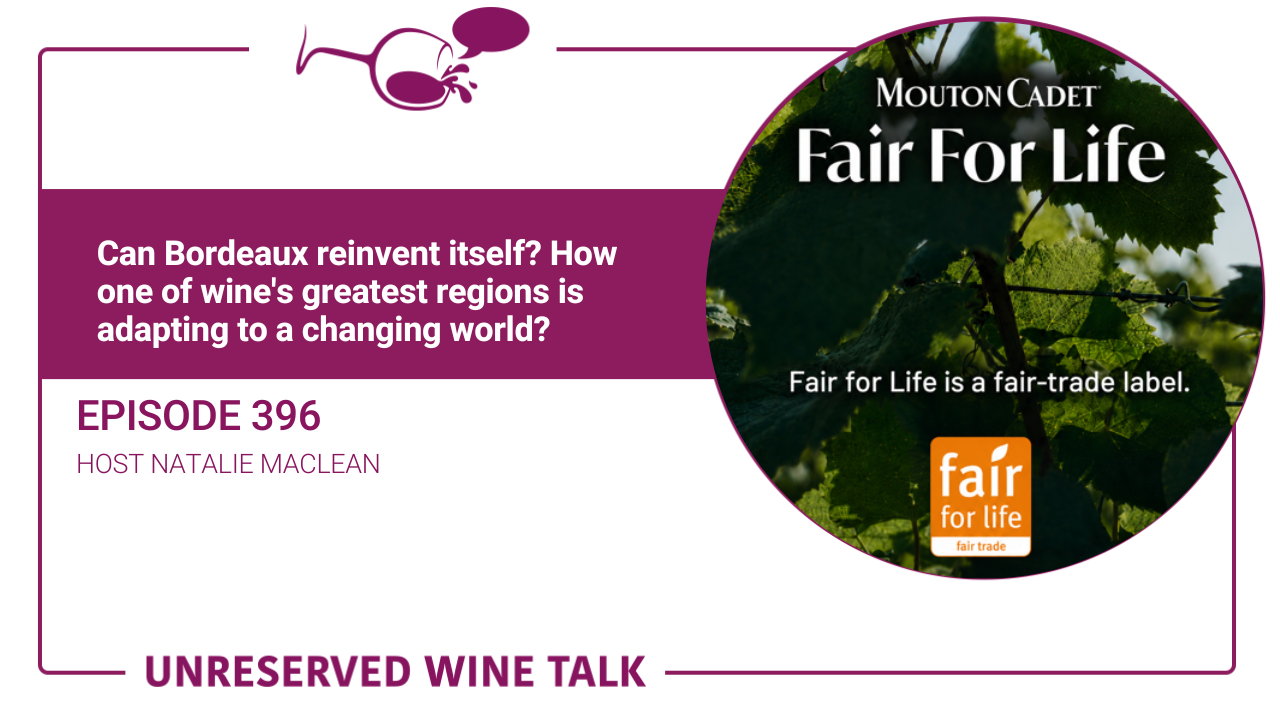
In this episode of the Unreserved Wine Talk podcast, I’m chatting with Véronique Hombroekx, the Managing Director for the Mouton Cadet Brand and Jérôme Aguirre, Director, Mouton Cadet Wines, about their Fair for Life program.
You can find the wines we discussed here.
Join me on Instagram, Facebook and YouTube Live Video
Join the live-stream video of this conversation on Wednesday at 7 pm eastern on Instagram Live Video, Facebook Live Video or YouTube Live Video.
I’ll be jumping into the comments as we watch it together so that I can answer your questions in real-time.
I want to hear from you! What’s your opinion of what we’re discussing? What takeaways or tips do you love most from this chat? What questions do you have that we didn’t answer?
Want to know when we go live?
Add this to your calendar:

Highlights
- Why did Canada become one of the first markets chosen for Mouton Cadet’s Fair for Life launch?
- What does the success of Fair for Life wines in Canada reveal about today’s wine consumers?
- Why does Veronique see consumer support as a direct investment in the future of winegrowers?
- How is Mouton Cadet helping consumers understand what the Fair for Life certification means?
- Why does Veronique view consumer confusion between Fair for Life and Fair Trade as an opportunity rather than a problem?
- Why does Veronique believe Bordeaux still faces difficult challenges despite signs of optimism?
- How are changing consumer preferences forcing Bordeaux to rethink its traditional style of wine?
- Why do Veronique and Jérôme believe curiosity and humility are essential to Bordeaux’s future?
- How is Mouton Cadet helping growers become more resilient instead of pulling out vineyards?
- Why is maintaining 30% organic vineyards more realistic than pursuing organic conversion at any cost?
- What does Jérôme mean when he says the 2022 vintage is “singing” while the 2023 vintage is “dancing”?
- If Veronique could summarize Fair for Life in a single sentence, what would she want consumers to understand?
Key Takeaways
- Can Bordeaux adapt to changing tastes without losing its identity?
- N: Véronique, you’ve previously said it is a dark night in Bordeaux because we have too much volume. Is the sun coming up yet or is it still getting darker?
- V: It is still very challenging with significant overproduction and declining volume. And yes, in that context we need to reflect and adapt. Bordeaux is traditionally known for complex red wine, but that no longer fully matches what many consumers are seeking according to a recent study we did. This study suggests growing demand for wines that are more approachable. Softer tannin, more fruitiness, and greater drinkability. White wine are also becoming more appealing to younger consumers because of their freshness and aromatic profile. So we need also to listen be humble. and change. Fair for life will not bring the solution, but it’s probably also part of the solution.
- How are modern Bordeaux producers, like Mouton Cadet, creating wines with more energy, smoothness, and drinkability for today’s consumers?
- The climate is king, but I think the 2022 vintage is singing and 2023 is dancing. We are making wine alive and our target is to make great, vibrant, dynamic wine. And this is super important because we are working with the team and the farmer, we want to catch the fruit during the harvest to have something really generous and perceive when you smell and when you taste the wine and always to be elegant drinkability, softness. This is a key because a new consumer doesn’t want to drink an old-style Bordeaux with many, many tannins and, too dry.
- Bordeaux is pulling up thousands of hectares of vines because of this overproduction. Does your model offer a way out for some of the wine growers?
- If we pull out some vines, it’s because we have managed the vineyard to limit the risk. Because frost, climate problems. Our model is made to improve the management of the vineyard and the key. Resilient. If you are resilient, if you have the capacity to produce quality and quantity every year. A farmer is much more resilient than many people you know.
About Mouton Cadet’s Fair for Life Certification
The Fair for Life fair-trade certification scheme officially recognises Mouton Cadet’s commitment and makes them unique in Bordeaux. The aim of this certification is to pursue existing initiatives with their winegrowers in response to a range of challenges: economic (more resilient operating models), environmental (support for the agroecological transition) and social (training, transmission of skills). Each bottle of Mouton Cadet with the Fair for Life label bears witness to the combination of a shared passion and a long-term commitment.
Resources
- Learn more about Mouton Cadet
- Unreserved Wine Talk
- My Books:
- Wine Witch on Fire: Rising from the Ashes of Divorce,Defamation, and Drinking Too Much
- Audiobook:
- Audible/Amazon in the following countries: Canada, US, UK, Australia (includes New Zealand), France (includes Belgium and Switzerland), Germany (includes Austria), Japan, and Brazil.
- Kobo (includes Chapters/Indigo), AudioBooks, Spotify, Google Play, Libro.fm, and other retailers here.
- Wine Witch on Fire Free Companion Guide for Book Clubs
- Audiobook:
- Unquenchable: A Tipsy Quest for the World’s Best Bargain Wines
- Red, White, and Drunk All Over: A Wine-Soaked Journey from Grape to Glass
- Wine Witch on Fire: Rising from the Ashes of Divorce,Defamation, and Drinking Too Much
- My new class, The 5 Wine & Food Pairing Mistakes That Can Ruin Your Dinner And How To Fix Them Forever
Tag Me on Social
Tag me on social media if you enjoyed the episode:
- @nataliemaclean and @natdecants on Facebook
- @nataliemaclean on Twitter
- @nataliemacleanwine on Instagram
- @nataliemaclean on LinkedIn
- Email Me at [email protected]
Thirsty for more?
- Sign up for my free online wine video class where I’ll walk you through The 5 Wine & Food Pairing Mistakes That Can Ruin Your Dinner (and how to fix them forever!)
- You’ll find my books here, including Unquenchable: A Tipsy Quest for the World’s Best Bargain Wines and Red, White and Drunk All Over: A Wine-Soaked Journey from Grape to Glass.
- The new audio edition of Red, White and Drunk All Over: A Wine-Soaked Journey from Grape to Glass is now available on Amazon.ca, Amazon.com and other country-specific Amazon sites; iTunes.ca, iTunes.com and other country-specific iTunes sites; Audible.ca and Audible.com.
Transcript
Natalie MacLean 00:00:00 Can Bordeaux adapt to changing wine tastes without losing its identity? Bordeaux is pulling up thousands of hectares of vines because of overproduction. How does Mouton Cadet’s model offer a way out for some wine growers? And how are modern Bordeaux producers like Mouton Cadet creating wines with more energy, smoothness, and drink ability for today’s consumers? In today’s episode, you’ll hear the stories and tips that answer those questions in Part Two of our chat with Veronique Hombroekx, the managing director for the Mouton Cadet brand, and Jérome Aguirre, director of Mouton Cadet Wines, about their Fair for Life program. If you didn’t catch Part One of our conversation, no problem. You can still listen to this episode. But then when you finish, go back and have a listen. By the end of our conversation, you’ll also discover why Canada became one of the first markets for Mouton Cadet’s Fair for Life launch. What the success of fair for life wines in Canada reveals about today’s wine consumers. Why Veronique sees consumer support as a direct investment in the future of wine growers. How Mouton Cadet is helping consumers understand what the Fair for Life certification means. How consumer confusion between Fair for Life and fair trade can be viewed as an opportunity. And why maintaining 30% organic vineyards is more realistic than pursuing organic conversion at any cost.
Speaker 2 00:01:34 Do you have a thirst to learn about wine? Do you love stories about wonderfully obsessive people, hauntingly beautiful places, and amusingly awkward social situations? Well, that’s the blend here on the Unreserved Wine Talk podcast. I’m your host, Natalie MacLean, and each week I share with you unfiltered conversations with celebrities in the wine world, as well as confessions from my own tipsy journey as I write my third book on this subject. I’m so glad you’re here. Now pass me that bottle, please, and let’s get started.
Speaker 3 00:02:17 For your food and drink calendar this week, July 1st is a packed one. Canada Day, Creative Ice Cream uFlavor Day, International Fruit Day, and National Media Day. Ice cream is technically a frozen emulsion, and a splash of alcohol lowers its freezing point for a noticeably softer scoop. So blend up a whiskey and roasted pecan milkshake or pour a chocolate stout over vanilla ice cream for an adult float. For the Madeira side of things, pour it chilled on its own. Mix a Madeira and tonic, or use a splash in a mushroom sauce for a savoury nod to the holiday. For Canada Day, raise a glass of Canadian wine, spirits, beer, or cider. July 2nd is National Anise day. Anise gets its black licorice flavour from the anise seed, prized in ancient Rome for its digestive properties. Sip it neat as a traditional after dinner digestif. Stir a splash into your morning espresso for a cafe carretto, or build an Anise espresso over ice. Pour a light spritz or set out a small glass with almond biscotti. July 3rd combines Eat Your Deans day – toot toot – National Chocolate Wafer Day and National Caesar Salad Day. Coffee beans aren’t legumes. They’re the roasted pits of a cherry like fruit. Shake up an espresso martini. Pour dark coffee liqueur over gelato. Set out white bean dip with a pale ale, or pair a bean salad with a dry rosé.
Natalie MacLean 00:03:54 July 4th brings National Barbecue, Spare Ribs Day and July 4th celebrations in the US. The tradition of pairing smoky barbecue with cold drinks goes back centuries to community pig roasts in the American South. Pour a smoky mezcal margarita with sticky ribs. Crack open a cold lager at the grill for a whiskey highball, or build a Caesar cocktail with extra horseradish on the side. July 5th is National Apple Turnover Day. Farmers have fermented apples into hard cider since at least 55 BC, when arriving Romans discovered the practice already underway in England. Sip a bone dry sparkling cider with a warm, buttery turnover. Mix a rum and hot apple cider toddy if the evening turns cool. Pour calvados and soda or open a late harvest Riesling. July 6th is National Fried Chicken Day. Sparkling wines’ natural acidity and effervescence cut straight through the rich saltiness of fried food. Pop a bottle of crisp Champagne with a bucket of extra crispy chicken. Sip a tart cherry sour beer between bites. Pour an off dry Riesling, a Pilsner or a dry cider.
Natalie MacLean 00:05:05 July 7th closes the week with four occasions. World Chocolate Day, National Dive Bar Day, Chocolate Day and National Strawberry Sundae Day. The Mayans, the ancient Mexican civilization that spanned 3500 years, valued chocolate so highly that they used the cacao beans as currency while also brewing them into spiced ceremonial drinks. Savour an Imperial chocolate stout, shake a dessert martini with premium vodka and dark cacao liqueur, or pour a sparkling Rosé alongside fresh strawberries. And for your weird but wonderful scientific fact this week, the colour compounds in wine called anthocyanins are the exact same family of pigments that turn leaves red and orange in the fall, which means that gorgeous autumn hillside and that glass of Cabernet in your hand are running on the same basic chemistry. Grapes just hold on to their branches longer. OK, on with the show.
Natalie MacLean 00:06:09 So what’s the projected fun size for 2025? The development fund size once the 2023 vintage ships to France and Canada. Do you have any predictions?
Jérome Aguirre 00:06:20 I think the fund will reach around the €260,000 thanks to the consumers. And it’s good because we can invest to invest more for many different projects. And this is good because we can see the interests out of the consumers from our farmers who are working with this Fair for Life. And I think this is good in a good way, this trajectory is really unique, as explained Véronique, in Bordeaux. And I think it’s a good way and it’s optimized way for the future.
Natalie MacLean 00:06:50 Absolutely. That sounds marvelous that it’s going to grow to 260,000. No doubt also helped by the fact that you are the number one premium selling wine from France, certainly in our market. You really win the categories, but that’s great that it all works together like that. Veronique, why did Canada make the short list alongside France for the Fair for Life launch. Why did you want to launch here?
Veronique Hombroekx 00:07:14 So first of all, there is a great history between Canada and Mouton Cadet because we started in Quebec in 1954 and in Ontario in 1962. So quite a long time ago. So this is already a good reason why. But also I think we discover that it’s a market that is very sensitive to sustainability and very receptive to credible initiatives. And we did also some research, and one consumer over three are willing to pay for wines that have a certification. So there is a kind of sensitivity, from a consumer point of view, to how the wine is bottled. It’s not only having a good wine, of course. You need to have quality. Quality is, as I said, is just the first step. But then if you can offer something more and if your consumer is willing to pay for it because then they feel part of the story.
Natalie MacLean 00:08:28 Absolutely. And so when did it officially launch in Canada? We’ve got the bottle here. I see the Fair for Life. So how long has this been in the market now?
Veronique Hombroekx 00:08:36 By I think it was December 24th. I need to go back on my memory on this one. I think it was December.
Jérome Aguirre 00:08:44 Yes, it was a vintage 22 December 24th.
Veronique Hombroekx 00:08:47 Yes.
Natalie MacLean 00:08:48 Okay. So it’s been a…
Veronique Hombroekx 00:08:49 Vintage 22. This is for sure.
Natalie MacLean 00:08:53 Right on the bottle.
Veronique Hombroekx 00:08:53 If I remember well, that was December 24th.
Natalie MacLean 00:08:55 Okay, great. So it’s been here a little bit, but not long. So Veronique, by December 31st, 2024, 1.5 million bottles had sold with the Fair for Life, with 20% of them in Canada, which is phenomenal. What does that 20% tell you about Canadian consumers? You’ve mentioned some interesting statistics. 1 in 3 really care about the sustainability message and is willing to pay for it. Is there anything else that comes to mind? Other than we have good taste, of course.
Veronique Hombroekx 00:09:26 No. And this is as I said, this is the first step. This is the price to play. If you don’t have quality, I think you can have all the label you want. But if quality is not there, then you will not buy again. So that’s the first way to address your consumer needs. But I think it just confirms that the approach resonates with Canadian consumers. And probably that’s as I said it. It is creating a different form, but it is also taking the consumer into a longer journey. And I think they feel part of the project and this is what I like.
Natalie MacLean 00:10:06 Yes, absolutely. And Veronique, are you concerned that consumers see the Fair for Life logo on the bottle and assume it’s the exact same as Fair Trade?
Veronique Hombroekx 00:10:17 Yes. There is sometimes an initial confusion with Fair Trade, but for us it’s a real opportunity rather than a concern because Fair for Life is specifically designed for a sector like wine, and it goes beyond a simple label. It covers the entire value chain from the vineyards to the consumer. But we also have a responsibility to educate consumers. So we must explain it clearly. And once they understand it, I think they appreciate the depth and the credibility of the approach even more and feel, as I said, like part of the story.
Natalie MacLean 00:11:10 That’s great. And how are you educating Canadian shoppers on what the orange logo actually stands for? So that’s on the back of the bottle. But we’ll include in the show notes the bottle front and back for those who are listening to us.
Veronique Hombroekx 00:11:24 So I think we have been taking a very pragmatic approach first. The label itself is key. It is visible, it creates a kind of curiosity, but it is really just the starting point. We need to communicate, to educate with clear, simple messaging in store through the QR code. On the back label of Mouton Cadet Rouge you have a QR code. If you go through this QR code, you scan it and then you been redirected to a beautiful video, a small movie that explain you what Fair for Life is all about. But what we did as well – and that was especially last year and we will redo it this year – we had a dedicated social media campaign focused on this Fair for Life label. What we did last year in Canada, which reached around 3 million people. And this is a good way as well, to explain what Fair for Life is all about. And we will redo this campaign again this year. But we also need to convince journalists, opinion leader like you, that Fair for Life is not just a gimmick, but a meaningful commitment.
Natalie MacLean 00:12:45 Yes. It’s not greenwashing or just a marketing thing. Yes, sign me up. I’m convinced. So you’ve done your job here. But it’s an ongoing process. It’s a story to keep telling over and in different ways on different platforms so that you reach different audiences.
Veronique Hombroekx 00:13:02 And we need to get some ambassador as well talking about that initiative. And I think consumer, they have a lot of curiosity. And once they are curious, then they are willing to take time to understand. And this is what I like.
Natalie MacLean 00:13:17 Absolutely. Now Veronique, you’ve previously said it is a dark night in Bordeaux because we have too much volume. Is the sun coming up yet or is it still getting darker and how does Fair for Life help?
Veronique Hombroekx 00:13:29 I will be very honest with you. It is still very challenging, with significant overproduction and declining volume. And yes, in that context we need also to reflect. We need to adapt. Bordeaux is traditionally known for complex red wine, but that no longer fully matches what many consumers are seeking. A recent study. We did some study as well with the CVB. This study suggests growing demand for wines that are more approachable with softer tannin, more fruitiness, and greater drink ability. White wine are also becoming more appealing to younger consumers because of their freshness and automatic profile. So we need also to listen. Being humble. Probably Bordeaux need to change, not from from one day to the other, but slowly surely listening to our consumer and also moving to a quality that is addressing the consumer need. And you know what? Therefore, Fair for Life will not bring the solution, but is probably also part of the solution. It is not because you will drop the price dramatically because you have too much volume. Then you need to drop your price to get more volume and to get that volume out to the consumer. No, this is not sustainable. This is taking your quality down. We need to go to the other side. We need to understand what consumers are looking like. And we need to provide to give to the consumer what their desire. And this is a work that we are going through together with Jerome and his team. We listen to the consumer. We take also climate change into consideration because this is also part of the game. So are we on the dark side or are we seeing the light at the end of the tunnel? I’m quite positive I’m looking to the light at the end of the tunnel, but we still have a lot of work. We need to take this with humility and taking seriously the consideration of the consumer, because this is what counts. He is the one who will drink the wine. And this young generation coming up – and I have young generation in my family as well – they are not looking at the wine like I do like you do, like some great connoisseur are doing. So we need to respect that.
Natalie MacLean 00:16:32 Sure. They’re looking for something that’s as they say is crushed or sessional. But that story, though of Fair for Life is still part of that package that the younger generation really values as well. They want authenticity. They want to know where this comes from for any product they buy or consume. So this is, as you say, an important part of the package, the Fair for Life.
Jérome Aguirre 00:16:53 Yes. I think the Fair for Life is a material value for our wines. Fair of Life is interesting because we support curiosity. Humility first, I think because it’s really challenging. Every year we are working with the farmers to find the best way, with a good cost, everything and the good quality. But we, in addition, we have this curiosity and as Veronique explained, we want to explore the future. We are working at a high part, we are looking at the light and we can imagine and, you know, in the wine, we need to have many imagination and we can imagine there is light. We are convinced both with Véronique, as with all the team, there is a light somewhere, and we are in a good way to find this light.
Natalie MacLean 00:17:40 I love that metaphor.
Jérome Aguirre 00:17:41 The light fight.
Natalie MacLean 00:17:42 The light for vision and leadership and seeing the future. And the light, of course, for the vines themselves. Now Veronique, with Gabriel and company, you were the first Bordeaux branded wine to put the orange Fair for Life logo on the front label first. What did that decision cost or earn you?
Veronique Hombroekx 00:18:01 I think this decision to highlight this Fair for Life reflects the famous, strong, long term commitment rather than a short term gain. So Fair for Life is a kind of recognition of the journey that we are going through, because it has required significant investment from adapting agricultural practices to implementing a full audit process, supporting our wine grower in meeting high demand standards, quality standards. And with each audit, the level of requirements becomes even more strict, which pushes us but also the entire value chain to continuously improve. So we are here talking about continuous improvement through all the value chain. And I really love that label because it is demonstrating the strong commitment we have for the wine grower, for the community, but also for the future. And at the same time, it is strengthening our differentiation in the market. And this is then, for me, a kind of win win situation. This is putting through the DNA of Mouton Cadet. It’s all about sustainability and transparency.
Natalie MacLean 00:19:46 Absolutely. And given the volume issue that you’ve mentioned, you do need to do things that differentiate and are authentic and have a great story. Now Jerome, Bordeaux is pulling up thousands of hectares of vines because of this overproduction. Does your model offer a way out for some of the wine growers? Are you looking at that aspect too, or how do you. Does that come into your model at all?
Jérome Aguirre 00:20:10 Yes, it’s a disaster because he’s a part of a story of Bordeaux. To have this vineyard, this fantastic vineyard around the city. If we pull out some vines, it’s because we have managed the vineyard to limit the risk. Because frost. Because I don’t know. climate problems. Our model is made to improve the management of the vineyard. And what we want is to work with winegrowers resilient and viable. This is a key, resilient. If you are resilient, if you have the capacity. For farmers, which is important, is to produce quality and quantity every year. That’s why we are working with this community to reduce the risk and to optimize the cost and to optimize the quality, but I think we are very resilient. A farmer is much more resilient than many people.
Natalie MacLean 00:21:08 They have to be. My goodness, if you’re dealing with Mother Nature, you just realize that it’s not a business for control freaks. You’re going to have to roll with whatever nature gives you. So 30% of your vineyards now are organic or in conversion to organic. What’s a realistic target for that percentage, say, in five, ten years?
Jérome Aguirre 00:21:31 Today, I think that our aim target. If we can maintain 30%, I think is fine. After the key is between our farmers is to exchange good practice and step by step. Our trajectory is no pesticide, is to work with mechanical cultivation, to have cover crops. And we are improving every year, step by step. Perhaps not with a label, but to have an organic community. But this can be a long way because you have the technical part, you have the economic part, you have the transmission part for the properties. And it’s a global view. For each property, we have a singular process.
Natalie MacLean 00:22:16 Mouton Cadet phased out chemical weed killers completely from 2019 onward.What’s replaced them in practice? Or is that the cover crops you’re talking about, or what’s been the most effective threat?
Jérome Aguirre 00:22:28 Red clover is beautiful. If you visit Bordeaux now, everything is red and its fantastic, is beautiful. But after you have all the new technical mechanics, soil cultivation and this is interesting too, and slowly exchanging the good practice and the experience, we are investing with our farmers to improve this part, because our target is when you buy a bottle of Mouton Cadet and you analyze a bottle, you don’t have pesticide inside the bottle. And this is more than unique. And I can say to you it’s a very unique commitment to have zero pesticide inside the bottle. When you open a bottle of Mouton Cadet, you don’t have pesticides inside.
Natalie MacLean 00:23:10 That is very impressive. Absolutely. And now the 2023 vintage will carry the Fair for Life label. How does the 2023 wine differ in the glass from 2022?
Jérome Aguirre 00:23:24 The climate is king, but perhaps I think 22 is singing and 23 is dancing. We are making wine alive and our target is to make vibrant, dynamic, and truly wine alive. This is super important and with the team, because we are working with the team and the farmer. We want to catch the fruit during the harvest to have something really generous and perceive. When you smell, when you taste the wine. And always, as Veronique asks me to say, to be elegant, drink ability, softness. This is a key because the new consumer doesn’t want to drink an old style Bordeaux with many, many tannins and too dry.
Natalie MacLean 00:24:08 That’s true. That style is changing. Absolutely. All this talk. What does it taste like? So I have the bottle which I’ve been showing and we’ll put in the show notes for the logos. But I would love to hear from both of you what you get in the glass, maybe. Jerome, you want to start?
Jérome Aguirre 00:24:31 First of all, when I’m tasting this wine, I have always a lot of emotion. Because this time commitment. I’m thinking about our farmers, about the diversity of the territory of Bordeaux. And it’s a lot of work. And after, if you smell this wine, we can see all the expressive palate of the Bordeaux with the red fruit, the black fruit, the spicy. It’s attractive.
Natalie MacLean 00:24:56 That’s beautiful. It’s so alive.
Jérome Aguirre 00:24:59 Yes. And you have this freshness. You don’t have too much, but you have this freshness.
Natalie MacLean 00:25:04 Oh, yes. Makes me want to eat.
Jérome Aguirre 00:25:06 If you want to drink again, you need to have this freshness. Yes, we want to be different. We have farmers with clay soil, gravel, soil, limestone soil and all in during the blending is really interesting because we are working to find the good balance between freshness, texture, structure and drink ability. And we only want to drink a glass now.
Veronique Hombroekx 00:25:30 You know what? I forgot my glass of wine [laughter].
Natalie MacLean 00:25:34 That’s ok. I’m sure you tried this one before, though [laughter].
Veronique Hombroekx 00:25:37 Jerome is talking about his experience in a glass. Much better than I could do. And what I love is when he say. 22 was dancing and 23 years is singing. This is absolutely enjoyable.
Natalie MacLean 00:25:53 This is so good. The wine. Some people think, what does fresh mean? I get what you’re saying. But it is just so alive. It makes your mouth water. The fruit is not heavy or dry. It’s just joyously ripe. But again, it’s not a fruit bomb. It’s still got that elegance. And the length goes on and on. So you’ve got a really well-made wine that still, I think, is what people are looking for. Very modern style, very sociable. It’s all those things. But it also to me says, get me some food because I think this would be marvelous with food. Do you have some food pairings?
Jérome Aguirre 00:26:30 With cheese, for sure. There are many pairings, but if you want to. You can have the pairing with the food, but you can taste this wine if you want to discuss with your best friend and to change the world, it’s the perfect bottle.
Natalie MacLean 00:26:44 To change the world [laughter]
Jérome Aguirre 00:26:45 Change the world.
Natalie MacLean 00:26:47 Pairs well with plans for world domination… change the world.
Jérome Aguirre 00:26:51 You can reimagine everything and the Fair for Life everywhere in any company.
Natalie MacLean 00:26:57 Those are great tasting notes.
Jérome Aguirre 00:26:59 It is important to have smiles.
Natalie MacLean 00:27:01 Yes. Absolutely. It just feels alive. I know these are seemingly abstract terms, but I think you really have to taste it to get what we’re saying if you haven’t before. But it’s just so lively. Yes, fresh, but it’s got this length on it. And it’s just so juicy. It makes you just want to go back to the glass again and again.
Veronique Hombroekx 00:27:20 It’s cool.
Natalie MacLean 00:27:21 Tasting note, more [laughter].
Veronique Hombroekx 00:27:26 You know, I’m very jealous because I don’t have my glass of wine.
Natalie MacLean 00:27:30 We know you’ve tried it at least a couple times before, Veronique, so we know you know what we’re saying here. But, Veronique, if you had to put one sentence on the back label about what Fair for Life means for Mouton Cadet, what do you think you would say or put?
Veronique Hombroekx 00:27:46 So I think first of all, Fair for Life is not just a label. I think it’s a philosophy. It’s a way of living. It’s a way of working. It is our commitment to build a more human Bordeaux, where every decision we make honours the people behind the wine, the lands that cultivate, and the future we choose to shape together. It’s a beautiful story. And this is my promise to you. This is the Mouton Cadet experience.
Natalie MacLean 00:28:24 Wow. Beautifully put. A more human Bordeaux. That’s poetic. I love it. I think this is a good place to wrap up, but let me ask you both. Is there anything we haven’t covered that you wanted to mention as we we bring the conversation to a close?
Veronique Hombroekx 00:28:43 No, I think it was a nice discussion. So thank you for that. And I think there is a special link between Canada, Canadian people and the Mouton Cadet. It’s a long story. Actually it’s 1954 and 1962.
Natalie MacLean 00:29:01 Yes, absolutely.
Veronique Hombroekx 00:29:02 A long story, and my wish is that we can permanently seduce the Canadian consumer, because you always have to question yourself and nothing is granted. So thank you. Thank you for drinking Mouton Cadet, because you’re making the life of wine growers better and you participate to a beautiful story.
Natalie MacLean 00:29:26 It is our pleasure to drink this. Thank you both for making it. And it’s always great to talk to a producer who is doing things at scale, showing the leadership, showing what can be done in the industry while still staying true to their roots, if you will, and producing a terrific wine that is keeping that human element involved. So we raise my glass to you both. Cheers. So I will say goodbye for now, but the next time has to be in person with this wonderful wine, please.
Veronique Hombroekx 00:30:01 In the vineyards. You should come and visit wth our family of wine growers.
Natalie MacLean 00:30:08 Yes. Oh, that would be wonderful.
Veronique Hombroekx 00:30:10That would be a great experience. And we have even more story to tell. But if you live the story with us, then you’re part of the family.
Natalie MacLean 00:30:19 That sounds great. All right, let’s make plans. Thank you very much. Thank you, Veronique, Jerome. This has been marvelous.
Natalie MacLean 00:30:34 Well, there you have it. I hope you enjoyed our chat with Veronique and Jerome. Here are my takeaways. Number one. Can Bordeaux adapt to changing tastes without losing its identity? As Veronique noted, it’s a dark night in Bordeaux because they have too much volume. As she explains, it’s still very challenging, with significant overproduction and declining volume of sales in that context. She says Bordeaux needs to reflect and adapt. It’s traditionally known for complex red wine, but that no longer fully matches what many consumers are seeking, according to a recent survey they did. There’s now growing demand for wines that are more approachable, softer tannins, fruitier and greater drink ability. White wine is also becoming far more appealing to younger consumers because of its freshness and aromatic profile. So she says Bordeaux needs to be humble to listen and change. Fair for Life is not the entire solution, but it’s part of it.
Natalie MacLean 00:31:31 Number two, how are modern Bordeaux producers like Mouton Cadet creating wines with more energy, smoothness, and drink ability for today’s consumers? As Jerome explains, the climate is king. But he characterizes the 2022 vintage as singing and 2023 as dancing. He says we’re making wine alive and our target is to make great, vibrant, dynamic wine. This is very important because both the winery and the farmers want to catch the fruit during the harvest, to have something really generous that you perceive when you smell and taste it. This is key because the new consumer doesn’t want to drink old style Bordeaux that is tannic and too dry.
Natalie MacLean 00:32:17 And number three, Bordeaux is pulling up thousands of acres of vines because of overproduction. Jerome explains, if we pull out the vines, it’s because we have managed the vineyard to the limit of risk due to frost and climate problems. The model is made to improve the management of the vineyard and the key is resilience. If you are resilient, you have the capacity to produce both quality and quantity every year. And, he adds, farmers are much more resilient than many people you know.
Natalie MacLean 00:32:47 If you missed episode 181, go back and have a listen. I chat about Bordeaux wines with Lori Budd. I’ll share a short clip with you now to whet your appetite.
Natalie MacLean 00:32:50 You were in Bordeaux. You participated in the en premier tasting.
Lori Budd 7 00:32:55 It was a once in a lifetime experience. You get to taste the wine that is bottled from barrel, and you’re tasting the wines prior to their release. All of these enpremier tasters are there and they rate the wines. This is what allows them to determine what price point they will do, and it also allows them to sell the wine before it’s even released, which is brilliant marketing.
Natalie MacLean 00:33:20 It’s kind of like a futures market.
Speaker 7 00:33:21 Exactly. It’s the original futures market is what it is.
Natalie MacLean 00:33:29 Do you know someone who be interested in learning more about Mouton Kids leadership with the fair for life program? Please let them know about this podcast. Email or text them now while you’re thinking about it. It’s really easy to find the Unreserved Wine Talk podcast. Just tell them to search for that title or my name Natalie MacLean wine on YouTube, Apple Podcasts, Spotify, their favourite podcast app or they can listen to the show on my website at nataliemaclean.com/podcast. Email me if you have a sip, tip, question or would like to win one of six drink books I have to give away. I’d also love to hear your thoughts on this episode, or if you’ve read my books or are listening to them. Email me at [email protected]. In the show notes, you’ll find a link to take a free online food and wine pairing class with me called The Five Wine And Food Pairing Mistakes That Can Ruin Your Dinner And How To Fix Them Forever at nataliemaclean.com/class. And that’s all in the show notes at nataliemaclean.com/396. Thank you for taking the time to join me here. I hope something great is in your glass this week, perhaps Mouton Cadet Rouge with your favourite, organic, sustainable dish.
Speaker 2 00:34:40You don’t want to miss one juicy episode of this podcast. Especially the secret full bodied bonus episodes that I don’t announce on social media. So subscribe for free now at nataliemaclean.com/subscribe. Meet me here next week. Cheers!