Introduction
How does biking through wine country help you better understand the wines? Why has wine held a unique place in the Bible and our culture when so many other foods like milk, olive oil, honey, dates, and pomegranates symbolize abundance and blessing? How do the aromas and complexity of wine create such deep connections to memory in the brain? Why do so many people feel disconnected in modern life despite being more connected than ever?
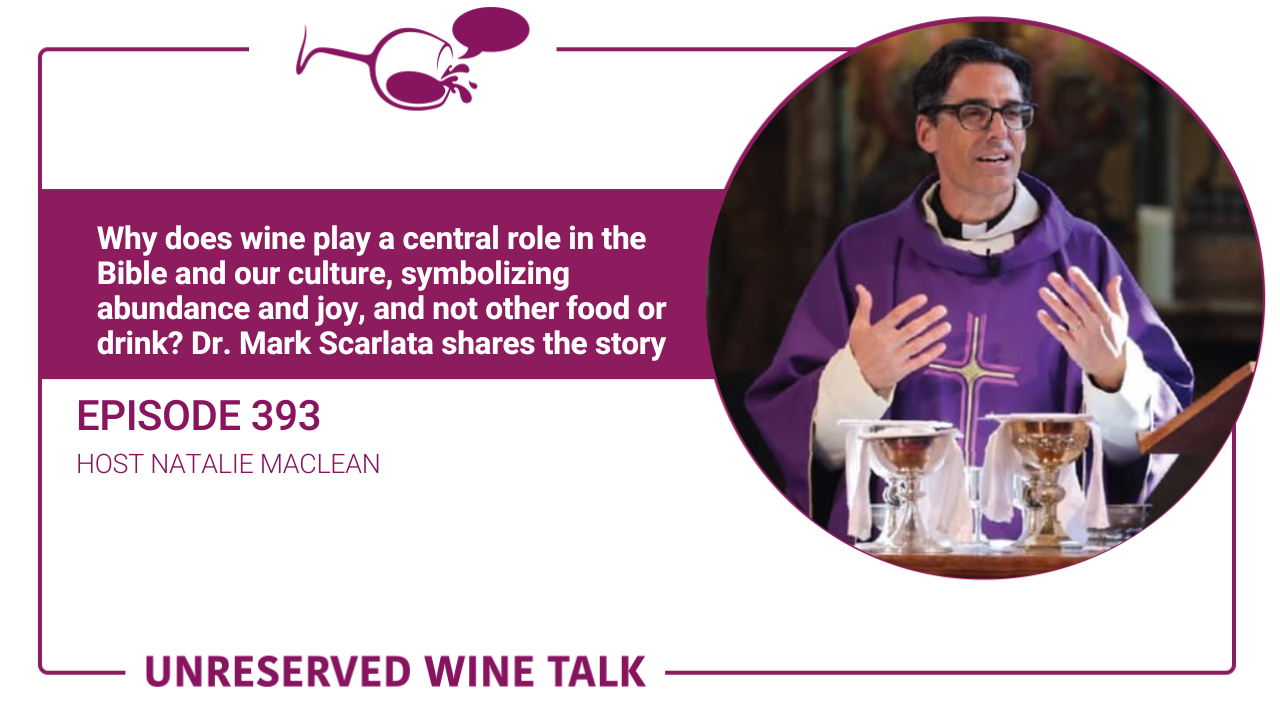
In this episode of the Unreserved Wine Talk podcast, I’m chatting with Professor Mark Scarlata, author of the new book Wine, Soil, and Salvation in the Hebrew Bible and the New Testament.
You can find the wines we discussed here.
Join me on Instagram, Facebook and YouTube Live Video
Join the live-stream video of this conversation on Wednesday at 7 pm eastern on Instagram Live Video, Facebook Live Video or YouTube Live Video.
I’ll be jumping into the comments as we watch it together so that I can answer your questions in real-time.
I want to hear from you! What’s your opinion of what we’re discussing? What takeaways or tips do you love most from this chat? What questions do you have that we didn’t answer?
Want to know when we go live?
Add this to your calendar:

Highlights
- What did cycling through French wine country teach Mark about the connection between wine, land, and place?
- Why did a biblical scholar decide to write a book about wine?
- What surprised Mark most when he began researching wine in the Bible?
- Why are wine, soil, and salvation so closely connected in Mark’s understanding of scripture?
- What does Noah’s transformation into a “man of the soil” reveal?
- Why do some commentators criticize Noah’s drunkenness when the biblical text itself seems far less concerned with it?
- What happens when wine is treated as a symbol of community and celebration rather than a source of status and exclusivity?
- How do wine’s aromas connect with the brain and our memories?
- Why does Mark think modern life leaves people feeling increasingly disconnected from the places where they live?
- How did wine become such an ordinary yet essential part of daily life in the ancient world?
Key Takeaways
- How does biking through wine country help you better understand the wines?
- N: You’ve biked up some of the Tour de France’s most brutal mountainous peaks, including the Alps and the Pyrenees. Has riding through vineyards shaped the way you read scriptures?
- M: I think one of the seeds in writing the book is, ever since we’ve lived over here for the past kind of 20 years, we always, or almost always, holiday in France, and we usually try to go to the mountains or somewhere, somewhere near. But we’ve always been near vineyards. There is something absolutely wonderful on a summer’s day of cycling through France, coming across a small village and just seeing a beautiful vineyard and a beautiful church and all of these types of things. I think France was really where I’ve had most of my schooling in wine. There is something wonderful about connecting to the land and to the place. And one of the things that I’ve always tried to do when we’re over there is tried to buy wines from the local area, to taste the land, taste the terroir and get a sense of what it’s like.
- Why has wine held a unique place in the Bible and our culture when so many other foods like milk, olive oil, honey, dates, and pomegranates symbolize abundance and blessing?
- I’m sure that it has to do with the alcohol, I’m sure that’s part of it. And wine the toil, as is said in Noah. You know, Noah’s dad predicts that Noah will kind of ease humanity of their toil. That has come from the whole story of the Garden of Eden. And you see this actually in Greek literature as well, and in Roman literature, this idea of wine is something that eases the burden of humanity. Life can just be very difficult but to sit down at the end of a day, I mean, most people were working in agriculture back in the day, but there’s something about that relaxation that it brings. But it’s also the joy.
- How do the aromas and complexity of wine create such deep connections to memory in the brain?
- I randomly came across a book by a chap called Gordon Shepherd. And he devotes a book to neuroenology. So enology is the study of wine, but neuroenology. I think he says that wine is the single most important drink in terms of engaging with our memories in different parts of the brain. And so there is something about that. Neurologically, there is something about the complexities and the smells and the taste and all these things of wine that kind of latch on, as it were, to our memories.
- Why do so many people feel disconnected in modern life despite being more connected than ever?
- We often call the first person who lived in the Garden of Eden, Adam. Adam and his wife, Eve. But Adam is a little bit deceptive, because it’s not a personal name in the very beginning of Genesis. Adam comes from adamah. So the wordplay is the biblical author’s way of saying, hey, we are literally from the soil. This is where we’ve come from and this is one of the most important connections in our lives. What you realize as you kind of get into kind of some of this biblical ideology and theology, then when you start looking at kind of the nature of our world, the nature of digital technologies, all of these different types of things that leave us with a sense of rootlessness, this sense of, you know, disconnection. Then you start thinking, oh, gosh, where are we in this world? And what are we doing to kind of establish those roots in our lives and establish, you know, kind of this idea of being rooted and producing fruit in the places where we live and in our communities and things like that.
About Mark Scarlata
Mark Scarlata is Senior Lecturer in Old Testament at St. Mellitus College, London. He is also the Vicar-Chaplain at St. Edward, King and Martyr, Cambridge, and the Director of the St. Edward’s Institute for Christian Thought. He has spoken on wine and faith internationally and continues to write on the subject.
Resources
- Connect with Mark Scarlata
- Unreserved Wine Talk Episode 222: Wine and Religion + Santa Ynez Valley with Adam McHugh
- My Books:
- Wine Witch on Fire: Rising from the Ashes of Divorce,Defamation, and Drinking Too Much
- Audiobook:
- Audible/Amazon in the following countries: Canada, US, UK, Australia (includes New Zealand), France (includes Belgium and Switzerland), Germany (includes Austria), Japan, and Brazil.
- Kobo (includes Chapters/Indigo), AudioBooks, Spotify, Google Play, Libro.fm, and other retailers here.
- Wine Witch on Fire Free Companion Guide for Book Clubs
- Audiobook:
- Unquenchable: A Tipsy Quest for the World’s Best Bargain Wines
- Red, White, and Drunk All Over: A Wine-Soaked Journey from Grape to Glass
- Wine Witch on Fire: Rising from the Ashes of Divorce,Defamation, and Drinking Too Much
- My new class, The 5 Wine & Food Pairing Mistakes That Can Ruin Your Dinner And How To Fix Them Forever
Tag Me on Social
Tag me on social media if you enjoyed the episode:
- @nataliemaclean and @natdecants on Facebook
- @nataliemaclean on Twitter
- @nataliemacleanwine on Instagram
- @nataliemaclean on LinkedIn
- Email Me at [email protected]
Thirsty for more?
- Sign up for my free online wine video class where I’ll walk you through The 5 Wine & Food Pairing Mistakes That Can Ruin Your Dinner (and how to fix them forever!)
- You’ll find my books here, including Unquenchable: A Tipsy Quest for the World’s Best Bargain Wines and Red, White and Drunk All Over: A Wine-Soaked Journey from Grape to Glass.
- The new audio edition of Red, White and Drunk All Over: A Wine-Soaked Journey from Grape to Glass is now available on Amazon.ca, Amazon.com and other country-specific Amazon sites; iTunes.ca, iTunes.com and other country-specific iTunes sites; Audible.ca and Audible.com.
Transcript
Natalie MacLean 00:00:00 How does biking through wine country help you better understand those wines? Why has wine held a unique place in the Bible and in our culture, when so many other foods like milk, olive oil, honey, dates, pomegranates also symbolize abundance and blessing? And how do aromas and the complexity of wine create such deep connections to memory in the brain? And why do so many people feel disconnected in modern life, despite being more connected than ever through our smartphones? And can wine and the soil help us find our roots again? In today’s episode, you’ll hear the stories and tips that answer those questions in our chat with Professor Marc Salata, author of the new book wine, Soil, and Salvation in the Hebrew Bible and the New Testament. By the end of our conversation, you’ll also discover why a biblical scholar wrote about wine. What most surprised Mark when he began researching wine in the Bible. Why wine, soil, and salvation are so closely connected to the understanding of Scripture. Why some commentators criticize Noah’s drunkenness when the Bible text itself seems far less concerned with it.
Natalie MacLean 00:01:17 What happens when wine is treated as a symbol of community and celebration, rather than as a source of status and exclusivity? And how wine became such an ordinary yet essential part of daily life in the ancient world.
Natalie MacLean 00:01:38 Do you have a thirst to learn about wine? Do you love stories about wonderfully obsessive people, hauntingly beautiful places, and amusingly awkward social situations? Well, that’s the blend here on the Unreserved Wine Talk podcast. I’m your host, Natalie MacLean. And each week I share with you unfiltered conversations with celebrities in the wine world, as well as confessions from my own tipsy journey as I write my third book on this subject. I’m so glad you’re here. Now pass me that bottle, please, and let’s get started.
Natalie MacLean 00:02:21 Welcome to episode 393. So what’s new in the drinks world? Well, this week in fur, feathers, and fermentation, a small winery in France made headlines this week when a veteran successfully trained a flock of rescue geese to act as natural lawnmowers and highly aggressive security guards to protect organic vines from pests and thieves.
Natalie MacLean 00:02:45 Although the social media post didn’t mention this, I’m sure those geese are very well organized with a distinct pecking order. In synthetic news, a tech savvy restaurant group in Tokyo unveiled a mechanical sommelier robot programmed with over 10,000 tasting notes that automatically projects customized, colorful animated light shows directly onto the diners tablecloth based on the flavor profile of the poured wine. Meanwhile, a home brewer in Belgium recently constructed a functioning miniature backyard roller coaster designed out of reclaimed oak beer barrels and copper brewing piping to automatically transport chilled bottles directly from his cellar to his outdoor patio table. Now it makes me wonder what it’s like being his next door neighbor. Fun times, I suppose if you get invited over. Otherwise, I think a lot of racket and a community pottery studio in California started a viral media trend called Throw and SIP, where participants attempt to sculpt clay replicas of a classic Bordeaux wine bottle on a rapidly spinning potter’s wheel while holding a full glass of Cabernet Sauvignon in their other hand. At first I thought, oh, cool, they’re throwing and smashing those misshapen clay bottles they’ll never use.
Natalie MacLean 00:04:04 Great way to vent. And maybe it’s similar to the European aristocratic tradition of throwing wine glasses into the fireplace after they drank their wine. The idea back then was that a glass used for a truly important toast, especially to honor a person or a king, was considered too sacred to ever be used for anything ordinary. Again, drinking from it afterwards would somehow diminish the moment. So you threw it into the fireplace to destroy it, ensuring it could never be used for a lesser purpose. There’s also a superstition layer to this breaking of glass. It was considered good luck in many cultures, the belief being that a loud, shattering noise scares off evil spirits or bad fortune. So throwing the glass wasn’t just a romantic gesture. Sometimes it was also a protective ritual. Anywho, in pottery, Throwing is the term for shaping clay on a spinning wheel. Sadly, it has nothing to do with the endlessly satisfying feeling of hurling bottles across the room and smashing them on the other wall. The word comes from the Old English word thrawn, which means to twist or turn, which describes what your hands are doing as the wheel spins and you press and pull the clay into shape.
Natalie MacLean 00:05:21 In more serious news, a group of 14 California winery executives flew to Washington this month to lobby for their products to go back on Canadian liquor store shelves. The delegation met with 25 House of Congress members, four senators and Canadian provincial representatives. The group argued that the dispute has become central to the health of U.S. wineries, because Canada had been the largest export market for American wine until last year. Meanwhile, the numbers confirm exactly how well Canadian products have filled that gap. Brown-Forman, the Louisville parent of Jack Daniel’s Woodford Reserve, and Herradura, reported that Canada was the largest drag on its fiscal 2026 results, with net sales down nearly 60% as American made products remain off shelves in most Canadian provinces. Personally, I am sure we could work out something really quickly if the man with the spray tan stops trying to terrify our auto industry out of existence in a weird but wonderful science note. Wine doesn’t just smell of grapes, it gets its astonishing range of aromas from esters, terpenes, seals, and hundreds of other volatile compounds that form during fermentation and barrel aging.
Natalie MacLean 00:06:39 A single sip of a well aged red can register over 400 distinct chemical compounds on a gas chromatograph. The reason trained sommeliers can detect specific aromas like saddle leather or pencil shavings is because those descriptors mapped directly to actual chemical families. Guayaquil, a byproduct of oak toasting, really does smell like smoke and vanilla. Three mercantile hexane oil, a Thiele in Sauvignon Blanc, and a little tasting descriptor I’d like to throw out in a restaurant when people are listening, is literally the same compound responsible for the smell of grapefruit. Your nose has been doing analytical chemistry all along. For your drinks calendar this week, June 10th, is National Iced Tea Day, and its origin story belongs to a desperate tea merchant at the 1904 World’s Fair in Saint Louis. He was trying to sell hot tea during an unexpected heat wave, when fairgoers kept walking past his booth without stopping. He poured his brew over ice and created an instant sensation. Iced tea is now the second most popular beverage in the world, after water, and in the US, it makes up about 85% of all tea consumed.
Natalie MacLean 00:07:55 Celebrate by mixing a classic Long Island iced tea, which famously contains no actual tea. Instead, it’s a potent cocktail combining five different liquors vodka, white rum, gin, tequila, and triple or orange liqueur, simple syrup, lemon juice and cola. June 11th is National Corn on the Cob Day. A single ear of corn typically has an even number of rows, almost always 16, because the rows develop in pairs from a single kernel. It’s one of those facts that sounds made up until you walk out into them, their corn fields and count them their ears. By golly, it’s true. Celebrate with a sweet corn and white wine pairing to see which style handles the sweetness best. Host a butter versus no butter tasting while comparing your drinks. June 12th is Red Rose day, which also happens to be International Falafel Day. A popular Middle Eastern dish of deep fried balls or patties made from ground chickpeas, fava beans, or a combination of both, it’s a great excuse for botanical pairings. Food historians trace falafel back to ancient Egyptian Copts, who used fava beans as a meat substitute during lent.
Natalie MacLean 00:09:13 Celebrate the food by stirring up a crisp botanical gin and tonic, garnished with cracked coriander seeds, fresh parsley and a squeeze of lime to mirror the herbs in the dish, or pour an ultra dry, mineral driven sauvignon blanc to match the bright herbaceous notes of a tahini drizzled plate. That smooth, nutty paste made from ground hulled or hulled sesame seeds. June 13th is a double holiday. National Rosé Day and World Gin Day both fall on the second Saturday of June. On the rosé side, the category is actually one of the oldest styles of wine in recorded history favored by ancient Greeks who viewed drinking dark, undiluted red wine as uncivilized. Global rosé sales doubled between 2002 and 2022. So blend up a frozen with frozen strawberries and a splash of elderflower liqueur for the most photogenic patio drink of the season. Or compare rosés from different regions to see how many shades of the sunset fit into one afternoon on the gin side. Dutch courage traces directly back to Geneva, the predecessor of gin that English soldiers consumed before battle during the 30 Years War.
Natalie MacLean 00:10:26 Fought primarily in Central Europe from 1618 to 1648. They used it to steady their nerves. Thus, Dutch Courage gin and tonic was invented as medicine, since British soldiers in India were required to take quinine to prevent malaria and mixed it with gin to make the bitterness bearable. Celebrate by hosting your own. Find your ideal garnish challenge with cucumber, citrus, fresh herbs, and whatever else is lurking in the crisper veggie drawer. June 14th is National Bourbon Day. Legend has it that Reverend Elijah Craig first produced bourbon on June 14th, 1789, after charring the inside of an old barrel that had previously held fish to eliminate the smell, and then discovered that whiskey, aged in that barrel came out mellower and sweeter than anything he’d made before. Praise God! By law, bourbon must be made from at least 51% corn aged in new charred oak barrels and produced in the US, though of course, with the ban on US products in Canada, a number of producers in this country now make bourbon style whiskeys. I did air quotes around bourbon style.
Natalie MacLean 00:11:38 I think there’s even one named Bourbon. Bourbon? Those rascals. In 1964, a congressional resolution designated Bourbon as America’s native spirit, meaning nowhere else in the world can legally call their whiskey bourbon. Every barrel can only be used once for bourbon, which is why used bourbon casks are so beloved by Scotch distillers. Celebrate by making an old fashioned cocktail the slow way, muddling sugar with bitters before the bourbon even goes in, because patience is rewarded in the glass. Or run a rye versus bourbon. Compare and contrast. Pour alongside a snack lineup built around caramel smoke and anything grilled. And challenge everyone to invent dramatic tasting notes like old library and campfire philosopher. June 15th is Beer Day Britain to celebrate the date the Magna Carta was sealed in 1215, and clause 35 of that landmark document standardized the measure of ale across England, making it the only human rights charter in history to also protect the size of your pint. Try a black and tan drink by carefully layering dark stout over pale ale in a single glass and watching the two not immediately mix.
Natalie MacLean 00:12:59 June 15th is also National Lobster Day. These crustaceans critters can live for decades and continue growing throughout their lives. Celebrate by pairing lobster with sparkling wine, since the acidity cuts through the richness beautifully and conduct a butter versus no butter taste test alongside different pours. To settle the question once and for all. And don’t forget to wear that embarrassing plastic bib. June 16th finishes the week with National Fudge Day and National Gin Day, which many bars observe as a separate date from World Gin Day because it’s really good for business. On the fudge side, one story traces the confection to 1886, in Baltimore, where a candy maker accidentally crystallized a batch of caramels landing on something better. Celebrate by pairing dark chocolate fudge with a rich tawny port whose nutty, oxidized notes cut through the richness in exactly the right way, or shake up a velvety chocolate martini with a dark creme de cacao and cream. On the gin side of June 16th. The trivia worth knowing is that juniper berries, which give gin its defining flavor are technically not berries at all, which sounds like a Cliff Clavin at the cheers bar.
Natalie MacLean 00:14:17 Did ya know kind of thing. They’re actually seed cones, the same botanical category as a pine cone, just much smaller and far more fragrant. Back to today’s episode. Congratulations to Georgina Bencic from Toronto, who has won a copy of Acquired Tastes The Lives and Recipes of Eight Culinary Ambassadors by James Chatto, and to Karina Eriksson from Teresa Sweden, who’s won a copy of Why We Drink Too Much? The New Science of Alcohol by Doctor Charles Knowles. If you’d like to win a copy of one of seven books I have to give away from previous episodes, please email me and say, hey, I’d like to win. It doesn’t matter where you live, I’ll choose seven winners randomly from those who contact me at Natalie at Natalie MacLean dot com. Keep them for yourself or give them as gifts. And if you’re reading the paperback or e-book or listening to the audiobook of my memoir, Wine Witch on Fire Rising from the Ashes of Divorce, defamation, and Drinking Too Much, a national bestseller and one of Amazon’s best books of the year.
Natalie MacLean 00:15:20 I’d love to hear from you at Natalie at Natalie MacLean dot com. There’s also a terrific free guide for book clubs. I’ll put a link in the show notes to all retailers worldwide at Natalie MacLean. Com forward slash 393. Okay, on with the show. Mark Scala is the senior lecturer in Old Testament at Saint Mellitus College, London. He is also the vicar chaplain at Saint Edward King and Martyr, Cambridge, and the director of Saint Edward’s Institute for Christian Thought. He holds a master’s degree from Yale Divinity School and a PhD from Cambridge University, and he has spoken on wine and faith internationally and continues to write on those subjects. And he joins us now from Cambridge, England. Welcome, Mark. We’re so glad to have you here with us.
Mark Scarlata 00:16:11 It’s great to be with you, Natalie. Thanks for having me on.
Natalie MacLean 00:16:14 All right. Let’s start off with you actually grew up in Connecticut and worked as a pastor. Yeah, at a Congregational church before crossing the Atlantic for a PhD at Cambridge.
Natalie MacLean 00:16:24 What pulled you all the way to England? Whereas you could have may have stayed in the US for your doctoral degree.
Mark Scarlata 00:16:29 Yeah, it’s a good question. We yeah, I think we were just at a kind of turning point in life. We had been at the church for about seven years, and I had always wanted to go back and do a PhD after doing some of my master’s level work for training. So Cambridge just became the place. Mainly it was where I got accepted and had.
Natalie MacLean 00:16:46 A shabby place to get accepted.
Mark Scarlata 00:16:48 Yeah, it was really lovely. And the good news was, is that my wife liked it because we were packing up our two children at the time. We have three now, but we were packing up our two children who were two and about three months old. So it wasn’t the most ideal moment to leave. But I think once we got settled in Cambridge and realised just the beautiful place that it is, and just being able to walk and cycle everywhere, we haven’t really looked back.
Mark Scarlata 00:17:11 And so yeah, after I finished my PhD and then got ordained in the Church of England here and then started working at my college in London, then this led to that and we’ve just been here ever since.
Natalie MacLean 00:17:24 Well, terrific. Now, you’re also a keen cyclist, and you’ve biked up some of the tour de France’s most brutal mountainous peaks, including the Alps and the Pyrenees. Has riding through vineyards shaped the way you read scriptures? Have been any overlap there?
Mark Scarlata 00:17:39 Riding up mountains shapes the way you think about suffering and pain and all of those kinds of things.
Natalie MacLean 00:17:45 Christian context. Yeah.
Mark Scarlata 00:17:46 So, yes, exactly.
Natalie MacLean 00:17:48 So that’s a good.
Mark Scarlata 00:17:48 Kind of like self punishment and self-inflicted punishment. But it is wonderful. But no, I love I think that is probably one of the seeds in writing the book is ever since we’ve lived over here for the past kind of 20 years, we always or almost always holiday in France, and we usually try to go to the mountains or somewhere near, but we’ve always been near vineyards, and there is something absolutely wonderful on a summer’s day of cycling through France, coming across a small village and just seeing a beautiful vineyard and a beautiful church and all of these types of things, and I think France was really where I’ve had most of my schooling in wine.
Mark Scarlata 00:18:22 And so, yeah, there is something about that. There is something wonderful about connecting to the land and to the place. And one of the things that I’ve always tried to do when we’re over there is you always try to buy wines from the local area, you know, to taste the land, to taste the terroir and get a sense of what it’s like. And there’s something beautiful about that experience. It’s something that really lives with you year in and year out. And you can recognize or you remember places not only by the bike rides that we’ve done, but you remember them also by the wines that you’ve drunk in that area. And yeah, so it’s been good fun. But yes, I try to get on my bike as much as possible because that makes me feel less guilty about drinking wine in the evening.
Natalie MacLean 00:19:00 I’ve never gone on a long ride. Exactly, exactly.
Natalie MacLean 00:19:03 Confession A little bike ride.
Natalie MacLean 00:19:04 Whatever helps the soul.
Natalie MacLean 00:19:07 I agree with you being able to slow down when you’re in wine country.
Natalie MacLean 00:19:10 Whether you walk, run, bike as opposed to just getting from point A to point B, it really does give you a sense of the land when you can do that. Now your first four books were on Cain, Exodus, the Sabbath, and Leviticus. What made you realize that wine deserved its own full length book?
Mark Scarlata 00:19:27 Full length treatment? Yes, I was in the midst of and I still am in the midst of writing some books on Leviticus, and what ended up happening was I heard a podcast of another scholar who had written a book. Her name is Gisela Craig Langer, and she had written a book called The Spirituality of Wine. And I was listening to this podcast. And then so I picked up the book because I was always been fascinated with wine and as I read it, my self. Being a biblical scholar, I realized that she was approaching wine for more of a spirituality and kind of a historical place. And so I thought, that’s interesting. There’s so many interesting kind of verses in the Bible, whether Old Testament or New Testament.
Mark Scarlata 00:20:04 And I said, I wonder, just a thought off the top of my head. I wonder if anybody’s ever really dug into this. And there were a few things out there, and there were some longer articles, and there were some other books that had been published a while back, but nothing recent. And I thought, oh, this would be a fascinating way to get into one, just to get into a passion that I already had. And so to combine it with my biblical studies and my work was even better. And so, yeah, as I got into it and then sent off a proposal to Cambridge University Press, and then they got back to me, and then it was accepted. And then this led to them. And then the moment that I started digging into it, I honestly didn’t think, even as I was writing the proposal, I honestly didn’t think that I was going to be able to get that much out of it. I thought, oh, maybe I’ll get a few chapters here and there, and I’ll have to extend them by doing other stuff, you know, talking about horticulture or something like that.
Mark Scarlata 00:20:51 But there was so much information, I mean, from anything, whether it was from the beginning of the Bible, whether it was from kind of wisdom literature or the Psalms, the songs and the Bible, whether it’s the New Testament, whatever it was, there was just so much and so much that had gone really untouched in the sense of most scholars just rush over the fact that wine is used and they just almost assume that it’s used. Whereas I think one of the things that was so fascinating about this study is that as I got deeper into it, one of the consistent things that you see in when wine is mentioned in the Bible is that across the whole of the Bible, from the beginning, the first book is Genesis and to the last book of the Bible and the New Testament is revelation. You see, this sense of wine is specifically tied to this idea of God’s salvation, this idea that God has given his people the peace and the protection and the fertility of the earth and the fertility of the vine, to live in their land and to rejoice and to celebrate.
Mark Scarlata 00:21:54 Celebrate their festivals, celebrate their offerings, celebrate all of these different things. And so that was one of these things that I just wasn’t expecting. It just wasn’t something. It is connection between one and salvation hadn’t really occurred to me until I really got into the topic itself.
Natalie MacLean 00:22:10 Wow.
Natalie MacLean 00:22:10 And so wine and salvation. I mean, can you summarize it in a few sentences?
Natalie MacLean 00:22:16 Sorry, but yeah. No, no, no, it’s a great question. Yeah, yeah.
Mark Scarlata 00:22:20 So it’s the sign of salvation. So it’s the physical, tangible sign of God’s presence with his people and his joy in his people. And so that’s why the title of the book is wine, soil and Salvation is because one of the things that obviously anybody who’s been in the wine world or understands the whole notion of terroir and the wine’s connection to the land. The moment that you get into wine is the moment you get into the soil. In this, in any case. But at the same is true in the Bible. And it’s this idea that where wine is present, it’s a physical, tangible sign of God’s grace and of his goodness.
Mark Scarlata 00:22:57 Because salvation, the experience of salvation, certainly in the Old Testament, is about being able to dwell in peace, being able to have a vineyard on your small plot of land, maybe a half or an acre, or something like that of a vineyard, and produce wine for the family and all these types of things. And so all of that kind of equates to this beautiful symbol of whether you have the cup of salvation, this idea that God fills your cup to overflowing, or throughout the Old Testament and then into the New Testament, this idea of the feast, you know, God preparing well, aged wines for his people and all these types of things. There’s just so many different things, but it just becomes this powerful symbol, and it does in the New Testament as well. But it comes becomes this powerful symbol of the sign that God is present, that he is pleased. He is happy with his people because he’s given them this blessing from the earth and this blessing and this gift of wine.
Mark Scarlata 00:23:54 And as you said in the beginning, it goes back to Noah. And that’s where the story for the Bible really starts. When it comes to wine.
Natalie MacLean 00:24:00 Sure.
Natalie MacLean 00:24:01 Absolutely. And we’re going to get to Noah momentarily. But in your acknowledgments, you thank the Cambridge wine merchants who were, quote, ever willing to answer my questions and guide me towards some excellent wines. Was there one specific bottle they introduced you to that opened up a passage of scripture for you, or that you paired while reading a particular passage?
Mark Scarlata 00:24:20 Let’s see. I don’t know if there was one particular bottle. There was one particular grape that became a big fan among some of our church members. We’ve done some wine tastings, and we do all their receptions and stuff when we have wine afterwards. And there was one that we read, I think it was called Vesuvio or something like that, but it was from the Italian Gina grape, so grown in Campania around parts of southern new, south of Rome. And it was funny because I decided at one point to go.
Mark Scarlata 00:24:46 As I was doing my research, I decided to go and look up a little bit more about the grape, and then I found that it was an ancestor of some of these early Roman wines. The early name for learning is goes back to this wonderful story in Rome. In Campania, there’s a farmer called Valerius and Dionysus, or Bacchus, the god of the Roman god of wine comes down and he hears about this man for fairness. He dresses up and pretends he’s an old kind of ragged hobo, and he goes to him and asks him if he can take care of him. He goes to Florence, and so Valerius invites him in and shows him hospitality, gives him a meal, gives him wine, and then Bacchus reveals himself and said, you, Florence, are a great man. You’ve hosted me, you’ve shown me your hospitality. And he said, your wine will be forever known throughout eternity and whatnot. And it turns out that that Fellini and Wine was actually fairly popular among the Roman senators and even the emperor.
Mark Scarlata 00:25:38 But that was a really fun discovery of a great, really lovely bottle. And and then how it tied into the book. So, yeah, that was good fun. They never led me astray. My lovely Cambridge wine merchants, those merchants.
Natalie MacLean 00:25:50 And that story has resonance with the biblical stories of you never know if Jesus is visiting you in the guise of the poor or whatever. So it all weaves together well, it’s the most difficult part in writing this book.
Mark Scarlata 00:26:02 Let’s see. Do you know, it’s funny because other books that I’ve written, just purely on kind of books of the Bible or Old Testament texts, have been much more difficult than this one. This one was just it was so much fun. It really wasn’t difficult in the sense of it just took time. But it was one of these books that was so much fun because it covered such a broad range of material, and I was getting into kind of plant biology and care for the soil and regenerative agriculture, and I was just getting exposed to all these new, different things.
Mark Scarlata 00:26:31 Yeah. So throughout the book, it was just so much fun. And obviously, the more that you write about wine, the more at the end of an evening you just think, now I have to go taste the glass, because I do.
Natalie MacLean 00:26:39 Experience.
Mark Scarlata 00:26:40 Writing about all day. And so no, it really wasn’t a difficult book. It was probably the easiest book that I’ve ever written in the sense of it was just never. I just never found it burdensome. There was always something new, and I was always listening to podcasts on wine and your podcast and other podcasts and just constantly reminding myself of why. Fruit of the vine. It’s very simple drink that goes back almost 5 or 6000 years. Still such an important thing for so many people. We have the most the most amazing global wine industry. But even if you didn’t, it’s still one of these remarkable drinks that cheers the hearts of gods and men.
Natalie MacLean 00:27:19 Yes, men. Yes, that’s the best. Cheers.
Natalie MacLean 00:27:22 Yeah. And that leads me right into you.
Natalie MacLean 00:27:24 Open your book with the fascinating question. Why wine and not milk? Olive oil, honey, dates, pomegranates. What’s the one sentence answer that makes wine impossible to swap? Is it simply that the buzz as well as the sensuality of it, or what is it?
Mark Scarlata 00:27:40 I mean, I’m sure that it has to do with the alcohol. I’m sure that’s part of it. And wine eases the toil, as is said in Noah. Noah’s dad predicts that Noah will ease humanity of their toil. That has come from the whole story of the Garden of Eden. And you see this actually in Greek literature as well. And in Roman literature, this idea of wine as something that eases the burden of humanity, life can just be very difficult. But to sit down at the end of a day, whether you’re doing agriculture or most people are working in agriculture back in the day, but there’s something about that relaxation that it brings, but it’s also the joy. I think this is part of the salvation bit that we were talking about before.
Mark Scarlata 00:28:19 There’s this wonderful it’s not a wonderful passage because the guy dies in the end, but I can’t remember.
Natalie MacLean 00:28:24 Which which which.
Mark Scarlata 00:28:25 Which which person is killed. There’s a phrase in Hebrew that says when the person’s heart is merry, and so the literal translation of it is just tov lave, which just means good heart. So it literally means that your heart after drinking a few glasses of wine, your heart is good, it’s merry, it’s in a lovely place. And so that kind of cheerfulness and that joy comes out in the celebration of feasts and the celebration of festivals, of weddings and all of this kind of stuff. There was a wonderful quote from Pope Francis, I don’t know if you came across this one. I think you were speaking to the Wine Guild or something of that nature in Italy. And he said something to the effect of, how could we live without wine? You can’t get to the end of the wedding or in the midst of a wedding celebration, and then offer everybody tea. He said, you have to have a bit of a let down.
Mark Scarlata 00:29:15 Yeah, that’s exactly it. He’s nailed it on the head. It didn’t matter if it was 2000 years ago or 3000 years ago, or if it’s today. It’s like it’s the same. I think that’s the reason why wine holds a special place in the scriptures now. certainly things like oil and honey and milk and other fruits and things like that are obviously part and bread being a main one for sustenance. But there are other kind of agricultural goods that do express the goodness of the land, the produce of the land, God’s blessing and things like that. But there is something very different, I think, about wine and how it works, both on a physical level, but then also on a metaphorical level, which I think is really important.
Natalie MacLean 00:29:53 Yeah, there is so much about that. Jesus being the vine and so on. But let’s dig in at the beginning. You mentioned that archaeologists traced the earliest evidence of domesticated grape wine to Zagros Mountains of present day Iran. How does that intersect with Noah’s story as the Ark lands on Mount Ararat in the same region? How did that all come together?
Mark Scarlata 00:30:16 I there was a long time ago.
Mark Scarlata 00:30:17 I don’t know how it came together, but I do know what the storyline is. Yes. So you’re exactly right. So Noah is. People don’t know the story of this, and so know the story. After the kind of fall in the Garden of Eden. Everything just goes completely pear shaped in the Bible, and people are doing all sorts of bad stuff, and everything is evil and wicked except for Noah. And Noah has been predicted and prophesied by his dad to be the one who will ease them of their toil. He will bring something from the earth to ease humanity from the toil caused by Adam, this first garden dweller. And so you’re exactly right. So he lands on Mount Ararat, which is in Armenia. It’s like northern Iran, I think it might be Armenia and that area, the Zagros Mountains. And. And then it said that Noah is the one who becomes the first kind of viticulture. But he figures out how to create these vines that are what we would call Vitis vinifera, these hermaphroditic vines that have yeasts on their grape, yeast on the grapes, and that they can produce, be crushed and produced into wine.
Mark Scarlata 00:31:15 And so, yes, but the fascinating thing is that the biblical authors and their stories compare or frame this within a story that is all about the complete and utter renewal of the earth and the renewal of humanity. And that was the thing that fascinated me so much, is Noah’s connection to the soil. And there’s this wonderful verse in Genesis that says, Noah, the way that I translated is Noah became a man of the soil, and we don’t know what he was before. We were not told what he was before. He’s a good carpenter because he built the ark, but he becomes a man of the soil, meaning that there’s something that he does in producing this vine that can then produce grapes to make wine, that kind of renews this connection between humanity and the soil, which we see kind of will go into all the details. But we see back with the creation of Adam or Adam, this creature who comes from the soil God scoops up the soil and breathes into it, and this human being becomes a living being.
Mark Scarlata 00:32:17 And so that was one of the things that I thought was just so fascinating in terms of our human identities and that connection with wine and the soil and the land and place, because I think there’s so much about not just the vine and its terroir. It’s all these things that affect the production of a grape, whether it’s the land or the soil or the wind, sun, rain, all these types of things. But when you transfer that idea to human beings, I think that’s what the Bible is doing. It’s saying we are connected to this soil and not only just the soil, but creation. The world around us. And the way we take root in our particular place is how we as human beings grow and bear fruit. And so I thought that was just an amazing connection between kind of the land and then who we are as human beings, or at least who the Bible understands us to be as human beings in God’s creation.
Natalie MacLean 00:33:15 Absolutely. And I don’t know if there’s an etymological root.
Mark Scarlata 00:33:19 It’s not the spread.
Natalie MacLean 00:33:20 The depth, but the humus and the dirt. Yes. And humans. Yes, yes. And then there’s ashes to ashes. Dust to dust. You came from the earth. You’ll return to the earth when you die. That whole thing. That whole circle of life soil.
Mark Scarlata 00:33:32 I mean, there’s a wonderful word play into in the Hebrew. So we often call the first person who lived in the Garden of Eden Adam and Adam and his wife, Eve. But Adam is a little bit deceptive because it’s not a personal name. In the very beginning of Genesis, Adam means human, but it’s a wordplay on the fact that Adam came from the soil, which is called Adam. So it’s just it’s Adam comes from Adam. So the wordplay itself is the biblical author’s way of saying, hey, we are literally from the soil. That’s it. This is where we’ve come from, and this is one of the most important connections in our lives. And what you realize as you get into kind of some of this biblical ideology and theology, then when you start looking at the nature of our world, the nature of digital technologies, all of these different types of things that leave us with a sense of ruthlessness.
Mark Scarlata 00:34:28 This sense of loss can have no roots. Yeah, exactly. Exactly. Then you start thinking, oh gosh, where are we in this world? And what are we doing to establish those roots in our lives and establish this idea of being rooted and producing fruit in the places where we live and in our communities and things like that?
Natalie MacLean 00:34:46 Wow. And now there’s a wonderful story where Satan slaughters a lamb, a lion, a pig and a donkey under Noah’s first vine, letting their blood flow into the soil to show what wine does at each stage of drunkenness. Tell us that in the various stages are we mimicking the actions of each of those animals as we get more?
Mark Scarlata 00:35:04 Yeah, that’s a yeah, that’s a rabbinic saying that was not from the Bible. So that was a much later interpretation, but it is hilarious. I always I love that that’s why I put it in the book, because I think when I read it out of the rabbis, I was just laughing so hard because it was I don’t remember what pages of the book.
Mark Scarlata 00:35:19 I have to go back and look at the thing, but it was like when you first drink it, you feel strong as a lion, but then you become as stupid as a monkey. And then finally, I think, would you end as a pig or something like that? I forgot what it was, but it was just kind of the stages of getting to the point of complete inebriation were described fairly well. I thought it was just a very clever way of saying, this is what happens if you drink too much.
Natalie MacLean 00:35:41 Basically, absolutely. And then there’s another story in either Greek or Roman mythology, Bacchus or Dionysus, where he’s carrying a vessel of wine. And it I don’t know, there’s something about different animals. And it’s that transformation to the more you’re affected by alcohol. I can’t recall it right now what it was, but there’s so many intertwining things here. But the biblical text reports Noah’s drunkenness without piling on shame, and you point out he was in the privacy of his tent when he was drinking.
Natalie MacLean 00:36:11 Why have some commentators across time kind of shamed Noah for his drinking when the text doesn’t?
Mark Scarlata 00:36:18 Yeah, I think just because essentially because in the rest of the Bible, drunkenness is always condemned. There’s really no place, apart from the story of Noah, where drunkenness almost isn’t explicitly condemned. So that’s probably why people come to that interpretation. But I was surprised, though, because. Because when I read most of the rabbinic texts, the rabbis interpretations, the Jewish rabbis, most of them all said Noah had no idea. You’re not culpable if you don’t know what’s going to happen, because this is the first time, apparently, that he drank wine. And then later there was a medieval theologian called Thomas Aquinas. And and he basically said the same thing. He said, look, if you drink something or take something and you don’t know what the effects are going to be, it’s not sinful. You’re not culpable for that. But I think just because throughout the rest of the Bible and because of all sorts of movement, all of the teetotaler absence movements and all that, blah, blah, blah.
Mark Scarlata 00:37:10 I think people just assume that if Noah was drunk, passed out. Interestingly enough, in that text, I think a lot of scholars will say the real issue is that his sons didn’t cover him, they didn’t respect him and they didn’t because he was naked. He’d pass out drunk and naked. A doubly shameful thing. But his sons, who are meant to honor their parents, they didn’t come in and cover him. And so that’s why they get the blame. So, yeah, but it is quite an interesting story.
Natalie MacLean 00:37:38 Yeah. I wonder if Thomas Aquinas was a drinker, too. Was he the one who said, God may.
Mark Scarlata 00:37:42 Be.
Natalie MacLean 00:37:42 Good, but just not yet? He wanted another better. I don’t know.
Mark Scarlata 00:37:46 I don’t know. I don’t know if that was his comment, but he did have. Oh, and a friend of mine. I can’t remember the quote. There was one in the book I think I have that he says something that drinking to the point of hilarity or cheerfulness is not sinful.
Mark Scarlata 00:37:57 And there was another really good quote that I just can’t remember off the top of my head. But no. Aquinas definitely loved his Italian wines. He was certainly not promoting abstinence, as did many of the monks across Europe. Even Saint Benedict, who was the founder of the monastic movement in the Western world, said his monks could have I forget what it was. It was something like half a liter or something, or a bottle a day or something like that, or maybe just a little bit less than that. I can’t remember, but it’s part of life, you know?
Natalie MacLean 00:38:24 Yeah, absolutely. And the Benedictines and the Cistercians especially really cultivated winemaking and advanced process, the technology, everything. Dom Perignon was a monk.
Mark Scarlata 00:38:34 Exactly, exactly. And we wouldn’t have half of the vineyards in Europe were it not for the monasteries. There would be no Burgundy. As far as we know, without kind of the lives of faithful men and women who gave their life to monasticism, and yet also produced some of the greatest wines that we have today.
Mark Scarlata 00:38:55 So, yeah. Anyway, it’s fascinating, isn’t it?
Natalie MacLean 00:38:57 It is, it is. Now you’re, as we mentioned, a vicar chaplain at Saint Edward, King and Martyr in Cambridge, one of the oldest churches in the city. How did your congregation react when you started talking about Noah’s hangovers or Jesus, the wine drinker? Did that prompt some discussion?
Mark Scarlata 00:39:13 You know, it’s funny over here in the UK, so having grown up in the States and having grown up in the church, why didn’t maybe just alcohol in general was always kind of a not quite a taboo topic, but it certainly wasn’t something that anyone felt particularly open to discuss or talk about. It was always the default, at least in my church circles. Was what? Don’t have wine or don’t have beer because you might lead someone away or something like that. So, but what I found over here in the UK is that the British culture is very different. They have a much more intimate, especially even in the. Yeah, exactly, exactly.
Mark Scarlata 00:39:46 All the Puritans left this country and went to the States. Oh, the drinkers stuck around. Exactly, exactly. But so yeah. So I found that most people just loved it. Most people really have done some wine tastings at my church, and most people really enjoy the fact that not just that they can justify their drinking because wine is so prominent in the Bible, but just because they feel a sense of, oh, like no one ever really speaks about wine as a blessing or as something that is a sign of God’s salvation or something that connects us to ecology in the land and creation and all of these different things. So I think a lot of people were just more fascinated by it. And then probably also a little bit of justification and, you know, it was fine that at church lunches we break out bottles of wine and those kinds of things.
Natalie MacLean 00:40:35 That’s great. That’s great. I go to your church, but it’s a little far for me to go.
Mark Scarlata 00:40:40 Yeah, exactly.
Natalie MacLean 00:40:42 And now you suggest readers pair the first chapters of your book with a Georgian.
Natalie MacLean 00:40:46 That’s. That’d be the country. Georgia, not the state. Orange wine fermented in Quivira. Those ancient beeswax lined clay vessels buried underground. Tell us what drinking one of those wines teaches a person that reading the text alone never could.
Mark Scarlata 00:41:02 Yeah. So it doesn’t necessarily have to be an orange wine, but to drink anything produced in that way in the traditional wine, the way probably wines were made during Jesus’s day and prior to that. I think there is something about the experience of drinking a wine and thinking and the experience of feeling the wine, tasting the wine, smelling the wine, and then thinking historically, oh, this could have been. It’s probably different, but this could have been the type of experience that someone that the disciples sitting around the table with Jesus at the Last Supper would have experienced, or whoever in the Bible who would have experienced it. And so I think there is something critical about that tasting history. I was going to tell you when we were talking about the wine grape, right.
Mark Scarlata 00:41:46 It was really fun. We take some of our students, so I trained students who are in the ordination process who are going to become priests in the Church of England. And so we take a group to Rome or we have taken in the past and we did several trips to Rome, or kind of an ecumenical type of trip. And anyway, one of the most delightful kind of experiences was going to our guest house, and we had cord around. We looked at all the churches and the church history and some of the art in the churches and the different periods and all of these different types of things, from early Christianity to Renaissance and so forth. And there’s something about going into churches and you can experience the church, and that’s fine. But there is something about sitting on. So we were it was 8:00 or something or 7:00 in the evening, and we were up on the balcony of our guest house. And in Rome, when you go up to the very, very top, usually they have some chairs, you can just go and hang out on the roof.
Mark Scarlata 00:42:39 And so we were sitting there and so we opened the kind of a prosecco to start. But then we opened a couple bottles of Fallon Gina and I said it was so fun. I said, we’ve seen Christianity through the lens of churches and things of that nature, but now I want you to taste the history and taste what might have been a historical grape that the first Christians in Rome would have drank. Maybe they had even used it for their first celebrations of the Eucharist. But there was something about then tasting the wine and looking out, and we had this beautiful view. The sun was setting down behind the big dome of Saint Peter’s, and there was just something about the kind of physical experience of that made the history just come alive. And I think you’re exactly right. When you have that drink in hand, there is something. It evokes this sensual response and a response that’s connected to our memories, to our bodies, to our minds, all of these types of things. And that’s what I love about wine.
Mark Scarlata 00:43:39 Some of my scholarly friends laughed at me when I put a wine pairing with the chapters in the beginning because they thought, this is not very academic or whatnot. And I thought, yeah, but actually to just read or just to write a book on wine in the Bible and to not think through a physical experiences of wine, you just miss half of what the Bible is actually saying about the topic.
Natalie MacLean 00:44:03 Very dry.
Mark Scarlata 00:44:04 Yes. So yeah, exactly. Wouldn’t be very fun.
Natalie MacLean 00:44:06 No. And I think you get a full multi-sensory experience, especially for something that is so multisensory as is wine. I always say that you could do a liberal arts degree with wine as the hub, because it ties to every facet of human endeavor, from history to agriculture, religion, science, commerce. And I just think that it evokes from us that sort of deeper experience. If you can combine the two and of course, we know that memory and smell, which is really what we get from wine rather than taste, although it can taste good, but smell is the only sense directly tied to memory.
Natalie MacLean 00:44:39 It doesn’t have to go through a circuitous route into the brain. It’s why Proust starts out with his. Madeleine remembers everything. It’s the smell, not the taste. But. So I would expect you’d want to have that full sensory, full circle experience.
Mark Scarlata 00:44:52 I randomly came across a book. I don’t know if you’ve seen this. I mentioned it in the book by a chap called Gordon Shepherd. I think his name is, and he devotes a book to neuro analogy. So analogy is the study of wine, but neuro analogy. And he makes the exact point. I think he says actually that wine is the single most important drink in terms of engaging with our memories in different parts of the brain. And so there is something about that neurologically. In our brains, there is something about the complexities and the smells and the taste and all these things of wine that kind of latch on, as it were, to our memories. Yeah. So you’re exactly right. That’s fascinating.
Natalie MacLean 00:45:31 It is. Sometimes my husband thinks I’m a savant in that I’ll remember the label of a wine we’ve had 12 years ago or something like that.
Natalie MacLean 00:45:40 And what I was wearing, what he was wearing, who was there? What? But it’s just because it’s. The memory has been implanted from the deep sensory experience. I don’t have that. I can’t find my car keys half the time. So it is wine and affecting us slowly, neurologically, as opposed to shooters and vodka or whatever. It’s a different sensory experience with this particular type of alcohol. But you mentioned that Egyptian pottery from the Palace of Amenhotep.
Mark Scarlata 00:46:07 DEP or something.
Natalie MacLean 00:46:08 Third, not to be confused with the second or the first, who ruled Egypt roughly 1390 to 1350 BCE. Labels. Wine jars. He had these labels. Wine for offerings, wine for taxes. Wine for merrymaking. Wine for a happy return. That sounds like it. Taxes. If similar shards had survived from ancient Israel. What categories do you think they might have added?
Mark Scarlata 00:46:32 Some of them are. I think there are some that are wine for the king, wine for I don’t know if there are taxes. That’s a good question whether there are taxed ones or not.
Mark Scarlata 00:46:40 But I do know that there are some pottery shards. That’s a kind of wine for the king. It’s just the royal kind of household. Yeah. What else would they have said? Wine for festivals, wine for offerings. Maybe the ones in the Temple in Jerusalem later on would have said wine for offerings, because that was part of the daily offering in the Jerusalem Temple was about. Oh, gosh, I think it was about half a bottle, or maybe it was almost a bottle that they would pour out at the altar as part of the offering to God. Yes. It’s so fascinating because this is the thing I think also that fascinates me about wine is that it was so much a part of the culture that there wasn’t any. Certainly when you get into wines for royalty and things like that, you’re getting into much nicer wines. But wine was such a it was just such a normal part of life. The more you read about it in history, the more you realize, I don’t know if you’ve gone to France or southern Italy or some of these areas where you can just go in wine country and it’s just there’s vineyards everywhere, every day.
Mark Scarlata 00:47:34 Is it? It’s like literally everybody has a backyard and everybody and everybody’s backyard. There’s a vineyard, whether it’s an acre or kind of a quarter of an acre, it doesn’t matter. And I like to think that’s probably a similar parallel with what ancient Israel was. Because wine was such a critical daily drink, it was healthier than water. It was used for medicinal purposes. It was just one of these key agricultural products that was just life sustaining. And I think anybody who could grow wine and did grow wine would. And so there is something about that is just so refreshing, because I think one of the things that I’m sure that you’ve come across this in your wine career, as you can get into this world where wine just becomes something that is so clinical and so snobby, and everybody’s kind of had the.
Natalie MacLean 00:48:17 Separated from the sensuality.
Mark Scarlata 00:48:19 Exactly. And it’s one of these things that you just think, no, no, actually, the way the Bible describes it, it doesn’t matter if you’re poor, if you’re rich, if you’re sitting around at a wedding feast, as Jesus was with his disciples and Mary, people are just celebrating.
Mark Scarlata 00:48:34 Even if the wine is terrible, people are still still celebrating. This is part of the joy of the occasion. But yeah, so that’s what that’s the nice thing about, I think about studying biblical stuff on wine.
Natalie MacLean 00:48:53 Well, there you have it. I hope you enjoyed.
Natalie MacLean 00:48:55 Our chat with Mark.
Natalie MacLean 00:48:56 Here are my takeaways.
Natalie MacLean 00:48:57 Number one, how.
Natalie MacLean 00:48:58 Does biking through Wine Country help you better understand the wines? Mark has biked up some of the tour de France’s most brutal mountainous peaks, including the Alps and the Pyrenees. But how did riding through the vineyards shape the way he appreciated both the wine and read scripture? So, as Mark said, I think that one of the seeds in writing a book was his family had been traveling around the world for 20 years, and a lot of the time they’d holiday in France and they tried to go to the mountains or somewhere near, but they’d always also visit vineyards. And there’s something wonderful, he says, about cycling through French vineyards on a summer day and coming across a small village and seeing a beautiful vineyard and a church.
Natalie MacLean 00:49:46 And he thinks that France is really where he’s had his most schooling in wine. And there is something about connecting to the land and to the place, especially when you have to slow down by biking and not zooming by in a car. It’s one of the things he tries to do every time he visits wine country. Number two Why has wine held a unique place in the Bible and in our culture with so many other foods? Milk, olive oil, honey, dates, pomegranates also symbolize abundance and blessing. Mark believes that the alcohol is part of the answer. Wine is toil. It takes work to produce it. Noah was the first one to say it, and Noah’s father predicts that Noah will ease humanity of their toil. That comes from the whole story of the Garden of Eden. And what you see is actually in Greek literature and Roman literature as well, the idea that wine is something that eases your burden. Life can be very difficult. Don’t we know it? But to sit down at the end of the day, most people were working in agriculture back then.
Natalie MacLean 00:50:57 But there’s something about that relaxation it brings and also the joy. Number three, how did the aromas and complexity of one creates such deep connections to memory in our brains. Marc randomly came across a book by Gordon Shepherd, and he devotes much of it to neurotechnology. That’s a new term for me. So oenology, of course, is the study of wine. But neural oenology is how wine connects with the brain and its functioning. And the author says that wine is the single most important drink in terms of engaging with our memories in different parts of the brain. Neurologically, there is something about the complexities and smells and taste of wine that latch on, as it were, to our memories. And finally, why do so many people feel disconnected in modern life despite being more connected than ever? And how can wine help? Mark notes that we call the first person who lived in the Garden of Eden. Adam. Adam’s wife. Eve, of course. But the name Adam is a bit deceptive because it’s not a personal name in the beginning of Genesis.
Natalie MacLean 00:52:16 Adam comes from the word Adam, so it’s a word play and the biblical author’s way of saying we are all literally from the soil. This is where we’ve come from, and it’s one of the most important connections in our lives. And when you start looking at the nature of our world and digital technologies, all of these things that leave us with a sense of ruthlessness and disconnection, you start thinking, where are we in this world, Mark? And what are we doing to establish those roots in our lives today? So the idea of being rooted and producing fruit in the places where we live and in our community comes through through the metaphor of wine, soil and salvation. One of my favorite passages or quotes from the Bible is bloom where you’re planted. I may not be able to change the world, but I can change what’s right around me, hopefully for the good. If you missed episode 222, go back and have a listen. I chat about Wine and Religion with author Adam McCue. I’ll share a short clip with you now to whet your appetite.
Adam McHugh 00:53:23 There was a movie that many people have heard of called sideways that introduced me to the Santa Ynez Valley. 80 something percent of the wineries in this area are made by family owned wineries, who make fewer than 10,000 cases a year. Those, to me, are the hidden gems of this valley. And so I would search out producers like Story of Soil and Dragon Ed and Future Perfect, and I would say in Solvang, which is this funny little Danish enclave that was established a little over 100 years ago. It’s really charming and lovely. It’s this town of half timbered buildings and windmills and storks nests, and very authentic Danish bakeries, and it’s a good home base for exploring the region.
Natalie MacLean 00:54:15 You won’t want to miss next week when we continue our chat with Mark to give you an idea of future guests, we’ll have John Baker on the intriguing backstory of Stalins wine cellar, now worth millions of dollars. Emily Milliken on artisanal tequila. Nick Fogg on the wines of Japan. Doctor Dave Nutt on wine and health.
Natalie MacLean 00:54:36 Ben Hawkins on port and sherry. Global bartending champion Caitlin Stewart on fresh new cocktails. Humorous Marie Chevrier on how to sound wine smart Karen Newman on 40 cocktails to close out any evening. Liz Gabay on rosé. Christiane Rester on whiskey. And Marisol de la Fuente on the wines of Argentina. Do you have a question for any of our guests? please let me know. Do you know someone who would be interested in learning more about the fascinating connection between wine and religion? Please let them know about the podcast. Email or text them now while you’re thinking about it. It’s really easy to find the Unreserved Wine Talk podcast. Just tell them to search for that title or my name Natalie MacLean wine on YouTube, Apple Podcasts, Spotify, their favorite podcast app or they can listen to the show on my website at Natalie MacLean comedy podcast. Email me if you have a tip, question, or if you’d like to win one of seven drinks books I have to give away. And yes, those future guests will also be giving away books so you can get the jump.
Natalie MacLean 00:55:41 Start now by contacting me for their books. I’d also love to hear your thoughts on this episode, or if you’ve read my book or listening to it. Email me at Natalie at Natalie MacLean dot com. In the show notes, you’ll find a link to take a free online food and wine pairing class with me, called the Five Wine and Food Pairing Mistakes That Can Ruin your dinner and how to fix them forever at Natalie MacLean. And that’s all in the show notes at Natalie MacLean. 393. Thank you for taking the time to join me here. I hope something great is in your glass this week. Perhaps a wine that inspires.
Natalie MacLean 00:56:20 A.
Natalie MacLean 00:56:20 Spiritual connection with the soil and your soul.
Natalie MacLean 00:56:30 You don’t want to miss one juicy episode of this podcast, especially the secret full bodied bonus episodes that I don’t announce on social media. So subscribe for free now at Natalie MacLean dot com forward. Meet me here next week. Cheers.