






Introduction
Why do Irish distillers believe triple distillation creates a smoother, more refined whiskey? What makes a whiskey feel warm and smooth on the palate instead of fiery or harsh? Why does the Belfast origin of ginger ale make it such a natural pairing with McConnell’s Irish Whisky?
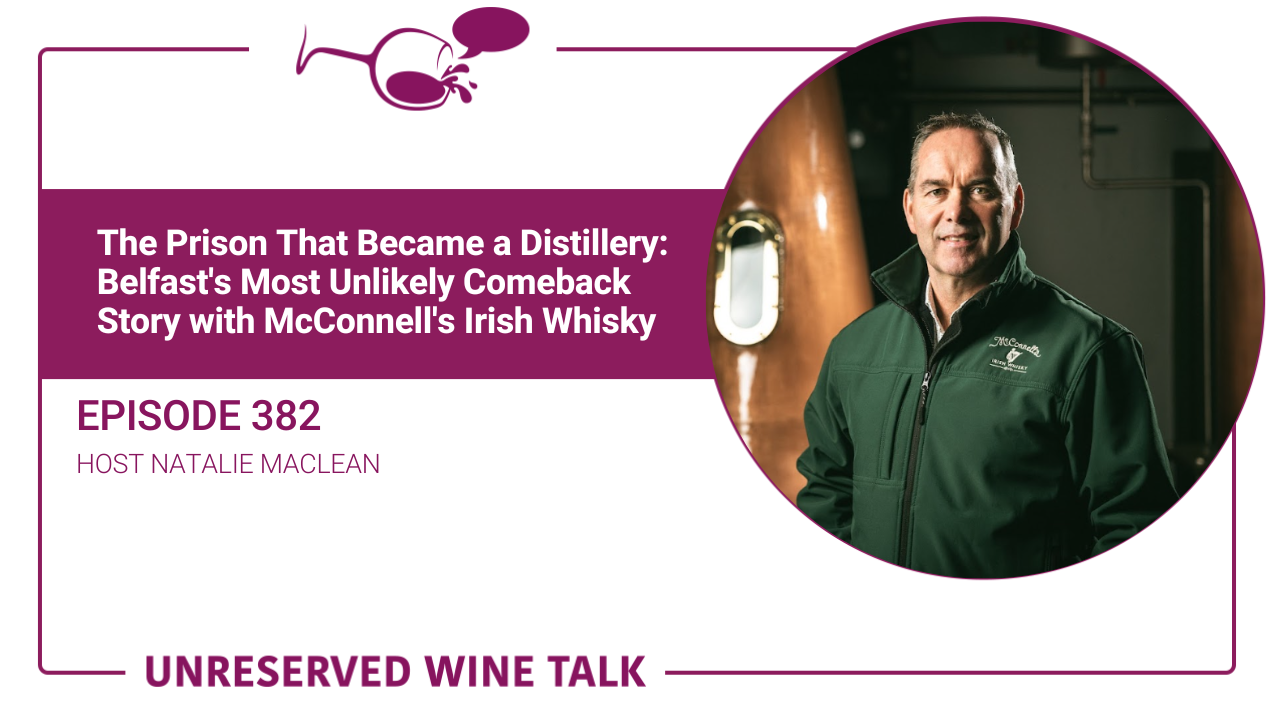
In this episode of the Unreserved Wine Talk podcast, I’m chatting with John Kelly, CEO of the Belfast Distillery Company, responsible for reviving one of Belfast’s most famous brands, McConnell’s Irish Whisky.
You can find the wines we discussed here.
Join me on Instagram, Facebook and YouTube Live Video
Join the live-stream video of this conversation on Wednesday at 7 pm eastern on Instagram Live Video, Facebook Live Video or YouTube Live Video.
I’ll be jumping into the comments as we watch it together so that I can answer your questions in real-time.
I want to hear from you! What’s your opinion of what we’re discussing? What takeaways or tips do you love most from this chat? What questions do you have that we didn’t answer?
Want to know when we go live?
Add this to your calendar:

Highlights
- Why does Irish whiskey traditionally favour triple distillation while Scotch producers rely on double distillation?
- How do first-fill American bourbon barrels shape the citrus, vanilla, and floral character of McConnell’s five-year-old whiskey?
- Why does the balance between grain and malted barley affect whether a whiskey feels warm and smooth or fiery on the palate?
- How does a higher malt content contribute to a longer, more persistent finish in blended Irish whiskey?
- What are the three classic styles of Irish whiskey?
- Why does McConnell’s focus on blending grain and malt whiskey rather than pot still whiskey?
- Why did the distillery choose Oloroso sherry casks for finishing, and how does sherry influence both color and flavor?
- What role does a higher bottling strength play in enhancing flavor and cocktail versatility?
- How did Belfast play an unexpected role in the invention of ginger ale?
- How do cognac casks create a more refined whiskey profile with notes like dried pineapple, caster sugar, and ginger spice?
Key Takeaways
- Why do Irish distillers believe triple distillation creates a smoother, more refined whiskey?
- It’s really all about the finishing of the product. The Scots are renowned for double distillation. In Ireland, three is the magic number. So we’ve got three styles of whiskey, the grain and the malt and the blend. And so we believe in Ireland that triple distillation through those copper pots. It’s just that little bit better than our Scottish neighbours. We think that that would lead to a more smoother or a better refined finish in our liquid. We can’t say that’s categorically right but it’s that final kind of smoothness that we’re always searching for and that happens through that third distillation. It’s something that’s important to us in Ireland and something that McConnell’s that we’re very precious about. So absolutely triple-distilled all the time.
- What makes a whiskey feel warm and smooth on the palate instead of fiery or harsh?
- Smooth is often the word that’s used. There’s a couple of things that I talk about in our liquid that’s maybe different to some other Irish whiskeys at a different price point. So some Irish whiskeys will have a very high grain content and a small malt content. We balance that. So we take up our malt content almost as much as our grain. this gives us is a warm sensation on the tip of your tongue, but not a burning sensation. if it’s a higher grain component, you get that fieriness. The second element is at the back of your throat and the kind of long-lasting finish. If this was a high grain content, that finish would dissipate very quickly. So warm, but not burny. And that long, lasting finish is what we get from the higher malt content, and also that kind of vanilla note from the bourbon barrels.
- Why does the Belfast origin of ginger ale make it such a natural pairing with McConnell’s Irish Whisky?
- When I speak to Canadians and I raise the topic of ginger ale, because of the famous Canada Dry ginger ale, people assume that Canada invented ginger ale, but no. And if I tell them that it’s actually little old Belfast back in the homeland, that was responsible for the person that invented ginger ale, they’re a bit surprised at that. But it was a doctor Cantrell who went on to build a business called Cantrell and Cochran, which is C and C, which is certainly very well known in Ireland and GB and across Europe. in the 1800s invented carbonated water and then added ginger to it. McConnell’s and ginger ale. It’s a natural fit.
About John Kelly
John Kelly is a highly respected drinks industry veteran, with over 30 years’ experience in the sector, including 22 years with Diageo, where he held senior roles in sales, marketing and general management within Ireland, Europe and the Middle East. John also worked with Walsh Whiskey in Carlow, Ireland.
In 2021, John joined Belfast Distillery Company as CEO and is building the team, bringing distilling back to Belfast in the repurposed Crumlin Road Gaol. In his spare time, John enjoys playing golf, coaching, and ferrying his children around to their various sports events, and best of all, watching from the sidelines.
Resources
- Find out more about McConnell’s Irish Whisky
- House of Commons Petition
- Unreserved Wine Talk
- My Books:
- Wine Witch on Fire: Rising from the Ashes of Divorce,Defamation, and Drinking Too Much
- Audiobook:
- Audible/Amazon in the following countries: Canada, US, UK, Australia (includes New Zealand), France (includes Belgium and Switzerland), Germany (includes Austria), Japan, and Brazil.
- Kobo (includes Chapters/Indigo), AudioBooks, Spotify, Google Play, Libro.fm, and other retailers here.
- Wine Witch on Fire Free Companion Guide for Book Clubs
- Audiobook:
- Unquenchable: A Tipsy Quest for the World’s Best Bargain Wines
- Red, White, and Drunk All Over: A Wine-Soaked Journey from Grape to Glass
- Wine Witch on Fire: Rising from the Ashes of Divorce,Defamation, and Drinking Too Much
- My new class, The 5 Wine & Food Pairing Mistakes That Can Ruin Your Dinner And How To Fix Them Forever
Tag Me on Social
Tag me on social media if you enjoyed the episode:
- @nataliemaclean and @natdecants on Facebook
- @nataliemaclean on Twitter
- @nataliemacleanwine on Instagram
- @nataliemaclean on LinkedIn
- Email Me at [email protected]
Thirsty for more?
- Sign up for my free online wine video class where I’ll walk you through The 5 Wine & Food Pairing Mistakes That Can Ruin Your Dinner (and how to fix them forever!)
- You’ll find my books here, including Unquenchable: A Tipsy Quest for the World’s Best Bargain Wines and Red, White and Drunk All Over: A Wine-Soaked Journey from Grape to Glass.
- The new audio edition of Red, White and Drunk All Over: A Wine-Soaked Journey from Grape to Glass is now available on Amazon.ca, Amazon.com and other country-specific Amazon sites; iTunes.ca, iTunes.com and other country-specific iTunes sites; Audible.ca and Audible.com.
Transcript
Natalie MacLean 00:00:00 Why do Irish distillers believe that triple distillation creates a smoother, more refined whiskey? What makes a whiskey feel warm and smooth on the palate, rather than fiery and harsh? And why does the Belfast origin of ginger ale make it such a natural pairing with McConnell’s Irish whiskey? In today’s episode, you’ll hear the stories and tips that answered these questions in part two of our chat with John Kelly, CEO of the Belfast Distillery Company, responsible for reviving one of Belfast’s most famous brands, McConnell’s Irish Whiskey, which actually dates back 250 years to this year to 1776. You don’t need to have listened to part one from last week first, but if you missed it, go back and have a listen after you finish this one. By the end of our conversation, you’ll also discover how first fill American bourbon barrels influence the citrus, vanilla, and floral character of McConnell’s five year old whiskey. How a higher malt content contributes to a longer, more persistent finish in blended Irish whiskey. Why McConnell’s focuses on blending grain and malt whiskey rather than pot still whiskey.
Natalie MacLean 00:01:11 Why the distillery chose Oloroso sherry casks for finishing and aging, and how sherry influences both the color and flavor of the whiskey. The role a higher bottling strength plays in enhancing flavor and cocktail versatility, and how Cognac Cask can generate a more refined whiskey profile with notes of dried pineapple, caster sugar, and ginger spice.
Natalie MacLean 00:01:43 Do you have a thirst to learn about wine? Do you love stories about wonderfully obsessive people, hauntingly beautiful places, and amusingly awkward social situations? Well, that’s the blend here on the Unreserved Wine Talk podcast. I’m your host, Natalie MacLean. And each week I share with you unfiltered conversations with celebrities in the wine world, as well as confessions from my own tipsy journey as I write my third book on this subject. I’m so glad you’re here. Now pass me that bottle, please, and let’s get started.
Natalie MacLean 00:02:25 Welcome to episode 382. So what’s new in the wine world this week? Well, as it.
Natalie MacLean 00:02:31 Stands.
Natalie MacLean 00:02:31 Now, a BC winery can legally mail a bottle to Seattle, but cannot mail that same bottle to someone in Toronto.
Natalie MacLean 00:02:40 Our country’s internal trade laws predate smartphones and Netflix, and are now being called out by winemakers who can sell faster and easier to foreigners than to their own neighbors two provinces over. That’s what prompted BC’s lightning Rock winery owner Ron Koubek to launch a national petition this week backing MP Dan Albas bill. See 262. As Ron says, Canadians should be able to buy Canadian. You can’t argue with that. Dan and Ron first worked on this in 2020 to 2021, before a snap election stopped the effort, and now this is back in Parliament. On March 9th, Dan tabled Bill C 262, which would amend the Canada Post Corporation Act to finally allow Canadian wineries, craft breweries and distilleries to ship their products directly to consumers across provincial lines. This isn’t a winery or distillery issue, it’s a consumer access issue. Canadians want to support wineries, breweries and distilleries across the country, especially given the wonderfully wild range of tastes that are not the same province by province, but in many cases were blocked or face significant barriers from doing this.
Natalie MacLean 00:04:03 That House of Commons petition is now live online at. Commons. Now I click through on that link and I’ll share it in the show notes with you. It’s the first petition I’ve ever signed and it took me 15 seconds to add my name. I strongly encourage you to do the same if you want access to a much wider range of Canadian wines, beer, whiskies and spirits, and to support these small family farms across the country, some of which will not survive without it. So again, that link is petitions dot our commons and in the show notes I’ll put the specific URL right to that petition alone, which is petition number 7258. Provinces are also working toward a May 2026 timeline to establish a national direct to consumer framework. They also need your support. In other wine news, the town of Pompeii, Italy, has officially begun harvesting grapes from vines replanted within the ancient city ruins. Using the exact same DNA mapped varietals that were buried by Vesuvius in 79 A.D., an ex Napa Valley winemaker was sentenced this week for a $2.5 million scam where he sold generic cheap grapes as high end varieties.
Natalie MacLean 00:05:35 His apology to the court included promise to stick to juice boxes from now on. Researchers have discovered that phylloxera, the vine killing pest, is evolving to survive in colder climates, sparking a new wave of bio secure vineyard tours in northern regions, a New York bar has started offering Japan’s rarest whisky at a staggering $4,100 Canadian per drink, served in a glass that the customer gets to keep as a souvenir of their financial daring or misplaced priorities. In a bizarre cultural crossover, Casamigos has been named the official spirit of a major international chess tournament, leading to a surge in the tequila Gambit memes on social media. A sinkhole on a Florida golf course recently revealed a hidden 1920s prohibition era wine cellar, though sadly, most of the bottles had succumbed to the humidity of the last century. A London pub offered discounts to guests who could pronounce Gewürztraminer correctly, turning pronunciation into entertainment with a surprisingly strong participation. Gilbert’s demeanour, of course, is that floral grape. Alsace is known for it, but it’s grown around the world, including in Canada.
Natalie MacLean 00:06:56 A Brazilian study released this week found that nearly 48% of Gen Z drinkers now ask AI to design their cocktails based on mood rather than ingredients, leading to the rise of the Sad Girl Spritz. A distillery in North Yorkshire, England, co-owned by the comedian Ricky Gervais, has just released its first single, malt, called Three Ridings, with a marketing campaign that mocks the seriousness of traditional whisky tasting notes. Rather than describing the whisky with typical flowery prose about hints of scorched leather or whispers of old library books. They’ve chosen the antique tasting note no tasting notes at all. For context. Ricky Gervais is previous. Honest marketing for the distillery included lines like enjoy life, you’ll be dead soon, and one day you’ll be underground for good. All right. For your calendar this week. Today, Wednesday, March 25th, is International Waffle Day and National Spanish Paella Day. It’s two for one Wednesdays for waffles. Try a waffle 75, which is a crisp toasted waffle topped with lemon curd alongside sparkling Riesling. Or go Belgian inspired with a classic Belgian tripel for paella.
Natalie MacLean 00:08:20 Pour a juicy Valencia red or a Spanish inspired rosé alongside the saffron and seafood pan. Thursday, March 26th is National Spinach Day, which would turn my son green. I swear he’s the president of the Anti Vegetable League. Still can’t get him to eat them, so lean into your green pairings here. A zesty Santorini artichoke has the saline punch to stand up to. Bitter greens. But not my son. Friday, March 27th is International Whiskey Day. The day was created to honor Michael Jackson, the beer and whiskey writer, not the pop star, and it raises awareness for Parkinson’s disease. Do a Canadian whiskey flight and compare it to Scotch and Irish expressions side by side. For something more structured, host a blind grain tasting with Ontario spirits next to traditional scotch to see if you can detect the barrel finish. Saturday, March 28th is National Black Forest Cake Day and National Something on a Stick Day. Another double header for the cake. Open a sweet red wine like Daniels from France that has that cherry and earth character to echo what’s on the plate.
Natalie MacLean 00:09:37 For skewers, think caprese skewers with a chilled rosé cava, or build a whole skewer and spritz situation around grilled veggie and chicken skewers And low alcohol by volume spritzes. Monday, March 30th is National Hot Chicken Day. He needs a counterpoint. I always say he meets sweet the best pairings and off try Riesling, a crisp lager or a cooling yogurt based cocktail if you really want to get creative. Tuesday, March 31st is National Oysters on the Half Shell Day. We’re saving the best for last. Fun fact oysters are high in zinc, which helps your body metabolize alcohol more efficiently. Classic pairings Muscadet, Chablis, Riesling. You could also try traditional methods sparkling wine, oysters and bubbles on a Tuesday. Oh, yes. And did you know that bubbles in your glass of sparkling wine aren’t just for show? A scientific study has found that fizz actually acts as a flavor elevator. As the bubbles rise, they drag aromatic molecules to the surface, which is why a flute of champagne smells more intensely than a still white wine.
Natalie MacLean 00:10:50 It’s also why a flute can smell completely different from a white coupe glass, even though the wine is identical. But hey, I beg to differ. I still enjoy my sparkling wines in a white wine glass that’s not as big a bowl as red wine, or certainly a coupe. But I like to swirl my wine and yes, even bubbles to really aerate the aromas. And finally, scientists at UC Davis University in California published a research paper showing that the cause of red wine headaches may not be sulfites after all. It may be quercetin, a flavonoid found in grape skins that converts to a compound called quercetin glucuronide. During digestion, that compound blocks an enzyme responsible for breaking down alcohol metabolites, allowing acetyl hide to build up in the body. Acetyl hide causes flushing, headaches, and nausea. Red vines grown in sun drenched conditions tend to have higher quercetin levels, which is why some bottles hit harder than others. Grapes essentially make their own sunscreen, and for some people, that sunscreen becomes quite a headache.
Natalie MacLean 00:12:02 Meanwhile, I’m writing my scripts for our Easter show specials on CTV Your Morning and City TV’s Breakfast Television coming up next week. On other shows later this season, we’ll be chatting about Mother’s Day, Father’s Day. FIFA World Cup, Canada Day and summer sipping. Whether it’s wine, beer, spirits, RTD or cocktails. If you’d like your brand featured on these TV segments or future ones, or would like to advertise with us through our podcast, newsletter, website, social media or mobile apps, please email me at Natalie at Natalie MacLean dot com. I’m sharing more tips and tips on Instagram at Natalie MacLean Wine, so join me there for more of the weird and wonderful. If you’re reading the paperback or e-book or listening to the audiobook of my memoir, Wine Witch on Fire Rising from the Ashes of Divorce, defamation, and Drinking Too Much, a national bestseller in one of Amazon’s best Books of the year. I’d love to hear from you and Natalie at Natalie MacLean. I’ll put a link in the show notes to all retailers worldwide at Natalie MacLean dot com.
Natalie MacLean 00:13:03 Forward slash 382. Okay, on with the show.
Natalie MacLean 00:13:13 Now, triple distillation is one of the hallmarks of Irish whiskey. What does that mean in a non-technical sense? I have a sense that the spirit is passing through the stills three times, three times, but is there anything more to it? And more importantly, what does that give the whiskey?
John Kelly 00:13:27 It’s really all about the kind of the finishing of the product. I mean, the Scots are renowned for double distillation. Okay. Scotch whisky, as we know, is incredibly successful. And that’s all based on a double distillation method in Ireland. You know, three is the magic number, you know. So. So we’ve got three styles of whiskey. We talked about that earlier. The gray and the malt and the blend. So we believe in Ireland that triple distillation through those copper pots is just that a little bit better than our, our Scottish neighbours, you know. And I guess we think that that would kind of maybe lead to a smoother or a better refined finish in our liquid.
John Kelly 00:14:08 Okay. We can say that’s categorically versus our Scotch counterparts. But yeah, it’s that final kind of finishing or that smoothness that we’re always kind of searching for. And that happens through that kind of third distillation. Right. So it’s a yeah, it’s something that’s important to us in Ireland and something that McConnell’s that we’re, we’re very precious about. So absolutely triple distilled all the time.
Natalie MacLean 00:14:33 Yeah. Marrying those grains. Let’s taste right. Yeah. We’ve done a lot. That’s lots of good ideas. Let’s taste. Let’s start with your five year old signature release. Tell us. Tell us about that.
John Kelly 00:14:42 So the five year old signature release. What can I say about this? Well, a number of things. First of all, we use American bourbon. First fill barrels. So in America, the bourbon barrels are used once. Okay. But they’re not used a second time. And that’s to protect the cooperage industry in America. So once those barrels have been used and disgorged, they’re available to other distillers around the world.
John Kelly 00:15:07 Okay. Scots and Irish use American bourbon a lot. What’s different about us is that we will only use American bourbon first fill. That means that the last liquid that was in that barrel was American bourbon, not another Scotch or another Irish. So if you want to nose and have a little.
Natalie MacLean 00:15:24 Nose, a little tutorial on how to nose, how it’s different, maybe from nosing a wine.
John Kelly 00:15:30 Right. Well, I’m not sure if it’s different from nosing a wine, but one thing that we always talk about is that each of your nostrils will have a little different kind of Knows you can get something a little different. So. So we kind of recommend that you try each nostril and you maybe will get something a little different out of each. Now in our, five year old. You know, we’re getting hopefully. I mean, this is all personal, right? Sure. What I get, what you get. You know, it can be affected by what you’ve been eating during the day also.
John Kelly 00:16:03 But, you know, we would like to get the thing. You get a little bit of citrus on the nose, maybe some floral notes. And then if you want to have a little taste, we should toast and say launcher, launcher, launcher.
Natalie MacLean 00:16:16 Yes.
John Kelly 00:16:17 And if you have a little taste, I’m hoping that you’re going to get some vanilla undertones coming from the bourbon.
Natalie MacLean 00:16:22 Okay. Wow. That just fills your senses well. It’s smooth.
John Kelly 00:16:28 Smooth is often the word that’s used. Absolutely. There’s a couple of things that I kind of talk about in our liquid. That’s maybe different to some other Irish whiskeys at a different price point. Let’s say so. Some Irish whiskeys will have a very high grain content.
Natalie MacLean 00:16:43 Okay.
John Kelly 00:16:44 And a small malt content. We kind of balance that. So we kind of take up our malt content almost as much as our grain. And what I feel that this gives us is a warm sensation on the tip of your tongue, but not a burning sensation.
Natalie MacLean 00:16:59 Right.
Natalie MacLean 00:16:59 That’s what it’s going to say. Whiskey at first for me, when, you know, years ago I was like, oh, I can’t drink it. It’s just too hot. Fiery. Fiery. Yes. And but this doesn’t.
John Kelly 00:17:09 For some people, that could be. If it’s a higher grain component, you get that fiery ness, right? The second element is, you know, at the back of your throat and the kind of long lasting finish we believe. Is that right? If this was a high grain content, that finish would disappeared very quickly. If it was like a 95 grain and five malt, it would be a more of a standard whiskey than a super premium. You would not get that finish that. You just got there. So warm, but not Bernie. And that long lasting finish is what we get from the higher malt content. And also that kind of vanilla note from the from the bourbon barrels.
Natalie MacLean 00:17:48 That’s the same in wine. The long finish that. How long can you continue to smell those aromas is a sign of good quality and excellence.
Natalie MacLean 00:17:55 Now what? Grains. Barley.
John Kelly 00:17:57 Barley? Yes, yes.
Natalie MacLean 00:17:58 And then the malt is.
John Kelly 00:17:59 It’s it’s malted barley. So it’s there are three styles. There’s a grain malt and pot whiskey. And we’re blending grain and malted barley. Okay. The third style of pot whiskey, we don’t actually produce pot whiskey. It’s unique to some distilleries in Ireland. Okay, it’s a quick aside. It was pot. Still, whiskey was invented by Irish distillers who were trying to avoid paying tax. You were taxed on your malted barley. Okay, so they started making whiskey with the malt in it. But we don’t do that. It’s really good stuff. But we don’t we don’t actually do that because we can’t do it in our distillery. But so this is a blend of grain and malt whiskey. So it’s a blend of those two.
Natalie MacLean 00:18:38 It’s a bit of a slasher. I guess it has to say. I’ve heard there’s a superstition, too, that the glasses have to clink, or else you’re inviting seven years of bad luck.
John Kelly 00:18:47 Right. There you go. Well, well, we should certainly clink our glasses. So that’s our. That’s our five year old blend. You know, I keep talking about super premium, you know, price point for this. And the Lcbo at the moment is $54. It’s not at that kind of $40 price point. It’s a little bit more premium than that. But you know, we believe for the quality of the liquid, the quality of the package, the transformation story that we’re telling. You know, it’s it’s.
Natalie MacLean 00:19:13 It is just so surreal that really I love it like it is mostly wine. Right now I do write about wine and spirits, but this just oh my, I, you know, good.
John Kelly 00:19:24 It doesn’t leave you kind of feeling.
Natalie MacLean 00:19:27 Burnt.
John Kelly 00:19:27 Burnt or flushed or anything like that.
Natalie MacLean 00:19:29 It’s warm. It’s like a it’s like a liquid hug. There you go. Like a kick.
John Kelly 00:19:33 Better for Saint Patrick’s Day, which is coming up very soon. What better than to try a little McConnell’s Irish whiskey? Coming up to Saint Patrick’s.
Natalie MacLean 00:19:42 Exactly. All right, so Sherry cask.
John Kelly 00:19:45 Sherry cask. Okay.
Natalie MacLean 00:19:46 All right. So you chose Oloroso sherry as opposed to no other types of.
John Kelly 00:19:51 No. No real reason for that. You know, Graham selects all of our barrels. So, you know, he his preference at that point in time and probably to do with availability also was these wonderful oloroso sherry casks. So again, I bow to his greater knowledge in this space. And but all or also in that sherry gives, you know, a lot in a short period of time, you know. So, like, even if we talked about it earlier. Look at the color there.
Natalie MacLean 00:20:19 I know it’s.
John Kelly 00:20:19 So incredible.
Natalie MacLean 00:20:20 Beautiful.
John Kelly 00:20:21 And people say to me, well, how long do you leave it in the, in the barrel for? Is it, is it a full year? And I say look it all depends. And they say, oh, what do you mean depends? Surely it has to be, you know, a certain length of time.
John Kelly 00:20:32 Yes, it does, but it depends on the quality of the weather outside. Our barrels are not kept, in fact, anywhere in Ireland. They’re not kept in a climate controlled environment.
Natalie MacLean 00:20:44 Okay, okay. Outside to season them.
John Kelly 00:20:46 No, no, they’re inside like a brick house or a warehouse. But the temperature in the warehouse can fluctuate quite dramatically.
Natalie MacLean 00:20:53 Right.
John Kelly 00:20:54 And that’s somewhere that Graham rightly delayed the bottling of our sherry cask. We’d had a particularly poor summer, even by Irish standards, which, you know, we don’t get great summers, but we had lots of cloud and rain, and it was damp and kind of chilly, If you had a really warm summer, the opposite of that, the liquid would have been ready. So when I tell people it could be 8 or 9 months, but it could be 10 or 11, it really is because the weather is important. If we have a really great summer, we could be taking that out in 8 or 9 months. It would just be the perfect blend for us and the perfect TZ profile for us.
John Kelly 00:21:32 But if it’s been called, we got to leave it in for that bit longer. And again, that’s the the kind of the art and the science, I guess, that Graeme brings to the operation but a different colour and yeah, you know, the season really matters.
Natalie MacLean 00:21:47 Yeah. And do you taste the sherry influence?
John Kelly 00:21:50 I believe you absolutely tasted it. First of all on the nose.
Natalie MacLean 00:21:53 Oh yes. Don’t you. Yes.
John Kelly 00:21:55 Immediately.
Natalie MacLean 00:21:56 And yet it’s still the whisky. I’m not confusing it with tasting sherry.
John Kelly 00:21:59 But you can get that kind of fortified wines coming through.
Natalie MacLean 00:22:03 Absolutely.
John Kelly 00:22:03 On the nose.
Natalie MacLean 00:22:05 and nutty figs nuttiness.
John Kelly 00:22:07 Yeah, you’re definitely getting that. Then on the palate, I talk about Christmas kick in a bottle, you know, so when you kind of when you taste this, you’re going to get a lot of those kind of cinnamon raisins just explodes, right?
Natalie MacLean 00:22:22 Yeah. It’s like it does.
John Kelly 00:22:24 A sherry burst. You know, this is kind of quite refined and coming out of the bourbon.
Natalie MacLean 00:22:29 This is like.
John Kelly 00:22:29 This is a sherry burst. This is right at you. I’m here. It is a good way of.
Natalie MacLean 00:22:32 Describing it yet. Not burning either, though. But it does burst. Oh my goodness.
John Kelly 00:22:40 Yeah, well.
Natalie MacLean 00:22:41 Yeah, I’ll have to go slow with these.
John Kelly 00:22:43 You do have to go slow with these. And important to note, the sherry cask is actually 46% ABV.
Natalie MacLean 00:22:51 Okay.
John Kelly 00:22:52 Whereas the five year is 42% ABV. Both of those things are a little notch above the norm. Whiskey needs to be 40% ABV. So we could easily bottle this at three years and 40%. Okay, but it’s five years and it’s 42%. Okay. And again, because we’re moving up and we’re what we call premium izing, you know, we’re going into a cask finish. We felt that it was right to kind of bottle that at 46%. Sometimes a little drop of water in the 46% can kind of just change the taste profile as well.
Natalie MacLean 00:23:27 Does it open up?
John Kelly 00:23:28 It opens up the aromas and that.
John Kelly 00:23:30 So we could, you know, we could try it like that. But sherry burst is really what you’re getting. Getting out of this guy here.
Natalie MacLean 00:23:36 And what does the extra alcohol do? Does it just carry forward those flavors more?
John Kelly 00:23:40 Yeah. It carries forward the flavors for sure. We also believe that it gives mixologists an opportunity to do different things with their cocktails. And today we just had a, you know, a lovely seminar with a number of mixologists. And we were talking just about that, you know, this is perfect. Like in a long drink, like a, you know, McConnell’s and ginger ale. And I must talk about ginger ale actually come back to that. But, you know, this is perfect in a, in a, in a long drink like a McConnell’s and ginger ale. But, you know, for a more complex kind of cocktail, the sherry cask finish at that kind of stronger teas profile, higher ABV really has those flavors. Kind of leaning into that.
Natalie MacLean 00:24:22 Too in the cocktail too. Without overwhelming.
John Kelly 00:24:24 Without overwhelming.
Natalie MacLean 00:24:25 It. Yeah. Oh, do go back to ginger ale. There’s a story there.
John Kelly 00:24:28 There is a story there. And it’s particularly appropriate, I think, in Canada, because when I speak to Canadians and I raised the topic of ginger ale because of the famous Canada Dry ginger ale. Yes. People assume that Canada invented ginger ale. But but no. And if I tell them that it’s actually little old Belfast back in the homeland that was responsible for the person that invented ginger ale, it kind of. They’re a bit surprised at that. But it was a doctor, Cantrell who went on to build a business called Cantrell and Cochran, which is C and C, which is certainly very well known in in Ireland and GB and across Europe, but C and C, and it was this guy Cantrell that in the 1800s invented carbonated water.
Natalie MacLean 00:25:15 Oh okay.
John Kelly 00:25:16 And then added ginger to carbonated water. So we firmly believe that because ginger ale was invented in Belfast.
John Kelly 00:25:25 And McConnell’s is bringing distilling back to Belfast and was once the the great whiskey of Belfast. That that we have a unique global.
Natalie MacLean 00:25:34 Yes.
John Kelly 00:25:35 To McConnell’s and Ginger. We are indeed at least we believe we have any.
Natalie MacLean 00:25:37 Way, any collaborations in mind or anything.
John Kelly 00:25:40 You can. We certainly have plans that nothing that we can reveal. But that’s, you know, yeah, it’s a natural fit and we believe we’ll tell that story to the full in the coming months and years.
Natalie MacLean 00:25:49 Excellent, excellent. Okay. Well sherry cask is sherry using. Oh my goodness. Next up we have the cognac.
John Kelly 00:25:56 Next up and last up is the cognac cask. And again you know the color tells a story here because you can see that the color is a little more color than the five year. But it doesn’t have as much as the sherry. And this is the kind of fortified wine and the oloroso sherry casks giving a different color than the kind of more refined kind of cognac.
Natalie MacLean 00:26:18 Cognac, of course, is the French white wine that’s distilled into a spirit in northern France.
Natalie MacLean 00:26:23 Exactly. So you’re using their cast?
John Kelly 00:26:25 Yeah. And when you nose this and taste this sugar is something that comes to mind. And caster sugar. Dried pineapple. People talk about ham. So. And that kind of long, lingering ginger spice is what you should get from this. But it’s a different taste, you know? This is kind of quite robust. This is more refined.
Natalie MacLean 00:26:48 It’s already more of a subtle nose than isn’t it. The second one.
John Kelly 00:26:52 Yeah. So the Sherry’s got that sherry boost if you want, but this is more refined. Kind of cognac. French. You know, it’s kind of larger.
Natalie MacLean 00:27:02 Oh, yes.
John Kelly 00:27:04 Don’t forget.
Natalie MacLean 00:27:04 That. Yes. Oh that’s beautiful. That’s five year old.
John Kelly 00:27:08 It’s the five year old. Yeah. It’s the five year old. But it’s been finished. And it’s look, it’s probably closer to six year old. But because we keep ourselves open, whether it’s eight months, ten months or a year. Sure. We still call it five year old.
John Kelly 00:27:20 So it’s five years. And then in cognac barrels for nine, ten months. It’s so. It’s very different.
Natalie MacLean 00:27:27 It’s beautiful.
John Kelly 00:27:27 Very, very good. But you can’t have any favorites, you know? It’s like I have four children at home, and.
Natalie MacLean 00:27:33 They’re all.
John Kelly 00:27:34 Equal in my eyes. And it’s the same. What we talk about is kind of different occasions, you know?
Natalie MacLean 00:27:39 All right.
John Kelly 00:27:40 This is your everyday beautiful whiskey. Neat whiskey with ginger. Beautiful product. This, for me, is kind of after dinner. Dark chocolate. Winter’s evening. Nice roaring fire. And then this is refinement. This is the champagne of Irish whiskeys. You know, in my humble eyes, you know, this is light, it’s fragrant. It’s got that sugary kind of flavor to it and, Yeah. Very refined drinking in the cognac finish.
Natalie MacLean 00:28:14 Absolutely beautiful. And do you ever pair them with food like with a meal or are they best do you think enjoyed after.
John Kelly 00:28:21 Well we do we have back at the distillery.
John Kelly 00:28:23 We have our own resident chef.
Natalie MacLean 00:28:26 Okay.
John Kelly 00:28:26 And, Gemma produces kind of different meals to, to different courses of the meal with, with, with, with each of the expressions. So, so this guy tends to be coming later on and with the kind of dessert, you know. and then chocolate is quite interesting, you know, so if you, if you wanted to have kind of chocolate, we would always recommend, you know, a lighter chocolate with these two. But a nice rich dark chocolate with the sherry cask is fantastic with this.
Natalie MacLean 00:28:54 I think it would like. Well, chocolate melts at body temperature, but I would think that, you know, it, the higher alcohol would just emulsified even more and just coat every crevice of your mouth. Oh my God, how decadent. Oh my goodness. Yeah, I do get the orange peel in there as well. Very Christmassy. It’s again brings back those spices. Yeah. All right. So we talked about the Lcbo. Let me make sure I’m covering everything.
Natalie MacLean 00:29:22 Saint Patrick’s Day is Canada’s single biggest, you know, whiskey moment. Yeah. What is the one thing you wish Canadian bar staff knew about McConnell’s?
John Kelly 00:29:32 Well, I mean, there’s so many things that they could talk about. McConnell’s. you know, I think if they’re talking about the quality of the liquid, which is important, right, because people go into bars and very often it’ll be the bartenders recommendation that will influence their choice of wine. Right. Yeah, exactly. You know, our, you know, even your choice of me often I kind of go I’m caught between the, you know, the steak and the fish. What would you recommend? So, you know, you know, our bartender community and those mixologists are, you know, really important to to our brand. So, you know, I would love those guys to talk about the fact that, you know, this is a, you know, this is a five year old premium Irish whiskey, you know, and that that number five is very important to us.
John Kelly 00:30:14 So if that one thing is the one thing to remember that that’s great. If they if they want to remember about the malt content then happy for them to talk about that as well. And and really replay that story that we talked about that, you know, it’s warm and smooth with a nice long finish.
Natalie MacLean 00:30:32 Right.
John Kelly 00:30:32 And again, that leans back into the to the five years old. So five year old and that high malt content for a blended whiskey would be the two things I would ask for them to talk about when they’re speaking about McConnell’s.
Natalie MacLean 00:30:46 And then as they pour their second and third drink, they can get into the snug and the prison and everything.
John Kelly 00:30:51 Exactly. And, you know, we we a lot of the, a lot of the stories are on the, on the bottles and on the bottles. So, you know, I talked to the staff at the Lcbo and our mixologists, and they’ve got so many things going on that they can’t remember everything. But but all of the cues for, you know, the little stories about Belfast are all in the bottle.
John Kelly 00:31:09 So yeah, if they just want to take time to read the label and, you know, familiarize themselves with this, then it’s all there.
Natalie MacLean 00:31:16 It’s all there. So globally, Irish whiskey exports grew 13% in 2024. That’s strong category momentum.
John Kelly 00:31:25 Absolutely.
Natalie MacLean 00:31:26 Canada has a very established relationship with Scotch and of course, Canadian rye whiskey. Where do you see McConnell’s fitting in the Canadian whiskey landscape?
John Kelly 00:31:35 I think it’s coming. You know, we’re growing our brand in Canada at a very interesting time. Obviously, there is no bourbon on the shelf here at the moment, and the Lcbo.
Natalie MacLean 00:31:47 Are looking for substitutes.
John Kelly 00:31:48 People are looking for substitutes. And whilst, you know, I sold Scotch whiskey in my previous career, sometimes the bridge from bourbon to scotch.
Natalie MacLean 00:31:58 It’s a big bridge.
John Kelly 00:31:59 Can be. Yeah, it’s a big bridge. Particularly if the Scotch is as like a smoky, peaty grain, high grain content.
Natalie MacLean 00:32:07 That’s what.
John Kelly 00:32:07 I was exposed.
Natalie MacLean 00:32:08 To first. Right.
John Kelly 00:32:09 So, yeah, if you’re if you’re in, I’ll not mention any brand names.
John Kelly 00:32:12 But if you’re in that space. Yes. And you go from a bourbon to here.
Natalie MacLean 00:32:17 That’s quite a palate.
John Kelly 00:32:18 Shot. That’s a palate shock for sure. I firmly believe that Irish whiskey is kind of a nice bridge there.
Natalie MacLean 00:32:25 Yeah.
John Kelly 00:32:26 I’m McConnell’s because of what we’ve spoken about earlier. Those first fell American bourbon barrels. You know, the tastings that I’ve been doing this week, a lot of people are saying, you know, I’m getting I’m getting bourbon from that. You know, would I be getting bourbon? The answer is yes. You would be. So. So I think we’re coming into Canada and the Lcbo at a really interesting time. You know, there’s there’s, an opportunity for Irish whiskey to really expand the category, to grow the category. And there’s colleagues of ours in the industry who are here this week pre Saint Patrick’s Day talking about, you know, the the industry because we compete on the shelf but we collaborate a lot. As an industry you know. So like our master distiller would would seek advice and give advice to other blenders and distillers around the industry.
John Kelly 00:33:11 And we share notes and all of that sort of thing. So. So I think Irish whiskey is on the rise. I think there’s an opportunity in Canada and I that maybe wouldn’t have presented itself. 18 months, two years ago. That’s true. And I think we’re in a great position to really grow that category. And, you know, we believe in that all saying that the rising tide.
Natalie MacLean 00:33:31 Lifts.
John Kelly 00:33:31 All the lift, all ships. We believe we’re in a we’re in a really good space as a category. And I believe that we’re in a great space for McConnell’s to to really grow the brand here in Canada.
Natalie MacLean 00:33:40 That’s exciting. All right, so if we were sitting here, we are sitting here a few days before Saint Patrick’s Day. There’s an Irish word that I love crack. I think it is meaning lively, fun atmosphere. We’re here at the House of Parliament pub in Toronto, and it’s one of the four pillars of experience at your distillery. What is the single best piece of crack or the funniest, strangest or most unexpectedly human moment that has ever happened? Well, bringing this whiskey to life.
John Kelly 00:34:10 Oh my goodness. I mean, so many things have happened. you know, in the distillery, I remember, when we were in the middle of construction and I was taking, the architect and I were going through and we were, we were looking at the space that was going to be our, our cocktail teaching class. You know, it’s a beautiful space for 16 people. A master mixologist teaches them how to make cocktails, you know, beautiful, beautiful part of the building. And it was a sunny day like this. And I was looking out the window and I could see a little kind of graffiti scored onto the window. And keep in mind that we’ve kept those same windows because we had to preserve the building. Okay. And I kind of peered a bit closer and, I’ll not say the name, but it was a name and Republican P.O.W.. And this is, someone who had been.
Natalie MacLean 00:35:04 You know, imprisoned.
John Kelly 00:35:04 In prison.
Natalie MacLean 00:35:05 During the.
John Kelly 00:35:05 Troubles. During the troubles. And he had one fine day, scored his name on this, and I and I kind of it took me back a little bit, you know, because, you know, that’s that is part of our history, you know, and we need to know that that’s been part of our history.
John Kelly 00:35:19 We’re moving on from that. But we have to recognize that that is something that happened in our history and acknowledge that that happened and really realize that there’s a brighter future. Sure. So that I remember that. And then in a similar context, on the opening day, we had politicians from all of the Northern Ireland parties there, and one of our politicians, had actually in a previous life spent a little bit of time in.
Natalie MacLean 00:35:49 In the prison.
John Kelly 00:35:49 In the.
Natalie MacLean 00:35:49 Prison before.
John Kelly 00:35:50 That’s not unusual because from either side of the political divide, you know, famously Gerry Adams from the Republican side in Paisley, from the Unionist side, both have, been in Crumlin Road jail. Éamon de Valera from the, you know, the the 1916 uprising. He was imprisoned in an Crumlin Road Gaol. So? So that’s not unusual. Belfast is a small city and you know lots of people for different reasons we’re there. But anyway, this politician who was there as a minister on the day was being interviewed and I was standing in the wings hosting proceedings, but not in the actual interview.
John Kelly 00:36:32 And the politician was said, well, how are you enjoying your second visit to the Crumlin Road?
Natalie MacLean 00:36:38 Second visit.
John Kelly 00:36:39 I almost nearly passed out. I thought the whole day is going to.
Natalie MacLean 00:36:45 That’s a great city off piste.
John Kelly 00:36:47 And I thought, how is he going to answer this? He answered it brilliantly and I really think it’s a story about McConnell’s that that on the jail that I, that I love to talk about. He said, yes, I was here once and back then this was a you know, it was a not a nice place. It was damp. It was dark. It was you were nervous. It was violent. It was a terrible place to be. And a prison. Right. And a prison in the 1980s. Of course it was. But look what we have done. Look what these guys have done to this building. They have transformed the building into this wonderful space that we have today, which is about bringing the Stelling back to Belfast, which is about bringing distilling and whiskey to all types of people and places and faces and spaces.
John Kelly 00:37:31 So. So he answered it wonderfully that this was a place of innovation in the future. Right? And I thought, wow, that was that was quite an exceptional. So from a moment where I thought everything was going to go, it was fantastic.
Natalie MacLean 00:37:42 Yeah. That’s great.
John Kelly 00:37:44 So lots of things like that. But yeah, we’re just really proud to be playing our part in bringing McConnell’s back and and bringing distilling back to Belfast.
Natalie MacLean 00:37:52 Wow. That’s a great way to wrap. Is there anything we haven’t covered that you’d like to mention?
John Kelly 00:37:58 Honestly, I think you’ve covered everything. Really. I can’t think of anything. It’s been great talking to you today. I’ve really enjoyed it.
Natalie MacLean 00:38:04 I love the stories, I love storytelling, that that’s what makes it memorable and even all the little pieces and of course, tasting them. It really? Yeah. Wow. It lit up my senses, and it really changed my perception of whiskey. So obviously, I have a lot to learn because these are beautiful.
John Kelly 00:38:20 Well, that’s part of my job. You know. Yes, of course I’m an ambassador. I’m very proud to be an ambassador for McConnell’s. But I also play my role in Irish whiskey. And, you know, we want Irish whiskey to to get back there, where it belongs. And Belfast to be at the epicenter of of of Irish whiskey again. So, so thank you for today.
Natalie MacLean 00:38:39 Yes, sir. And may I say, let’s see if I can remember this. May your troubles be less and your happiness more. And may nothing but good times walk through your door. Thank you very much.
John Kelly 00:38:50 Cheers. Cheers.
Natalie MacLean 00:38:57 Well, there you have it. I hope you enjoyed our chat with John. Here are my takeaways. Number one, why do Irish distillers believe triple distillation creates a smoother, more refined whiskey? As John explains, it’s really about finishing the product. The Scots are renowned for double distillation in Ireland. Three is the magic number. So they have three styles of whisky the grain, the malt and the blend.
Natalie MacLean 00:39:23 And they also believe that triple distillation through those copper pots creates a smoother drink. He notes they can’t say categorically that’s right, but that final kind of smoothness that they’re searching for really happens on that third distillation he finds. Number two, what makes whiskey feel warm and smooth on the palate versus fiery and harsh. So some Irish whiskeys tend to have a very high grain content and a smaller malt content. John explains that McConnell’s they balance that they take up or increase their content to almost as much as their grain content, which gives you that warm sensation on the tip of your tongue, but not the burning one. If there’s higher grain content, whether that’s barley or rye or whatever you’re using, you get more fiery ness, which you often will find if you compare, like Irish whiskey side by side with Canadian and Scotch. Now they’re going to argue as well that they’re smooth and whatever. But this was his explanation. And just a clarification note. Malt and whiskey refers to malted barley. Barley that’s been soaked in water and allowed to germinate or sprout and then dried in a kiln.
Natalie MacLean 00:40:40 So this process converts the starches into the fermentable sugars necessary for alcohol production. And it’s the defining ingredient in malt whiskey, creating those distinct, complex flavors. The second element that contributes to smoothness is about the finish, and it’s that element at the back of your throat. How long are you still smelling that whiskey after you swallow it. If there’s a high grain content, the finish, he says, will dissipate quickly. But that long lasting finish is what you get from a higher malt content. That kind of vanilla note that comes from bourbon barrels. And finally, why does the Belfast origin of ginger ale make it such a natural pairing with McConnell’s Irish whiskey? John says when he speaks to Canadians and raises the topic of ginger ale because of the famous brand Canada Dry Ginger ale, most people assume that Canada invented it, but no. Or nay. He tells them that it’s actually Belfast, back in the homeland that was responsible for inventing it, and they’re always a bit surprised it was actually a doctor, Cantrell, who went on to build a business called Cantrell and Cochrane, which is C and C, a very well-known brand in Ireland, Great Britain and across Europe in the 1800s.
Natalie MacLean 00:42:06 He invented carbonated water and then added ginger to it. McConnell’s and Ginger ale. It’s a natural fit and I see a product extension coming in the future. If you missed episode 331, go back and take a listen. I chat about how oak and yeast magically transform both wine and whiskey. I’ll share a short clip with you now to whet your appetite.
Natalie MacLean 00:42:29 When you’re drinking whiskey. And it’s that beautiful brown color that’s all from the wood. It is completely clear when it goes into a barrel and it’s brown when it comes out. So color is part of what changes and also all those flavors. Different spirits have different rules about how they age. So wine goes into new oak, bourbon goes into new oak. Single malt whiskey goes into old oak. It has to have been used for something else. Second fiddle. So they’ll use a bourbon cask or a port cask, or a sherry cask. That’ll get the flavor of whatever else has been in it, because the process of aging, as the temperature goes up and down, the pores in the wood, open and close so they’ll open, the liquid gets drawn into that inside layer of the wood and then gets pushed back out.
Natalie MacLean 00:43:07 So there’s this kind of back and forth process, which is why so many of the experimental attempts to accelerate that process use heat to try to cycle it faster. And it’s part of why people buy tradition more than anything else, will have younger American whiskies than European whiskies.
Natalie MacLean 00:43:29 You won’t want to miss next week when we chat with Alan Ramey, author of the new book Pressing Matters The debates, controversies and Mysteries That Have Shaped the World of Wine. Allen also competed on the blind tasting team for the University of Cambridge, and is now the owner and winemaker at Remy Cellars in Sonoma County. To give you a taste of future guests, we’ll have Michael Finnerty on pairing wine and cheese. Doctor Charles Knowles, who’s just published a bestselling memoir on why we drink too much. Maricel de la Fuente on the wines of Argentina. And Nicole and column Raymond Bassett on Tasting Victory the life and wines of the world’s favorite sommelier, Gerard Basset. Do you have a question for any of these guests? Please let me know.
Natalie MacLean 00:44:16 Do you know someone who would be interested in learning more about Irish whiskey and how to taste it? Please let them know about the podcast. Email them or text them now while you’re thinking about it. It’s so easy to find the Unreserved Wine Talk podcast. Just tell them to search for that title or my name Natalie MacLean Wine on Apple Podcasts, Spotify, their favorite podcast app, or they can listen to the show on my website at Natalie MacLean podcast. Email me if you have a tip, question, or would like to win one of six drinks books I have to give away. I’d love to hear your thoughts on this episode, or if you’ve read my book or listening to it. Email me at Natalie at Natalie MacLean dot com. In the show notes, you’ll find a link to take a free online food and wine pairing class with me called the five Wine and Food Pairing Mistakes. It can Ruin your Dinner and how to fix them forever at Natalie MacLean. And that is all in the show notes at Natalie MacLean 382.
Natalie MacLean 00:45:15 Thank you for taking the time to join me here. I hope something great is in your glass this week. Perhaps a glass of McConnell’s whiskey with ginger ale?
Natalie MacLean 00:45:32 You don’t want to miss one juicy episode of this podcast, especially the secret full bodied bonus episodes that I don’t announce on social media. So subscribe for free now at Natalie MacLean. Meet me here next week. Cheers.