Why do certain spices and dishes show up far from their origins, and how can tracing these cultural “foodways” change the way we think about wine and food pairing? Why did Cha create her own flavour wheel rather than rely on traditional wine-tasting vocabulary? How can expanding your flavour vocabulary through travel, food, and culture help us describe wine in ways that feel relatable?
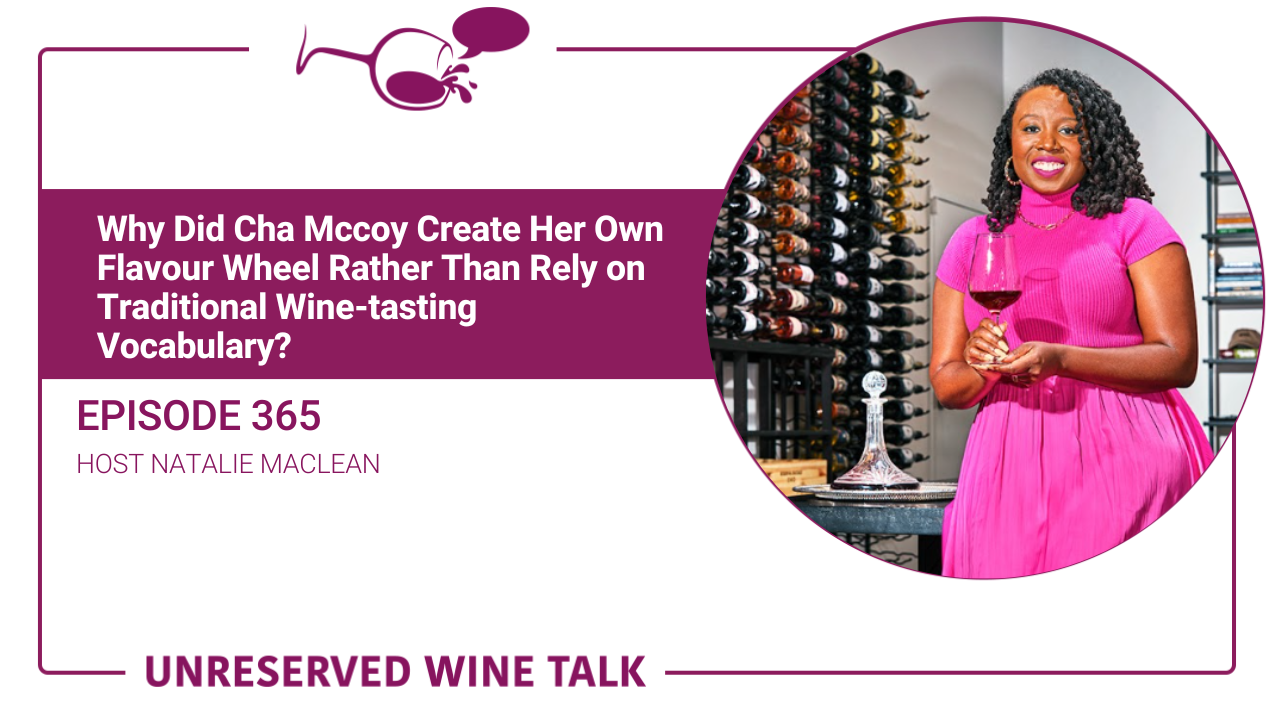
In this episode of the Unreserved Wine Talk podcast, I’m chatting with Cha McCoy, author of the new book Wine Pairing for the People.
After that, scroll down a tiny bit more and click on “Write a Review.” That’s it!
I’ll choose three people randomly from those who contact me.
I’ll be jumping into the comments as we watch it together so that I can answer your questions in real-time.
I want to hear from you! What’s your opinion of what we’re discussing? What takeaways or tips do you love most from this chat? What questions do you have that we didn’t answer?
Cha McCoy, MBA, is an entrepreneur, educator, event producer, and author. As a certified sommelier with the Court of Master Sommeliers, she developed The Communion, a wine dinner series that offers an inviting, accessible approach to gathering and enjoying wine. This experience inspired her to open her first retail space, The Communion Wine & Spirits. The dinner series was profiled in Food & Wine, and Cha was named one of Wine Enthusiast’s 40 Under 40. Her work continues through her highly anticipated book, Wine Pairing for the People: The Communion of Wine, Food, and Culture from Africa and Beyond, available now for pre-order and scheduled for release in November. Cha has held coveted positions such as Cherry Bombe Magazine’s first beverage director, the head of beverage for the Charleston Wine + Food Festival, and a sommelier at a Michelin-starred restaurant in Portugal and John Fraser Restaurant in New York.
Passionate about education, she spends her spare time mentoring and teaching at her alma mater, Syracuse University, where she served as an adjunct professor, educating and inspiring new wine drinkers. Catch Cha if you can in Harlem, New York, or on one of her international adventures.
Natalie MacLean 00:00:00 Why do certain spices and dishes show up far from their origins? And how can tracing these cultural foodways change the way we think about wine and food pairing? Why did Cha McCoy create her own flavour wheel rather than rely on traditional wine tasting vocabulary? And how can expanding your flavor vocabulary through travel, food, and culture help you describe wine in ways that feel even more relatable? In today’s episode, you’ll hear the stories and tips that answer those questions in Part Two of our chat with Ca McCoy, author of the new book Pairings for the People. You don’t need to have listened to Part One from last week first, but if you missed it, go back and have a listen after you finish this one.
Natalie MacLean 00:00:45 By the end of our conversation, you’ll also discover one of Cha’s wine and food pairings that received a lot of pushback from traditionalists. What cultural terroir means, how cultural factors influence a country’s wine preferences, and the wine styles it produces. Why Brazil’s vibrant culture makes sparkling wines such a natural fit. What foodways are and how the journey of ingredients and dishes informs cultural connections between food and wine pairings across continents. How cha navigated pairing wines for Senegalese dishes when her formal training had not prepared her for those flavours. Why Cha recommends rich, aromatic white wines for onion and garlic heavy dishes. How tasting local drinks expanded Cha’s vocabulary and her approach to wine education. How building a personal flavor wheel can help drinkers trust their own palates and avoid feeling intimidated by industry jargon.
Natalie MacLean 00:01:50 Do you have a thirst to learn about wine? Do you love stories about wonderfully obsessive people? Hauntingly beautiful places and amusingly awkward social situations. Well, that’s the blend here on the Unreserved Wine Talk podcast. I’m your host, Natalie MacLean, and each week I share with you unfiltered conversations with celebrities in the wine world, as well as confessions from my own tipsy journey as I write my third book on this subject. I’m so glad you’re here. Now pass me that bottle, please, and let’s get started.
Natalie MacLean 00:02:32 Welcome to episode 365. So what’s new in the wine world? This week, Winegrowers British Columbia and BC Grape Growers Association have announced that this year’s abundant harvest means B.C. wineries are moving away from the temporary relief measures introduced after the devastating 2023-2024 winter freeze, the temporary flexibility to import grapes from outside the province, which kept workers employed and tasting rooms open while the vineyards recovered will not extend past this year. As CEO Jeff Guignard put it, this program was never about replacing B.C. grapes. It was about protecting the people who grow and make BC wine. We’re now back to business as usual, celebrating 100% BC grown wines and the farmers who make them possible. The 2025 vintage is being called one of the most promising in recent memory, with winemakers from the Okanagan to Vancouver Island reporting balanced richness, generous yields and exceptional fruit quality. Yay!
Natalie MacLean 00:03:38 Ontario, meanwhile, is still basking in the afterglow of what many are calling a mind blowing 2025 harvest, with record heat units and plenty of sun creating wines that are already showing remarkable promise in the barrel. The resilience is palpable and the quality is undeniable. In Europe, France’s Champagne growers have started frost protection on the young vines, and Italy’s Tuscany saw olive harvests overlap with the final Sangiovese grape picks. A rare calendar clash and a feast for farm to table fans.
Natalie MacLean 00:04:13 Spain has suffered, with output falling to a 30 year low. However, there are some silver linings. Italy has reclaimed its title as the world’s largest wine producer, with an estimated 8% increase in output thanks to favourable weather. Meanwhile, Chile and Argentina are bracing for December hailstorms. I feel at this point I should be giving the sports scores, but I’ll try to stick to wine here today. November 26th is Drinks Giving Day. It’s observed the night before American Thanksgiving. Drinks Giving is an informal day where friends gather at bars or homes to enjoy cocktails, wines and spirits before the family centric holiday. December 1st is International – I’m going to muck this up – Maratheftiko Day, a day dedicated to the indigenous Cyprus red grape variety. It’s late ripening, ancient, and low yielding, and it produces wines that are deep coloured with complex aromas. December 3rd is National Rhubarb Vodka Day. Well, that’s pretty specific. It’s a nod to creative infusions in cocktails. Rhubarb vodka, though a niche product you don’t say reflects a larger trend toward infused spirits. Rhubarb itself, while generally found in pies, gives vodka a tart zing and a pretty pink colour, making it a favorite for visually striking holiday cocktails. That does make sense. I can’t wait for the cranberry addition.
Natalie MacLean 00:05:38 This week’s wine oddities were too good to miss. A British vineyard reported a visit from a runaway flock of sheep that nibbled only the Pinot Meunier rows, avoiding Chardonnay completely. Local shepherds praised their fine taste in terroir, which of course sparked playful theories about sheep sommelier certification. Bah. That’s a very bad play on words anyway. In Nova Scotia, a small batch winery thrilled Instagram by releasing a maple wine eggnog, a post that went viral as foodies debated whether it deserved a place on the holiday table or just at the kids end. I can only imagine those kids after maple wine eggnog. Anyway. And finally, sometimes the wine world delivers stories so delightfully observed that they restore your faith in human resilience. A 77 year old French cyclist from southern France survived three days trapped in a 40 metre deep gorge sustained entirely by the contents of his shopping bag, which only included several bottles of wine that miraculously survived the fall intact. The unnamed pensioner from Saint-Julien-des-Pointes missed a bend on the winding road, plunging down the steep slope into the riverbed for three days and nights in the cold and damp. He called for help whenever he heard passing vehicles, and when no one answered, he returned to his provisions. On the third day, road workers finally heard his cries and alerted rescue services, who evacuated him by helicopter. He was diagnosed with only minor injuries and mild hypothermia and maybe a hangover, and doctors called his survival a true miracle, noting his remarkable resilience had kept him alive. I’d say it was the wine and probably very good wine. The story went viral globally, prompting one headline writer to quip that it was a much needed shot in the arm against growing alcohol abstinence. Agreed.
Natalie MacLean 00:07:48 If you have some wine news or a quirky story you think I should share on the podcast, email me at [email protected]. And on CHCH Morning Live Show this week, we chatted about giving wine as a holiday gift. How do you know which one to choose and if choosing the right wine is so tricky. Why should we give wine as a gift at all? Well, I have an answer, of course. When you give the gift of wine, doubles are fine. Unlike toaster ovens, there are no wrong sizes. Unlike that ugly sweater. Please take that back. And regifting is so much easier compared to fruitcake or a bathroom scale. And let’s be honest, has anyone ever said, oh no, not another bottle of wine? Not my world.
Natalie MacLean 00:08:21 So let’s start with our first wine. We’re heading to Portugal’s spectacular Douro Valley, one of the world’s oldest wine regions, where terraced vineyards climb steep hillsides along the river. It’s produced by Vicente Faria Vinhos, a winery committed to farming organically and reducing its environmental impact. They’re saving the planet one delicious bottle at a time. We’re helping by drinking them. Yay! Teamwork! The Animus Douro Red is a bold blend of native grapes like Touriga Nacional and Tinto Roriz that delivers intense aromas of blackberry, plum and violet, followed by rich, dark fruit flavours with notes of chocolate, leather and a touch of Mediterranean herbs. The finish is long and warming, with velvety tannins to coat your palate. This is a wine with serious personality and main character energy. Animus means spirit or soul in Latin, and this wine captures the passionate character of Portuguese winemaking.
Natalie MacLean 00:09:25 Next up, Trivento Malbec Reserve. Mendoza, Argentina. Trivento is Argentina’s number one Malbec brand worldwide in a country that’s famous for Malbec. The grapes are grown in the most prestigious regions of the country. Malbec thrives in their high altitude vineyards in the foothills of the Andes, where the temperature difference between day and night creates incredible complexity. Mother Nature has created the perfect spa retreat for grapes, hot days, cool nights and mountain views, and of course, a glass of vino. This wine shows intense red colour with aromas of ripe cherry and red currant, with a whisper of vanilla smoke on the finish. It’s the kind of aroma that makes you pause mid-sentence because your nose has decided this wine deserves your full attention. I’d pair this with grilled portobello mushrooms stuffed with herb quinoa, topped with a melted aged cheddar that bubbles and browns perfectly. Or perhaps some dark chocolate chilli that’s been simmering for hours, with tender chunks of beef and a hint of cinnamon.
Natalie MacLean 00:10:14 All right, next up, I love this Pelee Island Wine Advent Calendar. It’s a masterpiece of anticipation, like the countdown to joy one cork at a time. 12 tiny doors, 12 little paws. Who needs chocolate Santas when you have Cabernet to keep you company? I detect aromas of surprise and delight. The kit includes 12 half bottles of red, white, rosé and sparkling wines, so you can try something new every second day or start on December 12th and go every day. Pair this with good conversation and laughter, but please, not fruitcake. Only if you insist. You can buy the advent calendar at liquor stores now or order it online at PeleeIsland.com.
Natalie MacLean 00:11:06 Finally, we have Lisbon By Night from Lisboa, Portugal. This mysterious Portuguese blend captures the romance of Lisbon’s cobbled streets with its complex mix of native grapes, creating layers of dark fruit, smoke and spice. The label even glows in the dark. At that point, I asked if we could turn off all the studio lights so we could see that, the response was no, keep going. This is your liquid passport to Portugal, transporting you to a Lisbon wine bar with a faded dessert, singing in the scent of grilled seafood hangs heavy in the air. This wine revels in blackberry liqueur notes intertwined with tobacco and a hint of Mediterranean herbs. There they are again, finishing with a warming spice that lingers like the perfect holiday evening. Fun fact. Lisboa, the wine region around Portugal’s capital, has a maritime climate, and wines from coastal regions tend to have higher acidity and fresher flavours than wines from warmer inland areas. That Atlantic Ocean breeze helps preserve the acidity and brightness, making it even more food friendly. I’d pair this with grilled octopus with smoked paprika and roasted red pepper coulis, where the char from the grill echoes the wine’s smoky notes. Sweet peppers complement its fruity richness, transporting you to a Portuguese tavern on a crisp holiday evening.
Natalie MacLean 00:12:27 All right. Any final words of wisdom? Well, first remember that gifting wine is an art form. And like all art, it’s subjective. If If someone doesn’t appreciate your carefully selected bottle, that tells you more about them than you. I’m kidding. Sort of. Mostly. The real magic is that long after the bottle is gone, the memory stays, which is the best kind of gift anyone can give. On Instagram, I’m at Natalie MacLean, where I’m sharing more wine picks and pairings. Follow me there. I’ll follow you back like a loyal sheep.
Natalie MacLean 00:13:02 On upcoming TV shows such as City TV’s Breakfast Television, CTV CP24 Breakfast Show, CHCH Morning Live and CTV’s The Social, we’ll be chatting about more terrific wines and spirits for holiday celebrations and gift giving. And believe it or not, we’re already planning dry-ish January with low and no alcohol drinks, as well as those that are low in calories or sugar, plus romantic wines and spirits for Valentine’s Day. Let me know if you’d like your brand featured on these TV segments, or on future ones, or if you would like to advertise with us through our podcast, newsletter, website, social media or mobile apps. If you represent a winery, distillery, brewery or an agency or regional council that represents wine, spirits, cocktails, cheese or other food brands, please email me at [email protected].
Natalie MacLean 00:13:56 Back to today’s episode. Just when you forgot what it was all about. Three of you are going to win a copy of Cha McCoy’s Pairings For The People. Sharon Laing, from Toronto, has won a copy of Elva Ramirez terrific book, Sparkling, with lots of beautiful ideas for sparkling cocktails just in time for the holidays. And I still have two copies of that book left to give away. If you’d like to win a copy of either of these books, email me and let me know you’d like to win. It doesn’t matter where you live, I’ll choose five winners randomly from those who contact me at [email protected]. Hoard them for yourself or give them as gifts or read them first, then regift them. Very sticky. Anyway, in other bookish news, if you’re reading the paperback or e-book or listening to the audiobook of my memoir Wine Witch on Fire: Rising from the Ashes of Divorce, Defamation, and Drinking Too Much, a national bestseller and one of Amazon’s best books of the year. I’d love to hear from you at [email protected]. If you’ve got a book club who’d like to read the book, email me and I will zoom drop in via video for part of your book club meeting. So again, just email me [email protected]. There is a book club guide that has all kinds of great questions related to the book, but sparks larger conversations like how do you feel about your relationship with alcohol? If you actually want to talk about that with your book club, how do you feel wine is marketed to men and women differently? I think it’s a chasm. And is social media still a good place to play? Not sure about that, but anyway, I’ll put a link to all the retailers worldwide at nataliemaclean.com. Okay, on with the show.
Natalie MacLean 00:15:43 Do you think there’s one pairing that might get some pushback like, oh no, that could not work. Like, I get fried chicken and Champagne. I think it’s brilliant. Do you think in the traditional circles there might be a pairing while people go, you’re kidding, right.
Cha McCoy 00:15:58 I don’t know. I hope not. I hope everybody’s willing to explore, but I do think there’s a few pairings that I really leaned into culturally. Like, what’s the connection here? Due to the history of the country as a ex colonized country, a lot of the Angolan dishes. Mozambique. So that wouldn’t be odd. But I think the way that I’m pairing would be a different way that we’re taught. So if an ex colony like Mozambique and we have Mozambican shrimp dish as one of the pairings as well, and I’m actually pairing it with wines from Portugal, which was the ex colonizer. There’s a different historical connection to choosing the wines from there. And in this book, we really focused on giving people like if you was on a jet to holiday, as they say on Instagram, if you were on a Jet2 holiday and you were in Mozambique or in Brazil, for example, why is there so many Portuguese wine and Portuguese nowhere near here, instead of French wines or somewhere else, you know? And then you start recognizing, oh, they speak Portuguese, they actually are ex colony. And so they have trade ties. They can read the label. They know the grapes. They’re not intimidated with the Portuguese language or the words on it. So then you’re like, oh, okay now this pairing makes more sense because of context. Historical context. Political context. So it’s not that there’s not a French wine or maybe even a Chilean wine that can’t go well with this Brazilian dish, it’s more the fact that there is a connection back to Portugal that still resonates with their food culture or food and beverage in this case. So maybe some pushback may come from there. But I try my best in each chapter to kind of explain more of the reason. That’s the way my thinking when I thought about culturally and Brazil, for example, was a place that I’ve spent some time. So I actually saw that firsthand. So it allowed me to also ask ok, they have a lot of wine they make right here in South America. Why are there so much Portuguese? Why are we going over to Europe? And so that was something I started thinking about as well.
Natalie MacLean 00:18:03 You talk about cultural terroir. I’ve heard of air noir, what’s in the air, and merroir, what’s in the sea like that the vines are very they pick up everything but cultural terroir. Is that part of what you’re referring to there? And can you give us another example?
Cha McCoy 00:18:17 Yes. I think that culturally the connections can be something that is, in this case, a country that was oppressed. These folks are now learning about an actual wine culture. So just to give you even more of a general idea of this, vines were planted in a lot of colonies at the time during imperialism and colonization to civilize or make the area or place civil. It was one of the tactics of imperialism at the time. Like how you would land on Mars and you put the American flag there. This is like, okay, we plant vines here because the Dutch has now arrived in South Africa. The Portuguese is now here. So this is where we’re going to plant the vines, even though a lot of them did not succeed at that time. It took immigrants, obviously, French Huguenots, coming to South Africa later on, Italian immigrants coming to Brazil later on to actually perfect and actually make the wine what it is today. But there is that first planting of the vines that actually started from a lot of the colonies, and that was their goal to actually have their stamp or make their mark in these different countries that they were at. So I think that’s important for historical context. When you think about, well, who thought to make wine in Brazil or Uruguay or Argentina anyway. It really started with this as the thought of the colonizer to show up in this way, in an agricultural way. That’s how we putting our foot down or our stamp on the land. So that was one main part of why I thought that was important to include in this kind of cultural context of terroir. Give that background first and then for the actual, whether it’s the music, the food, the lifestyle.
Cha McCoy 00:20:00 I think no matter what country we’re talking about, whether it’s Italy or Argentina, etc., I think there’s a lot to say about what folks are eating kind of influence what they’re making as their wine. It’s not crazy to think that Italian wine goes well with dishes that have tomato base, right. So even if the dish is not from Italy and there’s an influence of tomato paste or tomato sauce in the dish, picking in an Italian wine sounds like it works. This is why they make the wine. And it pairs well with pizza, pasta, you know, a lot of tomato based dishes. So that’s kind of cultural where I’m not looking at what grows together, goes together. But there is this similarity of kind of what the produce are of that country in the main produce of that dish, and actually seeing how there’s some other cultural connections in that case as well.
Cha McCoy 00:21:05 The music I mentioned, I mean, the lifestyle of the people, whether it’s what the dish they’re eating, like there’s a lot of nightlife or partying there, maybe it makes sense that they’re making a lot of bubbles in that area. So in my head right now, I’m thinking about Brazil still in the case that the Brazilian sparkling wine. Hopefully we become more of a thing here in regards to America’s imports in the future. But right now, obviously, given all the tariffs, etc., we can understand if even Europe is having a hard time trying to hold a place here. But you know, a lot of sparkling wines are doing great down there. Even Moet Chandon has also invested in the growing the terroir there for their own sparkling wines too. And so I feel like that makes sense. You think of Brazil, you think of festivals, you think of, you know, samba dancing. They would want sparkling wine. They were very vibrant culturally. It makes sense that bubbles is going to be the thing that really takes off there.
Cha McCoy 00:22:02 So I feel like that’s another type of. I guess I look at it as the anthropology of wine, understanding the people, their culture, their way of life, and being able to connect that to the type of wine makes a lot more sense. On what wine they should grow. I’m no geologist, so I can’t tell you if the soil was ripe for a particular grape in a type of wine they should make. But it makes sense if they’re buying and drinking a lot of that style, and it makes sense for them to then make that style themselves.
Natalie MacLean 00:22:31 Absolutely. I love how you write about terroir by osmosis, just underscoring what you’re just saying right now, how the wine becomes inseparable from the music and the aromas and the culture and the dancing and everything else.
Cha McCoy 00:22:44 So that’s the thing, the spices, right. It makes sense to be able to make wine that actually is a pairing with your culture. And so I think for foreigners, us, everyone, everywhere else, you know, for us to understand what makes sense when you arrive can tell you a lot about whether you’re making a dish at home or you’re going to a local Moroccan restaurant, If you’re actually taking a trip to Morocco, you’re going to see within the different bazaars and everything. You’re out there. The spices and the seasons, you’re going to smell that in the air. And so having dishes that are going to be using those and therefore making wine that pairs well. I feel like it all is connected at the end of the day. So that makes sense to me. The cultural terroir.
Natalie MacLean 00:23:29 Yes, the cultural terroir. I love that concept because you even use it instead of what grows together, goes together. What travels together kind of goes together, you know, like Peri Peri chicken’s journey from Africa, then to Portugal to South Africa and beyond. It’s sort of picking up all of these cultural nuances along the way.
Cha McCoy 00:23:49 Yes, that’s the important part of it. If Peri Peri as a seasoning, as a spice, as a pepper is being used to make certain dishes, that it makes sense that when immigrants come to live in Portugal, they’re bringing that with them. So you’ll see Peri Peri often and you’re nowhere near South Africa even though you’re in Portugal. But it’s on a lot of dishes, and that has a lot to say about how people play a large role. Like our own culture, what we bring with us. Like you mentioned in how food ways is very important when you’re thinking about pairing as well.
Natalie MacLean 00:24:26 What do you mean when you say food ways?
Cha McCoy 00:24:29 The food ways is like culturally connecting how Peri Peri made its way to Portugal. That’s the food way of that spice, etc.. So when people backtrack a dish and go, why are people making this dish here even though the elements of the ingredients are not originally from here. Trace that. The act of tracing it back is the food ways of actually.
Natalie MacLean 00:24:49 Are there wine ways?
Cha McCoy 00:24:51 You know what’s so funny, I don’t know. It doesn’t sound as cool as food ways I’ve been trying to come up with something, you know, for beverage in general, as you’ve seen in the book as well. I talk about rum, etc. so there is these kind of like, how do we track back, like where some of these origin stories are, but maybe we could say for your here for the podcast, we’re going to call it Wine Ways for sure.
Natalie MacLean 00:25:14 We’ll just start it now. Now, you mentioned during your time in little Senegal, locals would ask you about wine pairings for dishes. What was your process of figuring out pairings when your training hadn’t prepared you for them? I’m probably not pronouncing this correctly, but Yassa Poulet, a chicken dish from little Senegal. Like, how would you begin to suggest a wine for that dish?
Cha McCoy 00:25:39 Just going back to my conversation about the store. So Little Senegal is several blocks, but it’s on 116th Street in Harlem. So this is my neighbourhood that I grew up in, and that over time it’s a kind of grown into this particular immigrant community of Senegalese folks who are now my neighbours. And so literally in my building, there’s Senegalese people living there. So I’m used to smelling the sense of all of the spices that they use. I’m now going to work to the wine shop and I’m smelling it in the air as I’m walking. So the food almost transports me to Senegal. It is on my bucket list. I’ve never been. You know, that neighbourhood became very important for that same, that’s why New York City is so unique. As someone growing up in New York, you get to be in such close proximity to cultures and be able to learn so much without even having to have a passport. You know, you could. And so there is a lot to say about the amount of folks who were coming, particularly like that trip became almost a destination. So it was less about the locals because a lot of Senegalese folks actually practice Islam, so they don’t drink any alcohol. But it was folks who were coming to the actual store because a lot of their restaurants were BYOB since they didn’t serve alcohol. And so as someone who was obviously not Muslim, you would go to your local wine shop, ours right on the corner. And I had the ability to get to know the dishes from folks who were traveling up or maybe locals like myself who were not practicing Islam or wasn’t from Senegal, who were still eating in the area.
Cha McCoy 00:27:17 And I would say that’s one of the main things. It’s the same way with adventuring with the wine, maybe being adventurous with your food. So that’s how I got into pairing because like, hey everybody, keep going to these restaurants. And I never ate here. Maybe I should start eating here, too, so I can start understanding. So I was stumped. I didn’t know the dish. I didn’t know what it tastes like. I had no idea if it was spicy. If it was not. I didn’t know what to expect. And so the first things first was like, okay, I had a few customers come in and, and I’m recognizing that this is going to be a need really quickly. And so I myself started patronizing those restaurants in order to understand the dishes and ask more questions and then obviously looking it up for myself. So just doing that research was very important.
Natalie MacLean 00:28:00 And so did you land on a wine style that you tended to recommend for this chicken dish?
Cha McCoy 00:28:06 Oh, for this particular dish, I feel like this one is heavy with onions and garlic. So I feel like anything that you can use that is Chardonnay adjacent will be the perfect dish for this.
Natalie MacLean 00:28:19 So it would be Chardonnay adjacent?
Cha McCoy 00:28:21 Encruzado from Portugal.
Natalie MacLean 00:28:23 Okay. Tell us why that would work with garlic and onions.
Cha McCoy 00:28:28 I would say like you find the same kind of treatment that you would see on a Chardonnay where you may find a slight oak aging. So I’m not thinking about Chardonnay like from Chablis. I’m thinking Chardonnay. That’s a Burgundy Chardonnay or Chardonnay that’s rich and has the context of maybe some lees aging. And you can find that in other styles of wines, like Encruzado, for example. And so that would be a perfect pairing for this dish, this chicken dish that’s been baked and actually has amazing flavours. It’s not going to be overwhelmed by this grape, the chardonnay or an Encruzado which has a nice. Encruzado specifically may have a more cooked green bell pepper in it as well that I love. So I know, I know people like calling Chardonnay like a very neutral grape that grows everywhere. Well, I think there is something about the winemakers. I feel like as like a whisky maker. The same thing if you drink Chardonnay, you almost become like a whiskey maker, like it’s you. It’s your touch. Like, do you choose to put it in oak? Do you to choose to stir the lees or keep it on the lees at all? Are you choosing to make here? How much mallow is it undergoing? I feel like Chardonnay is a great. Like how a whiskey maker distiller would do. You actually have the choice.
Natalie MacLean 00:29:44 So winemakers, wine because it will bend to the will.
Cha McCoy 00:29:47 Exactly. And so you are able to do that. And I feel like other varietals that are known to work in similar ways. I feel like is a kind of great match for this dish. Really want the food to show here. It has amazing characteristics of herbs and, you know, its very lush dish and the sauce. It’s always about that garlic onion combo that they’re doing that is kind of really singing for this couscous chicken. I get plantains on the side as well. So it is definitely a very full dish. And I think a white wine that is aromatic. Viognier would work well, perfectly too here can go. So I feel like that’s what you want to lean into. Rich white wines that are medium plus body.
Natalie MacLean 00:30:34 That sounds great. You’re making me hungry and thirsty. So you’re doing your job now in a largely observant Muslim country. You also talked about mint tea and fresh juices. How did tasting these non-alcoholic drinks maybe help you improve your own wine descriptions?
Cha McCoy 00:30:52 Yeah, I think that Turkey, Morocco, for example, that I had on in a book as well. I think that it made me understand, kind of like their drinking culture and then pull out like how we would say in our wine lexicon. Gooseberries for Sauvignon blanc as a traditional tasting note. I feel like it at least helped me even with developing the flavour wheel or when I’m describing wines when I’m in front of guests knowing what that background is. It helped me to be able to explain wines. I can translate maybe this wine, knowing that fact about them, or in a restaurant that I know made or a chef making a dish that’s related to this. It wouldn’t make sense for me to use. I would say, I’m just going to keep going to gooseberry because that’s the easy one. Or petrol, which of course we have gasoline everywhere, but we don’t use the word petrol. So I wanted to stay away from using terminologies and vocabularies that is not. You know, if I’m talking to my demographic, I know where they’re from and I know what they’re drinking or I know what they’re eating. So I feel like having the fresh juices. Even when I recently was in Australia and having fresh juices of was it red currant juice? You know, I know red current comes up a lot. I’ve eaten red and black currant, but they used red and black currant often in fresh juices as well as in candy in Australia. That gets a common candy flavor. And so when you actually are traveling there, you now are immersed in multiple ways with maybe fruits and juices, different ways that you can have that. And now it adds to your own lexicon, and you can be able to now translate to who’s, you know, as I say, read the room, you know, and be able to instead of keep saying to my guests as a sommelier, ooh, I’m smelling. You know, it’s something like, I never had that before. So you smelling gooseberries is not helping because I don’t know what that means. You know what it is. So I feel like as a sommelier and a wine educator equally is our part to do that type of research and taste those juices if we can’t get them and in its raw form of the fruit to be familiar, especially if you’re working at a restaurant that may be more diverse.
Cha McCoy 00:33:11 So like what you said about the wine shop, I didn’t realize the shop was going to have so many people as guests visiting to those restaurants. And I would now need because the shop was not a Senegalese owned or anything. So I wasn’t prepared that that would be a style of food that I would often had to pair with. But it definitely put me in a place where I was like okay let me lock in with this and do that kind of out the textbook kind of research or exploring and R&D on my own, the same way chefs would if they were building their own menu. We should look at ourselves as that’s our role. We’re not making the wine as somms and wine educators, but we can do some R&D on our own by actually tasting fruit juices. The common practice people go learn about wine, go to a farmer’s market, try all the all the things at the markets. So this is the same thing I would the way I explored when I was in different countries by having those juices and having spices as well from there.
Natalie MacLean 00:34:02 That’s great advice for everybody to widen your vocabulary, but just also your taste, memory and so on. Now, you mentioned you have a flavour wheel that’s very different from standard industry flavour wheels. Tell us what’s different, what’s on there and how did you come up with it?
Cha McCoy 00:34:18 For those who don’t know, the flavour wheel is very commonly used and maybe beginner wine classes to help folks navigate deductive tasting. So if you are trying to. Like you can’t think. I’m sure now that you’ve been around a customer who’s like, I don’t know what this smells like. It smells like wine, you know? And so the flavour wheel is kind of like the training wheels on your bike, just to kind of help you, give you some core areas to be able to choose from aromas and tasting notes. And so I said, okay, let’s look at some of my common tasting notes that I’ve used. So I actually just backtrack through my old wine journals and tasting notes and actually seeing what ones I use often. Clearly, there’s probably a lot more out there, and there’s ones that back to I mentioned that is not part of my normal vocabulary. So why would I start throwing in things that I don’t use and smell often? But I also recognize that maybe I started finding more often in wines that folks maybe don’t say often. Let’s say saffron. Maybe saffron, you come up often. Turmeric. These are spices that are in my spice cabinet because I cook with them, but maybe not in yours, you know? And so sofrito is a sauce we talk about. And sofrito is a seasoning in Caribbean culture that they use in Puerto Rican cuisine. So these are the things that I cook with that’s in my house. And so I was like, okay, I find them in wine even though wine vocabulary don’t use them. And I feel like, oh, this would go well with that. So it actually is allowing me to give maybe everyone the right to say, hey, you can build your own flavour wheel. Go through your own tasting notes. What are some juices, spices that you’re familiar with that you can be able to put. And I implore everyone to do that, to be honest. And if you do have a journal, try to pull out like how come I always get this note whenever I. You know, it’s like a plastic. I got new tennis, you know. Balls you hear. New car. You know, maybe somebody ain’t never got a new car before. They don’t know what you’re talking about, but they may know what new sneakers smell like. They may know a freshly opened Barbie doll smell.
Natalie MacLean 00:36:35 Band-Aids and all the time Band-Aids. So weird.
Cha McCoy 00:36:39 I feel like this lets people have the ability to actually use what’s in their own everyday life, you know? And I feel like these small things, like we talk about micro-aggressions of the cultures when black people are in predominantly white environments, etc. These are the small ways I feel like white folks maybe didn’t even recognize it is a micro-aggression to force someone to say new car if they’ve never bought a new car. And that’s a class issue. That’s not race, right? If you’ve never had a new car, go who smells like new car? Smells like tennis. You ain’t never played tennis in your life. You know, you’re like, it smells like golf balls. You never play. These are things that. Are you still separating folks by saying, that’s the smell and they’ve never been exposed to it. So I feel like we should be more open to putting as many things out there that can be synonymous with that smell. No one’s going to help us. Those who are marginalized, welcome us to the industry. What I recognize is that’s something that I had to do myself. So literally create your own flavour wheel. Jot down those notes. And then when someone says new car and if you never had a new car, you said, you know what to me it smelled like new sneaker. Put new sneaker for you, for your own notes so that you can know when you come back to it and build up that palette memory like you just mentioned.
Natalie MacLean 00:37:57 Absolutely. It’s far more concrete because it’s tied into your real life. Your flavour wheel is in your book, correct?
Cha McCoy 00:38:01 Yes, yes it is.
Natalie MacLean 00:38:03 Because I was just going to say, can you get it on the website? But it’s surely…
Cha McCoy 00:38:08 It’s in the book. Yes. I marked it just in case sometimes because I feel like I have no idea what’s on there and someone calls out a note. It’s literally still in the index. You definitely have to see it in all its glory right there.
Natalie MacLean 00:38:23 That’s awesome. Oh we’ve got the coffee there. That’s great. Excellent. Beautiful colours. So you divide scents and tastes into four macro categories. Is this related to your flavour wheel? Fruity – floral, mineral – vegetal, spice, and chemical?
Cha McCoy 00:38:39 Yes. That is exactly the sections in the, I guess, core section of the of the flavour wheel. And that’s usually how I begin. A lot of people feel intimidated just going, oh, I smell, you know, thyme and I smell rosemary. They don’t want to go straight there. They so they. You actually gotta build them up. You know, a lot of my students. And so that’s like the best place to start is to actually kind of like do you smell herbs or do you smell fruits. Just kind of start with these categories and then they’re like, oh no, it’s definitely more fruit now. They get more comfortable now. Okay which fruit? Strawberries or lemons? Like things that are completely different so that they can be able to feel more like okay no it’s not lemon or yes it is lemon. Definitely not strawberry, you know. And then we can work our way into categories. So citrus notes within citrus. What do we have here? So I feel like that is my way of kind of getting them to actually peel back the confidence. Trust your palate. You know what lemons tastes like. But compared to strawberries? You don’t need a somm to tell you that, right? And so that is how I go about guiding them along the way in that process.
Natalie MacLean 00:39:52 I like the whole new sneaker thing so we could dive into that. Is it Nike or is it Brooks? Like be specific with your sneakers.
Cha McCoy 00:40:00 This is good.
Natalie MacLean 00:40:01 Yeah, yeah. So if you could mandate one change to the current educational curriculum to make it more inclusive of global cuisines and palates and pairing, what what would you recommend? Is there a topic or region or what would you add or change?
Cha McCoy 00:40:17 I mean, the book is about pairing, but ultimately is about a lot of historical context that I try to make sure it was important. So I would say adding wine history is something. That’s why it was important for me to include places like Georgia and Turkey in the book as well. We talk about wine from as if France invented winemaking. I do feel that if we’re more inclusive of if you want to call the ancient wine world. If you want to call Italy, Spain, and France the old wine world. If we think about those other countries, it will give us a more global context of where wine is coming from and where quality wine can be made. When we talk about Israel and Georgia and Turkey. I would want to change that. That is where that’s kind of where my food is at. We get to make more of a connection on truly how the Phoenicians, you know, was highly important for this to move and the importance of trade, etc., to actually even get to France or the Romans and their work with traveling with wines from there. But unfortunately, we don’t talk, we touch on it. Especially now that Georgia is becoming a major player in the conversation about wine. So you hear about it. I feel like way more today than we we heard about it when I got into the wine industry in 2012. I didn’t know much about Georgian wine, and I definitely didn’t know anything about wines coming from that area of the world. So I do hope that today we actually start including more of an actual wine history and knowledge.
Natalie MacLean 00:41:53 That’s a great suggestion. Of course, we’re talking about Georgia, the country, not the state.
Natalie MacLean 00:41:56 But I love your whole thing about we know New World is North America, Australia, New Zealand. Old World, Italy, France. But I love that there should be ancient world. It should be in there as well, in equal measure to get that sense of history and cultural terroir. Cha, this has been a pleasure. Is there anything that we haven’t covered that you’d like to mention as we wrap up?
Cha McCoy 00:42:20 No. I feel like I’m excited for the book to come out. November 4th is when it’s out and pre-orders are currently available. I will be doing a few wine release parties, so I don’t know in tastings and events throughout the whole month of November in different cities, so please be on the lookout. If you’re not following me already on Instagram or on my website. So my website is my name. Cha McCoy. So C H A McCoy.com and on Instagram Cha underscore squared. So those are the main places where I’ll be. LinkedIn, of course you can find me on my name there, Cha McCoy, where I’ll be sharing the locations and there’s tickets and ticketed events. So some free events, some pay for and support and local independent bookstores. And at least in November right now is five different cities.
Natalie MacLean 00:43:16 Oh, good for you. That’s quite the tour that going on.
Cha McCoy 00:43:18 So please be on the lookout for that.
Natalie MacLean 00:43:21 That’s awesome. And we’ll put links in the show notes to where people can find you online and those events. The podcast will be published just after your book comes out. So people should know that they can buy it when they hear this podcast, whether it’s online or at their local bookstore. I wish you all the best with the book launch. I’m sure it’s going to be terrific for it. Really well done and a great approach and given me lots to think about. So I’m sure our listeners are rethinking the whole pairing thing now.
Cha McCoy 00:43:51 I hope so. Thank you for having me, Natalie.
Natalie MacLean 00:43:53 All right. Thank you so much. Cheers.
Natalie MacLean 00:44:02 Well, there you have it. I hope you enjoyed our chat with Cha. Here are my takeaways. Why do certain spices and dishes show up far from their origins? And how can tracing these cultural foodways change the way we think about wine and food pairing? Well, as Cha explains, if Peri Peri is a seasoning, a spice that’s being used to make certain dishes, then it makes sense that when immigrants settled in Portugal, they’d bring that seasoning with them. So you’ll often see Peri Peri in Portuguese dishes even though you’re nowhere near South Africa. That has a lot to say about foodways. It’s culturally connecting how Peri Peri made its way from South Africa to Portugal. The act of tracing it back is what a food way is. And Cha notes that she often talks about rum. How do we track that back and where its origins are? Maybe we should call that wine ways, she says.
Natalie MacLean 00:44:57 Number two, why did Cha create her own flavour wheel rather than rely on traditional wine tasting vocabulary? Cha says the flavour wheel is commonly used in beginner wine classes to help people navigate deductive wine tasting. So they kind of break down what are the component aromas that are in this wine. And she had a look back at her tasting notes. And when she looked at them, she looked at descriptors that she used most often. And then she would start throwing in aromas that she doesn’t use or smell often. For example, saffron and turmeric are spices in Cha’s spice cabinet. She cooks with them frequently. She finds those aromas in wine, even though many traditional vocabularies do not contain them. So she built her own flavour wheels based on juices, spices, and other aromas that she was able to put in.
Natalie MacLean 00:44:50 And number three, how can expanding your flavour vocabulary through travel, food, and culture help you describe wine in ways that feel relatable? Cha says that Turkey and Morocco made her understand their drinking culture. It helped in developing her flavour wheel, and when she’s describing wines for guests, knowing their background can help her explain wines because she can translate the wine if she knows where they’re coming from, what might be relatable to them in terms of vocabulary. And she says, when you’re traveling, immersed in other fruits, drinks, and juices in another culture, it really adds to your own lexicon.
Natalie MacLean 00:46:34 If you missed episode 62, go back and take a listen. I chat about pairing wine and cannabis with herb sommelier Jamie Evans. I’ll share a short clip with you now to whet your appetite.
Jamie Evans 00:46:45 It turns out that 72% of cannabis users also drink alcohol, and many of those are wine consumers. Cannabis consumers also tend to be epicureans, so we really like the finer things in life, much like the wine consumer. And in California, it’s just becoming this mainstream product. So it seems like there’s people from all groups ages that are enjoying cannabis right now.
Natalie MacLean 00:47:14 You won’t want to miss next week when we chat with Simon Hardy, author of The Smart Traveler’s Wine Guide to Switzerland, published by Academie Du Vin. If you liked this episode or learned one thing from it, please email or tell a friend about the podcast this week. Especially someone you know who be interested in learning more about non-traditional wine and food pairings. It’s easy to find the Unreserved Wine Talk podcast, just tell them to search for that title or my name Natalie MacLean Wine. Yes, that’s my full name. Wine is my… MacLean is my middle name. Wine is actually my last name. On Apple Podcasts, Spotify, their favourite podcast app. Or they can listen to the show on my website at nataliemaclean.com/podcast.
Natalie MacLean 00:48:00 Email me if you have a question or would like to win one of five copies of the books I have to give away. I’d also love to hear your thoughts on this episode or if you’ve read my book or listening to it or your book club would like to read it in the upcoming year. Email me at [email protected]. In the show notes, you’ll find a link to take a free online food and wine pairing class with me, called The Five Wine and Food Pairing Mistakes That Can Ruin Your Dinner and How to Fix Them Forever at nataliemaclean.com/class. And that is all in the show notes at nataliemaclean.com/365. I’m here for you all year round, baby. Thank you for taking the time to join me here. I hope something great is in your glass this week. Perhaps a wine that pairs with breaking the traditional rules.
Natalie MacLean 00:48:55 You don’t want to miss one juicy episode of this podcast. Especially the secret full bodied bonus episodes that I don’t announce on social media. So subscribe for free now at nataliemaclean.com/subscribe. Meet me here next week. Cheers!