






Introduction
How can a single bottle of wine completely change your understanding of what wine can be? What makes a wine so remarkable that you can almost taste it again in your memory decades later? Why are people drawn to tasting notes even when words can never fully capture the experience of tasting and smelling wine?
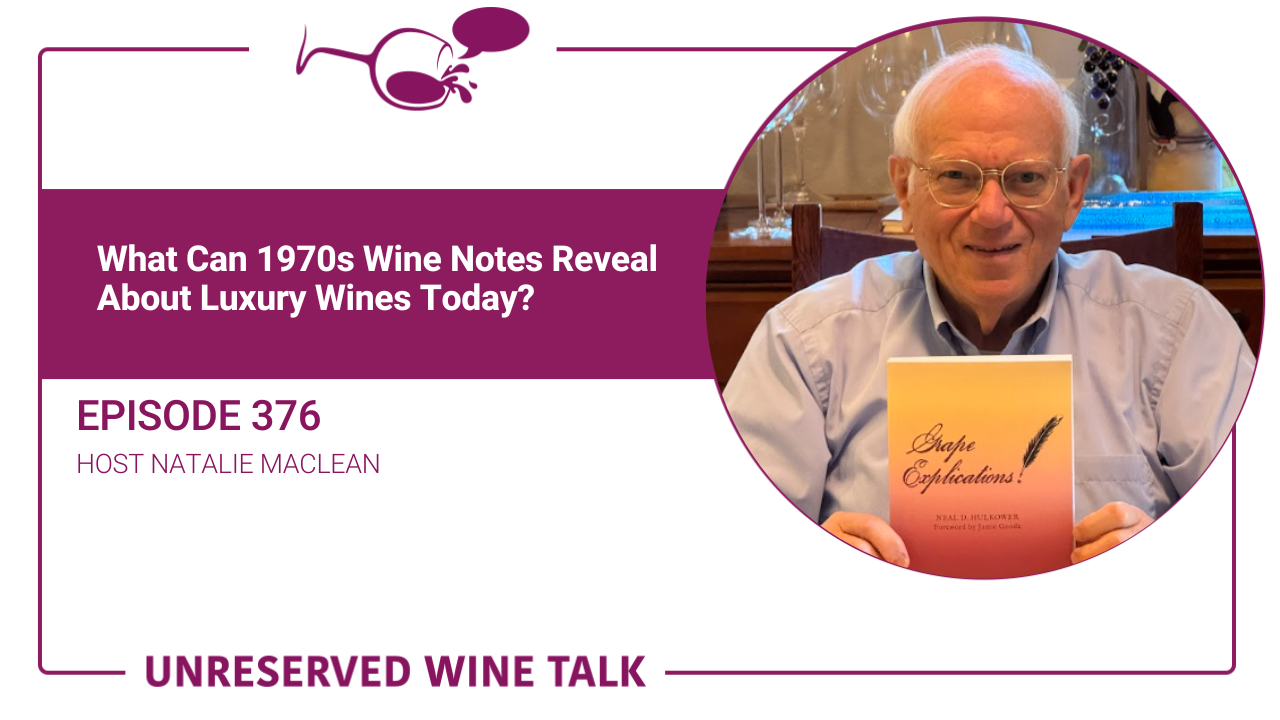
In this episode of the Unreserved Wine Talk podcast, I’m chatting with Neal Hulkower, a PhD rocket scientist, who has just published his first book, Grape Explications.
You can find the wines we discussed here.
Giveaway
Three of you are going to win a copy of Neal Hulkower’s terrific new book, Grape Explications.
How to Win
To qualify, all you have to do is email me at [email protected] and let me know that you’ve posted a review of the podcast.
It takes less than 30 seconds: On your phone, scroll to the bottom here, where the reviews are, and click on “Tap to Rate.”
After that, scroll down a tiny bit more and click on “Write a Review.” That’s it!
I’ll choose three people randomly from those who contact me.
Good luck!
Join me on Instagram, Facebook and YouTube Live Video
Join the live-stream video of this conversation on Wednesday at 7 pm eastern on Instagram Live Video, Facebook Live Video or YouTube Live Video.
I’ll be jumping into the comments as we watch it together so that I can answer your questions in real-time.
I want to hear from you! What’s your opinion of what we’re discussing? What takeaways or tips do you love most from this chat? What questions do you have that we didn’t answer?
Want to know when we go live?
Add this to your calendar:

Highlights
- What surprised Neal most when he reread five decades of his own wine writing while compiling Grape Explications?
- How has his palate, perspective, and choice of writing topics evolved throughout his life?
- Why did self-publishing matter so much to Neal?
- How did Neal’s first experience with wine shape his early expectations of wine?
- How did tasting classified growth Bordeaux as a college student completely reset his understanding of what wine could be?
- How did the Duncan Hines Memorial Bon Vivant Fellowship turn academic milestones into structured wine rituals?
- Why did Neal choose a 1959 Steinberger Trockenbeerenauslese to mark his PhD, and what made that bottle unforgettable?
- How did keeping meticulous notes help Neal develop his palate and his writing voice?
- What pushed him to leave academia for industry?
- Which emerging wine regions was Neal exposed to through moving across the US?
- What changed when Neal left a high-level technology career to become a freelance wine writer?
- How has Neal merged his two passions, wine and mathematics?
Key Takeaways
- How can a single bottle of wine completely change your understanding of what wine can be?
- So, my first wine friend, John Netrower, was the one whose mother, because he was underage, like I was at the time, provisioned him, this was in 1968, with a ‘61 Calon-Ségur and a ‘61 Léoville Las Cases. I asked him if he had recollection of when we cracked open one of those bottles, he believes that it was when he prepared his mother’s spaghetti sauce and that we opened it up. It was a revelation. He had already had some good stuff, and he kind of walked me through what to look for. The cedar notes and the fact that it was dry and balanced and lovely. I have a particularly good sense of smell. I rank that above my palate, especially as I age and I’m sure the aromas at that time really, really showed me what wine could be.
- What makes a wine so remarkable that you can almost taste it again in your memory decades later?
- It was the ‘59 Steinberger Trockenbeerenauslese. Deep, dark gold apricot, not oxidzed. Rich, intense fruity aromas. Thick. Remarkable flavor. Rich, thick, oily, cushy texture. Initially a very pleasant acid tinge, could be the bubbles, followed by the honeyed fruit and the depth of finish never before experienced. Maintains and glorifies the family traits exhibited by the ‘71 Spätlese, actually showed some secondary fermentation. Nectar with good balance, sufficient acid, fantastic. I had already been tasting wine at that time, seriously, been taking notes for seven years, so I was practiced at writing the notes. But the interesting thing is, when I think about it, I can almost imagine tasting it, because it was like biting into a juicy apricot, with the sweetness and then that beautiful acidity. It was a truly remarkable wine.
- Why are people drawn to tasting notes even when words can never fully capture the experience of tasting and smelling wine?
- The first notes were written in 1970 so we’re looking at 56, years ago but I wanted to remember the experience. I wanted to keep a record because this was so new to me, having graduated from Manischewitz and the sacramental wines. I have a really good sense of smell, and to me, it was another form of art that I was exposing my olfactory senses to. I wanted to try to capture that as well as I could in words. I think it’s futile. It’s been said that there’s millions of aromas and sensations and chemical reactions, and yet we only have a finite vocabulary to do it. So it’s sort of an exercise in futility to try to reconstruct what it was like to taste that wine from reading what someone else wrote. But there I was. I was a blossoming academic. You write things down, you keep track. It fit my personality. And I appreciate the fact that I did that, it’s given me a lot of fuel for some of my writing.
About Neal Hulkower
Neal D. Hulkower is an applied mathematician and freelance writer living in McMinnville, Oregon. His first contributions to a wine publication appeared in the early 1970s. Since 2009, he has been writing regularly about wine-related topics for academic, trade, and popular publications including the Journal of Wine Research, the Journal of Wine Economics, American Wine Society Wine Journal, Oregon Wine Press, Practical Winery & Vineyard, Wine Press Northwest, the Slow Wine Guide USA, and The World of Fine Wine and on wine-searcher.com, trinkmag.com, and guildsomm.com. Neal is a member of the American Wine Society, the American Association of Wine Economists, and the Circle of Wine Writers. His first book, Grape Explications, was released in 2025. He can occasionally be found pouring some of Oregon’s finest in a tasting room at the top of the Dundee Hills.
Resources
- Connect with Neal Hulkower
- Natalie MacLean’s Appearance on CTV Your Morning | What are 4 Fabulous Drinks to Toast Galentine’s & Valentine’s Day?
- Jackson Triggs Sparkling Reserve Brut – Niagara, Canada
- Mindful Rosé VQA – Niagara, Ontario
- Lenz Moser Grüner Veltliner – Austria
- Carolans Irish Cream Liqueur – Ireland
- Unreserved Wine Talk | Episode 12: Wine Scores: Misleading or Helpful to Consumers?
- My Books:
- Wine Witch on Fire: Rising from the Ashes of Divorce,Defamation, and Drinking Too Much
- Audiobook:
- Audible/Amazon in the following countries: Canada, US, UK, Australia (includes New Zealand), France (includes Belgium and Switzerland), Germany (includes Austria), Japan, and Brazil.
- Kobo (includes Chapters/Indigo), AudioBooks, Spotify, Google Play, Libro.fm, and other retailers here.
- Wine Witch on Fire Free Companion Guide for Book Clubs
- Audiobook:
- Unquenchable: A Tipsy Quest for the World’s Best Bargain Wines
- Red, White, and Drunk All Over: A Wine-Soaked Journey from Grape to Glass
- Wine Witch on Fire: Rising from the Ashes of Divorce,Defamation, and Drinking Too Much
- My new class, The 5 Wine & Food Pairing Mistakes That Can Ruin Your Dinner And How To Fix Them Forever
Tag Me on Social
Tag me on social media if you enjoyed the episode:
- @nataliemaclean and @natdecants on Facebook
- @nataliemaclean on Twitter
- @nataliemacleanwine on Instagram
- @nataliemaclean on LinkedIn
- Email Me at [email protected]
Thirsty for more?
- Sign up for my free online wine video class where I’ll walk you through The 5 Wine & Food Pairing Mistakes That Can Ruin Your Dinner (and how to fix them forever!)
- You’ll find my books here, including Unquenchable: A Tipsy Quest for the World’s Best Bargain Wines and Red, White and Drunk All Over: A Wine-Soaked Journey from Grape to Glass.
- The new audio edition of Red, White and Drunk All Over: A Wine-Soaked Journey from Grape to Glass is now available on Amazon.ca, Amazon.com and other country-specific Amazon sites; iTunes.ca, iTunes.com and other country-specific iTunes sites; Audible.ca and Audible.com.
Transcript
Natalie MacLean 00:00:00 How can a single bottle of wine completely change your understanding of what wine can be? What makes a wine so remarkable that you can almost taste it again in your memory decades later? And why are people drawn to tasting notes and trying to write them, even when words can never fully capture the experience of tasting and smelling wine? In today’s episode, you’ll hear the stories and tips that answer those questions. In our chat with Neil Hulk, our a PhD rocket scientist who has just published his first book, Great Expectations. By the end of our conversation, you’ll also discover what surprised Neil most when rereading 50 years of his own wine writing while compiling the book how his palate, perspective, and choice of writing topics evolved over his lifetime. How the Duncan Hines Memorial Bon Vivant Fellowship turned academic milestones into structured wine rituals. How keeping meticulous notes helped Neil develop both his palette and his writing voice. What pushed Neil to leave academia for the wine industry? The emerging wine regions Neil encountered while moving across the United States? What changed when Neil left a high level technology career to become a freelance wine writer? And how Neil has merged his two passions wine and math.
Natalie MacLean 00:01:28 Do you have a thirst to learn about wine? Do you love stories about wonderfully obsessive people, hauntingly beautiful places, and amusingly awkward social situations? Well, that’s the blend here on the Unreserved Wine Talk podcast. I’m your host, Natalie MacLean, and each week I share with you unfiltered conversations with celebrities in the wine world, as well as confessions from my own tipsy journey as I write my third book on this subject. I’m so glad you’re here. Now pass me that bottle, please, and let’s get started.
Natalie MacLean 00:02:10 Welcome to episode 376. So what’s new in the drinks world this week?
Natalie MacLean 00:02:16 Globally, the.
Natalie MacLean 00:02:17 Milano Cortina 2026 Winter Olympics are driving media headlines. Prosecco Doc’s status as the official sparkling wine of the Olympics gives the Italian fizz pride of place in hospitality events, and you can expect to see plenty metal coloured prosecco, pours in fan zones and VIP lounges as the games roll on. Figure skating legend Brian Boitano is co-hosting a guided wine tasting with wine educator Filippo Bartolotta to introduce wines of Italy to the foreign press in Toronto, Mayor Olivia Chow has successfully pushed for 9 a.m. alcohol service hours during the Olympics, February 6th to the 22nd, so fans can cheer on Team Canada with a mimosa in hand.
Natalie MacLean 00:03:06 Or maybe something stronger. Ontario is seeing interest in new to many drinks like Macaulay, a Korean rice wine which you can now buy at the Lcbo. It’s lightly sparkling, milky white and sits in that zone between beer and wine. Quebec drinkers, meanwhile, are about to get a very different type of offering starting February 12th. The SAQ has permission to sell off select US spirits that were stranded by last year’s import ban, mainly cream liqueurs and other clear glass bottles whose quality might start to slip if they sit too long. All with a 15% discount and the revenue going to food banks of Quebec. It’s a limited time, politically complicated clearance rack. Here are your food and drink holidays. This week, February 11th, is National Latte Day hello coffee stout float or espresso martini riff with a nano coffee spirit. It’s also National Peppermint Patty day. Make minty martinis or float peppermint schnapps in hot chocolate, or try a peppermint Patty martini with cream DeMint and a dark chocolate liqueur. That sounds good. February 12th is National Biscotti Day.
Natalie MacLean 00:04:20 Vin Santo energy or amaro or almond biscotti? February 13th is National Cheddar Day plus Italian Food Day cheddar with off dry Riesling or Italy with a spritz flight. It’s also National Tortellini Day. I don’t know why that’s not covered in Italian Food Day, but anyway, pair with prosecco or a crisp suave. Did you know that tortellini was allegedly inspired by the shape of Venus’s navel? It’s a cheeky pairing for a pre Valentine’s dinner day warm up. And of course Feb 14th is Valentine’s Day. It’s also cream filled chocolates, day port and truffles, or maybe a raspberry chocolate stout. National Gumdrop Day is on February 15th. Why not try some vodka gummy bears? International day is on February 16th. You want to get creative, host a blind Sriracha challenge where you compare a cool climate Syrah against a warmer one. Say Ontario versus Australia. February 16th is National Almond Day. Try an amaretto, sour or almond croissant with sparkling wine. And finally, February 17th is cafe au Lait Day and the Lunar New Year.
Natalie MacLean 00:05:35 So you could create a red and gold cocktail garnish challenge and pear dumplings with aromatic whites, or even spike your drink with Irish cream. It’s a quadruple header this week when it comes to hearts and roses. Clearly I’ve been listening to too much Olympic commentary. Well, I ran the gauntlet of doing for Valentine’s Day show specials, starting with CTV or morning, where we talked about if you’re flying solo or want to celebrate the bonds that really last friendship Galentine’s Day. That’s Friday, February 13th. You know, I always say friends at the family you choose. So let’s raise a glass to them. Galentine’s day is one of those fun micro holidays like Friendsgiving that celebrates friendship. Comedian Amy Poehler created it back in 2010 on her show Parks and Recreation. The premise women coming together to do what they do best along boozy brunch think Lilith Fair minus the angst. Plus, for starters, and let’s be honest, the bond between women and wine tends to outlast most relationships. Since then, we’ve included men with Bromance Day, but I have no idea where that came from.
Natalie MacLean 00:06:44 So let’s start with the Jackson Triggs Sparkling Reserve Brut. This elegant bubbly from Niagara has a gorgeous, toasty, freshly baked character that gives it a depth that most sparkling wines can only dream about. The fine, persistent bubbles create this luxurious, creamy texture on your palate. It does make you wonder why any other carbonated beverage even bothers trying. You’ll notice beautiful notes of baked honey apple toasted almonds dancing through the glass. The balanced acidity makes it incredibly food friendly, and at just 1795, it’s an amazing value, especially when you consider that most champagnes start at 80 bucks. Patriotism never tasted this great.
Next up we have the Mindful Rosé, another VQA wine from Niagara. Here’s something that’s perfect for those who want to keep the celebration going without overdoing it. This gorgeous pale rosé from Lakeview Wine Company has Pinot Noir in the blend. Pinot noir. Of course, is known as the Heartbreak grape because it’s so difficult to grow. But when you find the right one, the romance is real. Baby, this wine is made for people who want a real glass of wine just lighter, with lower alcohol at 8%, and remarkably low sugar at just one gram per serving.
Natalie MacLean 00:08:01 But light doesn’t mean boring. You still get the pretty floral aromatics and a bright mix of strawberry, red currant, cherry and raspberry. It’s light and crisp and keeps you reaching for the next sip at 13.95. It also pairs beautifully with the smoky notes in Burning your ex’s love letters, or those work files he couldn’t find when he was moving out. Closure tastes different for everyone.
Next up, the Lenz Moser Grüner Veltliner from Austria. This Austrian beauty is what brunch dreams with your besties are made of. Gruner Veltliner is Austria’s signature white grape, and it’s like having a major moment. Now it’s crisp and refreshing, with vibrant citrus notes, white pepper and a mineral quality that makes your mouth water. This wine has fantastic weight and texture without feeling heavy, and it’ll cut through rich egg dishes for today’s quiche like nobody’s business. The finish is clean and zippy.
Next up, try the Carolans Irish Cream. What makes Carolans special is that it’s made with real Irish farm fresh cream, the finest Irish whisky and spirits.
Natalie MacLean 00:09:09 And it’s sweetened with naturally harvested honey, not artificial sweeteners. You can really taste the difference. It’s smooth, rich, and it has this beautiful balance of sweetness and whisky warmth. Basically, it’s a hug from Ireland in liquid form. It’s amazing in coffee, but it also shines in an espresso. This is the cocktail that says I’m classy and caffeinated, which is honestly the best version of anyone, so you can get the recipe in the show. Notes Natalie MacLean. Com forward slash 376. But here are a couple martini drinks you can make. So you combine Carolans vodka and an espresso shot in a shaker with ice. Just shake it up till it’s chilled and frothy. Then serve in a glass. Maybe you want to garnish with a few coffee beans. You can also try the Marshmallow Toasted Coconut cocktail, two ounces of Carolans cream and two ounces of toasted coconut rum. That’s it. Garnish with a marshmallow. Carolans was awarded platinum at the 2026 San Francisco World Spirits Competition, which means it’s won double gold three years in a row.
Natalie MacLean 00:10:17 That is like winning the Deliciousness Olympics. And yes, it pairs beautifully with chocolate. The golden rule makes sure your drink is sweeter than the chocolate. Otherwise, it’ll taste bitter by comparison. So dark chocolate is always easiest to pair because it has the least sugar and dairy, but the most cocoa. So whether you’re celebrating romance or friendship this weekend, remember that the sparkle is both in your glass and in the eyes of the other.
All right, stepping up to the plate for Valentine’s show. Number two on CTV’s Cp24. Have you ever wondered which drinks pair best with the roller coaster ride of romance? From first dates to final goodbyes, where exploring wines that match every stage of your love life. My motto for Valentine’s Day candy is dandy. Liquor is quicker, but wine is divine. Let’s start with first dates. What to drink with those nerve wracking initial encounters? Try the saintly Rosé Sparkling, the perfect icebreaker for those butterfly moments. It flirts with wild strawberry and rose petal aromas. The ideal balance of fresh and fruity.
Natalie MacLean 00:11:27 Now what if that first date goes really, really well? Well, this wine also tastes like saying yes. Getting engaged calls for a joyous wine and rose colored glasses. Optimism pairs beautifully with bubbles. And how else would you get married these days, given the statistics? But not so glum, chum, when you taste this delightful sparkling rosé, it’s proudly Canadian from Ontario. Next up, the dockside premium Red blend, a terrific fuchsia from Ontario. When you’ve been ghosted. Swipe right on this Ontario Red that’s full bodied, offering consistently great pleasure. It shows up, it’s emotionally available, and it finishes strong. Unlike that idiot who never texted you back, can you taste the ripe dark berries in mocha? It also has a long finish, leaving you longing for more. Next up I have the Carolyn’s Irish Creme. It’s perfect for quiet night in. Or just because it’s Tuesday and you’re in love. Now, I’m not going to repeat the things I’ve already told you about Carolyn’s ice cream. Other than to say I loved it so much, I featured it on two shows.
Natalie MacLean 00:12:36 Now, speaking of the Olympics, feel free to try the Rossi Diageo Limoncello from Italy for anniversaries. Limoncello is like a perfect marriage complex, well structured and built to last. Traditional Italian limoncello is made by steeping lemon zest in pure alcohol for weeks, extracting all those gorgeous essential oils before adding some sweetness for balance. Serve it well chilled. It’s meant to be a digestive to help settle your stomach after a romantic meal. This limoncello opens with a rush of sunlit lemon peel, a touch of pithy bitterness and cool, silky sweetness that glides across the palate with finesse. Its texture is plush yet and refreshing, finishing with a clean snap of citrus that keeps it lively rather than cloying. And here’s a toast. May your glass in your heart always be full. And the third and final. Because I already shared the social with you on last week’s episode. So whether you’re planning an intimate dinner for two or celebrating with friends, pairing the drinks with passion inducing aphrodisiac foods can turn any evening into something truly memorable.
Natalie MacLean 00:13:46 And that is exactly what we talk about on city TV’s breakfast television. These libido lifting matches will prove that the way to the heart is through the stomach, with a detour to your taste buds first. Let’s start with oysters. They have a deliciously scandalous history. The ancient Romans named them as an aphrodisiac, but then again, they also thought the same about turnips, so their track record is kind of spotty. Casanova, that legendary 18th century Venetian lover. 840 oysters every morning for breakfast with his mistress in a bathtub built for two. Now that’s dedication. The science actually backs this up. Oysters are loaded with zinc, copper and iron. All the essential minerals for male fertility and energy. The challenge with oysters is that briny iodine flavor. You need something clean and crisp to refresh your palate. The beautiful oysters, as well as the cheeses, chocolates and bacon for this segment were kindly provided by our friends at Rapa Fine Foods in Toronto. Give them a visit. So we paired the oysters with evolved.
Natalie MacLean 00:14:55 The alkalis sparkles from British Columbia, crafted from 100% Okanagan Valley. Gewirtz demeanor. This frizzante bursts with lychee, rose petal and citrus notes. What makes it special is that it delivers full, aromatic character with just 4.2% alcohol, so you get all the celebration without any compromise. The golden hue is gorgeous, and those lively bubbles cut right through the oysters richness. You can taste the peach, tropical fruit and bright citrus with the refreshing Finish. It’s elegant, sophisticated, and proves you don’t need alcohol to create something extraordinary. I also have the Evolve Light sparkles at 7%. That represents a whole new category between zero alcohol and full strength. That’s the Goldilocks sweet spot. It’s for those moments when you want something with a bit more presence, but still want to stay clearheaded for whatever the evening brings.
Neal Hulkower 00:15:53 If you know what I mean.
Natalie MacLean 00:15:55 All right, so try this. It’s crafted from classic Chardonnay and Pinot Noir, with a portion of the Chardonnay fermented in concrete, which gives it incredible texture. Handpicked grapes from select vineyard sites harvested early, like traditional sparkling wine, also add to the quality.
Natalie MacLean 00:16:13 I should mention that Evolve Sparkling House in the Okanagan is doing a whole bunch of really fun events for Valentine’s Day, so if you’re in that area or you want to make it a destination trip February 13th are hosting Aiken Bombers of Flowers, a Galentine’s Day event with a do it yourself bouquet workshop. And of course, you’ll be drinking wine when you do that, so who cares what they look like in the end. And on the 14th and 15th, they’re offering Brut and Brunch, a three course sparkling brunch created by their chef, with each course paired with their sparkling. That sounds really good. And if you’re more into chocolate, they have their cuvée and cacao experience that pairs handcrafted chocolates with both sparkling and still wines in a seated, guided tasting. It’s romance that you can actually taste and count on, for God’s sakes. Anyway, let’s talk about rosé whispering Angel from Provence. It’s pretty in pink and you’ve probably seen it on Instagram, but this is a seriously great benchmark. Wine. Like your photogenic friend who also happens to have a PhD, and it’s transformed the entire rosé category into the fastest growing wine category globally.
Natalie MacLean 00:17:27 The name comes from the cherub carvings in the chapel at Chateau Declan, where it’s made now celebrating its 20th vintage. This one is converted more rosé skeptics than any other I know. It has a beautiful pale salmon pink hue and opens with delicate red berries and citrus. The medium body is sculpted by brisk acidity that gives it real structure. This wine pairs with everything from oysters to soft cheeses. Speaking of soft cheeses, Camembert and Brie are pure sensuality as they ooze like lava over crusty baguette. Oozing coating every crevice of your mouth. Yes, please. The creaminess needs that brisk acidity, like the snap of a whip to cut right through it. And that’s exactly what whispering Angel does, because it’s heaven sent. Hashtag full circle moment. Now, I’m also nominating bacon as one of the most potent aphrodisiacs on the planet. Here’s the science behind it. Studies show that certain aromas increase blood flow to strategic areas. For men, it’s pumpkin pie and lavender. For women, it’s cucumber and licorice. Basically, men feel romantic about Thanksgiving, and women a day at the spa makes sense.
Natalie MacLean 00:18:43 Interestingly, people who lose their sense of smell lose their sexual appetite. Now, bacon hasn’t been scientifically proven yet. But think about it. Is there anything sexier in the morning than someone who cooks bacon for you and does the dishes afterwards? People, that’s not romance. That’s a marriage proposal. Woof. So for bacon, you need something with depth and complexity. Enter liqueur 43. This premium liqueur has a fascinating backstory. When the Romans conquered Carthago Nova, they discovered a golden aromatic elixir made with local fruits and herbs called liqueur. Mirabilis. Miracle liquor. The Romans band it to avoid temptation, but the Carthaginians kept making it in secret. Prohibition never works. Rome. When will empires ever learn? That’s probably the start of their fall, anyway. This ancient elixir inspires liqueur. 43 recipe today made with 43 natural ingredients, including Mediterranean citrus fruits and botanicals. It’s now the number one selling Spanish liqueur in the world and the fastest growing premium liqueur globally. Wine enthusiast magazine named the carajo the best cocktail of the year, and it has just two ingredients the core 43 and coffee.
Natalie MacLean 00:20:06 Again, I’ll put the recipe on my website Natalie MacLean. Com forward slash 76. But this is glorious. Add ice cubes to martini glass. Pour 50ml. I’ve translated the ounces on there of liqueur 43 a shot of espresso ice cubes and shake. Well, it should froth at the top. It’s essentially a caffeinated hug that tells you everything’s going to be okay, even if you forgot to buy a Valentine’s Day card. Online searches for carajo were up 11%, and they’re set to overtake searches for Espresso Martini. And that’s because liqueur 43 versatility is incredible. You can use it in desserts like tiramisu, cheesecake, macaroons, as well as pancakes, crepes, and French toast. Basically, if it’s on a brunch or dessert menu, liqueur 43 can make it better. It’s the overachiever of liqueurs. And for chocolate lovers, just when you thought I forgot about you, no I didn’t. Casanova loved chocolate, too. He drank a cup of hot chocolate every day. It’s a wonder how he kept his tremendous figure.
Natalie MacLean 00:21:13 Chocolate ignites the same positive endorphins as being in love. Which is why I’ve been in a committed relationship with chocolate now for ten years. It’s chemistry and romance in one delicious package. We are so happy together. After 70 years, liqueur, 43, has just introduced a sibling worthy of the original the liqueur 43 horchata. This light, deliciously silky Spanish liqueur is inspired by horchata, the iconic Spanish drink fused with original liqueur. 43. It’s vegan, gluten free, and absolutely delicious. Finally, a treat that checks all the dietary restriction boxes and tastes amazing. Take that boring rice crackers. The aroma alone is captivating. Spice, citrus, roasted nuts, and a subtle floral touch of summer sunsets on the Mediterranean coast. Take me there now. One at 16% alcohol, it’s distinct from any other liqueur. The refreshing taste leaves no one indifferent. You either like it or you love it. It’s most commonly served over ice, and it’s a fun, tasty addition to fresh espresso or coffee. And another final toast.
Natalie MacLean 00:22:26 Here’s to the person who loves you enough to cook bacon, but respects you enough to give you the last crispy piece. And may your heart stay light, your spirits stay bright, and your glass never find its bottom before the conversation does. On upcoming TV shows, we’ll be chatting about fresh spring wines for March. Saint Patrick’s Day beer and spirits and wine and environmentally sustainable drinks for Earth. Our Easter, Mother’s Day, Father’s Day and any other day you can think of. Let me know if you’d like a brand featured on these TV segments or future ones, or if you’d like to advertise with us through our podcast, newsletter, website, social media or mobile apps, please email me at Natalie Natalie MacLean. Com. I’ll be sharing more sips and tips on Instagram at Natalie MacLean wine. So join me there. From where? The weird and the wonderful mom. Back to today’s episode. Three of you will win a copy of Neal’s new book. And if you’d like to win, please email me and say, hey, I’d like to win.
Natalie MacLean 00:23:26 It doesn’t matter where you live, I’ll choose three winners randomly from those who contact me at Natalie at Natalie MacLean dot com. If you’re reading the paper, book or e-book or listening to the audiobook of my wine memoir, wine switch on Fire rising from the Ashes of Divorce, defamation and Drinking Too Much, a national bestseller in one of Amazon’s Best Books of the year. I’d love to hear from you. I’m in a race with myself to see how fast I can say that. Gotta keep it interesting, right? Some of these repetitive things. So anyway, I’ll put a link in the show notes to all the retailers worldwide at Natalie MacLean. Com forward slash 376. Okay, I’m with the show. Neil Hooker is an applied mathematician and freelance writer living in McMinnville, Oregon. He’s been writing about wine since the early 1970s, and has contributed to the Journal of Wine Research, the Journal of Wine Economics, the American Wine Society, Wine Journal, the Oregon Wine Press, Practical Winery and Vineyard Wine Press Northwest, The Slow Wine Guide, USA, The World of Fine Wine Magazine, which is a gorgeous magazine, by the way, as well as several leading wine websites, so he’s quite prolific.
Natalie MacLean 00:24:42 Neal is a member of the American Wine Society, the American Association of Wine Economists, and the Circle of Wine Writers. He has just published his first book, Great Explications, and he joins me now from his home in McMinnville, Oregon. Welcome, Neal. We’re so glad you could join us.
Neal Hulkower 00:25:00 Thank you, Natalie, and happy New Year.
Natalie MacLean 00:25:02 Happy New Year to you, too. Neal, we are recording this just after New Year, although we will be publishing it a little bit after that. So what was the most surprising insight you discovered while writing this book? Neal?
Neal Hulkower 00:25:16 So the book is a compilation of articles that I’ve written over 50 years. And what struck me as I went through it and did my own light editing, is how much my writing has changed about wine. What topics I thought were important between the time I first started drinking wine until the present. Last article in there was written in 2020 for my palate changed, my location changed, all reflected in the topics that I that I covered.
Neal Hulkower 00:25:52 Quite honestly, I think I became a better writer with practice. I was always complimented on my writing, but I think it’s gotten more refined as a result of doing it more, but also reading marvelous wine writers who I’d love to talk about. I do a lot of book reviews, as you know, and I do get to read some marvelous prose about wine, which become models for me in my own writing.
Natalie MacLean 00:26:24 That’s terrific. Wow. So, yeah, it’s a good survey of your writing and how you’ve changed as a writer. And I’m sure as a person. What was the most difficult part about writing the book?
Neal Hulkower 00:26:35 A lot of the material was already written, at least in some form, and I went through and edited and so on. There’s a whole culture surrounding, as you know, the creation of a book, and I had to learn that. So I read materials, I did research. I settled on a publisher, Luminary Press, in Eugene, Oregon. The book is the complete Oregon product, by the way, And they were terrific.
Neal Hulkower 00:27:07 But the process of vetting potential publishers and then conforming to their process to produce a gorgeous looking book, quite frankly, I can show you.
Natalie MacLean 00:27:21 Have it there.
Neal Hulkower 00:27:22 All right. Have it right there.
Natalie MacLean 00:27:23 Okay. And so for those of you who are listening, we’ll put a link in the show notes as well as the cover page. An image. Yeah.
Neal Hulkower 00:27:29 This is the paperback. There’s also a hardback and an e-book and so on. my goal was, of course, to produce something. It’s considered self-published, but my goal was to have it indistinguishable from a conventionally published book. And I think Luminary Press wildly succeeded in that.
Natalie MacLean 00:27:49 They have a great reputation. And these days, that old snobbery about self-publishing has gone the wayside. There’s so much you can do now with a book, and even if you’re with a traditional publisher, you’re still having to do all that same work. There’s not much advantage. And given that online sales are so important these days, it’s not about bricks and mortar. So much more and more traditional authors are going to self-publishing.
Natalie MacLean 00:28:14 But that’s a rabbit hole I won’t go down.
Neal Hulkower 00:28:16 I also like that because I’m very picky. I’ve dealt with editors that that are good and editors that I had issues with. And in this particular case, I owned complete editorial control. There was nothing in that book. There is nothing in that book that doesn’t reflect the way I wanted it. And that was very, very important to me. One of the things I did do when I created the book was I started with the or text, not the published text, because the published text had a lot of edits that I didn’t necessarily agree with. In some cases, there were errors. Once in a while I made them. Once in a while. The editor introduced it, and it was critically important for me to straighten all that out and have it say exactly what I wanted it to. So I’m I’m usually in favor of self-publishing.
Natalie MacLean 00:29:14 Yes, absolutely. And you’ve done so much publishing with your academic career as well, in your background, which we’ll get to momentarily.
Natalie MacLean 00:29:21 But let’s talk about that first taste of wine. It was the Manischewitz. Concord grapes?
Neal Hulkower 00:29:28 Yeah.
Natalie MacLean 00:29:28 Wine. Religious rituals. Now, I shouldn’t chuckle. Everything’s come a long way. But what was your impression of that wine back when you tasted it?
Neal Hulkower 00:29:36 Cough syrup?
Natalie MacLean 00:29:37 Yeah.
Natalie MacLean 00:29:38 That’s being kind.
Neal Hulkower 00:29:40 I’m Jewish, and and it’s a kosher wine. And we used it for rituals on Friday night for my bar mitzvah and all that kind of stuff. It’s. What? It’s just what you had now. My father, who actually had a reasonable palate once switched over from the regular Concord grape to the dry Concord grape.
Natalie MacLean 00:30:05 Okay. Was that an improvement?
Neal Hulkower 00:30:07 It was an improvement, but it still didn’t make it good.
Natalie MacLean 00:30:10 It’s like cherry flavored cough syrup, maybe.
Neal Hulkower 00:30:13 Yeah. The sweetness was mitigated. It was still Concord grape wine.
Natalie MacLean 00:30:19 Right. Right.
Neal Hulkower 00:30:21 Now, fortunately, I mean, I don’t worry about kosher or anything like that, but I have relatives who do. And there is considerably better kosher wine out there that would be appropriate for rituals and so on.
Neal Hulkower 00:30:34 Absolutely. All over the world.
Natalie MacLean 00:30:35 So yeah, they’ve come a long, long way, just like other categories like organic and all kinds of others. So walk us through that moment in college when you tasted your first classified growth from Bordeaux and realized that one could be so much more than that first taste that you had.
Neal Hulkower 00:30:52 My first wine friend, John Trower, whose mother, because he was underage like I was at the time, provisioned him. This was in 1968 with a 61 Callan Seger and a 61 Leo Viola case. Wow.
Natalie MacLean 00:31:10 Top growths.
Neal Hulkower 00:31:11 Yeah. Top. Yeah. Unfortunately, he he died a little over three years ago. But before he did, I asked them if he had recollection of when we cracked open one of those bottles. He didn’t have the exact date, but he believes that it was when he prepared his mother’s spaghetti sauce and that we opened it up. And I believe it was the Leo Velasquez. It was a revelation. And it was. It was enough. He had already had some good stuff, and he walked me through what to look for the cedar notes and, and the fact that it was dry and balanced and lovely.
Neal Hulkower 00:31:55 I have a particularly good sense of smell. I rank that above my palate, especially as I age, and I’m sure the aromas at that time really showed me what wine could be. It was the beginning of me getting hooked for a while until we became of age in the United States. It’s 21. It’s still 21. I had to rely on other folks to get me the bottles and so on. Wasn’t hard. We had an older friend who parents, I believe he lived with his parents south of Chicago, and he was able to keep a stash of terrific wines there, and he would share those. We got to taste some remarkable stuff during my early years.
Natalie MacLean 00:32:48 That’s marvelous. And then you you co-founded the Duncan Hines Memorial. Bon Vivant fellowship international. As an undergraduate. Tell us about this delightfully named organization. And what prompted you to create a tradition of drinking German? Ashley’s for bachelor’s degrees, Baron Ashley’s for masters and the truck and Baron Ashley’s for PhDs.
Neal Hulkower 00:33:10 Sure. So the organization was founded, I believe.
Neal Hulkower 00:33:15 Yeah, I was in my junior year. I was really underage. And the Duncan Hines comes from the fact that my co-founder, his last name was Dennis and mine is Hulk our. So D.H. and it suggested Duncan Hines after undergrad disappeared. He was no longer active in that organization. It really didn’t take off until I came back to northwestern. I graduated in 1970, went to Texas for a year for grad school, dropped out and then went back to northwestern as a mathematician instead of an astronomer. And the organization came to life with a different set of players. We were in various stages in our education. So bachelor’s degrees, you know, back then, even though we weren’t admitting to liking sweet wines to the preference of anything else, a beautifully balanced ourselves was something we would seek out. Plus it was affordable. Back then, you have to understand that we were drinking on graduate students budgets and so that was accessible. And then some of us got masters, and then I was the only one who actually finished the PhD and we thought, well, gee, we didn’t outlays it for bachelors.
Neal Hulkower 00:34:45 The next step up is Beer and Alice. Liza. Why not? And then the PhD, which again I was the only one to actually finish.
Natalie MacLean 00:34:54 Sure, sure. Which one was it and what year was it?
Neal Hulkower 00:34:58 It was the 59 Steinberger truck and Baron Silesia. I finished in 1977. I had a tasting of 59 clarets in my tiny two bedroom apartment. Graduate housing, invited professors, one of my friends and we finished with this marvellous nectar. I have the notes here if you’re interested.
Natalie MacLean 00:35:24 Oh, sure, sure.
Neal Hulkower 00:35:25 So these are my notebooks, by the way. Oh, yes.
Natalie MacLean 00:35:28 I want to get to those. Yes.
Neal Hulkower 00:35:30 Deep dark brownish apricot, which I corrected to be gold because brownish implies that it was motorized. It wasn’t rich. Intense fruity aromas. Thick, remarkable flavor. Rich, thick, oily, cushy texture. Initially, a very pleasant acid tinge could be the bubbles, followed by the honeyed fruit and the depth of finish never before experienced maintains and glorifies the family.
Neal Hulkower 00:36:00 Traits exhibited by the 71 space laser actually showed some secondary fermentation nectar with good balance. Sufficient acid. Fantastic.
Natalie MacLean 00:36:12 Wow, that’s a great tasting note. And you were so young too.
Neal Hulkower 00:36:15 Yeah, and I don’t do. Well, I actually do. I still do tasting notes, but rarely. I had already been tasting wine at that time, seriously for taking notes for seven years, so I was practiced at writing the notes. But the interesting thing is, when I think about it, I can almost imagine tasting it because it was like biting into a juicy apricot, you know, with the sweetness and then that beautiful acidity. It was a truly remarkable wine. How I came across it is also interesting. Evanston was mostly dry, had no liquor stores when I was at northwestern, and there was a wonderful wine shop that still exists on the border with Skokie called Schaefer’s. That’s where I spent a good part of my graduate stipend. And George Schaefer, who was the proprietor at the time. You know, I was looking for a truck, and Baranowski said he had this bottle of the Steinberger that he was willing to sell to me for the remarkable price of $85.
Neal Hulkower 00:37:27 This is a lot of money in 1977, and it had just gone at auction for 200. The only condition was that it had to pour off an ounce for him, and that was a no brainer. But it was for a long time. The most expensive bottle I had ever bought, $85. My stipend was, I think at that time, maybe $250 a month. Something like that.
Natalie MacLean 00:37:56 Oh, wow. Half a month.
Neal Hulkower 00:37:58 I had a wife and a daughter. You know, groceries would cost 20, $25 a week. So to give you sort of a context, $85 was a lot of money, and it was worth every penny. Given that I still it’s almost 50 years and I, I, I’m still smiling. Thinking about drinking it, you know.
Natalie MacLean 00:38:20 Oh that that’s quite memorable. And so you’ve mentioned that you just showed us the notebooks. And between 1969 and 79, you kept meticulous notes, notebooks on 450 wines in four small notebooks, recording everything from prices to tasting notes.
Natalie MacLean 00:38:38 What drove you back then? I mean, you were enraptured with wine, but as a young mathematician, why did you want to document that tasting journey versus just enjoying the wines? I’m sure you enjoyed them, too.
Neal Hulkower 00:38:49 Oh, I enjoyed them.
Natalie MacLean 00:38:51 Yes.
Neal Hulkower 00:38:52 The first notes were written in 1970s. So we’re looking at 56 years ago. I wanted to remember the experience. I think that without trying to guess all the way back, I wanted to keep a record of. Because this was so new to me. Having graduated from Manischewitz and, and, you know, the, the, the sacramental wines and the fact that it was I have really as I said, I have a really good sense of smell. And it was to me, it was another form of art that I was exposing, In particular, my olfactory senses do. And, you know, I wanted to try to capture that as well as I could in words. I think I think it’s futile. I know you write tasting notes.
Neal Hulkower 00:39:52 I still write them for limited things, and certainly for when I have to publish something. But, you know, it’s been said that there’s millions of aromas and sensations and chemical reactions and so on, and yet we only have a finite vocabulary to do it. So it’s sort of an exercise in futility to try to reconstruct what it was like to actually taste that wine from simply reading what you wrote, or certainly what somebody else wrote. But there I was. I mean, you know, I was a blossoming academic. You write things down, you keep track. You. I was a scientist. So you record lots and lots of detail. It fit my personality then. I’m still hardcore aged venerable nerd now, and I appreciate the fact that I did that. It’s given me a lot of fuel for for some of my writing.
Natalie MacLean 00:40:53 Yeah, those are great memories. Like, yeah, almost like a travel journal, but for the senses. So you completed your PhD in applied mathematics at Northwestern University in 1977, and then you tried your hand in academia for a while at Vanderbilt University teaching mathematics? Yes.
Natalie MacLean 00:41:13 Correct. Okay. And then you decided to leave academia, and you went in to quite an August business career that took you through 11 states, working at some of the most respected technology and aerospace companies, eventually becoming president and CEO of RAF technology. How did you balance this demanding career with your growing passion for wine or did they just naturally fit together?
Neal Hulkower 00:41:38 There were a number of reasons why I left academics. I had a small family to support and the salary was meager. But as I tell folks, I couldn’t afford good wine and my then wife couldn’t find a job. So we were living on my meager academic salary and I had issues, you know, an adjustment and so on and pay. And so we headed west to California, and I became a rocket scientist. That was the initial thing I did. I worked for Jet Propulsion Lab all the times that I did this bouncing around, I was ratcheting up my salary in California, of course, I became heavily exposed to California wines. that was 1979 when we moved there.
Neal Hulkower 00:42:29 And that was, you know, only three years after the judgment of Paris. And so California wines were on everybody’s radar. Quite frankly, I found them at that time to play second fiddle to the stuff I had been drinking as a graduate student, which included the classified growth clarets, the beautiful Riesling from Germany and in particular the Pinot noir from Burgundy. California Pinos couldn’t hold a candle to them. They were too fruity, you know, they lack complexity. But I compromised and I tasted around and so on. The full time employment enabled me to have the resources to maintain a small but growing stock of of wine. It was always a hobby, but a pretty intense one. It was an excuse for socializing. I made some converts, you know, that I could taste with. And as I moved around, some states had viable wine areas. Washington state has a beautiful wine area, and I that’s where I was the CEO of a small software company. I lived in Virginia. Virginia. It’s not to be ignored.
Neal Hulkower 00:43:53 They’ve got some seriously good vino there, and it’s progressively better.
Natalie MacLean 00:44:00 That’s interesting. Yeah, we don’t get any Virginia wine up here yet, but, yeah, I’m sure it’s coming. That was the home of, Thomas Jefferson. Yes. Who took grape plantings from Bordeaux and planted them in Monticello or something like Monticello.
Neal Hulkower 00:44:15 And they unfortunately didn’t, didn’t take. But there are vineyards there now that are thriving, I think, even at Monticello.
Natalie MacLean 00:44:23 But okay.
Neal Hulkower 00:44:25 There. When I lived there, there was some stuff that was less interesting. But now I have a daughter who still lives there. So we go back and, and I try to pick up some, you know, examples, and they’re quite enjoyable. It’s vinifera. It’s not the hybrids. You know, Cab Franc is, is very big there. Petite man saying is now displacing Viognier as the white of choice and or in Virginia. I did a book signing in May of last year. Now at a winery that that specializes in that and it’s it’s pretty, pretty nice stuff for you know, when I lived in areas that had a wine region, it was I could pop over and check out Virginia wines.
Neal Hulkower 00:45:24 I lived in Massachusetts for a long time. I worked at the Mitre Corporation. My favorite grown up job. And, there’s actually a tiny wine region near the border with Rhode Island, which also has a microscopic wine region. And there’s a winery in Massachusetts called Westport River winery that makes pretty credible sparkling wines. When you think about it, sparkling wines are generally made from grapes that are slightly underwrite, and given that it’s cold in Massachusetts, it was a suitable place for that. So I popped over there a couple of times.
Natalie MacLean 00:46:08 So you learned as you went wherever your business travels, took your wine palate followed, and then you say in 2011 you had your last full time grown up job, and you moved to McMinnville and became a freelance wine writer. Describe that transition from sort of analyzing risks for billion dollar government programs to analyzing whether, you know, Pinot shows a whole cluster fermentation character or whatever, like, or did it just sort of naturally evolve that way?
Neal Hulkower 00:46:39 Yes. And and there was a bit of random walk, you know, from topic to topic.
Neal Hulkower 00:46:45 So the transition was that they converted me from a full time. I was a vice president of technical something or other. I had some fancy title, got to be too expensive, converted me to a consultant. I did some consulting back there and I said, good, I don’t have to live in Virginia anymore. We had bought our place in Oregon in 2009, and we’re coming out here part time. I worked here. I’m in my office right now where I work back at in Virginia, and we said, okay. So we sold our place in Virginia. We had this place, we came over and I said, now I’m going to get the permit to try to go and work in tasting rooms and start applying for that. And I said, I’m going to write because I guess I should rewind back to 2009. There was a hiatus between about 1977 when I published my last article and now defunct vintage magazine, and when I started writing about wine. In between, I wrote about all kinds of things.
Neal Hulkower 00:47:58 You know, I have a large list of publications and reports and so on on technical matters and the various things that I did for my job and so on. But in 2009, we went to see the movie Bottle Shock, and at that time I had been interested in what’s called a board account, which is a way of aggregating preferences. And it’s actually the way we should vote, but we can talk about that separately. The reason I got into it is, is my dissertation advisor, Don Sarri, got into it after I finished my PhD. My PhD, just for the record, was in a field called celestial mechanics, which is the mathematical modeling of the motion of of heavenly bodies. And my topic was the zero energy three body problem. Anybody who’s watching this may have seen the Netflix.
Natalie MacLean 00:48:58 Yeah, three body problem.
Neal Hulkower 00:49:00 Yeah. Not to be too picky, but that was actually restricted for body problem. But who’s counting?
Natalie MacLean 00:49:07 apparently you are.
Neal Hulkower 00:49:08 As I was.
Neal Hulkower 00:49:09 Yeah, yeah. So, you know, long before that I did that and I solved a 90 year old problem.
Neal Hulkower 00:49:16 System mechanics, a particularly difficult Field. Newton basically started it and all the easy problems were solved and what’s left are really hard problems. So not letting many people go into this while I was serious, got interested in mathematical economics and he started looking at voting methods. So he proved some of the central theorems that show the uniqueness of the board account. And I got interested in that. And when I was at the Miter Corporation, I had him out to talk some of the people in my organization. I was a department head in the Economic and Decision Analysis Center there for a while. Some of the people applied that to some of our work, and I was watching this movie, and I was wondering how they came up with the ranking for the.
Neal Hulkower 00:50:18 The bottle shop. Not the true body problem. Back to bottle shock. Yeah.
Natalie MacLean 00:50:22 And was this based on the 1976 Judgement of Paris tasting in Paris?
Neal Hulkower 00:50:26 Yes.
Neal Hulkower 00:50:27 Yes it was, but only the whites. He only focused on the whites. Okay, there’s an interesting thing that there’s a book by George Taber.
Natalie MacLean 00:50:36 Yes. Judgment of Paris.
Neal Hulkower 00:50:38 Yes, judgment of Paris. And he was trying to make a movie at the same time this came out.
Natalie MacLean 00:50:43 Oh, okay.
Neal Hulkower 00:50:45 There was some noise that it was going to happen, but then it never happened. So I’m watching this movie and saying, I wonder how they came up with the ranking because, you know, border was on my mind. Wine is always on my mind. And this was my very first opportunity to bang the two together. I started doing research. I got in touch with George Taber. I got his book, which is marvelous, and I collected all of the as as much as possible the original data, and I redid it using the board account. So the issue is that the way they came up with the ranking is that each of the judges on a 20 point scale ranked a wine, and then.
Neal Hulkower 00:51:35 They added four.
Natalie MacLean 00:51:35 Out of 20.
Neal Hulkower 00:51:36 Yeah.
Neal Hulkower 00:51:37 0 to 20.
Neal Hulkower 00:51:38 Okay.
Neal Hulkower 00:51:39 Not a hundred. This is more like what Jancis Robinson uses.
Neal Hulkower 00:51:43 She uses a 20 point scale. I think there were some crude guidelines given for them, but the numbers were all over the place. And when you add up the scores like that, somebody who scores say everything between 90 and and 100, there are no 100 point wines, has a disproportionate influence on the final sum. Then somebody who rates in the 80s. Okay. This violates one judge, one vote. Now, there’s a whole controversy as to whether or not that’s a bad thing. I happen to think it’s a bad thing. So I said, gee, board of can fix that. And I and I sat down and I converted the scores to rankings, aggregated them using the board account, and came up with a different outcome for the read.
Natalie MacLean 00:52:42 And just to step back for a minute. I don’t have your math background, but Borda, if I understand it in a crude way, says that every judge just gives like a first, second, third, fourth, fifth or whatever. Like just a a numeric ranking, not a score out of 20 or whatever.
Natalie MacLean 00:52:57 But you know, each wine gets one. Like if you got 20 wines, there’s going to be one first place wine, one second, place wine one third. And that gets a standard number of points so that it’s the same across each judge rather than the loud voice, the person who scores 99 for everything. Having the scales tipped in their favor for the winners.
Neal Hulkower 00:53:18 Precisely. Although there is a way of doing border that allows ties, and in this conversion from the scores to the rankings, there were in fact wines that had the same scores. So that translated into the same ranking. Basically, what you do is you average those border scores. So if you have ten wines, the top ranked wine gets nine points, second eight all the way down to zero. You can actually do it with ten, nine, eight, seven all the way down to one, but it doesn’t change the outcome. What’s critical is that spacing has to be exactly the same. Any change in that spacing distorts the outcome.
Neal Hulkower 00:54:00 Right.
Neal Hulkower 00:54:01 And so when I did that the 1970 O’Brien came in first place. And the Stag’s Leap, which was advertised. Being first place came in a close second, and the whites, the Monteleone, persisted in first place. Now down the column there were also little puts and takes. So I wrote this all up. There were some some nuances relating to the fact that some of the original scores for the whites were lost, and so there was some slight discrepancy. Minor. And this really gets into nerdy stuff that we don’t have to get into. But I said, this is novel. Nobody’s come up with this before. They’ve done statistical studies, and we can get into that too. But nobody did applying the board account to it. So I wrote it up, sent it into the Journal of Wine Research, and it was published. It’s a referee journal, went through rigorous peer review, and it was published. So now I was back in the wine writing business, banging together my two loves math and wine.
Neal Hulkower 00:55:11 Yay!
Neal Hulkower 00:55:12 It was great.
Neal Hulkower 00:55:14 Then I said okay. Most people who love wine don’t read the Journal of Wine Research. And before we moved to Oregon, we would come out here and we can order and so on. And this is a nice publication called the Oregon Wine Press and monthly. Nice. Very nice publication. And I said I’d like to write for them. And the first thing I published was in 2011, shortly after we became permanent Oregon residents. And it was called Borders Better, and I call it the Golden Book version of my piece in the Journal of Wine Research. Then I was hooked. And so, you know, I started looking for excuses to write. But the transition from Virginia to Oregon. Except for the actual physical, getting the house ready and so on in Virginia was smooth. It was that was a six week hell period and so on. But we moved here. We settled in, changed our registration, say goodbye to Virginia, and I started looking again for writing gigs and then also tasting room gigs.
Natalie MacLean 00:56:36 Well, there you have it. I hope you enjoyed our chat with Neil. Here are my takeaways. Number one, how can a single bottle of wine completely change your understanding of what wine can be? I just love the story that Neil tells about his wine friend John, whose mother was, very, very indulgent, gave him a 61 camel cigar and a 61 Leo Viola case, both top notch Bordeaux’s. This was back in 68. And, you know, he prepared his mother’s spaghetti sauce. So his mother did teach him something useful there. And it was a revelation. The wine, not the sauce. So John had already tasted the good stuff, and he really started to ignite Neal’s passion for wine, sort of open the world to what it tasted like when it’s a fine wine. Cedar notes, dry, balanced. I’ve had those moments. Have you? Number two, what makes a wine so remarkable that you can almost taste it again in your memory decades later? For Neal, this was the 59 Steinberger talk about an hour later.
Natalie MacLean 00:57:39 I must say that again. Truck and Baron hours later. I love seeing that deep, dark gold apricot not oxidized, Neal says, intensely fruity. Can you imagine still holding up remarkably rich? Thick, oily, cushy texture, pleasant acid tinge, honeyed fruit, depth of finish. My goodness. I mean, just listening to it, I start to taste it. The ghost of Neal’s ghost wine in my own mind or palate. And finally, why are people drawn to tasting notes on fools errands like me, like Neal, even when words can never fully capture the experience of tasting and smelling wine? Neal’s first notes were written in 1970. So you’re looking at 56 years ago. He wanted to capture that experience. I think that’s what drives all artists, whether they’re writers, painters, whatever, and regular human beings. We all want to capture those experiences, those highs in our life. Right? And he had just graduated from Manischewitz and Sacramental wines. I had a great sense of smell. He said we have a limited, finite vocabulary, but he still wanted to press on.
Natalie MacLean 00:58:54 He was an academic, so that’s what he did, he observed. He wrote. He thought he revised, and that was kind of the approach he brought to wine writing. Right. So if you missed episode 12, go back and take a listen. I chat about wine scores and tasting notes. Are they misleading or helpful? I’ll share a short clip with you now to whet your appetite for the first few years that I wrote about wine. I didn’t score them as I just didn’t have the confidence to do it. I just wrote tasting notes. However, my readers kept asking for scores as they really wanted this shorthand for their shopping lists. Some wanted to do a quality price ratio analysis, or QPR using my score for quality against the price of the wine. Like the way they evaluate shares of a company. So to be of service, I started rating wines. However, I still don’t score wines below 80 as I don’t think they’re worth your time or attention. Do you really want to remember a long list of wines that you shouldn’t buy? However, this easily understood shorthand for quality is also the most difficult to pin down.
Natalie MacLean 01:00:12 Is 85 good? Very good or great? You won’t want to miss next week when we continue our chat with Neil, and to give you a little taste of future guests, we’ll have Michael Finnerty on pairing wine and cheese. Sarah Heller, Master of wine on the shape and texture of wine. Doctor Charles Knowles, who has just published a bestselling memoir, which was just reviewed in The New York Times, Why We Drink Too much. Marisol de la Fuente on the wines of Argentina. Alan Ramey, author of the new book Pressing Matters, about starting a career journey in the wine world, and Nicole and Ramon Bassett on the book Tasting Victory The Life and Wines of the world’s favourite sommelier, Gerard Basset. Do you have questions for any of our guests? Please let me know. Do you know someone who would be interested in learning more about tasting wine, especially those that can change your world? Please let them know about the podcast. Email or text them now while you’re thinking about it, please. It’s easy to find the Unreserved Wine Talk podcast.
Natalie MacLean 01:01:19 Just tell them to search for that title or my name Natalie MacLean wine. On Apple Podcasts, Spotify, their favorite podcast app or they can listen to it on my website, Natalie MacLean podcast. Email me if you have a question, or if you’d like to win one of three books that I have to give away. I’d also love to hear your thoughts on this episode, or if you’ve read my book or listening to it. Email me at Natalie at Natalie MacLean. Com in the show notes, you’ll also find a link to take a free online food and wine pairing class with me, called the five wine and food pairing Mistakes that can Ruin your dinner and how to fix it forever at Natalie MacLean glass. That’s all in the show. Notes. Natalie MacLean 376. Thank you for taking the time to join me here. I hope something great is in your glass this week. Perhaps a wine that takes you back in time. You don’t want to miss.
Natalie MacLean 01:02:23 One juicy episode of this podcast, especially the secret full bodied bonus episodes that I don’t announce on social media.
Natalie MacLean 01:02:31 So subscribe for free now at Natalie MacLean. Meet me here next week. Cheers!