






Introduction
Why do some cultures embrace wine as a cultural expression while others see it simply as a beverage? Why do some cultures embrace wine as a cultural expression while others see it simply as a beverage? Can fine wine actually be defined, or is it something subjective to be debated? Why is it so important to identify both the aroma and structure of wines when tasting?
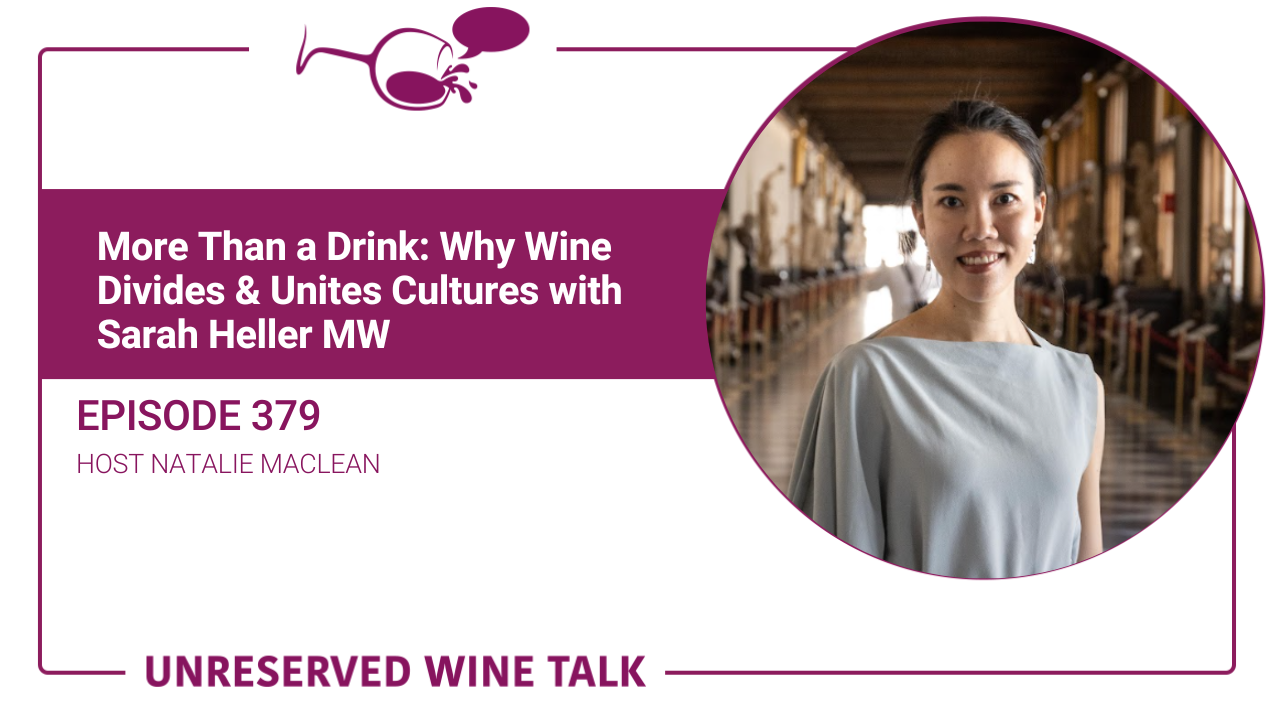
In this episode of the Unreserved Wine Talk podcast, I’m chatting with Sarah Heller, Master of Wine.
You can find the wines we discussed here.
Join me on Instagram, Facebook and YouTube Live Video
Join the live-stream video of this conversation on Wednesday at 7 pm eastern on Instagram Live Video, Facebook Live Video or YouTube Live Video.
I’ll be jumping into the comments as we watch it together so that I can answer your questions in real-time.
I want to hear from you! What’s your opinion of what we’re discussing? What takeaways or tips do you love most from this chat? What questions do you have that we didn’t answer?
Want to know when we go live?
Add this to your calendar:

Highlights
- What was it about tasting Barolo for the first time that completely changed Sarah’s understanding of wine complexity?
- How does Nebbiolo grown on clay soils in Piemonte create a sense of density and structure that feels different from Tuscan Sangiovese?
- How has Attilio Scienza’s perspective on synesthesia shaped Sarah’s approach to wine education?
- Why does Sarah believe wine should be understood as a cultural artifact rather than just a beverage?
- How does the ancient figure of Bacchus in Ovid’s Metamorphoses reveal wine’s power for both chaos and redemption?
- Why does Sarah feel that studying wine deeply increases enjoyment?
- How do different cultures respond differently to studying wine before enjoying it?
- What is Sarah’s pragmatic definition of a fine wine?
- How did Sarah train for the Master of Wine tasting exam?
- Why did Sarah design the Elements glass collection around fire, water, air, earth, and balance instead of grape-specific shapes?
- Why does Sarah see wine education and global exchange as a two-way dialogue?
Key Takeaways
- Why do some cultures embrace wine as a cultural expression while others see it simply as a beverage?
- Certainly, the part of the Italian wine industry that I work with,, is much more comfortable with this idea of wine as a cultural product, as an artwork. Whereas I think in a lot of Anglo-Saxon environments that I’ve been around, there’s real pushback against this. The thing that I really want to stress is that it’s not as if these cultures don’t know that wine is dangerous. It has that potentiality, right? So at the moment I’m reading the Metamorphoses and there are a number of times that Bacchus or Liber, There’s a madness that has been associated with wine since its earliest days in culture, but it’s also the potential for generosity and redemption.
- Can fine wine actually be defined, or is it something subjective to be debated?
- I retreat to something really dry. It’s a wine that you know has the potential to improve over time and therefore is worth keeping in circulation. I think because otherwise we can go down a very subjective path and get into ideological positions on what degree of intervention is appropriate, To skate past all of that, it’s just its impact in the market. It’s the wine that enough people have agreed is going to maintain its value over time. And that has to be grounded in the fundamental wine quality allowing it to hold together and ideally improve, at least by some metrics, over time.
- Why is it so important to identify both the aroma and structure of wines when tasting?
- It was my first year assessment for the Master of Wine exam, which is basically what you do after your first year in order to allow you to progress to the second year, which is the “real exams.” But it’s supposed to be a compressed version of the full exams. And so we had 12 wines, which is one paper, effectively, and then two essays, I think. I had just been in Piemonte for about a month before this. I was interning at a winery. Then the wines, spoiler, were three wines from Piemonte. They were Barolo, Barbera and Dolcetto, which in retrospect should have been really obvious by the logic of the question. It was one region, three different, single variety wines. There are not that many regions that could be. But instinctively, I smelled it and I was like, well, this smells Spanish to me because they were kind of oxidative in style and I was getting a fair amount of oak. It almost smelled like American oak. So immediately, that Barolo to me was Rioja. And then where do you go from there? It’s like, is this going to be Graciano? I don’t remember what nonsense I wrote but if I had taken a moment and tried to suppress my sense of smell and tasted the structure, it’s very hard to confuse Barolo tannins for Tempranillo tannins after they’ve been oxidized out by new oak.
About Sarah Heller
Sarah Heller MW is an internationally acclaimed wine expert and visual artist whose work explores the cultural history and multi-sensory experience of wine. Trained in fine art at Yale, she creates paintings, drawings and digital pieces — including her Visual Tasting Notes series — which have appeared in exhibitions and publications across several continents.
She is the Italian wine reviewer for Club Oenologique, Faculty of the Vinitaly International Academy and Wine Editor for Asia Tatler. Sarah has co-hosted the series Wine Masters and Wine Masters Class and has collaborated with Lucaris Crystal on a line of hand-blown glasses. Before these roles, she worked in the wine trade in New York and Hong Kong, where she was Executive Director of Meiburg Wine Media, and she recently relocated to the Pacific Northwest.
Resources
- Connect with Sarah Heller
- Unreserved Wine Talk
- My Books:
- Wine Witch on Fire: Rising from the Ashes of Divorce,Defamation, and Drinking Too Much
- Audiobook:
- Audible/Amazon in the following countries: Canada, US, UK, Australia (includes New Zealand), France (includes Belgium and Switzerland), Germany (includes Austria), Japan, and Brazil.
- Kobo (includes Chapters/Indigo), AudioBooks, Spotify, Google Play, Libro.fm, and other retailers here.
- Wine Witch on Fire Free Companion Guide for Book Clubs
- Audiobook:
- Unquenchable: A Tipsy Quest for the World’s Best Bargain Wines
- Red, White, and Drunk All Over: A Wine-Soaked Journey from Grape to Glass
- Wine Witch on Fire: Rising from the Ashes of Divorce,Defamation, and Drinking Too Much
- My new class, The 5 Wine & Food Pairing Mistakes That Can Ruin Your Dinner And How To Fix Them Forever
Tag Me on Social
Tag me on social media if you enjoyed the episode:
- @nataliemaclean and @natdecants on Facebook
- @nataliemaclean on Twitter
- @nataliemacleanwine on Instagram
- @nataliemaclean on LinkedIn
- Email Me at [email protected]
Thirsty for more?
- Sign up for my free online wine video class where I’ll walk you through The 5 Wine & Food Pairing Mistakes That Can Ruin Your Dinner (and how to fix them forever!)
- You’ll find my books here, including Unquenchable: A Tipsy Quest for the World’s Best Bargain Wines and Red, White and Drunk All Over: A Wine-Soaked Journey from Grape to Glass.
- The new audio edition of Red, White and Drunk All Over: A Wine-Soaked Journey from Grape to Glass is now available on Amazon.ca, Amazon.com and other country-specific Amazon sites; iTunes.ca, iTunes.com and other country-specific iTunes sites; Audible.ca and Audible.com.
Transcript
Natalie MacLean 00:00:00 Why do some cultures embrace wine as a cultural expression, while others see it simply as a beverage? Can fine wine actually be defined, or is it something subjective to be debated? And why is it so important to identify both the aroma and the structure of wines when tasting? In today’s episode, you’ll hear the stories and tips that answer those questions in part two of our chat with Sarah Heller, master of Wine. You don’t need to have listened to last week’s episode, part one first, but if you didn’t catch it, go ahead and listen to it after you finish this one. By the end of our conversation, you’ll also discover what it was about tasting Barolo for the first time. That completely changed Sarah’s understanding of wine complexity. How Nebbiolo grown on clay soils in Piemonte creates a sense of density and structure, distinct from Tuscan Sangiovese. How Atilio Sansa’s perspective on synesthesia shaped Sarah’s approach to wine education. How the figure of Bacchus in Ovid’s Metamorphoses reveals wine’s power, both for chaos and redemption. Why? Sarah feels that studying wine deeply increases your enjoyment of it.
Natalie MacLean 00:01:14 How Sarah trained for the Master of wine tasting exam. Why Sarah designed the elements glass collection around fire, water, air, earth, and balance rather than grape specific shapes. And why Sarah sees wine, education and global exchange as a two way dialogue.
Natalie MacLean 00:01:39 Do you have a thirst to learn about wine? Do you love stories about wonderfully obsessive people, hauntingly beautiful places, and amusingly awkward social situations? Well, that’s the blend here on the Unreserved Wine Talk podcast. I’m your host, Natalie MacLean. And each week I share with you unfiltered conversations with celebrities in the wine world, as well as confessions from my own tipsy journey as I write my third book on this subject. I’m so glad you’re here. Now pass me that bottle, please, and let’s get started.
Natalie MacLean 00:02:21 Welcome to episode 379. So as we roll into the first week of March, the talk of the town or should I say tongue? If you’re watching Bridgerton, The Talk of the town is a massive retail expansion in Ontario. In B.C., convenience and big box stores are fully integrated into the wine and ready to drink RTD markets.
Natalie MacLean 00:02:43 We’re seeing the Quebec ification of Ontario, with 24 packs of cider and local VQA wines appearing next to snacks and corner stores right where they should be. More than 8500. New retail outlets are now allowed to sell beer, wine, cider and TDs, and they must carve out 40% of their shelf space for Ontario wines and 20% for local beer and cider, a move that could make those Niagara, Prince Edward County and Pelee Island labels feel as normal as milk in a corner store. Norman Beal, chair of the Ontario Craft Wineries Association, noted that roughly 40 to $50 million in capital investment has flowed into the Ontario wine sector in the past year, and he expects that to double this year, according to reporting in The Globe and Mail and CBC. The province now faces a genuine grape shortage, which Beal describes as a good problem to have since it’s prompting wineries to plant new vineyards. The challenge, though, from my perspective, is that grapes don’t produce fruit worthy of wine for 5 to 7 years, so it’s a long term commitment and the demand could change again when U.S. brands re-enter the market.
Natalie MacLean 00:03:57 Personally, I think this has been a giant sampling program for Canadian wines, which is much needed and appreciated. And I do think a lot of people have found new favourites among Canadian wines. But I do think there will be a recalibration back to US brands. It just depends on how much that change will happen. I guess we’ll have to wait and see. In Quebec, the week’s biggest headline is a move to allow spirit based TDs at 7% alcohol by volume or less, to be sold in grocery and convenience stores in marketing moves this week. There’s a bizarre product crossover that I actually kind of like. Canadian sustainable footwear brand sole released a limited edition version of their record sneaker, the first to feature a technical midsole crafted from 52 recycled natural wine corks. They’ve called it the mineral. The upper is treated with natural grape skin dye that mimics a perfect red wine spill across the toe box, which is just perfect for me and others who are prone to accidents. The footbed has cork based insoles, micro encapsulated with a fragrance developed by a French perfumery engineered to release subtle notes of toasted oak and dark berry tannins with every step you take.
Natalie MacLean 00:05:24 It is essentially a wearable olfactory homage to wine, so if you’ve ever wanted to smell like a very good bottle of wine from the bottom of your soles up, your Cinderella slipper has arrived. Footnote, so to speak. I wouldn’t wear these when tasting wine or going to a tasting room. Perfumes are never good, even if they are meant to smell like wine. They do interfere with your tasting ability. So save the cork sneakers for other activities. The cognac house Martell has just unveiled a partnership with Vital Link Technology to debut an ultra lightweight bottle made from the same reinforced glass used in smartphone screens. It’s a sleek, futuristic move aimed at cutting shipping emissions without losing that luxury feel. Speaking of bottles, a massive 15 litre Nebuchadnezzar bottle of champagne was recently spotted being delivered via a custom built motorized miniature gold chariot at a high end ski resort. Proving that the era of quiet luxury might be taking a backseat to sheer alpine spectacle. Hashtag first world marketing. A vineyard in the Loire Valley has begun employing a musical shepherd who plays classical cello to the vines twice a day, claiming that the specific vibrations helped the grapes develop thicker skins and better resistance to late season.
Natalie MacLean 00:06:50 Mildew. A stray cat in a Turkish boutique winery has become an internet sensation for its tasting abilities. The cat reportedly only nips on the boxes of the highest rated vintages, leading the winery, of course, to officially name it their chief feline sommelier in southwest France. One small producer recently went viral for turning their pruned vine canes into a sort of do it yourself vineyard xylophone, stringing them up along a barn wall and inviting visitors to play simple tunes before tasting the resulting video of a various serious winemaker gamely clacking out Frere Jacques before heading to the tasting room to pour samples. A rare bottle of 19th century Scotch was kidnapped from a private collection recently, only for the thief to return at 48 hours later, with a note saying it was too intimidating to open and that they preferred their usual supermarket plant. An Australian distillery has successfully aged a small batch of gin at the bottom of the ocean, claiming the constant swaying of the tides and the pressure of the sea created a salty, sweet botanical profile that cannot be replicated on dry land or in a press release.
Natalie MacLean 00:08:03 Archaeologists recently discovered a 2000 year old Roman Thermopolis, an ancient fast food stall that still had traces of crushed fava beans in the bottom of wine jars used by the Romans to brighten the flavor and color of their wine. Looking at the calendar, we have a genuinely delicious lineup from March 3rd to the ninth. March 3rd is a triple threat National Mulled Wine Day, Irish Whiskey Day, and Moscow Mule Day all land on the same day, which feels like the universe is trying to tell us something. Not sure what mulled wine day. Why don’t you enjoy a Niagara Cabernet Franc with cinnamon, star anise and a splash of Ontario ice wine served in mugs like it’s a very chic ski lodge kind of thing. For Irish Whiskey Day, hold a side by side, blind tasting with great Irish expressions and a Canadian rye to see which one wins your taste buds. Moscow Mule Day. Go for gin or vodka. Trivia point. Moscow Mule was invented in 1941, in Los Angeles, and has absolutely nothing to do with Russia, though I do love those dented, shiny copper mugs.
Natalie MacLean 00:09:15 March 5th is National Absinthe Day and National Poutine Day. For absinthe, try a traditional louche ritual. Slowly drip cold water over a sugar ice cube on a slotted spoon resting above your glass, and watch the liquid turn opalescent and milky. And yes. Absence. Legendary reputation for causing hallucinations is mostly myth regulated through June. Levels in modern absinthe are not nearly high enough to summon any green fairies or leprechauns for that matter. For a high, low pairing, try absinthe rinsed cocktail glass alongside a full poutine bar. March 6th brings National White Chocolate Cheesecake Day, a National Oreo Day. Since white chocolate is essentially cocoa butter and sugar, skip the heavy reds and pear cheesecake with a chilled, honeyed ice wine or Late harvest Riesling. The acidity cuts through the fat like a sharp knife through silk. For Oreo day, it’s basically a stout and cookies kind of occasion. Dark stout for those double stuffed Oreos. No apologies. March 7th is National Cereal Day for a truly unhinged but surprisingly gourmet celebration. Try a cereal milk white Russian cocktail using toasted oak infused vodka.
Natalie MacLean 00:10:33 You know you want to. March 9th is International Women’s Day and also International Women’s Collaboration Brew Day, when women led brewing teams around the world come together to brew a communal beer. It’s one of the more genuinely heartwarming corners of the craft beer industry, and it keeps growing every year. March 9th is also a double hitter. National Crab Meat Day and National Meatball Day trivia point. In 19th century Maryland, crab was so plentiful it was often served free in saloons to make patrons thirsty for more beer to celebrate. Run a surf and turf flight. Try a crisp chablis for the crab and a rustic Sangiovese. Barbera or bright Ontario game for the meatballs. And did you know? Right now, most Northern hemisphere vineyards are finishing up their winter pruning. One common rule of thumb is that each vine ends up with roughly the number of buds that matches the number of bottles the grower hopes to produce from it, which means every cut happening in March is literally a quiet bet on next autumn’s harvest. One weird but wonderful scientific fact to end on your nose doesn’t just smell flavor, it actively shapes it.
Natalie MacLean 00:11:53 When aromas from a sip travel up the back of your throat and into the nasal cavity, that’s your retro nasal smell. Your brain stitches together aroma and taste into a single experience. That’s why the exact same drink can feel muted when you have a cold, or why covering your nose makes a complex spirit taste oddly flat. Wine, beer and cocktails are basically edible perfume with a storyline, and your nose is the narrator. I’ll be featuring more sips and tips on Instagram at Natalie MacLean Wine, so join me there for more of the weird and the wonderful. Okay, on with the show. And what was it about Barolo and Barbaresco that drew you? Was it just. Were they the first great wines you tasted? You have a special place for them in your heart?
Sarah Heller 00:12:45 Yeah. I mean, it probably is as simple as that, right? It’s just I had not been exposed to particularly elevated wines growing up. My my parents, they drank wine, they enjoyed it, but it was not a particular interest for them.
Sarah Heller 00:12:59 It was when I was working or interning again at a restaurant in an Italian restaurant in Hong Kong. Before actually before I went to Piemonte and I went to a wine fair or the first, in fact, Hong Kong International Wine and Spirits Fair in Hong Kong. And the Franco used to meet the general manager. I think of the restaurant I was working with, and he was chaperoning me, and we tasted a Barolo. And it was just this, this idea of like of an aroma that could evolve over time, a texture that could be so intricate on the palate. It was just not something I’d considered before. I think a lot of the wine had been exposed to in Hong Kong was a little bit more, in that Barossa Shiraz might be more elevated than what I was exposed, right? Just not quite yellowtail, but the sort of more straightforwardly, purely hedonistic kind of fruit. Softness, alcohol. What’s not to like? That sort of combination. But I hadn’t thought about wine as something that it had this level of complexity.
Natalie MacLean 00:14:05 Wow. And you’ve described Nebbiolo, the grape, as sort of boggy, whereas Sangiovese, another very popular Italian grape, is not. What did you mean by boggy? I was just curious about that.
Sarah Heller 00:14:17 Oh, I’m not sure.
Natalie MacLean 00:14:18 Okay, maybe you.
Natalie MacLean 00:14:19 Did say it misquoted you.
Sarah Heller 00:14:23 If I’m trying to imagine it might have been something to do with the way that the environment sort of generates what I think is the wine style, right? I mean, there’s definitely kind of clay, moist soils that get very, very hard. They get very wet when it rains. And it being here really does remind me of Piemonte, much more so than Tuscany, which to me is much more California. I mean, even though there are there are soils that have clay in them, there’s an aridity to everything, right? Like the, the classic soils are this kind of bone white. It’s not white everywhere. That is it. But there’s an angularity, I don’t want to say lack of generosity, because it really isn’t that.
Sarah Heller 00:15:01 But the the generosity comes from the sun, whereas you feel like the generosity to the extent that it has it in barrel and Barbaresco and other great wines made from Nebbiolo comes from the soil, especially when they’re grown on clay soils. Right. There’s a, there’s a, a compactness, a density that comes as sort of the core that I think comes from there. I really sound like a mistake.
Natalie MacLean 00:15:24 And I think, I think you’re trying to rescue my question. Actually, you’re just being nice, but thank you. Yeah.
Natalie MacLean 00:15:31 That’s it. That’s the theory. Thank you. There we go. We did it. There’s something else that you probably didn’t say, but maybe you once said, I think that you want to live wine more like we live art. You’re in a region known for glass art and natural beauty, being there on the West Coast. Do you ever plan to create any physical installations that might merge the two worlds?
Sarah Heller 00:15:55 I would love to. I a really bad glassblower. I did actually try years ago.
Sarah Heller 00:16:01 I came and actually the project with the contact lenses on the face came out of a couple of weeks that I spent at Pilchuck at Delta Julie’s school up north. But I think in terms of installations I’ve talked about with a couple of friends doing site specific work, whether that’s in a winery or in vineyards. But the challenge is just time. Like, I have two young children, so taking the time to go be in Austria or in Italy for the time it would take to make something I think would would endure. First of all, in an outside environment would be sort of outside the limits of what I have at the moment.
Natalie MacLean 00:16:40 Sure, everything in its season, they won’t be little for a long time. You know, they do grow up quickly.
Sarah Heller 00:16:45 Exactly. So? Exactly.
Natalie MacLean 00:16:48 Let’s go back to the cross modal thing. Most people think of synesthesia as a rare neurological condition where the senses are cross wired, i.e. tasting colors. And you’re talking about shape and color when it comes to wine. Do you believe your visual tasting notes are teaching regular wine drinkers to unlock maybe a latent form of synesthesia? Or, I guess, a new way of seeing wine? That’s definitely for sure what you’re doing.
Natalie MacLean 00:17:11 But is there anything there that you wanted to comment on?
Sarah Heller 00:17:15 Sure, I’m not a synesthetic. I don’t literally see colors when I taste things. I don’t see colors when I hear notes. I think that would be an incredible experience, but I can’t really speak to that experience. However, there’s sort of a more a looser definition of synesthesia or synesthesia as as he calls it that Attilio Scienza, who I work with on the Italy International Academy. He’s our scientific director. That he has been very adamant about. That has to do with cross-disciplinary thinking, right? Multidisciplinary thinking, using many different modes of study to think about wine. And I have taken that so much to heart. He’s an anthropologist by training, but then he’s also a grape vine geneticist. And, you know, one of Italy’s most prominent also has done a lot of geological mapping and soil mapping. So he takes that sort of multivalent way of thinking into everything that he does. And so I’ve and I mean, in a way, the master of wine is about that as well.
Sarah Heller 00:18:21 Right? Having this 360 view on the way that wine is made, the way that it’s disseminated, marketed, exists in the world. It’s about using the senses more fully and hopefully also kind of engaging our minds more fully. My skepticism, as I’ve said around demystifying wine, I understand that it can be intimidating. I realize when some of the things that I am going down rabbit holes with at the moment, because I’m in the middle of developing a painting show about the history of wine and its relationship with religiosity, and to the past 8000 years, going down some rabbit holes. And I it’s not that I expect that the specific things that I’m reading necessarily to be certainly not a prerequisite for enjoying wine, and certainly not something that I expect everybody to have to read. But if somebody is curious, it’s just this prompt. Right? And I wish we as a wine industry and I think, I think Italians, certainly the part of the Italian wine industry that I work with that I’m exposed to, is much more comfortable with this idea of wine as a general cultural product, as a, as an artifact of culture, as an artwork.
Sarah Heller 00:19:38 There’s not the same discomfort. Whereas I think in Anglo-Saxon environments that I’ve been around, it’s real like pushback against that. It’s like, oh, it’s a beverage and.
Natalie MacLean 00:19:47 A.
Sarah Heller 00:19:48 Place too. Yeah, yeah, I know that. Well, I mean, so are so many things.
Natalie MacLean 00:19:54 That’s true, that’s true. But you’re right. In Italy, it’s part of the culture, the art. Yeah, I get that.
Sarah Heller 00:20:00 The thing that I really want to stress is that it’s not as if these cultures don’t know that wine is dangerous. It has that potentiality. Right? So at the moment I’m reading the Metamorphoses, and there are a number of times that Bacchus or Liber, he’s called different things appears and his followers, and sometimes they’re doing brutal things, right. They’re ripping people to shreds. There’s a madness, right, that has been associated with wine since its earliest days in culture. It’s also the potential for generosity and redemption.
Natalie MacLean 00:20:30 Yes.
Sarah Heller 00:20:30 Yeah. Yeah, absolutely. I mean, of all of the figures in Metamorphoses of All the Gods, I think Bacchus is the only one who never assaults any women.
Sarah Heller 00:20:41 You put that out there. I mean, it’s a very, like, very dark.
Natalie MacLean 00:20:44 Yeah.
Sarah Heller 00:20:46 I mean, he has he has some dark moments, but I think there’s a certain redemption in the role that Ovid sees. For wine, I wish we could all be comfortable with the idea of wine, having that meeting right as something that can be enjoyed on many levels. Right. As just a daily pleasure and as this this sort of incredible cultural artifact.
Natalie MacLean 00:21:10 Something more, if you want it to be. I’ve always said you could, you know, do a liberal arts degree with wine as the hub because the spokes linked to every facet of human endeavor. I mean, it really does. And I yeah, I know, like Sarah, you probably, you know, you can go to an art exhibition and respond in a much richer and deeper way. It doesn’t we don’t have to say it’s better, but I think it’s certainly richer and deeper than I would. And conversely, like I was a dancer.
Natalie MacLean 00:21:33 So when I see someone do like a jet or whatever, I respond with my muscles. It’s like, I know what it takes to do that. And I think with wine that’s there too and just enjoy it. Hedonistic. Or you can take that deep dive.
Sarah Heller 00:21:46 Yeah, absolutely. I mean, the thing that I think has held us up is that there are different kinds of knowledge, right? There’s there’s sort of the, the anthropology and the history angle, which is so much literally, intimately tied to human human endeavor and human labor. And then there’s this sort of technical aspect. And I think so much wine education leads with that, and that is where there is a bit of a disconnect, because a lot of the time it can be a process where some of the magic goes away. Right. Because you know, now that the reason why this wine smells like the earth is not because it, you know, lifted the earth through its its roots. It’s because it has bread. Right? It has it has a yeast.
Sarah Heller 00:22:36 So I think if there is a way to communicate that information without ruining the magic entirely, that’s sort of what we’re trying to do within Italy International Academy. That’s what I’m trying to do with my work more generally, but I don’t know. I don’t know. I also, having worked in soap with so many different cultures, I know that it resonates in some places. I know that, I mean, everything that I do was sort of forged by working in Hong Kong and in China, where there is, I think, not a discomfort with having to study something to enjoy it that doesn’t that doesn’t devalue it. Whereas I’m still figuring out the North American environment. I arrived in Mercer Island four years ago. Now, I haven’t really immersed myself in the U.S. wine scene, but I do just. In interactions with people on a regular basis, there’s, there is a strand of of of thinking that, well, I shouldn’t I shouldn’t have to make this effort to enjoy something. It’s either enjoyable or it isn’t.
Sarah Heller 00:23:38 And I’m just not sure that’s true.
Natalie MacLean 00:23:40 Right?
Sarah Heller 00:23:41 I mean, as you said, right? Like when you when you when you know something a bit more about something, there’s, there’s a richness to your experience that’s maybe not immediately accessible.
Natalie MacLean 00:23:50 Not necessarily better, but definitely richer, deeper. Which kind of leads me into the definition of a fine wine, because there’s so much debate, at least in the wine world, about this. Is it one that expresses terroir? Is it typical? Does it have the least human intervention and manipulation? I mean, I think you’ve talked about this previously, where I mean, if we’re going to go with that, look at champagne and the 72 steps you need to do that or. Moroney, where do you net out on or is there a definition of fine wine, or is it more. You can’t again bring it down to words.
Sarah Heller 00:24:25 Yeah, I think I retreat to something really dry. It’s just it’s a wine that, you know, can has the potential to improve over time and therefore is worth keeping in circulation.
Sarah Heller 00:24:35 I don’t know. I think because otherwise we can so readily go down a very kind of soft, subjective path and get into, you know, very kind of tense discussions and real ideological positions on what degree of intervention is appropriate. And I think this past all of that, it’s it’s just it’s literal impact in the market. Right. It’s so wine that enough people have agreed kind of like the art market. Right. Enough people have agreed is going to maintain its value over time. And that has to be that has to be grounded in the fundamental wine quality, allowing it to hold together and ideally improve, at least by some metrics over time.
Natalie MacLean 00:25:16 Okay. I think that’s satisfying. Textbook for sure. But it’s it actually avoids all these different tangles. We can go down like, is it a single vineyard or is it a blend? And Bordeaux is a blend and, you know, all the rest of it.
Sarah Heller 00:25:30 Yeah, yeah yeah, yeah. And I mean, Italy is right in the middle of that discussion because fine wine in a way, is a concept imported from France.
Natalie MacLean 00:25:39 Okay.
Sarah Heller 00:25:39 It might take some flak for saying that, but, Italian wine. I’ve been I’ve been spending a lot of time recently reading on particularly the history of Italian cuisine, because a lot of it is is surprising. It hasn’t exactly unfolded the way I think the sort of the national image has sort of developed right there. There is, yes. This idea that, like Italian cuisine is extremely regional and that is true. But on the other hand, it elite Italian cuisine used to be more or less the same in all the sort of capitals, because there was this cross-border European elite. Right. So the the cooks would go. I think at one point in sorry, I would. I just find this so amusing. at one point in medieval history, the most prestigious cooks were German cooks.
Natalie MacLean 00:26:28 Oh, really? Okay. They were traveling.
Sarah Heller 00:26:32 Yeah, yeah. The concept, though, of wine as it has existed, this this idea of a sort of tradable wine where you would if you were in one of these elite courts, you would drink wines from all over Europe.
Sarah Heller 00:26:45 You wouldn’t necessarily be drinking your local wine. Italian wine exists today. A lot of it is what the normal people, the common people, had that they were growing for their own consumption. And so trying to figure out which of these grapes, how they fit into this model, and think about the way that wines are typically made for fine wine consumption for for sort of fine wine positioning in France, historically, they would have been aged in oak barrels of various Sizes, but generally on a relatively small scale with a fair amount of new French oak. I’m not talking about like 500 years ago. I’m not talking about relatively, let’s say, since the classification of Bordeaux, say, 1855. Yeah. Whereas Italian wine in that period, there are some exceptions, right? Chianti was elevated by the Medici family as a potential export product from Tuscany. And I think there were some efforts to send it to Great Britain, which is sort of like the arbiter of fine wine taste, I think, much more so than the French.
Sarah Heller 00:27:55 Right, because they were responsible for the trade of wine. But Italian wine was really not part of that trade in any major way other than Marsala, which was effectively a British imposition on a wine culture that was pre-existing but was not as systematized prior to the arrival of the English. So it’s now trying to figure out how these wines fit into the fine wine scheme. This is why you have so much experimentation in Italy, because people are trying to figure out how much the traditional methods versus imported methods make sense for their grape varieties.
Natalie MacLean 00:28:33 And tradition can’t even dictate that. Even in Italy, with its centuries old winemaking tradition, you have relative upstarts like, you know, Saskia or whatever, Nello, that rewrite the rules and become fine wines. So it’s not like they had.
Sarah Heller 00:28:51 Absolutely.
Natalie MacLean 00:28:52 So everything gets turned on its head. It’s interesting for those who like to debate it. Yes. Okay, so the master of wine tasting exam has a pass rate of less than 10%, as you are aware. Can you describe, like the mental gymnastics you performed during the exam to identify wines without, say, leaping to conclusions and how you were successful? What you why you think you were able to get through such an arduous exam?
Sarah Heller 00:29:18 It’s very hard because we think of wine so instinctively and as a sensory experience in reality.
Sarah Heller 00:29:26 Right. As I was sort of alluding to before, all of our sensory cues blend together. So actually, the really analytical approach that we take in standardized wine tasting is a bit of a leap of the imagination, to be honest. But it’s if you sort of accept that and you, you say, well, I need to I need to make a conscious effort to block myself off from making the synthetic conclusions. Right. Bringing information together. I’m just going to focus on getting down the information without trying to form a conclusion. That’s sort of as close as you can get to turning yourself into a precise sensory instrument. Then you go back almost with a clean mind. Right. But again, it is this, this work of mental gymnastics and look at the information that you’ve assembled and then think about logically, what is this pattern? Right. Then then it becomes about pattern recognition. And then there’s a third stage where it’s about communicating that information as convincingly as possible. So it is really three very different cognitive exercises.
Sarah Heller 00:30:29 And so I tried to so Kiki, I, I tried to focus on doing those separately. So I would, I would literally while I was training practice those separately, I would have times when I was just doing the tasting and note taking, then times when I had to, like I’d have a an imagined grid, so I would write down information and then try and synthesize that into what my conclusions would be and just arrange everything and sort of blocks and like logically, this plus this means that. And then separately, I would work on writing my prose, making sure that it was convincing. And I think it’s, there’s, there’s a chess grandmaster then, like jujitsu champion Josh Watson, who wrote a book. Of course, the title is Escaping me right now. Anyway, Josh Watson, I think he I think he’s only written one book, but it was the concept of smaller and smaller circles and sort of identifying smaller and smaller units. I think you can relate to this as a dancer, right? If you try to learn a dance immediately, right, by just watching it, it’s like everything seems insane.
Sarah Heller 00:31:37 But if you nail down each individual step, get those and then string them together, then you can do it faster and faster because that is another is another factor is the time in the master of Wine. It’s it’s time time constraint. And so I tell people like if you’re struggling with time, don’t just practice doing the whole thing again, you’re not going to get faster. The only way you’re going to get faster is by breaking apart the entire process and then doing a diagnosis, basically, of where your weaknesses are, and then you can compress it Well.
Natalie MacLean 00:32:12 You also mentioned that judging a wine too quickly is dangerous because structure rarely lies. Can you share a detective story where the structure of a blind wine saved you from making the wrong guess?
Sarah Heller 00:32:24 So it was my first year assessment for the Master of Wine exam, which is basically what the what you do after your first year in order to allow you to progress to the second year, which is the, quote, real exams, but it’s supposed to be a compressed version of the full exams.
Sarah Heller 00:32:42 And so we had 12 wines, which is one paper effectively, and then two essays, I think years ago now. And the I had just been in Piemonte for about a month before this, I was interning at a winery. I was doing various things, and, then the wine Spoiler. Were three wines from Piemonte. They were Barolo, Barbera and Dolcetto. Which in retrospect should have been really obvious by the logic of the question. It was one region, three different single variety wines. There not that many regions that could be. But instinctively I smelled it like this smells Spanish to me because they were kind of oxidative in style and I was getting a fair amount of oak. It almost smelled like American oak. So immediately that Barolo to me was real hot. And then where do you go from there? Right. It’s like, is this going to be Graciano? Like what? But so I don’t remember what nonsense I wrote that page was. Just scroll, scroll scroll scroll. But if I had taken a moment and tried to suppress my sense of smell literally and tasted the structure, it’s very hard to confuse Barolo tannins for Tempranillo tannins after they’ve been oxidized out by new oak.
Natalie MacLean 00:34:12 How do they feel or taste aging? Yeah.
Sarah Heller 00:34:14 So the thing I say about Nebbiolo tannins. when Nebbiolo comes from the longa, basically where the clay rich soils are, is that they feel contiguous on your palate. It’s almost like your palate thinks shrink wrapped. Right? It’s every surface of the mouth. But then there’s no discernible individual grains, right? So it’s just like, whereas Sangiovese goes like a stripe down the middle of your tongue and it’s discernible grainy. That’s where I think this idea of dusty ness, if it has any sort of objective basis. That’s interesting. That comes from. Okay. Rioja. Right. Because it is exposed to so much oxygen right through that and not, not, not like a deliberate motorization or anything, but just compared to wines that are typically aged in a bottle. There’s a sort of round and a folding ness to the tannins and I, you know, if I’m making an image, it would have a lot of curlicues like this. And so I think it’s very difficult one if you, if you’re, if you know what to look for, if you are suppressing your sense of smell and just focusing on the texture to confuse those two textures.
Natalie MacLean 00:35:26 Okay, that’s really fascinating. I’m going to try that this weekend.
Sarah Heller 00:35:31 These two sounds like a fun experiment.
Natalie MacLean 00:35:34 So you have an elements glass collection with is it Lucas?
Sarah Heller 00:35:39 It’s Lucas.
Natalie MacLean 00:35:40 Lucas okay, there we go.
Sarah Heller 00:35:41 It’s a made up word, so.
Natalie MacLean 00:35:43 Okay, it’s Lucas.
Sarah Heller 00:35:44 Lucas.
Natalie MacLean 00:35:45 Yeah, I find this fascinating. You use concepts like fire, water, and air instead of grape varieties. Why did you decide that, say, a Cabernet glass is less useful than a fire glass? What do those concepts mean when it comes to tasting wine?
Sarah Heller 00:36:01 Yeah. So this this arose out of the fact Lucas. I’d done a little bit of work with them before I got the master of wine, but they were the first call. The moment I got the master of wine, like we wanted to produce a collaborative collection. Do you have any amazing ideas? Like which? Just off the top of my head. But I went away and I knew that as a company. So Lucas is a brand of ocean glass, which is a, a huge producer of soda lime glassware.
Sarah Heller 00:36:33 So, you know, this sort of thing, not this specific glass, but this kind of thing. And they’re based in Thailand, and they had developed licorice as a machine blown crystal glass for black brand for for wine glasses. Now they’ve expanded into spirits, glasses and things. But the idea was always to have a sort of Asian spin, which at the time seemed like something. applicable to myself. It was fun. I was in I was in Asia and there was so much curiosity, excuse me, around that at the time around Asian food and wine pairing, for instance. And so that was one idea they threw out at me. What if we could find something that related in some way to food and wine, like, okay, went away and had a think? And something that’s always been interesting to me is this sort of binding together of cultures, right, especially across the Eurasian continent. And, I mean, I think that sort of extends, right, because of historical immigration patterns and things.
Sarah Heller 00:37:40 But what what are things that are shared in the, philosophical background of these two cultures? And the thing that, that was a linkage was this idea of the natural element. Right. That was kind of predated our modern scientific understanding of what an element is. And I was really interested by how there were the four. I think in ancient Greek philosophy there are. I’m going to get this wrong. There are 5 or 5 in Ayurveda, and it’s a six in traditional Chinese medicine or the other way around.
Natalie MacLean 00:38:22 Chakras or elements.
Sarah Heller 00:38:24 Elements. So air. So Ayurveda has ether. Okay, we didn’t make an ether glass.
Natalie MacLean 00:38:32 But I sort of can’t see it.
Sarah Heller 00:38:36 Yes, exactly. It’s it’s ethereal. but we came down on the idea of originally we were going to do four. Okay. And then we thought that maybe that was not ideal, given four is not a lucky number in Chinese. Ideas around, auspicious numbers. And so we did five. And so, Then we had to decide which ones they were going to be.
Sarah Heller 00:39:04 And so I think. Fire. Fire. Air. Water. What are the pretty obvious ones? And then it was was it going to be wood? Like a wood glass for wine. Maybe. Maybe for a bourbon glass I don’t know. I don’t know. But so we the whole idea though was kind of around balancing and individual sort of composition or identification or preferences. So the idea was that the glasses would shape the wine to be the thing that you needed it to be, rather than presenting the wine in its ideal form. Right. Because they I’d come across a lot of glasses were positioning themselves as universal glasses. And this is, I think, pretty standard idea. And that one glass can be the ideal glass for everything and every wine and every person. But I just don’t think that’s fundamentally true, right? Some of us prefer rounder wines, some of us prefer fresher wines. And then over time, that sort of evolved. Or I realized people don’t necessarily. It’s not that the glass is made, the wines all taste the same, but they drew out that particular element in the wine.
Sarah Heller 00:40:22 So the water glass made the wine fresher and more precise. The air glass emphasized the aromatic profile while still keeping it fresh, so that it didn’t feel cloying as I was as I was talking about with Nebbiolo earlier. And, they went through a lot of iterations. It was a three year process getting from that initial conversation around, why don’t we do something about the elements to actually having having the glasses. And of course, we release them in 2020, right as the pandemic was starting. So that was fun. But Anyway, it’s, So it’s not that I. It’s not that I disavow. I think people if people want to have a Cabernet glass and that feels like, they want. They want the sort of reassurance of being told this is the best way to experience this wine. This is the most authentic way to experience the wine. That’s totally fine. But my idea is certainly at the time, and I think I still believe this to be true, is that there are people who can sort of take ownership of what they enjoy and wines, and we can all be sitting in a room, have different preferences, drinking the same wine, and we’re getting completely personalized experiences.
Sarah Heller 00:41:34 So that was that was sort of the the thinking behind that.
Natalie MacLean 00:41:38 I get that. So how does what does the fire glass do to Cabernet make it more I don’t know volatile. What’s it doing.
Sarah Heller 00:41:46 It does actually. So because it is a wide flat base, it does like you’re getting more alcohol release and that’s bringing like a huge cloud of aromatic intensity. But okay, but you are also getting this sense of heat and then it’s a wider rim than a lot of the others. So you get this simultaneity. Everything lands on the palate at once. So there’s a sense of potency for all of them. It’s a combination of, I mean, the original prototypes, I’ll tell you. We’re like very simple. It was just about the ratio of what I call the hips. Right. The widest part of the bowl to the rim. Okay. And, the design team and the marketing team were like, do you think we could do something a little bit more interesting.
Natalie MacLean 00:42:30 Because.
Sarah Heller 00:42:30 They were just all sort of variations on tulip glasses with different widths and rims.
Sarah Heller 00:42:36 And so we went we went really broke. I mean, at one point we had like a glass that was asymmetrical to be the air glass it was going to be. It was going to be like a cloud puff. I don’t think we would have sold many of those, but maybe we would have. And it was fun. And then we pulled back from there. Okay. So it’s a combination of the dimensions of different things. But then also some of them have like the hourglass now has almost like a donut around the middle. So it’s just this like very rounded soft surface in which you can do the aeration. Okay. And like, I mean, there’s a lot of kind of fluid dynamics that you can get into. Right. It’s like because it’s more rounded, it’s a gentler oxygenation than if it were hitting like in the fire glass. It’s hitting against a hard wall. But then there’s this sort of rippled base at the bottom that keeps it a little bit more stable. Okay. So there was a lot of there was a lot of kind of later detail that we put into it.
Sarah Heller 00:43:31 But the basic concept is around how we can draw out particular facets in, in different lines.
Natalie MacLean 00:43:39 That’s interesting. That’s great. And are they are they still on the market? Have they done well as glassware.
Sarah Heller 00:43:46 Well so they the decision we came to the the glassware company as I said, do machine blowing glasses. But the problem with machine blown is that once you decide on a shape, you have to commit to making 120,000 pieces. Oh, wow. And given the sort of unusual shapes we were doing, we all had severe anxiety around that. So we decided to go with hand-blown okay? Which meant that we they couldn’t do it in Thailand. So we ended up blowing them in Hungary. But so they were really limited production runs. And as I said, we started in the middle of the pandemic. So we were doing like a thousand piece, production runs. And then I think there are still some in stock. But it became quite challenging working with that factory. Now, the company at the moment is thinking about doing a limited range machine.
Sarah Heller 00:44:48 Blown. but, yeah. We can’t get into more detail.
Natalie MacLean 00:44:56 Oh, no. That’s fine. Yeah. No corporate secrets, though. It’s fascinating. Fascinating. I’ll have to Google that afterwards and take a look at what they look like. Thank you. Our time has flown. Sarah. I haven’t got through nearly all of these questions, but, is there anything we haven’t covered that you’d like to mention? before we wrap up?
Sarah Heller 00:45:18 Yeah. You know, I think the thing I have really come to appreciate in the work that I’ve been able to do around wine, particularly within Italy International Academy, with working with people and the way that the program is structured. Our main program is every year in April, we invite 60 people from around the world or they apply, but we we end up with about 60 people from all over the world. and it’s really, part of it is the quality of the students, but also it’s dictated by which markets the the fair and by extension, Italian trade agency wants to focus on.
Sarah Heller 00:45:59 And so we’ve had different areas of focus over time. Originally it was there was a heavy emphasis on China. There’s been more of an emphasis on North America in the past couple of years. But also there’s a big Central Asian contingent. We actually did a session in Kazakhstan at one point. Oh, and, I really I think it’s important to understand that wine, the kind of dissemination of wine knowledge, is not a one way street. I think there is. There’s a degree to which. There’s a current of thought that it’s just about culture going in one direction. But to me it’s very it’s very bidirectional. Right? The, the amount of impact that I’ve seen with the sort of wine boom in Asia coming back and shaping the wine industry. It’s this wonderful, dynamic industry that’s able to welcome people in. And I think we see this with the the incredible winemaking that’s happening in China, how it’s sort of going beyond now being what it was, I think in the early days, which was trying to follow a Bordeaux model.
Sarah Heller 00:47:06 Now it’s it’s sort of gone, gone in all kinds of fascinating directions. And so I, I, I want to emphasize, I guess, wines role as a connector. That truly is both ways. And I love that about it.
Natalie MacLean 00:47:20 Absolutely. And we should say just a few more things about the vine Italy faculty. You’re part of that. And so do you do online classes as well. Or is it the once a year by invitation only 60 people. How does that work?
Sarah Heller 00:47:36 So that’s the main course. So this is the there’s the vanilla International Academy. And then there’s the ambassador program that I’m the faculty for the academy in general, but I’m also the lead instructor for the ambassador program, and that’s sort of the pinnacle of our pyramid. But there’s also, there are different tiers. They’ve just gone through a revision of the sort of feeder tier for that. So, that’s sort of in the process of being rolled out. But our, our core program, as I say, is a 60 person program in Verona.
Sarah Heller 00:48:10 And typically we do 2 to 3 satellite editions over the course of the year. So the past couple of years, we’ve done two in the US and one somewhere else. this year we have one in New York in October. but, we’re still deciding what the others are going to look like up and pushing for Asia just so I can can justify going home. But, we’ll see. We’ll see what happens.
Natalie MacLean 00:48:37 Oh that’s great. And where can people find you? In Italy? The, the school, everything online.
Sarah Heller 00:48:45 Thanks. So. my my Instagram, where I still occasionally post some of my art, although it’s probably going to get its own account relatively soon. Okay, is at Sarah Heller MW okay. and then my website is Sarah Heller. Italy International Academy is part of the Vine Italy website. So if you just google Vine Italy International Academy, it’ll pop up and show you the dates of the next programs. So yeah, I hope to see some of your listeners at at one of those programs.
Sarah Heller 00:49:18 It’s it’s truly it’s one of my very dear to me projects.
Natalie MacLean 00:49:25 It’s different. I’m sure you will see the responses we’ve had to previous podcasts. People are very engaged, so we’ll put all the links in the show notes in case people have missed writing that down, I will say thank you so much. This has been a delightful Conversation. really enjoyed it. and cheers to you. Good luck with everything you’re doing. I can’t believe how you. I don’t know how you do it. And you have two young children, so holy smokes, you have a schedule that would tire a horse. But. But congratulations. Thank you. Well. Thank you. Next time, Sarah, we can chat over a glass of wine in person.
Sarah Heller 00:50:08 That would be great. I would love that.
Natalie MacLean 00:50:09 All right. Cheers. All right. Well, there you have it. I hope you enjoyed our chat with Sarah. Here are my takeaways. Number one. Why do some cultures embrace wine as a cultural expression, while others simply see it as a beverage? As Sarah explains, certainly the part of the wine industry in Italy that she works with is much more comfortable with the idea of wine as a cultural product and artwork, whereas she believes that a lot of Anglo-Saxon environments, there’s kind of a pushback against this.
Natalie MacLean 00:50:48 The thing that she wants to stress is it’s not as if these cultures don’t know that wine is dangerous. It has that potential, but it also has the opposite potential. At the moment, she’s reading Metamorphoses by Ovid, and there were a number of times when Bacchus or Lieber were associated with wine. Since the earliest days of culture, there was a madness to what they did, but there was also the potential for generosity and redemption. I love that. Number two can fine wine actually be defined? Or is it something subjective to be debated? Sarah believes that wine that you know, that has the potential to improve over time is worth keeping in circulation in the market. And she sticks with that very simple definition, because otherwise she believes we go down a very subjective path and get into ideological positions. On what degree of intervention in winemaking is appropriate. I agree with her. To skate past all that fine wine has an impact in the market. It’s the wine that enough people agree is going to maintain its value over time.
Natalie MacLean 00:51:59 And that has to be grounded in the fundamental wine quality, allowing it to hold together and ideally improve, at least by some metrics over time. And number three, why is it important to identify both the aroma and the structure of wines when you’re tasting them? Sarah recounts her first year assessment for the Master of Wine exam, which is kind of a warm up for the, quote unquote, real exams. They had to taste 12 wines and then complete one paper and two essays. She had just been to Piedmont for a month before this experience, interning at a winery and the wines during this exam were all from Piedmont or Piedmont. I should say they were Barolo, Barbera and Dolcetto, which in retrospect, she says, should have been obvious by the logic of the question. It was one region, three different single variety wines. There are not that many regions that have this kind of complexity and diversity. She smelled it and she thought smells Spanish because they were kind of oxidative in style with a fair amount of oak, smelled like American oak to her.
Natalie MacLean 00:53:11 So immediately that Barolo to her was a Rioja. Completely understandable. So where do you go from there? It’s like, okay, so is this going to be Graciano? So you start thinking of okay, what are three Spanish grapes? In retrospect, she says she should have suppressed her sense of smell and tasted the structure because it’s very hard to confuse Barolo tannins for Tempranillo Tannins of Spain after they’ve been oxidized out by new oak. Fascinating. If you missed episode 139, go back and take a listen. I chat about wine scores, pairings, and writing with Master of Wine Vanessa Conlon. I’ll share a short clip with you now to whet your appetite.
Natalie MacLean 00:53:55 Give them something they.
Natalie MacLean 00:53:56 Understand a score.
Natalie MacLean 00:53:57 Because.
Natalie MacLean 00:53:57 We know that. And at first I resisted.
Natalie MacLean 00:54:00 But then I.
Natalie MacLean 00:54:00 Came over to his way of thinking, because that’s the way I feel I can be of greatest service, and that’s why I score wines in addition to those, I hope. Elegant extra tasting notes.
Vanessa Conlin 00:54:09 How would you recommend someone is trying to figure out which critic to align with or who to listen to? How should a consumer make that decision?
Natalie MacLean 00:54:19 I think it’s finding someone whose palate lines up with yours.
Natalie MacLean 00:54:22 Also someone who can guide you a little bit further, taking you out of your comfort zone. I think it comes down to palate taste, but it can also be a preference for personality, like the way they write about wine or they make it interesting or fun. There’s just so much out there these days with the internet and social media and videos and everything else. I think there’s a critic for everyone. These days, everyone is a critic, but there’s so many ways to be guided.
Natalie MacLean 00:54:47 I think.
Natalie MacLean 00:54:48 That’s an easy choice these.
Natalie MacLean 00:54:49 Days.
Natalie MacLean 00:54:54 You won’t want to miss next week when we chat with John Kelly, CEO of the Belfast Distillery Company, responsible for reviving the historic McConnell’s Irish whiskey brand. It’s just in time for Saint Patrick’s Day, and he’ll be sharing stories and sips from the historic Crumlin Road Jail, a Victorian prison in Belfast that was retrofitted for state of the art distillery equipment and a tasting room. To give you a sense of other future guests, we’ll have Michael Finnerty on pairing wine and cheese.
Natalie MacLean 00:55:27 Doctor Charles Knowles, who has just published a bestselling memoir, Why We Drink Too Much. Marisol de la Fuente on the wines of Argentina. Alan Ramey, author of the new book Pressing Matters, about starting a career journey in the wine world, and Nicole and Ramon Bassett on Tasting Victory the life and wines of the world’s favourite sommelier, Gerard Basset. Do you have a question for any of our guests? Please let me know. Do you know someone who would be interested in this week’s episode? Learning more about how to taste wine, especially those wines that can change your world. Please let them know about this podcast. Email or text them now while you’re thinking about it. It’s easy to find the Unreserved Wine Talk podcast. Just tell them to search for that title or my name Natalie MacLean wine. On Apple Podcasts, Spotify, their favorite podcast app. Or they can listen to the show on my website at Natalie MacLean or podcast in the show notes. You can also find a link to take a free online food and wine pairing class with me, called the five Food and Wine Pairing mistakes that can ruin your dinner and how to fix them forever at Natalie MacLean.
Natalie MacLean 00:56:38 And that, my friend, is all in the show notes at Natalie MacLean. Com slash 379. Thank you for taking the time to join me here. I hope something great is in your glass this week. Perhaps a wine that has an intriguing shape and texture.
Natalie MacLean 00:57:01 You don’t want to miss one juicy episode of this podcast, especially the secret full bodied bonus episodes that I don’t announce on social media. So subscribe for free now at Natalie MacLean. Forward. Subscribe! Meet me here next week. Cheers!