






Introduction
How can a wine story rooted in darkness leave you feeling hopeful about your life? Why is France such a symbol of freedom, possibility and reinvention for her? How can discovering France through art, cinema, and wine become an escape into a completely different world?
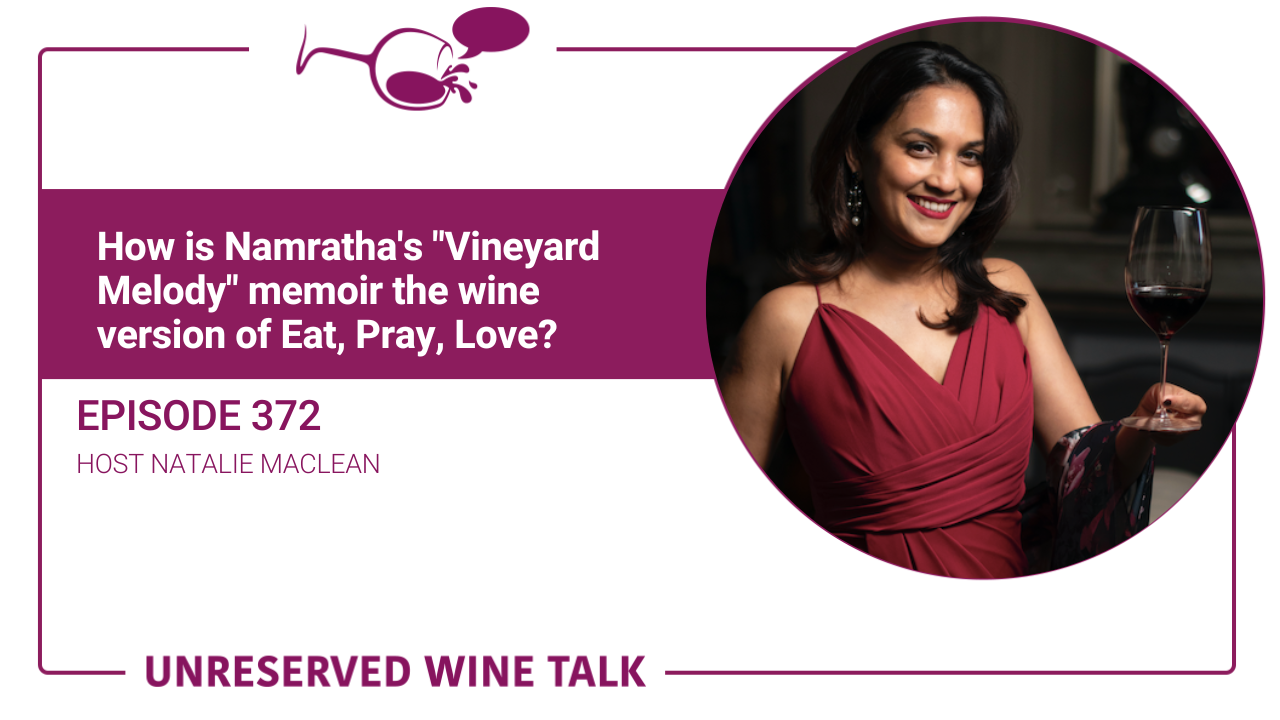
In this episode of the Unreserved Wine Talk podcast, I’m chatting with Namratha Stanley, author of Vineyard Melody: How One Woman Rebuilt Her Life, One Grape At A Time.
You can find the wines we discussed here.
Giveaway
Three of you are going to win a copy of Namratha Stanely’s terrific new book, Vineyard Melody: How One Woman Rebuilt Her Life, One Grape At A Time.
How to Win
To qualify, all you have to do is email me at [email protected] and let me know that you’ve posted a review of the podcast.
It takes less than 30 seconds: On your phone, scroll to the bottom here, where the reviews are, and click on “Tap to Rate.”
After that, scroll down a tiny bit more and click on “Write a Review.” That’s it!
I’ll choose three people randomly from those who contact me.
Good luck!
Join me on Instagram, Facebook and YouTube Live Video
Join the live-stream video of this conversation on Wednesday at 7 pm eastern on Instagram Live Video, Facebook Live Video or YouTube Live Video.
I’ll be jumping into the comments as we watch it together so that I can answer your questions in real-time.
I want to hear from you! What’s your opinion of what we’re discussing? What takeaways or tips do you love most from this chat? What questions do you have that we didn’t answer?
Want to know when we go live?
Add this to your calendar:

Highlights
- Which childhood moments shaped Namratha’s sense of courage and adventure and understanding of injustice?
- What is Vineyard Melody about and how does it differ from other wine and reinvention stories?
- Why did Namratha feel compelled to write this book despite the risks of telling her truth?
- What early warning signs in her marriage did Namratha only recognize in hindsight?
- How did the system ultimately fail to protect Namratha and how did learning French become an act of survival?
- Why did the language prove so valuable when an unexpected job opportunity in Paris arose?
- How did ridicule and resistance at home strengthen her resolve to pursue independence through work?
- What was it like to arrive in Bordeaux for her wine MBA?
- What did seeing the Eiffel Tower and having her first meal in Paris symbolize about freedom and possibility?
- Why did Namratha ultimately decide that leaving India permanently was the only path toward rebuilding her life and identity?
Key Takeaways
- How can a wine story rooted in darkness leave you feeling hopeful about your life?
- I think, Natalie, a lot of people, have written stories of survival, grief and of vineyards. I think mine is an amalgamation of all of these stories because there’s darkness and then you go into light. So, it’s Eat, Pray, Love. It’s a From Scratch. It’s A Year in Provence. It’s all put together and the book is about that. It is going to give hope to a lot of people who think life is just… it cannot go on further. But they will see that when I thought life will not go on further, I took that first step, life could go on further and you could discover beautiful things. Your life can become whatever you dreamed of.
- Why is France such a symbol of freedom, possibility and reinvention for her?
- When I was on the flight and the flight was descending, I peeped out of the airplane to see this, silver snake-like river, that was flowing down beneath… the Gironde. And I was so excited when I saw that, I felt that finally I’m here, finally there’s freedom. And, I think when I really, got into the car and the visa was stamped… The next day, I went around with my Airbnb host. He was kind enough to take me around Bordeaux, showing me the river, showing me the beautiful buildings, the cafes. That’s still very memorable for me.
- How can discovering France through art, cinema, wine become an escape into a completely different world?
- I was almost like finding freedom, the liberté that, you know, the French call. It’s almost like finding France in India at the Alliance. People are liberal. Nobody is judging you. You can have a nice conversation with anybody on campus. We are all there to learn it. It was a window into a different world. We were learning about museums, art. We were learning about cinema. We were learning about music and the films gave me an insight into the real French culture. We were learning about wine, the boulangerie and all of that. So I was seeing that in cinema. So somewhere it was a window into a different world and I loved it so much. It was an escape for me.
About Namratha Stanley
Namratha Stanley is the debut author of Vineyard Melody, a memoir chronicling her personal and professional transformation. Once confined to a patriarchal household in India, where she was barred from working, she broke free from marital violence and moved to France in 2017 to pursue a Wine MBA. She went on to found Wine Equation, a Bordeaux-based wine merchant company, and created Solicantus, her signature wine brand now distributed in five countries. Today, she serves as Program Director at INSEEC (Omnes), mentors women and students, and donates part of her wine sales to support children’s education in India. Her journey—from traditional housewife to entrepreneur—has been featured in Forbes, Decanter and many other magazines. Namratha lives in France with her daughter and two cats, continuing to write and grow her wine business.
Resources
- Connect with Namratha Stanley
- Website: NamrathaStanley.com
- Instagram: @namratha_stanley_author
- Book: Vineyard Melody: How One Woman Rebuilt Her Life, One Grape At A Time
- Wine: Solicantus
- Unreserved Wine Talk | Episode 332: Start a Bordeaux Winery and Make The Midlife Move with Sally Evans
- My Books:
- Wine Witch on Fire: Rising from the Ashes of Divorce,Defamation, and Drinking Too Much
- Audiobook:
- Audible/Amazon in the following countries: Canada, US, UK, Australia (includes New Zealand), France (includes Belgium and Switzerland), Germany (includes Austria), Japan, and Brazil.
- Kobo (includes Chapters/Indigo), AudioBooks, Spotify, Google Play, Libro.fm, and other retailers here.
- Wine Witch on Fire Free Companion Guide for Book Clubs
- Audiobook:
- Unquenchable: A Tipsy Quest for the World’s Best Bargain Wines
- Red, White, and Drunk All Over: A Wine-Soaked Journey from Grape to Glass
- Wine Witch on Fire: Rising from the Ashes of Divorce,Defamation, and Drinking Too Much
- My new class, The 5 Wine & Food Pairing Mistakes That Can Ruin Your Dinner And How To Fix Them Forever
Tag Me on Social
Tag me on social media if you enjoyed the episode:
- @nataliemaclean and @natdecants on Facebook
- @nataliemaclean on Twitter
- @nataliemacleanwine on Instagram
- @nataliemaclean on LinkedIn
- Email Me at [email protected]
Thirsty for more?
- Sign up for my free online wine video class where I’ll walk you through The 5 Wine & Food Pairing Mistakes That Can Ruin Your Dinner (and how to fix them forever!)
- You’ll find my books here, including Unquenchable: A Tipsy Quest for the World’s Best Bargain Wines and Red, White and Drunk All Over: A Wine-Soaked Journey from Grape to Glass.
- The new audio edition of Red, White and Drunk All Over: A Wine-Soaked Journey from Grape to Glass is now available on Amazon.ca, Amazon.com and other country-specific Amazon sites; iTunes.ca, iTunes.com and other country-specific iTunes sites; Audible.ca and Audible.com.
Transcript
Natalie MacLean 00:00:00 How can a wine story rooted in darkness leave you feeling hopeful about life? Why is France such a symbol of freedom, possibility and reinvention? And how can discovering France through art, cinema and wine become an escape into a completely different world? In today’s episode, you’ll hear the stories and tips that answer those questions in our chat with Namrata Stanley, who will be publishing her debut memoir, vineyard Melody, on February 10th. It’s the wine version of eat, pray, love, and you can pre-order it now online. By the end of our conversation, you’ll also discover the childhood moments that shaped Nam’s sense of courage, adventure, and understanding of justice. Why Nam felt compelled to write this book despite the risks of her telling the truth, how the system failed to protect her, and how learning French became an act of survival, why the language proved so valuable when an unexpected job opportunity in Paris arose. What it was like to arrive in Bordeaux and to enroll in the wine MBA, and what? Seeing the Eiffel Tower for the first time and having a first meal in Paris felt like and symbolized for her.
Natalie MacLean 00:01:22 Do you have a thirst to learn about wine? Do you love stories about wonderfully obsessive people, hauntingly beautiful places, and amusingly awkward social situations? Well, that’s the blend here on the Unreserved Wine Talk podcast. I’m your host, Natalie MacLean, and each week I share with you unfiltered conversations with celebrities in the wine world, as well as confessions from my own tipsy journey as I write my third book on this subject. I’m so glad you’re here. Now pass me that bottle please and let’s get started. Welcome to episode.
Natalie MacLean 00:02:05 372. We’re kicking off a mid-January stretch that is surprisingly packed with reasons to celebrate, even if you’re trying to keep things dry or damp. As of this morning, the landscape for Ontario drinkers has fundamentally changed where two weeks into the open market era and the latest data shows that retailers are wasting no time. A new regulatory amendment took effect on New Year’s, allowing grocery and convenience stores to sell alcohol online right beside your milk and your bread. Removing the old requirements. Recent BMO market stats indicate that 70% of Canadian wineries expect sales growth this year.
Natalie MacLean 00:02:46 George Caelius, president and CEO of the Lcbo, will retire on January 31st after nearly 30 years with the organization and the last decade at the helm as CEO. The Lcbo is second only to Costco in terms of being the largest purchaser of beverage alcohol in the world. Celsius joined the Lcbo in 1997 as a quality assurance inspector, rose to executive VP and then went on to be CEO for ten years. His successor, Aaron Campbell, currently chief of staff and VP of Corporate affairs, strategy and sustainability, will step in as interim president and CEO on February 1st. I’m sure there’s going to be lots more changes coming as a result. Celsius exits at a time that’s pretty turbulent for the Lcbo in terms of navigating new competition from convenience stores and grocery stores. US tariffs product listings over 3600 American brands remain unavailable, and the ongoing shift toward moderation among consumers. January is shaping up to be a record breaking one for dry January. 41% of Canadian consumers are fully participating or reducing their alcohol intake this month, with interest having surged 242% since tracking began.
Natalie MacLean 00:04:11 In the US, 30% are joining Dry January, which is also a big jump, and Gen Z continues to lead the charge. The marketing world is split between the dry and damp camps. This year’s strategies have pivoted away from the Don’t Drink now lectures toward the drink better Empowerment seed lip. Diageo’s pioneering alcohol free spirit brand is celebrating its 10th anniversary this month with the launch of its cheeky yet a drink campaign, directly addressing skeptics who still question whether non-alcoholic spirits count as real drinks. And by the way, my personal opinion is absolutely these days, great. When you get good brands in the spirits or wine categories, you’re getting something that actually tastes good. Yes, it doesn’t have alcohol or it may be low alcohol and there’s a trade off with that in terms of the body and weight. Alcohol is also a carrier of flavor, but these new drinks that are coming on the market now are pretty darn good. That’s why I’ll be doing a special segment on low and no alcohol drinks on city TV’s breakfast television this month.
Natalie MacLean 00:05:25 London and Paris bars are now serving luxury sips one ounce pours of premium wines at 15 to $20, giving budget conscious drinkers a taste of the good stuff without committing to a full bottle or a full glass. Even that’s appealing, apparently, to osmotic and other GPL one users who have reduced appetites and thirst for wine. If you’re looking for a reason to pour something specific this week. The calendar is working overtime. January 14th is National Pastrami Day. Skip the soda and try a bold, peppery Syrah or a tangy craft cider to cut through that salty smoked fat and all the nitrates that can cause cancer anyway. All things in moderation, right? January 16th. It’s international Hot and Spicy food day. Celebrate by making a spicy margarita or a marg with a bird’s eye chili. Or for trivia buffs, remember that spicy food releases the same endorphins as runner’s high, making it the perfect legal buzz. We also have National Hot Buttered Rum Day on January 17th. A great excuse to warm up with this colonial classic featuring dark rum, butter, brown sugar, and warming spices.
Natalie MacLean 00:06:39 Mix yours with a splash of Newfoundland screech and toast to surviving the polar vortex. O January 18th. Doubles as gourmet Coffee Day and Peking Duck Day, may I suggest pairing a crispy duck with an off dry Alsatian? Cabot’s demeanor while sipping on a coffee infused Kahlua digestif afterward. Baltic Porter Day rolls in on January 18th. Why not try pairing this dark, roasty beer with smoked cheddar or even a chocolate lava cake? This once niche style that crossed the Baltic Sea centuries ago, where British porters were beefed up to survive long, chilly voyages, ended up inspiring local brewers to create the inky, high gravity versions that taste like liquid rye bread soaked in cocoa. January 19th is National Popcorn Day. Try the buttered kernels with a creamy chardonnay. Jan 20th is both Butter Crunch Day and Cheese Lover’s Day, which practically begs for a cheese board paired with a buttery chardonnay or a nutty, aged Gouda alongside a tawny port. in Marketing Moves. This week, we’re seeing a major shift in how brands talk to us on social media.
Natalie MacLean 00:07:53 The era of the polished celebrity spokesperson apparently is being replaced with what marketers called authentic entry points. How do they manage to make simple things sound complex? Maybe it’s justification for their salaries anyway. Brands like Curtis Family Vineyards are now using augmented reality enabled labels, where a quick smartphone scan doesn’t just show you a tasting note, but drops you into a live 360 degree behind the scenes feed of their sustainable water management systems. Which just sounds profoundly boring. But I’m sure as we get used to using this technology more effectively, we’ll get into a little bit more excitement. All right, I’m sure some people do find water management very exciting and I’ll be hearing from them. the Wine Dogs 2026 calendar has officially launched, featuring loyal dish liquors from famous wine estates. It’s the ultimate possum accessory for any tasting room, while this year, as well as lovers of both wine and her, what do they call a canine friends? As you can tell, I’m not a fur mama. A new record was recently set for the world’s largest alcoholic mixed drink, using a staggering 2650 bottles of Jose Duero gold.
Natalie MacLean 00:09:15 The resulting Margarita could have served 134,000 people. That is, if they could have found a straw large enough. In the records, you shouldn’t try at home category. A Polish mixologist recently claimed the title for the largest gin and tonic, mixing over 500l of gin with 1700 liters of tonic. Now that’s enough GMT to fill a decent sized garden pond. Archaeological chemists have confirmed that wine actually predates the we’ll I knew it while the wheel showed up around 3500 BCE. Evidence of fermented honey mead in China dates back to 9000 years, proving that humans prioritized a good drink over easy transportation. That’s probably why Air Canada is making alcoholic drinks free on board. I mean, who cares where my luggage went? Get me another Merlot and the world’s most expensive bottle of scotch. A macallan 1926 continues to haunt auctions with a $2.7 million. That’s US dollars price tag. Only 40 bottles exist, so it’s almost too precious to actually open. And a thief in Guelph, Ontario, with very expensive taste and very poor morals stole a 70 year old woman’s debit and visa card information in late November and then used the cards to withdraw 3500 in cash and purchase two bottles of Chateau Margaux from the Lcbo, valued at $4,200.
Natalie MacLean 00:10:53 Chateau Margaux is one of only five Bordeaux estates awarded first growth status in the 1855 classification, and the thief choosing two bottles of Margaux over, say, grabbing a bunch of mid-range bottles suggests either genuine wine knowledge or very good advice. Either way, this is a thief with grand ambitions and again, no sense of right and wrong. And here’s a weird but wonderful scientific fact if you’re watching your sugar and using diet mixers in your cocktails, you might be getting tipsy faster. A study found that people who use artificially sweetened mixers like diet soda, have significantly higher breath alcohol readings than those who use regular mixers. The sugar in regular soda actually slows down the rate at which your stomach empties its contents into the small intestine, which is where most alcohol is absorbed. Without that sugar break, the alcohol hits your bloodstream at high speed. I’m sharing more weird tips and sips over on Instagram at Natalie MacLean Wine, so join me over there for more of that. And back to today’s episode three of you will win a copy of Nam’s new memoir.
Natalie MacLean 00:12:10 If you’d like to win, just email me and let me know. Hey, I’d like to win. It doesn’t matter where you live, I’ll choose three winners randomly from those who contact me at Natalie at Natalie MacLean dot com. Keep them for yourself or give them as gifts. Congratulations to Agnes Gentry in Latvia, who has won a copy of the Smart Traveler’s Wine Guide to the Rhone Valley by Matt Walls. Thank you so much for listening. Agnes. on upcoming TV shows. We’ll be talking about fresh spring wines in March. Saint Patrick’s Day wine, beer and spirits. Now there’s a new word a beer and spirits and environmentally sustainable drinks for Earth. Our Easter and Mother’s Day. Let me know if you’d like your brand featured on these TV segments or future ones, or if you’d like to advertise with us through our podcast, newsletter, website, social media or mobile apps, please email me at Nathalie at Natalie MacLean. Com. If you’re reading the paperback or e-book or listening to the audiobook of my memoir, Why Witch on Fire Rising from the Ashes of Divorce, defamation and Drinking Too Much, which I can now say at Warp Speed, which is a national bestseller and one of Amazon’s best books of the year.
Natalie MacLean 00:13:24 I’d also love to hear from you. Good things only, please. I’ll put a link in the show notes to all retailers worldwide at Natalie MacLean 0072. Okey dokey. On with the show. Before I introduce our guest, just let me say that three of you are going to win a copy of her terrific new book. It’s called vineyard Melody. All you have to do is email me at Natalie at Natalie MacLean dot com and let me know you like to win a copy. I’ll pick three people randomly from those who contact me. All right, back to our guest. Namrata Stanley has just published her debut memoir, vineyard Melody, a soul stirring memoir that traces Nam’s journey from the darkness of domestic violence in India to the sun drenched vineyards of France, where she reinvents herself to become a wine entrepreneur. She explores domestic and cultural tensions, the challenges of motherhood, and of becoming the person she was meant to be, all the while finding healing and winemaking. Storytelling and travel. Vineyard Melody offers a message of hope, resilience and rebirth, especially for women rebuilding lives on their own terms.
Natalie MacLean 00:14:39 She joins me now from her home in Bordeaux, France. Nam, we’re so glad you could join us. Welcome.
Namratha Stanley 00:14:45 Thank you so much. It’s wonderful to be on your podcast, Natalie, and thank you for having me as your guest.
Natalie MacLean 00:14:51 Absolutely. Well, when you reached out to me and you told me just in a short couple paragraphs your story, it was just so compelling. I had to talk to you. But. But before we dive into your wine career, tell us about the time when you and your sister, when you were children, you apparently took off to see a blind lioness called Sheba at a veterinarian doctor’s home in Bangalore. So what gave you this idea? Like, how far was it? Tell us about that. That experience.
Namratha Stanley 00:15:19 Well, that’s a very funny experience. And this was around the time I was in ninth grade. And my sister, she loved animals and she still loves animals. We are a family of people who love animals. And she came to me one Saturday afternoon and said, you know, I know this person who has this lioness in the house.
Namratha Stanley 00:15:40 He has rescued the lioness. She’s partially blind, and it would be nice to go and see her. And she didn’t tell me it was a lioness, the full grown lion, as she told me she was a cub. So I was so excited and I was always adventurous. So she asked me if I could take her there. And I had this little motorbike. So I took her there. And when the veterinarian, he opened the door and we got in, I saw this huge lioness, full grown lioness sitting on the floor of a medium sized house living room. And I was so scared. But my sister, she was so brave. She sat down on the floor and she was petting the lioness like a dog and playing with her like a dog. And yes, she was partially blind and she was rescued by the doctor and was getting rehabilitated, but it took time. So he had her in the house and he was very kind enough to welcome us. But I had made a pact with my sister that we wouldn’t tell our parents about it.
Namratha Stanley 00:16:44 So we, you know, we petted her. I just patted her on her head and went back home that night feeling extremely excited about this whole experience. We did eventually tell my mother and but not my father, because my father was a little strict when my mother got to know.
Natalie MacLean 00:17:03 What did your mother say?
Namratha Stanley 00:17:04 She was shocked. And she she said, never do this again without me.
Natalie MacLean 00:17:08 Because that was a lioness from the wild. It hadn’t grown up domesticated, right?
Namratha Stanley 00:17:12 No, she was from the wild. But she was partially blind, so she was in need of care.
Natalie MacLean 00:17:18 Right? So. Oh my gosh. Yeah. Your sister sounds like a a real character, real sense of adventure there early on between the two of you?
Namratha Stanley 00:17:27 Absolutely.
Natalie MacLean 00:17:29 No. You have another childhood memory that’s more disturbing, but again, had a profound impact on you. Tell us about when you were with a cousin on the beach, what happened and what that meant to you?
Namratha Stanley 00:17:42 Oh, yeah. This is a little more bleak.
Namratha Stanley 00:17:45 unfortunately, this memory has stayed with me. I think I’m going to take it to the grave. Mostly because it’s so profound. This was when I was eight years old. I was on the beaches of Pondicherry with my uncle and aunt and my cousins. we were there on a holiday. I was there along with my sister again, as every beautiful day we were enjoying the sea in the evening and my cousin was standing near the shore. I remember it was dusk, it was getting a little dark, and my cousin was standing near the shore and he was waving at me. And I ran to him thinking, you know, he must have found some something, you know, probably a treasure, you know. And I go to him and I see this lovely face of a doll shining in the moonlight. And I pick her up and I drop her instantly. I was shocked because it was not a doll. It was a baby girl. Oh, I could see the umbilical cord, the clip on the umbilical cord, and it sank into me that, you know, the gravity of the situation.
Namratha Stanley 00:18:50 And I looked at my cousin. We both were shocked. And, you know, that memory stayed with me. It’s basically in India at that time, female infanticide was so rampant and sex selective abortions was rampant. They’ve changed the laws. It still exists in little pockets across India. But that memory has made me really changed my perspective about life and to navigate patriarchy, misogyny and, you know, a whole lot of things that a girl, as she grows up and a woman as we navigate life that we have to face. And when I was stuck in a difficult marriage, things like that, that changed a lot of who I was to become the woman I am today.
Natalie MacLean 00:19:37 And it also impacted you. We’ll get to this. But the charitable drives and organizations that you support today the education of women, the end of girls, and some of the other things you do. So really, it had a lifelong impact. I can imagine you will remember that one forever. All right. So let’s talk about your book, which you know is as described full of light and dark darkness.
Natalie MacLean 00:20:03 But in the end, it’s a happy story. Spoiler alert. But tell us in a nutshell what this book is about and what makes it different from other books that may be similar. Because we’ve, you know, there’s kind of a genre of people finding themselves in the wine industry, you know, from Peter Mills Year in Provence to all kinds of things under the Tuscan sun. But tell us about your book again. In a nutshell.
Namratha Stanley 00:20:28 I think, Natalie, a lot of people, like you said, have written stories of survival, grief. They’ve written beautiful stories about vineyard, and I think mine is an amalgamation of all of these stories, because there’s darkness and then you go into light. There’s always hope in the story. When you read the story, you’ll go from feeling terrible to cheering for me and feeling, you know, you want me to come out of this situation as a winner. And that’s what happens. So it’s eat, pray, love. It’s from scratch. It is a year in Provence.
Namratha Stanley 00:21:05 It’s all put together and the book is about that. It is going to give hope to a lot of people who think life is just. You cannot go on further, but they will see that when I thought life will not go on further, but when I took that first step, that life could go on further and you could discover beautiful things. Your life can become whatever you dreamed of.
Natalie MacLean 00:21:27 Well, you don’t have a copy of the book because it’s not quite yet published. And by the way, pre-orders are really important. If you’re listening. Please pre-order the book. It’s vineyard Melody on Amazon or wherever you shop, but you sort of have a copy of the book. Maybe show that for those who are watching the video, you’ll see the cover of this book. I’ll put a picture in the show notes. There it is. But how did you how did you create this book? Because you don’t have the published book yet. What’s underneath.
Namratha Stanley 00:21:55 You? Absolutely right. I’m still waiting to get my copy of the book, but what I’ve done is because, you know, time is running out and publication date is 10th of February.
Namratha Stanley 00:22:06 So I needed some pictures for social media. So what I did was I was I printed a sheet and I stuck it on eat, pray, love the book cover.
Natalie MacLean 00:22:15 The top of the pray love. I think that’s a good luck omen, if any. Everyone must be familiar with I pray love. And that, of course, is another journey of a woman who finds herself this time through food, prayer and love. Yeah. Okay. So anyway. That’s great. So February 10th. But pre-orders are really important. They tell Amazon and any other ebook retailer, wherever you live, that this book is going to sell well, if there’s a lot of pre-orders. So that’s important and we’ll put a link in the show notes. So what specific moment convince you that this story had to be written rather than just living out? I mean, you you came through it. You did the work, did the healing. But why? Why did you want to write about it? Especially because you you have a lot of relatives in this book, and they’re not all portrayed in the most positive light.
Natalie MacLean 00:23:03 Truthfully, from your perspective, I know, but that can be tough. So what convinced you you had to write it?
Namratha Stanley 00:23:09 Memoirs are difficult to write an utterly like, you know, and I think somewhere between I think it was about the late 2019 I was sitting and replaying my life in my head and I was thinking, oh my God, I have this wonderful brand. And I was thinking, from being a housewife to being abused to, you know, moving to France and to having all these wonderful adventures in France. And I’m thinking, and that’s when I realized, oh my God, this could be a book and this could be a film. And I said, you know, maybe I could start writing and, you know, thinking about writing, actually. So I was charting this in my head. But also, memoirs are very hard to write because they are real characters. They are real people. They’re real incidents. And, you know, anything you say can you can have a backlash.
Namratha Stanley 00:24:13 But as an author of a memoir, you always have to be courageous and to tell the truth. And once you have the truth backing you up, nothing’s going to trouble you. And I’ve changed the names of the characters, the identifying details. I mean, it’s usually what happens when you write the memoir. So I have done all of that, and I think that, you know, people who have done good in my life and been there for me or, you know, that’s great. And people who haven’t been there and who’ve harmed me in different ways. They know who they are. And it’s always, it always reflects back on them. This is not a revenge story. It is telling the the story from my point of view, from my perspective. And that could be something different from the other person’s perspective.
Natalie MacLean 00:25:09 Yeah. They can write their own memoir. Yeah. One memoirs, one memoir said for the people who complain. You know, I didn’t look. I didn’t come off very well in your memoir.
Natalie MacLean 00:25:19 She said, well, you should have treated me better if you wanted to come off better anyway. What was the most surprising insight you discovered while writing the book? Now?
Namratha Stanley 00:25:31 I think while writing the book, I felt this inner voice that kept telling me, right? And as in when I was writing, I felt courage. I felt that the story could inspire a lot of people, and I felt that this is very cinematic. I discovered that I could write a writer as a writer.
Natalie MacLean 00:26:05 Surprise was that you could actually write. That’s great. Yeah, because.
Namratha Stanley 00:26:08 I was not a writer. I’m a debut writer. And the first three chapters were really, really hard to write. And I kept it away. And I said, nobody’s going to read this. But then I took it back and I said, there’s some voice in me saying, you know, right. The world needs this book. So I kept writing after. And then it was a flow.
Natalie MacLean 00:26:32 Yeah. That’s great. When you hit that flow state and things get easier.
Natalie MacLean 00:26:36 The words seem to come more easily. So let’s let’s go into your story. Now, you met your husband March at a family event in Bangalore and you fell in love with, quote, his bewitching smile in charming ways. What were the early signs that you missed or chose to ignore? Because later those darker patterns of abuse did emerge?
Namratha Stanley 00:27:02 Absolutely. I think that when we had a courtship period, so I hadn’t seen any kind of signs, red flags as such, I We were a perfect couple. a lot of people envied us. Now, going into marriage, what I realized was I didn’t have that time where actually lived with him. We were meeting outside. We were meeting friends. We were going out. But I didn’t have that time period where I actually lived with him and his family and saw what it was to live in, in the family. So everything was based on just love, love and love. But the reality was completely different. So I wish there was that transition period that I and in India live in.
Namratha Stanley 00:27:57 Relationships are frowned upon. So I feel that if I had that, then maybe I would have changed my mind. Maybe I would have seen the red flags much more closely.
Natalie MacLean 00:28:10 Sure. Yeah. Courtship is the fun part. But your. Your father in law told you directly. Allowing women of the house to work shows that we’re weak and incapable of taking care of the vulnerable. That’s culturally ingrained, obviously. But then you landed a job as a junior chef, and your family and your husband demanded you give it up. Can you describe that conversation? What happened? And you know how you. I think at that point you weren’t married yet, but so you had to choose between a career and marrying the man that you loved at that time.
Namratha Stanley 00:28:47 Yeah. I think it was a really difficult situation to be in because you at one on one hand, you love this person and on the other hand, you have to give up your whole career. And when my father in law told me that, you know, we women are vulnerable and, it’s a it’s not in them to let a woman go out and work.
Namratha Stanley 00:29:13 I was pretty shocked because I came from a family who did believe in working women. My mother, of course, never worked, but my father always encouraged me and my sister to work. And a lot of people in my family did work. so when I when I was facing this situation, I was thinking to myself, I can ride a bike, I can make patisserie, I can do a whole lot of things. I was modeling also at that time. I was earning a little bit of money at that time. I’m capable of a lot of things, and I had to give up not only the job, but the modeling career. I had to give up literally everything. So it was very upsetting, but I didn’t want to upset them. I was in this very tight situation. I did protest, but I didn’t want to cause a scene.
Natalie MacLean 00:30:07 That must have been tough because you describe your initial marriage is, quote, being trapped in a golden cage where each feather was slowly clipped from my wings while your mother in law told me, you listen to me carefully after you marry.
Natalie MacLean 00:30:20 We will be responsible for your safety and well-being. It is not in our culture tradition to let women go out and earn. Tell us so. Tell us an example. Might that might illustrate. This is when you wanted to go visit your family. And I guess you are now married. What happened?
Namratha Stanley 00:30:37 That was I was completely taken aback because my mother in law told me that, if you need to go and visit your parents, you have to ask your father in law’s permission. And for me, that was total control. And I realized that at that point of time, the extent of leverage that I had given to them by giving up my financial freedom. So I protested, of course, and I was stuck again in this situation where I had to convince them, but they were not getting convinced. Then I had to convince my husband moksha at that time where he, you know, he. He understood to a certain extent. But, he wanted to please his parents, so he didn’t have a voice.
Namratha Stanley 00:31:36 And I felt disturbed. I felt like my whole life was going, sinking into an abyss. And I did, of course, protest. And, you know, at a certain point, they realize that I’m not going to I’m drawing the line there that I want to see my parents, and I’m going to see my parents, if even if I’m going to give up this relationship. So I think they stopped. And at that time.
Natalie MacLean 00:32:03 They backed off a little bit. But then there’s a harrowing scene where your husband grabs you by the neck and threatens you. Quote. I’ll break every bone in your body if you ever try to humiliate me or my family. So what gave you the courage that night to call the police?
Namratha Stanley 00:32:20 It still sends shivers down my spine that night. Yeah, I.
Natalie MacLean 00:32:24 Can.
Namratha Stanley 00:32:24 Imagine. Yeah. It was. Well, I was well into the marriage. I had a two year old child at that time. And, there was that evening a lot of abuse, that had happened, and I was very scared, but I.
Namratha Stanley 00:32:44 I told myself if I wouldn’t do anything, if I wouldn’t react, then this is going to continue. I needed somebody to to warn him to, you know, draw a line and say, hey, you know, this is not okay. Physical abuse and mental abuse. Emotional abuse is not okay. And I wanted to give the message and I wanted protection. But unfortunately I didn’t have enough confidence with the system in India because there were many times I’ve heard, you know, people say that the complaint was never taken, and sometimes you’re most of the time not sometimes when you complain and then you, you know, you don’t have protection after the your abuser, you they can come to you and they, they can do anything. And then what are you going to do. What are you going to say? I’m not going to have a cop standing next to me 24 over seven.
Natalie MacLean 00:33:54 That right.
Namratha Stanley 00:33:55 So it’s it’s a difficult situation to be in. There are laws that have changed now, Natalie, but I think that at that time, this I’m talking a decade and a half earlier.
Namratha Stanley 00:34:10 Those times were different. Now it’s still there. It’s still rampant. And I should tell you that I filed a complaint recently a couple of years back, and the complaint was not taken for a long time, and I had to really push to get that complaint registered. So yes, it’s the reality, unfortunately, today for women, I cannot, as a woman go into a cop station and register in a complaint easily.
Natalie MacLean 00:34:41 Wow. Wow. So in the meantime, in this terrible situation, you decided to learn French at the Alliance Francaise de Bangalore. Kind of a French, not embassy, but school that teaches French. If I understand correctly. What gave you that idea? Were you just drawn to? To learn something? Or was it French in particular?
Namratha Stanley 00:35:08 I actually wanted to learn German. That was my goal. Especially because, you know, my aunt and uncle lives, they live in Germany and my aunt doesn’t speak English. So I said to in order to keep away from the the post-natal depression that I was getting into, I told myself I have to keep myself occupied doing something that’s, you know, gives reason to live to, you know, to survive this situation that I was in and I but the German school was really far away.
Namratha Stanley 00:35:45 I had to drive for an hour almost in Bangalore. Traffic. And the traffic is terrible. So Allianz was not too far away. It was about ten, 15 minutes away from our house. So I would drive. I was not living with. We were not living with our in-laws. We had moved out to a house opposite to an apartment opposite to my in-laws house. but still, I, you know, I, I was always fearful that I was, I would be watched or I would be asked where you’re going. I always would tell my nanny I had a nanny at the time. So in the afternoons I would put my daughter to bed and I would tell the nanny, I’m going to the market, take care of her. So, that, you know, really helped me. And it opened a window into a different world. So there was always fear and, Yeah, somehow I finished B one level, and they did come to know after. But, you know, I was already in a, in a good level where I could speak good French.
Natalie MacLean 00:36:47 Wow. Good for you. My goodness. And you, you said that through the French language, you became completely immersed in French culture. What specific aspects of French culture really drew you to it.
Namratha Stanley 00:37:02 I think the very fact that, it was almost like finding freedom. The liberty that the French call. it’s almost like finding France in India at the Alliance. People are liberal. People are. Nobody is judging you. You can have a nice conversation with anybody in the campus. We are all there to learn it. It was a window into a different world. We were learning about museums, art. We were learning about cinema. We were learning about music and the cinemas. The films gave me an insight into the real French culture. We were learning about wine, the boulangerie and all of that. So I was seeing that in cinema. So somewhere it was a window into a different world and I loved it so much. It was an escape for me.
Natalie MacLean 00:37:58 Lovely. Now, although your family forbade you to work, they did allow you to study.
Natalie MacLean 00:38:04 So you positioned a job with a French tech firm looking to outsource work to India as a as another training or learning experience. But the hiring manager said you’d need to train in Paris for a month. And you. You. Right. I felt like I just choked on something, so. Walk us through now. You’ve got this opportunity. But given your, you know, the situation, what did you think? What did you feel? How did you handle that?
Namratha Stanley 00:38:34 I sent sent out the resume, and I was thinking I would get a job as a teacher in a school, and I was expecting jobs like that. And when this IT company reached out to me, I was shocked. I was like, they’re never going to hire me. Why would you think somebody without any kind of experience, Somebody who just knows, you know, a little bit of French. And I never thought that they’re going to hire me, but I still put on my old dress. I went for the interview and I, I sat there really in my head thinking, this is never going to happen.
Namratha Stanley 00:39:15 And they loved my, fluency in French. And they told me that they could. What shocked me was they told me that they could train me into engineering, into coding and things like that, but they couldn’t train an engineer to learn French. You know, I was at an advantage without even knowing it. And the icing on the cake that evening was that afternoon was them telling me that, you know, you need to go to Paris and train. And then I had this mixed emotions within me. I wanted to you know, I felt so much joy. I, I but I felt so much sorrow, too, because I knew that, you know, I may not be able to go given that situation that I was in, given the marriage. And I really, really wanted to go. But I looked at them and I said, I’ll come back to you with an answer soon. And I headed back home. On the way, I called one of my best friends and she said, Susan said, you have to try.
Namratha Stanley 00:40:27 You have to go, do whatever it takes. You got this girl, go for it. And, I think, yeah, that really changed a lot of, she was very inspirational with that.
Natalie MacLean 00:40:42 So what did you say to your husband when you got home? How did you convince him?
Namratha Stanley 00:40:47 Oh, I was, I when I got home, of course. You know, I picked up my daughter from the golf course and went back home, and, he was he had his friend over, and he was sitting there in the balcony on the canopy and, you know, having a couple of trains. And luckily for my luckily that day, his friend’s wife had got a promotion and I just jumped in and said, hey, I have I’ve got this wonderful job. And I remember feeling humiliated. Humiliated because about my husband and his friend laughed at me. And they yeah, they really laughed at me. And they said, somebody is giving you a job and somebody is going to pay your tickets, and somebody is going to fly you to Paris and pay you to do a job.
Namratha Stanley 00:41:43 And, you know, I felt terrible that they thought of me like that. I knew my husband would think of me like that, but I think that had also reflected on the friends and. I. In my head, I said, okay, I need this job more than ever.
Natalie MacLean 00:42:06 Yeah.
Namratha Stanley 00:42:07 So, so I had to really, really convince them to let me go.
Natalie MacLean 00:42:13 Was there anything you said that was the turning point or was it just he was in a good mood because his friend was talking about his wife, or was there something you said?
Namratha Stanley 00:42:23 Well, no, it never happened that day. He never agreed for anything that day. But it went on for a few weeks and then. Okay. Yes, he did sign the papers because the travel agent, she sent me the papers to sign, and, Yeah. And I had to beg, plead, dance to everything.
Natalie MacLean 00:42:43 But oh.
Natalie MacLean 00:42:44 My gosh.
Natalie MacLean 00:42:45 My goodness. So you arrive in Paris. Wow. And describe your first glimpse of the Eiffel Tower.
Namratha Stanley 00:42:54 Oh, gosh. This is one of the most beautiful moments of my life. Because, you know, you read about Eiffel Tower in your textbooks. You look at pictures on your computer or on television, but you never, never really think about the magnitude of that beautiful tower that’s sitting in the middle of Paris. It’s just a gorgeous sight. And it was after a couple of days, I when I reached Paris, I went to see the Eiffel Tower. And I was blown away. Blown away? I was like falling in love with a metal.
Natalie MacLean 00:43:36 I love.
Natalie MacLean 00:43:36 That. You fell in.
Natalie MacLean 00:43:37 Love with it. It is.
Natalie MacLean 00:43:38 Ginormous.
Natalie MacLean 00:43:39 Isn’t it? I mean, if you’re standing up close to.
Natalie MacLean 00:43:41 It’s just so.
Natalie MacLean 00:43:42 Huge and yet at a distance. It’s also so magnificent and so majestic. Yeah. Wow. That was really a great high for you. And tell us about your first meal in Paris.
Namratha Stanley 00:43:56 Oh, this was in a crappy, This was at a crappy inn. you know, I think around Montparnasse, the area.
Namratha Stanley 00:44:03 Montparnasse. And, I had ordered this galette, which is a savory version of a crab, and they had mushrooms in it, and it was one of the best meals that I had. You know, I wasn’t cooking it, but, you know, I was having it was a different cuisine. I had read about this in books, and it was so exciting to have something like that in Paris.
Natalie MacLean 00:44:30 It must have tasted like freedom.
Namratha Stanley 00:44:33 Absolutely.
Natalie MacLean 00:44:35 Yeah. So now there’s a pivotal chapter called The Revelation, where you decide to leave India permanently because you have great experience in in Paris. But what was the exact moment that you made you believe that you had to leave the country and not return? Not just leave temporarily for like some training? Well.
Namratha Stanley 00:45:01 I think that I was never inclined to leave. I wanted to leave permanently. I think that was in 2000. 15 and 16 is when I really wanted to leave. After my marriage had broken apart. I really wanted to leave. But, you know, as everybody, you need a visa.
Namratha Stanley 00:45:24 and I wished I had, you know, permanent visa, but that was not the case. So I always thought this is going to be temporary for a couple of years, and then we’ll figure out. But, I, I kind of said to myself, I’m going to Try my best to get to. Where? To? To France. And to do a course in wine. my sister, I remember we sitting at. I remember sitting with my sister and she telling me, look up any courses that you like and do something else with your life. And I chose France because I could speak the language.
Natalie MacLean 00:46:14 That makes sense. And so you decide to return to France under the guise of more training. You enroll in the wine MBA program in Bordeaux at Insead Business School. How did you tell your daughter, who is nine years old at the time, that you were leaving her behind in India?
Namratha Stanley 00:46:33 It was heartbreaking. It was heartbreaking because she was nine. Her whole world had come apart. We had moved from.
Namratha Stanley 00:46:47 Our house and we had moved to my parent’s house. She had lost her bed, her toys, she had lost her roll environment that she lived in. And suddenly. And I was a safe space. And suddenly I was leaving.
Natalie MacLean 00:47:04 Yeah. Wow.
Namratha Stanley 00:47:05 And for her, it was heartbreaking. And for me, it was heartbreaking, too. But she was very mature. She understood. And my mother had stepped in, and my mother really takes care of her, took care of her when she was in India. So I knew I could leave her with my mother, so it somehow worked out. My mother was a bridge between me and her. and yeah, she took care of not only my daughter. She took care of my dog, Casper. Oh. yeah, it’s. She’s wonderful. She’s a wonderful human being. And my father stepped into. And he he said, you know, I’ll guard her. I’ll give her securities. Don’t worry. So I had family, my sister and my brother in law.
Namratha Stanley 00:48:00 They said they will take care. So they were my whole family had stepped in, come together. So I was not as, worried as anybody else. The only worry was, what if shloka falls sick and she needs me and I’m 5000 miles away and I cannot, you know, just drive down. I cannot fly down in an hour’s time. So the distance really mattered. But I think my mom managed everything really well.
Natalie MacLean 00:48:31 That’s a great mother. She is. And. Yeah. How did you manage the the I mean, you said you spoke to shloka every day by phone. Was it or weekly?
Namratha Stanley 00:48:44 I did, I did speak to her, time and again, sometimes it was hard because we had a time difference. And she would be in school and I would be in school and things like that. But I think our bond was so strong as a mother and daughter that it didn’t feel like, you know, disconnected. We still chatted. Oh, she still told me she’s a chatty girl.
Namratha Stanley 00:49:09 She’s always a chatty girl, even now. She told me about, she her experiences, her school experiences, what was happening in her school, her birthday, her Casper, our dog. And she told me everything on phone call. So I was I was still very involved in her life. I was there when, you know, to fix the meetings. I With the golf coaches. I was there to make sure that, you know, if she had to be picked up and dropped somewhere, I’d make sure friends were would organize that. And I was still involved even from far away. So and I have a huge set of friends back in India and, they’ve been great help to their my family.
Natalie MacLean 00:50:02 Yeah, absolutely. So so you chose Bordeaux? because quote, as an Indian, I hadn’t heard of Burgundy or the Rhone, but Bordeaux was the crown, the king of wines. What were your first impressions of Bordeaux when you arrived?
Namratha Stanley 00:50:17 So when I was on the flight and, you know, the flight was descending, I peeped out of the airplane to see this silver.
Namratha Stanley 00:50:33 river, that was flowing down beneath. And yes, the she ruined. And I was so excited when I saw that, I said, I felt that finally I’m here, finally there’s freedom. And I think when I really got into the car and the the visa was stamped because as everybody, you’re always wondering, you know, when you get here and the immigration officer, you know, he looks at you in that very serious face.
Natalie MacLean 00:51:10 And.
Namratha Stanley 00:51:11 Says, you know, you rejects your visa or whatever. You never know. So you’re always anxious. But yeah, I had, you know, once he stamped and I took, I took the taxi to my Airbnb and I was exhausted, of course. But yeah, it set in, after those are the memories. And going around Bordeaux and visiting, I think the next day I went around with my Airbnb host. He was kind enough to take me around Bordeaux, showing me the river, showing me the beautiful buildings, the cafes. So yeah, that was very that’s still very memorable for me.
Natalie MacLean 00:51:54 Yeah. And you even write about the mascaras or the frightening masks that are carved in stone buildings of Bordeaux. What do they look like and why are they there?
Namratha Stanley 00:52:03 Oh, they are gorgeous. So they, they did back to the 18th century. And they are there. They were actually created, carved into stone buildings just about the door.
Natalie MacLean 00:52:16 Well, there you have it.
Namratha Stanley 00:52:16 To ward off.
Natalie MacLean 00:52:17 Enjoyed our.
Namratha Stanley 00:52:18 Chat with, but.
Natalie MacLean 00:52:19 Here are my takeaways.
Namratha Stanley 00:52:19 I think at some point of time it just became wine story. The movie starts.
Natalie MacLean 00:52:23 The.
Namratha Stanley 00:52:24 Richer the whole, the more beautiful, the more people have written the stories about survival.
Natalie MacLean 00:52:30 Like.
Natalie MacLean 00:52:31 Grief and others of vineyards. Okay. And hers is kind of a combo deal of all these stories. There’s darkness, there’s light, there’s highs and lows. It’s the eat, pray love of wine a from scratch story, and it’s all put together. She hopes it will give people who feel that they cannot go further. Some hope as they can follow her story.
Natalie MacLean 00:52:54 And when she didn’t feel she could go further, she kept going and discovered a new, beautiful life. I agree with her. Number two why is France such a symbol of freedom, possibility and reinvention? Nam says she was on the flight. I love this. And as the flight was, the plane was descending. She looked out the airplane window and saw that silver snake like river, the Gironde, that splits the right and left banks of Bordeaux. And then when she touched down, she thought, finally, I’m here, it’s freedom. And the next day she went around with her Airbnb host, and he showed her the river and the beautiful stone buildings and their carvings and the cafes made a big impact on her. And finally, how can discovering France through art, cinema and wine become an escape into a completely different world and for her, a new life? Nam said it was like finding La Liberté, the French call that freedom, la liberté, liberty. It’s what she also found at Alliance Francaise in India when she was studying French.
Natalie MacLean 00:54:01 No one was judging. She could converse with people they were all keen to learn. It was a window into a new world. And they talked about museums and art and cinema and French culture, all of it. And that really was an escape. A survival tactic for her. If you missed episode 332, go back and take a listen. I chat about starting a Bordeaux winery and making a midlife move with Sally Evans. I’ll share a short clip with you now to whet your appetite.
Sally Evans 00:54:36 Frances has an interesting history in that it was very well known in the past in that it had the first wines that were produced, went up to the royal court of Versailles, to the French royalty, mainly thanks to the fact that Cardinal Richelieu was also the Duke of France. Also in history, Charlemagne had a folly here, so that was great. But then as time went by, an area like Saint-Émilion, which became a Unesco World Heritage Site, really overtook France in terms of notoriety. We have very similar soil and I think that France fell behind at that time when climate was a little bit cooler as well.
Sally Evans 00:55:19 Some of the wines tended to be a little bit more rustic, maybe not quite as ripe or as elegant as they could be. And so it kind of fell behind in terms of notoriety.
Natalie MacLean 00:55:35 You won’t want to miss next week when we continue our chat with Nam. If you liked this episode or learned even one thing from it, please email or tell a friend about the podcast this week. Especially someone you know who would be interested in learning more about how someone turned their life around in the wine industry. It’s easy to find the Unreserved Wine Talk podcast. Just tell them to search for that title or my name Natalie MacLean wine. On Apple Podcasts, Spotify, their favorite podcast app. Or they can listen on my site Natalie MacLean podcast. Email me if you have a question, or I’d like to win one of three copies of the books I have to give away. I’d love to hear your thoughts on this episode, or if you’re reading my book. In the show notes, you’ll find a link to take a free online food and wine pairing class with me called the Five Wine and Food Pairing Mistakes That Can ruin your dinner and how to fix them forever at Natalie MacLean.
Natalie MacLean 00:56:31 And that is all in the show notes at Natalie MacLean. Three. Seven. Two. Thank you for taking the time to join me here. I hope something great is in your glass this week. Perhaps a wine.
Natalie MacLean 00:56:44 That inspires.
Natalie MacLean 00:56:45 You to look at the.
Natalie MacLean 00:56:46 World.
Natalie MacLean 00:56:46 Differently.
Natalie MacLean 00:56:55 You don’t want to miss one juicy episode of this podcast, especially the secret full bodied bonus episodes that I don’t announce on social media. So subscribe for free now at Natalie MacLean. Com forward slash meet me here next week. Cheers.