






Introduction
What’s the hidden meaning behind the opaque ribbed glass at the bottom of a McConnell’s Irish Whisky bottle? What made the opportunity to revive McConnell’s Irish Whisky important enough to leave a long and secure career behind? How does a master distiller notice that something is off long before anyone else can spot it?
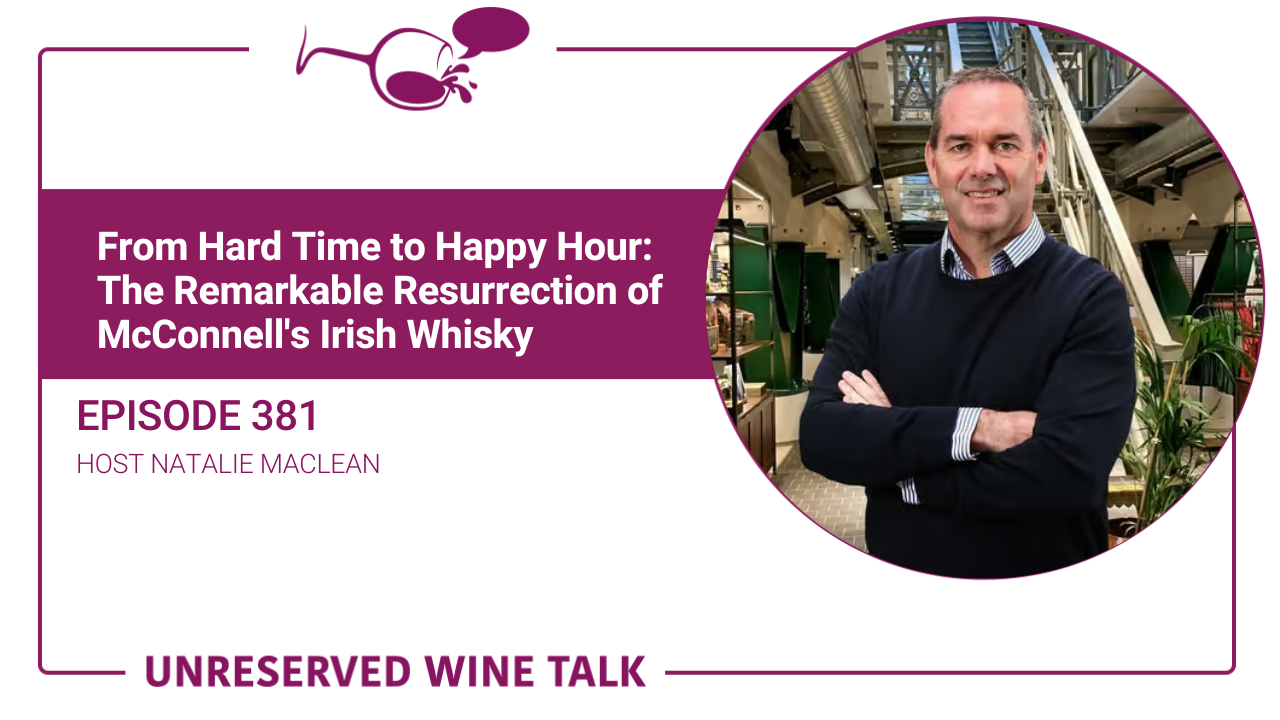
In this episode of the Unreserved Wine Talk podcast, I’m chatting with John Kelly, CEO of the Belfast Distillery Company, responsible for reviving one of Belfast’s most famous brands, McConnell’s Irish Whisky, which actually dates back 250 years this year to 1776.
You can find the wines we discussed here.
Join me on Instagram, Facebook and YouTube Live Video
Join the live-stream video of this conversation on Wednesday at 7 pm eastern on Instagram Live Video, Facebook Live Video or YouTube Live Video.
I’ll be jumping into the comments as we watch it together so that I can answer your questions in real-time.
I want to hear from you! What’s your opinion of what we’re discussing? What takeaways or tips do you love most from this chat? What questions do you have that we didn’t answer?
Want to know when we go live?
Add this to your calendar:

Highlights
- What made John take on the challenge of bringing McConnell’s back to Belfast?
- How did Belfast go from exporting more than 75% of Irish whiskey to losing the McConnell’s brand for nearly 80 years?
- What do the symbols on the McConnell’s bottle reveal?
- How does the opaque glass at the base of the bottle pay tribute to the hidden snug rooms where women once had to drink out of sight?
- How did John navigate Covid, government negotiations, and US investors to keep going on the McConnell’s revival journey?
- How did relationship building and a strong sense of place help McConnell’s earn a spot with the LCBO in Canada?
- What did it take to transform Belfast’s old Crumlin Road prison into a working distillery?
- Why does John describe McConnell’s as the first legal whiskey distillery ever built inside a prison?
- What’s the connection between the brand and female empowerment today?
- Why does McConnell’s deliberately spell whisky without the “e,” unlike almost every other Irish whiskey?
- Why is five years the magic number for McConnell’s, and what does that extra time in cask add to the whiskey?
- How does master distiller Graeme Millar use his palate to catch problems in production?
- Why do patience and discipline make all the difference for award-winning whiskey?
Key Takeaways
- What’s the hidden meaning behind the opaque ribbed glass at the bottom of a McConnell’s Irish Whisky bottle?
- Our matriarch, Eleanor McConnell, was the mother of James and John McConnell, J and J McConnell, and she ran the business in the 1800s. She was a rectifying distiller in the 1800s. She was not allowed to go into a bar but she was a rectifying distiller. So like a master blender if you want, someone who brings those together and then blends them to their recipe. For a lady to have that job was unheard of back then. You’ve talked about this opaque glass at the bottom of the bottle. Ladies were not allowed to drink in the pubs of Belfast back in the 1800s. Clever Publicans had little rooms in the pub downstairs, but they would have had an opaque glass around it. So if the police came in to have a look to see if there’s any ladies in the room, they couldn’t see through the glass. So we thought this was a great story, and we thought we would kind of, you know, bring that into the design of the bottle. The snug.
- What made the opportunity to revive McConnell’s Irish Whisky important enough to leave a long and secure career behind?
- I’ve spent 30 something years in the industry, 22 years with the global giant Diageo and I was working with another Irish whiskey company, and I was approached by the chairman of Belfast Distillery Company, who’s 86 years old and a real legend in the bourbon whiskey in the US. I had known about this project. The project had been around for a while, but for a variety of reasons, it just never got off the ground, be that financial or strategic or, board level. But it just didn’t happen. And I got approached about this. And when I listened to the story I thought, wow, that’s quite amazing. And look, I was in a really good job with a good company. And I sat with my wife and I said, look, this has come up. This is an opportunity. I’ve got goosebumps thinking about it now, actually, because, you know, she said to me, look, if you don’t do this, someone else will and you’ll forever regret not taking this on.
- How does a master distiller notice that something is off long before anyone else can spot it?
- Graeme Millar maintains that the best time to drink whiskey, to taste whiskey, is around 9:30 in the morning. He firmly believes that this is the right time to do that. And a couple of quick stories he told me. At one point in the late morning, he could smell a different aroma in the distillery that wasn’t the aroma for that time of day. The aroma was fine, but it was just too early in the process. And he kind of ran into the control room and he said, something’s not quite right. I’m not sure what it is, but I’m smelling this kind of fancy smell as he described it. I don’t really know what that fancy smell is, but there’s something not right. He looked around the kind of control panel, and sure enough, there was a like a 0.5% difference in one of the mechanisms in the control panel. He’s a complete expert in this.
About John Kelly
John Kelly is a highly respected drinks industry veteran, with over 30 years’ experience in the sector, including 22 years with Diageo, where he held senior roles in sales, marketing and general management within Ireland, Europe and the Middle East. John also worked with Walsh Whiskey in Carlow, Ireland.
In 2021, John joined Belfast Distillery Company as CEO and is building the team, bringing distilling back to Belfast in the repurposed Crumlin Road Gaol. In his spare time, John enjoys playing golf, coaching, and ferrying his children around to their various sports events, and best of all, watching from the sidelines.
Resources
- Find out more about McConnell’s Irish Whisky
- Unreserved Wine Talk | Episode 159: Cosmo’s Sex & the City, Champagne, Whisky Women in Mallory O’Meara’s Girly Drinks
- My Books:
- Wine Witch on Fire: Rising from the Ashes of Divorce,Defamation, and Drinking Too Much
- Audiobook:
- Audible/Amazon in the following countries: Canada, US, UK, Australia (includes New Zealand), France (includes Belgium and Switzerland), Germany (includes Austria), Japan, and Brazil.
- Kobo (includes Chapters/Indigo), AudioBooks, Spotify, Google Play, Libro.fm, and other retailers here.
- Wine Witch on Fire Free Companion Guide for Book Clubs
- Audiobook:
- Unquenchable: A Tipsy Quest for the World’s Best Bargain Wines
- Red, White, and Drunk All Over: A Wine-Soaked Journey from Grape to Glass
- Wine Witch on Fire: Rising from the Ashes of Divorce,Defamation, and Drinking Too Much
- My new class, The 5 Wine & Food Pairing Mistakes That Can Ruin Your Dinner And How To Fix Them Forever
Tag Me on Social
Tag me on social media if you enjoyed the episode:
- @nataliemaclean and @natdecants on Facebook
- @nataliemaclean on Twitter
- @nataliemacleanwine on Instagram
- @nataliemaclean on LinkedIn
- Email Me at [email protected]
Thirsty for more?
- Sign up for my free online wine video class where I’ll walk you through The 5 Wine & Food Pairing Mistakes That Can Ruin Your Dinner (and how to fix them forever!)
- You’ll find my books here, including Unquenchable: A Tipsy Quest for the World’s Best Bargain Wines and Red, White and Drunk All Over: A Wine-Soaked Journey from Grape to Glass.
- The new audio edition of Red, White and Drunk All Over: A Wine-Soaked Journey from Grape to Glass is now available on Amazon.ca, Amazon.com and other country-specific Amazon sites; iTunes.ca, iTunes.com and other country-specific iTunes sites; Audible.ca and Audible.com.
Transcript
Natalie MacLean 00:00:00 What’s the hidden meaning behind the opaque ribbed glass at the bottom of a McConnell’s Irish whiskey bottle? What made the opportunity to revive the historic McConnell’s Irish whiskey brand important enough to leave behind a long and secure career? And how does a master distiller notice that something is slightly off? Just by smelling the air, long before anyone else can spot it? In today’s episode, you’ll hear the stories and tips that answer those questions in our chat with John Kelly, CEO of the Belfast Distillery Company, responsible for reviving one of Belfast’s most famous brands, McConnell’s Irish Whiskey, which actually dates back 250 years to 1776. By the end of our conversation, you’ll also discover how Belfast went from exporting more than 75% of all Irish whiskey to losing the McConnell’s brand and being wiped out for nearly 80 years. What the different symbols on the McConnell’s bottle reveal its fascinating history and backstory. How John Kelly navigated Covid. Government negotiations and U.S. investors to keep the McConnell’s revival going. How relationship building, in a strong sense of place helped McConnell’s earn a spot with the Lcbo, which is really tough to get into.
Natalie MacLean 00:01:35 What it took to transform Belfast’s Crumlin Road Gale, a Victorian prison, into a working distillery and visitor centre. Why John describes McConnell’s as the first legal whisky distillery ever built inside a prison. The connection between the brand and female empowerment in the whiskey industry today. Why McConnell’s deliberately spells whiskey without the E unlike almost every other Irish whiskey. And why five years is the magic number for McConnell’s. And with that extra time in the cask adds to whiskey.
Natalie MacLean 00:02:20 Do you have a thirst to learn about wine? Do you love stories about wonderfully obsessive people, hauntingly beautiful places, and amusingly awkward social situations? Well, that’s the blend here on the Unreserved Wine Talk podcast. I’m your host, Natalie MacLean, and each week I share with you unfiltered conversations with celebrities in the wine world, as well as confessions from my own tipsy journey as I write my third book on this subject. I’m so glad you’re here. Now pass me that bottle, please, and let’s get started.
Natalie MacLean 00:03:02 Welcome to episode.
Natalie MacLean 00:03:04 381.
Natalie MacLean 00:03:06 Happy Saint Patrick’s day.
Natalie MacLean 00:03:08 Or should I say top of the mornin to you. Whether you’re Irish or just Irish for the day, there’s no better time to raise a glass. And that’s just what we did on city TV’s breakfast television this morning. But did you know that how you poor clink or even stir your drink can make or break your luck? So today we’re exploring five Irish drinking traditions and spirits that pair perfectly with each one. Now both my grandmothers were Irish, Bryden and Brophy, so these superstitions and drinks are essentially my family DNA and history in a glass. And yes, I will not be doing this entire podcast with an Irish accent or as one of my grandmothers would have said, now cut it out now, so I will. Ireland is likely the birthplace of whisky. The first written record of whisky anywhere in the world comes from Ireland in 1405. Let’s start with superstition. Number one, make it ring. This first superstition goes back centuries in Irish pub culture. If two glasses touch but don’t make a sound during a toast, you’ve invited seven years of bad luck or worse, seven disappointing drinks in the pub, which in Ireland is likely the greater tragedy.
Natalie MacLean 00:04:24 The clink is the sound of the official start to the evening, and which whiskey is perfect to ring in your toast? Why, I’d say Jameson triple triple Irish whiskey. And you’re not seeing double double. It is triple triple. Jameson was founded in 1780 by John Jameson, a Scottish lawyer who moved to Ireland, married Margaret Haig, and they raised get this 16 children together in their spare time, they built one of Dublin’s most prestigious and storied distilleries. The family motto Sine Metsu means without fear and was earned in part through encounters with pirates. So it is still on every bottle today. Now, just speaking personally. But if your brand story includes persevering through pirates, you’ve got my attention now. Dina, the host on breakfast TV, asked me, what is triple triple meaning and triple triple means they’re running this, the whiskey, through the stills three times. And with Jameson, triple triple would be six times. So it becomes extra smooth. What also makes Jameson triple triple stand out is its maturation in French chestnut casks.
Natalie MacLean 00:05:41 It’s the only whiskey in Canada finished this way. Chestnut imparts toasted, nutty, dark chocolate notes that weave beautifully in with Jameson’s signature smoothness. Jameson Triple Triple won the silver at the World Whiskey Awards in 2025. And if you need further proof that Ireland has always known how to make people happy, look no further than the 10 million cases produced of Jameson triple. Triple. Now that makes me take a double take and makes me so happy. I want to add another triple in there. In the glass you get rich aromas of toffee, vanilla and chestnut driven dark chocolate with a bit of yellow pear green apple all coming through on the nose. On the palate, it’s creamy and lush with a gentle nuttiness, layered wood, spice and orchard fruit. The finish lingers with fruit and spice in a beautifully balanced fade. I showed it on the show both neat and on the rocks, but it’s also great in a cocktail. It’s very versatile. I’d also pair it with dark chocolate almond brittle shards of bittersweet chocolate flecked with toasted almonds.
Natalie MacLean 00:06:54 Their crunch. Warm and fragrant from a warm oven. And the bitter snap of cocoa. Pulling every dark chocolate and toasted almond note right out of the Jamison triple, triple and onto your tongue. I cannot help myself. I just really want to do an Irish accent. All right. Number two, what’s the second superstition against crossing your arms when you toast? Crossing your arms with someone else or entangling them? Wrapping them around while clinking glasses intertwines your luck and your love life with them. So careful as she goes here. The toast should be direct, face to face and with full eye contact. Unless your goal is entanglement. This isn’t a square dance or the Irish jig though. That was my favorite dancing competition as a child. Our drink pairing is Sharky’s Whip, a full flavored Irish whiskey liqueur that is as spirited as its namesake. I showed it neat on the rocks as a shot and in an espresso martini, which the hosts loved. The story goes that Shanky was an Irish jockey with a rebellious streak.
Natalie MacLean 00:08:08 After falling out with racing officials, he decided to create his own kind of whip, not for the horses, but for himself. I find that extremely impressive. Not only did he stand up to people much taller than he was, but he also did it while wearing super tight pants. So he blended Irish whiskey and spirits with caramel and vanilla to create a smooth, rich liqueur. I also respect anyone who does a career pivot and brings caramel with them. The finish is cozy and lingering like a spirited hug. And you know if a cable knit sweater could host a dinner party, it would be pouring Yankees. It occupies that lovely spot between 100% whiskey and a cream liqueur, giving it a lighter texture and a versatile personality. In the Glass, Shanks opens with a rich, creamy sweetness and inviting aromas of vanilla, caramel and soft spice on the palate. It’s smooth and easygoing, with warm toffee, vanilla and a light kiss of Irish whiskey warmth that never overpowers. I pair it with salted caramel chocolate truffles.
Natalie MacLean 00:09:18 Their bittersweet ganache centers trembling as you bite through the thin, dark shell dusted with fine cocoa. The salt on the surface drawing the caramel warmth of shanks up and through every velvety mouthful. Take me away now. All right. Number three, pouring a bottle with your palm facing downward is called. The dead man’s poor and was a bad omen associated with your final drink. Hold the bottle with your palm facing down. To signal openness, friendship and that you actually know how to hold a bottle without dropping it. And the whiskey that deserves this respectful pour. Well, that would be Redbreast 12. It’s the gold standard. The kind of whiskey that makes you want to sink into a big leather chair and discuss philosophy. Or the latest episode of Bad Sisters. Love that show. In their Irish accents, I offered the hosts Redbreast 12 meat or in a simple but delicious cocktail called The Scent of Spring with bitters and soda water. Now, Redbreast was first bottled in 1912 by Dublin wine merchants W and Gilbey, who had a clever solution for their emptied sherry casks.
Natalie MacLean 00:10:38 They sent them exclusively to the Jameson Distillery on Bow Street to be filled with pot still whiskey. It’s a great example of recycling. Proving that the Irish were green long before it became a marketing trend. That Sherry influence has been at the heart of Redbreast ever since. The name came from the managing director of the time, who happened to be an avid bird watcher. He named it after the beloved robin redbreast, a bird associated with warmth and the festive season and joy, which turned out to be a perfect description for this whiskey. Naming a whisky after a bird is brilliant, but good thing he wasn’t looking at a pigeon at the time where we’d have a very different kind of drink. Redbreast 12 is the world’s most awarded single pot still whiskey, and it took double gold and a unanimous gold at the San Francisco World Spirits Championship in 2023. It’s also the official whiskey of the Toronto International Film Festival, which feels exactly right for a brand built on story, craft and character. Apparently, it was the only celebrity at the festival that didn’t complain about its trailer or demand only green M&Ms in the glass.
Natalie MacLean 00:11:54 The nose is complex and inviting, with red apple, cinnamon and nutmeg on the palate. It’s full flavored and silky smooth, with a beautiful balance of spice, fruit, sherry and toasted notes. The finish is satisfyingly long and lingers with real complexity. This is a whiskey you savor. Not rush. I pair it with baked apple strudel pulled from the oven, the pastry shattering crisp and golden at the edges, and the filling fragrant with cinnamon, nutmeg and soft caramelized apple. Every warm bite echoing the spiced nose and apple character of Redbreast 12 as though they were made for each other. Superstition number four. Stir with a knife. Stir up strife. Using a blade to mix drinks was believed to invite arguments at the table. Whether you are making an Irish coffee, cocktail or anything that needed a stir. Always reach for a spoon or a glass stirrer. The butter knife is for butter, not for mucking around with your destiny. And the drink. Were pairing with this superstition is ox’s Irish cream liqueur, because this is exactly the kind of drink you want to stir slowly and carefully.
Natalie MacLean 00:13:13 It’s the velvet tracksuit of beverages. Fancy yet comfortable, smooth yet strong. Oh, cases. Irish cream liqueur on its own is beautiful. Or in an Irish coffee topped with whipped cream and sprinkled with cinnamon and nutmeg. Oh, cases comes from First Ireland Spirits, Ireland’s largest independent cream liqueur company, Established in 1993, in the small village of Abbey Lay in County Lewis. The company has its own purpose built production facility on a seven acre site and is now available in 33 countries, making it the largest Irish owned producer of Irish cream liqueur in the world. They have successfully turned deliciousness into a national export right after lost poets and love songs. First crafted in 1994, Oasis uses only the highest quality Irish cream and Irish whiskey blended with fine spices. It has won awards twice at the prestigious International Wine and Spirit Competition in London, and took home the Chairman’s Trophy at the Ultimate Spirits Challenge. One of the most respected competitions in the world. In fact, it has more trophies than my entire high school athletics department and tastes much better than a participation ribbon in the Glass Oasis opens with rich and decadent aromas of creamy vanilla, with light hints of chocolate on the palate.
Natalie MacLean 00:14:46 Those notes carry through delicate, sweet flavors and a beautifully velvety texture that feels indulgent. It’s like drinking a cloud that went to toffee finishing school. I’d pair it with dark chocolate brownies, dense and fudgy at the centre, with a crinkled top pulled straight from a warm oven. That oven is getting overdrive today. With deep cocoa richness of the brownie meeting the vanilla creaminess of showcases and a pairing that feels like the best kind of indulgence on a chilly evening. And the final superstition today in Irish tradition, your final sip of whiskey reveals the year ahead. If it goes down smooth. The months ahead will be too. But if it burns. Buck up buttercup. No pressure. But your destiny is in this glass. And for a final sip, worthy of that kind of attention, it has to be Yellow spot. Irish whiskey. You can enjoy it neat. Or in a classic highball cocktail. The story of Yellow Spot opens on Grafton Street in Dublin with wine merchants Mitchell and Son like Redbreast. The spot range was born from a clever cask reuse tradition.
Natalie MacLean 00:16:07 Mitchell and Son would fill their empty imported wine casks with pot still whiskey, then mark the casks with colored spots of paint to indicate the age. Green for ten years, yellow for 12, and so on. Green spot is still produced today and holds the distinction of being the longest continually produced pot still whiskey in the world. Yellow spot had a different fate. It disappeared from shelves in the 1950s and was essentially forgotten. Then, after a successful revival of Green Spot in the 2000, Mitchell and Son went back to the historic log books and found the original recipe working with the distillery. They rebuilt it from those notes and relaunched Yellow Spot in 2012 to immediate global acclaim. This is proof that something truly great does not ever vanish. It simply waits to be rediscovered. What makes Yellow Spot unique is its triple cask maturation in sherry, bourbon and Malaga wine barrels. No other whiskey in the spot family uses this combination. Yellow spot earned 99 points, plus the Chairman’s Trophy at the Ultimate Spirits Challenge, one of the highest scores ever awarded to an Irish whiskey.
Natalie MacLean 00:17:33 99 points. That’s the kind of score that makes every other whisky on the shelf pause, look inward, and reflect on some self-improvement in the glass. The nose opens with freshly mowed. Hay and cracked black pepper, red bell pepper, nutmeg, clove oil and green tea. And then the Malaga casks deliver a wave of sweet honey and fresh peaches. On the palate, you get honeyed sweetness with pot still spice, along with fresh coffee, creamy milk chocolate, creme brulée, red apples and toasted oak. The finish is sophisticated, complex and sweet, followed by notes of red grape and dry barley. Just sayin. If the year ahead tastes like this, it promises to be a very good year, or at least the start of one heck of an evening. I pair it with baked Brie with honey and fresh thyme, the rind soft and yielding from again that warm oven. the interior, a warm, flowing pool of creamy cheese, the honey golden and fragrant on top, every bite echoing the honeyed peach and pot still warmth of yellow spot.
Natalie MacLean 00:18:46 All right. Any final words of wisdom for our viewers, Salonica? May your troubles be less and your blessings be more. And nothing but happiness come through your door. I have two more, just in case. May you be in heaven half an hour before the devil knows you’re gone. And finally, may you have the hindsight to know where you’ve been, the foresight to know where you’re going, and the insight to know when you have gone too far with your darn Irish accent. All right. On upcoming TV shows, we’ll be chatting about fresh spring wines, beer and spirits, and drinks for Easter, Mother’s Day, Father’s Day, FIFA World Cup, Canada Day and summer sipping. Let me know if you’d like your brand featured on these TV segments or future ones, or if you would like to advertise with us through our podcast, newsletter, website, social media or mobile apps. Email me at Natalie at Natalie MacLean. I’m sharing more tips and tips on Instagram at Natalie MacLean Wines, so join me there for more of the weird and wonderful.
Natalie MacLean 00:19:58 Speaking of that, what’s new in the drinks world this week? Well, in France there is a small wine fountain in the town of Marino that mistakenly pumped white wine into the local household water pipes during a festival instead of the town square, leading residents to get a pleasant surprise and buzz when they turned on the kitchen taps. Bone broth cocktails are having a moment. Food and Wine magazine recently highlighted drinks such as tequila cocktail with chicken bone broth and another one with wagyu tallow broth, pickle brine and sriracha, suggesting that the dirty martini has wandered into the soup kitchen and decided to stay there for dinner. The brand Black Tears Rum unveiled a digital competition recently called Race to Havana, in which participants try to travel 600km using bottles of rum as currency. It sounds like part road trip, part fever dream and entirely designed for anyone who has ever looked at a bottle and thought, yes, that could buy me passage. Meanwhile, the liqueur brand Pessoa has just launched the Sunset Tracker, a global digital tool that notifies users exactly two hours before sunset in their specific city, directing them to local bars with the best views.
Natalie MacLean 00:21:24 And wow, they just happen to be pouring Pessoa a clever bit of experiential tech to drive the Spirit’s occasion with their fruit flavour liqueurs. In the bizarre legal department. It remains a standing law in Ohio that it is strictly illegal to get a fish drunk. A statute that reportedly stems from old animal cruelty laws, but leaves one wondering exactly what kind of wild lake parties prompted its creation in Alaska. It’s illegal to give a beer to an elk. That actually reminds me of the book I read to my son when he was a child. If you give a mouse a cookie, what happens anyway? Don’t give a beer to an elk. It’s a law that dates back to a 1930s incident where a pet elk named Mortimer caused a local riot after drinking a bucket of homebrew. Oh, Mortimer! A distillery in Scotland recently launched a silent spirit produced in a vacuum sealed room to ensure no outside air or sound vibrations affect the molecular aging process, a move that has some observers calling it the most expensive quiet time in history.
Natalie MacLean 00:22:38 A researcher recently discovered that the bubbles in a glass of Guinness, also great for Saint Patrick’s Day, actually sink instead of rise because of the shape of the glass. The bubbles move up in the center and create a downward current along the sides, an optical illusion that baffles pub goers nightly. If you ever find yourself drinking a cocktail with diet soda, be careful. Science shows that the lack of sugar causes your stomach to empty faster, leading the alcohol to hit your bloodstream significantly quicker than with a regular soda mixer. And for your weird scientific fact of the week. Did you know it takes roughly 600 to 800 individual grapes to produce a single regular 750ml bottle of wine. That is a staggering amount of fruit. All right for your calendar this week. March 18th is National Sloppy Joe Day and National Laci Oatmeal Cookie Day. The Sloppy Joe is a gloriously messy sandwich that oddly plays well with wine. The sweet tomato based sauce pairs surprisingly well with juicy reds like Zinfandel Primitivo or a ripe Gamay. For something more playful, try a canned craft beer or a retro rum and cola alongside something unapologetically saucy.
Natalie MacLean 00:24:04 Finish the meal with lacy oatmeal cookies and lean into the nostalgic cafeteria vibe. A late harvest Riesling, or tawny port, makes cookies feel like a grown up dessert. March 19th is National Poultry Day and National Chocolate Caramel Day. Oranges and lemon Day roast chicken is famously one of the most wine friendly foods on Earth because of its crispy skin, fat and savory flavors that work well with both whites and reds. Some secretly use it as a universal pairing test. A fun chicken three ways tasting works beautifully fried chicken with champagne or pet net. Roast chicken with a chardonnay. Lemony chicken with a bright Sauvignon blanc. Round out the day with chocolate caramel with a chocolate caramel dessert and an orange or lemon accented cocktail to honor both the sweet and citrus holidays landing on the same date. March 20th is National Ravioli Day, the great meet out day. Crawfish Crackers Awareness day and National Bock Beer Day. And hey, the first day of spring. Spring officially arrives on March 20th, making it the perfect occasion to crack open a rich multi German style bock lager and bid farewell to winter.
Natalie MacLean 00:25:23 See you later. Buck beer and crawfish are basically a built in backyard boil pairing. For pasta lovers, ravioli is Italian comfort food at its finest. Tomato based versions pair beautifully with Sangiovese or Barbera, while creamy fillings like ricotta or mushroom work better with Chardonnay or Nebbiolo. If you want to keep things lively, pour a Lambrusco, which Italians have been drinking with rich pasta dishes for generations. The Great Meet Out Day offers a plant based counterpoint to all of this, so a meatless mushroom ravioli with a glass of Nebbiolo covers both bases elegantly. March 21st is maple syrup. Saturday, National Strawberry Day, National Corndog Day, National Crunchy Taco Day, National French Bread Day, and World Vermouth Day. This is the busiest day of your week and it plays like a carnival meet. Sugar shack fever dream Maple whiskey sours, or a splash of syrup in a sparkling cocktail is a great way to celebrate. Strawberries are excellent with rosé sparkling wine. They amplify the red fruit notes in Pinot Noir, making them taste even more vibrant.
Natalie MacLean 00:26:36 Corn dogs a cold lager. Full stop. Crunchy tacos, margaritas or palomas, French bread pairs with everything from Beaujolais to Cab Franc, but the most creative move is a crunch and splash, dipping a warm, sea salt crusted baguette into a chilled citrus forward white vermouth for for a savory aperitivo moment. Now, World Vermouth Day deserves far more respect than it gets. Vermouth is one of the most versatile bottles behind any bar. Pick up a dry, a Bianco a Red and pour them over ice with an orange slice and spend the evening pretending you’re in Turin. Vermouth is one of the most misunderstood Drinks in the world. It’s a wine based fortified aperitif made with botanicals, and it should be stored in the fridge and consumed within weeks. The word vermouth comes from the German word Vermont, meaning wormwood. One of its key botanicals. If your vermouth tastes flat and metallic, it ain’t the drinks fault. Buy a fresh bottle, refrigerate it, and drink it within the month. Your Negroni will thank you.
Natalie MacLean 00:27:49 March 22nd is National Crepes Day, a ready made excuse to build a crepe and sparkling wine brunch flight. Classic lemon sugar crepes with Prosecco, Nutella crepes with slightly sweet sparkling red savory ham and cheese crepes with a crisp German section. March 23rd National Chip and Dip Day, National Cheer Day, National Melba Toast Day and National Tamale Day an excellent reminder that wine pairings don’t have to be fancy. Salty chips work beautifully with sparkling wine and a crisp lager because bubbles cut through fat and salt. A high acid Riesling with truffle salt chips is pure pairing chemistry. Line up a full chip and dip spread and match by style. Maybe an IPA with spicy salsa off dry Riesling with guacamole. Lighter lager with queso A chia seed brunch bowl alongside a pet gnat is a great start to your day, and Tomales close things out with a mezcal or a cold Mexican lager. And finally, March 24th is National Cheesesteak Day. National chocolate covered Raisins Day and National Cocktail Day National Cocktail Day is one of the biggest beverage holidays of the year.
Natalie MacLean 00:29:03 The word cocktail first appeared in print in 1806, in a New York newspaper describing a mix of spirits, sugar, water and bitters. Today, it’s a global celebration of creativity behind the bar. The simplest way to honor it. Make whatever cocktail you’ve been meaning to dry for the last six months. A cocktail world tour works as a concept. One classic stir drink like a Manhattan old fashioned or martini, one citrusy shaker cocktail and one low or no alcohol by volume option for food. A cheesecake is hearty enough to need equally bold drinks. The fat in the melted cheese softens tannins in red wine, which is why big Red suddenly tastes smoother alongside rich, fatty foods. Cabernet Franc, Malbec or a hoppy IPA all hold their own here. Finish with chocolate covered raisins and lean in to this cinema’s snack energy. There are surprisingly fun match with a glass of age tawny or even a rye whiskey cocktail. All right, if you’re reading the paperback or e-book or listening to the audiobook, my memoir, Wine Witch on Fire rising from the Ashes of divorce, defamation, and Drinking Too Much, a national bestseller and one of Amazon’s best books of the year.
Natalie MacLean 00:30:20 I’d love to hear from you at Natalie at Natalie MacLean. Com. I’ll put a link in the show notes to all retailers worldwide at Natalie MacLean. Com forward slash 381. Okay, on with the show.
John Kelly 00:30:38 All right. So John Kelly, welcome to Canada.
John Kelly 00:30:41 Thank you. Thank you. I’m delighted to be here.
John Kelly 00:30:43 I’m excited to try your whiskies. Not only are they fabulous, but you’ve got many colorful stories to share with us. Right. For those who may not be familiar with your history or the brand, I’m going to just share a few details first and then we’ll get into it. Perfect. Sounds good.
John Kelly 00:30:59 Okay, perfect. Sounds great.
John Kelly 00:31:00 So you are the CEO of the Belfast Distillery Company. You’re responsible for putting Belfast back on the whisky map. Good for you. The city is also where you were born and raised. And you.
Natalie MacLean 00:31:11 Even.
John Kelly 00:31:11 Said your high school is kind of, like, really close to where the whiskey is made today. Right.
John Kelly 00:31:16 Well, our brand home is in an old prison.
John Kelly 00:31:19 When I was at school, it was right beside the prison so we could hear the guys kind of kicking football in their yard as we were kicking, playing soccer in our yard, you know? So, yeah, it’s great. It’s great. But change times, you know, that was an interesting period in Belfast history. And things have transformed and changed a lot. But yes, I am very delighted to be producing our whiskey in my own backyard.
John Kelly 00:31:42 And you’re literally what did your teachers tell you when you were a kid?
John Kelly 00:31:46 Occasionally some of my teachers would have said, Kelly, if you don’t behave yourself, you’ll end up next door. And and here I am.
John Kelly 00:31:52 You did? That is great. So Belfast used to be the epicenter of whiskey production and exported over 75% of all Irish whiskey. I didn’t know that. I mean, it was at the height of its power, but then there was kind of a.
Natalie MacLean 00:32:07 Collapse, prohibition and some other factors. And now there’s just two distilleries in the city.
Natalie MacLean 00:32:13 Yours and one other.
John Kelly 00:32:14 One other.
Natalie MacLean 00:32:15 That’s okay. Wow. Yeah. But your whiskey dates back to 1776. It has quite a long history, but you’re really back to put it on the whiskey map to revive the legend. The story of McConnell’s. And so, under your leadership, the brand has not only transformed, but it’s now available and sold in 45 markets, countries.
John Kelly 00:32:35 Around the world.
Natalie MacLean 00:32:35 This is amazing. In five years.
John Kelly 00:32:37 Thank you. Yes.
Natalie MacLean 00:32:38 Yes. Yes. Okay. So I must add, though, to before we begin that, I feel like I’m kind of talking to kin with kin because both of my grandmothers were Irish. Oh, Brophy and Bryden. Very good. And so they are raising a toast to you in heaven right now. So their own bottle of McConnell’s up there.
John Kelly 00:32:55 I think, from the north of Ireland. What part of Ireland were they?
Natalie MacLean 00:32:58 Kilkenny.
John Kelly 00:32:58 Kilkenny. Lovely city. Wow. Beautiful.
Natalie MacLean 00:33:00 Kilkenny and Ulster. Okay.
John Kelly 00:33:03 So, Ulster.
Natalie MacLean 00:33:03 Well, two different regions.
John Kelly 00:33:04 There you go.
Natalie MacLean 00:33:05 There you go.
John Kelly 00:33:06 Close to home. Ulster?
Natalie MacLean 00:33:08 Yes. Okay, so. And we want to know if there’s a moment, John, when you really knew that you wanted to bring McConnell’s back to life. So it has this history, 1776, but it had faded. What kind of triggered the thought? We this is a story that needs to be brought back, a brand that needs to be brought back to life.
John Kelly 00:33:28 Well, look, my background is in this industry. You know, I’ve spent 30 something years in the industry, 22 years with the global giant that was Diageo or is Diageo. And I was working with another Irish whiskey company, and I was approached by the chairman of our company, who’s 86 years old and a real legend in the bourbon whiskey in the US. Okay. I had known about this project. The project had been around for a while, but for a variety of reasons, it just never got off the ground.
John Kelly 00:33:58 Be that financial or strategic or, you know, board level. But it just didn’t happen. And I got approached about this and, when I listened to the story and I thought, wow, that’s quite amazing. I’m Look, I was in a really good job with a good company, and I sat with my wife and I said, look, this has come up. This is an opportunity. I’ve got goosebumps thinking about it now, actually, because she said to me, look, if you don’t do this, someone else will write and you’ll forever regret not taking this on because, you know, it was a it was a challenge. You know, we had to create the brand. We had to create the liquid, the packaging and everything. Everything from them build our brand home. So yeah, that was the moment we had that conversation and we said, look, you got to go for this. You gotta go for that. And here I am. You know, I’m delighted to be part of the team that’s resurrected the McConnell’s brand.
John Kelly 00:34:47 And as we’re playing our part and as you said, bringing distilling back to Belfast and Belfast was once the epicenter of the whiskey world, you know.
Natalie MacLean 00:34:55 75%.
John Kelly 00:34:56 Exactly. But that was in a day when Scotch whiskey wasn’t that big. Irish whiskey was at the forefront of whiskey production anywhere in the world. Okay, so to have 70 plus percent of that volume, exporting through Belfast to nearly nothing. Well, really nothing at the turn of the century. Yeah. I just wanted to be, you know, at the forefront of the revival of McConnell’s and and to help bring distilling back to Belfast.
Natalie MacLean 00:35:22 Yeah. Oh, there’s so much about this brand that I want to get into as well. Every aspect from the bottle to the stories. But now Belfast was famous for rope making, linen and shipbuilding. Right. You mentioned just before we got started, the Titanic was built there.
John Kelly 00:35:36 That’s.
Natalie MacLean 00:35:36 I did.
John Kelly 00:35:37 Not really. Yeah. I mean, shipbuilding was probably the biggest industry alongside whiskey. Okay.
John Kelly 00:35:43 And we got to go back to the 1800s, when Belfast was one of the cities of that industrial revolution in the 1800s. You know, it was a capital of the Industrial Revolution. Shipbuilding, whiskey making, rope making, linen making. Those were the big industries back at that time. And then it all kind of went a little south for the Irish whiskey industry. You know. Geopolitical wars.
Natalie MacLean 00:36:10 Prohibition.
John Kelly 00:36:11 Prohibition. World War one. World War two. Fires. The 1916 uprising. The civil war in Ireland. There was an economic war with the Commonwealth, which meant that Irish whiskey couldn’t be exported to India, Australia or here to Canada. Oh, wow. So that really saw the decline of of Irish whiskey? Sure. And it was in 1938 that the McConnell’s brand finally closed its eyes and lay dormant for 80 years, until we resurrected the brand. And, you know, Irish whiskey kind of really fell away quite a lot then, so that there were only four distilleries on the island of Ireland at the turn of the century.
John Kelly 00:36:48 And when we opened our brand home and our distillery in April of 24, we were the 50th five zero distillery on the island of Ireland. So we’re so we’re delighted that we’ve gone back from a near-complete demise to 50 distilleries across Ireland.
Natalie MacLean 00:37:04 Oh, sure. And the symbols of linen making and shipbuilding and rope making. They’re on your label, right?
John Kelly 00:37:11 They are. I mean, this this badge that we have here. you know, we like to pay homage to the great kind of shipbuilding industry of Belfast. And if you ever get a chance to do the Titanic Museum tour, you’ll hear about those shipbuilders who had, you know, these steel plaques, you know, riveted into the ships. You know, that was a job to be a riveter. So that’s a little homage to that. You know, the harp of Erin, the beautiful, harmonious symbol of of Ireland and old traditional music in Ireland. And we are very fortunate that we have a trademark opportunity for the harp of Erin, because it was on our old bottle.
Natalie MacLean 00:37:48 Okay.
John Kelly 00:37:49 Guinness, for example, also has a trademark for the harp. So it’s it’s a number of brands have it. But but we kind of like this as a symbol of the harmonious blend, because our whiskey is a blend of grain and malt whiskey, and this kind of harp is a symbol of the harmonious blend of our liquid. Yeah, and lots of other stuff.
Natalie MacLean 00:38:08 There’s lots of other stuff. While we’re at the bottle here. Yeah. Now, this ribbed part of the bottle also has significance.
John Kelly 00:38:15 I mean, this is this is significant. We thought about the old bars in Belfast in the 1800s. You won’t believe this, but ladies were not allowed to drink in the bars.
Natalie MacLean 00:38:26 Mother’s ruin was actually.
John Kelly 00:38:28 Oh my.
Natalie MacLean 00:38:29 Goodness. Take care of the children.
John Kelly 00:38:31 Stay home. Exactly. But our matriarch, Eleanor McConnell, was the mother of James and John McConnell JNJ McConnell, and she ran the business in the 1800s. She was a rectifying distiller in the 1800s.
Natalie MacLean 00:38:43 In the 1800s, when women weren’t even in business at all.
John Kelly 00:38:45 She was not allowed to go into a bar.
Natalie MacLean 00:38:48 To sell her product.
John Kelly 00:38:49 She was a rectifying distiller.
Natalie MacLean 00:38:51 Oh, okay. Okay, so what is rectifying distillery?
John Kelly 00:38:54 This is a person who refines the liquid that’s coming from other distillers. So like a master blender, if you want someone who brings those together and then blends them to to their recipe.
Natalie MacLean 00:39:04 Sure.
John Kelly 00:39:05 So it’s a.
Natalie MacLean 00:39:06 Pretty high skill to.
John Kelly 00:39:07 Have for a lady to have. That job was unheard of back then, but the reason I mention it now is, and you’ve talked about the, you know, this opaque glass at the bottom of the bottle. Ladies were not allowed to drink in the pubs of Belfast back in the 1800s. Clever publicans had little rooms almost like this in the pub downstairs, but they would have had an opaque glass around it. So if the police came in to have a look to see if there’s any ladies in the room, they couldn’t see through the glass. They were high. So we thought this was a great story, and we thought we would kind of bring that into the design of the bottle.
Natalie MacLean 00:39:40 And they called that little room the snug.
John Kelly 00:39:42 The snug, snug.
Natalie MacLean 00:39:44 Little snug.
John Kelly 00:39:45 Put them all in the.
Natalie MacLean 00:39:46 Story of our whiskey. I don’t care how snug it is.
John Kelly 00:39:48 Yeah, exactly. Exactly. But so yeah, lots of, you know, great stories that we like to tell on on because.
Natalie MacLean 00:39:54 There’s so much just to the bottle alone. Thank you. You know, a lot of people pitch brand revivals but never follow through. So what was the one thing that almost stopped this from happening? What was the biggest obstacle to reviving this brand?
John Kelly 00:40:05 Well, Covid was a big obstacle.
Natalie MacLean 00:40:08 When you started.
John Kelly 00:40:09 Well, exactly who exactly who would have thought that?
Natalie MacLean 00:40:12 Some restaurants are shut down.
John Kelly 00:40:13 Exactly. So there is no doubt that. But listen, Covid was a difficult time for everyone, and the industry kind of managed to get around that by doing things, by innovating. You know, so so we were we were briefing sales staff at the Lcbo. We were having virtual calls over, over teams and that type of thing.
John Kelly 00:40:31 But there’s no doubt that Covid was one hurdle that we had to get over. Unique to our project, I would say that our home is an old prison, and we have a 125 year lease on that prison owned by the government. Oh, really? So we were negotiating with the government. We also have a board of directors who are very keen to invest in Northern Ireland, but they’re all US based. So you’ve got a board of directors in the US, you’ve got the Northern Ireland government who own the building. You’ve got all of the legal guys, the financial guys, the banks. It’s quite an incredible, eclectic mix of business people. Yeah. My job was to kind of get everyone kind of together and just kind of take us in the in the direction that we wanted to go in. And, and in all honesty, that that took like a couple of years to really get everybody on the same page signed up to the one document. And it was August of 2022 when we actually we actually got going with the reconstruction.
Natalie MacLean 00:41:27 So that is great. And was there getting into the Lcbo. I mean, the I think the world’s single largest purchaser of alcohol, maybe second only to Costco, but what was the conversation or how did you get in that is so hard to get in?
John Kelly 00:41:41 Well, you know, I’m a sales person. You know, I’ve general management rules and but primarily, you know, what I do is sales and I talk about shoe leather and building relationships. You know, so it’s so important to get out there. Be it to Canada, to Asia, to Europe. Even in our home city. Sure. Burn that shoe leather, get around the pubs, build relationships, talk to people. That’s kind of part of the journey that we had with the with the Lcbo. You know, I met them on a number of occasions here. They were on an education trip to the distilleries of Ireland, and we were very fortunate that they wanted to come and see us when we had them in the distillery, and we had a nice kind of tasting and a little bit of dinner, and they got to really, I think, experience what what we’re trying to do.
Natalie MacLean 00:42:26 Story.
John Kelly 00:42:27 The story, just what we’re talking about today. And that was probably a pivotal moment in the relationship, because there are a couple of hundred Irish whiskey brands out there. There’s there’s 50 distilleries, but only 20 something of those distilleries have a brand home, okay?
Natalie MacLean 00:42:42 And they’re virtual distilleries. The rest of them.
John Kelly 00:42:44 Like, they just they just don’t have people who can come and see the distillery and spend time in the distillery. Right. Whereas we see this as like hand in glove, we see having the whiskey being part of the alcohol industry, but having the brand home being part of the tourism industry, we see that as like, like so important to the success of the brand. And I think that resonated with the Lcbo. They thought, wow, yeah, you know, these guys are playing their part in bringing distilling back to Belfast. Sure. But they’re also like bringing tourism to Belfast and particularly this part of Belfast which suffered after the troubles that we had in Belfast, the.
Natalie MacLean 00:43:20 Northern Ireland conflicts. Yes, 1998. No.
John Kelly 00:43:24 It started.
Natalie MacLean 00:43:25 In the 60s.
John Kelly 00:43:26 60s to 98. 30 years was when the Good Friday Agreement and where our distillery is and where I went to school was like a bit of a I don’t want to say battle lines, but, you know, the two communities were segregated, and this was one of the lines of segregation. So a lot of kind of regeneration was needed in their space. And we were investing a lot of money into the space. And I think the Lcbo really saw what we were doing for the community, what we’re doing for tourism, and obviously what we’re doing for Irish whiskey. And yeah, so it’s not one meeting. I guess it’s a series of meetings that that’s led to the great relationship that we have with the with the Lcbo and I.
Natalie MacLean 00:44:02 That’s great. I, I keep putting this off, but I want to talk about the distillery itself. So you showed me a video before we started and we’ll put that video as part of this video.
Natalie MacLean 00:44:11 But the prison itself is huge. Yeah, it was a Victorian prison and it closed in 1996, so it laid dormant, but you took it over and gave it a complete, not a complete, but a real retrofit facelift. But you still kept the character of the Victorian prison. Tell me how you blended the two.
John Kelly 00:44:30 Well, I would say it is a complete reconstruction, but we left everything intact that that we could do and that we were architecturally approved. To do so, we had to have our own architect, but we also had to have a architect from the government.
Natalie MacLean 00:44:50 Because it’s a historic building.
John Kelly 00:44:51 Historic heritage. Create a listed building. So all of the work that we’ve done in that building had to be signed off by those two architects before we could even start the construction. That’s one of the things that took such a long time. Sure. So we had to preserve everything. So to give you an example, the gangways or the walkways where the cells are have these wonderful slit walkways.
John Kelly 00:45:13 You know, it’s an old fashioned prison if you think of, Alcatraz. So if you think of Alcatraz, it’s balconies and there’s this kind of atrium. But we had these slate walkways on either side of the atrium, and we had to protect those. That meant that we couldn’t knock away the walls or the the walkways. So we had to actually lower our equipment through a hole in the roof by crane. Oh, wow. I’ll never forget the day that we lowered our pot stills through the roof. So yes, we had to preserve everything in that reconstruction. And I think, you know, I feel we’ve done an amazing, amazing job. You know, we’ve protected the history, the heritage, the wonderful building that it is. But, you know, we you know, we’ve brought employment and we’re producing wonderful whiskey in that space. So I’m very proud of the the architects and the engineers. You kind of made that happen.
Natalie MacLean 00:46:03 Well, I didn’t realize until I saw it on the video, but it feels warm and cozy, and yet it’s a prison.
Natalie MacLean 00:46:10 I mean, you can still see the echoes of the prison there, but it still feels like an inviting place where you’d want to sit down. There are bar areas and barrel areas, and I wondered how you married the two when you know it has this history of suffering, and yet now it’s a place of joy and welcoming.
John Kelly 00:46:25 Well, I do wonder, what would some of those prisoners that spent time there think?
Natalie MacLean 00:46:29 They think.
John Kelly 00:46:29 Probably they would love.
Natalie MacLean 00:46:30 It. Yeah. That’s right.
John Kelly 00:46:32 We do tell, you know, like prisons were known around the world for illegal distilling, you know? Okay, prison inmates were making their own bootleg, their own moonshine. So we like to talk about our our distillery as the first legal distillery in a prison anywhere in the world.
Natalie MacLean 00:46:49 That’s great, I love it. Let’s talk about Eleanor. You mentioned she took over the business. Her husband died. Yeah. 1828. You know, in a world where women really weren’t in business at all. Give me an example.
Natalie MacLean 00:47:01 Now, she became a rectifying distiller. That’s amazing. But is there another example that comes to mind that really showed how much fortitude she had?
John Kelly 00:47:08 Well, I just think the fact that she was able to, you know, rare her family. She had the two boys, but she was pregnant with her third child, and she was able to rear her family and be a businesswoman with all of the sales and marketing that comes from running your business and also be, you know, a rectifying distiller. When I think about our organization, I kind of do the general management, the sales and marketing. But I’ve got a professional, great master distiller who looks after that, right. But she managed to combine all of this. You know, so it’s quite incredible. And you know, a big thing for us is changing places, changing faces, because we want to bring Irish whiskey and McConnell’s to a new set of consumers. You know, so if I think about changing places, we’ve talked about that.
John Kelly 00:47:55 We’ve transformed this old prison into a wonderful brand home and distillery. Changing faces for us is about bringing McConnell’s to a new demographic. You know, people think of of whiskey in the past as kind of old peel and steel or white peel and steel, you know. So it’s kind of an older man who drank whiskey. Sure. We don’t think about it that way. You know, when we look at our target demographic, it’s 50% male, 50% female. Okay. And we really want to create, you know, wonderful cocktails and beautiful blends of whiskey that appeals to everyone. And, and I guess that inspiration is also coming from Eleanor, who was a wonderful woman in her day. And we want to make sure that, you know, we can continue in her footsteps and engage with, with lots of female consumers on the McConnell’s brand.
Natalie MacLean 00:48:45 Right. And if Eleanor were to see what you’ve done today, what do you think she would say?
John Kelly 00:48:48 I think she’d be very proud of it, you know.
John Kelly 00:48:50 I mean, you know, we’ve created different styles of whiskey here that appealed to different tiers, you know. And. Yeah, but we’ve we’ve managed to, you know, transform the brand, but we’ve, we’ve held on to the really the great product cues that we talked about earlier in.
Natalie MacLean 00:49:04 The history of.
John Kelly 00:49:05 The history and heritage. So I think, you know, hopefully, hopefully she’s looking down at us thinking, you’re doing a you’re doing a good job. And the other thing, just lastly and kind of on female’s connection to the business, the suffragettes in northern.
Natalie MacLean 00:49:19 Advocated for the vote. Yes.
John Kelly 00:49:21 Correct. In the 1920s, I’m going to say, but my history may only be correct, but I’m pretty sure it’s the 20s or early 1900s anyway. But the suffragettes in Belfast, whenever they were marching and some of them were actually imprisoned. Believe it or not, they were imprisoned in a wing, which is the wing that we’re in. So not only did we have a wonderful matriarch in Eleanor McConnell, but we had some of those those women back in the day who were fighting for civil rights on their fair rights, and they were also in our presence.
John Kelly 00:49:50 So we think there’s big connections there. Yeah.
Natalie MacLean 00:49:52 Yeah, absolutely. Love it. So today, like, how do you ensure that Eleanor’s legacy isn’t just a marketing footnote? Are there any other things you do?
John Kelly 00:50:02 You know? Women in whiskey is a is a big program in Ireland. All of the women that are involved in our business are all part of that kind of project. You know, so that’s a dedicated project on the island of Ireland to kind of, you know, encourage females to come into the industry. So we make sure that all of our females that are part of our, our workforce are all part of that program. So again, that’s a little bit of something that that we think we’re doing in kind of respect of Eleanor and the wonderful work she did.
Natalie MacLean 00:50:29 She would like I would like my grandmothers to meet Eleanor.
John Kelly 00:50:32 Yeah.
Natalie MacLean 00:50:32 I’m sure. Okay. So let’s just skip ahead to some of the things that we haven’t got to yet. Yeah. So you opened the distillery in April 2024 inside the old Crumlin Road Gale, a Victorian prison? Yeah.
Natalie MacLean 00:50:46 There’s a photo of prisoners on the roof in 1994, with a photo of the copper stills beside them.
John Kelly 00:50:53 Almost 30 years later.
Natalie MacLean 00:50:55 Okay.
John Kelly 00:50:55 That roof were those. Look, the inmates were in cells that were built in 1840s. Oh, wow. And this is in 1994. You know, these cells didn’t have a toilet facility. There was no en suite, you know. So this was, slopping out in the in the morning time, like, you know. So in the 1990s, that was, like, not right. So they got on the roof and there for about a week in the summer of 94, they were on the roof kind of saying enough was enough protesting. Okay. And the prison closed down in two years later in 1996. It lay derelict for many years, and it was really only when we when we got this project finally into place. It was August of 22 and we started the reconstruction. It was quite incredible.
Natalie MacLean 00:51:38 That’s a huge project.
John Kelly 00:51:39 And the building lay derelict for all that time.
John Kelly 00:51:41 You know, so so the fact that we’ve been able to transform that building, bring life back to that building again. We’re super proud of that.
Natalie MacLean 00:51:49 Yeah, absolutely. Now, one thing I wanted to ask, and it would have been the first question my Brophy grandmother would have asked because she was an English teacher. You spell whiskey without an E. We do. Unlike all the other Irish whiskey, we do. That’s more like a goddess.
John Kelly 00:52:03 That’s quite right. So whiskey here without the E and we. And we tell the story on the bottle here. What about the E? Right. So the E was introduced to Irish whiskey in the 1800s. Okay. And at that point in time, Scotch whiskey was starting to climb. Okay. And Irish whiskey was knowing this kind of new competitor. They were innovating with the column. Still, they were producing the liquid more cost effectively. So they were starting to steal market share. And the Dublin Distillers decided that they would do something different. And one of the ideas they had was, well, we’re going to call our spell our whiskey E.
John Kelly 00:52:38 Okay. But like bourbon. So bourbon is spelt with with an E. So the Dublin distiller is to say that this is what we’re going to do. It’ll be a point of difference between Irish whiskey and Scotch whiskey, and it has proven to be that.
Natalie MacLean 00:52:50 Okay.
John Kelly 00:52:51 But that was in the 1800s. We go back to 1776. So we were we were the original. We always spelled it that way. So when we got the old bottles from the museum and had a look at the old labels, you know, this is how it was spelled back then. The McConnell’s family didn’t follow suit with the Dublin Distillers. They proudly held on to that old spelling. So we felt there’s no way that we were going to introduce the E, and we now are the, I believe, the only Irish whiskey that is spelt. You talked about stories earlier. You know, people love a love a story or two. And that’s just a nice little story that you can, you know.
Natalie MacLean 00:53:27 There’s so many pieces on that label alone.
John Kelly 00:53:29 You just need to have a look at the bottle and you can tell lots of stories.
Natalie MacLean 00:53:32 Yes. All right. That’s whiskey with an E. Yeah. All right. McConnell’s five is a magic number.
John Kelly 00:53:39 Five is the.
Natalie MacLean 00:53:40 Magic. Why is it a magic number?
John Kelly 00:53:41 We believe that it’s better to keep the liquid that little bit longer in the barrel. Okay, so the law in Ireland and the geographic indication is that to be Irish whiskey, you have to be in a barrel on the island of Ireland for three years.
Natalie MacLean 00:53:58 Okay.
John Kelly 00:53:59 The myth that goes with that is it should be three years and one day, just in case you can’t remember which time of day you did it, okay. Three years ago. So if you did it for three years and one day, you’re sure to be over the right. So that’s the three years and one day myth. But we decided to go that bit further. You know, we believe that we have a super premium Irish whiskey here. Yes, it would be more cost effective for us to take it out of the barrel and bottle it and sell it at three years.
John Kelly 00:54:26 But but we believe that five is our magic number. So we keep it in the barrel for those extra two years.
Natalie MacLean 00:54:32 And what happens to the whiskey? Does it get smoother or.
John Kelly 00:54:35 Well, yeah. I mean there’s lots of different terms that people use, but that that extra maturation would lead to. Yeah, maybe more will lead to more color in the whiskey. Okay. So even if you look at the three whiskeys we have here, this is our five year. Yes and American first fill bourbon. This is the same liquid in American first fill bourbon and then into our sherry casks. Okay. So look at the difference. It may only be in the sherry cast for about ten months. Okay. But the sherry gives a lot of color. So that’s what happens whenever the the whiskey is in the barrel. You get lots of more color or lots more TZ profile. You know, we could leave it for a lot longer than that, but we’ve decided that five is our magic number and we take it out after five years.
John Kelly 00:55:19 So it’s kind of a signal of our our quality credentials and this super premium Irish whiskey.
Natalie MacLean 00:55:25 Sure. Well, it certainly costs you more to do that.
John Kelly 00:55:27 It does, it does. But we think it’s the it’s the right way. Yeah. Yeah, we really do. We really believe in that. It’s important to us.
Natalie MacLean 00:55:33 Okay. Your master distiller, Graham Miller, is always trying to create the harmony of the flavor like we spoke about with the harp. Yeah. Now he tastes everything right.
John Kelly 00:55:44 Yeah, he has a say in every stage of the production process, and that’s quite unique because we are a distillery that’s industrial in volume and scale. We produce a half a million, 500,000l of pure alcohol. Okay, so that’s about 4000 barrels of whiskey. Okay. So that’s like industrial scale.
Natalie MacLean 00:56:06 Yeah.
John Kelly 00:56:07 But just to give you a comparison, some of the big distilleries would produce 12 or 14,000,000l of pure alcohol. So it’s a lot bigger than us. Sure. So we feel that we’re in this kind of really special place where every stage of the production, whilst it’s automated, Graham has a view at the closing point of every stage.
John Kelly 00:56:28 He’s a complete expert in the business. Award winning master distiller for our sherry cask and for our 20 year old blend. So he really has the final call on everything in terms of that part of the business. So so that’s his part of the business. And we think we’re in a nice spot because we’re not fully automated. We’re kind of small batch. And Graham makes the decisions.
Natalie MacLean 00:56:49 That’s quite a commitment to have him taste everything. Has he ever rejected anything?
John Kelly 00:56:53 Well he has and a couple of. Graham maintains that the best time to drink whiskey to taste whiskey is like around 930 in the morning.
Natalie MacLean 00:57:01 It’s true. Right. That’s when your palate is sharpest.
John Kelly 00:57:04 Exactly.
Natalie MacLean 00:57:04 That’s when your will to taste, though, is lowest. And he’s really personally.
John Kelly 00:57:08 He firmly believes that this is the right time to do that. And a couple of quick stories he told me at one point in the late morning, he could smell a different aroma in the distillery. Okay, that wasn’t the aroma for that time of day.
John Kelly 00:57:23 Oh, the aroma was fine, but it was just too early in the process. Oh, really? And he kind of ran into the into the control room and he said, something’s not quite right. I’m not sure what it is, but I’m smelling this kind of fancy smell as he described it. I don’t really know what that fancy smell is. And there’s something not right. He looked around the kind of control panel, and sure enough, there was a like a 0.5% difference in one of the kind of mechanisms in the in the kind of control panel. Like what happened here? Why is that there? It should be there. So. So he had the kind of course, correct to slow things down and get that fixed. Smelled it. And he smelled that.
Natalie MacLean 00:58:01 The princess and the pea. Wow.
John Kelly 00:58:04 He’s a complete expert in this. And then another quick story. this was going back a couple of summers ago, and we were ready for our a new batch of our sherry cask.
John Kelly 00:58:14 And I and my team had kind of started lining up orders, you know, so I’m like, hey, Graham, let’s get this bottled. You know, we got some orders. It’s late August, early September. And he went to to taste what was in the barrel. And he came back and he said, I got some bad news, boss. It’s not ready. It’s not going to be ready for another six weeks. I’m my grim. We’ve kind of got these orders lining up.
Natalie MacLean 00:58:35 Here going into the holiday season.
John Kelly 00:58:37 And he’s like, John, this is my call. And I’m like, I know it’s your call. Absolutely. So we waited for 6 or 8 weeks at that time because he’s the expert in this. I’m not the expert in this type of decision making. And that’s why he’s an award winning blender and distiller, because he makes the decisions and we listen to his decisions. We left it for almost two more months in the barrel. And that year, the Sherry Cask Finish won the Best Aged statement blended whisky on the island of Ireland.
John Kelly 00:59:06 Oh, wow. And that was a little bit more patience from Graham and expertise from Graham that allowed us to to get it bottled at the right time.
Natalie MacLean 00:59:13 Oh, wow. Didn’t even have to say I told you so. I guess we know.
John Kelly 00:59:16 He knows his part of the business, and he’s just a complete expert in that space.
Natalie MacLean 00:59:25 Well, there you have it. I hope you.
Natalie MacLean 00:59:26 Enjoyed our chat with John. Here are my takeaways. What’s the hidden meaning behind the opaque ribbed glass at the bottom of a McConnell’s Irish whiskey bottle. As John explains, their matriarch, Eleanor McConnell, was the mother of James and John McConnell, J&J and she ran the business in the 1800s at a time when women were not in business at all. She was the rectifying distiller, but she was not allowed to go into a bar even where her own whiskeys were being served. A rectifying distiller is a master blender, someone who brings together those blends in their own special recipe. The opaque ribbed glass at the bottom of the bottle is a tribute and a callback to when women were not allowed to drink in the pubs of Belfast back in the 1800s.
Natalie MacLean 01:00:19 Clever publicans, those who owned pubs built little rooms in the pub downstairs, but they would have an opaque glass around it. So if the police came in to check to see if there were any ladies in the room, they couldn’t see through the glass. And that glassed in area was called the snug. So they were keeping all the women snug, which was fine as long as we have our whiskey. No, it’s not fine. We need to be out and seen. Anyway, that was the 1800s. Let’s not judge by modern standards. So we have this great story and we thought we would honor it, says John, and bring that into the design of a bottle. Number two, what made the opportunity to revive McConnell’s Irish whiskey important enough to leave behind a long and secure career? John had spent 30 years in the industry, 22 of them with the global giant Diageo, and he was already working with another whiskey company. And he was approached by the chairman of the Belfast Distillery Company, who was 86 years old and a real legend in the bourbon whiskey business in the US.
Natalie MacLean 01:01:21 John had heard about the project. It had been around for a while, but for various reasons it never got off the ground. Financial strategic board level approval. It just wasn’t happening. But when he heard the story and thought, wow, that’s amazing. Talked to his wife who said, look, if you don’t do it, you’re going to have regrets. Hey, John still has goosebumps thinking about it now because he did it. And finally, how does a master distiller notice something that is off long before anyone else can spot it or smell it? So McConnell’s distiller, Graham Miller, maintains that the best time to drink whiskey to taste it is around 930 in the morning. And yes, regrettably, that is also the best time to taste wine because your palate is freshest. Even though, personally speaking from personal experience, even when spitting just tired me out. Oh my gosh. Those tastings. Oof! So back to Graham. At one point late one morning, he could smell a different aroma in the distillery.
Natalie MacLean 01:02:18 That wasn’t the correct aroma for that time of day. The aroma was fine. It wasn’t off, but it was just too early in the process. So he ran into the control room and said something’s not right. Not sure what it is, but I. I’m smelling this fancy smell. And he looked around at the control panel and sure enough, there was like a 0.5% difference in one of the mechanisms there, you know, and as I told John, this reminds me of the story of the princes in the pea. This man has such an acute sensitivity when it comes to smell. Holy smokes. So now, if you missed episode 159, go back and take a listen. I chat about Cosmos in Sex in the City Champagne and Whiskey Women with Mallory O’Meara, who wrote the book Girly Drinks. I’ll share a short clip with you now to whet your appetite. The signature drink of sex of the city was The Cosmopolitan. How did that happen.
Mallory O’Meara 01:03:15 Up until that point? Besides Julia Child drinking wine, there weren’t many women drinking on TV.
Mallory O’Meara 01:03:22 Carrie Bradshaw orders a Cosmo. Here was this very feminine drink. It’s in a martini glass, but it’s pink. A lot of girls couldn’t afford Louboutins or a coach purse, but women could afford to order a Cosmo. So women wanted to be like Carrie. They wanted to feel literally cosmopolitan. And all of a sudden, the drink swept the nation like wildfire. And it really became the first cocktail that women were influenced from the media to order. And people still drink it today.
Natalie MacLean 01:03:58 You won’t want to miss next week when we continue our chat with John to give you a taste of future guests, we’ll have Michael Finnerty on pairing wine and cheese. Doctor Charles Knowles, who has just published a bestselling memoir, Why We Drink Too Much. Maricela de la Fuente on the wines of Argentina. Alan Ramey, author of the new book Pressing Matters, about starting a career journey in the wine world, and Nicole and Ramon Bassett on tasting victory the life and wines of the world’s famous sommelier, Gerard Basset. Do you have a question for any of our guests? Please let me know.
Natalie MacLean 01:04:34 Do you know someone who would be interested in learning more about Irish whiskey and how to taste it? Please let them know about this podcast. Email them or text them now while you’re thinking about it. It’s easy to find the Unreserved Wine Talk podcast. Just tell them to search for that title or my name Natalie MacLean Wine on Apple Podcasts, Spotify, their favorite podcast app, or they can listen to the show on my website at Natalie MacLean. Email me if you have a question, or if you’d like to win one of six drinks books that I have to give away. I’d also love to hear your thoughts on this episode, and if you’ve read my book or are listening to it. Email me at Natalie at Natalie MacLean dot com. In the show notes, you’ll find a link to take a free online food and wine pairing class with me, called the Five Wine and Food pairing mistakes that can ruin your dinner and how to fix them forever. At Natalie MacLean. Com forward slash class. And that’s all in the show notes at Natalie MacLean.
Natalie MacLean 01:05:31 Com forward slash 381. Thank you for taking the time to join me here. I hope something great is in your glass this week. Perhaps a glass of McConnell’s Irish whiskey that has many stories to tell.
Natalie MacLean 01:05:52 You don’t want to miss one juicy episode of this podcast. Especially the secret full bodied bonus episodes that I don’t announce on social media. So subscribe for free now at Natalie MacLean. Forward. Meet me here next week. Cheers.