






Introduction
Why is spitting essential if you want to taste wine seriously? What made Hong Kong’s wine boom in 2010 feel both extravagant and generous? Does formal wine tasting language strip the emotion out of wine writing?
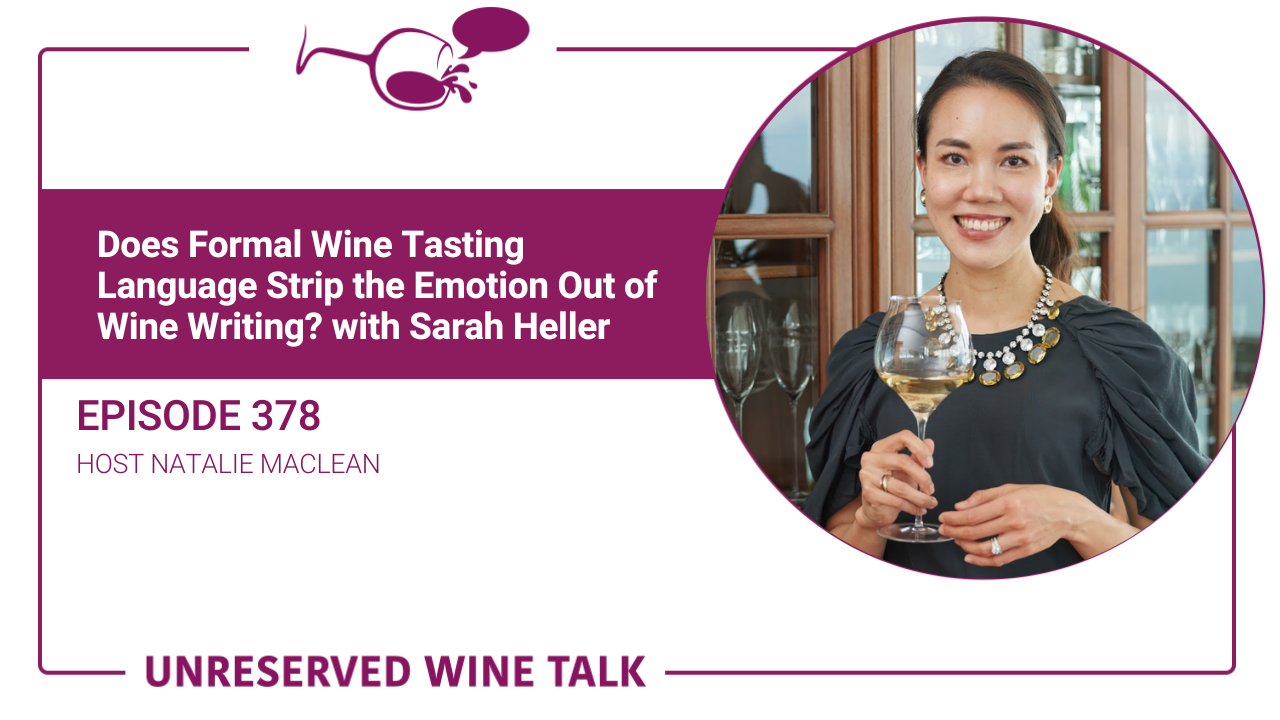
In this episode of the Unreserved Wine Talk podcast, I’m chatting with Sarah Heller.
You can find the wines we discussed here.
Join me on Instagram, Facebook and YouTube Live Video
Join the live-stream video of this conversation on Wednesday at 7 pm eastern on Instagram Live Video, Facebook Live Video or YouTube Live Video.
I’ll be jumping into the comments as we watch it together so that I can answer your questions in real-time.
I want to hear from you! What’s your opinion of what we’re discussing? What takeaways or tips do you love most from this chat? What questions do you have that we didn’t answer?
Want to know when we go live?
Add this to your calendar:

Highlights
- How did Sarah’s wine career almost end before it began?
- Why did her accident in southern France strengthen her commitment to the wine industry?
- What was it like to represent a restaurant alone at age 20 at the world’s largest wine trade fair?
- How did an early lesson about spitting wine become a memorable introduction to professional wine culture?
- What’s the difference between wine marketing and wine education?
- What made Hong Kong’s wine scene during the 2010s feel both extravagant and unusually generous?
- How did Burgundy tastings in Hong Kong highlight the intersection of rarity, money, and shared passion?
- How did Sarah’s fine art training at Yale shape the way she thinks about wine?
- What inspired her to move beyond traditional tasting notes to creating visual tasting notes?
- Why does Sarah believe conventional wine descriptors can feel sterile?
- How do shape, color, mood, and texture form the foundation of her visual tasting method?
- How does the shape of a wine differ between a plush Australian Shiraz and a structured Barolo?
Key Takeaways
- Why is spitting essential if you want to taste wine seriously?
- Sarah: There was a wine producer who took me under their wing and shepherded me round. But I will say, one thing that was not made entirely clear to me, and probably should have been before I went, is that you’re really meant to spit when you try wines. There was a little bit of a macho culture around it, like, oh no, real, real, real people don’t spit. And I was like, I don’t know, that doesn’t seem very smart. But, there I was. And so by the end of the day, the people who had been assigned to take me under their wing were decanting me into a taxi. I made it safely home, thank goodness.
- What made Hong Kong’s wine boom in 2010 feel both extravagant and generous?
- Sarah: It’s not really like the spirits industry, for instance, where I think a lot of celebrities and a lot of show goes into it necessarily. I think it’s more about just the craziness of the bottles that people are bringing to things. And something about Hong Kong that I think distinguishes it, certainly from the UK collector scene, which was sort of my reference point to a certain degree, is that people open their bottles. I mean, some people have generational collections, but most people this was the collection they started. They can remember starting it and they want to share it with people. There’s this idea that it’s all about showing off. And obviously showing off is part of it, there’s no denying that. But there’s also an incredible spirit of generosity in wanting to share these incredible treasures that you have in your cellar with everybody around you, with the people that you care about. If I contemplate some of the events that I’ve been to, probably the more ridiculous, flamboyant ones are Burgundy events just because of how expensive Burgundy has become.
- Does formal wine tasting language strip the emotion out of wine writing?
- Sarah: Obviously, I don’t want to dump on the idea of writing wine notes, I mean we all do it. But, it was more honestly a reaction after having finished the Master of Wine, which is very, very much a bounded problem. You have to accept that this is the way that things are done. And if you try to expand beyond that, the only person who’s going to suffer from that is you. It’s very directed and clear, which I think is useful if you’re trying to create a standardized certification. But having got out on the other side of that and broken my writing style down so that it was as objective as possible and as simple and direct as possible, I was just a bit done with it. I don’t want to talk about red versus black fruit. It had become sort of sterile at that point for me. It’s not that I don’t think people should study that, but it was just the phase that I was in, and I wanted to figure out what my voice was going to be.
About Sarah Heller
Sarah Heller MW is an internationally acclaimed wine expert and visual artist whose work explores the cultural history and multi-sensory experience of wine. Trained in fine art at Yale, she creates paintings, drawings and digital pieces — including her Visual Tasting Notes series — which have appeared in exhibitions and publications across several continents.
She is the Italian wine reviewer for Club Oenologique, Faculty of the Vinitaly International Academy and Wine Editor for Asia Tatler. Sarah has co-hosted the series Wine Masters and Wine Masters Class and has collaborated with Lucaris Crystal on a line of hand-blown glasses. Before these roles, she worked in the wine trade in New York and Hong Kong, where she was Executive Director of Meiburg Wine Media, and she recently relocated to the Pacific Northwest.
Resources
- Connect with Sarah Heller
- Natalie MacLean’s Appearance on CTV’s The Good Stuff with Mary Berg | Can these 3 wines turn your living room into a tasting room?
- Oyster Bay Sauvignon Blanc – Marlborough, New Zealand
- Palatine Hills Oh Goody! Rosé – Niagara Lakeshore, Ontario V.Q.A., Canada
- Casillero del Diablo Devil’s Carnaval Red – Chile
- Unreserved Wine Talk | Episode 73: Women v Men Wine Tasting and Texture with Dr. Gary Pickering
- My Books:
- Wine Witch on Fire: Rising from the Ashes of Divorce,Defamation, and Drinking Too Much
- Audiobook:
- Audible/Amazon in the following countries: Canada, US, UK, Australia (includes New Zealand), France (includes Belgium and Switzerland), Germany (includes Austria), Japan, and Brazil.
- Kobo (includes Chapters/Indigo), AudioBooks, Spotify, Google Play, Libro.fm, and other retailers here.
- Wine Witch on Fire Free Companion Guide for Book Clubs
- Audiobook:
- Unquenchable: A Tipsy Quest for the World’s Best Bargain Wines
- Red, White, and Drunk All Over: A Wine-Soaked Journey from Grape to Glass
- Wine Witch on Fire: Rising from the Ashes of Divorce,Defamation, and Drinking Too Much
- My new class, The 5 Wine & Food Pairing Mistakes That Can Ruin Your Dinner And How To Fix Them Forever
Tag Me on Social
Tag me on social media if you enjoyed the episode:
- @nataliemaclean and @natdecants on Facebook
- @nataliemaclean on Twitter
- @nataliemacleanwine on Instagram
- @nataliemaclean on LinkedIn
- Email Me at [email protected]
Thirsty for more?
- Sign up for my free online wine video class where I’ll walk you through The 5 Wine & Food Pairing Mistakes That Can Ruin Your Dinner (and how to fix them forever!)
- You’ll find my books here, including Unquenchable: A Tipsy Quest for the World’s Best Bargain Wines and Red, White and Drunk All Over: A Wine-Soaked Journey from Grape to Glass.
- The new audio edition of Red, White and Drunk All Over: A Wine-Soaked Journey from Grape to Glass is now available on Amazon.ca, Amazon.com and other country-specific Amazon sites; iTunes.ca, iTunes.com and other country-specific iTunes sites; Audible.ca and Audible.com.
Transcript