






Introduction
How does smoking whisky grains with elephant dung translate into flavours like raspberry and sandalwood? What does the saying “you can’t turn a donkey into a racehorse” reveal about making great whisky? How are modern whisky makers using blending to capture emotions and experiences?
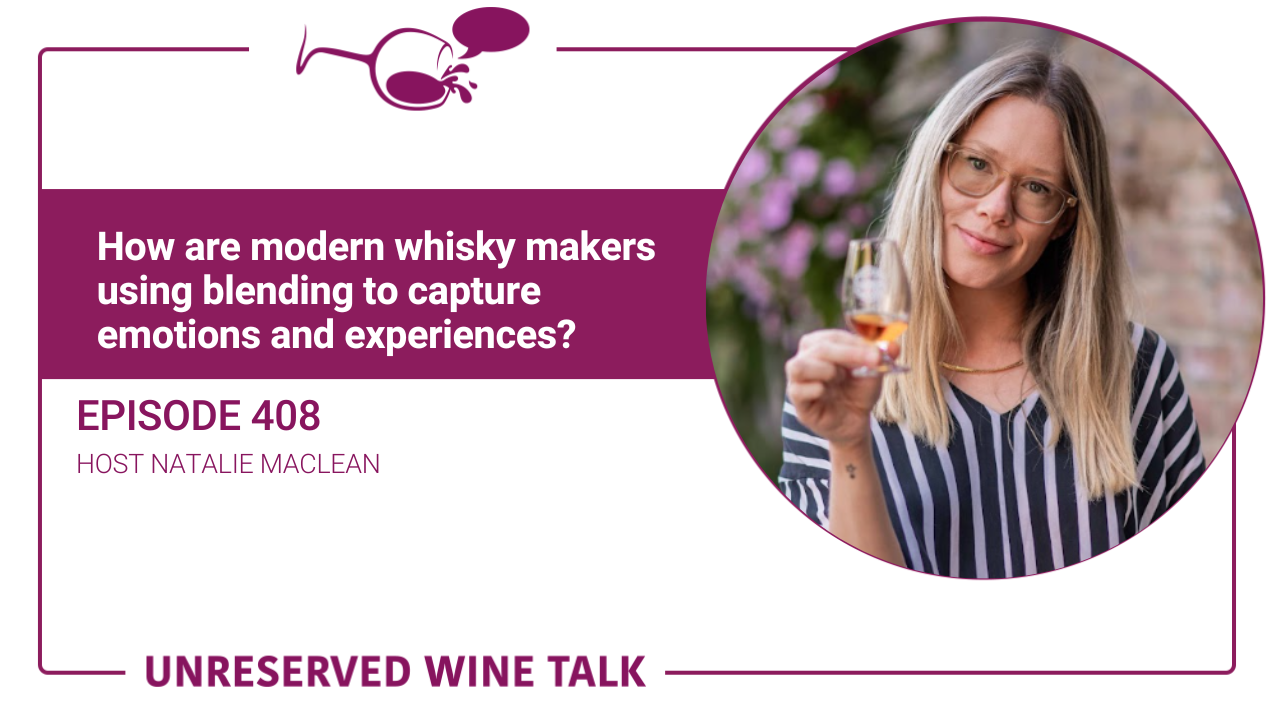
In this episode of the Unreserved Wine Talk podcast, I’m chatting with Kristiane Westray.
You can find the wines we discussed here.
Giveaway
Three of you are going to win a copy of Kristiane Westray’s terrific book, Savour.
How to Win
To qualify, all you have to do is email me at [email protected] and let me know that you’ve posted a review of the podcast.
It takes less than 30 seconds: On your phone, scroll to the bottom here, where the reviews are, and click on “Tap to Rate.”
After that, scroll down a tiny bit more and click on “Write a Review.” That’s it!
I’ll choose three people randomly from those who contact me.
Good luck!
Join me on Instagram, Facebook and YouTube Live Video
Join the live-stream video of this conversation on Wednesday at 7 pm eastern on Instagram Live Video, Facebook Live Video or YouTube Live Video.
I’ll be jumping into the comments as we watch it together so that I can answer your questions in real-time.
I want to hear from you! What’s your opinion of what we’re discussing? What takeaways or tips do you love most from this chat? What questions do you have that we didn’t answer?
Want to know when we go live?
Add this to your calendar:

Highlights
- How are modern whisky makers using blending to capture emotions and experiences rather than simply create consistency?
- Why are smaller distilleries more likely to experiment with different grains, yeasts, and production methods?
- How can something as simple as changing yeast dramatically influence the flavour of a whisky?
- What does the saying “you can’t turn a donkey into a racehorse” reveal about making great whisky?
- How can a whisky maker’s background and philosophy become almost like another ingredient in the final spirit?
- What does ageing whisky in former Japanese shochu casks add that more familiar bourbon or Sherry casks cannot?
- How do unconventional materials create entirely new flavours in whisky?
- Why does Kristiane think whisky drinkers should focus on enjoying what’s in the glass?
- How do altitude and atmospheric pressure affect the way whisky is distilled and matured?
- What makes Canada’s craft whisky scene so exciting?
- Why is whisky and ginger ale Kristiane’s go-to pub drink, even when she’s using single malt?
- What are Kristiane’s three essential tips for anyone who wants to enjoy whisky more?
Key Takeaways
- How does smoking whisky grains with elephant dung translate into flavours like raspberry and sandalwood?
- N: Namibia uses elephant dung as a peat substitute.
- K: So what I do know is that flavour is created at every stage of whisky production? So instead of having the peat, they were using elephant dung. That is obviously a very localized, very readily available resource to light your fire, use as fuel. like the phenolic compounds all over the world, the equivalent of them in elephant dung will cling to the grains in exactly the same way as peat. What happens from that point forward is how they react to the yeast in fermentation, how they react to the cask that they’re using to mature their whiskey. And it will be every single one of those points, those flavor compounds behaving differently.
- What does the saying “you can’t turn a donkey into a racehorse” reveal about making great whisky?
- N: You can’t change a donkey into a racehorse. So what does that mean for how the finest spirits are made?
- K: Basically, if you’re being really careful, are considered at the early stages of spirit production, you’re going to get something really good at the other end. If you’re not really paying attention to it, you’ve got your donkey. How is that going to turn into a racehorse through production, you know? for a long time, whiskey makers focus on things like yield, getting them as much alcohol as possible and optimizing everything and consistency. Yes, you do get a very consistent product at the end of it. but is it going to be necessarily the best?
- How are modern whisky makers using blending to capture emotions and experiences?
- K: I love Pete [Allison]. He’s one of my favourite people in whisky. they’ve just announced that they’re going to be having this new set up, which just looks like it’s going to be fantastic. So something that Woven are doing, and Pete’s really spearheading that, is whisky to be drunk, and it’s whisky that’s kind of like blended to reflect, almost like a human emotion. And I love it because whenever I pop in, it’s like walking into the contents of someone’s mind spilled out across the table. you’ll have,, a thousand samples. All these tasting glasses, these pipettes. And he’s, like, creating. And what he does, he does something super small scale and then when it works, he’ll scale it up, see if that still works.
About Kristiane Westray
Kristiane Westray is a whisky communicator and author. Her first book Savour was published by Bloomsbury in October 2025. She has written about spirits since 2012, and her work has appeared in Whisky Magazine, The Malt Whisky Yearbook, The Times, Club Oenologique and many more. She is the former editor at The Spirits Business and led the content team at Master of Malt, where she trained as a WSET Spirits Educator. As a judge in the UK and US, she has tasted and assessed thousands of whiskies from around the world. An accomplished presenter, Kristiane has hosted numerous tastings, co-hosted live broadcasts, and appeared as a whisky expert on Channel 4’s Sunday Brunch. A passionate advocate for equity in whisky, her work on social media drives education and inclusivity with the vision that whisky is for everyone. Kristiane is based in Brighton, UK, where she lives with her girlfriend and a tiny ginger cat.
Resources
- Connect with Kristiane Westray
- Unreserved Wine Talk
- My Books:
- Wine Witch on Fire: Rising from the Ashes of Divorce,Defamation, and Drinking Too Much
- Audiobook:
- Audible/Amazon in the following countries: Canada, US, UK, Australia (includes New Zealand), France (includes Belgium and Switzerland), Germany (includes Austria), Japan, and Brazil.
- Kobo (includes Chapters/Indigo), AudioBooks, Spotify, Google Play, Libro.fm, and other retailers here.
- Wine Witch on Fire Free Companion Guide for Book Clubs
- Audiobook:
- Unquenchable: A Tipsy Quest for the World’s Best Bargain Wines
- Red, White, and Drunk All Over: A Wine-Soaked Journey from Grape to Glass
- Wine Witch on Fire: Rising from the Ashes of Divorce,Defamation, and Drinking Too Much
- My new class, The 5 Wine & Food Pairing Mistakes That Can Ruin Your Dinner And How To Fix Them Forever
Tag Me on Social
Tag me on social media if you enjoyed the episode:
- @nataliemaclean and @natdecants on Facebook
- @nataliemaclean on Twitter
- @nataliemacleanwine on Instagram
- @nataliemaclean on LinkedIn
- Email Me at [email protected]
Thirsty for more?
- Sign up for my free online wine video class where I’ll walk you through The 5 Wine & Food Pairing Mistakes That Can Ruin Your Dinner (and how to fix them forever!)
- You’ll find my books here, including Unquenchable: A Tipsy Quest for the World’s Best Bargain Wines and Red, White and Drunk All Over: A Wine-Soaked Journey from Grape to Glass.
- The new audio edition of Red, White and Drunk All Over: A Wine-Soaked Journey from Grape to Glass is now available on Amazon.ca, Amazon.com and other country-specific Amazon sites; iTunes.ca, iTunes.com and other country-specific iTunes sites; Audible.ca and Audible.com.
Transcript
Natalie MacLean 00:00:00 How does smoking whisky grains with elephant dung translate into flavors like raspberry and sandalwood? What does the saying you can’t turn a donkey into a racehorse reveal about making great whiskey? And how are modern whiskey makers using blending to capture emotions and experiences? In today’s episode, you’ll hear the stories and tips that answer those questions in part two of our chat with Christiane Rester. You don’t need to have listened to part one from last week first, but if you missed it, go back and have a listen after you finish this one. By the end of our conversation, you’ll also discover why smaller distilleries are more likely to experiment with different grains, yeasts, and production methods. How something as simple as changing yeast can dramatically influence the flavor of a whiskey. How whiskey makers background in philosophy can become almost like another ingredient in the final spirit. What aging whiskey and former Japanese soju casks adds that more familiar bourbon or sherry casks cannot. How altitude and atmospheric pressure affect the way whiskey is distilled and matured. What makes Canada’s craft whisky scene so exciting? Why whiskey and ginger ale is Christian’s go to pub drink, even when she’s drinking single malt and Christian’s three essential tips for anyone who wants to enjoy whisky more.
Natalie MacLean 00:01:30 Do you have a thirst to learn about wine? Do you love stories about wonderfully obsessive people, hauntingly beautiful places, and amusingly awkward social situations? Well, that’s the blend here on the Unreserved Wine Talk podcast. I’m your host, Natalie MacLean, and each week I share with you unfiltered conversations with celebrities in the wine world, as well as confessions from my own tipsy journey as I write my third book on this subject. I’m so glad you’re here. Now pass me that bottle, please, and let’s get started.
Natalie MacLean 00:02:12 Welcome to episode 408. So what’s new in the drinks world? Well, this.
Natalie MacLean 00:02:16 Weekend.
Natalie MacLean 00:02:16 Fur, feathers and fermentation. Wild elephants in India possess a legendary sweet tooth and an intense craving for alcohol. Specifically the local villagers homemade rice beer drawn from the forests by the strong, pungent aroma of fermentation. Whole herds of up to 50 elephants have been known to smash through brick walls, tearing down roofs to access massive vats of the brew. After downing hundreds of litres, the multi tonne pachyderms go on famously rowdy, destructive neighborhood rampages before stumbling off to sleep for days under the shade of nearby trees.
Natalie MacLean 00:02:55 Sounds like frosh week on campus. In human news, a German winery recently hosted a cellar speed dating event where participants were paired based on matching their blind wine tasting preferences. Love that. Hey, your fine tannins are just the smooth move I’ve been looking for. And in 16th century France, ambitious winemakers looking for a shortcut to sweeter vintages began secretly adding lead to their barrels. The dangerous additive masked the bitter acids and created a velvety texture while triggering a silent epidemic of lead poisoning among oblivious drinkers who couldn’t understand why their favorite sweet wine was causing such agonizing stomach pains. It certainly gives new meaning to the phrase killer vintage. Then, in the late 19th century, a popular brand called Vin Mariani blended Bordeaux wine with cacao leaves to create a patented cocaine wine. The drink was wildly successful, earning enthusiastic endorsements from Queen Victoria and even Pope Leo the 13th, who reportedly carried a flask of it and awarded the inventor a Vatican Gold medal before it was eventually outlawed. And for your weird but wonderful scientific fact this week, you might assume that champagne bubbles are perfectly uniform.
Natalie MacLean 00:04:15 But no. Physicists recently discovered that the lifespan of a bubble depends entirely on microscopic proteins floating in the wine. These invisible proteins coat the outside of each carbon dioxide bubble as it rises, acting like a tiny suit of armor that prevents the bubble from popping immediately upon reaching the surface. So the next time you raise a glass of bubbly, you can appreciate the microscopic physics happening right under your nose. And for your calendar. This week, September 23rd, is stacked. First National Pot Pie Day. Pot pies go back to the Roman Empire, where cooks layered meat and vegetables under pastry. Yum. Banquet chefs sometimes baked live birds beneath the crust for a flying surprise at the table. They weren’t kidding about 1420 blackbirds baked in a pie. The comfort food version we know today took hold during the Great Depression. It’s also National White Chocolate Day. White chocolate isn’t truly chocolate since it carries no cocoa solids, only cocoa butter, sugar, and milk solids. Nestlé made the first bar in the 1930s and its national snack on a stick day.
Natalie MacLean 00:05:26 Born in 2016 as a nod to the smoked and cured sausage sticks that grew from old preservation methods. September 24th is National Cherries Jubilee Day. French chef Auguste Escoffier created it for Queen Victoria’s Golden Jubilee in 1887. Flambé the cherries in Kirsch. The cherry brandy over vanilla ice cream. It’s also National horchata de horchata began in ancient Egypt and traveled to Spain with the Moors as a tiger nut drink and became the rice based cooler loved across Latin America. September 25th is National Lobster Day. Lobster was once the poor man’s food in colonial America. Not to mention my dear province of Nova Scotia, where I grew up. It was so plentiful in Massachusetts that prisoners reportedly griped about eating it too often. It didn’t turn luxury until the 20th century. I do recall stories of my mother, I think, talking about her grandparents perhaps being embarrassed if lobster was in their lunch box. Wow. Times have changed. It’s National Quesadilla Day two quesadilla hails from central and southern Mexico. Corn tortillas folded around cheese. Its name is rooted in queso.
Natalie MacLean 00:06:46 September 26th is National Dumpling Day. Dumplings show up in almost every cuisine, from Chinese to Japanese to Polish. Think pierogies, raviolis in Italy with roots more than 1800 years deep. Legend credits a third century Chinese physician who wrapped mutton, chili and herbs in dough to treat frostbitten ears. That’s weird. It’s also National Key Lime Pie Day. The pie comes from the Florida Keys, where cooks used sweetened condensed milk because fresh milk spoiled too quickly in the times before refrigeration. National Pancake Day rounds out the 26th. September 27th is National Chocolate Milk Day. Cocoa and milk were paired centuries ago, long before bottled chocolate milk reached the dairy case, with one story crediting an Irish born physician who met the mix in Jamaica in the late 1600s. The 27th is Oktoberfest, when around 300 musicians gather at 11 a.m. for a joint concert in front of the Bavarian statue in Munich. September 28th is National Drink Beer Day. The Sumerians prayed to the beer goddess named nginx under the Code of Hammurabi. A brewer court selling a ruined batch could be drowned in it.
Natalie MacLean 00:08:06 The day also falls on Arthur Guinness’s birthday. Born in 1725 and September 29th. Closes the week with National Coffee Day legend handing the discovery to a ninth century Ethiopian goatherd who watched his goats turn very lively after nibbling red berries off a wild shrub. Speaking of lively on city TV’s breakfast television this week, we announced that Canada has a brand new wine category. Not a new label, not a new winery, but a whole new category with its own rules written into our wine regulations. The first bottles have just started arriving in Lcbo liquor stores and the Wine Rack. I’ve spent two decades explaining other countries bubbles. Now I get to tell you about one. That’s all ours. This is pretty much the peak of my career today. So France has champagne. Italy has prosecco. Spain has cava. Canada now has Freesat. It rhymes with cassette. A new wine word that comes with a handy pronunciation tip. How friendly and Canadian is that? This is a dry, vibrant Canadian sparkling wine, and the name comes from a combination of frozen and facet, a nod to the grapes frozen on the vine and to the many facets in the wine because it’s very complex.
Natalie MacLean 00:09:26 It’s a wine that is born in winter because we are the true north. The word is protected just as champagne is, which means that only a wine made in this country in this exact way is allowed to call itself fresh Set. And I love that we have laid down the law for Canadian bubbles. Now I know what you’re thinking. You’re thinking that ice wine is sweet. So how can it end up in a dry, delicious sparkling wine? Great question. Every sparkling wine gets its bubbles the same way you add a little sugar in yeast to a still wine. Then seal it, whether that’s in the bottle or in the tank. The second fermentation creates the carbon dioxide. In other words, bubbles. So instead of using sugar to start, that second fermentation for a set uses just a splash of ice wine. The yeast eats it up and creates these incredible flavors so you get the depth and flavor of ice wine, but not the sweetness. Let’s start with Enniskillen for set rosé from the Niagara Peninsula in 1975.
Natalie MacLean 00:10:33 This winery was awarded the first commercial license in Ontario post prohibition. They named the winery for the Inniskilling Fusiliers, the Irish Regiment, whose colonel farmed that land. After the War of 1812. Ontario didn’t issue a winery license for decades before that one. Nobody has explained that to my satisfaction. In a Skilling’s first ice wine attempt in 1983 went to the birds. Actual birds ate the entire crop. They netted the vines the following winter, and the harvest survived. In 1991, Enniskillen Ice Wine put Canadian wine on the world map when it won the industry’s most prestigious award, up against thousands of international wines. Four decades later, a splash of ice wine is what starts the bubbles in the bottle. This rosé is made from Cabernet Franc grapes. It is gorgeously ripe raspberry and cranberry aromas with a little rhubarb underneath. The bubbles are fine, giving it a silky mouthfeel, and a touch of grapefruit keeps it crisp on the finish. Enniskillen for set is ideal to mark the memorable moments like date night engagements, birthdays, special dinners.
Natalie MacLean 00:11:44 It would be amazing with cranberry turkey sliders at the kitchen island or. But the big Bird itself. At Thanksgiving it’s just 34.95, a fraction of the price of champagne. And that is the kind of math I like. Next up, saintly. The good fresh set is from the Niagara Peninsula. It’s a heavenly wine that you don’t need to be a saint to drink it. Lord knows I’m not the Chardonnay here. It comes from one grower, Bill George, farming between Vineland and Beeville in Niagara, only 100m away from Lake Ontario. And yes, let me just say that is and always will be Lake Ontario. So that’s close enough to that. The lake decides how the fruit ripens. That body of water made an excellent decision this year, resulting in slow ripening for great complexity. The grapes were picked on September 22nd and were pressed the same day it reached the winery to preserve freshness. Only the free run juice went into the baseline. Then a small amount of Vidal ice wine started the second fermentation for the bubbles.
Natalie MacLean 00:12:49 You get aromas of fresh apricot and orange zest on the nose, then crunchy green apple, nectarine and dried apricot. The notes the ice wine leaves behind. It finishes rich then snaps back clean. I kind of would like that on my tombstone. Finishes Rich and snaps back clean. Anyway, it’s just 23.95. This would be fantastic with a lemon roast chicken steaming straight out of the oven. Saintly. The good for set is the bottle to open on a Tuesday. No special reason required. Tuesday is the reason. Wednesday actually also works. And come to think of it, so does Thursday. Sparkling wine isn’t just for fancy occasions anymore. 10 million Canadians pour it regularly. And finally, cue Freesat. That’s KGW. Also from the Niagara Peninsula Vineyards sits on the beams Bill bench, an 80 acre estate where some of Niagara finest Riesling vines were planted. Every vine is still tended by hand from winter pruning through harvest picking. This one uses the three classic grapes of champagne Pinot Noir, Chardonnay and Pinot Meunier.
Natalie MacLean 00:13:56 The ice wine going in is Vidal, harvested on the coldest nights of winter. Somebody was standing in that vineyard at minus eight degrees in January, and I thanked them for their service. The 2025 vintage brought a long, dry summer with no irrigation. The roots on clay went looking for water and dug deep for flavor. You get apple blossom and nectarine aromas on the nose with a note of warm almond pastry. The palette runs to pear, golden apple and peach, all carried on a wave of generous mousse. It’s just 26.95, and it would be perfect with smoked salmon on the brunch table. From plan get togethers to impromptu events, queue for set is the easy pour to have on hand. So if you are in the liquor store, what should you look for? The word preset is on the front label. That’s the key. It’s a protected term. Now, the way champagne is, serve it at eight degrees rather than ice cold. Eight degrees is oddly specific, but worth it. Cold hides the fruit that ice wine put in there.
Natalie MacLean 00:14:59 Serving wine to cold is what we do for cheap wine at gallery openings. This is not that. Skip the flute. Two flute glasses are a gift you receive. They’re not a choice you make. If you want pleasure, a white wine glass lets those gorgeous aromas come forward instead of trapping them. So let’s toast to a truly Canadian bubbly. Sparked by ice. Only the ice wine capital of the world could have invented it on Instagram. I’m at Natalie MacLean wine. Come for the bubbles. Stay for the backstory. Back to today’s episode three of you will win a copy of Christian’s wonderful new book Saver. If you’d like to win, please email me and say, hey, I’d like to win. It doesn’t matter where you live. I’ll choose three winners randomly from those who contact me at Natalie at Natalie MacLean dot com. Keep them for yourself or give them as gifts. Congratulations to Sylvia Zimba from Nairobi, Kenya, who has won a copy of Great Expectations by Neil. Hulk over. And if you’re reading the paperback or e-book or listening to the audiobook of my memoir, Wine Witch on Fire rising from the Ashes of Divorce, defamation, and Drinking Too Much, a national bestseller and one of Amazon’s best books of the year.
Natalie MacLean 00:16:09 I’d love to hear from you at Natalie at Natalie MacLean. Com there’s a terrific free guide for book clubs. I’ll put a link in the show notes to all retailers worldwide at Natalie MacLean dot com for 408. Okay, on with the show.
Natalie MacLean 00:16:30 You write.
Natalie MacLean 00:16:31 Oh okay. We talked about that single malt thing. So let’s keep moving on there. Pete Allison at woven whiskey calls. We’re talking about some modern makers now calls his bottlings experiences with names like Shindig and Echoes. Walk us through his imaginarium of a blending lab in Chile. Lees is at Leith. Life in Leith. Yeah. Yes. Okay.
Kristiane Westray 00:16:54 Yeah, it’s up in Edinburgh. So I love Pete. He’s one of my favorite people in whisky and I actually went to visit them maybe even last month. It was super recent and they’ve moved Blending Lab now, which was even more exciting to get to see what they’re up to in this new space. And they’ve just announced that they’re going to be having this whole new kind of like set up, which just looks like it’s going to be fantastic, but basically, yeah.
Kristiane Westray 00:17:15 So something that woven are doing which and Pete’s really spearheading that is it’s whisky to be drunk and it’s whisky that’s blended to reflect almost like a human emotion. And I love it because whenever I pop in, it’s like walking into the contents of someone’s mind spilled out across this table. You’ll have like a thousand samples, all these tasting glasses, these pipettes. And he’s like creating. And what he does, he does something super small scale. And then when it works, he’ll scale it up, see if that still works. And something that I love about it is they buy these parcels of super interesting whiskies increasingly from all around the world as well. It’s not just Scotch to create something that’s so much more than the sum of its parts. And for me, that’s such an expression of modern whisky. Making like blending is incredible. You can layer these things together, and something like shindig feels so like vibrant and like a party when you drink it. It’s light, it’s vibrant, it’s playful, and I just love that.
Kristiane Westray 00:18:11 I love that you can capture, yeah, these emotions and these mindsets through aroma and flavor. I think it’s an incredible art.
Natalie MacLean 00:18:18 That’s terrific. Wow, how interesting an approach. Now Hollywood Distillery in Edinburgh has a neon sign reading test, learn, improve, repeat. Tell us about co-founder Rob Carpenter’s trials with as many as 99 different malt recipes and 50 different yeasts.
Kristiane Westray 00:18:36 It’s incredible. So yeah, so Rob is the founder so he can sell it all up. And he’s got an amazing sort of whisky creation team there. Distillers, blenders everything. And again you walk around there and there’s this blackboard on the wall of you can see how they’re trying to track these different yeast strains that they’ve used, like where they’ve done like multiple pictures of everything and just different strains of like grain as well. So different types of barley going in like at the very early stages. And it’s like a mix and matching all these different ways of flavor creation. Their philosophy is that they don’t want like a core consistent range.
Kristiane Westray 00:19:11 They want to be constantly creating something new, pushing the boundaries of like flavor and what you can do in whisky. And I just find that so fascinating. It’s way beyond, like my scientific understanding. It’s the sort of thing that made me wish I’ve studied like chemistry and physics at school, even biology, I guess, with fermentation. But yeah, it’s amazing to me. And I think what is fascinating is that oftentimes it’s these smaller makers like Hollywood and Woven, who are really like seeing what can be done. A lot of the bigger companies, particularly at the moment with a bit of a downturn, are playing it safe. But you go and visit these makers and I’m like, wow, you were doing such cool stuff,
Natalie MacLean 00:19:50 That’s great. And now White Peak in Derbyshire collects, quote, big white buckets of live yeast every week from Thorn Bridge Brewery, makers of Jet Power IPA beer. Describe what the yeast actually does to this spirit.
Kristiane Westray 00:20:06 Amazing. So yeah. So I love White Peaks. So they’re an English whiskey maker and they are the first time I have.
Kristiane Westray 00:20:12 I been once or twice, I can’t remember. Anyway, we went to visit them and it’s like this old white works factory where they made all these great big cables, and it’s right by a river. There’s a forest next to it. It’s just it doesn’t look like a conventional distillery at all. And I love it. And it’s so true to its industrial roots and it’s just really cool. Anyway, when we were there, They were literally like, oh yeah, we’ve just had a yeast delivery. Held up this like giant white bucket. And it was just liquid yeast that was left over from the beer making process. Why is this important? It creates so much flavor. So I think it’s helpful to think of whiskey in its most simple terms as distilled beer. So you’ve got to make your beer before you can distill it to make your whiskey. So they’re using this yeast that’s come from a brewery to make their own beer or to sort of I’m sure there’s way more to it than that. It might be a second pitch.
Kristiane Westray 00:20:58 I’m not entirely sure. Again, not a biologist, sadly, but yeah, they’re sourcing it from the brewery up the road, which gives it like this amazing, like, like sense of place. Again, we’re talking about how rooted in locations these drinks makers can be. And I just think as well, like if you’re creating something that stands up as a beer in its own right before you then distill it and capture those aroma and flavor compounds you want from distillation. If you’re doing that early in the setup, I think you’re going to get something really quite cool out the other end and that’s what they’re getting. Wow.
Natalie MacLean 00:21:32 Now, at Starting in Denmark, co-founder Alex Munch and eight friends decided to launch a distillery. While sitting in the sauna. Tell us about that and share. Stunning Wildest Cask experiment. There’s something about hot sauce and heather smoked balsamic vinegar. What’s going on there?
Kristiane Westray 00:21:49 Yeah. Again, this is another maker that’s really playing and seeing what they can do. So stunning is amazing.
Kristiane Westray 00:21:56 It’s such a cool distillery. It is right on the coast in Denmark. And it just architecturally stunning as well. They’ve got I think it’s they said I was about to say 12. I think it’s 36 loads of tiny little stills. And yeah they are always experimenting with their casks. They’ll do tiny little runs of production as possible. But yeah, some of them they’ll do in partnership with restaurants even. And I think this is what the hot sauce one was. So they’ll like season a cask with whatever. And then yeah take the output the whisky and let’s see what happens. And one of the reasons they can do that and distilleries in Scotland can’t is because in Scotland you’ve got really strict rules around what you can and can’t aid your whisky in. So in other parts of the world, people are really like doing out there crazy things they can get their hands on and often in partnership with, as I say, like local restaurants or other food and drink makers. And it’s so much fun. I love it and I’m like, if you can create these amazing whiskies that you can’t see anywhere else, why not?
Natalie MacLean 00:22:57 Yeah, sure.
Natalie MacLean 00:22:58 People are flavour seekers. And that’s your own approach with the book. Again, another parallel with wine there. This isn’t new, but they’ve been aging wine in bourbon barrels like ex bourbon barrels to get that richer, more caramelized kind of rounded finish on especially the big reds red wine. So there’s I haven’t heard of hot sauce yet but I’m sure it’s coming.
Kristiane Westray 00:23:20 Give it time. You never know.
Natalie MacLean 00:23:22 Yes, that and dill Pickle seem to be the flavors of the month. So at Maison Leonetti in France, Doctor Magali Picard uses concrete egg shaped vessels for fermentation. And co-founder Alex Casco quotes Jean-Michel Rene’s speech to you if you can’t change a donkey into a racehorse, so what does that mean for how the finest spirits are made?
Kristiane Westray 00:23:47 Oh my goodness. Okay, I’ll start with that quote first, and I’ll come back to tell you something else. What makes athletics that’s so cool? Basically, you can’t turn the donkey into a racehorse. Similar vibes to what you were just saying about White Peak, where if you’re being really careful and considered at the early stages of spirits production, you’re going to get something really good at the other end if you’re not really paying attention to it.
Kristiane Westray 00:24:08 You’ve got your donkey. How is that going to turn into a racehorse through production? That was just a quote. I got on a call and I was like, this is we were chatting away, and when they said that, I was like, that’s so true. And I do think sometimes, again, this isn’t saying the outcome of this is bad, but I think for a long time whisky makers focus on things like yield, getting them as much alcohol as possible and optimizing everything and consistency. Yes, you do get a very consistent product at the end of it, but is it going to be necessarily the best? I’m not sure. And I think the approaches they take at Mason Leonetti, oh my goodness, that is one distillery that I wish I could just hang out in for a week or more because they are there literally studying in such granular detail whisky making so that they can understand. Like we went to Magdalene Lab as well and she has all these. I like you put your bit of whatever material, your study spectrometer, that’s what it is.
Kristiane Westray 00:25:09 And just looking at all these flavor compounds like that, almost like molecular detail and mapping it all out, which has never really been done in whisky before. And part of the reasons they’ve got those egg fermenters, again, very similar to winemaking. People aren’t really doing it in whisky. The amount of control you can get. Doing it differently. It’s just so fascinating. And I think, I don’t know what a good phrase to live life by as well. With whatever you’re creating, you can’t turn a donkey into a racehorse to be excellent at every stage. And I know that’s one that really stuck with me.
Natalie MacLean 00:25:39 It’s true. And it all goes back to the inputs. Some would say measure twice, cut once, but also in the the wine world, it’s all about the grapes and the terroir. And you cannot make a fine wine out of grapes that have been over cropped or have a bad sun exposure, or poor soils in the sense that they don’t drain well. So yeah, lots of parallels.
Natalie MacLean 00:26:00 Now Pablo in Medoc in Patagonia, Argentina, trained as a physicist with a PhD in the UK before founding the distillery. Tell us how maybe a physics brain approaches making whiskey different from a brewer’s brain.
Kristiane Westray 00:26:16 So that was an interview that I loved. It was so fascinating. So sadly, I didn’t get to go out to Argentina. That would have been very cool, but when we were chatting away, it just really struck me about how I think. Sometimes I think whisky is the perfect example of where art and science meet, and I sometimes think that if you are focused on the creativity, you end up with something amazing. But he is so focused on the mechanics, the almost like the construction of everything. I think the way his mind works and how its attention to detail, but in a way that is mathematical, is that this mathematical approach to whisky making. And again, I said earlier, I think the philosophy of the whisky maker is almost like a fourth ingredient sometimes to me, you can make whisky in so many different ways.
Kristiane Westray 00:27:03 And the way he does it just blew me away. And again, I have so much respect to people who can talk about this stuff in the second language. I speak one language and I struggle to understand it, but go into all these technical details. I’m like, you are so thorough in your approach, and it was so fascinating. And chatting to other people who were like, well, give it a go, we’ll try anything. Neither of these are better or worse than the other, but I do think it speaks to different focuses. And you do get different styles of whiskey as a result. And that’s the joy of whiskey, right? You get so many different people, some different approaches, some different philosophies, so many different whiskeys at the end of it.
Natalie MacLean 00:27:37 Absolutely, absolutely. Now in Japan, the founder whose name I’ll let you say, told you he recognized whiskey as a universal language. His grandfather pioneered Japan’s first Oak Age whiskey. Tell us what these or I should say, oak aged, sort you casks.
Natalie MacLean 00:27:58 What they do to a spirit that say bourbon and sherry casks can’t do.
Kristiane Westray 00:28:04 Yes. So we’re talking about Konosuke Distillery, which again, I’m so sorry to the team for pronouncing it wrong. And Yoshitsugu Kamata is how you pronounce it. But again, so much respect to what you’re doing and I’m so sorry for mispronouncing your name again. This was an interview I did. I sadly couldn’t get out of to Japan. I wish I could have done it and this is a distillery like absolutely on top of my bucket list to get to again right by the sea. And he is somebody who has. He comes from a family of shochu makers. He was like, how can I make whisky based on this traditional Japanese spirit? And that’s literally what he did. Some of the whiskeys are literally made in the stills that they used to make shochu. And I think the cask is so important in whisky making. There are various schools of thought that say up, I’ll say up two, because otherwise I’ll have brewers and distillers like getting very upset about this.
Kristiane Westray 00:28:57 Fairly up to maybe, maybe 70% of a whiskey’s flavor can come from the cask. There are so many different factors that affect that. If you are literally doing like a very run of the mill focusing on yield kind of whisky, you’ll be around 70%. Other whiskies will be different, but that’s how important good quality casks are. Casks to me are same with wine. They. You hope they’re watertight, but they’re not airtight. So they can breathe. As they breathe, they draw whatever’s in them into the oak staves. So if you’ve got shochu in that cask first, tip it out. Use that extra cast to fill up your whisky that starts breathing in and out of the oak staves as well. It will pick up the character of what was in there before, what’s left behind in those staves, and that will get drawn into the whisky. So whether it’s x bourbon, x sherry, x rum, x tequila, whatever, that is why you get that character drawn out of that barrel, that cask into the whisky.
Kristiane Westray 00:29:50 So that’s why it’s so different. They use all kinds of other techniques as well to make it distinct and different over there at colonoscopy. It’s such a fun whisky. Definitely want to taste. I might pull myself a little dram afterwards. Got excited about it. Now speaking.
Natalie MacLean 00:30:03 About it, you truly love what you do. So on. Jaba in Namibia uses elephant dung as a peat substitute. Very interesting. And you write that it smells or tastes of raspberry and sandalwood. How is this different? What’s the. Are they using the same process but with elephant dung? And how does that get translated into raspberry and sandalwood? What are the elephants eating? I don’t know.
Kristiane Westray 00:30:33 Okay, so if I was I want like a chemist here to tell me exactly how this works. So what I do know is that flavor is created at every stage of whisky production, right? So instead of having the peak that we talked about earlier, going all the way back to the bone kiln, they were using elephant dung.
Kristiane Westray 00:30:50 I’ll come back to that, because I think there’s so much to be said about different ways to like smoke, whisky, peat, whisky, whatever that is obviously like a very localized, very readily available resource to light your fire uses fuel and basically like the phenolic compounds of the word, they won’t be phenols. That’d be something else. But the the equivalent of them in elephant dung will cling to the grains in exactly the same way as peat. What happens from that point forward is how they react to the yeast in fermentation, how they react to the cask that they’re using to mature that whiskey. And it will be every single one of those points, those flavor compounds behaving differently. So I’m sure it is partly the fact that it obviously is the fact that it’s done and probably what the elephants were eating. But the fact that it’s a different fuel source has translated out the other end with all these other components and these other influences as a whiskey that tastes like this. And that to me is what’s so astonishing about it.
Kristiane Westray 00:31:45 And I really think that elephant dung is a great example. Again, callback to saying using different sources of what can we use instead of peat to get these flavors? Obviously elephant dung creates different flavor compounds, but I from speaking with chemists, I know you can hack the peat phenolics. You’re using things like yeast and engineering the yeast to get that output. You could never use dung to make like a Scotch single malt. Obviously you can make the movie in single malt and other whiskeys with it. that. But yeah, I think it’s just a really interesting talking point about how we drive these kind of like smoky notes in whiskey and what you’re smoking them with. There’ll be things like juniper oak smoked whiskey or alder smoked whiskey. Thinking about one coming from the Nordics because you can use almost anything. It just depends what the end result is and how you can tweak that along the way.
Natalie MacLean 00:32:34 I think there’s a really rare coffee that I don’t know. They somehow use the excrete excrement of cats or something. I don’t forget where it is.
Natalie MacLean 00:32:43 I’m forgetting where it is, but it’s just my mind is going to animals and dung now, but anyways.
Kristiane Westray 00:32:48 And dung. I also think it’s an interesting conversation around how we can be quite squeamish about this kind of stuff. And I’m like, if it’s readily available, environmentally friendly, maybe we need to take a step back and be like, why do we think this is not okay?
Natalie MacLean 00:33:03 Yeah, the circle of life, the circle of life in one end out the other.
Kristiane Westray 00:33:08 Absolutely.
Natalie MacLean 00:33:10 Now, Arthur in Lebanon ages. Whiskey and clay amphorae very similar again to wine with Lebanese oak inserts and cedarwood, which wouldn’t fly in markets where aging requirements require solely oak casks, you write. What does cedar do to the spirit?
Kristiane Westray 00:33:26 So again, it will depend on all kinds of the other things as well. But my general understanding is that cedar will give almost like a slightly more like aromatic key, maybe slightly floral elements. But again, it’s one of many levers you can pull to create flavor and end up with like a certain character.
Kristiane Westray 00:33:44 We see it with things like chestnut oak in Irish whiskey, and even different like oak species within oak, like Andean oak, Columbian oak, Mongolian oak. Whatever type of wood you’re using will impart different flavors because of like literally the weave of the tree, the weave of the tree. You know what I mean? How tight the the green knots are. The grain. That’s the word I’m looking for. And the different makeup of things like linens and stuff like this again. I wrote about this a couple of years ago, and I’m trying to pull them from my memory.
Natalie MacLean 00:34:16 Yeah, yeah. But yeah, it’s complex. It’s minute, but it’s fascinating too. Will you try to pick out because you’re picking out molecules of your own pleasure when you start to dissect at this level, it’s not just science, it’s also the sensory pleasure.
Kristiane Westray 00:34:28 So 100%.
Natalie MacLean 00:34:30 The more you understand, I think, the more pleasure you can have. Not that you have to be an expert.
Kristiane Westray 00:34:35 Yeah. And I think this is like a whole other conversation as well as like, I definitely think you get so much joy from the education and understanding and figuring out where this stuff comes from.
Kristiane Westray 00:34:45 But I also think with whiskey especially, which it’s almost like educational nothing this whole time, it’s like whiskey drinkers have to be educated. No you don’t. You can just go and enjoy this whiskey without knowing anything where it comes from. I think both are so valid, and I think we’ve put too much focus on the educated drinker and not enough focus on a drinker that just wants to have a nice time.
Natalie MacLean 00:35:05 Yeah, absolutely. Absolutely. Absolutely. Absolutely. Absolutely. In Mexico, a distillery is the first purpose built whisky distillery in that country that sits at almost 2400m elevation above sea level. Tell us why corn is sacred in Mexico and what that elevation means for the maturation of whisky made there.
Kristiane Westray 00:35:27 Oh my goodness, there’s so much to say about this. And unpack. And somebody from Mexico will give you a much more detailed explanation of this than me. But in kind of like ancient cultures, I believe. Like the story of creation is that humans were made from like, corn at one point.
Kristiane Westray 00:35:41 and that’s something that has been passed down. I don’t know how like, strongly held a belief it is these these days, but corn is seen as this, like amazing, incredible grain. Obviously, it’s so widely used in food and it’s just so critical, I think, to so much of like the the agri and food economy in Mexico. So I think from culture and religion through to the actual the economics and markets, it’s critical. And I love that we hear a lot about bourbon, which is obviously like massively corn focused. I love that. Mexico is like carving out a name for itself. Making corn whiskey and altitude is so fascinating. And this was something I was looking at distilleries all around the world, not just altitude, but things like atmospheric pressure. And it does stuff not just to maturation, but also distillation. You’ll have to make for distillation. Your cut points will be different depending on atmospheric pressure. What does this deal at different times. So cut points. So basically when you are turning your beer into a whiskey you’re boiling it in stills usually, but not always.
Kristiane Westray 00:36:43 We’ll talk about pots through distillation. You’d usually, but not always do it twice. The first one you’re just getting the ABV up a bit. The second one you’re not just increasing the ABV, but you’re also at that point choosing which bits, which flavor compounds you want. And the reason that you can do that is because the spirit at that point is a mixture of water, alcohol, other flavor compounds. All of these things have got different boiling points in the same way that if you like, boil a kettle or fractional distillation in the oil industry, all kind of the same. Like you boil something, it comes over at different times depending on how volatile all the different compounds are. So your cut points are literally over time where you decide to start collecting your vapors to turn them back to liquid. You’ve got your head cut and your tails cut. Different words depending on where you are in the world often. And it’s that hot in the middle that you’ll put in a cask that will go on to become whiskey.
Natalie MacLean 00:37:38 Interesting. And again, in the wine world, like we make rosé. Some people use the first or first run juice, the palest juice, whereas others will give the full bleed the sun method. So I understand cuts like what you’re looking for, but the whole distillation and what comes over is it distillates is it evaporates and then re condenses is fascinating. Yeah.
Kristiane Westray 00:38:01 Yeah absolutely. And you’ll have like if you it depends what you’re trying to make if you’re trying to make one of these really like grubby, rude, worki, heavily peated whiskies, you’ll have a much later second cut point because you want some of those those heavier things to hang around energy. Yeah, to get them to evaporate. Whereas if you want like a light whiskey, that’s maybe more like citrusy floral, you’ll have an early second cut point. So you’re only getting the lighter flavor of the head. Yeah, exactly. That is a very simplistic way of describing it. There may be distillers listening who are like.
Natalie MacLean 00:38:36 Well, this isn’t the whisky podcast.
Natalie MacLean 00:38:38 This is us trying to understand whisky. Yeah, I know, I understand it better now. I’m really loving this because it’s really helping me figure out what the parallels are and how to enjoy whisky. So you’re just back from a Vancouver, BC trip where you got to visit three distilleries here in this country. So tell us about one of them that really stood out for you and what makes Canadian whisky, although I know there’s various producers across the country. But from your perspective, what kind of makes Canadian whiskey different from other countries?
Kristiane Westray 00:39:09 Amazing. Yeah, it was such a good trip and I loved all of it. And I’m so grateful to everyone for hosting me. But the one that I keep thinking about now is Sons of Vancouver, which is, yeah, just north part of the city. And their mission, their vision is to like we if you think you know rye whiskey, you think of rye as being quite spicy, quite fiery. Maybe they’re distilling and blending in ways to push out that flavor profile in all kinds of unexpected directions.
Kristiane Westray 00:39:37 And I just think it’s so inventive. So there’ll be like a very menthol expression or quite a creamy expression. And the fact that you can do that from the same grain ultimately, but just maybe fermenting, distilling, blending in different ways. It’s so interesting. And I think for me, what really sticks out about craft distillers in Canada are very different rules to what we have here. Even with things like export, not just internationally, but internationally, but even to different states. And all of this is like the requirement to use like hyper local sourcing. And I love again how that taps into that sense of place and those philosophies. And I think it was I think it was Sons of Vancouver. But this might be incorrect. But moving from sourcing from like a co-op of farmers to working individually with farmers and being able to see like exactly who’s growing what and why and the terroir of it all and all of these things. It’s just so interesting. And I think anything like that drives these different flavor experiences are just so fascinating to me.
Kristiane Westray 00:40:35 And there’s so much to learn that, oh my goodness. Yeah. And I could have spent a week with each each maker because it was so cool.
Natalie MacLean 00:40:42 Oh that’s awesome. Now you right. The highball is your go to whiskey drink or cocktail in pubs. Why is that? And what’s the most surprising whiskey you’ve ever ordered as a highball that made a bartender’s eyebrow rise? Maybe rise, I don’t know.
Kristiane Westray 00:40:58 Oh, okay. Why do I love highball so much? I think it’s because they’re so there’s such simplicity to them for the first part. It’s basically like whisky plus mixer. So whatever you’ve got, you can make a highball, whether it’s like a very traditional, like whisky and soda. My personal go to in a pub is whiskey and ginger ale. One of the other reasons I love it is that for many reasons, and I hate saying it out loud, I’m not a beer drinker. I struggle with beer. I find it very bitter. I know they’re not all like that, some of them less so than others, but I haven’t found my beer yet.
Kristiane Westray 00:41:31 Let’s put it that way. I’m open to trying more, but we’ve not quite crossed that threshold so often. If I’m in the pub with my friends, they’ll be drinking pints and I need a long drink. Otherwise, if I’m drinking wine at the same rate they’re drinking pints, it could be very disastrous. Basically, I need a long, slow, steady drink. And no, a single or indeed a double lengthened out is like perfect for that. And also like most pubs have some whiskey and most pubs have some mixer, right. So it’s easy. The biggest surprise, I think, is when do you know what? And this isn’t like a slight. I think there’s a real need, I think, for education, for for the hospitality when it comes to whisky. And I think people are like, are you sure you want to put that single malt or whatever with the mixer? And I’m like, yeah, because it’s really delicious. Things like Jameson and ginger ale, which is like such a well-known go to that.
Kristiane Westray 00:42:24 That’s very conventional. Normal, you could say. But if I’m like maybe a Glenmorangie or a Glenfiddich, they’re like, people normally have that neat. And I’m like, yeah, sure. But it’s also great with a mixer. So yeah, it’s fun.
Natalie MacLean 00:42:36 Oh that’s great. And do you have or do you recall a favorite childhood food and what you’d pair with it today as an adult. Like with whiskey.
Kristiane Westray 00:42:45 Okay. So this was actually like I love making like a whiskey meme type thing. A little while ago I did like a if you like this, try this thing on Instagram. okay. Here in the UK, I do. You have Marks and Spencer are in Canada. I know you know.
Natalie MacLean 00:43:00 I only know because I used to go to Scotland because I was a Highland dancer. So we don’t have Marks and Spencer here. Yeah. Yeah, fine.
Kristiane Westray 00:43:07 And dancing. That was amazing. Do you still do that now?
Natalie MacLean 00:43:10 No, but I did it for all my childhood. Then I taught it and I competed across the country and in Scotland.
Natalie MacLean 00:43:16 It was quite serious about it as a teen and child. Yeah, but I hung up my slippers and turned to wine.
Kristiane Westray 00:43:24 Yeah, it’s pretty intense. Like it’s spoken to like Highland dancers before. It’s intense. Yes. But yeah. So yeah, there’s a sweet, a bit of confectionery that Marks and Spencer makes is called Percy Pigs. And I just think they’re so delicious. They’re so fun, but also vegetarian.
Natalie MacLean 00:43:40 Do they taste like.
Kristiane Westray 00:43:41 Oh, I wish I had a bag of them now to show you. They’re basically, like, super sweet. They literally are like, like little pig faces and they taste like, I guess, almost like artificial kind of strawberry, raspberry, generic red fruit, kind of like, okay, I love them. And I think having them with single grain whiskey is just such a treat. I love it, I paired them together in my little meme set. If you like Percy Pigs, you’ll like single grain whiskey and it works.
Natalie MacLean 00:44:05 That’s great. I love that, that’s fun.
Natalie MacLean 00:44:07 Oh, this has been fun, Chrissie. If a listener walks away from our conversation remembering just three things about whiskey, it could be something that we’ve already talked about or something that you want to mention now that we haven’t covered. What are your top three tips for them?
Kristiane Westray 00:44:20 Okay, limiting this to three will be tough because I can go on all day. I really think the first one is don’t overthink it. Don’t overthink whiskey. Just have fun with it. Just let go. So many of my friends are like, can I drink that? An anecdote. Drinking highballs in the pub. Some of my friends like. How do I order that? I’m like the same way you order a gin and tonic, whiskey and ginger ale. Chill out. And I think we still have this thing. That whiskey is this very fancy, very inaccessible thing. And if you’re not doing it properly, you can’t or you’re not welcome in some way. And I say, just have fun with it, you know? Take it off the pedestal and enjoy it.
Kristiane Westray 00:44:58 So that’s number one. number two, I would go back to nosing and tasting. Take it super slow, remember? I often say stranger danger and don’t go in too quickly. Nose and taste from afar and take tinier sips than you think. This is not like wine or beer. Tiny sips. You can always go back for more. And I think the third one is just taste as widely as you can. Whiskey is so diverse and distinct. There are light floral whiskies. There are these roadworthy kerosene whiskies. There are whiskies that tastes like ice cream wafers. There are herbal whiskies. There are all kinds of stuff, and you just never know. You never know what you’re going to have in your tasting glass. And that’s so fun.
Natalie MacLean 00:45:35 Oh that’s marvelous. Marvelous. Kristy, where can we find you and your book online?
Kristiane Westray 00:45:40 So savor a little orange book, baby. All good bookstores, your Amazons, your Waterstones, all of these kind of things. So that’s where she lives. I am best found on Instagram at Christiana Westray.
Kristiane Westray 00:45:51 And yeah, we like to have fun with whiskey over that. And also it’s a mix of having fun, getting rid of some of these myths and stereotypes. But also, I think something I’m really passionate about talking about is equity and whiskey, diversity, inclusion and just campaigning for whiskey. As for everyone, that’s what I say all the time. Whiskey is for everyone. Just making sure that lands.
Natalie MacLean 00:46:10 Absolutely. It certainly does with you and your book. Christy, I’ll put the links in the show notes to your book, to your Instagram and anything else, but thank you so much. This has been wonderful. I’ve learned so much. My mind is imploding, but now all I want is a glass or a little wee dram of Highland Park. I’ve got to go find it somewhere. Yeah. Thank you. I really have inspired me to try more whiskey. So you’ve done your job. Thank you.
Kristiane Westray 00:46:37 Oh, I was so pleased. Honestly. Thank you so much for having me. I’ve learned so much from you about why there’s.
Kristiane Westray 00:46:41 Well. So. Thank you. This has been so much fun. And yeah, have a wonderful weekend. Thank you to weekend.
Natalie MacLean 00:46:47 Christy and cheers. Cheers.
Natalie MacLean 00:46:55 Well, there you have it. I hope you enjoyed our chat with Christiane. Here are my takeaways. Number one, how does smoking whisky grains with.
Natalie MacLean 00:47:02 Elephant dung.
Natalie MacLean 00:47:03 Translate into flavors like raspberry and.
Natalie MacLean 00:47:05 Sandalwood? In Namibia, they’re using elephant dung as a peat substitute. And as Christiane explains, the flavor is created at every stage of whisky production. This is obviously a very localized tradition, and the resource is readily available to light. Your fire is fuel, so the phenolic compounds in the elephant dung will cling to the grains exactly the same way as peat does. What happens from that point forward is how they react to the yeast in fermentation, and to the cask they’re using to mature the whisky. It will be every single one of those points where flavor compounds are behaving differently. Number two, what does the saying you can’t turn a donkey into a racehorse reveal about making great whiskey As Christian notes, you have to be careful, especially at the early stages of spirit production, because you’re going to get something really good at the other end if you are.
Natalie MacLean 00:48:01 If you’re not paying attention. You got your donkey. For a long time, whiskey makers were focused on aspects like yield, getting as much alcohol as possible, and optimizing everything for consistency. Now, more and more are looking for quality and distinctive character. And number three, how are modern whiskey makers using blends to capture emotions and experiences? Christiane loves Pete Allison. He’s just announced he’s spearheading a whiskey that is blended to reflect human emotions. Whenever she walks into his tasting lab, it’s like walking into the contents of someone else’s mind spilled out across the table. He has thousands of samples and tasting glasses and pipettes. He’s always creating and coming up with something on a super small scale. And when it works, he scales it up. You won’t want to miss next week, when we chat with Karen Newman, who reviews spirits for Wine Enthusiast Magazine, Bloomberg Food and Wine and The Wall Street Journal and BBC travel. She’s also the author of seven cocktail books, and she’ll join us from New York City.
Natalie MacLean 00:49:10 Do you know someone who would be interested in learning more about whiskey and how to appreciate it? Please let them know about this podcast. Email or text them now while you’re thinking about it. It’s easy to find the Unreserved Wine Talk podcast. Just tell them to search for that title or my name Natalie MacLean wine on YouTube, Apple Podcasts, Spotify, their favorite podcast app or they can listen to the show on my website at Natalie MacLean or. Email me if you have a tip, question, or if you’d like to win one of six drinks books I have to give away. I’d love to hear your thoughts on this episode, or if you’ve read my book. Email me at Natalie at Natalie MacLean dot com. In the show notes, you’ll find a link to take a free online food and wine pairing class with me, called a Fine Wine and Food Pairing Mistakes that can Ruin Your Dinner and How to Fix Them Forever at Natalie MacLean. And that’s all in the show notes at Natalie MacLean zero eight.
Natalie MacLean 00:50:01 Thank you for taking the time to join me here. I hope something great is in your class this week. Perhaps a whiskey that stirs your emotions?
Natalie MacLean 00:50:17 You don’t want to miss one juicy episode of this podcast, especially the secret full bodied bonus episodes that I don’t announce on social media. So subscribe for free now at Natalie MacLean. Meet me here next week. Cheers!