






Introduction
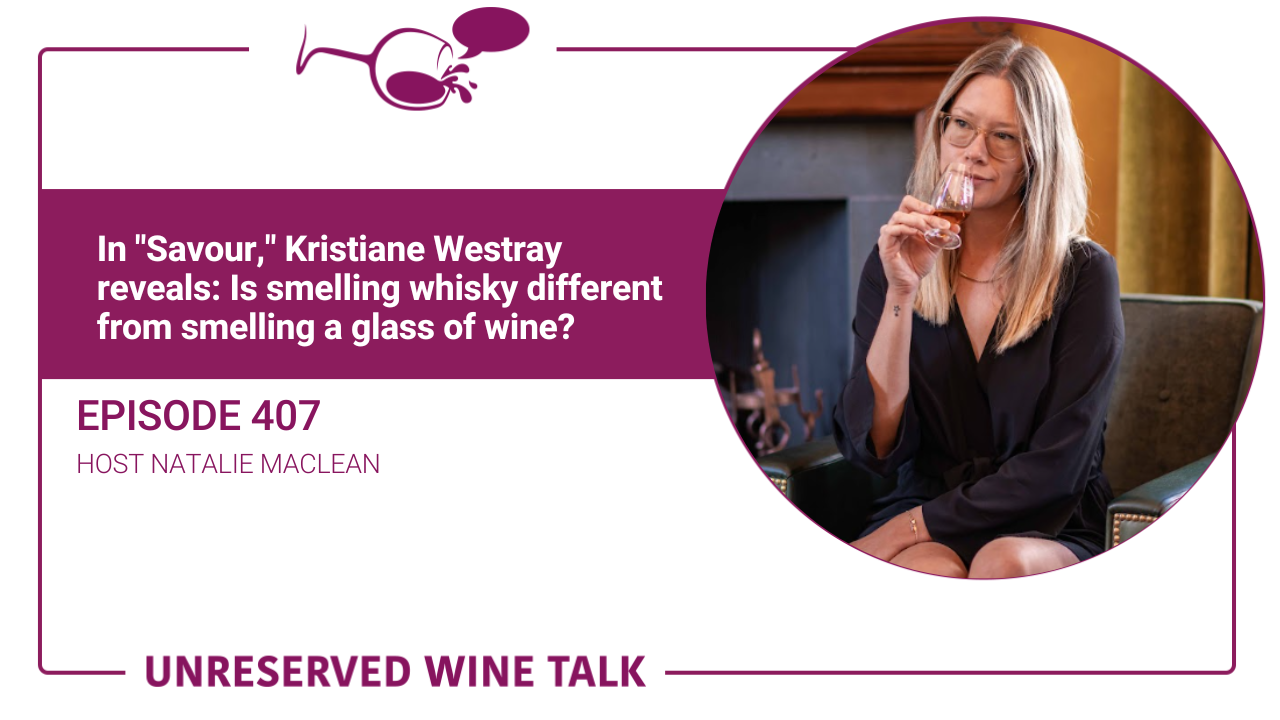
Is smelling or nosing whisky different from smelling a glass of wine? How did a 1960s marketing campaign convince generations of whisky drinkers that single malt was better than blended whisky? What is it like to step inside a working whisky kiln and experience peat smoke firsthand?
In this episode of the Unreserved Wine Talk podcast, I’m chatting with Kristiane Westray, author of Savour: A Guide To Tasting and Exploring Whiskies of the World.
You can find the wines we discussed here.
Giveaway
Three of you are going to win a copy of Kristiane Westray’s terrific book, Savour: A Guide To Tasting and Exploring Whiskies of the World.
How to Win
To qualify, all you have to do is email me at [email protected] and let me know that you’ve posted a review of the podcast.
It takes less than 30 seconds: On your phone, scroll to the bottom here, where the reviews are, and click on “Tap to Rate.”
After that, scroll down a tiny bit more and click on “Write a Review.” That’s it!
I’ll choose three people randomly from those who contact me.
Good luck!
Join me on Instagram, Facebook and YouTube Live Video
Join the live-stream video of this conversation on Wednesday at 7 pm eastern on Instagram Live Video, Facebook Live Video or YouTube Live Video.
I’ll be jumping into the comments as we watch it together so that I can answer your questions in real-time.
I want to hear from you! What’s your opinion of what we’re discussing? What takeaways or tips do you love most from this chat? What questions do you have that we didn’t answer?
Want to know when we go live?
Add this to your calendar:

Highlights
- What was it like stepping inside the smoky kiln at Bowmore and experiencing peated whisky production firsthand?
- Why did Kristiane write Savour for flavour lovers rather than whisky geeks?
- How did writing the book reinforce Kristiane’s belief that whisky needs to welcome new drinkers?
- How did Kristiane go from an aspiring fashion and beauty writer into a whisky obsessive?
- Why should you approach nosing whisky differently from nosing a glass of wine?
- How can the type of peat used in different regions create dramatically different aromas in whisky?
- Does the glass you drink whisky from really matter?
- How can exploring the landscape around a distillery deepen your understanding of its whisky?
- How does Kristiane challenge the lingering idea that whisky is primarily a drink for men?
- How did a 1960s marketing campaign help convince generations of drinkers that single malt was better than blended whisky?
- Do whisky drinkers worry too much about caramel colouring, small batch claims, and chill filtration?
Key Takeaways
- Is smelling or nosing whisky different from smelling a glass of wine?
- K: I think this is why a lot of people think they don’t like whisky because they nose whisky like they would a beer or wine. you forget that it’s like 40-plus ABV. compared to a quarter of that for wine. So I think of it as a bit like if you meet someone for the first time, you don’t run up and give them a hug straight off or I wouldn’t anyway. You might approach from afar. Shake their hand, say hello, whatever. And it’s the same with nosing a whisky. Don’t stick your nose right in the glass. Smell it from afar. Okay, see what it’s saying? See how loudly it’s shouting? And then, as you get a bit more familiar, then get closer.
- How did a 1960s marketing campaign convince generations of whisky drinkers that single malt was better than blended whisky?
- N: Was it a 1963 Glenfiddich marketing campaign that said you shouldn’t mix a single malt with anything, it should be just pure on its own.
- K: Yes. We marvel at how this ad campaign completely changed the industry on its head, and how now it feels like it’s coming back to bite it a little bit. in the 1960s. It was a William Grant and Sons director called Sandy, At that time, like today, but even more so, the vast majority of whiskies were blends. You would go to maybe like, you know, your famous houses, your Johnnie Walkers, you know, all of these styles of whiskys were being drunk predominantly at the time. Cutty Sark is a great example of a historical Scotch that’s a blend. Now, they were trying to position Glenfiddich as a single malt that was separate and better, and single malt being better than blends.
- What is it like to step inside a working whisky kiln and experience peat smoke firsthand?
- So you hear quite a bit about how peated whisky is made, but the vast majority is made at these great big industrial maltings. A handful of them still have their own ones. come into the Maltings. So we saw how you can, turn the floor malt,. But then, you go into the kiln and underneath you’ve got the fire. Luckily it wasn’t too intense, but you’re on this floor and it’s a bit like a sieve, so the smoke can come up beneath. And it was just one of the most evocative, sensory, fantastic and unique experiences of my life. like a very sweet bonfire. And I am gluten intolerant, but I just had to taste the barley around me. And I kind of was so excited I forgot. And then later that night, I was all bloated.
About Kristiane Westray
Kristiane Westray is a whisky communicator and author. Her first book Savour was published by Bloomsbury in October 2025. She has written about spirits since 2012, and her work has appeared in Whisky Magazine, The Malt Whisky Yearbook, The Times, Club Oenologique and many more. She is the former editor at The Spirits Business and led the content team at Master of Malt, where she trained as a WSET Spirits Educator. As a judge in the UK and US, she has tasted and assessed thousands of whiskies from around the world. An accomplished presenter, Kristiane has hosted numerous tastings, co-hosted live broadcasts, and appeared as a whisky expert on Channel 4’s Sunday Brunch. A passionate advocate for equity in whisky, her work on social media drives education and inclusivity with the vision that whisky is for everyone. Kristiane is based in Brighton, UK, where she lives with her girlfriend and a tiny ginger cat.
Resources
- Connect with Kristiane Westray
- Unreserved Wine Talk | Episode 331: How Do Oak and Yeast Magically Transform Wine and Whisky?
- My Books:
- Wine Witch on Fire: Rising from the Ashes of Divorce,Defamation, and Drinking Too Much
- Audiobook:
- Audible/Amazon in the following countries: Canada, US, UK, Australia (includes New Zealand), France (includes Belgium and Switzerland), Germany (includes Austria), Japan, and Brazil.
- Kobo (includes Chapters/Indigo), AudioBooks, Spotify, Google Play, Libro.fm, and other retailers here.
- Wine Witch on Fire Free Companion Guide for Book Clubs
- Audiobook:
- Unquenchable: A Tipsy Quest for the World’s Best Bargain Wines
- Red, White, and Drunk All Over: A Wine-Soaked Journey from Grape to Glass
- Wine Witch on Fire: Rising from the Ashes of Divorce,Defamation, and Drinking Too Much
- My new class, The 5 Wine & Food Pairing Mistakes That Can Ruin Your Dinner And How To Fix Them Forever
Tag Me on Social
Tag me on social media if you enjoyed the episode:
- @nataliemaclean and @natdecants on Facebook
- @nataliemaclean on Twitter
- @nataliemacleanwine on Instagram
- @nataliemaclean on LinkedIn
- Email Me at [email protected]
Thirsty for more?
- Sign up for my free online wine video class where I’ll walk you through The 5 Wine & Food Pairing Mistakes That Can Ruin Your Dinner (and how to fix them forever!)
- You’ll find my books here, including Unquenchable: A Tipsy Quest for the World’s Best Bargain Wines and Red, White and Drunk All Over: A Wine-Soaked Journey from Grape to Glass.
- The new audio edition of Red, White and Drunk All Over: A Wine-Soaked Journey from Grape to Glass is now available on Amazon.ca, Amazon.com and other country-specific Amazon sites; iTunes.ca, iTunes.com and other country-specific iTunes sites; Audible.ca and Audible.com.
Transcript
Natalie MacLean 00:00:00 Is smelling or nosing whiskey different from smelling a glass of wine? How did a 1960s marketing campaign convinced generations of whiskey drinkers that single malt was better than blended whiskey? And what is it like to step inside a working whiskey kiln and experience peat smoke firsthand? In today’s episode, you’ll hear the stories and tips that answer those questions in our chat with Christiane Westray, author of savor A Guide to Tasting and Exploring Whiskies of the world. By the end of our conversation, you’ll also discover why Christiane wrote savor for flavor lovers rather than for whiskey geeks. How writing the book reinforced Christian’s belief that whiskey needs to welcome new drinkers. How Christian went from being an aspiring fashion and beauty writer to a whiskey obsessive. How the type of peat used in different regions can create dramatically different aromas in whiskey. Whether the glass you drink whiskey from really matters. How exploring the landscape around a distillery can deepen your understanding of its whiskey. How Kristian challenges the lingering idea that whiskey is primarily a drink for men, and whether whiskey drinkers worry too much about caramel coloring, small batch claims and chill filtration.
Natalie MacLean 00:01:22 Those sound like things the cool kids say.
Natalie MacLean 00:01:31 Do you have a thirst to learn about wine? Do you love stories about wonderfully obsessive people, hauntingly beautiful places, and amusingly awkward social situations? Well, that’s the blend here on the Unreserved Wine Talk podcast. I’m your host, Natalie MacLean, and each week I share with you unfiltered conversations with celebrities in the wine world, as well as confessions from my own tipsy journey as I write my third book on this subject. I’m so glad you’re here. Now pass me that bottle, please, and let’s get started.
Natalie MacLean 00:02:14 All right. Welcome to episode 407. So what’s new in the drinks world? On September 8th, the US banned the import of Canadian alcohol starting on September 29th. The list covers malt beer, wine, cider, whiskey, vodka and other spirits. The US spirits lobby wants the shelves reopened on both sides of the border, as do we all Ontario craft wineries in Niagara on the Lake reports that only 1% of VQA bottled wines rely on the American market.
Natalie MacLean 00:02:45 Spirits Canada released a report showing that sales of American spirits have plummeted 66% across the country as consumers rally behind local craft options. Canadian spirits producers will be more hard hit, as a number of them rely on the US market for 30 to 40% of their sales. Meanwhile, the Alcohol and Gaming Commission of Ontario will now permit liquor vending machines in licensed establishments framed as another self-service option while keeping public safety and responsible service rules in place. I can just imagine pouring myself a glass of Guinness from the machine in the member’s lounge, and then walking over to the next machine and getting my Twinkies or whatever else is on the vending menu. Meanwhile, champagne producers in France just received emergency approval to raise alcohol levels to 15% from the traditional 13% cap due to record summer heat, accelerating the sugar accumulation in grapes and the smallest anticipated crop in decades. In other sparkling news, a Swiss dentist has just set a new world record for champagne bottles savored in one minute, blowing the tops off of 118 bottles in 60s. That’s roughly two bottles a second with a blade.
Natalie MacLean 00:04:10 Now I wonder if he’s just as fast at fillings. I certainly hope not. This week in fur, feathers and fermentation, fall in Sweden brings an influx of moose wandering into suburban backyards to binge eat rotting, fermented windfall apples scattered across lawns. The most famous incident occurred near Gothenburg, where a thoroughly plastered £1,000 female moose lost her footing while reaching for a high branch, becoming tangled and suspended in the resident’s apple tree with her legs dangling off the ground. Terrified neighbors had to call emergency services, prompting a team of police and firefighters to soar down the branches to safely slide the confused, hungover giant back to Earth, where she spent the night sleeping it off in the grass and a couple of weird but wonderful scientific facts. A new study published in the Journal of Applied and Environmental Microbiology showed that regional microbial imprints from vineyards persist throughout fermentation even when commercial yeast is inoculated, explaining why wines from different regions taste distinct despite similar winemaking techniques. Now, that sounds like I should be getting a subscription to Applied and Environmental Microbiology.
Natalie MacLean 00:05:30 Can’t miss out on those new fall trends and recent chemical studies on ethanol water solutions show that as alcohol warms up, its water and ethanol molecules rearrange themselves into chain like clusters that expose aromatic compounds directly to our taste receptors. When a drink is served, icy cold ethanol molecules hide inside protective cage structures formed by the water molecules, which explains why a warm pour of whiskey or wine hits your palate with a much sharper alcoholic punch than when it’s thoroughly chilled. And for your food and drink calendar this week, September 16th, has two occasions its Mexican Independence Day, the real one, not Cinco de Mayo. It goes back to 1810, when Father Miguel Hidalgo rang his church bell in the town of Dolores. He used it to call for independence. It’s also National Guacamole Day. Your excuse to thank the Aztecs who invented the dip back in the 16th century. September 17th is National Apple Dumpling Day. The dumpling goes back to colonial America. The whole spiced apple hugged in pastry and baked soft. September 18th carries two big ones.
Natalie MacLean 00:06:46 It’s International Grenache Day, always on the third Friday of September. Grenache is one of the most planted grapes on earth, thin skinned and sun loving, it’s the backbone of Chateauneuf de pap and the Garnacha behind Spain’s Preah Rat. It’s also National Cheeseburger Day. The origins are disputed, with claims from Pasadena, Colorado and Louisville all taking a piece of the story. One version credits a 16 year old fry cook, who reportedly added the cheese in 1924. September 19th is International Day. Her two friends invented it as a joke in 1995. Rum was the currency of the high seas, so celebrate September 20th is National Rum Punch Day. Doubling as National Pepperoni Pizza Day. The word punch likely comes from the Hindi panch, meaning five for the old template of spirit sugar, citrus, water and spice. April 21st shares three occasions its National Chai Day. Chai means tea Masala chai means mixed spice tea. And of course, I used to always say I’ll have a chai tea please. And chai enthusiasts would chide me for saying I want a t tea, please.
Natalie MacLean 00:08:03 It’s National Pecan or Pecan cookie. Day two. The pecan is one of the few major tree nuts that is native to North America. It’s also national beer lovers. De beer is one of the oldest prepared drinks in history, with evidence dating back to Mesopotamia around 3500 BCE. September 22nd is a big turn of the season. It’s the autumn equinox, the first day of fall when the sun crosses the celestial equator and day and night land at nearly equal length worldwide. It’s the unofficial handover from crisp whites and cozy reds. And just to be ornery about it, it’s also National White Wine Day. In other words, white wines aren’t going anywhere just because it’s the fall. And finally, it’s also National White Chocolate Day. White chocolate holds no cacao solids at all, so you get to cheat on regular chocolate. Back to today’s episode. Three of you will win a copy of Christian’s wonderful new book saver. If you’d like to win a copy, please email me and let me know you’d like to win.
Natalie MacLean 00:09:07 It doesn’t matter where you live, I’ll choose three winners randomly from those who contact me at Natalie at Natalie MacLean dot com. Keep them for yourself or give them as gifts. Congratulations to Lorrie Hood from Newmarket, Ontario and to Mike Hanlon from Keswick, who have each won a copy of Three Cheers cocktails, Three Ways Classics, riffs and zero proof sips. I love how that kind of rhymes, and if you’re reading the paperback or e-book or listening to the audiobook of my memoir wine, which on fire rising from the Ashes of Divorce, defamation and Drinking Too Much, a national bestseller on one of Amazon’s best books of the year, despite its really dreary title. Beginning with Dee Dee Dee, I’d love to hear from you at Natalie at Natalie MacLean dot com. There’s a terrific free guide for book clubs. I’ll put a link in the show notes to all retailers worldwide at Natalie MacLean. Forward slash 407. Okay, on with the show. Cristiano Westray is a.
Natalie MacLean 00:10:09 Whiskey communicator.
Natalie MacLean 00:10:10 And author.
Natalie MacLean 00:10:11 Her first book.
Natalie MacLean 00:10:12 Savor, was published.
Natalie MacLean 00:10:13 By Bloomsbury.
Natalie MacLean 00:10:14 In October 2025, and she has written about spirits since 2012. Her work has appeared in Whisky Magazine, The Malt Whisky Yearbook, The Times Club, oenology and many more, and this year she was shortlisted as the Fortnum and Mason Drinks Writer of the year, which is an extremely prestigious award. She is the former editor of The Spirits Business, and led the content team at Master of Malt, where she trained as a W spirits educator, as a judge in the UK and the US. She has tasted and assessed thousands of whiskies from around the world. An accomplished presenter, Christiana has hosted numerous tastings and co-hosted live broadcasts, and appeared as a whisky expert on Channel Four’s Sunday Brunch, which I believe is the BBC. A passionate advocate. We’re over here in Canada, Christiana. So I just have to clarify that. A passionate advocate for equity in whisky. Her work on social media drives education and inclusivity with a vision that whisky is for everyone. And I’ll drink to that.
Natalie MacLean 00:11:18 And she joins us now from her home in Brighton, England. Welcome, Christiana. So glad to have you here with us.
Kristiane Westray 00:11:25 Oh my goodness. Thank you so much for having me. It’s such a joy to chat with you today.
Natalie MacLean 00:11:29 All right. Pleasure’s all ours. And I’ve been given permission to call you Christy, if that’s okay with you.
Kristiane Westray 00:11:36 Yeah, absolutely. Christiana. I love the name, but it’s such a confusing spelling, I think so my friends call me Christy. Thank you. Perfect.
Natalie MacLean 00:11:44 Okay, great. So before we dive into your book, Christy, let’s chat about some of your more memorable whiskey experiences, starting with your girlfriend. Share with us what you did on your second date. That was whiskey related.
Kristiane Westray 00:11:58 Oh my goodness. So I in some ways it’s a miracle that we’re still together now. So yeah, we she loves flavor and loves food and all of this stuff. So I figured it was probably okay. But she came around and I got out like a PowerPoint presentation and took her through probably about 10 or 12 slides of whiskey.
Kristiane Westray 00:12:14 And I do think be authentic when you’re dating. I’m such a nerd. I’m such an enthusiast. It was so funny. I think she liked it. We’re still together now, four and a half years later, so let’s hope so.
Natalie MacLean 00:12:25 That’s great. That’s a unique strategy, a PowerPoint presentation. And at the end, did you open it up for Q&A as to how your relationship may proceed? Just kidding. That’s great I love it, I love it. Now tell us about the strangest whiskey experience you’ve had. You’ve been inside a kiln at the famous Bowmore distillery in Islay, which is in Scotland. Tell us about that. You were inside the kiln?
Kristiane Westray 00:12:48 Yeah. Oh my goodness. So you hear quite a bit about how like, peated whisky is made, but the vast majority is made at these like great big kind of industrial maltings. A handful of them still have their own ones. And we were there on a tour like just before dinner, and they were like, come into the Maltings.
Kristiane Westray 00:13:02 So we saw how you can turn the floor malt, which is like a whole cool separate thing. But then, yeah, you go into like the kill and so underneath you’ve got the fire. Luckily it wasn’t too intense, but you’re on this floor and it’s a bit like a sieve, so the smoke can come up beneath. And it was just one of the most evocative, sensory, just fantastic and unique experiences of my life. Like, it smelt incredible. A bit like a very sweet bonfire. And I am gluten intolerant, but I just had to taste the barley around me and I was so excited I forgot. And then later that night I was all bloated and I said, I haven’t eaten wheat. And I was like, oh, it would be the barley.
Natalie MacLean 00:13:36 The barley from your gluten.
Kristiane Westray 00:13:38 It would be.
Natalie MacLean 00:13:38 The barley intolerance. Wow. Wow. So that must have been so beautiful. It must have been, as you say, it smelled so evocatively. And what kind of aromas were you getting?
Kristiane Westray 00:13:47 I am one of these people who loves the smell of the roadworks and kerosene, and it wasn’t this heavy or industrial as that, but they definitely was that.
Kristiane Westray 00:13:55 And then there was still kind of the organic smoke as well. And we were right by the water, and bone was just through right on the coast. So there was almost like a minerality, like a salinity to it, to it. It was just so gorgeous. And yeah, it was like in my hair for days afterwards, which I’m not complaining about. It was like a douse myself in this amazingly phenolic perfume.
Natalie MacLean 00:14:15 That’s right. What’s that you’re wearing? Oh, it’s.
Kristiane Westray 00:14:18 Oh, it’s Bowmore smoke.
Natalie MacLean 00:14:21 All right, so let’s get to your book saver. Tell us in a nutshell what the book is about. What makes it different, say, from other books about whisky?
Kristiane Westray 00:14:29 Yeah. Of course. So when I started writing Sabre, I really had a sense that it wasn’t really a whisky book out there. That was for people who loved flavour, but weren’t necessarily already into whisky or whisky geeks. And I had a lot of my friends in mind who don’t like in the industry. They love finding new restaurants.
Kristiane Westray 00:14:45 They love things like natural wine, they love craft beer, speciality coffee, all of these things. So I wanted to put together a more lifestyle book. It’s got illustrations, not photographs. And for me it’s about pickling flavor first and taking whisky kind of off the pedestal. We sometimes put it on and just make it something that’s fun. It’s something to be discovered and savoured ultimately.
Natalie MacLean 00:15:08 Yes, you certainly accomplished that in your book. As I said, it’s wonderful. Now, what’s the most surprising insight you discovered while writing the book?
Kristiane Westray 00:15:16 Do you know what one of the biggest challenges was? I started writing out. I think it would have been, yeah, it was during the summer of 2014, and I’d done various research trips and gotten to see people and agreed with my editor that who I was going to put in there and all of this. And one of the hardest things was hearing about a lot of distillery closures at the time, which is not a very optimistic note to start on, but having to go back in the editing stage and put these notes in that these distilleries are close.
Kristiane Westray 00:15:43 The one front of mind was Waterford in Ireland. Obviously that has now been bought out. And it was interesting putting this book together at a time where the industry was struggling and in many ways still is, but that made it a bit more urgent to me. Like we need to bring in new drinkers, right? We need to say that this is a spirit for everyone. You don’t have to be a whiskey nerd if you’re into all these other spirits and you love flavour, come and join in the whisky party. I guess it kind of made the purpose of it a bit more. It brought it to the forefront for me. I’m glad to say that. Yeah, some of them that seemed to be in trouble have now come out the other side as well. There was a whole thing a little while back about a big investment group pulling out of quite a few of distilleries in the book, but yeah, they seem to be finding a new way forward, which is really good to see.
Natalie MacLean 00:16:27 That’s encouraging.
Natalie MacLean 00:16:28 Now we write about working through the fogs of imposter syndrome and writer’s block in your acknowledgements. Yes, describe your lowest point of writing the book and what got you back to the keyboard or to that finish line.
Kristiane Westray 00:16:41 I think I don’t know if you have this. I feel like a lot of writers and creatives will maybe relate. Well, you almost have a sense of biting off more than you can chew, and you’re sitting there at your laptop and you’ve spoken to all these amazing people and you’ve done these interviews, you’ve been to the distilleries, you’ve tasted the whiskeys or in the process of tasting them and you’re like, oh my goodness, how do I put this together? And you forget that, you know, this stuff, or you feel a bit in awe of everyone else and you play the comparison game. I don’t know if this is particularly as what I would say as a woman in whiskey, where there’s not that many of us and other marginalized groups, obviously, in whiskey are also underrepresented, and you end up comparing yourself to other people.
Kristiane Westray 00:17:21 And I think that’s a really it’s not a very positive game to play, because we all have our own voices. We all have our own message and our things to say. And I think reminding myself to stay in my lane and finding that voice was a really important thing. And I also think having a deadline is very motivational.
Natalie MacLean 00:17:36 It certainly is. Yes. Absolutely no. Deadlines help. It’s I just find with a lot of things because we’re creatives. Do you bite off? You get excited about new ideas and concepts with that finishing energy that last 20%, it’s like, oh, I just want to go on to the next thing before I do this one. But good for you for finishing it. Yeah.
Kristiane Westray 00:17:56 And there’s that thing as well. Where how do you know when you’re done? Because similar to like wanting to update with all these distilleries, it’s like, oh but what about that. What about that. This thing I’ve just discovered, and I think one of the most exciting things about whiskey, which I’m sure will pick up on later on, is that you never stop learning.
Kristiane Westray 00:18:11 Maybe a new release comes out or you have a completely unrelated interview and it’s like, can I just pull that back to edit? And then your editor’s like, no. Yeah. So yeah.
Natalie MacLean 00:18:20 I know if it were back in the the, I don’t know, 50 years ago and you could chase after the van that was taking the manuscript away, I’d be running down the street. Yes. One more edit. Okay, so you began as a young journalist in fashion and beauty, and your editor at the time sent you to Sweden to cover the Cinderella Viking Line Whiskey Fair. What was the moment? Was it during that trip, or somewhere around that time that you became fascinated with whiskey?
Kristiane Westray 00:18:47 It was literally on that trip on that boat and it’s really ridiculous. It was a travel retail magazine. And yeah, I wanted to get into fashion and beauty writing. I had written for a magazine called glass a bit before that, and travel retail seemed to me to be. If you think about the fancy shops in an airport to cover those products and see what’s coming up, it was like where I it seemed like a good place to be.
Kristiane Westray 00:19:07 I was 24 and trying to figure out the next thing for me, and then my editor was like, you need to go and cover this whiskey event. And I was like, oh, it’s going to be like full of drunk men, which it was. There’s more to say on that. And I was like, it’s just not for me. I don’t want to be on a boat. It was this kind of overnight thing. You start from Stockholm, go around the island islands to get your tax free benefit. And I was like, you couldn’t pay me to go. He was like, I literally pay your salary, so you have to go there a sponsor, get over it. So off I went and I have to say it was so surprising for so many reasons. People in whiskey are so generous with their time and knowledge they take you on the journey. I just discovered that whiskey is, first of all, full of incredible stories and amazing people. And secondly, the first time I properly noted a whiskey.
Kristiane Westray 00:19:53 Not when you’re like 1718, I haven’t. Whiskey wasn’t my drink of choice. Legal drinking age is 18 here, by the way. Okay, and you’re maybe in a field with your friends. Are you doing all these silly things with whatever. But yeah, I was like, wow. I feel like there’s so many parallels with fragrances here. I can smell, I don’t know, I remember one particular whiskey that was like mossy and dried citrus peels, and it was so layered and intricate, and then whiskey didn’t taste anything like I thought it would taste like. For one, it wasn’t this horrible burning thing. There was like layers and layers of flavors that you could discover, like food or like wine. And I was just obsessed after that point. And I got back and my editor was like, you changed. And then I went on every single trip I could and in every tasting I could in every interview I could. So yeah, here we are. What is that? This is 14 years later.
Natalie MacLean 00:20:41 Yeah, you definitely got the whiskey bug. So you mentioned learning how to nose properly for those who aren’t like our audiences. Has a lot of wine drinkers. Is it similar nosing whiskey to smelling wine, getting your nose right in there? Or what are the differences in similarities?
Kristiane Westray 00:20:59 So I actually think this is why a lot of people think they don’t like whiskey because they taste whiskey or nose whiskey like they would a beer or wine. Okay. And you forget that it’s 40 plus ABV if you’re thinking about wine. I’m terrible at maths, but even if it’s 12% ABV, that’s like almost a quarter of it. And beer?
Natalie MacLean 00:21:17 Yeah. Alcohol?
Kristiane Westray 00:21:18 Yeah. Lower again? Yeah. So I think of it as a bit like if you meet someone for the first time, you don’t run up and give them a hug straight off the bat, or I wouldn’t anyway, you might like approach from afar. Shake their hand, say hello, whatever. And it’s the same with nosing a whiskey. Don’t stick your nose right in the glass.
Kristiane Westray 00:21:33 Smell it from afar. See what it’s saying. See how loudly it’s shouting. And then as you get a bit more familiar, then get closer. Otherwise, I feel like with tasting with anything, it’s about trying to hack your own sensory system to almost get around the alcohol in a way. And with whiskey, that’s quite the task. But you can. And I think, yeah, starting super slow and some super peated whiskies. My whisky collection is just over there. So every time I look at them I’m like, oh yeah, that one. Yeah, some of the super peated ones. If the cork was opened over there, I could smell it from here. Right. You don’t need to go straight in straight away to get all the stuff out of it.
Natalie MacLean 00:22:06 Okay. And what do you mean by super peated? Like, again, for those who are not familiar.
Kristiane Westray 00:22:11 Of course. So peated whiskies are the ones that they’re made, like we were describing at Bowmore in a kiln. They’ll be burning the peat under it.
Kristiane Westray 00:22:18 All the smoke comes up into this almost like sieve like layer, and the phenols and smoke from that fire cling to the grains the whole way through. So you get this, like amazing, almost like smoky, earthy profile. Yeah. And peat comes in so many different styles as well. And it’s not always heavily pitted. And so it’s basically decomposed organic material. I think the technical term would be. And it’s literally dug out of the ground. And there’s a whole discussion around that about how horribly. Environmentally friendly it is. So yeah, that’s a whole nother discussion.
Natalie MacLean 00:22:49 Removing it from the natural. Bogs or wherever?
Kristiane Westray 00:22:52 Absolutely. Yeah, yeah. Peat bogs are like a natural carbon sink, similar to trees that absorb carbon and hold on to it. And when you cut it, not even burning it, just cutting it releases so much peat into the atmosphere. I think cutting peat in Scotland for whisky. I’ll fact check this if it’s not correct, but I wrote out last year it accounts for some 4% of the UK’s greenhouse gas emissions.
Kristiane Westray 00:23:14 Oh my goodness. And that’s I know. Yeah. And I think I was chatting with a friend literally today about how the industry needs to start seriously looking at this and finding there are the ways to get that flavour. Yeah, let’s start doing that.
Natalie MacLean 00:23:27 Yeah, absolutely. And you described whiskies that tasted like the description from your book is marvellous. Marmalade on toast with oak moss. Others, like iodine and roadworks. You’ve mentioned. Yes. And you compare the experience to reading the most captivating novel and discovering all these new characters in the most immersive parallel universe. Was there one whiskey that stood out among them all?
Kristiane Westray 00:23:50 Oh, I mean, there would be so many. But if I go back to that trip back in 2012, I was a guest of at the time, it was called Maximum Travel Retail, which is basically Edrington being Suntory or Suntory Global Spirits. Now the industry changes, but one of the whiskies that the team represented was Highland Park, and that’s such a captivating distillery. It’s up on the Orkney Islands.
Kristiane Westray 00:24:11 There’s a whole thing there about its own peat, so because it’s so windy you don’t get that many trees growing. So the nature of that, that decomposed matter is all like basically heather and shrubs and all of this. So when you burn that peat, it’s much more floral than maybe you’d have some aroma on either. And for me, smelling that and having a much lighter, almost like incense, aromatic peat, smoke that really stood out. And I thought, yeah, this is a distillery that’s going to be like a protagonist in my whiskey journey. And it has been, and it’s always fun to get to check in with those old friends and see what they’re doing. And yeah, check out.
Natalie MacLean 00:24:47 I’m motivated now to taste that my Scottish heritage, but I’ve just never got on to whisky as much as my ancestors did.
Multiple Speakers4 00:24:56 I was going to say McLean is such a Scottish surname. Do you know where.
Kristiane Westray 00:24:59 Your ancestors were from in.
Multiple Speakers4 00:25:01 Scotland?
Natalie MacLean 00:25:01 Yeah, from the Hebrides and the outer Islands.
Natalie MacLean 00:25:04 And my mother’s maiden name was a McDonald. So it’s Scottish all the way back except for Brophy. Irish. So that’s whisky as well.
Kristiane Westray 00:25:12 Well, I guess we need to arrange a trip and we need to go whisky tasting. It’s going to be so fun.
Multiple Speakers4 00:25:16 Absolutely.
Natalie MacLean 00:25:18 Now, the ferry also that you were on this trip over to Sweden hosted a Eurovision esque disco once the car deck closed for business. What happened then?
Multiple Speakers4 00:25:30 So I’ll give it.
Kristiane Westray 00:25:30 A bit of context, because otherwise this sounds even more bonkers than it was. So basically the ferry boat that we were on, they turn where you’d normally drive your cars onto it to take you across the Baltic Sea. That was like the consumer whisky event. So you could buy a ticket, go and taste all your whiskeys from different brands on the car deck. Once that closed, you have your dinner or whatever. And then there’s ridiculous disco, which was like nothing I had ever seen. Let it be known that I’m a proper pop girly.
Kristiane Westray 00:25:58 I love the classics, I will dance and yeah, you go upstairs and it’s the 80s 90s classics. And then, yeah, all these very stereotypical whiskey men were trying to break down stereotypes. But what you would imagine as a European whiskey drinker in his maybe 50 or 60s bopping like his life depended on it, flashing disco lights, things like Madonna, things like the Spice Girls. And I was like, maybe whiskey isn’t so bad after all. Maybe I can find a bit of myself here.
Natalie MacLean 00:26:29 They can loosen up a little bit. So your W set spirits education training came through. A gentleman named Nick King whom you thank in the acknowledgement share. One specific thing that Nick taught you that changed the way you taste whiskey.
Kristiane Westray 00:26:44 Now, Nick literally taught me pretty much everything I know. I don’t believe he works now. He’s doing like, all kinds of other interesting things. But the thing that I really took away and that I think about almost every single day, I quite often write tasting notes for clients, is about how tasting notes aren’t meant to be this highfalutin crazy, really, I don’t know, pompous thing.
Kristiane Westray 00:27:07 Tasting notes are meant to be understood by somebody, and I feel like that really got drilled into me. And you have to think about your audience and who you’re writing for when you’re writing tasting notes. So if you’re writing tasting notes for, I don’t know, literally like a box or a whiskey retailer, you’ve got to keep it simple. There’s no point in me talking about my grandmother’s perfume, Because if somebody is logging on who’s never met me and never knows me. How do they know what my grandmother’s perfume smells like? If I say something like roses? Maybe they would know that. And I think sometimes as writers, it’s tempting to go really flowery, really verbose. And actually, for tasting notes especially, we’re trying to communicate the experience of drinking a whiskey. The aromas, the flavors, the textures. And it’s not really about us and our writing style. It’s about getting the character of this amazing liquid across in the most effective way possible. So fewer words are better words.
Natalie MacLean 00:28:01 Yeah, that’s a challenge in wine as well.
Natalie MacLean 00:28:03 I’m sure it depends on the whiskey and the blend and everything else. But is there a classic or best glass for a lot of whiskeys that you tend to use?
Kristiane Westray 00:28:12 So I think it depends on what and why you’re drinking. If you’ve just got a whiskey at home and you want to enjoy it, I do not care what glass you use. Literally. I think sometimes we get really caught up in not having a proper tasting glass or oh no, I don’t have a tumbler or I don’t have what you’d call a Glencairn or an ISO glass. As long as you’re enjoying that whiskey, your friends have come around, you’ve got out the glassware. I literally don’t care. However, if you want to nose and taste and as we said earlier, hack your own olfactory system a bit. You’ll want a glass that’s tapered a bit at the top. So yeah, the sort of very standard ISO glasses. You’ll often see cairn glasses again, they’ve got that tulip shape if you don’t have them. Champagne flutes work just as well.
Kristiane Westray 00:28:57 We don’t have to be like fancy or ridiculous about this. And that’s yeah, that’s one of the things that I really want savour to be about is we put whiskey on a pedestal, we try and gatekeeper all the time. We don’t have the proper glassware or single malt, sir. The only the only proper whiskey to drink. I’m like, no, you’re enjoying it. I don’t care what you’re drinking out of.
Natalie MacLean 00:29:15 Good. Licensed to chill there.
Kristiane Westray 00:29:18 Okay, I love it. Licensed to chill. Exactly.
Natalie MacLean 00:29:22 And what’s your top tip? If you’re visiting a distillery, especially one that’s in a rural setting.
Kristiane Westray 00:29:27 What I love to do. I feel like whiskey distilleries are just the epitome of hospitality these days. You’ll have amazing tour guides. They you have so many opportunities to ask questions and tastes. It’s amazing what I love to do and what I think gives you such like a a real overview of the sense of place and I guess the history and maybe the culture that’s really informed a lot of this whiskey making is to get out around the distillery, particularly like out on the Hebridean islands or in rural places.
Kristiane Westray 00:29:54 I love to go for a run if I can, if I’m staying over there like one morning, do a little five k loop 10-K at this time, just get out and see maybe the water source for the distillery or like the mountains surrounding it, like we said about Highland Park and Orkney, that there are no trees. What does that feel like? I love that none of these distilleries are ever the same, and I think the landscape around them. It sounds like some people would argue that terroir doesn’t exist in whisky. I really think it does. And I also think, like the philosophy of the whisky maker is almost like an ingredient we don’t talk about and so much of that is informed by the locale as well. So yeah, get out and see what’s going on.
Natalie MacLean 00:30:30 Yeah, that’s a great advice too. If you’re visiting a winery, the these are drinks of place. And the more you can implant the place into your memory, your sense memory as well, the more you’re going to remember everything about it now.
Natalie MacLean 00:30:43 Good advice. Now you call the old narrative that whiskey is for boardroom boardrooms, hotel suites and strip clubs. You call it out. Tell us about maybe the most galling moment you’ve ever experienced in the industry and has have things changed?
Kristiane Westray 00:31:00 In short, yes, I think my are getting better. And I think particularly within the industry, they’re getting better. I think a lot of the time it might be like at an event with consumers or punters. That’s where you find some of these lingering attitudes. Although, having said that, almost every time I get a taxi somewhere and you just have a chat and I’m asked, what, what do you do? And I’m like a whiskey writer. Oh, do you actually like whiskey? I’m like.
Natalie MacLean 00:31:24 Yes, you’re a woman.
Kristiane Westray 00:31:26 Okay, because I’m a woman. Oh.
Natalie MacLean 00:31:28 But very dainty of, you.
Kristiane Westray 00:31:30 Know, not very dainty at all. But actually something I will share, which was, like, quite personal to me and was actually at an industry event.
Kristiane Westray 00:31:39 And I think this shows how far we’ve got to go as a drinks industry, not just the whiskey industry. I’ll say the event. I won’t say the person in question, but I was at the IWC Awards a few years ago and I had been shortlisted for Drinks Writer of the year, and it was really exciting. And you’re often invited with a plus one. So I brought Ro, my partner, and it’s an industry that’s not always used to a lot of queer visibility, and I hadn’t one that was completely fine. At the end of the night, though, this fairly prominent older gentleman, I guess maybe in his 50s or 60s, came over to me and row and didn’t say anything. Congratulations on being shortlisted. Anything like this. What he said was, oh, it’s such a pleasure to see you together. Bit in a bit of a way. You can tell when someone’s being a bit creepy. Yeah. And ro, because she is like this and I love this about her, was like, what do you mean by that? Would you say this to two men who were here? And he was like, no, I mean, it’s like for me personally, it’s very visually appealing to see two women.
Kristiane Westray 00:32:41 And I was like, this is gross and weird and creepy. And basically we ended up having to do like a whole load of education to this man who really should know better. And I do think that is something that I’ve learned with age as I’ve got older, particularly in settings like that, where you do feel physically safe is actually asking people what they mean is a really good way to hold a mirror up to these biases. Like when someone is like, oh, I’m really surprised that you’re a woman in whiskey. I’m like, what do you mean by that? Or where is that coming from? And I’ve had it on a cool as well, where someone’s made quite a sexist joke. This is when I worked in house somewhere very senior and being like, I don’t get the joke. Can you explain it to me so I don’t know.
Natalie MacLean 00:33:25 For them to self-reflect. Yeah. Rather than telling them which they wouldn’t listen to anyway, but to try to get them to go inside and think what it is they’re saying.
Kristiane Westray 00:33:34 Yeah, exactly. Yeah, for the most part, yeah. I do think it’s got by that. I do hear stories from younger women in the industry, I would say on a fortnightly or monthly basis where they’ve experienced like a best harassment, sometimes assault. Still it happens. Yeah. But yeah, I do think it is getting better. We just need to keep having these conversations, I think, and just keep raising awareness.
Natalie MacLean 00:33:54 Yeah, absolutely. Now your book saver is celebrated as the first mainstream whisky book to be written by a woman in the UK. And you write that whiskey is for drinking, not dissecting. Tell us about. Have you had an encounter with a whiskey snob or nerd? And did you correct them? How did you handle it? What happened?
Kristiane Westray 00:34:14 I mean, I think we’re coming back at things with humor is always a really good way to dissect things, and I think whiskey snobbery as well. I think that is something that isn’t directed at me. It’s not like a personal thing, it’s just attitudes that people hold.
Kristiane Westray 00:34:31 So quite often at tastings it will be like, oh, but this is a bland. I don’t like blends or whatever. And again, it’s not. Why don’t we taste it? Why don’t we have a think about it. Like where is this coming from? And I just think that a lot of the time at tastings as well, people, it’s quite handy for people to not know what they’re tasting until after they taste it, let’s put it that way. And something that I really love. There’s so many, like, little tiny things that it’s almost not worth getting to specifics. And it’s always around if I’m drinking like a whiskey cocktail. Oh, you shouldn’t mix single malt. Says who? This is really nice. You’re missing out. If you don’t want to have an Old Fashioned with a single malt. I know it’s like American whiskey just giving people permission to mix up. And I think having the attitude of you’re missing out if you sit ingrained in these kind of like mindsets is a really good way of like countering it as well.
Natalie MacLean 00:35:23 Absolutely. That’s a great way to handle it. Now, you touched on it. So was it a 1963 Glenfiddich ad or marketing campaign that said, yeah, shouldn’t mix a single malt with anything. It should be just pure on its own.
Kristiane Westray 00:35:36 Yes. And you know what? I talk about this, I would say pretty regularly with friends in the industry, and we marvel at how this ad campaign completely changed the industry on its head, and how now it feels like it’s coming back to bite it a little bit. So basically, the story goes, it was in the 1960s. It was a William Grant and sons director called Sandy, who there’s a whiskey called House of Hazelwood called The Accelerator and the break. If anyone’s familiar with that or some homework, go Google that. He was the break in this set up. One brother super like, ambitious and adventurous one that was always like raining people. Like, don’t spend that money. All of this together. They were a formidable team. And as a result, we ended up with this ad campaign that we’re still talking about now.
Kristiane Westray 00:36:17 So that’s a bit of a backstory. So basically at that time, the vast majority of whiskies were blends you would go to, maybe your famous grouses, your Johnnie Walkers. All of these styles of whiskies were being drunk predominantly at the time. Cutty Sark is a great example of a historical Scotch. That’s a blend. Now, they were trying to position Glenfiddich as a single malt that was separate and better, and single malt being better than blends. And it was this kind of marketing campaign that really kicked off, I guess mostly in like the 80s and 90s this other people following suit and being like, actually, yeah, single malts are more prestigious. Single malts are what you should be drinking and you should be seen to be drinking. Despite all of that, today the vast majority of Scotch was exported. Maybe like depending on how you speak, to 70, 75, 80%, if you include bulk stuff, which that’s a whole nother conversation really. They are still blends, but we have this attitude that single malt is the best thing to drink and that again, it overlooks super high quality blends.
Kristiane Westray 00:37:19 It overlooks single grains, blended grains, all these other things. And what about world whiskies that are coming live with some single malts and things like Bourbons, ryes, all these other delicious things? And yeah, if we’re going to bring more people into whisky, we need to say it isn’t just about single malt, because that’s one category. And of course, there’s a vast flavor spectrum within single malt. But imagine that replicated with all these other whisky styles.
Natalie MacLean 00:37:42 Sure, sure. It reminds me a little bit about vintage champagne being better than non vintage, whereas non vintage is sometimes the hardest to get right because it’s the house signature that should stay consistent year after year, even though the weather is all over the map. It’s an assumption that isn’t always proven.
Kristiane Westray 00:38:00 Yeah, and that’s so interesting. And I think a thing with single malt to remember as well, probably similar to the example you’ve just given with champagne, is if you think about something like, I don’t know, Laphroaig ten, Highland Park 12.
Kristiane Westray 00:38:11 All these whiskies, single malts, one distillery, all of this. But they’ll still be blended from multiple casks. There’s still the art of combining different casks, different barrels to create something that is consistent. It’s not. Unless your whisky is labelled single cask, you’re going to have blending going on somewhere in there, even if it isn’t malt and grey. And there’s still the art of the whisky maker gone into that.
Natalie MacLean 00:38:32 That is very true. Now about caramel or caramel colouring in whisky. You right? It really isn’t a big deal despite the chatter in the whisky circles. Tell us what it is like. What creates it? Is it just from the oak and why people are so fussy or fussed up about it?
Kristiane Westray 00:38:48 Yeah, it’s a really interesting debate. So what is caramel color? Caramel color? Is this additive that a lot of whisky makers use to create a consistent look across batches? Now, Lagavulin 16 year old absolutely iconic whisky that has the tiniest amount imperceptible to the nose or palate of caramel color going in there because you want, if you buy it in January, buy another bottle in July, buy one, maybe three years later, you want it to look the same, and when you use it appropriately, it literally is.
Kristiane Westray 00:39:18 You want to, as we say, blend. Combine these barrels for aroma consistency, flavor, consistency. If they didn’t look the same, we’d all be really confused. Now there is a certain type of whisky geek, which I say with some love because I consider myself a whisky geek who thinks that natural colored whiskies are better than anything that’s got color added. And I’m like, no, that’s just one way of presenting whisky. It’s not better. It’s just a production choice. And that’s what I mean by that. I think you can have amazing whiskies that have color added, you can have amazing whiskies and natural color. Don’t worry about it at all.
Natalie MacLean 00:39:55 Okay, great. And then another misconstrued term is small batch, which you say is a meaningless term that has no legal definition anywhere. So what should be used instead, if any term?
Kristiane Westray 00:40:08 Well, I kind of I don’t hate the term, The thing that I hate about it is that it’s very rare that anyone quantifies what that means. So, for example, I’ve seen small batch whiskies that are literally five casks battered together.
Kristiane Westray 00:40:24 That is like genuine small batch. You could say the same for maybe 500 casks for a bigger brand when you’re getting into the thousands. That doesn’t mean that whiskey’s bad at all, and it’s definitely still a batch. But is it a small batch? I don’t know. I think it’s more about transparency for me. I just want to know, especially if you’re positioning it as a premium product because it’s small batch. It’s like, what do you mean? I want to understand why this is seen as like better or otherwise. I don’t know, I think it’s just misleading. And it’s crazy to me that, yeah, no one’s tried to codify that anywhere. Yeah.
Natalie MacLean 00:40:59 That’s interesting.
Kristiane Westray 00:41:00 I don’t know it.
Natalie MacLean 00:41:00 Yeah. No, it’s true. The word reserve in wine, it has legal definitions in some European countries, but in North America it doesn’t. And you can get very large producers putting reserve or seller selection or whatever on the labels they want. So again, more parallels with the wine world.
Kristiane Westray 00:41:18 That’s so interesting. Does anyone ever get upset that producers across the Atlantic from here can use reserve? I’m sure like.
Natalie MacLean 00:41:25 I’m sure they do. I just don’t think they know what to do about it, because we don’t have as many laws in North America as they do in European producing countries. So it’s more of a marketing thing, and they’re going to use it if they can. Not all, but some definitely do.
Kristiane Westray 00:41:41 That’s so interesting. I remember once I was working at spirits business, so it must have been maybe like, I don’t know how many years ago, maybe ten. I think he was the CMO at the time of Johnnie Walker, described Johnnie Walker as the world’s biggest craft brand and similar to like, Small Batch. The word craft just is meaningless. And I think it was in an investor call where everyone was like, what? And again, I love Johnnie Walker. I love Johnny Walker, Black Label especially like it’s a good whiskey, but is it craft?
Natalie MacLean 00:42:09 Craft? Yeah.
Natalie MacLean 00:42:10 Biggest croft. Yeah. Whiskey. It’s like jumbo shrimp or something, I don’t know. Bit of an oxymoron, but another term. Interesting. Chill filtration isn’t the big drama you write that people believe it is. What is chill filtration? Why has it become popular?
Kristiane Westray 00:42:28 Yeah, this is another interesting thing. And again, there’s a big debate about this in again, whiskey geek circles. And some people will vehemently advocate that non filtered whiskeys are so much better than chill filtered whiskeys. I’m like babe, chill out, they’re both fine. Get over it. It’s basically a production thing. A lot of people, particularly if your whiskey is bottled under 46% ABV, they’ll chill, filter it so that you basically filter out some of the sort of fatty compounds so that when it gets cold, these compounds don’t come out of suspension and go cloudy. Because basically what would happen is particularly in transit, something like what’s a 40% ABV in my eyeline, I don’t know Glenfiddich. Actually, that is 43. I can’t see it anyway.
Kristiane Westray 00:43:12 A very delicious whisky that’s under 46%. There are very many of them. It goes on a ship or in a container gets cold. Whisky goes cloudy. I see it on the shelf in the supermarket and I’m like, what’s up with that? Nothing. It’s fine. But yeah. So you chill field trip to take those compounds out so it doesn’t go cloudy. Some people argue that affects the texture or it’s like been meddled with in some way. That means it’s not whisky in its purest form. That is true, I guess. You’ve taken something out of it. But does it mean it’s a bad whisky? Absolutely not.
Natalie MacLean 00:43:45 No. Again, another parallel, if I may, with wine.
Kristiane Westray 00:43:49 Oh, I love it.
Natalie MacLean 00:43:50 I’ll keep dragging it back to wine here.
Kristiane Westray 00:43:52 But please, I’m learning so much.
Natalie MacLean 00:43:54 Vice versa. So wine? That’s not cold stabilized. I chill filtered, but we call it cold stabilized. What happens is if it gets cold on shipping or in any point of its on its route to you, it can form tar traits which look like almost like glass shards along the edge of the bottle, especially at the neck.
Natalie MacLean 00:44:14 And people think, oh my gosh, is this dangerous? Does it make the wine taste different? It’s nothing. It’s completely benign. But people get really they return a lot of wines that are showing these tar traits, and it’s simply because the wine wasn’t cold stabilized, but they’re completely natural. And in some cases, the less intervention with some wines, they weren’t filtered, they weren’t fine, they weren’t cold stabilized. They’re just trying to be a little bit more natural, although that has a whole other definition. They’re trying to actually preserve the character. But people think, oh, this must be a fault. I’m seeing all these these little shards, these glass shards in my bottle.
Kristiane Westray 00:44:49 Yeah. No, it sounds so similar. And I think by chill filtering or indeed adding caramel color, for me, it’s a way of making whiskey more accessible because you don’t have to know that this stuff is okay to enjoy it. You don’t have to worry about it. It doesn’t even cross your mind, so it doesn’t require a certain amount of Education as like a ticket to enter.
Kristiane Westray 00:45:08 You don’t have to pass an exam to know this. So yeah, I feel really strongly that we are worrying way too much about these things.
Natalie MacLean 00:45:15 Absolutely.
Natalie MacLean 00:45:21 Well, there you have it.
Natalie MacLean 00:45:22 I hope you enjoyed.
Natalie MacLean 00:45:23 Our chat.
Natalie MacLean 00:45:24 With Christiane. Here are my takeaways. Is smelling or nosing whiskey different from smelling a glass of wine? And Christiane says, absolutely. A lot of people think they don’t like whiskey because they nose it as they would beer or wine. But you forget it’s 40 plus alcohol by volume, compared to just a quarter of that for wine. So she says it’s like meeting someone for the first time. You don’t run up and give them a hug straight off. Or most of us. Wouldn’t. You approach from afar? You shake their hand, you kind of keep your personal space. And it’s the same with nosing whiskey. Don’t stick your nose right into the glass. Keep your beak up a little bit. Smell it from a fur and see. What’s this saying? How loudly is it shouting? And then you can get a bit more familiar and get closer.
Natalie MacLean 00:46:14 Number two, how did a 1960s marketing campaign convinced generations of whisky drinkers that single malt was better than blend whisky? It was that 1963 Glenfiddich marketing campaign, by the way, that you should not mix a single malt with anything. It should be pure on its own. And Christiane says, yes, we marvel how this ad campaign completely changed the industry, flipped it on its head, and now it’s coming back to bite a bit, both at that time and today. But even more so, the vast majority of whiskies are blends. All of the famous houses Johnnie Walker, Cutty Sark, etc. all had historically great blends. Glenfiddich was trying to position the single malt as separate and better. Even though she argues it’s not. And number three, what is it like to step inside a working whisky kiln and experience peat smoke firsthand? So we all hear about how peated whiskey is made, but the vast majority of it is made at these great industrial maltings. A handful of them distilleries still have their own maltings, and she came in on the malt floor.
Natalie MacLean 00:47:28 But then she went into the kiln. And, you know, that’s of course, where they got fire and smoke. Luckily, she said, it wasn’t too intense, but you’re on the floor and it’s a bit like a sieve, so the smoke is slowly curling its way up through the malt. And she said it was one of the most evocative, sensory and unique experiences of her life. A sweet bonfire. But she noticed she’s also gluten intolerance, so she felt she had to taste the barley around her. She got so excited. And then later that night she got a little bit bloated. If you missed episode 331 go back and Take a Listen. I chat about how oak and yeast magically transform both wine and whiskey with author Adam Rogers. I’ll share a short clip with you now to whet your appetite.
Adam Rogers 00:48:16 When you’re drinking whiskey. And it’s that beautiful brown color that’s all from the wood. It is completely clear when it goes into a barrel and it’s brown when it comes out. So color is part of what changes.
Adam Rogers 00:48:25 And also all those flavors, different spirits have different rules about how they age. So wine goes into new oak, bourbon goes into new oak, single malt whiskey goes into old oak. It has to have been used for something else. Second fiddle. So they’ll use a bourbon cask or a port cask or sherry cask that’ll get the flavor of whatever else has been in it, because the process of aging, as the temperature goes up and down, the pores in the wood open and close. So they’ll open the liquid gets drawn into that inside layer of the wood and then gets pushed back out. So there’s this kind of back and forth process, which is why so many of the experimental attempts to accelerate that process use heat to try to cycle it faster. And it’s part of why people buy tradition more than anything else. Will have younger American whiskies than European whiskies.
Natalie MacLean 00:49:16 You won’t want to miss next week when we continue our chat with Christiane Westray. Do you know someone who would be interested in learning more about whisky and how to appreciate it? Please let them know about the podcast.
Natalie MacLean 00:49:27 Email or text them now what you’re thinking about it. It’s easy to find the Unreserved Wine Talk podcast that also talks about whisky and other things. Just tell them to search for that title or my name. Natalie MacLean wine on YouTube, Apple Podcasts, Spotify, their favourite podcast app or they can listen to the show on my website at Natalie MacLean. Com podcast. Email me if you have a SIP tip question or if you’d like to win one of six drink books I have to give away. I’d also love to hear your thoughts on this episode, or if you’ve read my book or are listening to it. Email me at Nathalie at Natalie MacLean. In the show notes, you’ll also find a link to take a free online food and wine pairing class with me, called the five Wine and Food Pairing Mistakes That Can Ruin Your Dinner and How to Fix Them Forever. At Natalie MacLean. Com forward slash class. And that’s all in the show notes at Natalie MacLean dot com 407. Thank you for taking the time to join me here.
Natalie MacLean 00:50:19 I hope something great is in your class this week. Perhaps. Are we dream of whiskey?
Natalie MacLean 00:50:31 You don’t want to miss one juicy episode of this podcast, especially the secret full bodied bonus episodes that I don’t announce on social media. So subscribe for free now at Natalie MacLean dot com. Subscribe. Meet me here next week. Cheers!