






Introduction
How can a hospitality disaster completely change your approach to wine and service? When do wine tasting notes become so over-the-top that they stop meaning anything? What makes natural wine like an unfiltered snapshot of a single moment?
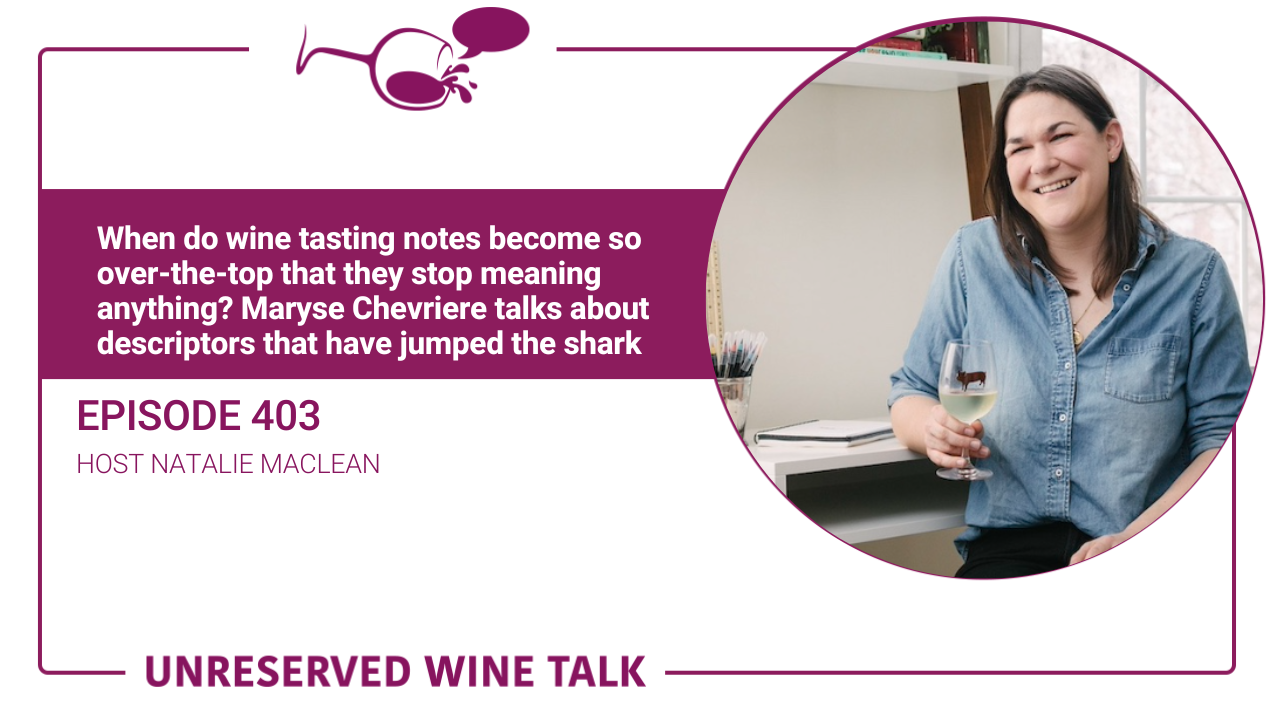
In this episode of the Unreserved Wine Talk podcast, I’m chatting with Maryse Chevriere, author of the new book How to Sound Wine Smart.
You can find the wines we discussed here.
Giveaway
Three of you are going to win a copy of Maryse Chevriere’s terrific book, How to Sound Wine Smart: An Illustrated Guide.
How to Win
To qualify, all you have to do is email me at [email protected] and let me know that you’ve posted a review of the podcast.
It takes less than 30 seconds: On your phone, scroll to the bottom here, where the reviews are, and click on “Tap to Rate.”
After that, scroll down a tiny bit more and click on “Write a Review.” That’s it!
I’ll choose three people randomly from those who contact me.
Good luck!
Join me on Instagram, Facebook and YouTube Live Video
Join the live-stream video of this conversation on Wednesday at 7 pm eastern on Instagram Live Video, Facebook Live Video or YouTube Live Video.
I’ll be jumping into the comments as we watch it together so that I can answer your questions in real-time.
I want to hear from you! What’s your opinion of what we’re discussing? What takeaways or tips do you love most from this chat? What questions do you have that we didn’t answer?
Want to know when we go live?
Add this to your calendar:

Highlights
- What was Maryse’s most mortifying moment while working as a sommelier?
- Does wine education need more humour and plain language?
- What finally convinced Maryse to move from food writing into the wine world?
- How did working a harvest in Alsace shape the way Maryse thinks about natural wine?
- Why is working in a wine shop as much about listening as it is about recommending?
- Why are underdog grapes like Riesling and Chenin Blanc some of Maryse’s favourites?
- How did a wine bar bathroom wallpaper eventually lead to Maryse’s book deal?
- Why does Maryse describe a “loud” wine as one of her favourite tasting terms?
- What inspired the name Fresh Cut Garden Hose, and why has it become such a perfect fit for her illustrations?
- Why does Maryse think “sweet” is one of the most misunderstood words in wine?
- Why have tasting notes become so over-the-top?
Key Takeaways
- How can a hospitality disaster completely change your approach to wine and service?
- I was working in San Francisco at a restaurant called Petite Crenn. We had booked out a private wedding reception, so, a big deal. Very important day for these folks. I had the brilliant idea of wanting to surprise them with a little splash of Rosé Champagne and instead of using common sense and setting the glasses down and pouring for everyone, I poured all the glasses on the tray, picked up the tray, and decided to try and hand them out. And as somebody was grabbing for one, trying to talk to me, the whole tray of like 20 glasses fell, smashed onto the bride, her brother, her husband, on everyone, in front of my boss. The restaurant owner was there also just to make sure things were going smoothly. And they didn’t. So, you know, it’s a good lesson, a good reminder not to take yourself too seriously, which is kind of my whole ethos in wine.
- When do wine tasting notes become so over-the-top that they stop meaning anything?
- N: You say you used to chase the wildest, most roll-your-eyes tasting notes for material. What’s a note someone wrote that was too pretentious, even for you to draw?
- M: I think I did illustrate one where I was like, this is really maybe kind of like jumping the shark. He was talking about a bosomy cherry that was in a spearmint bodice, and there was petrichor, and there were rocks in the oven, it was just too much. what does this mean? I think the ones that are hardest to draw and the tasting notes in general, if you’re speaking to somebody, are just the lists of fruit things. I think for me it’s much more evocative and interesting if you’re describing a personality.
- What makes natural wine like an unfiltered snapshot of a single moment?
- N: How do you explain what natural wine means to a skeptic?
- M: The smell that I always think of from that cellar is the smell of Gewürztraminer, it’s a very aromatic wine. I think they were doing their first attempt at making an orange wine from it, and it was sitting in there fermenting, and the whole place just smelled like roses. And it was just such a cool place. It wasn’t like I was smelling oak or other things. It was like the wine as it was. I think the goal of natural wine is to just be the clearest picture of the grapes, the vineyard, the place of that moment. So it’s like if you just took a photo and you didn’t put a filter on it, and that photo was the wine that you were drinking. That’s kind of my interpretation of natural wine.
About Maryse Chevriere
Maryse Chevriere is a writer, wine professional, and illustrator living in Boston, Massachusetts. A certified sommelier, her career in wine has spanned across New York City, San Francisco, and Boston, where she has enjoyed roles as a retail consultant, restaurant wine director, and distribution sales representative. Her witty, whimsical “drunk doodles” have been published in print and online in Bon Appétit, Food & Wine, Wine Enthusiast, and more. Her printed work has appeared in restaurants and wine bars in New York City, Washington, DC, Boston, and London. In 2016, her Instagram @FreshCutGardenHose was honored with a prestigious James Beard Award in the category of humor. In 2020, her account was nominated as a finalist for a IACP Digital Media Award. Maryse is a fervent proponent of living life glass (at least) half full and believes that learning and talking about wine should be as accessible and fun as drinking it is.
Resources
- Connect with Maryse Chevriere
- Unreserved Wine Talk Episode
- My Books:
- Wine Witch on Fire: Rising from the Ashes of Divorce,Defamation, and Drinking Too Much
- Audiobook:
- Audible/Amazon in the following countries: Canada, US, UK, Australia (includes New Zealand), France (includes Belgium and Switzerland), Germany (includes Austria), Japan, and Brazil.
- Kobo (includes Chapters/Indigo), AudioBooks, Spotify, Google Play, Libro.fm, and other retailers here.
- Wine Witch on Fire Free Companion Guide for Book Clubs
- Audiobook:
- Unquenchable: A Tipsy Quest for the World’s Best Bargain Wines
- Red, White, and Drunk All Over: A Wine-Soaked Journey from Grape to Glass
- Wine Witch on Fire: Rising from the Ashes of Divorce,Defamation, and Drinking Too Much
- My new class, The 5 Wine & Food Pairing Mistakes That Can Ruin Your Dinner And How To Fix Them Forever
Tag Me on Social
Tag me on social media if you enjoyed the episode:
- @nataliemaclean and @natdecants on Facebook
- @nataliemaclean on Twitter
- @nataliemacleanwine on Instagram
- @nataliemaclean on LinkedIn
- Email Me at [email protected]
Thirsty for more?
- Sign up for my free online wine video class where I’ll walk you through The 5 Wine & Food Pairing Mistakes That Can Ruin Your Dinner (and how to fix them forever!)
- You’ll find my books here, including Unquenchable: A Tipsy Quest for the World’s Best Bargain Wines and Red, White and Drunk All Over: A Wine-Soaked Journey from Grape to Glass.
- The new audio edition of Red, White and Drunk All Over: A Wine-Soaked Journey from Grape to Glass is now available on Amazon.ca, Amazon.com and other country-specific Amazon sites; iTunes.ca, iTunes.com and other country-specific iTunes sites; Audible.ca and Audible.com.
Transcript
Natalie MacLean 00:00:00 How can a hospitality disaster completely change your approach to wine and wine service? When do wine tasting notes become so over the top? They stop meaning anything. And what makes natural wine like an unfiltered snapshot of a single moment? In today’s episode, you’ll hear the stories and tips that answer those questions in our chat with Maurice Chevrier, author of the terrific new book How to Sound Wine Smart. By the end of our conversation, you’ll also discover why wine education needs more humor in plain language. What finally convinced Maries to move from food writing into the wine world? Why working in a wine shop is as much about listening as it is about recommending y underdog. Grapes like Riesling and Chenin blanc are some of Murray’s favorites. How a wine bar bathroom wallpaper eventually led to Marisa’s book deal. Why she describes a loud wine as one of her favorite tasting terms, And why. Sweet is one of the most misunderstood words in wine.
Natalie MacLean 00:01:10 Do you have a thirst to learn about wine? Do you love stories about wonderfully obsessive people, hauntingly beautiful places, and amusingly awkward social situations? Well, that’s the blend here on the Unreserved Wine Talk podcast.
Natalie MacLean 00:01:27 I’m your host, Natalie MacLean, and each week I share with you unfiltered conversations with celebrities in the wine world, as well as confessions from my own tipsy journey as I write my third book on this subject. I’m so glad you’re here. Now pass me that bottle, please, and let’s get started.
Natalie MacLean 00:01:52 Welcome to episode 403. So what’s new in the drinks world will this week confer feathers in implementation. Certain species of butterflies, such as the red admirals and commas, love to party. They routinely bypass fresh flowers in favor of fermenting fruit juices. Because their bodies are so small, the ethanol impacts their nervous systems almost instantly, making them lose their defensive reflexes entirely. Drunk butterflies can be seen flying in clumsy, sluggish, slow motion loops, and they become so intensely relaxed and disinhibited by the alcohol that humans can easily walk right up to them and gently pick them up directly off the fruit by hand. Though of course, you want to be kind, and even better, just let them sleep it off in a field somewhere.
Natalie MacLean 00:02:40 Adventurous wine lovers with valid scuba diving certifications can explore a submerged cellar located 14m beneath the surface of the Adriatic Sea near the town of dress. The. The edifice of Vena Winery ages its local Plavix Valley red grapes inside traditional clay amphorae that are secured within a sunken sailing ship. The bottle spend over 700 days underwater, where the constant cool temperatures and the gentle swaying of the sea currents helped mature the liquid while preventing oxygen exposure. When the bottles are finally retrieved by divers, the exteriors are covered in seashells and coral, while the wine inside carries a distinct sea salt tinge developed during its long marine slumber. A hot spring theme park located in the mountains of Hakone, Japan, allows bathers to submerge their entire bodies into a giant pool filled with warm red wine. The spa features a specialized outdoor bath where natural hot spring water is mixed with real red wine, dominated by a massive 3.6m tall novelty wine bottle that towers over the swimmers several times each day, spa employees perform a live show where they spray the soaking guests with fresh bottles of wine, creating an aromatic experience meant to mimic the ancient beauty rituals of historical queens.
Natalie MacLean 00:04:05 While the grape colored waters are highly praised for their skin softening benefits, patrons are strictly forbidden from drinking directly out of the pool for obvious sanitary reasons. It is best, they say, to bring your own clean glass to sip poolside from wine poured directly from the bottle. Engineers at the University of Glasgow, Scotland, have developed an artificial tongue made of nanotechnology that can taste the difference between genuine and counterfeit spirits, led by researcher Alastair Clark. The device consists of 2 million sub microscopic metallic taste buds made of gold and aluminum, arranged in a tight checkerboard pattern that is 500 times smaller than a human hair. When a liquid like a single malt Scotch is poured over the surface, a specialized spectrometer measures how the nano metals scatter and absorb light frequencies to create a unique chemical fingerprint. The digital tongue achieved over 99% accuracy in distinguishing between famous distillery brands, and it can even identify the exact age of a spirit or determine whether the whiskey was matured in a rum or brandy cask. And for your calendar this week.
Natalie MacLean 00:05:21 August 19th is National Potato Day and the birthday of prohibition. Potatoes have long supplied starch for vodka production, although most vodka today is made from grains. August 19th is also sometimes called the birthday of prohibition, because the 18th amendment took effect in the US in 1920, reshaping drinking culture for more than a decade. August 20th is National Lemonade Day and National Wine Fridge Day. Lemonade was popularized by traveling Paris street vendors in the 1830s who sold a chilled mixture of lemon juice, honey and sparkling water. Some calendars also call August 20th Wine Fridge Day, a playful tribute to the dedicated wine coolers now appearing in home kitchens and cellars. August 21st is National Sweet Tea Day and pre crash season. One of the earliest published sweet tea recipes appeared in an 1879 cookbook and called for green tea boiled with white sugar. August 21st also falls near the start of harvest preparations in some early ripening wine regions, when wineries begin berry sampling, pre crush tastings and vineyard checks. August 22nd is National Eat a Peach Day and summer distillery release weekend.
Natalie MacLean 00:06:40 Peaches belong to the same botanical family as almonds, which helps explain why peach and almond flavors work so well together. August 22nd also aligns with the summer release weekends at North American craft distilleries when limited cask strength bottles appear before the fall season. August 23rd is the last day of summer cocktail promotions. Retailers and bars sometimes use this day for last day of summer cocktail promotions, and the idea is to try to stretch patio season before menus start filling with apples, cinnamon and emotional support knitwear. August 24th is National Waffle Day and fall drinks preview season. National Waffle Day marks the anniversary of Cornelius Swart Holt’s 1869 American patent for a waffle iron. Many Canadian wineries and distilleries are also previewing their fall programs, harvest events, and September releases. August 25th is National Banana Split Day, National Whiskey Sour Day, and end of summer flights. The banana split is generally credited to apprentice pharmacist David Strickler, who created the desert in Pennsylvania in 1904. National Whiskey Sour Day honors a drink formerly recorded in Jerry Thomas’s 1862 book The Bartender’s Guide.
Natalie MacLean 00:08:03 Although sailors had mixed spirits with citrus juice long before that. Bars and breweries can also use August 25th for end of summer flights and limited pause before autumn menus arrive. Back to today’s episode. Three of you will win a copy of Morris’s wonderful new book, How to Sound Wine Smart. If you’d like to win a copy, please email me and let me know you’d like to win. It doesn’t matter where you live, I’ll choose three winners randomly from those who contact me at Natalie at Natalie MacLean dot com. And if you’re reading the paperback or e-book or listening to the audiobook of my memoir, Wine Witch on Fire Rising from the Ashes of Divorce, defamation and Drinking Too Much, a national bestseller and one of Amazon’s best books of the year. I’d love to hear from you with Natalie at Natalie MacLean dot Com there’s a terrific free guide for book clubs. I’ll put a link in the show notes to all retailers worldwide at Natalie MacLean 403. Okay, on with the show.
Natalie MacLean 00:09:07 Marie Chevrier is a writer, wine professional and.
Natalie MacLean 00:09:10 Illustrator living in Boston, Massachusetts.
Natalie MacLean 00:09:13 A certified sommelier.
Natalie MacLean 00:09:14 Her career in wine has spanned across New York City, San Francisco and Boston, where she has held roles as a retail consultant, restaurant wine director and distribution sales representative. Murray’s is truly witty and whimsical drunk. Doodles have been published in print and online in Bon Appetit magazine, Food and Wine Enthusiast and others. Her Instagram account, and you’ll want to bookmark this at Fresh Cut Garden. Hose was honored with the prestigious James Beard Award in the category of humor, and nominated as a finalist for an IACP Digital Media Award. Marie’s is a fervent proponent of living life glass half full, or at least, she says, and maybe all the way for some days. Yeah, exactly. And believes that learning and talking about wine should be accessible and as fun as drinking it is. And she joins us now from her home in Boston. Welcome, Marie. We’re so glad to have you here with us.
Maryse Chevriere 00:10:10 So much for having me. I’m so excited.
Natalie MacLean 00:10:12 All right. Cool. So let’s start with maybe one of your most memorable or mortifying wine moment when you were either a sommelier, a wine director. You were working in a restaurant, maybe. Tell us about.
Maryse Chevriere 00:10:24 That. Well, I was working in San Francisco at a restaurant called Petite Crenn. It was Dominique Krenz tasting menu restaurant that was smashed. Or her home of Brittany. It was like at the height of when the chef’s table came out. She was always super popular, but we had booked out a private wedding reception. A big deal, very important day for these folks, and I’ve had the brilliant idea of wanting to surprise them with a little splash of rosé champagne, and instead of using common sense and setting the glasses down and pouring for everyone, I poured all the glasses on the tray. I picked up the tray and decided to try and hand them out. And as somebody was grabbing for one trying to talk to me, the whole tray of 20 glasses fell smashed onto the bride, the brother, her husband, everyone in front of my boss, Dominique Crenn, who was there also just to make sure things were going smoothly and we didn’t.
Maryse Chevriere 00:11:21 That’s a good it’s a good lesson, a good reminder not to take yourself too seriously, which is my whole ethos in wine.
Natalie MacLean 00:11:28 I love that, and I love your humble enough to admit this incident in public, so that must be something. The bride still that you gave them a story to dine out on for years.
Maryse Chevriere 00:11:37 I’m sure like rain on your wedding.
Natalie MacLean 00:11:39 I clean the dress and the champagne dress.
Maryse Chevriere 00:11:42 Who knows?
Natalie MacLean 00:11:44 That’s great. Oh my goodness. So tell us in a nutshell what this book is about and maybe how it’s different from other books, wine books.
Maryse Chevriere 00:11:52 So the book and I can show it.
Natalie MacLean 00:11:54 Yes, please do, and we’ll link to it for those who are just listening. Yes. Lovely cover.
Maryse Chevriere 00:11:59 Essentially, it’s an illustrated glossary for wine tasting note terms and I think tasting notes, wine terminology, the lingo, if ever in a book about wine, is just like the back few pages of a textbook kind of tome, and one I really didn’t want to do a textbook big, deep dive kind of wine book.
Maryse Chevriere 00:12:18 I wanted something that was just fun to flip through. If you’re into wine new, like a little more advanced that it could grab you, or even if you just like looking at the pictures, it would be something fun coffee table esque. Just show that wine is a little bit more accessible. And I think also the lingo is the great barrier. I mean, with wine specifically, but any number of topics, it’s a thing like, well, I don’t feel comfortable saying, I don’t know, I don’t speak the language. And this is the idea is to help you feel a little bit more comfortable speaking the language.
Natalie MacLean 00:12:47 Absolutely. And it does that in a marvelous way. Now, for those just listening, they can’t get a sense of your drawings. They have to buy the book, of course, but it’s so whimsical. How would you describe your style of illustrating? I just can you compare it to some something they might have seen before? I know we’re unique in the world, but.
Maryse Chevriere 00:13:06 I can draw. But I always say that it’s very simple. It’s a little character. It’s a little line drawn, man. They’re so cute. I, you know, I mean, there’s not really detail, so it’s just very simple, very stark. More a play on just the pun of the words. And I will do little. I used to only do just one pop of color. And then I have expanded since then, but I think I would say my little dude kind of looks like the Keith Haring kind of drawings, like.
Natalie MacLean 00:13:33 The what sort?
Maryse Chevriere 00:13:34 Keith Haring yeah, I think would be probably the closest that I can. I’m trying to think it’s a artist, but he makes very simple Characters that have a similar kind of look, just a line drawn kind of person with a round kind of head. And I saw that I was like, oh.
Natalie MacLean 00:13:50 Yeah, no, they’re.
Maryse Chevriere 00:13:50 Great to my guy. I think I got that name.
Natalie MacLean 00:13:53 But you’re so fun the way you put him in big wine glasses or pile on fruit.
Natalie MacLean 00:13:58 And it’s hard to describe. So truly you have to get the book. But all right, so what was the most surprising insight you discovered while writing your book or illustrating?
Maryse Chevriere 00:14:05 It may be surprising, but like the biggest reminder was just how much of a Pandora’s Box wine is. I think I was saying I set out to really not make it super text heavy, and I would write something and realize I can’t say this without explaining that. And so I do include like some mini deep dives like little 101 sections throughout the book to support things that are maybe that need a little bit more explanation, but it’s just the wine is it’s just such a complex and vast topic. And it was.
Natalie MacLean 00:14:40 That’s why you get Jancis Robinson with her annual edition of 800,000 words, or whatever it is. The Oxford Companion to Wine. Exactly. But yeah, I empathize. Yeah, that that would be a challenge. And so that’s the most challenging thing. But now you got into wine reluctantly, after four years of food and beverage writing, what was the moment that kind of converted you?
Maryse Chevriere 00:15:02 So yeah, I’d been covering beverages, food and beverages in general for this startup food website in New York.
Maryse Chevriere 00:15:09 And I had an assignment to go interview this bartender at a wine bar called terroir. And just in speaking with him, it was like maybe half an hour kind of interview, not even that much time. But he just the way he spoke about wine was so different than anything I’d ever thought about it, as he was so excited about it. He made his job so fun, and it really made me feel like you can learn so much reading and writing about it, but I think I personally also am just like the best learner by doer. And a couple months later I was like. Do you are you guys hiring? And ended up getting a job at a new branch that they were opening?
Natalie MacLean 00:15:49 Oh that’s great. Do you recall his name?
Maryse Chevriere 00:15:50 His name is Tanner Whaley. He actually he and his, I believe now wife have a really cool wine bar in Northern California called Valley Bar and Bottle that I haven’t been to, but I’ve heard is amazing. Okay. Yeah.
Natalie MacLean 00:16:04 Great. Have to put that on my to do list for both cities.
Natalie MacLean 00:16:08 Now. You also worked as a harvest cellar intern in Alsace in France. What’s the smell or sound? Maybe from that cellar that you still pull up when you’re trying to explain maybe what natural wine means to a skeptic?
Maryse Chevriere 00:16:22 The smell that makes me that I always think of from that seller is the smell of conversion meter. I feel like it’s a very aromatic wine, but I feel like I will never get that wrong in a blind. It was just they were doing. I think they were doing their first attempt at making an orange wine from it, and it was just sitting in there. Melting. And the whole place just smelled like roses. And it was like, oh, okay. The reverse meaning that I will always associate that smell with that. And it was just such a cool place and it definitely was. It wasn’t like I was smelling oak or other other things. It was just kind of like the wine as it was. And he was a great proponent of they were natural biodynamic, but I love that he was very much not super woo woo about it.
Natalie MacLean 00:17:09 He was. And it can get off the deep end on the woo woo side. Yeah, yeah. And then you’ve also described natural wine as wine without lipstick I think without makeup on. Is it something like that without makeup on. Yeah that’s a neat way to put it. Maybe expand on that. For people who aren’t as familiar with natural wine, I.
Maryse Chevriere 00:17:25 Think the goal of natural wine is to just be the clearest picture, the clearest picture of the grapes, the vineyard, the place of that moment. So it’s if you just took a photo and you didn’t put a filter on it, and that photo was the wine that you were drinking. That’s my interpretation of natural wine. And it can go in a million different directions. It’s tricky because there’s no actual definition of it and 100 other things. But I just think for me, there’s some of the most exciting, interesting, kind of fun wines to drink right now.
Natalie MacLean 00:18:02 That’s another great metaphor. No filters. Now, your jobs since then have included retail consultant and distribution sales rep in Boston.
Natalie MacLean 00:18:10 Which of those jobs was either hardest to do or hardest on the ego? Or maybe you could share a story from either position that might illustrate what it was like to do one of those jobs.
Maryse Chevriere 00:18:20 I mean, in terms of ego, try not to have ego and try not to. You know, what I want to drink is not necessarily what somebody else is going to want to drink. So be open minded. But retail is really tough. And I was working in the financial district, location of a wine shop, great wine shop in Boston, and you would get the bros that would come in with their expense account and want to just get a wine because it was from a certain region or a certain grape and hit a certain price point. And that can be just a little disheartening. But it’s like you’re not really able to have that conversation. But if that’s what somebody wants, if somebody wants, that’s great. And you just kind of wait for the people that do want to geek out and nerd out with you and talk and actually have a little bit more of an exchange, because that’s really what makes that job fun.
Natalie MacLean 00:19:04 Absolutely. Yeah. I remember talking to staff at local wine shops here and they said, we have the best job in retail because you’re selling your passion if you’re into wine, of course. Yeah.
Maryse Chevriere 00:19:15 That’s great. Try so much. You can meet people like that’s great.
Natalie MacLean 00:19:19 Yeah. Yeah, absolutely. Now you’ve described yourself as drawn to underdog grapes like Riesling, Chenin blanc and others. Who or what got you hooked on those? Was it back to that Alsatian winery or have there been other influences?
Maryse Chevriere 00:19:32 Terroir is probably like the ultimate influence for everything. That place was the biggest push into the deep end for wine knowledge I could have ever asked for. If they have a program still called Summer of Riesling, where the only white wine by the glass is Riesling. And so it was 25 white wines, and somebody would come in saying, hey, I want a Chardonnay. Hey, I want to solve plonk, whatever it was that they wanted. We had to find a wine that fit that within Riesling, and it was just such a cool challenge and a great way to force people to have the conversation and to drink outside of the box a little bit.
Natalie MacLean 00:20:08 That’s great. I love the challenge. It’s a creative way to do it, to show the diversity and range of Riesling. Now let’s talk about your Instagram account at Fresh Cut Garden Hose, which I just love. How? Let’s let’s first start start with how did you start or when did you start, or why did you start illustrating tasting notes before we get to the name of the Instagram account.
Maryse Chevriere 00:20:29 I started it. I was studying for my certified Somm exam and I was having some wine, as you do, and I got a little bored and I was decided instead to flip through Instagram. I started a lot of I was following different wine professionals accounts that were showing bottles and tasting notes and just had a moment of in my wine haze, but I think I could draw this. This is such a visual thing that they’re describing. What would that look like? And then I just flipped over a tasting note card and threw it up. I just saw the reaction.
Natalie MacLean 00:21:03 That’s great. And tell us how your literary agent, who represented you to get this book to your publisher.
Natalie MacLean 00:21:09 How did she discover you?
Maryse Chevriere 00:21:11 She. Shout out to Adriana. She went to a wine bar in DC that I had been working with for years and years now. They reached out and had asked me when they were opening if they could buy some illustrations to wallpaper their bathroom. And so when she was there one time I saw the illustrations, I thought, this is super cool. Reached out for a custom illustration, and then after that had said, you ever thought about turning this into a book? And I said, oh my God, I’ve been trying to turn this into a book for ten years. So, so it was a wonderful, just a happy coincidence kind of moment.
Natalie MacLean 00:21:42 That’s awesome. And I’m just curious, how long did the process take to get your book placed?
Maryse Chevriere 00:21:47 Once we had the proposal together, that was pretty quick. I’d say within a couple months we were getting offers, which was really exciting. That’s great. Yeah, but then it took maybe like a year and a half to two.
Maryse Chevriere 00:22:04 Yeah, yeah.
Natalie MacLean 00:22:05 That’s standard. Yes. A year and a half would be rushing it in the publishing industry. But yeah, it’s a long pipeline. And so that that balm DC that was called Revelers Hour.
Maryse Chevriere 00:22:15 Yes. If you’re ever in DC it’s incredible.
Natalie MacLean 00:22:18 Okay okay. Another one to add to the list. Now your first cartoon was a pioneer read from northern Italy. You described as never thought I’d see so many roses in one room. Just quite poetic. Where were you when you did that doodle?
Maryse Chevriere 00:22:34 Oh, so that note is was written by Levi Dalton, who has a wife.
Natalie MacLean 00:22:41 Oh, a podcaster.
Maryse Chevriere 00:22:42 Yeah, yeah. so I obviously have tasting notes and as I drink and things, but what I loved was looking for inspiration from other people. So I just came across his teaching note, and I thought that was really visually evocative. Could be drawn relatively easily in a simple kind of way. I was just in my, like, little room in San Francisco. Okay. Like after work? Yeah.
Natalie MacLean 00:23:06 And it struck you? Yeah. That’s great. And do you remember the first wine term or Psalm speak that clicked for you and was is continues to be one of your favorite terms to use?
Maryse Chevriere 00:23:17 Yeah, absolutely. I think right when I was like working in wine and starting to get into it, I was out at a wine bar kind of describing what I was looking for. I think with wine, there’s so much flavor wise that can be very subtle and very kind of hard to put your finger on. And so I really gravitate towards things that are very aromatic and really in your face. And that could be like a little gratuitous in that way. And I was saying this and the song that was helping me was just like, oh, this was something that was loud. And I was like, oh yeah. Wow. Exactly. And the way that it sounded like what it was. I love that, and I still use that one.
Natalie MacLean 00:23:53 I want a loud wine today. Just like that.
Natalie MacLean 00:23:56 Sounds like you.
Maryse Chevriere 00:23:56 Grab one, too.
Natalie MacLean 00:23:57 Yeah. That’s great. All right, let’s get to fresh cut garden hose for your Instagram account. How did you come up with that name or what was the inspiration?
Maryse Chevriere 00:24:08 Oh, from the documentary song I basically borrowed Ian Cobbles tasting note like very. You know, that movie was so popular at the time that I started this, which was in 2015, and, and it just seemed to exemplify the whole vibe that I was going for. I was just like, ridiculous sounding the way, how ridiculous it can sound when wine professionals speak.
Natalie MacLean 00:24:33 So he was describing a particular wine.
Maryse Chevriere 00:24:36 As describing.
Natalie MacLean 00:24:36 Having the smell of fresh cut garden.
Maryse Chevriere 00:24:38 I think I’ve seen it, but I’m pretty sure that would seem right to me.
Natalie MacLean 00:24:43 But I wonder which brand of fresh cut garden because there’s a lot of different hoses. Turns out.
Maryse Chevriere 00:24:48 That’s true.
Natalie MacLean 00:24:50 Couldn’t he be more specific? And for those who aren’t familiar, the documentary Som, short for sommelier, it chronicles the journey of several.
Natalie MacLean 00:24:58 I think they’re all men trying to study for their Master Sommelier designation. So they’re practicing and they’re studying and they’re tasting and they’re coming up with weird terms like fresh cut garden hose. And do you know how he reacted when he found out about the name of your account, or has he? Are we springing it on him now? I don’t know.
Speaker 4 00:25:16 That I’ve ever heard.
Maryse Chevriere 00:25:18 From him, or I would hope he would be flattered.
Natalie MacLean 00:25:22 Yeah, hopefully we didn’t put a crimp in his hose. So, yeah, he’s immortalized his.
Speaker 4 00:25:27 Words. I don’t know.
Maryse Chevriere 00:25:28 That I’ve ever done one of his tasting notes or that I had ever heard from him. But yeah, I said hopefully be flattered and not offended that maybe I kind of took his term because obviously much more famous.
Natalie MacLean 00:25:41 And what’s the most misused tasting descriptor you’ve ever heard in relation to wine?
Speaker 4 00:25:46 Sweet.
Natalie MacLean 00:25:48 Sweet. Oh.
Speaker 4 00:25:49 Oh.
Natalie MacLean 00:25:50 Interesting.
Maryse Chevriere 00:25:51 People use sweet when it’s not technically correct. I understand why it happens, but rarely are you going to encounter a red wine that is actually sweet.
Maryse Chevriere 00:26:01 And most of the white wine that is out there, at least in the US, is dry. I would encourage people, let’s write you in the book to use other words instead, like fruit forward, fruit driven, lush, juicy, like so many other things because it’s like, right, it’s probably not sweet.
Natalie MacLean 00:26:18 Yes, because technically, as you say, most wines are fermented to complete dryness. All the sugar has been turned into alcohol. If someone measured it chemically, there’s no sugar. Very little sugar left in from the grapes. But of course, if it’s made from really ripe grapes that have these luscious, fruity, juicy aromas, people will associate it with sweet fruit and sweet. But it’s not. It’s, as you say, fruity. Yeah. That’s great. Now you say you used to chase the wildest, most roll your eyes tasting notes for material. What’s a note someone wrote that was too pretentious, even for you to draw? Or one that you don’t have to name names.
Natalie MacLean 00:26:57 But it was the one that. Oh my God, I can’t illustrate that.
Speaker 4 00:27:00 I think I.
Maryse Chevriere 00:27:01 Did illustrate one where I was like, this is really maybe jumping the shark.
Speaker 4 00:27:06 Okay.
Natalie MacLean 00:27:06 Which one.
Speaker 4 00:27:06 Is that? Like.
Maryse Chevriere 00:27:07 He was talking about a bosom cherry that was in a spearmint bodice, and there was Petrarch, and there was like rocks in the oven, and it was just too much.
Speaker 4 00:27:19 Too much, which is the point.
Maryse Chevriere 00:27:20 Where I was like, that’s a great. What does this mean? Bosom. Cherry.
Natalie MacLean 00:27:25 Okay. Yeah. Patrick, if anyone’s wondering, is that nice smell you get after fresh rain has hit the rocks and you get that clearing and fresh spring smell. But that’s quite the combination that this person was putting together. Okay. And you illustrated, did you? How did you illustrate that way?
Maryse Chevriere 00:27:42 I think I try to do it as literally as possible. I had a cherry in a bodice and in a corset. In a corset in the kitchen. Take out whatever, all the tasting notes.
Maryse Chevriere 00:27:52 It just wasn’t, as I think, the ones that are hardest to draw and the tasting notes in general, just if you’re speaking to somebody that are like, not as maybe grabbing or just the lists of fruits, non fruits, things. I think for me it’s much.
Natalie MacLean 00:28:06 Fruit.
Maryse Chevriere 00:28:06 Salad. It’s much more evocative and interesting if you’re describing a personality, which I have a section of the book that is a little bit more encapsulating and a little bit more relatable than that.
Natalie MacLean 00:28:17 Yeah, absolutely. No. You write that wine prose can slip into some speak or parcel tongue trying to outward each other. And of course, Parcel Tongue is the fictional language of snakes in the Harry Potter series. Now, can you give us a flagrant example? Or was that the one you just shared? Is there any others that come to mind?
Maryse Chevriere 00:28:36 I think that’s that. That is the one that that’s a topper sticks out in my mind is just being like really wild. But there are. Yeah there are. I’ve seen like almost like haikus used as.
Maryse Chevriere 00:28:49 Oh yeah. Yeah. Wine tasting notes. You find crazy things on Instagram?
Natalie MacLean 00:28:52 Yeah, yeah. And your boss, for instance, described a wine as where a Moroccan whorehouse meets a coastal redwood forest in the spring. What was that? Wine? Or was he on LSD or something as well?
Maryse Chevriere 00:29:06 It was colorful. It was a Pinot noir from California. Pay, I believe, was a producer. And was it correct? It’s. That’s what she felt. I can’t say if it was right or wrong, but I will say even the more obnoxious tasting notes. Don’t you want to try that wine?
Natalie MacLean 00:29:25 Yeah, it does make me care.
Maryse Chevriere 00:29:26 It makes you kind of want to be like, yeah, I need to know.
Natalie MacLean 00:29:29 Am I gonna get Moroccan or Algerian or something? But no doubt the winery has posted that tasting note on their website. Probably not, because I don’t know. Now, you were pregnant while you were writing this book and not drinking. Oh my God. Well, oh, congratulations for doing that.
Natalie MacLean 00:29:49 Do you think that changed the way you wrote it or the final book? At all?
Maryse Chevriere 00:29:53 I think it made it tricky. Certainly I started the drawings as like, my wind down thing of like, I would have a glass of wine and draw, and that was fun. So having to dissociate, that was a bummer. And then with the tasting notes that were like, I was really having to rely on my taste memory a lot, which when you’re pregnant and your hormones are crazy, is a whole other thing. But it would have been nice if I was trying to distinguish between terms that are big synonyms to be able to have a little side by side, or by have drinking games in the book to help people hopefully try and understand terms. It would have been nice to be able to do those in real time to be like, oh yeah, like this is more velvety than silky and what have you. That would be nice.
Natalie MacLean 00:30:36 Yeah, I know when I was pregnant there was the nausea, but then I got this heightened sense of smell too, that made everything not as attractive as you might think.
Natalie MacLean 00:30:44 So I don’t know if that was happening to you either. Or certain smells would be really strong and kind of distorted.
Maryse Chevriere 00:30:50 I feel like my senses were told. I don’t know.
Natalie MacLean 00:30:53 Yeah. Oh, look at you. I wished for that. Please stop the onslaught now. Your voice is witty. It’s irreverent. It’s kind. Was there a specific line, sentence or illustration that the publisher pushed back? And then you fought hard to keep it and it ended up in the book?
Maryse Chevriere 00:31:11 No, honestly, I was pretty lucky. They were super supportive of whatever I was going with. I think actually, sometimes they maybe had to rein me in where I was trying to go for a joke and add a little extra sass onto something where it didn’t need it. Or maybe it was like borderline right? This could be interpreted as rude or whatever it was. And and so we had to rein a couple things back, I think. But otherwise you’re like, no, go for it.
Natalie MacLean 00:31:36 That’s great. Great to have that support.
Natalie MacLean 00:31:44 Well, there you have it. I hope you enjoyed our.
Natalie MacLean 00:31:45 Chat with Marie’s.
Natalie MacLean 00:31:47 Here are my takeaways. Number one how can a hospitality disaster completely change your approach to wine and service? As Morris explains, she was working in San Francisco at a restaurant called Petite Crenn and they had booked out a private wedding reception. So a big deal for all of those attending. And she had the brilliant idea of surprising them with a splash of rosé champagne. Instead of using common sense, as she says, and setting the glasses down and pouring for everyone, she poured all the glasses on the tray, Picked up the tray and decided to hand them out. As someone was grabbing for one trying to talk to her. The whole tray of 20 glasses landed and fell and smashed onto the bride, her brother, the husband in front of her boss, the restaurant owner had been there to make sure that things were going smoothly. They didn’t. So, you know, it’s a good lesson and a good reminder not to take yourself too seriously, she said.
Natalie MacLean 00:32:44 And now that’s her whole approach to wine. Number two, when do wine tasting notes become so over the top? They stop meaning anything. As Maries says, she used to chase the wildest, most. Roll your eyes. Tasting notes for material. So I asked her what note someone wrote that was just too pretentious even for her to draw, and she said that she did illustrate one where it was kind of jumping the shark. He was talking about a bosom cherry that was in a spearmint bodice, and there was Petracca and there were rocks in the oven. I mean, what does that even mean? I think the one she says that her heart is to draw, and tasting notes in general are just lists of fruit for her. It’s much more evocative and interesting if you’re describing or drawing a personality. And number three, what makes natural wine like an unfiltered snapshot of a single moment? Murray says that the smell she thinks of is from the cellar of where they were making converts demeanor and natural wine converts demeanor, which is already a very aromatic wine.
Natalie MacLean 00:33:54 It was their first attempt at making orange wine. It was fermenting and the whole place smelled like roses. She says that the goal of natural wine is just to be the clearest picture of the grapes, the vineyard and that place in that moment. So it’s like if you took a photo, didn’t put a filter on it, and that was the wine you were drinking. If you missed episode 378, go back and take a listen. I chat about whether a formal wine tasting language strips the emotion out of wine. Writing with Master of Wine Sarah Heller. You won’t want to miss next week when we continue our chat with Marie’s. Do you know someone who would be interested in learning more about how to sound wine smart? Please let them know about this podcast, email or text them now while you’re thinking about it, it’s easy to find the Unreserved Wine Talk podcast. Just tell them to search for that title or my name Natalie MacLean wine on YouTube, Apple Podcasts, Spotify, their favorite podcast app, or they can listen to the show on my website at Natalie MacLean or podcast.
Natalie MacLean 00:34:59 Email me if you have a tip or if you’d like to win one of seven drinks books I Have to Give away. I’d also love to hear your thoughts on this episode, or if you’ve read my book, email me at Nathalie at Natalie MacLean. In the show notes, you will find a link to take a free online food and wine pairing class with me, called the five Wine and Food Pairing Mistakes That Can Ruin Your Dinner and How to Fix Them Forever at Natalie MacLean. That’s all in the show notes at Natalie MacLean 403. Thank you for taking the time to join me here. I hope something great is in your glass this week. Perhaps a wine that you describe as just right for you.
Natalie MacLean 00:35:46 You don’t want to miss one juicy episode of this podcast, especially the secret full bodied bonus episodes that I don’t announce on social media. So subscribe for free now at Natalie MacLean. Meet me here next week. Cheers!