






Introduction
How did a single decision trigger Sherry’s decline from Britain’s favourite drink? What would it take for Sherry to make a comeback after decades of decline? How can you make the most out of your trip to the Sherry region of Spain?
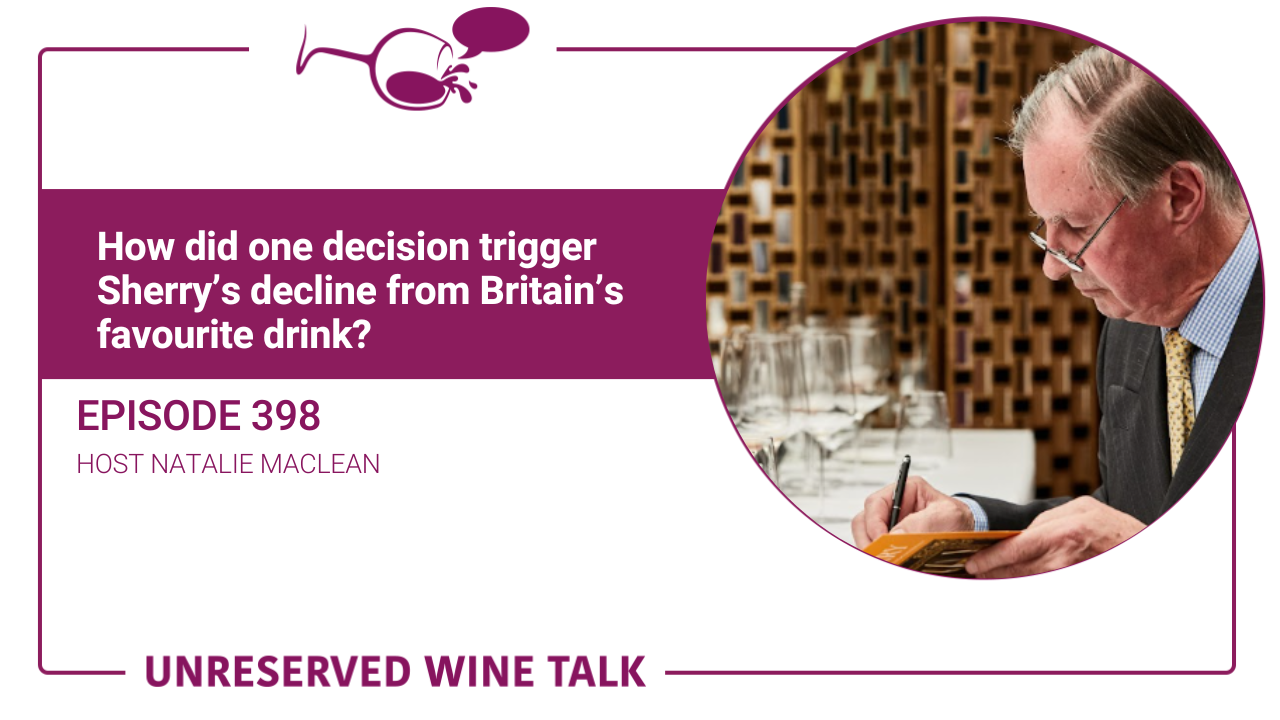
In this episode of the Unreserved Wine Talk podcast, I’m chatting with Ben Howkins, author of a new book on Sherry.
You can find the wines we discussed here.
Giveaway
Two of you are going to win a copy of Ben Howkin’s terrific book, Sherry: Maligned, Misunderstood, Magnificent!
How to Win
To qualify, all you have to do is email me at [email protected] and let me know that you’ve posted a review of the podcast.
It takes less than 30 seconds: On your phone, scroll to the bottom here, where the reviews are, and click on “Tap to Rate.”
After that, scroll down a tiny bit more and click on “Write a Review.” That’s it!
I’ll choose two people randomly from those who contact me.
Good luck!
Join me on Instagram, Facebook and YouTube Live Video
Join the live-stream video of this conversation on Wednesday at 7 pm eastern on Instagram Live Video, Facebook Live Video or YouTube Live Video.
I’ll be jumping into the comments as we watch it together so that I can answer your questions in real-time.
I want to hear from you! What’s your opinion of what we’re discussing? What takeaways or tips do you love most from this chat? What questions do you have that we didn’t answer?
Want to know when we go live?
Add this to your calendar:

Highlights
- Why was Pedro Ximénez once considered too valuable to bottle on its own?
- Why did Shakespeare mention Sherry so often in his plays?
- How did Sherry become one of the world’s most popular wines before its dramatic decline?
- How did one businessman almost single-handedly bring down the modern Sherry industry?
- Why did people in Jerez say José María Ruiz-Mateos had turned wine back into water?
- How has the collapse in Sherry sales unexpectedly created a rare opportunity for wine lovers?
- Why does Ben believe the world’s finest old Sherries remain one of wine’s greatest bargains?
- What would it take for Sherry to become fashionable again?
- Why are small independent bodegas giving Ben renewed hope for the future of Sherry?
- What makes a visit to Jerez unlike any other wine region in the world?
- How did Ben help revive one of Europe’s oldest and most celebrated sweet wines after the fall of the Iron Curtain?
- Why did Hungary insist on calling it the Royal Tokaji Wine Company instead of the Imperial Tokaji Wine Company?
- What does “five puttonyos” actually mean on a bottle of Tokaji?
- After a lifetime in wine, what advice does Ben have for anyone looking to enjoy wine more?
Key Takeaways
- How did one decision trigger Sherry’s decline from Britain’s favourite drink?
- I would start with José María Ruiz-Mateos, who almost single-handedly wrecked the Sherry industry. What was happening up until then is that Sherry had a unique position in England, which is the biggest market because you could keep it in a bottle and leave it there. It wasn’t like still wine. Every time you met anybody or spoke to somebody who went for an interview, you were invariably given a glass of sherry. The vicar gave you a glass of sherry. Before glass of wine, before sparkling water, before all these sorts of things, Sherry had a complete monopoly of our drinking habits. So this went on and Harvey’s Bristol Cream was then the biggest selling wine, very successful. And this man managed to get a 99-year lease on the sales supply of Bristol Cream, which is 13.5 million bottles a year. So armed with that kind of security, he then went on a big spending spree. He famously bought all these companies on the strength of his collateral with the supply. But the sherry that he was offering became much less exciting in taste, much more boorish, much more bland. And people didn’t really want to keep drinking his bland stuff coming out of Spain called Sherry. So that’s why it’s all waned, 40 years it’s still going down.
- What would it take for Sherry to make a meaningful comeback after decades of decline?
- At its height, the sherry industry was controlled by multinational corporate companies, of which one I worked for was one. Because it was a drinks category that was large and increasing. And then gradually the next generation they all sold out. So all sherry companies, bodegas, producers are now owned by Spaniards. Most of them either they’re very small and they just have a stash of really good old sherry, or they’ve had to diversify into either table wines or into food. So until somebody or something happens, the margins aren’t there to reinvest. Without reinvestment, it’s difficult to run about and shout about the brand. The only way really it’s going to start moving is for demand, that actually people do appreciate these blends as fine wines and then gradually it’ll come up. I think it will, but I think we’ll ever see the mass-produced sherry that was yesterday. I think that’s history.
- How can you make the most out of a trip to the sherry region of Spain?
- Sunshine, flamenco dancing, wonderful horse fairs, bullfighting, Seville, a wonderful city, hilltop towns. There’s so much to drive around the region. Then when you filter down to Jerez, or you fly to Seville mainly, then go to Jerez that way, and Puerto and Sanlúcar, I would go visit a large bodega, González Byass, Hidalgo in Sanlúcar, and then try and visit a smaller one. And just get immersed. I mean, the tapas, the food, the bars in Jerez are just wonderful. The value is tremendous. It’s just not expensive. Great food. And then, of course, if you can time it that you go to the feria in May… it’s a whole week of total celebration.
About Ben Howkins
Ben Howkins is widely regarded as the UK’s leading writer and expert on port and sherry. In 1963, he became the youngest recipient of the Vintners Scholarship, an experience that took him across Europe’s vineyards and helped shape his lifelong passion for wine education, particularly fortified and dessert wines. A prolific author, he has written extensively for both consumer and trade publications. His books include Rich, Rare & Red, Real Men Drink Port… and Ladies Do Too!, Sherry and Adventures in the Wine Trade.
He is a member of the Vintners’ Company and has lectured for the Wine & Spirit Education Trust, where he also served as a Trustee. An international wine judge and public speaker, he has led vineyard tours across Europe and South America and promoted wine globally, including in the USA and China. He is co-founder of the Royal Tokaji Wine Company and a key figure in reviving Tokaji Aszú’s global reputation.
Resources
- Connect with Ben Howkins
- Unreserved Wine Talk
- My Books:
- Wine Witch on Fire: Rising from the Ashes of Divorce,Defamation, and Drinking Too Much
- Audiobook:
- Audible/Amazon in the following countries: Canada, US, UK, Australia (includes New Zealand), France (includes Belgium and Switzerland), Germany (includes Austria), Japan, and Brazil.
- Kobo (includes Chapters/Indigo), AudioBooks, Spotify, Google Play, Libro.fm, and other retailers here.
- Wine Witch on Fire Free Companion Guide for Book Clubs
- Audiobook:
- Unquenchable: A Tipsy Quest for the World’s Best Bargain Wines
- Red, White, and Drunk All Over: A Wine-Soaked Journey from Grape to Glass
- Wine Witch on Fire: Rising from the Ashes of Divorce,Defamation, and Drinking Too Much
- My new class, The 5 Wine & Food Pairing Mistakes That Can Ruin Your Dinner And How To Fix Them Forever
Tag Me on Social
Tag me on social media if you enjoyed the episode:
- @nataliemaclean and @natdecants on Facebook
- @nataliemaclean on Twitter
- @nataliemacleanwine on Instagram
- @nataliemaclean on LinkedIn
- Email Me at [email protected]
Thirsty for more?
- Sign up for my free online wine video class where I’ll walk you through The 5 Wine & Food Pairing Mistakes That Can Ruin Your Dinner (and how to fix them forever!)
- You’ll find my books here, including Unquenchable: A Tipsy Quest for the World’s Best Bargain Wines and Red, White and Drunk All Over: A Wine-Soaked Journey from Grape to Glass.
- The new audio edition of Red, White and Drunk All Over: A Wine-Soaked Journey from Grape to Glass is now available on Amazon.ca, Amazon.com and other country-specific Amazon sites; iTunes.ca, iTunes.com and other country-specific iTunes sites; Audible.ca and Audible.com.
Transcript
Natalie MacLean 00:00:00 How did a single decision trigger Sherry’s decline from Britain’s favourite drink? From being Britain’s favourite drink? What would it take for Sherry to make a comeback after decades of decline? And how can you make the most out of your trip to the sherry region of Spain? In today’s episode, you’ll hear the stories and tips that answer those questions in part two of our chat with Ben Hawkins, author of a new book on Sherry. If you didn’t hear part one from last week, that’s okay. You can listen to this one. And then when you finish, go back and have a listen to that episode. By the end of our conversation, you’ll also discover why Pedro X-Men ISS was once considered too valuable to bottle on its own. Why Shakespeare mentions Sherry so often in his plays. How the collapse of sherry sales unexpectedly created a rare opportunity for wine lovers. Why Ben believes the world’s finest old Sherry’s remain one of wine’s greatest Bargains. Why small, independent bodegas are giving Ben renewed hope for the future of Sherry, and how Ben helped revive one of Europe’s oldest and most celebrated sweet wines.
Natalie MacLean 00:01:11 After the fall of the Iron Curtain and what five petunias means for a bottle of Tokai.
Natalie MacLean 00:01:23 Do you have a thirst to learn about wine? Do you love stories about wonderfully obsessive people, hauntingly beautiful places, and amusingly awkward social situations? Well, that’s the blend here on the Unreserved Wine Talk podcast. I’m your host, Natalie MacLean, and each week I share with you unfiltered conversations with celebrities in the wine world, as well as confessions from my own tipsy journey as I write my third book on this subject. I’m so glad you’re here now. Pass me that bottle, please, and let’s get started.
Natalie MacLean 00:02:05 Welcome to episode 398. So what’s new in the drinks world this week? In fur, feathers and fermentation. A mischievous parrot. Aren’t they all in a seaside rum distillery in Cornwall, England managed to unscrew the caps off of several sample bottles and tip them onto the floor before falling asleep in a barrel stave. The distillery owners had to temporarily close the tasting room, while they coaxed the hungover bird out of his hiding spot with fresh fruit and water.
Natalie MacLean 00:02:37 What in Harrow, Spain. Thousands of people celebrated the June 29th Batalla del vino by soaking one another in red wine until their white shirts turned purple. It’s a local tradition that continues to prove. Laundry is a state of mind. And in Darwin, Australia, the 52nd Beer Can Regatta sent homemade boats made mostly from cans across the Mindel beach, where Scotty Hannaford, Down Under Safari Pirates won the Maine race for the second year in a row. Good going mate. Arrival. The Australian Defence Force crew reportedly kept its 2000 canned boat together with duct tape and zip ties, which is also the unofficial engineering degree of the summer. In your weird but wonderful scientific fact. Did you know peanuts can dance in beer? Researchers studied the Argentine habit of dropping peanuts into beer and found a repeating cycle. The peanut sink’s bubbles grow on its surface. The added buoyancy lifts it. The bubbles detach at the top and the peanut sinks again. Happy hour has its own elevator system. And for your calendar this week, July 15th, brings National Gummy Worm Day and National Tapioca Pudding Day.
Natalie MacLean 00:03:53 The gummy worm traces back to 1981, when the German candy maker trolly decided to expand on the gummy bear craze. I guess I missed that one. It had helped to popularize market by dropping a few neon worms straight into a glass of fruit flavored sparkling wine, or freeze them inside ice cubes for a vodka highball. I think that would also be perfect for Halloween. Now, July 16th covers National Cherry Day, National Cherry Lime Day, lime eight day, National Corn Fritters Day, and National Fresh Spinach Day. One of those doesn’t belong. July 17th is National Peach Ice Cream Day. Why not build a peach Bellini float? July 18th stacks up National Caviar Day. National Strawberry rhubarb wine Day, National Tropical Fruit Day, and National Sour Candy day. The 19th is National Daiquiri Day, and in some calendars it’s also National Ice Cream Day. The daiquiri traces back to 1898, and an American mining engineer named Jennings Cox, who ran out of gin while entertaining guests in Cuba and improvised with local rum, lime, and sugar instead.
Natalie MacLean 00:05:05 A quietly heroic choice. July 20th brings National Lollipop Day, National Vanilla Ice Cream Day, and National Fortune Cookie Day. For lollipops, try a candy colored spritz, a hard candy cocktail stirrer, or a zero proof lemonade dressed up enough to look like it owns sunglasses. National 21st closes the window with National Junk Food Day and International Lamington Day for the lamington that Australian coconut and chocolate sponge cake. It pairs well with a coffee liqueur or a splash of coconut rum. Meanwhile, on city TV’s breakfast television, we paired great gift wines and spirits with something we all secretly Love or love to hate. Dad jokes. And even though the drinks are seriously good, we can still have fun dad style. Father’s day is past, but these drinks and the groans from the jokes live on so dads can be impossible to buy for. Last year my friend got so desperate she gave her father all her dead batteries free of charge. Ha ha. I’m here all week, folks. All right, let’s start with the rotary.
Natalie MacLean 00:06:15 Art Italiana brut from Trento, doc, Italy. Dry humor is all about understatement. Until it lands and delights. And there’s no better match for this than rotary. It’s named after the Lombard King Rotary, who ruled northern Italy back in the seventh century. Strength, clarity and distinctive identity. This wine embodies all of that. The Trento Doc Appalachian was the first Doc in Italy dedicated entirely to traditional methods. Sparkling wine, which is the same labor intensive process used in champagne. So you’re getting champagne calibre craft at a much better price. It’s made primarily from Chardonnay growing on estate owned vineyards in the Adige Valley, at elevations between roughly 350 and 600m above sea level. That altitude gives the wine its signature crispness and minerality. It opens with delicate aromas of ripe yellow fruit, citrus zest, lemon, and freshly baked bread. On the palate, there’s a soft, creamy mousse with real texture and a long, persistent finish. This wine is perfect for toasting the dad, who loves dry humor. As in what do you call fake spaghetti? An in pasta? Boom boom boom.
Natalie MacLean 00:07:32 This wine would actually be great with real pasta. Next up we have the megalomaniac narcissist Riesling VQA Niagara Peninsula from Ontario. Now here’s a wine that’s seriously good but doesn’t take itself too seriously. I mean, how could you with a name like megalomaniac narcissist. This gorgeous Riesling is an estate wine. So the grapes grow right next to the winery on the Niagara Escarpment. The limestone soil gives this wine its brilliant minerality and racy acidity. That’s why this Riesling has won many medals in national and international competitions. This is the last wine available from the 2024 vintage. So when it’s gone, it’s gone. So get it down. The wine offers lemon, lime, citrus, white flowers and stone fruit aromas on the nose and on the palate. Bright citrus and green apple, crunchy acidity and a smooth texture. There’s also a touch of fruit sweetness balanced by that racy acidity, which makes it so food friendly. Think spicy Thai or cream sauces. Repairing this wine with a dramatic joke from the dad, who doesn’t lack confidence, as in my wife accused me of being a flamingo so I had to put my foot down.
Natalie MacLean 00:08:41 Then we have the volcanic hills, magma red from the Okanagan Valley in British Columbia. Bold punch lines are striking in their character, and that’s exactly what the volcanic hills magma read is. It’s made by a family owned winery in West Kelowna on the slopes of Mount Bushiri, an extinct volcano that has shaped the region for millions of years. Three generations have honed their expertise on this vineyard to create a wine that expresses both the land and their perseverance. The magma Red is a blend where each grape is fermented in age separately before being brought together, which gives it real complexity. It’s just arrived in the Lcbo, so we’re celebrating that too. And of course, with all Canadian wines, if you’re in Canada, you can order directly from the wineries and they’ll ship it right to your door. The nose gives you dark plum, cherry, spice and mint, and on the palate, juicy black fruit, clove and then deeper notes of leather and cigar box on the finish. It has silky tannins and bright acidity.
Natalie MacLean 00:09:40 It’s the wine that brings people back for a second glass and it would be perfect with a thick grilled ribeye steak. Dad’s bold punch line for this wine. Did you hear about the terrific restaurant that just opened on the moon? Amazing food, but no atmosphere. They turned away SPC spiced Rum from the Philippines. Crowd pleasers are warm, inviting and work for everyone at the table. Tandoori is exactly that, and the timing is great because June is Philippine Heritage Month. It was founded in 1854, making it the oldest rum producer in the world, and it’s consistently the top selling rum brand globally. The SPC has crafted from a blend of rums aged up to seven years in former bourbon barrels. Its aromas of warm baking spices, honey and caramel come from the Asian spice tradition, which gives it a completely different personality from Caribbean spiced rums. That’s the heritage of the Philippines. In a glass, it opens with inviting aromas of vanilla, caramel and cinnamon. On the palate, layers of honey, gentle spice, and tropical fruit lead into a warm, lingering finish with soft oak, smooth, balanced, and not overly sweet.
Natalie MacLean 00:10:52 Try it over ice, which opens all that spice up beautifully. It would be gorgeous with barbecue ribs or chicken skewers to complement the rums warm spice and caramel tones, or even with grilled pineapple or mango for your crowd pleaser joke. Here it is. Why did the pro golfer bring two pairs of pants to the greens in case he got a hole in one? And next we have Clos du Soleil Winemaker series Syrah from the Similkameen Valley, and BC sharp. One liners are precise and leave a lasting impression. And Lotus Lei does that in the glass. This is the 20th anniversary year for Chloris, which means vineyard of the sun. This winery I consider to be BC’s leading producer and is nestled in the Similkameen Valley, one of Canada’s most dramatic wine regions, with steep desert cliffs and wild sagebrush as closely as vineyards are certified organic and biodynamic. And what makes this wine unusual is that it’s co fermented with Viognier grapes, which the winery grows specifically for this wine, and then it’s fermented in concrete tanks imported from France.
Natalie MacLean 00:12:05 Winemaker Mike Clark calls it hauntingly beautiful, and you’ll see why when you taste it. It’s also unconfined and unfiltered. The nose offers wild raspberries, plums, violets and forest floor. On the palate, blackcurrant, pomegranate, pepper and spice. There are full, fine grained tannins, and this wine picked up the silver medal at the prestigious Decanter Magazine Awards. It’s available at the Lcbo for a limited time or directly from the winery. It would be stunning with a char grilled steak your sharp one liner. I’m reading a book about anti-gravity and I can’t put it down. All right. And a final toast to dad’s. Here’s to dad on his special day. I had hoped to compose a better toast than this, but I only know 25 letters of the alphabet. I don’t know why. All right. On Instagram, I’m at Natalie MacLean wine, where the punch bowl is usually better than the punch line. Back to today’s episode. Two of you will win a copy of Ben’s wonderful new book on Sherry.
Natalie MacLean 00:13:10 If you’d like to win one, just email me and let me know. It doesn’t matter where you live, and I’ll choose two winners randomly from those who contact me at Natalie and Natalie MacLean dot com. Keep them for yourself or give them as gifts. Congratulations to Sylvia Zimba from Nairobi, Kenya, who has won a copy of Smart Mouth Wine Essentials for you. Me and everyone we know by Jordan Salcedo. And if you’re reading the paperback or e-book or listening to the audiobook of my memoir wine, which on fire, rising from the Ashes of Divorce, defamation and Drinking Too Much, a national bestseller, one of Amazon’s best books of the year. I’d love to hear from you at Natalie at Natalie MacLean dot com. There’s a terrific free guide for book clubs. I’ll put a link in the show notes to all retailers worldwide at Natalie MacLean dot com. Forward slash 98. Okay, on with the show. So finally you write that Pedro FW amenities okay. Is arguably the sherry sherry producer’s most valuable Venus asset.
Natalie MacLean 00:14:13 And you describe a 1946 you tasted as gentle, succulent toffee with gravitas, adding that the senses deepen and bewitch. What is it about that makes it so unlike any other sweet wines?
Ben Howkins 00:14:27 Gosh, is the grape is a dry grape. But this particular to get the Blend the style. The grapes are picked at when they’re really ripe and put on esparto mats. Sun drenched for 3 or 4 weeks.
Natalie MacLean 00:14:41 That sounds like the Amazon method. The drying on the straw.
Ben Howkins 00:14:44 Man is similar, and they’ve done that for years and years and years. Centuries. They’ve done that for really. So that’s what it is. And it’s ideal by itself. One flavor ice cream. So it’s a classic example of something really, really rich. It’s decadent. It’s wonderfully decadent. And it’s always been used really historically as an additive. So that’s what gets you Bristol cream.
Natalie MacLean 00:15:08 Oh okay. By adding peaks.
Ben Howkins 00:15:10 To a regular.
Ben Howkins 00:15:11 Order.
Ben Howkins 00:15:12 Oh, okay.
Ben Howkins 00:15:13 Not. But you’re adding peaks. And I was involved, as I said earlier, with Croft original pale cream sherry.
Ben Howkins 00:15:20 And we then as a company and this back in the 60s figured how can we take on half of this cream. And so we added a moscatel sweet wine. And that’s why Croft Original is a lighter color than Bristol Cream. Because at that stage, our advertising agency said people think it’s smart to to drink dry. Drinking sweet wine is not good. And it was smart to drink dry. And so therefore people liked the idea of Croft Bristol looking dry in fact tasted sweet. So that’s just a bit of brand history. But to say that’s what is really. So it was never really bottle and sold separately. It was kept by bodegas and used, but you didn’t really see daylight until about 20, 30 years ago.
Natalie MacLean 00:16:06 Fascinating.
Ben Howkins 00:16:07 And again, not expensive.
Natalie MacLean 00:16:09 Okay. So Sherry has this long and rich history. You described how Ferdinand Magellan, on setting out to circumnavigate the world in 1519, spent more on sherry than on armaments for the trip. Sir Francis Drake, from the British took 2900 barrels of sherry from the Spanish ships in 1587, the equivalent of nearly 2 million bottles.
Natalie MacLean 00:16:34 King James, the first limited I’m putting that in quotes, limited himself to 64 bottles of sherry a day. Oh my God. I’m surprised the man didn’t die of liver failure.
Ben Howkins 00:16:45 Yeah, right.
Natalie MacLean 00:16:47 Shakespeare, you write, cited Sherry in no fewer than 40 references across eight of his works. Now, the Elizabethan English term for sherry was sacker or was sack rather than sack. It’s from the Spanish verb sarkar meaning to dry out, which probably refers to the practice of drawing wine from a solera or cask when it’s ready for consumption. And you write that Shakespeare’s Falstaff delivers one of the most enthusiastic defenses of Sherry ever written, or of wine ever written. And I’ll just share that, and then we’ll jump back in. A good sherry sack ascends me into the brain I love that drives me there. All the foolish and dull and curdie vapors, which in turn it makes it apprehensive, quick forgetting. Full of nimble, fiery and delectable shapes which deliver. Ode to the voice, the tongue which is the birth and becomes excellent wit.
Natalie MacLean 00:17:42 But for all that history and cultural elevation, and that literature, Shari has had a precipitous decline, which you note. So at its height. When was that? How much sherry did Spain produce.
Ben Howkins 00:17:55 At its height? The sherry market. And I’ve done it in bottles as we grate 200 million bottles of sherry at its height. That’s a lot of sherry. And that was famously in 1979. Statistics were show that was when it absolutely reached its height. Today we are and I haven’t got the exact figures, but I know that we’re south of 50 million bottles, so that three quarters of that was at its zenith. At its peak. It’s been wiped out for reasons that we can talk about, but yes. So that’s why the region has, as it were, retrenched to 7000 hectares. And I was working out that 15,000 hectares is the same size as two Manhattans. I mean, not to drink Manhattan, but to two Manhattan islands.
Ben Howkins 00:18:51 Wow.
Ben Howkins 00:18:52 You know, so it’s a drama that was pulled up there.
Natalie MacLean 00:18:55 So what do you think was the decline? What was the primary reason? Do you think for the decline? I’m sure there’s a confluence, but what would you start with?
Ben Howkins 00:19:03 I would start with a man, I’m afraid. Who? Jose Maria Reyes Mateos, who almost single handedly wrecked the sherry industry. What is happening up until then is that Sherry had a unique position in England, which is as big as market because you can keep it in a bottle and leave it, though you didn’t have to. It wasn’t like still wine, right? And so it was the absolutely. Every time you met anybody or spoke to somebody who went for an interview, you were invariably given a glass of sherry. The vicar gave you a glass of sherry. It was just before glass of wine, before sparkling water, before all these sorts of things. It said, had a complete monopoly in quotes of our drinking habits port as well in the UK. But port was a heavier wine, so this is more the ladies.
Ben Howkins 00:20:00 And so this went on. The Bristol Cream was then the biggest selling wine selling goddess Harmony houses of bottles, but very successful. And this man managed to get a 99 year lease on supplying sell supply of Bristol Cream, which sent around 1350 50 million bottles a year.
Ben Howkins 00:20:24 So that’s Harveys Bristol cream.
Natalie MacLean 00:20:26 Yeah. Wow.
Ben Howkins 00:20:27 So, armed with that kind of security, he then went on a big spending spree and he famously bought three packs a day. And he did this and the other and bought all his companies to on the strength of his collateral with the supplier. Of course, the result was that the sherry that he was offering became not only on the screen, but all the other. So it became much less exciting and taste much more boorish, much more bland. And people didn’t really want to keep drinking his bland stuff coming out of Spain called Sherry. And so that’s why it’s waned completely. 40 years. It’s still going down. No region can sustain that really without big changes. And one of the things we see is price is that the price of a similar sort of ten year old 20 year old between cherry and pork roughly reported double.
Ben Howkins 00:21:25 The price was half the price. And that’s purely on demand. Cost of production cost. Other sets appear on demand.
Natalie MacLean 00:21:34 So the costs are the same. It’s just the demand is.
Ben Howkins 00:21:36 Flattening the price.
Ben Howkins 00:21:37 I mean, argue certainly the production costs are higher in the Doe Valley because it’s much more complicated and all the rest of it. But basically the costs of corks and bottles and things are the same. So it’s just that unfortunately, the margins aren’t there in Harris at the moment to reinvest.
Ben Howkins 00:21:53 Yeah.
Natalie MacLean 00:21:53 Wow. So let’s go back to that man because he seems like a real character. You describe him really well. So he was the son of a small sherry producer. This his Mateo’s became the exclusive supplier to Harvey’s of Bristol cream. Best selling champagne or sherry brand in 64. You describe him as a local boy gone bad, ran debts up to over €2 billion and sent the sherry industry into decline. Now, you also said he was a devout opus de adherent, which I think is a division or sect of the Catholic Church, who on business trips used to suddenly stop the car and start to pray.
Natalie MacLean 00:22:32 And you quote the saying that circulated in areas where Jesus managed to turn water into wine. Jose Maria succeeded in turning it back again. So this was his low quality, probably, perhaps watered down product. But how did someone that colorful and so crooked fool so many serious, sophisticated people for so long?
Ben Howkins 00:22:54 Again, he went outside the cherry region and that’s why he was praying. I think that all that. But he was just a real. We could all think of people in this world today who are.
Ben Howkins 00:23:05 Doing very.
Natalie MacLean 00:23:05 Charismatic but.
Ben Howkins 00:23:07 Crooked.
Ben Howkins 00:23:08 Not doing very good things.
Natalie MacLean 00:23:09 Some of them are launching IPOs right now in the tech industry anyway.
Ben Howkins 00:23:13 Some of them.
Ben Howkins 00:23:14 We could all think of people in history. but current day, whether it’s in the States or whether it’s Europe or wherever, who just get away with it and he got away with it and harvest, the company with whom he had this nice nine year contract, did see through him like 2 or 3 years afterwards and stopped the sale contract.
Ben Howkins 00:23:37 But he was a manipulator and he was on a spending spree. The banks would lend him any money against these assets for almost zero interest. There was a price export price regulation, that he borrowed money from one company and just moved around there, and he was just on a spending spree.
Ben Howkins 00:23:56 I mean, you could.
Ben Howkins 00:23:57 All I’m sure we could all think of people alive or in our lifetime who have gone on spending sprees. And they usually I think of several right now and they usually can’t resist over one more conquest.
Natalie MacLean 00:24:14 The one that likes the House of cards collapse like the Bernie Madoff you’ve mentioned. Comparison to him?
Ben Howkins 00:24:20 Absolutely. And that’s what happened.
Natalie MacLean 00:24:22 Yeah. You can only shuffle it around so long. So after the Spanish government expropriated his business in 1983, Ruiz Mateos emerged from prison. In 1989, formed a political party that won two seats in the EU parliament, and then started a new business, which turned out to be a straight up Ponzi scheme again, and went bankrupt in 2011. And you wrote that most of Jose Maria’s six sons are now safely behind bars.
Natalie MacLean 00:24:48 At what point did it become clear that the damage to the sherry industry was generational, not just temporary, from he and his sons?
Ben Howkins 00:24:56 I think they’re still behind bars. I was asking the other day, but what was before I answer that question is that when I understood vaguely what razzmatazz had done, but it was only when I dug deep that I realized what a bombshell that he had deliver the industry. When I said, I’m going to write about it, a full chapter to people who got quite nervous. You really were going to write about arithmetic. I said, absolutely, I could write it. As far as I’m concerned. Everything I write is kind of what I hear and backed up with that. And they almost said you were very brave writing about him in the terms I did. I had no problem about it, but he.
Ben Howkins 00:25:37 Just.
Ben Howkins 00:25:37 Shows still the shadow of his legacy. Unfortunately, legacy still hangs just lightly in there, but I think you could see over time that it was very difficult to get show back to where it was.
Ben Howkins 00:25:54 So I think that it was a daunting aspect, that it was in a downward spiral. And of course, the counterargument, the benefit for falling sales means that the stock that you would have been selling each year Stays in wine cellars.
Ben Howkins 00:26:13 So.
Natalie MacLean 00:26:13 It’s aging more and more. Getting more in complex. Yes.
Ben Howkins 00:26:17 The great thing about Sherry is that it couldn’t happen to a better wine because actually it will stay happily there for ten, 20, 30 or 40, 50, 60, 70, 80 years. So they’re gradually this old stock of wine is being sold and moved out. And that’s why I say buy it now. Not that it’s going to increase in value so much, but it just won’t be any more of it. So huge stash of this really fine wine still in in the sherry triangle.
Ben Howkins 00:26:48 Yeah.
Natalie MacLean 00:26:48 You write that sherry has style in spades and that while fashion comes and goes with each season, style remains. And you also write that it’s diverse, fulfilling, back in style. Back in style.
Natalie MacLean 00:27:00 Share with us some examples. Is it making a comeback somehow with a younger generation or cocktails? Or is what do you see a resurgence in some respects for Sherry.
Ben Howkins 00:27:10 I wish I could look her in the eyes and say yes, but I really think that we’re not glimmers of understanding that the Sherry’s we’ve been talking about, the six blends are fine wines. They’re world class wines. And they of course, there are some sommeliers who understand this, and some restaurateurs and some wine merchants and or restaurateur. But in terms of a radical re-emergence, I can’t see it. I can’t see anything sufficiently tangible to say, we’re on the up. I’m not that close to it now. But that’s my feeling, though, and it is up to all of us. If everybody listening or watching likes wine, please just try. A bottle of either in Rancho Fino or Manzanilla. Doesn’t really matter which brand. Parla. Cortado. Oloroso Montero. So if you.
Ben Howkins 00:28:05 Think.
Natalie MacLean 00:28:05 What do you think the sherry industry needs to do to start a revival.
Ben Howkins 00:28:09 Gosh, old deep stuff. At its height, the sherry industry was controlled by multinational corporate companies, of which one I worked for was one because it was a category, a drinks category that was large and increasing. And then gradually over the next generation, they all sold out. So all sherry companies, bodegas producers are now owned by Spaniards. One exception is the man who owns who’s a Filipino, and he owns the Harveys funded all Brandy brand, but mainly for the brandy, not the sherry. So they’re all really owned by Harrisons. And most of them, either they’re very small and they just have a stash of really good old sherry, or they’ve had to diversify into either table wines, vegetable wines, or into food. There are two main aspects of diversified into so and in a way. So until somebody or something happens the margins aren’t there. They said to reinvest and without reinvestment then it’s difficult to run about and shout about the brand. So anyway really it’s got to start moving is for demand that actually people do appreciate these blends as fine wines and then gradually it’ll come up.
Ben Howkins 00:29:35 I think it will, but I think it will ever see the mass produce sherry. That was yesterday. I think that’s.
Ben Howkins 00:29:42 History.
Natalie MacLean 00:29:42 And tastes are changing to lighter alcohol wines, the glass of white wine culture you’ve mentioned. I don’t know, maybe there’s some hope for a lighter style Fino, which is light in color to get in on that, I don’t know.
Ben Howkins 00:29:57 I don’t know either. We’ve tried to try. I think there’s several steps that are happening which are positive. One is that Sherry’s funeral mass near Sherry’s. Can I be still on wine list as of the dry wine?
Ben Howkins 00:30:09 That’s good, because.
Ben Howkins 00:30:10 It’s dry wine.
Ben Howkins 00:30:11 So don’t.
Natalie MacLean 00:30:11 Put.
Ben Howkins 00:30:12 Them into the dry wine.
Ben Howkins 00:30:13 Peterson, who got this wonderful Roberta. He’s invested there. And he was saying the other day that it is his main policy hope guide is just to create these. Spain’s finest white wines are, in fact, Fino master Jerry.
Natalie MacLean 00:30:32 That’s good strategy.
Ben Howkins 00:30:33 Yeah.
Natalie MacLean 00:30:34 Yeah, absolutely. And you note that in 2018, 85% of sherry sales were controlled by six companies, but that simultaneously, a wave of boutique bodegas and passionate small producers has emerged.
Natalie MacLean 00:30:46 And you call them a are you characterize them as a mini gold rush going on in a recently unfashionable wine region. So maybe we’ll get these little startup, little garage tiki type producers, too.
Ben Howkins 00:30:58 I think people are producing dry wines, not sherry as well. So all sorts of things happening. I’m biased only because it’s not a wonderful place to go and visit.
Natalie MacLean 00:31:09 Yes, that’s the question I was going to ask you if someone wanted to visit. What are your top two tips in getting the most out of a visit to Sherry? How does.
Ben Howkins 00:31:17 Gosh.
Ben Howkins 00:31:18 Sunshine, flamenco dancing. Wonderful horse fairs. Fighting.
Ben Howkins 00:31:25 Oh, yes.
Ben Howkins 00:31:27 Seville, a wonderful city. Hilltop towns. There’s so much to enjoy about the region. And then when you filter down to Paris or you fly to Seville mainly then, or Gibraltar, go to rest that way and Puerto and Sanlucar. I would go visit a large bodega, Gonzalez.
Ben Howkins 00:31:46 Bias.
Ben Howkins 00:31:46 Bobadilla in Sanlucar, and then try and visit a smaller one, Bodegas John for one, and various others and just get immersed.
Ben Howkins 00:31:54 The tapas.
Ben Howkins 00:31:55 The food is yeah.
Ben Howkins 00:31:57 Tavistock interest are just wonderful. The value is tremendous. It’s just it’s not expensive. Great food. And then, of course, if you can time it that you go to the feria in Earth, which I’ve just been to in.
Ben Howkins 00:32:12 What is that?
Ben Howkins 00:32:13 It’s a horse Feria. And there’s one in Seville, one in Sanlucar, one in Puerto. But the big one is an arrest for terror. It’s a whole week of total celebration of girls dressed in lovely flamenco dresses, horses and carriages parading around every producer. And many others have their own casita or bar where you go in and buy them. I think they get half the sherry drunk in Spain is actually consumed at these fairs.
Ben Howkins 00:32:45 Oh, that.
Natalie MacLean 00:32:46 Sounds.
Ben Howkins 00:32:46 Lovely.
Ben Howkins 00:32:46 It closes about midnight. It opens again at about ten. There’s just a mass of. But nobody I’ve ever seen has been what you might call worse for wear. And so if you can hit one of those in May. Then that just brings her into life, sir.
Ben Howkins 00:33:02 And so it’s worth putting additional color.
Natalie MacLean 00:33:05 Now, that sounds wonderful. I did want to touch briefly upon Royal Tokai, given your history. Yes. Hugh. John. Yeah. Hugh Johnson, author of The Wine Atlas of the world, writes in your Sherry book, The Forward, that you launched the most successful Tokai company of all time. The former Hungarian president Miklos Németh, named your five petunias as you in 1990 and said, this is the one I remember while sitting on my grandfather’s knee. Lovely. Now, you launched the Royal Tokai Essentia at the 1993 New York Wine Experience that’s hosted, I think, by Wine Spectator magazine. And you saw Marquis Alexandra de SA Salus, the owner of shadowy, which is the top number one Bordeaux, also a sweet dessert wine Sauternes standing in line 4 or 5 people, deep glass in hand, waiting to taste your wine. And you. Right. We’ve made it. What did that feel like?
Ben Howkins 00:34:03 It really was so very special. Of all my time in this wonderful business, that creating role to guy from nothing, from scratch.
Ben Howkins 00:34:12 Hugh Johnson had the idea with his friend, winemaker Peter Diaz, also a friend of mine. They had the idea when the Iron Curtain came down, the Berlin Wall came down, that to try and see what was going on in Tokai in northeast of Budapest, about 100 miles north east of Budapest. And for the last 40 years, everything produced in this, really the original fine wine of Europe was in Tokai.
Ben Howkins 00:34:39 Then it was called.
Natalie MacLean 00:34:39 The Wine of Kings, right?
Ben Howkins 00:34:40 That took wine of kings. It was denominated as first grade, second grade, third grade. I got a first grade here, buying glass around 1700. So it predates Bordeaux. Predates all this sort of thing though. But for the last 40 years, the Russians Controlling Hungary had milked the whole area, and these wonderful wines of Tokai had been just volume orientated, not to call it at all consciously. And it all went to Russia and this great thing was lost. So we came in. It’s a long story and I’ll be brief as I can.
Ben Howkins 00:35:14 But to me it was the most fascinating part of my career. It was huge. And Peter were already out there. They had already established a joint venture with 100 hectares and that was fine, but they’d run out of money. I had been working with Lord Rothschild, Jacob Rothschild. It was wonderful.
Ben Howkins 00:35:33 Of the Bordeaux.
Ben Howkins 00:35:34 Of Bordeaux fame, indeed, Lord Rothschild. And and he had Hungarian art, and he wanted me to go and buy a vineyard in Tokai. So I went out there and I joined forces with Peter and Hugh, and we formed the company. We raised more money, formed the company and Called the Royal Touquet Wine Company. He wants to be called the Imperial Tokai Wine Company and they all said, no, no, Mr. Johnson, we’re not an empire, were a kingdom. So he said, let’s call it the Royal Tokai Wine Company. And that’s how it became the Royal Tokai Wine Company.
Ben Howkins 00:36:08 Oh that’s great.
Ben Howkins 00:36:09 The named after all the king’s things. But that was something very special because literally no privately produced Tokai had been exported for 40 years.
Ben Howkins 00:36:20 No market, there’s no brand, there’s no pricing. Like starting out with your first ever champagne company or your first ever Bordeaux Chateau. Just extraordinary. And that’s exactly that. So when Peter produces amazing blends of Azul wine, which is a another complicated production anyway, as he was sweet white and we just didn’t know if it was, as it were, we were on the right lines That this was the original Takamatsu signs of 40 years. Centuries ago. So we took it around the place and we took it to your right. Prime Minister, name it. We tracked down London. Yes. He said, I took it to the manager of the Four Seasons Hotel in New York, who was Hungarian. This, I believe. We never thought we’d see this wine ever again. This fiery wine. I took it to Peter Morrell in New York.
Natalie MacLean 00:37:20 Famous merchant.
Ben Howkins 00:37:21 The famous merchant, old friend. And he just got he went berserk about it. And anyway, so that’s how that was simply just taking a bottle around the world.
Ben Howkins 00:37:31 So yes, that was pretty special.
Natalie MacLean 00:37:32 So in just a brief overview, Tokai Wines from Hungary’s RTO is it Tokai region, Tokai. Tokai region?
Ben Howkins 00:37:39 Yes.
Natalie MacLean 00:37:39 Are either Tokai okay are either dry whites or sweet wines, and ferment is the dominant grape price for its high acidity and aging potential as you as the flagship style of Tokai, a concentrated suite of botrytis affected wine, meaning the noble rot, the good kind of rot that concentrates the grape sugars. High acidity. Flavors from the grapes are harvested one at a time by hand. There’s a couple of other categories we really need to dedicate, I think, an entire episode to Tokai, but I’m shoving it in here at the end because you have such a strong association with it. But you talk about just the one question I keep having is five petunias. What does that mean, Tanya? Is that just the degree of sweetness?
Ben Howkins 00:38:24 Yes and no. Good politicians answer plutonium or plutonium? Originally it was a wooden cask. The UK on your back and you filled with grapes.
Ben Howkins 00:38:38 So once you’ve filled a bit on Europe, you then emptied it, figuratively speaking, into a barrel of dry white wine. Okay, so about dry white wine. And then you’ve got the juice from these various sweet grapes. So if you had one put on so it becomes gently sweet. If you added two more, three.
Ben Howkins 00:39:00 More.
Ben Howkins 00:39:01 Four moors five classic six is which I’ve got one here. Six is the ultimate. So they’ve now reorganized and the different levels. Basically there were three, 4 or 5 petunias originally under the state. Now it’s ready. The market settled on five and six portfolios. So it means that roughly 50% of the content of your glass is made up from the azo wines, 50% from dry white wine. There’s from.
Ben Howkins 00:39:35 It.
Natalie MacLean 00:39:35 Yeah. That’s why I was going to ask you. How would you compare it?
Ben Howkins 00:39:38 It’s just one grape and it goes through the process. Whereas here we have two grapes going through, as you were, the fermentation process. So that’s the difference.
Ben Howkins 00:39:47 So we have more. So we rods guys more acidity. Almost double the acidity. So turn with less alcohol.
Natalie MacLean 00:39:57 Okay. And some of the flavors are the same. Like the apricot peach. That kind.
Ben Howkins 00:40:01 Of. Absolutely.
Ben Howkins 00:40:03 You get this. I’ve upgraded myself to a first gross here. A first gross meshes my great first gross. And that in Magyar in Hungarian means honeycomb.
Ben Howkins 00:40:13 Honeycomb.
Ben Howkins 00:40:14 Lovely honeycomb. So that’s what you’re getting here.
Natalie MacLean 00:40:17 That sounds so good. Wow. Okay.
Ben Howkins 00:40:20 It really is. And if you haven’t tried, you really just need to try. Go for a five. Put on us.
Ben Howkins 00:40:26 And. Okay.
Ben Howkins 00:40:26 Roger, guy. We started out being the smallest because a lot of other large people put money in. But we’ve now over 20 or so years, we’ve now, I think, pretty much the brand leader. So do.
Ben Howkins 00:40:38 Please. Yeah.
Ben Howkins 00:40:39 Have a look. Contact Wilson. Daniels. They’ll supply Canada or whoever.
Natalie MacLean 00:40:44 Okay.
Ben Howkins 00:40:45 Terrific.
Natalie MacLean 00:40:47 Sounds good. Okay, then.
Natalie MacLean 00:40:50 Time has flown. Is there anything that you wanted to mention as we wrap up that we haven’t covered yet?
Ben Howkins 00:40:56 Gosh, I think all I would try and say is that wine is fun. Wine should be fun. And I think consumers, you and me, not get too serious about it. I think we should. And I enjoy bottles or just like, go to your favorite restaurants. I want to go to your favorite wines. They talk to you, belong to you. And so of course, try different things. But if you like one particular thing, stick with it. Stick to your favorite restaurant. Yes. Let’s just keep going.
Natalie MacLean 00:41:24 Absolutely. Keep going. I love that I’m really inspired to to try Sherry and your Tokai. So I believe I’ve had your Tokai. Or at least I know I’ve tried Tokai before, but I’ve got to get back to Sherry because I was just. I just have that image too. I know I’ve tasted fino and almond manzanilla and I should know better.
Natalie MacLean 00:41:44 But my perception is still fortified. End of the meal.
Ben Howkins 00:41:48 I’m saying, what does it mean, exactly? I know. Well, of course.
Ben Howkins 00:41:52 Yeah, but both these two and I’ve got these two here. Ridiculously, almost identical color. The cherries on the left. The eyes on the right. The best chance. But that’s the great thing. Fortified is such a was plus word. And that’s a negative word in many people’s minds. Ports fortified and they wish they could have not called it fortified. And the key thing is do try in Rama, Fido and.
Ben Howkins 00:42:15 Rama. Yes, I’m going to look for that.
Ben Howkins 00:42:17 Any good merchant would have one. Doesn’t matter really which particular brand. And I just think you’d get that. Really that add on flavor of Flor, which makes it all make sense. And Roger guys start start with a fiber Daniels and heavy pudding. Heavy with dessert heavy chocolate. They don’t wait the end and just drink sherry and talk a normal white wine glasses. Don’t give us special glasses, okay? Yeah.
Ben Howkins 00:42:44 The industry is very keen. Both. All the talk I poured on sherry is not to treat it as it was separate as an add on, as you say. Often after. Do we want one? No, they’ve got to dry. They’ve got to go somewhere. Just treat as normal. Normal wine.
Natalie MacLean 00:43:00 Okay, then. All right. Ben, this has been delightful. Thank you so much for all the stories and tips and really opening my mind to the world of Sherry and giving me a taste of Tokyo. And to follow up on that as well. Thank you. And I hope next time we can raise a glass in person.
Ben Howkins 00:43:17 Indeed, in her best interest.
Natalie MacLean 00:43:19 That’s right. That’s the appointment. Okay. All right. Thanks so much.
Ben Howkins 00:43:23 Thank you very much. Thank you.
Natalie MacLean 00:43:30 Well, there you have it. I hope you enjoyed our chat with Ben. Here are my takeaways. Number one, how did one decision trigger Sherry’s decline from being Britain’s favourite drink.
Natalie MacLean 00:43:40 Ben says it started with Jose Maria Ruiz Mateos, who he says almost single handedly wrecked the sherry industry.
Natalie MacLean 00:43:49 What was happening up until then is Sherry had a unique position in England, which was its biggest market, because you could open a bottle and leave it there for some time. It’s fortified. Nature keeps it tasting good. For a long time. It wasn’t like still wine. Every time you met anyone or spoke to somebody or you went for an interview, you were offered a glass of sherry. The vicar gave you a glass of sherry before a glass of wine, sparkling water, or anything else. Sherry had a complete monopoly on UK drinking habits. Then Harveys Bristol Cream was the biggest selling sherry. Very successful. And this man, Jose Maria managed to get a 99 year lease on the sale supply of Bristol Cream, which is 13.5 million bottles a year. So armed with that kind of security, he went on a big spending spree. Bought all these companies on the strength of his collateral with the supply. But then the sherry he was offering became much less exciting in taste and boorish and bland, Ben says.
Natalie MacLean 00:44:53 And people didn’t want to keep drinking this stuff. So it waned. In 40 years later, it’s still on the decline. Number two, what would it take for Sherry to make a meaningful comeback after decades of decline? Ben says at its height, the sherry industry was controlled by multinational corporate companies, of which he had worked for one. And then gradually, the next generation, they all sold out. So all the sherry companies, bodegas producers are now owned by Spaniards. Most of them are either very small or they just have a stash of really good old sherry, or they’ve had to diversify into table wines or food. So until somebody or something happens, the margins aren’t there to reinvest. And without that, it’s difficult to publicize Sherry and reinvigorate it. It’s only really going to start moving, Ben says. When people appreciate these blends as fine wines, he thinks eventually that’ll happen. But he thinks we’ll never see the mass produced sherry that was yesterday. That’s history. And number three, how can you make the most of your trip to the sherry region of Spain? Ben says sunshine, flamenco dancing, wonderful horse fairs, bullfighting, Seville, which is a wonderful city.
Natalie MacLean 00:46:08 And hilltop towns. There’s so much to do and drive around the region. And when you filter down to Harrah’s or you fly into Seville, then you can go to Harrods that way and Porto and Sanlucar. He would visit a large bodega, Gonzalez, Baez or Hidalgo in Sanlucar, and then try and visit a smaller one. Get immersed, He says the tap is the food. The bars in Juarez are wonderful. The value is tremendous. It’s not expensive. And go to the festivals in May. There’s a whole week of celebration. If you missed episode 317, go back and have a listen. I chat about the famous white soils of champagne, as well as Dom Perignon Grand Cru champagne and marketing myths with Chris Rowland. I’ll share a short clip with you now to whet your appetite.
Chris Ruhland 00:47:00 So the part that’s not true is that he invented sparkling wine or invented sparkling champagne. So champagne wasn’t a sparkling wine in any significant way until after Dom Perignon s death. But what is true is he was a cellar master of the abbey and over.
Chris Ruhland 00:47:17 You can actually visit the Abbey today. At the time, he was just a very important figure in champagne in terms of wine production, advancing wine quality, advancing great quality. He was very focused on improving the quality of the vines. He mastered gently pressing the grapes to make white wine from red grapes. But if you go to Moet, there’s a statue of Dom Pérignon. Well, nobody knows what he looks like. Looked like. So there aren’t any photographs or paintings on them. So there’s this cartoonish version of him that Moet very smartly appropriated in the early 20th century for its prestige cuvée. And that’s how it lives on.
Natalie MacLean 00:47:58 You won’t want to miss next week when we chat with Caitlin Stewart, the first Canadian to win the World Bartender competition and the author of the book Three Cheers Cocktails Three Ways Classics, riffs and zero proof SIPs. To give you a taste of future guests, we’ll have John Baker on the intriguing backstory of Stalin’s secret wine cellar, now worth millions of dollars. Millie Milliken on artisanal tequila.
Natalie MacLean 00:48:23 Nick Fogg on the wines of Japan. Doctor Dave Nutt on wine and health. Humorist Marie Chevrier on how to sell wired smart. Keren Neumann on 40 cocktails to close out any evening Liz Gabay on rosé, Kristy and Rest Ray on whiskey. And Marisol de la Fuente on the wines of Argentina. Do you have a question for any of our guests? Please let me know. Do you know someone who would be interested in learning more about Sherry? Please let them know about the podcast. Email or text them now while you’re thinking about it. It’s really easy to find the Unreserved Wine Talk podcast. Just tell them to search for that title or my name Natalie MacLean wine on YouTube, Apple Podcasts, Spotify their favorite podcast app where they can listen to the show on my website at Natalie MacLean. Com podcast. Email me if you have a tip, question, or would like to win one of seven drinks books that I have to give away. I’d also love to hear your thoughts on this episode, or if you’ve read my book or listening to it.
Natalie MacLean 00:49:19 Email me at Natalie at Natalie MacLean dot com. In the show notes, you’ll also find a link to take a free online food and wine pairing class with me, called the five wine and food Pairing Mistakes That can Ruin Your Dinner and how to fix them forever. At Natalie MacLean. Com forward class. And that is all. Everything in the show notes at Natalie MacLean. Com. 398. Thank you for taking the time to join me here. I hope something great is in your glass this week. Perhaps a dry sherry on a sunny veranda. You don’t want to miss one juicy episode of this podcast, especially the secret full bodied bonus episodes that I don’t announce on social media. So subscribe for free now at Natalie MacLean. Meet me here next week. Cheers!