






Introduction
Why does buying from a good cheese shop often beat picking up a wedge from the supermarket? How do people underestimate the physical labor and other demands of being a cheesemonger? How does using a cheese iron reveal where a wheel of cheese is in its life?
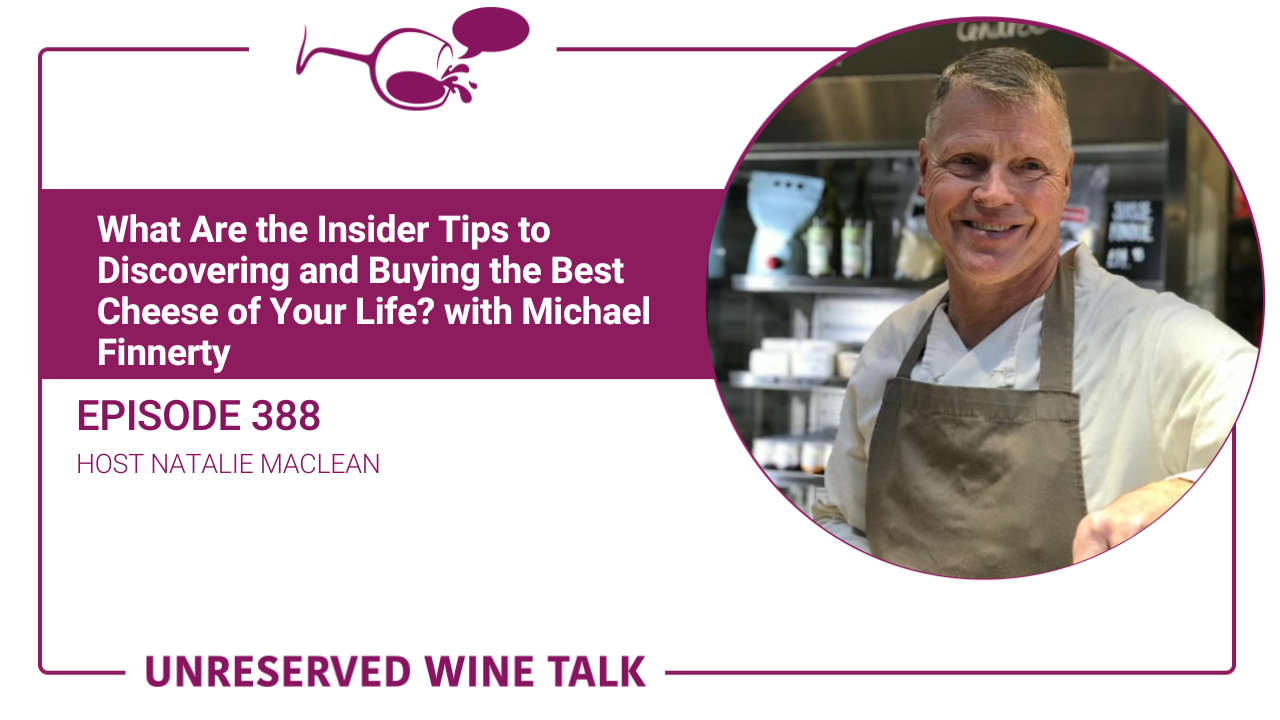
In this episode of the Unreserved Wine Talk podcast, I’m chatting with Michael Finnerty, author of the terrific new book The Cheese Cure: How Comté and Camembert Fed My Soul.
You can find the wines we discussed here.
Giveaway
Three of you are going to win a copy of Michael Finnerty’s new book, The Cheese Cure: How Comté and Camembert Fed My Soul.
How to Win
To qualify, all you have to do is email me at [email protected] and let me know that you’ve posted a review of the podcast.
It takes less than 30 seconds: On your phone, scroll to the bottom here, where the reviews are, and click on “Tap to Rate.”
After that, scroll down a tiny bit more and click on “Write a Review.” That’s it!
I’ll choose two people randomly from those who contact me.
Good luck!
Join me on Instagram, Facebook and YouTube Live Video
Join the live-stream video of this conversation on Wednesday at 7 pm eastern on Instagram Live Video, Facebook Live Video or YouTube Live Video.
I’ll be jumping into the comments as we watch it together so that I can answer your questions in real-time.
I want to hear from you! What’s your opinion of what we’re discussing? What takeaways or tips do you love most from this chat? What questions do you have that we didn’t answer?
Want to know when we go live?
Add this to your calendar:

Highlights
- Why do so many people underestimate the physical labor and other demands behind life as a cheesemonger?
- How does using a cheese iron reveal where a wheel is in its life?
- Why can two wheels of the same Comté taste noticeably different?
- How do grading systems help protect cheese quality?
- Why do locally made cheeses sometimes outperform famous imported cheeses?
- What are the advantages of visiting a cheese shop over supermarkets and bulk retailers?
- How do cheesemongers tell the difference between a cheese that is flawed and one that is stronger than their taste preferences?
- What causes washed rind cheeses to develop those famously funky aromas?
- What made the Hervé Mons 1924 Bleu so unforgettable that Michael describes it as a narcotic cheese?
- Why should you always taste a cheese before buying it?
Key Takeaways
- Why does buying from a good cheese shop often beat picking up a wedge from the supermarket?
- Once you cut a wedge of cheese from the wheel, you are instantly shortening its lifespan, because it’s been taken away from the whole, and it will start to lose flavor. That’s the other thing I would say. Taste it. Always taste. Especially if you’re going to a cheese shop, as opposed to buying it in the supermarket or buying it at one of those bulk retailers where they’ll sell you a big chunk of Comté. The advantage to going to the cheese shop is exactly this. You have a relationship with the mongers, you get to talk to them, you get to taste them, you know what you’re getting. And if you don’t like it, then don’t buy it.
- How do people underestimate the physical labor and other demands of being a cheesemonger?
- N:You were given what you called the cheese talk, a dissuasion technique, delivered by a fellow cheesemonger who worked at your stall. What key points did he use to try to dissuade you from taking this job?
- M: The point of the talk is trying to put you off doing the job if what it is that you want to do is just sell cheese and have a laugh with the customers, and eat cheese. We’ve been talking about all the nice things about cheese, but there’s a lot of not nice things about cheese. They’re messy and sticky and stinky and we have to make sure that there’s a healthy environment, that we’re respecting the food handling rules, all of that requires constant cleaning. Cheeses are heavy. They need to be displayed properly, that means they need to be cut well. For instance, these big alpine wheels are 40kg, almost 90 pounds heavy. And closing down the stall after you’ve spent the entire day on your feet, it’s a lot of work. All the cheeses need all sorts of crazy special care because they’re really fussy. They all have a thing that if you don’t respect them, they’re just going to react badly, and they will get you the next day.
- How does using a cheese iron reveal where a wheel of cheese is in its life?
- N: You write about carotting the Comté, using the cheese iron. What’s happening there? They’re assessing the cheese’s aroma, texture and flavor?
- M: It’s done throughout the life of the cheese. So you’ll get a wheel of, let’s say, Stilton, or a wheel of cheddar or a wheel of Comté in this case… you take the sample out and you take a bit off, and then you put it back in, because you can’t just leave a hole in the cheese, because oxygen will be getting in, etc. So we always will see where it has been carroted in the past and what they’re trying to do as they mature it and what we will then do as well as, you’re trying to, grade the cheese. When it’s leaving the maturation caves, it’s a very serious business. It’s also a serious business for us, but what we’re trying to do is figure out where it is in its life and what its flavor profile is.
About Michael Finnerty
Michael Finnerty is a cheesemonger, journalist, and author based in both London, UK, and Montreal. After almost 30 years of success and acclaim working for the CBC, BBC, and The Guardian, he found joy and a new life selling cheese at London’s iconic Borough Market. Mike has a weekly column on Pénélope on Radio-Canada, works part-time at Global Montreal, but for most of the year, you can find him slinging cheese with the other mongers. Critically acclaimed, The Cheese Cure is his first book.
Resources
- Connect with Michael Finnerty
- Unreserved Wine Talk | Episode 105: Wine and Cheese Pairings to Celebrate the Holidays with Janet Fletcher
- My Books:
- Wine Witch on Fire: Rising from the Ashes of Divorce,Defamation, and Drinking Too Much
- Audiobook:
- Audible/Amazon in the following countries: Canada, US, UK, Australia (includes New Zealand), France (includes Belgium and Switzerland), Germany (includes Austria), Japan, and Brazil.
- Kobo (includes Chapters/Indigo), AudioBooks, Spotify, Google Play, Libro.fm, and other retailers here.
- Wine Witch on Fire Free Companion Guide for Book Clubs
- Audiobook:
- Unquenchable: A Tipsy Quest for the World’s Best Bargain Wines
- Red, White, and Drunk All Over: A Wine-Soaked Journey from Grape to Glass
- Wine Witch on Fire: Rising from the Ashes of Divorce,Defamation, and Drinking Too Much
- My new class, The 5 Wine & Food Pairing Mistakes That Can Ruin Your Dinner And How To Fix Them Forever
Tag Me on Social
Tag me on social media if you enjoyed the episode:
- @nataliemaclean and @natdecants on Facebook
- @nataliemaclean on Twitter
- @nataliemacleanwine on Instagram
- @nataliemaclean on LinkedIn
- Email Me at [email protected]
Thirsty for more?
- Sign up for my free online wine video class where I’ll walk you through The 5 Wine & Food Pairing Mistakes That Can Ruin Your Dinner (and how to fix them forever!)
- You’ll find my books here, including Unquenchable: A Tipsy Quest for the World’s Best Bargain Wines and Red, White and Drunk All Over: A Wine-Soaked Journey from Grape to Glass.
- The new audio edition of Red, White and Drunk All Over: A Wine-Soaked Journey from Grape to Glass is now available on Amazon.ca, Amazon.com and other country-specific Amazon sites; iTunes.ca, iTunes.com and other country-specific iTunes sites; Audible.ca and Audible.com.
Transcript
Natalie MacLean 00:00:00 Why does buying from a good cheese shop often beat picking up a wedge from your supermarket? How do people underestimate the physical labor and other demands of being a cheese monger? And how does using a cheese iron reveal where the wheel of cheese is in its life? In today’s episode, you’ll hear the stories and tips that answer those questions in part two of our chat with Michael Finnerty, author of the terrific new book The Cheese Skewer How Comte and Camembert Fed My Soul. You don’t need to have listened to part one from last week first, but if you missed it, go back and have a listen after you finish this one. By the end of our conversation, you’ll also discover why two wheels of the same comp day can taste noticeably different. How grading systems help protect cheese quality. While locally made cheeses can sometimes outperform famous imported cheeses. How cheese mongers tell the difference between a flawed cheese and one that simply smells or tastes stronger than their personal taste preferences. What causes washed rind cheeses to develop their famously funky aromas? What made the survey among 1924 blue so unforgettable? That Michael describes it as a narcotic cheese, and why you should always taste cheese before buying it.
Natalie MacLean 00:01:26 Do you have a thirst to learn about wine? Do you love stories about wonderfully obsessive people, hauntingly beautiful places, and amusingly awkward social situations? Well, that’s the blend here on the Unreserved Wine Talk podcast. I’m your host, Natalie MacLean, and each week I share with you unfiltered conversations with celebrities in the wine world, as well as confessions from my own tipsy journey as I write my third book on this subject. I’m so glad you’re here. Now pass me that bottle, please, and let’s get started.
Natalie MacLean 00:02:08 Welcome to episode.
Natalie MacLean 00:02:09 388.
Natalie MacLean 00:02:11 So what’s new in the drinks world this week? British Columbia Premier David Eby and Alberta MLA for Boundary Similkameen Raleigh Russell signed a new memorandum of understanding ending the ban on direct to consumer wine sales between the two provinces. Opening up the Alberta market to BC’s 320 wineries that contribute 2 billion to the B.C. economy. And by the way, Alberta does have wineries, but they tend to make wine from fruit other than grapes. So berries and so on. And let’s get into our animal stories, or what I’m going to call going forward this week in fur, feathers and fermentation, a vineyard in South Australia has made headlines this week by employing a guard goose named Gary, of course, to protect its premium Chardonnay grapes from local cockatoos.
Natalie MacLean 00:03:04 Gary has become a local celebrity after a video of him chasing a drone meant to monitor crop health garnered millions of views, proving that nature’s security is sometimes more vigilant than high tech solutions. Meanwhile, a winery in California is offering cat yoga in a cave where participants perform sun salutations among aging barrels of Cabernet Sauvignon, while kittens from a local shelter roam on the mats. The program has been so successful that the winery has reported a 100% adoption rate for the feline tasting assistance in the UK. A hidden stash of pre-war gin was discovered behind a false wall in a London basement during a kitchen renovation. The owner originally thought the bottles were old cleaning supplies, until a local auctioneer identified them as limited. 1930s batch of Gordon’s Gin, which had been perfectly preserved by the cool, dark conditions behind the brickwork. They were worth $2,000 a bottle, just a little more than your Windex. In Japan, a new bar has opened where the cover charge is a piece of original art. The sketch and sip in Tokyo requires patrons to draw a portrait of the bartender before they are allowed to see the cocktail menu, resulting in a wall covered in increasingly abstract and drunken interpretations of the staff.
Natalie MacLean 00:04:29 Though I don’t know how they get drunk if they can’t see the cocktail menu first. Anyway, an artist has created a series of micro masterpieces painted entirely with red wine reductions using a single drop of Malbec. She creates hyper realistic landscapes that change color over time as the wine oxidizes, so the art literally ages on the wall. The shift toward intentional drinking is further evidenced by a recent Nielsen report showing that 53% of North American adults now prioritize the wellness impact of their drink choices over traditional brand loyalty and in science. Did you know that wine grapes are actually the most planted fruit crop in the entire world? We might think of apples or bananas as the global leaders, but there are 18 million acres of vineyards globally. However, because wine grapes have much thicker skins and higher acidity than table grapes, you buy the grocery store, they are virtually inedible as a snack. Proving that nature clearly intended them to be fermented rather than to be eaten for your food and drink. Calendar. This week, Wednesday, May 6th, is a triple bill.
Natalie MacLean 00:05:45 National Beverage Day is wonderfully democratic since tea, tonic, beer, wine and sparkling water all get a seat at the same table. It’s a fine excuse for a build your own spritz bar, a tea cocktail with citrus and honey, or a zero proof pairing flight that runs from kombucha to alcohol free Riesling. May 6th is also International No Diet Day. Founded by British activist Mary Evans Young in 1992 to promote body acceptance and skip the diet culture noise that gives you full permission, of course, to drink something rich like a Sauternes with blue cheese or a fully loaded espresso martini topped with a small mountain of whipped cream. Build a cocktail charcuterie board where every garnish is a deep fried snack. Why not? Or run a blind calorie guest tasting game where the person who picks the most indulgent garnish wins a bottle? And May 6th also marks National Crepe Suzette Day, which all but begs for a flaming pan of orange and Grand Marnier crepes set alight. Or crepes, I don’t know. Crepes crepes set alight in front of unsuspecting guests, ideally paired with a chilled demi cover.
Natalie MacLean 00:06:57 According to legend, this dish was created by accident in 1895 when 14 year old chef Henri Charpentier set a sauce on fire while serving the future King Edward the Seventh at Monte Carlo, and decided to bluff it as innovation. The name Suzette refers to Edward’s dining companion, Mademoiselle Suzette, and it’s National Nurses Day in both Canada and the US, kicking off National Nurses Week, which is a worthy reason to raise a low alcohol by volume spritz. Pour a round of mocktails or host a wine and cheese night where someone else does the work for once. Thursday, May 7th, is National Cosmopolitan Day, a tribute to the cranberry lime vodka classic that became a pop culture accessory before most cocktails had a publicist try a white cranberry version for something less sweet, a blood orange twist, or a mini Cosmo flight in three coupe glasses with three different garnishes. May 7th is also National Roast leg of Lamb Day, a tradition that traces back to ancient Passover rites and spring festivals. It practically begs for a bold, herbaceous Syrah or a classic Bordeaux to cut through the rich fat.
Natalie MacLean 00:08:14 For something playful, try a reverse pairing, where you pick the wine first and require the chef to season the lamb to match the specific notes of herbs, plum or black pepper in the glass. Friday, May 8th this National have a Coke Day wonder who came up with that? Which sits sweetly alongside National Coconut Cream Pie Day. The Coke side opens up a world of variations, from a classic rum and Coke with fresh lime to a Mexican Coke spiked with mezcal and a pinch of sea salt. The coconut cream side marries beautifully with a chilled glass of Sauternes, so turn is definitely on my brain today. Or a Tokai or a coconut rum espresso martini if you’re feeling ambitious. Saturday, May 9th is a full house. It’s World Moscato Day, honoring the aromatic Muscat grape, one of the oldest and most perfumed forward grape families in the world. With origins traced to the southeast Arabian Peninsula thousands of years ago. Pair Moscato with spicy Thai takeout berry pavlova, or pour a low alcohol Moscato d’Asti. They usually come in at only 5 or 6% alcohol at brunch, so that you don’t have to do a full calendar reset.
Natalie MacLean 00:09:26 May 9th is also Europe Day, marking the 1950 Schuman Declaration and the idea of European unity, which is a tidy fit for the wine crowd. Given how many classic wine and spirit traditions come from the continent. Build a European flight that hops from Champagne to Rioja to Greek. Assert co and lay out a tapa style snack board, or mix a cocktail around a continental aperitif like lily, Aperol or a kachi Americano and its National Foodies Day, which is essentially permission to eat dinner at three different restaurants in one night, take an annoying number of photos and call it research. Sunday, May 10th, is Mother’s Day and one of the busiest shipping holidays on the spring calendar. You betcha. We need our wine. Think brunch bubbles, a floral gin cocktail with elderflower and cucumber, or a zero proof garden drink so that everyone has a glass in hand. The smartest move is to pick a bottle she actually likes, rather than one you think she should like. Stop telling me what to do. May 10th is also National Shrimp Day, celebrating a seafood that accounts for more than one quarter of all North American seafood consumption.
Natalie MacLean 00:10:39 That makes it the perfect time to experiment with a manzanilla sherry, a crisp vino verde, or a chilled Muscadet run, a shrimp tail competition where every participant designs a cocktail. Shrimp tail using a prawn as a functional stir or garnish, or host a maritime mimosa brunch with salt rimmed glasses and a splash of pickle brine. Monday, May 11th is Eat What You Want day, which requires no further commentary except that it pairs beautifully with National Low Diet Day. It also kicks off Craft Beer Week, a fine excuse to celebrate by trying a beer from a local brewery you’ve never heard of. Tuesday, May 12th closes the week with National Nutty Fudge Day, a tribute to a confection that gained popularity at women’s colleges in the 19th century, when students secretly cooked up batches in their own dorm rooms after curfew. This calls for a nutty, oxidized tawny port, a French Jellico based fudge flip cocktail, or a boozy fudge flight where each piece is paired with a different cask strength whiskey. you go girls! Back to Mother’s Day on CTV’s The Social.
Natalie MacLean 00:11:50 This week we raise a glass to the woman who shaped us. For some, that’s mom. For others, it’s an aunt, a grandmother, a mentor or a cherished friend. Whoever she is, we honor her and we’re bottling up her best advice and pairing each pearl of wisdom with a wine that was made to deliver it. As a mom myself, I’ve been on the receiving and giving sides of this advice. My son took them to heart. I, on the other hand, was the rebel with her fingers in her ear singing.
Natalie MacLean 00:12:19 La la la la la. Can’t hear you.
Natalie MacLean 00:12:22 Poor mom. She did say you’ll thank me later. Well, this is later, so thank you, mom. All right. What’s the first wine and advice we’re on? Corking. It is a mom. Classic. Always put your best foot forward. So we’re starting off on the right foot with the bread and butter. Prosecco. Made in a small town close to Venice, Italy. Winemaker Linda Trotta works with a family who has owned their winery for 90 years.
Natalie MacLean 00:12:49 The wine’s name itself captures mom’s philosophy do the basics well and don’t overthink it. That’s your bread and butter in life and in the glass. This Prosecco is crafted from Galera Chardonnay and Pinot Grigio grapes, which gives it that fresh orchard fruit character, making this prosecco so charming. It’s approachable, polished, and effortlessly social. That’s mom in a bottle. On the palate, you’ll taste ripe yellow apple, kiwi and peach with soft bubbles that give it a creamy mouthfeel. It’s bright and quietly confident, with a freshness to welcome your Mother’s Day guests and serve throughout the afternoon or evening. This would be lovely with a platter of calamari and mild cheeses. Wine number two pairs with her suggestion to dress in layers, which is mom speak for Canadian weather isn’t always predictable, even if your teenage moods were beach glass. Riesling Pinot Grigio is made at Ontario’s only beachfront winery and named for those smooth, sea worn pieces of glass that you find on the beaches of Lake Erie North Shore. Like mom’s advice, it reveals its polished wisdom with time.
Natalie MacLean 00:14:04 The wine itself dresses in layers. This is a blend of Riesling for a bright top note and Pinot Grigio for its luscious Mellon side. You’ll smell clean, fresh aromas of grapefruit, lemon curd and a cool whisper of sea spray on warm stone. On the palate, it’s layered like a fresh Canadian spring morning crisp at the start, sunny in the middle and a soft mineral breeze on the finish. It tastes like optimism, but with structure. Wouldn’t this be wonderful with a citrus glazed salmon warm off the grill? Why number three pairs with eater greens? No, eat them now. You can’t have dessert. Greens are famously tricky to pair with wine. This mezza Corona Pinot Grigio from Italy wins the match every time. Its zesty acidity and citrus snap make greens taste great and mom will beam. Look at you eating your greens and I didn’t have to even take away your screen time. Mezza Corona is one of Italy’s oldest wine cooperatives, founded in 1904 by farming families working the dramatic slopes of the Dolomites in northern Italy.
Natalie MacLean 00:15:14 Today, more than 1500 small growers still tend those alpine vineyards where cool mountain air and crystalline light give this estate grown and estate bottled Pinot Grigio its signature crispness. Every cluster is picked by hand, which keeps the grapes whole and the aromas pristine. Mesa Corona was practicing sustainable farming long before it became trendy with integrated pest management, water conservation and renewable energy. Mum would call that doing things the right way the first time. The vineyards are in Trentino, in the Italian Alps region that hosted the 2026 Winter Olympics, Meza Corona was just named the best Italian cooperative for the past 25 years at the Mundus Vini 2025 Awards. Mother Earth raised those vines well. The name Meza Corona is the town itself, nestled between Lake Garda and the Austrian border. This is one of the most recognized and loved Pinot Grigio in Canada, and when you taste it, the first thing you want next to it is something garden fresh. Mom will catch you reaching for that salad bowl and smile from across the table. Finally, the moment she’s been waiting for for 30, 40, 50 years, I don’t know.
Natalie MacLean 00:16:37 On the palate, Its zesty and bright, with notes of green apple, white pear and a squeeze of lemon on the finish. This would be beautiful with a buttery spring pea risotto wine. Number four goes with mom’s classic Always Be Yourself. Whitehaven Sauvignon Blanc from New Zealand is always itself no apologies. You know it the second you take a sip. Marlborough Sauvignon Blanc is one of the most recognised wine styles on the planet, and Whitehaven helped define it. The winery was founded in 1994 by Sue and Greg White, who sailed the Pacific Ocean for months before anchoring in the stunning Marlborough Sounds to shelter from hurricane season. In fact, their daughter Samantha spent the first six months of her life at sea. They were inspired to stay there and start a winery. Whitehaven is named for their family and for the place that felt like their safe haven. You can still see the anchor on the label. Now that’s a love story mom would approve of. Whitehaven has achieved the respected Appalachian marble wine accreditation. It’s the gold seal of authenticity for Marlborough wine.
Natalie MacLean 00:17:47 This mark, which you’ll find on the back label, guarantees that what is in the bottle is 100% Marlborough grown fruit in the vineyards certified by sustainable wine, growing New Zealand and blind tasted by an expert panel to guarantee its quality. This wine was also selected for the AMW Annual Collection, a selection of 12 wines that reflect the very best of Marlborough Sauvignon Blanc. So when you pour Whitehaven, you’re getting the real Marlborough Protected, proven and positively delicious. The grapes come from the stony soils of the Wero and Artois river valleys, where bright sunshine and cool nights coax out the wine’s vibrant character. It’s a wine that knows exactly who it is, and that’s something mom always wanted for you to On the palette, you’ll find notes of fresh lemon, white peach, and a zesty lime finish that snaps you to attention. It’s bright, dry, and full of personality. The wine equivalent of mom’s no nonsense pep talk. How great would this be with freshly shucked oysters and a squeeze of lemon? And our final bottle today pairs beautifully with.
Natalie MacLean 00:18:55 Sharing is caring. Mom’s way of saying no one should sit out the toast. French Blume La Rosé is a luxury alcohol free sparkling wine crafted in Lamu in the south of France. It was co-founded by Constance Jablonski and Maggie Frere-Jones. Taittinger, whose name is famous for champagne. It’s made from organic Chardonnay and Pinot noir grapes. Certified vegan halal with no added sugars or sulfites in just 19 calories per glass. French Blume has been named the world’s best alcohol free sparkling wine for three years now, and it’s also the official non-alcoholic sparkling wine of Formula One racing for the next decade. This wine truly lets everyone join the toast, including expectant moms, designated drivers, race car drivers and anyone choosing a mindful moment. Mom’s goal is always to have the whole family around the table together, and with this wine, no one misses that celebratory moment. On the palate, you’ll find wild berries and white peach with a delicate rose petal lift. The bubbles are fine and playful, and the finish is silky with a soft mineral whisper.
Natalie MacLean 00:20:06 How lovely this would be with a delicate tuna tartare on a crown of microgreens. So here’s to the advice that aged better than we expected. And to the woman who waited patiently for us to catch up. Then on CHCH Morning Live, we’re celebrating mom with Canadian wines and craft beer from coast to coast in honor of all that she’s poured into us for years. A lot of it was emotional support and some of it was orange juice we didn’t ask for but drank. Anyway, we’re starting on the West Coast with Joy Farm’s anthem Chardonnay. You’ll always remember where you were the first time you taste it all. Femi is French for with family, which makes it a joyful Mother’s Day poor. The fruit comes from the Kavita and Seacrest Mountain vineyards. Kavita sits on the bench, one of base’s newest and most exciting sub appellations. Winemaker Richard Charnock uses ambient ferments from natural airborne yeast, which means no commercial yeast and no shortcuts. He lets the land and the grapes do the work, the opposite of helicopter parenting.
Natalie MacLean 00:21:13 This wine took silver at the Chardonnay demand, the world’s largest Chardonnay competition, and Richard’s mom is so very proud of him. This wine and the Pinot Noir are available at the Lcbo. Of course, you can order them directly from the winery and they’ll ship them right to your doorstep no matter where you live in Canada. It’s a great way to support small Canadian producers and family farms. On the nose, you’ll get baked pecan meringue, vanilla bean, and fresh white flowers. I love when my tasting notes start smelling like a bakery. There are layers of orchard fruit, sage, tarragon, and a touch of cinnamon to add depth. The finish is long, elegant, and built to age. On the palate, there are subtle mineral notes of wet rock and granite to bring structure. Hints of cherry blossom and big pine needle. Evoke the warmth of the valley. The palate is effortlessly creamy yet lifted by mouthwatering acidity, bright citrus, lemon curd and crisp apple meat, delicate herbs, apple cinnamon and the earthy warmth of sunlit pine trees, finishing with a whisper of strong spice.
Natalie MacLean 00:22:20 This is the Chardonnay that converts the anything but Chardonnay crowd. ABC. Wouldn’t it be heavenly with pan seared scallops in a brown butter lemon sauce? Staying with your.
Natalie MacLean 00:22:31 Firm.
Natalie MacLean 00:22:32 We also have their Pinot Noir. It’s generous and fruit forward with a round, silky texture. This is the wine you want to open tonight, even before our dinner is on the table. On the palate, you’ll get bright cherry raspberry jam and a touch of cinnamon lifted by notes of small violets. It’s like a forest floor. Went to finishing school. The palate carries that signature Pinot silky ness right through a long, gentle finish, and it would be perfect with cedar planked salmon. Now let’s head to the other coast, Nova Scotia, and something worth toasting on March 2nd. Ontario and Nova Scotia signed an agreement that allows small wineries, breweries and distilleries in both provinces to ship drinks straight to your door. Across provincial lines, there’s never been an easier moment or a better one to support a small Canadian producer and delight mums taste buds at the same time.
Natalie MacLean 00:23:25 It’s almost like the government actually wants us to be happy. Go figure. sea level brewing at Millstone Harvest Brewhouse and Farm is nestled in the heart of Annapolis Valley, the only estate brewery in Nova Scotia, which means they grow most of their ingredients on their family farm, including the hops, barley and fruit. They’ve won gold at the Atlantic Brewing Awards for their Blue Heron Extra Special. Bitter Sea Level was only one of ten craft breweries in Nova Scotia when they opened back in 2007. Now there are more than 50 in the province. The Millstone Harvest Pale Ale is their best seller, brewed with 100% farm grown malted barley and a blend of glacier cashmere and Cascade hops. You’ll taste honey, light malt, lemon and a touch of melon with a refreshing lemongrass lift on the finish. This would go beautifully with golden Atlantic haddock, fish and chips. Next up, the raspberry blossom cider. They start with their crisp, dry valley blossom cider made from apples sourced across Annapolis Valley, then blend in fresh pressed juice from raspberries grown right there on their farm.
Natalie MacLean 00:24:39 It’s crisp and dry, with a subtle sweetness balanced by light tartness and juicy raspberry that lingers on the finish. Picture pink sunshine in a glass. It would sing alongside a fresh fruit salad with a honey citrus dressing. And last up from sea level Brewing is their Blueberry Pale Ale. They blend pressed wild blueberry juice from Van Dyck’s farm, a beloved Nova Scotia institution, into Millstone Harvest Pale Ale base. You’ll taste wild blueberry, blueberry jam, honey and a hint of lemon zest all over that gentle pale ale base. It’s like dessert in a pint glass without being too sweet. Two of those four tasting notes are blueberry, which is a level of conviction I respect. This would be wonderful with warm blueberry grunt, that classic Atlantic Canada cobbler dessert. And finally, we’re coming home to Ontario and finishing in our own backyard with the Good Earth Food and Wine Company in Niagara. Good Earth was one of the first farm to table wineries in Niagara. It started as a small cooking school and working farm. Over the years, Open Table has named it one of Canada’s Top 100 restaurants overall and tops for both brunch and lunch specifically.
Natalie MacLean 00:26:00 So when you take mom for a visit, you can treat her to dinner and she can indulge in the ricotta gnocchi or the Wellington County Prime sirloin, and then enjoy some wine on the patio with live music. For weddings, the winery offers a beautiful backdrop of their vineyard. Mom’s been wondering, by the way, when you’re going to pop the question, so get moving along so she doesn’t have to keep nudging you on that. This rosé is a juicy blend of Cabernet Franc and Gamay grapes that burst with aromas of fresh strawberry and watermelon. It has that refreshing, juicy acidity and then it lingers with a finish of sun warmed herbs and wildflowers. It wakes up your senses like a cold splash of water on your face, but way more delicious and socially acceptable. This is a beautiful Niagara expression that holds its own next to European classics. It would be lovely with a fragrant Thai green curry. So here’s to mum, who poured everything into us and now deserves a glass or two to celebrate her. And maybe a quiet room where no one is asking her where their socks are.
Natalie MacLean 00:27:04 On Instagram I’m at Natalie MacLean wine. Come for the drinks. Stay for brunch. Back to today’s episode. Three of you will win a copy of Michael Findlay’s terrific new book, The Cheese Cure How Comp and Camembert Fed My Soul. If you’d like to win a copy, please email me and let me know you’d like to win. It doesn’t matter where you live, I’ll choose three winners randomly from those who. Contact me at Natalie at Natalie MacLean dot com. Keep them for yourself or give them as gifts. If you’re reading the paperback or e-book or listening to the audiobook of my memoir, Wine Witch on Fire rising from the Ashes of Divorce, defamation, and Drinking Too Much, a national bestseller and one of Amazon’s best books of the year, I’d love to hear from you at Nathalie Natalie MacLean. Com. I’ll put a link in the show notes to all retailers worldwide at Natalie MacLean. Com 4388. Okay, on with the show. Now, you weren’t given what you called the cheese talk, a suasion technique delivered by a key.
Natalie MacLean 00:28:05 And I think a fellow cheese monger who worked at your stall called Hmong Cheesemaker. I’m probably butchering the accents here.
James Chatto 00:28:13 Yeah. No, no, it’s my mom’s. You can pronounce the s. It’s a it’s a proper name. It’s named after a okay, a family, actually. Yeah.
Natalie MacLean 00:28:22 So what key points did he use to try to dissuade you from taking this job?
James Chatto 00:28:28 The point of the talk and this, no matter how well you do the talk, it doesn’t always work. And I think actually, Kian was right key in it. He was hard to warm to. He was one of those people. And I’m sure everybody has these people in their life where when you first met them, you thought, is this person going to like me? Is I am I going to like this person? Is this a person that has a good place in my life? And I don’t want to give spoilers to the book, but our relationship does grow and we end up living through a lot of stuff together.
James Chatto 00:29:06 But yeah, Kian was trying to put me off and then that’s what the talk is doing, is trying to put you off doing the job. If what it is that you want to do is just sell cheese and have a laugh with the customers and or eat cheese. Right. We’ve been talking about all the nice things about cheese, but there’s a lot of not nice things about cheese. They’re messy and sticky and stinky, and we have to make sure that there’s a healthy environment that we’re respecting the food handling rules. All of that stuff requires constant cleaning. Cheeses are heavy. They need to be displayed properly. That means they need to be cut. For instance, these big alpine wheels are 40kg, which is what, £90? Or, you know, they’re heavy and closing down the stall after you’ve spent the entire day on your feet is a lot of work. You’re sweeping things. You’re scrubbing things, you’re bleaching things. All the cheeses need all sorts of crazy special care because they’re really fussy.
James Chatto 00:30:10 They have what I like to call in the book riders. You know how like, Mariah Carey wants, like a nice plant in their room, the cheeses want to be wrapped in paper or wrapped in plastic or in a bed of straw. They all have a thing that that if you don’t respect with them, that they’re just going to react badly and they will get you the next day and you’ll taste them and they’ll be like, not very nice. So all of that is a lot of work. And what Kian was trying to do was to say, if you’re not up to it, then you shouldn’t take the job because don’t waste our time sort of thing. And and it still happens. I’m telling you, Natalie, there’s there’s people who’ve taken on the job this year who will leave after two months because they didn’t realize they had to spend the time scrubbing the floor. Right, right. Or in one case, like cleaning the staff toilet. Like who else is going to do it?
Natalie MacLean 00:31:01 Yeah, exactly.
Natalie MacLean 00:31:02 Well, yours. Wine, fashion publishing. A lot of these are romance industries where people like to dabble, and they think, if I have, I like to read, I like to drink wine, I like to eat cheese. Why wouldn’t I want to work in this industry? But it’s work. You know, like I like to say, if you want to open a winery, be sure you want to be a farmer. It’s not that glamorous. It’s fancied up farming or whatever. So anyway.
James Chatto 00:31:26 It’s a ton of work. It’s. And it’s hard work. And there’s a lot of heartache involved as well. Because to get them where they’re fantastic and just in the right place. It’s a lot of blood, sweat and tears.
Natalie MacLean 00:31:39 Sure. So your first task was sweeping for mouse droppings. Manager Tom said to take this seriously. Were you in a quota system with the mice poops or something?
James Chatto 00:31:53 I mean, the mice poops are they’re important to keep track of. This is an open air market, so this is not a shop.
James Chatto 00:32:00 Shops occasionally have most problems. Our shop does not have a mouse problem, but we also have the stall at Borough Market where we have mice and birds and yeah, all sorts of flies and all sorts of little wildlife. Occasionally you will get a squirrel, although not as many as here. What I didn’t know. I didn’t know a lot of things, and I didn’t know almost anything about mice. But they are incontinent, so they just kind of scurry around and they will poop whenever they need to poop. Basically, it’s not an appointment to poop, it’s just the way they poop. What I learned about Archie’s style, too, because we have the pest control, people come around and I always end up chatting with them, and they say that our stall is the cleanest or one of the cleanest in the market, and that the poops are the mice transiting through our stall. Because all the cheeses are locked away, everything has to be sort of airtight and refrigerated at different degrees depending on the cheese and their riders.
James Chatto 00:32:58 And so the reason why you want to know how many poops there are is you can gauge how long the mice are spending in the stall. So it does really actually matter.
Natalie MacLean 00:33:07 Wow. Okay, back to the more savory part of the job. You right.
James Chatto 00:33:14 You’re welcome. You asked for reality I know, I know, I walked right into that.
James Chatto 00:33:19 Sometimes you see the mice. I mean, lately you’ve been seeing. I call them mice. I call them all Max. Max the mouse. Sometimes you see Max, which is surprising. I’m like, Max, what are you doing out here in the middle of the day? But then he’ll scurry away. That’s a kind of. I don’t know why recently, it’s. Sometimes it’s change of seasons.
Natalie MacLean 00:33:37 Okay. You write about correcting the content using the cheese iron, a thin, hollow, sharp edged metal probe that’s plunged deep into the center of an £80 wheel, twisted to remove a small cylindrical core sample known as a plug or a carrot.
Natalie MacLean 00:33:53 Tell me why. What’s happening there? They’re assessing the cheeses aroma, texture and flavor.
James Chatto 00:33:59 The whole thing. And it’s done throughout the life of the cheese. So what, you’ll get a wheel of, let’s say Stilton, or a wheel of cheddar or a wheel of content in this case, that will have the because you take the sample out and you take a bit off, and then you put it back in, because you can’t just leave a hole in the cheese, because obviously that’s not going to work out because oxygen will be getting in, etc.. So we always will see where it has been corrected in the past and what they’re trying to do as they mature it, and what we will then do as well. You’re trying to grade the cheese when it’s leaving the maturation caves. It’s a very serious business. It’s also a serious business for us. But what we’re trying to do is, is figure out where it is in its life and what its flavor profile is. We will send our buyer.
James Chatto 00:34:57 She will go over to the caves and in Switzerland or in France, and she will go through a process of creating the different wheels with the producers. And she’s looking for certain tasting notes in the cheeses that she is choosing. And interestingly with the court, which this is something I actually didn’t realize until the last couple of years. As I’m always learning more about how the business goes. But there’s another major content importer in the UK, and they have a slightly different profile of what they want the content to taste like. And ours has to be something that is not exactly the same, so that what you know that when you’re getting our content, you’re getting a certain profile she’s looking for, that content can taste really different from one to the other. I’m not talking about bad or good. It’s about something like toffee. Like, does it taste or taste a bit more? I think toffee nutty or, you know, something can taste grassy. So she’s trying to get it in that zone so that predictably, the content that you’ll buy from us will taste not exactly the same, but at least sort of similar from wheel to wheel.
Natalie MacLean 00:36:09 Sure. And there again, it reminds me of negotiations. Wine agents. More in the French system that will go around to different growers and select different barrels to raise them, or the l of age or elevate them. But they’re looking for certain distinct characteristics. So when that negotiations name is on the ball, you know, you’re getting a certain style of, say, Burgundy and they use the pipette. Of course, they use that sort of big glass turkey baster to draw from the barrel the carrying of of wine. Now, you mentioned that those scoring 14 or higher get the prestigious green label commit extra, while those scoring 12 to 14 receive the Brown label. It’s only those that are get the highest scores that can be exported, I believe. What do you think about the whole grading system for cheese and wine? Do you think it’s of service or is it problematic in any way?
James Chatto 00:37:07 I think it is of service, very much so. I don’t think what they’re trying to do by grading the content is to stop certain flavors from coming through.
James Chatto 00:37:19 I think they’re trying to stop flaws from getting through. And the cheeses that fall below the standard for the content, Appalachian, are still used. It’s just that the uses that you’ll make of them will be more, for instance, an industrial food production cooking because it is a cheese that you often use to mix into a sauce or a recipe. And when they’re a lower grade, then maybe they’re better for that. We will sometimes when we have a piece of content that has been too long cut from the we’ll, we’ll sell it at a discount as a cooking cheese, which still has its appeal. And one of the parts of the appeal will be the the price being a bit lower, and it’ll be delicious in a recipe. Absolutely. So I think it’s good for us to. So they want to make sure there’s a level of humidity that’s right. That it’s that feels right in the mouth, that it’s not too acidic, a whole bunch of things that they’ll be looking for in order to grade it to, to make sure that it’s of a standard.
James Chatto 00:38:23 I mean, you know, from there, it’s not it doesn’t mean you’re not still going to get variations or even a quality that you don’t like because it’s such a personal thing. There are, frankly, contests that I often get. I always say to people, I’m a big booster of Canadian cheeses or cheeses that are made locally, and there’s a lot of great ones.
Natalie MacLean 00:38:45 What are some of your favorite, by the way?
James Chatto 00:38:47 In our part of the world, there’s a cheese called La Betta Cigar, which I love, which is a sort of Brie, but it’s a little bit punchier, a little bit sort of fuller tasting. It’s made by a co-operative on Yellow Grou. There’s a a washed rind cheese called Limerick, which is a really good price and it’s got lots of great funky notes to it. There’s a Gunns Hill in Ontario, which is terrific. They do a bunch of fantastic cheeses, Stone town, north of London, Ontario. They have some fantastic alpine cheeses. And what I guess I’m saying is that the wild card, when you’re here in North America and you’re importing cheese, is that you don’t know the voyage that cheese is taken as well as, for instance, we would over there.
James Chatto 00:39:42 I suppose that’s true there as well. But, you know, I think you once you cut a wedge of cheese from the wheel, you are instantly shortening its lifespan because it’s now been taken away from the hole and it will start to lose in flavor. it will get drier. and so sometimes you can buy a piece of content. Where in in in Canada. I mean, the same can be true in Europe too. But if it’s if it’s not been cared for properly, it’s not going to taste very nice, even though it has that green ribbon.
Natalie MacLean 00:40:15 Okay, interesting.
James Chatto 00:40:17 And you shouldn’t be afraid of saying so. It’s the other thing I would say. Taste it. Always taste. If you’re going to a cheese shop, as opposed to buying it in the supermarket or buying it at, you know, one of those big retailers, bulk retailers, whether they’ll sell you a big chunk of the advantage to go into the cheese shop is exactly this is you have a relationship with the mongers, you get to talk to them, you get to taste them.
James Chatto 00:40:39 You know what you’re getting. And if you don’t like it, then don’t buy it.
Natalie MacLean 00:40:42 No. That’s true. I should do that myself more often. Asked to taste first. Yes, it’s a great tip.
James Chatto 00:40:49 And fun.
Natalie MacLean 00:40:50 Yes. And fun. And free. I’ll just have a sampling and I’m good.
James Chatto 00:40:54 Yeah, yeah.
Natalie MacLean 00:40:57 Wine. There’s a concept of drinking windows. The period when the bottle’s at its peak. You describe becoming so ripe as to make you wince, and newer cheese mongers wanting to throw it out. One of the cheese mongers finally slices it up and watches people flock to them and snap up. The cheese is knowing when the cheese is truly past its prime, a skill that takes years to develop? Or can you develop a good sense of it, like within a month or two?
James Chatto 00:41:25 What I would say about that is that, weirdly, you have a pretty good sense of when a cheese is past its prime. Just innately, you will taste a cheese notley and say, this has been around too long.
James Chatto 00:41:38 It’s a sort of a mediated taste, or it’s just too strong. We know what you learn is that people don’t have the same tastes as you do. You also learn to respect that. And so I will think this cheese is past its prime in that instance with that varchar, which is a seasonal mountain cheese with a strap of spruce bark around the aside that people will often put it in the oven. It can be really big, and it can be really funky to the point where sometimes when I’m served it, I’m like, I don’t think I want to eat this. It’s just it’s not for me. And then there will be people who will eat that exact same cheese in that exact same situation and say, this is exactly what I was looking for. What I think you learn is you learn not to judge if someone likes that cheese. That’s great. For me, that is a flaw for you. That is what you’re looking for. And now we know it. So I think what we always have to do and when, when a new monger will say, oh, I think there’s something that’s not right with this cheese, with this Tom, for instance, you’ll always say, have you tasted it? And one of the things you do as a monger, and I actually just written a piece about this for a cheese industry magazine is recently I got some pretty gnarly looking pieces of Stilton that had somehow been left on a shelf over the Christmas period.
James Chatto 00:43:07 A lot of people buy Stilton at Christmas, and then there’s all sorts of pieces left over, and I thought that they would have to be discounted or wasted. And after having given them a trim, and I was doing this while I was up there because it was a slower morning, I was doing this at the stall while people were walking by. I gave a taste to one of these gnarly pieces that I had then cleaned up and brushed up, and it tasted so good, Okay, better than what I thought was the wheel that we had that day. And as I was tasting it, a customer was there and said, what is that that you’re tasting that you seemed to like so much? And so I gave him a taste and he said, well, just give me that piece right away. And I was going to mark it down. I was so yeah, that is a valuable piece of cheese I had. And in the case of what you mentioned in the book, people will write off a piece of cheese because either they’ve made a judgement that they haven’t really explored, or that they’re projecting onto the cheese their own tastes.
James Chatto 00:44:07 There are a lot of people who like really strong cheese. I don’t actually like it when it’s that strong, but people will like it. So you just have to make sure that people know this. So what you never want to do is sell a piece of very strong cheese to someone who doesn’t like strong cheese. You want to sell the strong cheese to the person who likes the strong cheese. You need to get to know the customers. You need to respect that. Everybody has different taste buds.
Natalie MacLean 00:44:28 You do talk about the stink questions, people looking for those, the stinky cheese as often some sort of coming of age ritual or freak show mentality. What are they doing? Are they just trying to? Is it like a hazing ritual? I don’t know. Or are there people who just. I want to eat the stinky cheeses all the time?
James Chatto 00:44:48 I think it’s a bit of both. And having just talked about respecting everybody, I have a slight issue with the stink testers because I think that in some cases they are just looking to be grossed out.
James Chatto 00:45:02 Oh, this really tastes rank. Eat it, eat it. And they’re trying to sort of like something to eat.
James Chatto 00:45:10 Something that smells like, you know, a foot that hasn’t been washed for a long time. They’re trying to to kind of like, let’s be honest, it’s often guys, it’s often men who get excited by these strong smells and trying to force people to eat it. It has happened. And it’s in the book where you have a father and their son, and he’s trying to get them to taste, let’s say, a really ripe a plus, as a sort of if you can eat it, then you’re a man sort of thing.
Natalie MacLean 00:45:43 And the applause, just for those who don’t know, kind of smells and tastes like ammonia. Like.
James Chatto 00:45:47 Or if it tastes like.
James Chatto 00:45:49 Ammonia, I would say that that is a flaw. Ammonia is one of those things that I think genuinely is a flaw. But there it will also get really sort of funky. stinky. Yeah. Big.
James Chatto 00:46:03 Aggressive flavored. Meaty. mah. Mighty. and really in-your-face about it. But it’s not always like that, by the way. Sometimes it’s when it’s younger. It really can be one of my favorite cheeses, but also a cheese that I won’t eat. And when it’s in that stage where I won’t eat it, some people think it’s great. So yeah, you’ll get a father trying to force it on a son to try to make a point that they need to.
Natalie MacLean 00:46:31 Get some hair on their chest.
James Chatto 00:46:34 That’s exactly it. And so there is a there is a bit of that. And I think it’s sort of like, you know, we’re just down the road from the London Dungeon. There is a kind of like, freak show thing that goes on with some of the the funny cheeses. I, I’m a bit protective of them because I think I don’t want people to be laughing at the cheeses either. I want them to be respecting them. But honestly, if that’s what you like, then great.
Natalie MacLean 00:46:57 Yes, you are protective. You write that you once leaned into a monster after someone insulted it. You whispered, don’t listen to them. A lot of cheese. Empathy.
James Chatto 00:47:06 Yeah.
James Chatto 00:47:08 Monster really does smell bad. Breath. Or an unwashed part of your body or body odor. Or an armpit. Or it. It really. It just does. I’m sorry.
James Chatto 00:47:23 Sure. Fax is.
Natalie MacLean 00:47:25 Fast. Yes.
James Chatto 00:47:26 And that’s how it smells. It doesn’t. People will say it doesn’t taste like that. And it doesn’t taste like that, I guess.
James Chatto 00:47:32 Yeah.
James Chatto 00:47:32 It’s not my favorite cheese. It tastes sort of sausage and. But it’s. That’s the thing that, Me, it doesn’t work for me, but people will snap it up. People love it and cook with it, and they want that order. But when the when we have like, for instance, wheels of monster sitting out unwrapped, you will sometimes forget that they’re unwrapped and you’ll just be wondering What is Gois? Someone didn’t brush their teeth today or and and then you’re like, oh, it’s because I haven’t wrapped the monster yet.
Natalie MacLean 00:48:06 Well, you also have that word from under from under from an American couple describing a long gray. Longer, a.
James Chatto 00:48:15 Long.
James Chatto 00:48:15 Long.
Natalie MacLean 00:48:16 A pungent.
James Chatto 00:48:17 Wash.
Natalie MacLean 00:48:17 Drawing cows cheese from the champagne region. And you said from underwear. What does that slang term mean?
James Chatto 00:48:26 So I had never heard of before because it was this couple’s words. They invented it. But I have now published it, and maybe someday it will be in a dictionary of cheese tasting notes. I don’t know, but yeah, they said from under and they said it a couple of times and I finally said, excuse me, what are you saying? And I said, from under, from plus under. So from under and I’m from underwear. And they started laughing and they said, well from under the covers. From under your trousers, from under.
James Chatto 00:49:01 That was the words not washed that you referred to earlier.
Natalie MacLean 00:49:04 From down there.
James Chatto 00:49:06 Basically. Yeah. It’s funk. What’s going on with these cheeses is they’re almost if they have that kind of from from under that’s to use the word it’s because they’re a washed rind cheese.
James Chatto 00:49:19 So this is a cheese that as it’s maturing it’s usually not a very it’s not like a dryer is in a container washed as well. But they’re big alpine cheeses and they don’t have that from undergoing on. But in a younger soft cheese that is washed rind like long like Munster, like the one I mentioned, Limerick, which is made in Quebec. Just loads of them. People love them. They’re delicious. What happens is that as the as you wash them with a saline solution, what it’s doing with the pH is it’s encouraging the development of a pair of river bacteria, aurantiaca and linens. And those are the exact. In the case of be linens, that that is the bacteria that grows on your feet.
James Chatto 00:50:07 Oh, wow.
James Chatto 00:50:08 So, yeah.
Natalie MacLean 00:50:09 So specific. Yeah.
James Chatto 00:50:11 Yeah. And the outcome? I’m probably not saying it right. we’ll give it a sort of an orangey hue. Often these cheeses are slightly orange, slightly ochre, sometimes a little bit on the pink side. And they also have this funk, this from under, and that’s why.
James Chatto 00:50:33 But people seek it out. It, it once you start getting into it. It’s pretty delicious. Yeah I mean I don’t like them when they’re super far or big from London but I like them a lot. So I will like a long up to a point. And then I’m like okay that’s for you.
James Chatto 00:50:52 It’s good. Well, it’s almost like developing.
Natalie MacLean 00:50:55 A taste in wine and developing a taste for bitterness and tannins and like a, you know, a Barolo or something. But why do some people douse their long with champagne and set it on fire? What’s happening there? Why are they doing that?
James Chatto 00:51:07 There it is. There are all these. Many of the cheeses are tightly associated with the regions, and so there are just a bunch of customs that then grow up with the cheeses. They become a point of pride. Like, for instance, when we in Borough Market, when French people walk by there, they stick their chests out and they name all the cheeses. They’re so proud of it.
James Chatto 00:51:32 So with long it’s a cheese that as it matures, they don’t flip it like most cheeses are flipped. And so it develops a sort of divot, a little decompression in the center. It looks like an orange brain. It’s really wrinkly. And that’s because of some of the molds on the surface and because of the the bacteria on them. And so I guess people must have at some point thought, well, this divot. Let’s put something in this divot. And because it came from the. It comes still from the champagne region, people will pour champagne in it, but they’ll also set it alight and they’ll set it alight with usually mop the bowl going. So it’s a mark, like a brandy, like an OTV from Burgundy. And then they’ll light it and it’ll get us. I guess it’s the same way that you might light it. Dessert for.
James Chatto 00:52:29 Instance.
Natalie MacLean 00:52:29 Flambé.
James Chatto 00:52:30 It’s. Yeah. Exactly. And and it’s a sense of ceremony too. And I’ve not done it. Maybe I need to do it.
James Chatto 00:52:39 For the next.
James Chatto 00:52:39 Book we ever meet. We’ll do it.
James Chatto 00:52:41 Oh, yes. Of course. Yes.
James Chatto 00:52:42 Let’s do.
James Chatto 00:52:42 One minute.
Natalie MacLean 00:52:44 Just for the heck.
James Chatto 00:52:45 Of it.
James Chatto 00:52:45 You choose the wine?
James Chatto 00:52:46 Yeah.
Natalie MacLean 00:52:46 We’ll drink in the champagne, though. We’re not lighting it on fire.
James Chatto 00:52:50 okay. I don’t do that to champagne.
Natalie MacLean 00:52:55 Oh, I want to get to the 1924 cheese. I think you call it a narcotic cheese. And it caught you in a trance. But you mentioned this at the outset, so the whole Appalachian system came into being with Roquefort 1925. Therefore, they’ve got this saucy little blue cheese called 1924. What are they saying with that?
James Chatto 00:53:17 So this is a recent cheese. And what they’re doing, it’s a it’s a it’s it’s sort of inside baseball for, for cheesemakers. But what they were setting out to do. People are always trying to make new cheeses because people do and they’re trying to make new they make new wines. And and so you have the, the wines that people know and love and that have a history and a tradition.
James Chatto 00:53:42 And then you have these new ones that come along. And in the case of 1924, it’s a relatively new cheese less than ten years. They set out to try to make a cheese that was the love child of Stilton and Roquefort. So Roquefort is made with sheep’s milk and Stilton is made with cow’s milk. So they did a blend of a cheese. And the reason they called it in 1924 is because it is the same shape as a Roquefort. So it’s a wheel about yay big. And it has the same sort of bluing in the paste and the same moist paste, but it has cosmic in it. And to be a Roquefort it has to be only sheep’s milk. Okay, but what these guys were saying was actually back in 1925, some people did make Roquefort with cow’s milk and sheep’s milk, but now you can’t. So that’s the point of the 1924. So the 1924 just happened to be that cheese that sort of knocked me off for the very first time, knocked me off my chair.
James Chatto 00:54:46 Basically, when I tasted it, it was so delicious, so transcendent. It was so many things were happening with it at the same time. And it was it was ticking every single box because it had the creaminess, but it also had the buttery ness because it’s a mix of sheep and cows milk. Sheep has a bit more fat in it. It has this line of sweetness in it that Roquefort Roquefort can have sweetness to, and it can. It’s tends to be a bit fruity, but this has a sort of sweetness that I associate with Oreo cookies. Yeah, exactly. Plus all the funkiness, plus the the blue flavors and all of that together was just.
James Chatto 00:55:27 Wow.
Natalie MacLean 00:55:27 I’ve got to find that cheese.
James Chatto 00:55:29 That sounds like what.
Natalie MacLean 00:55:30 You call a narcotic cheese.
James Chatto 00:55:31 Right?
James Chatto 00:55:32 Not a great cheese. I mean, the the problem is, is that not every wheel is going to taste like that. So it just it just happened that when I began working, there was a batch that was Blow your mind.
James Chatto 00:55:47 It had weird sort of yellow mold on it too, which I always associate with being like almost like a highlighter pen which has a name. And I’ve forgotten it because I’ve only been in the business for a few years, but other like super serious cheese people will know exactly what it is. And yeah, somehow it tasted just that good that I couldn’t stop eating it. And I had low self-control at that point in my career. And so I was like, I basically pretty much had 1924 smeared on my face as I was.
James Chatto 00:56:18 That’s great. Sorry. Oh, you.
Natalie MacLean 00:56:21 Call those cheeses narcotic? I call certain wines that are so good intervention wines. Meaning I need an intervention to stop.
James Chatto 00:56:29 I need a family meeting. Why we’ve.
Natalie MacLean 00:56:32 Brought you here is you’re drinking too much of that.
James Chatto 00:56:34 Rosé.
James Chatto 00:56:35 But I’m going to steal that word. I love that word.
James Chatto 00:56:38 I’m going.
James Chatto 00:56:39 I’m taking it.
Natalie MacLean 00:56:40 Please. It’s yours. But you refer to one customer, maybe Gwendoline Christie. She was the actress who played Brienne of Tarth in Game of Thrones TV series.
Natalie MacLean 00:56:52 You weren’t sure though, if it was her, but she liked she liked that 1924. She’s right. You said she ordered impossibly large pieces of it.
James Chatto 00:57:01 Yeah. So she. She would come up to the store and a big, imposing, English woman with a shock of blonde hair. I mean, I just sometimes get nervous about asking people. Who are you? And she. She came up to this, to this doll and said, I’m looking for a cheese. I can’t remember the name of it, but it’s it’s a year. It’s four digits, 19, 24. That’s it. And I said, okay, well, we have someone here. I’ll take a slice. I’ll take a slab. An impossibly large slab. Yeah. So she really was super keen on it. And she I said, would you like to taste it? And she said, I mean, I want to eat it. I don’t feel I need to taste it. But I said to her, look, you, you should taste it.
James Chatto 00:57:44 And I will say to everyone listening, even if you have had it in the past, even if you love it, even if it like, blew your socks off. Yes, if you can taste.
Natalie MacLean 00:57:55 It, taste.
James Chatto 00:57:56 It, taste it.
Natalie MacLean 00:57:57 I can see now with all the variables that it might not be the same thing. Yeah.
James Chatto 00:58:01 Not. And and and you could end up with a great surprise, but you could also be disappointed. And if you’ve tasted it, you’re not going to be disappointed. You’ll know it’s going to taste like that. You’ll taste it and you’ll say, oh, well, this is not the same as I remember it. And and you know what? It’s not the same as you remember it, because it’s not the same cheese. It’s a different wheel. It was made at a different time of year. it was probably milk from a different animal. It might have been made by a different cheesemaker. It might have been made at a different site. so many things.
Natalie MacLean 00:58:33 What is the strangest question that a customer has ever asked you?
James Chatto 00:58:37 I think the strangest thing that I have ever seen at the. I’ve seen a lot of strange things. By the way, Natalie, you see, I mean, anyone working with the public sees a lot of strange things, and we have a lot of tourism, so you get a lot of strangeness. But I think the strangest thing was a woman who came up once to the stall and tasted through just loads of Jesus, and she said, I’m looking for a round cheese. And I thought at first it was because she was looking for a specific cheese that she remembered was round, but she just, I think didn’t. She didn’t like the triangles. She didn’t like the look of them. She didn’t like the pyramids. She didn’t like the square ones. She didn’t like the big wedges of alpine cheeses. She just wanted, a little round cheese. I think she wanted a circle.
Natalie MacLean 00:59:35 Well, we’re happy to oblige.
James Chatto 00:59:37 Yeah, yeah, I was super happy we found it.
James Chatto 00:59:40 She was so happy.
Natalie MacLean 00:59:41 There you Very cool. And that’s what was important in the end.
James Chatto 00:59:44 Yeah.
Natalie MacLean 00:59:45 Michael, there were so many cheeses I wanted to ask you about. As you like. Just different types. Your your book has so many, you know, from gateway cheeses to the history of mistresses and kings and queens. We’re not going to get to them all. So people definitely have to get your book, the Cheese QR, because they will have endless dinner party details and stories to share and impress. But just to the joy of learning about cheese for themselves and following your journey. Much as I hesitate, I’m going to wrap it up, but is there anything we haven’t covered that you would like to mention before we do?
James Chatto 01:00:24 I suppose this is a bit of advocacy, but yeah, I would say that one of the things that is important for those of us here in Canada, the same is true of the UK, is raw milk cheeses are fantastic. raw milk cheeses which are made from milk that’s not pasteurized.
James Chatto 01:00:42 So there’s an elevated risk factor working with unpasteurized milk, but it’s different. Drinking the liquid unpasteurized milk and making cheese with it. And currently there are import restrictions here in the United States. It’s even harder to get unpasteurized cheeses. They’re so good. And they’re and we don’t. And they are when they’re done right. They are absolutely safe to eat. And there are more interesting things happening with them. I would say if you’re a foodie and you have the power to sort of say things to politicians, let’s try and loosen up a bit on the restrictions on on raw milk cheeses and try them when you go to France and they by the way, you we can sell raw milk cheeses here and there are a number of them here in Canada. Give them a try. See what you think.
Natalie MacLean 01:01:39 I will.
Natalie MacLean 01:01:40 Yes. Good advice. That’s great. Michael, where can we find you and your book? Online.
James Chatto 01:01:47 So it’s pretty easy to find the cheese cure. You will find it at. You know, all the big online retailers.
James Chatto 01:01:57 You can order it from the big Canadian and American bookshops. It has the UK edition. There’s an audiobook which you have to get from audible in the UK or another source in the UK, and there’s going to be paperback editions that are going to be coming out in May in the UK and in September in North America.
Natalie MacLean 01:02:19 Terrific. Well, congratulations on this book. It’s just a marvelous read for so many reasons. But yeah, next time we’ll have to bring our pipette and our carrot and our have a little toast and burdensome non champagne and eat lots of cheese.
James Chatto 01:02:37 And Cheese party? Absolutely.
Natalie MacLean 01:02:39 Wouldn’t that be fun?
James Chatto 01:02:41 Absolutely. It would.
Natalie MacLean 01:02:42 Be.
Natalie MacLean 01:02:43 This has been a delight. Michael.
James Chatto 01:02:44 Thank you for letting me. It’s been a real pleasure chatting and lovely to speak to everyone out there. Who are your regular podcast listeners? From viewers. And. Yeah. Eat some cheese. Yes. Taste the cheese.
Natalie MacLean 01:02:57 Taste.
James Chatto 01:02:58 The cheese. See what you like and push your boundaries.
Natalie MacLean 01:03:02 Absolutely. Cheers to that.
Natalie MacLean 01:03:09 Well, there you have it. I hope you enjoyed our chat with Michael. Here are my takeaways. Number one, why does buying from a good cheese shop often be picking up a wedge from your local supermarket? As Michael explains, once you cut a wedge of cheese from the main wheel, you’re instantly shortening its lifespan because it’s been taken away from the hole and it will start to lose flavour. The other thing is taste. Always taste, especially if you’re going to a cheese shop as opposed to buying it in the supermarket. The advantage had a cheese shop is exactly that. You have a relationship with the cheese mongers. You get to talk to them, taste with them, and you know what you’re getting. Number two, how do people underestimate the physical labor and demands of being a cheese monger? Well, Michael explains, he got the cheese talk, the dissertation technique delivered by a fellow cheese monger to discourage him from taking the job. And as he says, if all you want to do is sell cheese and have a laugh with customers and eat great cheeses, go away.
Natalie MacLean 01:04:10 Cheeses are messy and stinky and sticky, and they have to make sure there’s a healthy environment. So they’re respecting all the food handling rules, which requires constant cleaning. Cleaning cheeses are heavy and have to be displayed properly and cut well. The big alpine wheels are 40kg or almost £90, and when you close down the stall and you’ve spent the entire day on your feet, it’s a lot of work. All the cheeses need crazy special care because they’re fussy and they all have a thing. They need to be wrapped away in particular papers or different respects. And if you don’t do it correctly, they will get you the next day. And finally, how does using a cheese iron reveal where a wheel of cheese is in its life? So Michael writes about correcting the comp day and he says it’s done throughout the life of a cheese. You have a wheel, say Stilton or cheddar or Comte. You take a sample out, take a little bit out or off, and then put the rest back in because you can’t leave a hole in the cheese.
Natalie MacLean 01:05:14 The oxygen would get in and you see where it’s been corrected in the past. And what we’re trying to do, he says, is mature it to its peak. Sometimes you’re also trying to grade the cheese when it’s leaving the maturation caves. This is a very serious business. All right. If you missed episode 105, go back and take a listen to chat about festive wine and cheese pairings with author Janet Fletcher. I’ll share a short clip with you now to whet your appetite.
Janet Fletcher 01:05:45 There are lots of similarities. You know, to me, one of the biggest ones is that cheese makers like winemakers start with the simplest palette of ingredients. They have milk and they have cultures and they have rennet, just like winemakers have grapes and yeast, grape juice, fresh liquids.
Natalie MacLean 01:06:03 That are going to be fermented. Yeah.
Janet Fletcher 01:06:05 What gives us such a range of taste experiences in the cheese world, of the wine world are the decisions that the producer makes along the way to take it in one direction or another. And of course, with wine, there’s a little more of that place element that comes into play, a little bit less so with most cheeses, but with cheese it’s more that the cheese maker makes a million little decisions all along the way.
Janet Fletcher 01:06:27 In that recipe that takes milk and cultures and a little bit of rennet and makes so many different kinds of teeth.
Natalie MacLean 01:06:39 You won’t want to miss next week when we chat with Doctor Charles Knowles, the New York Times bestselling author of Why We Drink Too Much. The New Science of Alcohol. And to give you a taste of future guests, we’ll have Millie Milliken on artisanal tequila, Nick Fogg on the wines of Japan. Professor Mark Salata on the intersection of wine and religion. Doctor Dave Nutt on wine and health. Ben Hawkins on port and Sherry. Global bartending champion Caitlin Stewart on fresh new cocktails. Humorist Marie Chevrier on how to sound wine smart. Cara Newman on 40 cocktails to close out any evening. James Chatto on the iconic recipes and drinks that have shaped our taste. Liz Gabay on rosé. Christiane Rester on Sark and Marisol de la Fuente on the wines of Argentina. Do you have a question for any of our guests? Please let me know. Do you know someone who would be interested in learning more about buying and enjoying cheese? Please let them know about the podcast.
Natalie MacLean 01:07:43 Email or text them now while you’re thinking about it. It’s easy to find the Unreserved Wine Talk podcast. Just tell them to search for that title or my name Natalie MacLean Wine on Apple Podcasts, Spotify, their favorite podcast app, or they can listen to the show on my website at Natalie MacLean. Podcast. Email me if you have a sip dip question, or if you’d like to win one of seven drinks books I have to give away. And yes, those future guests will also be giving away books so you can get a jumpstart by contacting me now. I’d also love to hear your thoughts on this episode, or if you’ve read my book or are listening to it. Email me at Natalie at Natalie MacLean. Com. In the show notes, you’ll find a link to take a free online food and wine pairing class with me called the Five Wine and Food Pairing Mistakes that can ruin your dinner and how to fix them forever at Natalie MacLean. And that’s all in the show notes at Natalie MacLean. Thank you for taking the time to join me here.
Natalie MacLean 01:08:44 I hope something great is in your glass this week. Perhaps a wine that pairs beautifully with a cheese that you tasted before buying it at your local cheese shop.
Natalie MacLean 01:08:59 You don’t want to miss one juicy episode of this podcast, especially the secret full bodied bonus episodes that I don’t announce on social media. So subscribe for free now at Natalie MacLean. Meet me here next week. Cheers!