






Introduction
Why did this author start the book with tasting, rather than history, regions or grapes? Was that because you wanted to get right into the sensory experience, rather than maybe some of the drier knowledge? Why is your experience of what tastes good as personal as a fingerprint? When it comes to wine, what do you mean by structure? Why are these important, these structural components? Do you think they matter more than identifying that, that wine’s from Burgundy, that wine’s from Bordeaux?
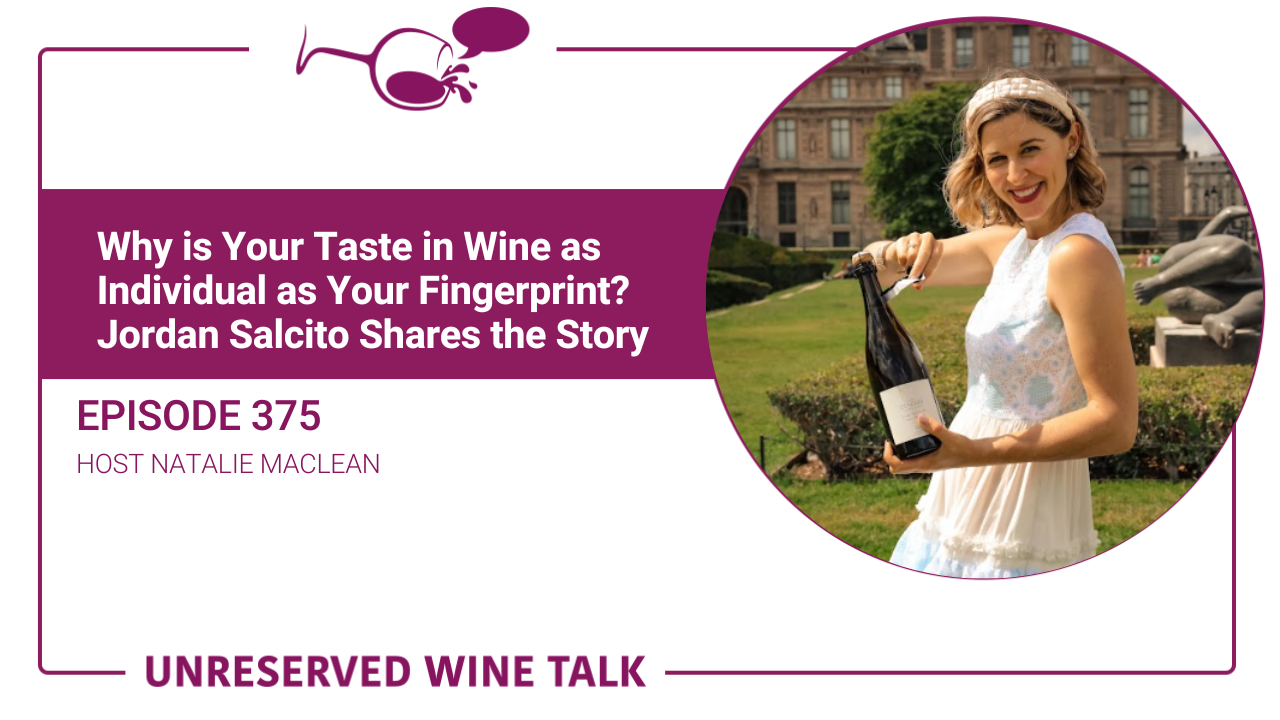
In this episode of the Unreserved Wine Talk podcast, I’m chatting with Jordan Salcito, author of Smart Mouth: Wine Essentials for You, Me, & Everyone We Know.
You can find the wines we discussed here.
Giveaway
Three of you are going to win a copy of Jordan Salcito’s terrific new book, Smart Mouth: Wine Essentials for You, Me, and Everyone We Know.
How to Win
To qualify, all you have to do is email me at [email protected] and let me know that you’ve posted a review of the podcast.
It takes less than 30 seconds: On your phone, scroll to the bottom here, where the reviews are, and click on “Tap to Rate.”
After that, scroll down a tiny bit more and click on “Write a Review.” That’s it!
I’ll choose three people randomly from those who contact me.
Good luck!
Join me on Instagram, Facebook and YouTube Live Video
Join the live-stream video of this conversation on Wednesday at 7 pm eastern on Instagram Live Video, Facebook Live Video or YouTube Live Video.
I’ll be jumping into the comments as we watch it together so that I can answer your questions in real-time.
I want to hear from you! What’s your opinion of what we’re discussing? What takeaways or tips do you love most from this chat? What questions do you have that we didn’t answer?
Want to know when we go live?
Add this to your calendar:

Highlights
- Why does our first impression of a wine’s aroma matter more than we realize
- Why did Jordan ultimately walk away from the Master Sommelier service exam?
- How did the title Smart Mouth come together and capture the spirit Jordan wanted for the book?
- Why did Jordan choose to begin Smart Mouth with tasting instead of regions, grapes, or wine history?
- Why does Jordan see point scores and rigid wine hierarchies as a form of ego rather than a useful guide for drinkers?
- How do different people visualize or conceptualize wine while tasting?
- How does Jordan’s concept of wine personas differ from traditional tasting language?
- What does the TALL framework explain about wine structure?
- How can simple sensory exercises help drinkers identify tannin, alcohol, acidity, and earth driven flavors with confidence?
Key Takeaways
- Why did this author start the book with tasting, rather than history, regions or grapes? Was that because you wanted to get right into the sensory experience, rather than maybe some of the drier knowledge?
- Okay, so it was exactly that. That is also the question that I get asked the most often like, “Hey, I had this wine that I liked, why did I like it?” or “How can I find another wine like this?” And so I thought of that as the most empowering way to approach wine. Whether you’re new to wine or more familiar with it, it’s sort of like, why is it that we resonate with the things that we do? And then the other thing I hoped to do with this book is sort of peel back a little bit this idea of like, what resonates with us is almost always a value system as well. So trying to give people more tools to think about their own value system in regards to wine.
- Why is your experience of what tastes good as personal as a fingerprint?
- One other little interesting tidbit I uncovered while researching this book: We all have between 2 and 10,000 taste buds. So there are a lot of taste buds, but some of ours work and some of them don’t, and they’re all configured differently. So our appreciation for what is good and what is delicious is as individual as a fingerprint. That for me was a good reminder. My husband, who is extremely knowledgeable about wine… we went on a vacation over the summer that celebrated our wedding anniversary of 17 years, but we had two different wines. I wanted this wine from Liguria that I love. It’s not a fancy wine, it’s an excellent wine and he was like, No, this is a very special moment. I want to drink the fancier wine. When we had two different wines, it was like his wine was perfect for him and mine was perfect for me.
- When it comes to wine, what do you mean by structure? Why are these important, these structural components? Do you think they matter more than identifying that, that wine’s from Burgundy, that wine’s from Bordeaux?
- I think so much of those are part of the same conversation. Like a Bordeaux is going to Cabernet or Merlot, but a sort of thicker-skinned grape that is going to have more tannin, that’s going to be darker, the tannins have to be managed differently because the skins are so much thicker. The acidity is a different scenario. The climate is different. Versus Burgundy, where it’s a thinner-skinned grape, but it’s Pinot Noir, and even though it’s a thin-skinned grape, it still has a lot of tannin. It’s not better or worse, but it’s just different. So when you’re thinking about do I want to sip on this wine or do I need some snacks to have nearby or is this really like a sort of wine for dinner versus a wine for apero, there’s the interplay, there’s the flavor, which is very much part of the aroma. We forget that smell and taste are basically the same thing.
About Jordan Salcito
Jordan Salcito is an award-winning sommelier, author, and entrepreneur. A wine industry veteran, she has over a decade of experience as a sommelier at restaurants including Momofuku, Restaurant Daniel, and Eleven Madison Park (where she was part of the team to win the award for Outstanding Wine Service from the James Beard Foundation). Her wine programs at Momofuku were regularly recognized in The New York Times, Eater, and Food & Wine, and were named “Most Creative Wine List in the World” by the World of Fine Wine magazine.
Long a student of wine, Salcito passed the tasting portion of the Master Sommelier exam on her first attempt and feels fortunate to have learned so much though working harvests at world-renowned wineries in Burgundy, Tuscany, California and Patagonia.
A pioneer of the ready-to-drink beverage category with her organic Italian spritz company, Drink RAMONA, Salcito will also publish her first book, Smart Mouth: Wine Essentials for You, Me, & Everyone We Know, with Penguin Random House’s Ten Speed Press this October. Jordan lives in Paris with her family.
Resources
- Connect with Jordan Salcito
- Website: DrinkRAMONA.com
- Book: Smart Mouth: Wine Essentials for You, Me, and Everyone We Know
- Instagram:
- Unreserved Wine Talk
- My Books:
- Wine Witch on Fire: Rising from the Ashes of Divorce,Defamation, and Drinking Too Much
- Audiobook:
- Audible/Amazon in the following countries: Canada, US, UK, Australia (includes New Zealand), France (includes Belgium and Switzerland), Germany (includes Austria), Japan, and Brazil.
- Kobo (includes Chapters/Indigo), AudioBooks, Spotify, Google Play, Libro.fm, and other retailers here.
- Wine Witch on Fire Free Companion Guide for Book Clubs
- Audiobook:
- Unquenchable: A Tipsy Quest for the World’s Best Bargain Wines
- Red, White, and Drunk All Over: A Wine-Soaked Journey from Grape to Glass
- Wine Witch on Fire: Rising from the Ashes of Divorce,Defamation, and Drinking Too Much
- My new class, The 5 Wine & Food Pairing Mistakes That Can Ruin Your Dinner And How To Fix Them Forever
Tag Me on Social
Tag me on social media if you enjoyed the episode:
- @nataliemaclean and @natdecants on Facebook
- @nataliemaclean on Twitter
- @nataliemacleanwine on Instagram
- @nataliemaclean on LinkedIn
- Email Me at [email protected]
Thirsty for more?
- Sign up for my free online wine video class where I’ll walk you through The 5 Wine & Food Pairing Mistakes That Can Ruin Your Dinner (and how to fix them forever!)
- You’ll find my books here, including Unquenchable: A Tipsy Quest for the World’s Best Bargain Wines and Red, White and Drunk All Over: A Wine-Soaked Journey from Grape to Glass.
- The new audio edition of Red, White and Drunk All Over: A Wine-Soaked Journey from Grape to Glass is now available on Amazon.ca, Amazon.com and other country-specific Amazon sites; iTunes.ca, iTunes.com and other country-specific iTunes sites; Audible.ca and Audible.com.
Transcript
Natalie MacLean 00:00:00 Why did the author of this wine book start with tasting and the sensory experience rather than history, regions or grapes? And was that the reason, perhaps, or one of them, why this book was chosen as one of the best four wine books of this year? Why is your experience of what tastes good, whether it’s wine or anything else, is personal as a fingerprint. And when it comes to wine, what do we mean by structure? In today’s episode, you’ll hear the stories and tips that answer those questions in Part Two of our chat with Jordan Salcito, who has published Smart Mouth: Wine Essentials For You, Me and Everyone We Know, which was, yes, just selected as one of the four best wine books of the year by the New York Times. You don’t need to have listened to Part One from last week first, but if you missed it, go back and have a listen after you finish this one.
Natalie MacLean 00:01:04 By the end of our conversation, you’ll also discover why our first impression of a wine’s aroma matters more than we realize. Why Jordan ultimately walked away from the Master Sommelier Service exam. How the title Smart Mouth came together and captured the spirit Jordan wanted for the book. Why Jordan sees point scores and rigid wine hierarchies as a form of ego, rather than as a useful guide for drinkers. How different people visualize or conceptualize wine while tasting. How Jordan’s concept of wine personas differs from traditional tasting language. What the TALL framework explains about wine structure. And how simple sensory exercises can help drinkers identify tannin, alcohol, acidity, and earth driven flavors with confidence.
Natalie MacLean 00:01:53 Do you have a thirst to learn about wine? Do you love stories about wonderfully obsessive people, hauntingly beautiful places, and amusingly awkward social situations? Well, that’s the blend here on the Unreserved Wine Talk podcast. I’m your host, Natalie MacLean, and each week I share with you unfiltered conversations with celebrities in the wine world, as well as confessions from my own tipsy journey as I write my third book on this subject. I’m so glad you’re here. Now pass me that bottle, please, and let’s get started.
Natalie MacLean 00:02:36 Welcome to episode 375. So what’s new in the drinks world this week, you ask? Well, JP Wieser’s 24 year old was named Canadian Whiskey of the year at the 2026 Canadian Whiskey Awards, reinforcing the growing reputation of aged Canadian expressions. Other producers, such as Pike Creek and Lot 40 also earned recognition, signalling depth across the category rather than isolated success. Inter-provincial wine shipping reform continues to be a major discussion point, with negotiations aimed at expanding direct shipping of Canadian wine across the provinces by May 2026. If implemented without excessive fees, this could significantly improve access to premium Canadian wines beyond their home provinces. And finally, Canadian distilleries are investing heavily in education and craft storytelling, from grain to glass transparency to formal tasting programs and collaborations with culinary schools. These efforts are shaping a more informed consumer base that is increasingly willing to explore premium Canadian spirits with intention and curiosity. The ready-to-eat cocktail trend is officially taking over with high end bars now serving gelatin based spheres that burst in the mouth, or drinks topped with chewy foams.These playful serves are designed to offer a sense of silly escapism for patrons who are tired of the serious, stirred down classics. Yawn. A new premium matcha liqueur was launched this week, but with a warning for bartenders. The natural chlorophyll makes it so light sensitive that it comes in a completely opaque, UV shielded bottle to prevent the vibrant green spirit from turning a dull, swampy brown. If left out on a sunny back bar, that’s not tasty.
Natalie MacLean 00:04:27 In Argentina, the historic Bodega Norton, the winery, is currently embroiled in what local media are calling a mega bankruptcy involving a family feud worthy of a prestige TV drama. The legal battle has frozen assets and barred directors from leaving the country, proving that vintage family squabbles can be just as dramatic as those in the media industry in real life. The Ellison’s bid for Warner Brothers. And in fiction, one of my favourite TV series, Succession. For your calendar, this is Le Poutine Week, and it’s running nationwide from February 1st to the 7th. While food focused, the event has become a meaningful showcase for local beverage pairings, with many restaurants highlighting Canadian beer, ciders and wines, along with creative poutine offerings giving smaller producers national visibility. February 4th celebrates National Homemade Soup Day. Soup pairs beautifully with a crisp, aromatic white, such as an Ontario Riesling or cool Climate Chardonnay, where the acidity cuts through the richness. By the way, did you know the word restaurant actually comes from the French word for restorative, referring to the restorative soups sold by early French eateries in the 18th century. National Stuffed Mushroom Day is also February 4th, so lean into this umami dish, making them a great match for structured reds or smoky barrel aged whiskey. It’s a busy day on February 4th. It’s also Medjool date day. The large, sweet and soft varieties of dates often called the Queen of dates, known for their rich, caramel like flavour and chewy texture, making them a popular natural sweetener and energizing snacks distinct from smaller, firmer dates like Deglet Noir. They’re packed with fiber, potassium, and other minerals enjoyed fresh and in various recipes. Medjool dates shine alongside a tawny port or rich fortified wines, especially when stuffed with goat cheese and honey. Not the wines. The dates.
Natalie MacLean 00:06:26 I Heart Horror Day, an annual fan driven celebration of the horror genre typically held in or around February 4th, honours the shared birthdays of horror icons George A. Romero and Alice Cooper. This event brings fans together for community, charity and appreciation of all things spooky and macabre. It’s also a great excuse to open a dark stout or a smoky Islay style whiskey while revisiting classy, spooky films or campfire stories. February 5th is National Chocolate Fondue Day and World Nutella Day both perfect for indulgent pairings. Melted chocolate paired surprisingly well with sparkling wines, especially your sparkling reds. As the bubbles refresh the palate between bites, Nutella flavours can be echoed in hazelnut liqueurs or brown spirit cocktails with a creamy texture leaning into dessert style sipping without being cloying. Nutella, by the way, was born from necessity. During World War Two, cocoa shortages in Italy’s Piedmont region prompted pastry maker Pietro Ferrero – recognize that name? – stretched limited cocoa supplies by adding abundant local hazelnuts. The name didn’t appear until 1964, when his son Michel Ferrero rebranded the spread. Today, Ferrero, the chocolate maker, uses 25% of the world’s entire hazelnut supply, and one jar is sold every 2.5 seconds globally.
Natalie MacLean 00:07:59 February 6th is National Chopsticks Day. Celebrate with Sake pairings or try Japanese whiskey with sushi. Make homemade dumplings and pair them with a crisp Riesling or sparkling wine. Chopsticks have been used for over 5000 years, first appearing in China. Originally used for just for cooking, they transitioned to eating utensils around 400 A.D. when the population growth made fuel scarce, leading to smaller food pieces that cooked faster. February 6th marks National Frozen Yogurt Day. Tart frozen yogurt works nicely with lightly sweet wines like a Moscato or an off dry Rosé, offering contrast rather than competition. February 7th is International Pisco Sour Day and National Fettuccine Alfredo Day. This is a perfect surf and turf celebration day. Start with a pisco sour aperitif, which is pisco, lime juice, simple syrup, egg white and Angostura bitters, then moved to fettuccine Alfredo paired with a buttery Italian white like Gavi or a Soave. Soave is not that buttery, but it would still go well with the dish. The Pisco Sours origin story involves an American bartender, Victor Morris, who ran out of whiskey at a railway completion party in Peru around 1904 and improvised with pisco. Both Peru and Chile claimed the cocktail as their national drink, creating an ongoing rivalry. Peru made National Pisco Sour Day an official government holiday in 2003. That’s my kind of bureaucracy.
Natalie MacLean 00:09:33 February 8th brings National Potato Lovers Day. Yes, and National Molasses Bar Day. Potato based dishes pair naturally with vodka, particularly those made from prairie grains or potatoes, whether served chilled or in a simple martini, molasses bars lean into dark, warm flavours that work beautifully with rye whiskey or spice forward rum cocktails that echo the sweetness and depth of the dessert. February 9th is National Pizza Day, and National Bagels and Lox Day. Pizza remains a natural partner for juicy, low tannin reds like Gamay or Pinot noir and Sangiovese, which complement the tomato sauce and melted cheese without overpowering them. A quick slice of trivia here. Pizza’s ancestors were ancient flatbreads topped with oil and herbs, but it was the arrival of New World tomatoes in the 16th century that eventually gave us sausage versions that we now instinctively reach for. Pair with Lambrusco, Chianti or hazy IPA. Bagels and lox are lifted by citrus driven sparkling wine or dry rosé, where acidity balances smoked salmon and cream cheese. The Montreal style bagel differs from New York bagels by being smaller, sweeter, made with honey and egg and wood fired. Montreal’s two legendary bagel shops, Fairmont and Saint Viateur, have been in an ongoing bagel war since 1957. We hit a peak on February 8th with Super Bowl Sunday and National Potato Lovers Day. Skip the cheap light beer and try crisp, high acid Riesling with your salt and vinegar chips to see why sommeliers call it the ultimate snack wine. This is also International Scotch Day, which begs for our nachos and single malt segment from half time highball bars, where guests build their own scotch and soda to blind tastings of smoky versus sherry malts and wings.
Natalie MacLean 00:11:29 February 10th closes the week with National Cream Cheese Brownie Day. The rich, savoury, sweet swirl of chocolate and cream cheese pairs best with dessert wines such as a late harvest Riesling or a tawny style fortified wine that mirrors the desert’s richness while keeping sweetness in check. Created by the spirits maker Diageo in 2017 to honour Johnnie Walker pioneer Alexander Walker’s birthday, this is a perfect day for scotch tasting. Try a flight comparing Speyside, Highland and Islay expressions. Pair your dram with dark chocolate or molasses bars for a sweet pairing. Scotch must legally age a minimum of three years in oak casks and can only be produced in Scotland. There are currently over 130 active Scotch distilleries. Diageo alone has nearly 12 million barrels maturing in Scotland, more than double Scotland’s human population of 5.5 million. And an oddball scientific fact to wrap this up, did you know that you actually don’t digest alcohol in the traditional sense? Unlike food, which must be broken down by enzymes in the small intestine. Alcohol is a molecule ninja that is absorbed directly into your bloodstream through the lining of your stomach and upper digestive tract. Because it skips the long line of digestion, it hits your brain in as little as 5 to 10 minutes. Yes. Please. in moderation. This is why the food buffer is so vital. Having a meal in your stomach doesn’t just soak up the booze like a sponge, it physically slows down the exit of the alcohol into the small intestine, where the surface area for absorption is much larger, effectively acting as a speed limiter for your buzz. Think about that.
Natalie MacLean 00:13:16 So I’m sharing more tips and tips on Instagram at Natalie MacLean Wine. So join me there for more of the weird and wonderful. On CTV’s The Social, in honour of Valentine’s day, we are mixing two of life’s great love stories: dating and wine. Because wine, like dating, is all about finding the right match. What makes your best friend swoon might not appeal to you. And that’s not a flaw in the person or the bottle, it’s chemistry baby.
Natalie MacLean 00:13:53 So what I did is I created dating profiles for five fabulous wines. I got the hosts to get to know them, their backgrounds, take a sip and decide whether it was a match for them or someone they know. First up in the lineup is a Canadian Riesling. This truly is a game changer. Riesling from Vineland Estates Winery in Niagara from Vineland Estates Winery. Born and raised in Niagara. Local Canadian roots. Very proud. It’s bright and zesty and here to change everything you know about Riesling. This isn’t that overly sweet ex who ghosted you years ago. It’s medium dry, with racy acidity and just a hint of sweetness to keep things lively. Think lime, lemon zest and harvest peach. Definitely not into oak. It’s light on its feet at 9% alcohol, so it won’t knock you out on a Tuesday, but it’ll absolutely keep the conversation going. It’ll aged beautifully until 2040, so it’s got long term relationship potential in wine years. That’s basically your beloved immortal. Its love language is cheese. Literally all of it. Brie? Yes. Aged cheddar? Absolutely.This is the perfect match for someone who loves energy, balance, and a wine that proves light on their feet doesn’t mean lightweight.
Natalie MacLean 00:14:58 And let me just say, when it comes to wine, there’s no such thing as a wrong choice. There’s only preferences. It’s about for me or someone I know. And as my grandmother used to say, in the kitchen of love, there’s a lid for every pot. So is this a swipe right for you or more of a swipe right for someone you know? So the hosts made their choices and then they asked. People are quick to swipe left, meaning no on both dating profiles and wines based on preconceived notions. So why would someone who actually doesn’t like Riesling give this one a chance? And what I said was, this will convert those who think they don’t like Riesling because they’re all sweet, it’s fresh, it’s zippy, and it’s nothing like they were expecting. It’s a game changer.
Natalie MacLean 00:15:56 Next up, a French rosé. Rosé is a style that’s had quite a glow up over the past two decades. It went from being dismissed as wine for people who don’t know what they want to becoming the fastest growing wine category globally. Provence essentially invented the modern Rosé movement, and there’s a reason the region’s Mediterranean climate, with hot days and cool nights, creates Rosés with that signature pale salmon pink hue. They use a method called direct pressing that gives them their ethereal colour and refreshing character. The name Whispering Angel comes from the cherub carvings in the chapel at Chateau d’Esclan where it’s made pretty in pink. Provincial? Yes, you’ve seen it on Instagram, but here’s the thing. It’s not just another pretty label. This is a seriously great benchmark wine. Like your photogenic friend who also happens to have a PhD, it opens with delicate red berries and citrus, concentrated and confident. A little flirty, but then there’s this subtle peppery hint underneath. It’s medium bodied, and it’s sculpted by brisk acidity. And the texture silky seductive. The finish lingering with just a touch of spice. It pairs with everything from oysters to charcuterie to that pizza you’re ordering because you don’t feel like cooking. It’s ready to enjoy straight away. No games, no waiting. It’ll text back immediately. Revolutionary. Ideal for brunch patios and those who love effortless sophistication. So for those who are skeptical about Rosé being just summer water without substance, this is a serious wine. The brisk acidity gives it real structure. It pairs beautifully with savoury dishes, and this world class wine is celebrating its 20th vintage. Its converted more Rosé skeptics than any other I know.
Natalie MacLean 00:17:41 Next up, this Pinot Noir comes from Adamo Estate in Mono, Ontario, nestled in the Hockley Valley. Winemakers call it the heartbreak grape because it’s so hard to get right, but when you find a good one, the romance is real, baby. This one is the local heartthrob with an old world soul. Elegant, silky and yes, this is the red wine for people who usually don’t like red wine. It hears that all the time, and it’s not offended. It’s flattered. It offers everything you love about Burgundy from France, that velvety, silky texture, but with richer notes of fresh cherries and berries because it’s a little more generous that way. It’s 100% estate grown and sustainably farmed. It can give you a lifestyle you’ll love. Its home at Adamo Estate is one of Canada’s prettiest wineries, set beside the Hockley Valley Spa RTesort. This one has better weekend plans than I do. We’re talking massages, beekeeping classes, yoga, movies in the vineyard, culinary feasts. It’s not just a wine, it’s an experience, baby. Best suited for those who want a medium bodied wine with depth and sophistication that’ll make you feel like you’re on permanent spa vacation. And why is this the red for people who usually don’t drink red wine? Pinot noir is known as the gateway red for a reason. It doesn’t have those big, grippy tannins that make some people feel like they’re chewing on a teabag. It’s silky smooth and incredibly food friendly. If you’ve been wounded by a big, aggressive Red before, this one will be gentle with your heart and taste buds.
Natalie MacLean 00:19:15 Next up, we have a Spanish wine. That’s the definition of a great catch. It’s got the top pedigree coming from Spain’s largest wine family. It’s high quality but low maintenance on your wallet. It’s actually been named the best value in Rioja Crianza in the liquor store. Not bragging, just facts. It opens with inviting aromas of ripe cherry and berry fruit, followed by gentle hints of vanilla and warm spice from oak aging on the palate. It’s juicy, with red and dark fruit, layered with subtle earthy notes and a whisper of smoke. The texture is velvety and inviting without feeling heavy. It finishes clean, lingering with a pleasant touch of oak. This wine is looking for someone who appreciates a classic without pretense. Perfect for someone who wants a red that’s easy to enjoy with great food. So for skeptics, I would say this is the one you want when you’re looking for versatility. Some reds are too heavy, others are too light. This is the Goldilocks zone. Plus, if you think you need to spend a fortune to get quality wine in Spain, this is your wine. It over delivers at its price point, which is only $13.95, by the way.
Natalie MacLean 00:20:23 Two Sister Vineyards from Niagara, was founded by sisters Angela and Melissa Marotta, and the 11th post in the wine’s name refers to the fence post on their property that marks the spot where they decided to build their dream winery. They have also since opened a second Niagara winery, Stone Eagle, in November. This is a Bordeaux style blend of Merlot, Cab Sauv, Cab Franc. Yes. It’s complex. It contains multitudes. The Merlot brings plush, approachable fruit. The Cabernet Sauvignon adds structure, backbone and serious commitment potential. And the Cabernet Franc. Well, that’s its playful, earthy side. The layers you’ll keep discovering. It’s also a gold medal winner at the National Wine Awards of Canada. But it’s not here to intimidate. It’s here to whisk you off your feet. It likes romantic dinners, deep conversations, and those who appreciate craftsmanship. It’s full bodied, structured and built for the long haul, ideal for those who love red blends and Ontario Wines that compete with the very best in the world. For skeptics, some people think blends are less pure or quality than single varietal wines made from one grape. But that’s like saying a symphony is less musical than a solo. The blend here creates complexity and balance. It’s proof that teamwork makes the dream work.
Natalie MacLean 00:21:47 On upcoming TV shows we’ll be chatting about fresh spring wines in March. Saint Patrick’s Day wines, beers and spirits, and environmentally sustainable drinks for Earth Hour, Easter, Mother’s Day, and Father’s Day. Let me know if you’d like your brand featured on these TV segments or future ones, or if you’d like to advertise with us through our podcast, newsletter, website, social media and mobile apps, please email me at [email protected].
Natalie MacLean 00:22:12 Back to today’s episode. Three of you will win a copy of Jordan’s new book. If you’d like to win, please email me and just say I’d like to win. It doesn’t matter where you live. I’ll choose three winners randomly from those who contact me at [email protected]. Keep them for yourself or give them as gifts. If you’re reading the paperback or e-book or listening to the audiobook of my memoir, Wine Witch on Fire: Rising from the Ashes of Divorce, defamation, and Drinking Too Much, a national bestseller and one of Amazon’s best books of the year, I’d love to hear from you at [email protected]. I’ll put a link in the show notes to all the retailers worldwide at nataliemaclean.com/375 Okie dokie. Let’s get on with this show.
Natalie MacLean 00:22:58 Going back to that first thing you said, I thought that was really interesting because when you smelt the wine first, you had one impression. Ten, 15 seconds later, it didn’t smell the same because you had accommodated to it. The way our brain works is that when a new sense or smell comes into our environment, we say, okay, that’s what that is, and then we move it to the back because we couldn’t possibly keep processing if we were trying to hold all of those senses at once. So to me that that makes sense scientifically, but also it says trust your gut. Like your first impression. Like, don’t dismiss it because it may not be back again either. Especially when you’re smelling wine. So that’s a really cool. I’d never heard anybody talk about it that way. So that’s really neat. So you passed that. You passed the tasting and the written. But then there’s the third component, which is the service in the Master Sommelier where you come out and serve judges as you would in a restaurant. So you were so close to earning this coveted designation. Why did you stop? You write in the book that the judges felt during the service exam you didn’t seem like yourself, despite the fact you felt you were feeling confident. So what was going on and how did you feel about that feedback?
Jordan Salcito 00:24:09 Yes. Okay. So this was, now they’ve changed the order. But when I took the exam the first time, the way it used to be. When I was going through this process, you have three tries to pass all three parts and it didn’t matter. Now, they sort of like to gate-keep with the oral exam, the theory. So it’s like a hundred question and you’re in a room and answering them. And that I also ended up passing. But what I found so interesting as a result. All right. So first time I passed the Master Sommelier tasting and I don’t pass the other two. And then the second time, I studied a lot, I’m much more focused, and I still don’t pass anything. And that was so helpful. I mean, the not passing is the best feedback because I was given good feedback in that it was like I ran out of time on the decanting table, and I didn’t know. I did not have a big arsenal of Spanish dessert wines, and I needed that. Like it was a Spanish restaurant, which I had not prepared for. I was ill prepared. And so the feedback was study harder, learn more, memorize more, do better. Like tune out. And I was also not working the floor as much that second time that I took the exam.
Jordan Salcito 00:25:34 The third time, which was the sort of the final time, either you pass or you reset, and then you lose the credentials that you’ve earned. So this was my very final time. And this at moment in time and in my life, we had just opened Momofuku Ko, which was the tasting menu. We had moved Ko from the original location to the new location, which was at Extra Place. And Dave Chang’s mandate to me was build me a great wine program. I don’t care what the expense is.
Natalie MacLean 00:25:54 What fun!
Jordan Salcito 00:25:56 It’s so much fun. You know the rules, now break them. That was his mandate to me. And so I was on the floor. And in fact, Bobby came in. Bobby Stuckey and his amazing wife Jeanette came in. They were in town for, I think, the Beard Awards. And Bobby had the tasting menu and the pairings. And he said afterwards, what you were doing here is the most important menu right now. This pairing, I’m telling everyone to come here. And something that I was very, very proud of. At this point, I had worked on the team as part of the team at Eleven Madison Park, where we had won the best wine service. And I had a lot of experience working service. And again, it’s like reps and it’s like are you comfortable? So because of my life in that moment, I was extremely comfortable in service. And then the other part of it is, okay, you’re comfortable in real service, but this is like a pretend service obstacle course. So are you prepared for that? And I remember this was when I really started visualizing. So every night before I’d fall asleep, I would think about, okay, do I have a full menu of wines from any country that anyone could possibly ask for? And I was prepared back front, left right? Basically, in that final iteration, I passed. I passed all the questions. I answered them correctly. I had fun doing it. I remember thinking to myself, oh my gosh, this is so crazy! Because usually I sort of know right away if something went well or if something went poorly, and if the the first two times I took it, it’s like this was the sort of opposite experience. In fact, I was worried about theory even though it was easy and I felt like those questions sort of flew by and it felt easy, but who knows? You know, you just never know if what you say the answer, but they’re looking for something else anyway, when the feedback came.
Jordan Salcito 00:27:47 So there were three tables at any given service. Practical. There’s this sort of mystery table where you correct a wine list and they have the wrong. They have a Premier Cru vineyard listed as a Grand Cru, or they have the wrong producer with the wrong vineyard. And you just have to sort of know these things. And that was an easy table. And then there was the decanting table, which I remember was very challenging, but I passed it. And then the Champagne table was the table that I ended up not passing, according to the court. And it was a table full of people who have never seen me, ever. They don’t know me. They’ve never seen me work in a restaurant. This particular group of people didn’t work in restaurants themselves. It’s not like Bobby Stuckey saying you didn’t do a good job with service.
Natalie MacLean 00:28:35 Or that you’re not yourself. I don’t know how people who don’t know you can say you’re not yourself.
Jordan Salcito 00:28:40 Why it was a gift in the end because it was so absurd. It was so ridiculous. And I remember calling the guy who was in charge of the court at a certain point, and I was like, I don’t know what to do with this feedback, because the other times that I’ve taken this exam, I’ve taken this feedback to heart, and it’s made me better. But I can’t do anything. I can literally do nothing with this feedback because I felt very much like myself. And also it was just. For me, it felt so arbitrary and so ridiculous that sort of like, wait, I can’t invest any more time in this because I could nail every single exam and there’s always the possibility that somebody decides, somebody who doesn’t know me decides. And it actually was a woman who I think her sort of identity was this title. And so I think maybe that was part of it. She was the one who delivered the news, but it didn’t matter. In the end, it resulted in a different direction, which was very, very liberating.
Natalie MacLean 00:29:41 Again, you handled the setbacks as motivation. So kudos to you, Jordan. So let’s get on to your book, Smart Mouth And The Wine Philosophy. Now I love this title, Smart Mouth. It’s playful and confident. How did you come up with that?
Jordan Salcito 00:29:56 This was a group effort. There was this sort of working title and then it was actually the team at Ten Speed. I would love to say I came up with this title, but the second I heard it, I was like, yes, that is the title. My dad used to call us smart mouths when we were little, but I just I think it just sort of encompasses what I hope the spirit of the book is.
Natalie MacLean 00:30:18 Yes. Because, you know, and it’s about tasting that involves the mouth. What was the working title?
Jordan Salcito 00:30:23 I don’t remember. And whatever I say is not going to be good.
Natalie MacLean 00:30:27 It’s probably more pedestrian. So you start the book with tasting rather than history, regions or grapes. Was that because you wanted to get right into the sensory experience, rather than maybe some of the drier knowledge, or what was the thinking there?
Jordan Salcito 00:30:41 Okay, so it was exactly that. It was sort of like wait a minute, why are people picking up this book? And that is also the question that I get asked the most often is hey, I had this wine that I liked and why did I like it? Or how can I find another wine like this? Or oh, have you ever tried this? I really loved it. And so I thought of that as the most empowering way to approach wine. Whether you’re new to wine or more familiar with it, it’s sort of like, okay, why is it that we resonate with the things that we do? And then the other thing I hoped to do with this book is sort of peel back a little bit, this idea of what resonates with us is almost always a value system as well. So sort of trying to just give people more tools to think about their own value system in regard to wine.
Natalie MacLean 00:31:35 And I love that you say delicious is personal. How does that square with the fact that the wine world especially is full of scores and ratings and sommeliers and designations and all kinds of tiers and caste systems from the 1855, whatever. How does that all go with delicious is personal?
Jordan Salcito 00:31:55 Yes, because it really is. And the other thing that one other little interesting tidbit I uncovered while researching this book. We all have between 2000 and 10,000 taste buds. So there are a lot of taste buds, but some of ours work and some of them don’t, and they’re all configured differently. So our appreciation for what is good and what is delicious is as individual as a fingerprint. That, for me was a good reminder. My husband, who is extremely knowledgeable about wine. We went on a vacation over the summer that celebrated our wedding anniversary of 17 years, and it was like the night of, but we had two different wines. I wanted this wine from Liguria that I love. It’s not a fancy wine. It’s an excellent wine. And we had actually had a different bottling from him the prior day. And he was like, no, this is a very special moment. I want to drink a more special wine and or a fancier wine. And so I think we said that we had two different wines. It was like his wine was perfect for him and mine was perfect for me, and nobody’s wrong. And that was, I think. Growing up in my career while dating and then engaged to and then married to somebody who is so opinionated and is so educated about wine. I think that is what made me want to make sure that I really believed in my own opinions, or that I knew where my opinions were coming from. And I wasn’t just sort of borrowing somebody else’s. And so that I think is the other piece of this where it’s such an American invention that 100 points this is good and therefore it’s collectible. And that is not good because I said so.
Jordan Salcito 00:33:42 I think that it is another version of rugged individualism slash a lot of ego and and that for me I mean I think we’re seeing it in the wine world at large right now. I think there’s there’s so much pushback against that right now, which I think is really healthy.
Natalie MacLean 00:34:05 Yeah. That’s true. And you mentioned a winemaker in Burgundy. When he tastes, he sees shapes and colours. A Master Somm you mentioned envisions types of flooring, which I found intriguing. What are we talking about? Hardwood versus laminate when he tastes wines?
Jordan Salcito 00:34:21 And it’s a she, and I have no idea. I have no idea. I’m glad I asked her because it was the weirdest answer I could have possibly ever imagined. So I was like this is going to be good because it’s a good reminder that everyone approaches just even this process differently.
Natalie MacLean 00:34:40 Yes, absolutely. And then you create a persona based language for wines by comparing them to celebrities, which is a lots of fun. Spanish Rioja reminded you of Penelope Cruz. Sauvignon Blanc from Sancerre reminded you of Gwyneth Paltrow as leith and steely, full of resolve. Were you trying to make wine more relatable, and if so, what comparison might you make today?
Jordan Salcito 00:35:01 Oh my goodness. All right. And I also want to say all of that, sort of those connections came back in my very, very earliest days like pre WD-50. So that was when I was sort of trying to understand wine and then sell it by the glass to people who came in and wanted to say, hey, you know, should I get this Rioja or this Sangiovese? And I think I needed a hook.
Natalie MacLean 00:35:29. A hook. A relatable hook.
Jordan Salcito 00:35:31 Exactly. And a framework and it’s so funny. I don’t think of wines in that way in terms of celebrities anymore, but it really worked at the time and it definitely resonated with other people. I think that kind of creative approach has been drilled out of me a little bit with this, with it, but I still think about it. I guess now I think about how it feels like when I’m like. Sorry. I think it’s a mix of, you know, I don’t know. I don’t know how to answer this question thoughtfully because or just correctly because I think that was like how I started. And then once I had more tools, then it was helpful because I sort of didn’t have tools. And so it’s like, well, what do I have? I have celebrity reference points. So this is sort of behaves this way, and this one behaves that way. And creating enough differences in language for that. And now I think of it. Yeah, I guess I do sort of think of them. There are personas to wine. I just don’t attach names to them. But I think. Some are elegant and some are more subtle and some are more bombastic and like that kind of framework. But I think when I’m tasting, I really am sort of analyzing point by point. And the Chambolle-Musigny winemaker, he’s one of the great winemakers. I won’t name him, but we know his wines are extremely collectible. And it was so interesting to ask him that question and have him share this. And it was just another good reminder that everyone can have their own approach. And we do and it works for us. And the sort of notion that an expert knows and you don’t is, I think, not a very inclusive way of thinking about it.
Natalie MacLean 00:37:23 That’s true. Now you break down very helpfully the acronym TAAL: tannins, acid, alcohol, and length for understanding wine’s structure. Because structure seems like such an abstract term when it comes to wine, we think of it. It’s liquid. What do you mean by structure? Why does understanding structural components like tannin, that furry mouth feeling, walnuts, over-steeped tea, acid, the mouth watering. alcohol, the heat. Length, how long after you swallow it the finish comes back to you. The perception why are these important, these structural components. Do you think they matter more than identifying that the wine is from Burgundy, that wine is from Bordeaux?
Jordan Salcito 00:38:04 Well, and I think so much of those are part of the same conversation. Like a Bordeaux is going to be a Cabernet or Merlot with other blending grapes, Cabernet Franc, maybe for talking about Cheval Blanc. But sort of a thicker skin grape that is going to have more tannin, that’s going to be darker. The tannins have to be managed differently because the skins are so much thicker. The acidity is a different scenario. The climate is different. And versus Burgundy, where it’s a thinner skinned grape, it’s Pinot noir, and even though it’s a thin skinned grape, it still has a lot of tannin. I remember being shocked the first time I really started to understand, like, okay wait a minute, this wine from the Rhone Valley. Here’s a Syrah from Hermitage and which I always think of as a big, full bodied wine because it’s almost purplish in colour. There’s always a tiny purplish hint to Syrah, but when you are tasting these wine side by side, there’s a lot more grip in a Pinot Noir. And it’s not better or worse, but it’s just sort of different. So when you’re thinking about do I want to sip on this wine or do I need some snacks to have near me while I’m sipping on it? Or is this really like a sort of wine for dinner versus a wine for an aperitif? And also, what am I having for dinner? And so there’s the interplay. There’s the flavour, which is very much part of the aroma. It’s like we forget that smell and taste are basically the same thing. So without smell, there is no taste. So that’s part of it. That’s almost like the flesh but then you have the bones, the skeleton, and that is the tannin structure. And then, you know, what are the tannins. If it’s high tannin but a thin skinned grape like Sangiovese or Nebbiolo that’s such a different mouthfeel than Cabernet, which is more luscious and big and juicy. And usually there’s more alcohol.
Jordan Salcito 00:40:01 I mean, Nebbiolo also has a very high alcohol, but that’s sort of once you get to understand the profiles of, for me at least, these grapes. It just sort of opened up this world. And that’s where the game of logic came in and where it’s like, okay, wait a minute. Nebbiolo is always high acid, it’s always high tannin, and it’s always high alcohol because it’s really sunny there. You have the rain shadow effect. I mean, of course there are vintage variations and there are some exceptions to the rule. But by and large, these generalizations are helpful when thinking about what is what can you expect from Nebbiolo. And of course, then there’s also the amazing aromas: the truffle and the violets and the tar and the coffee and the sort of black fruit versus, you know, in Cabernet from Napa. You’re going to also have high tannin and high alcohol, but you’re going to have a lot less acidity. And the fruit is going to be much juicier. And there are going to be a lot of the sort of greener tones, the pyrazines. So like the sort of green, peppery eucalyptus qualities that are going to be delicious in a very different way. And so thinking about what is the right meal for that versus what is the right meal for building a meal around a great bottle of Nebbiolo, or in there are some really beautiful white wines from Galicia. I’m thinking about that now because I realize we’re talking about all these very, very expensive wines, but they’re also really, really, really beautiful wines that are not at all that same price point. And for me, that’s where it’s like fish and tomatoes and the salty ocean or this fermented. So I love. Sometimes I’ll make spaghetti all the way because I want to have a glass of that wine. But then it makes so much sense with a salty spaghetti, olive oil. And it’s just sort of like there you are, transported to the Ligurian coast.
Natalie MacLean 00:41:57 So because you know the structure of the wine, you can back that out into what kind of meal or dish to prepare. You also describe a trick for identifying tannins as something readers can try. What is that?
Jordan Salcito 00:42:07 We talked about it a little bit, but it’s basically that trapping a little bit of wine between your gum and back of your. Yeah, the front of your top lip, your gum and your top lip right in there. So you track that and then what are you looking for. Then you just sort of swish it around a little bit and then you spit it out. But then you think about it and then you pay attention to how grippy it was. And you have to do that with a few different times so that you have your reference points. But like Nebbiolo is screamingly high tannin and it just will feel like you have a million little claws inside
Natalie MacLean 00:42:42 Like cotton batten or something really drying out?
Jordan Salcito 00:42:45 Yes, exactly, exactly. And then versus like a Gamay which will not do that almost at all. And so if you do that, you try that with the sort of Gamay and Pinot Noir and Cabernet Sauvignon and Merlot and then Cabernet Sauvignon and then Nebbiolo, you will start to get these reference points where t’s just very interesting. I think for me, that was one of those revelatory things where you have to try it a few times so that you understand what you’re looking for in your own sensation. But once you have done that, it’s. And then another one like that is high alcohol. You can smell a glass of wine with your eyes open, and a high alcohol wine will burn your retina.
Natalie MacLean 00:43:32 Really? Okay. If it’s close enough, I guess to the glass.
Jordan Salcito 00:43:35 Yes, exactly. Smell that with your eyes open. But then if you do that with a lower alcohol wine, say a something from, like a Muscadet from the Loire valley and nothing will happen. And it is sort of wild. I got tospeak with a couple of different groups of people lately for some different conversations. And, and we tried that trick and people are always so blown away. O my gosh, try that.
Natalie MacLean 00:44:02 I feel that I’ve got to try both of those. And I talked to, Chris from the UK Wine Podcast. And for acidity, he says swish it around. And then he kind of lets his mouth hang open and how much drool comes out. How acidic is the wine? So I love these little tests. It really helps make it more concrete, these abstract kinds of concepts. You write about earth flavours and descriptors when tasting wine. For someone who’s never tasted forest floor in wine, how do you get them to recognize these flavours? That seems so abstract. I mean, I know we can go to the forest and smell it, but are there any other tricks?
Jordan Salcito 00:44:44 Let’s see. For me, I guess a part of it is I grew up in Colorado, like in the mountains, and we would hike all the time. And so I think it’s it’s almost like that smell of like being in the like to get more specific. It’s like being in the fall, in the forest if you’re on a hike and it’s just rained and there’s a bunch of aspen leaves on the ground or those sort of big leafy leaves versus if you’re hiking and it’s like you’re in a wetter, more sort of humid place and there’s lots of moss and that sort of there’s like that smell of moss, which is like a little bit green and leafy, but also a little bit wet and damp. And there’s there are different gradients of that. But I do tend to get that, especially it’s like more earth like wine regions. I like to think of it as more earth focused versus technology focused. And some of that will also just be from the cellar yeasts that are in the cellars, but that tends to be in cellars that are not afraid of having old bottles. And you know, for me those are always the most interesting, where you’re walking around and in the shop cellar there are always these walls where it’s like or Rouleau actually to I’ll borrow a quote from him.
Jordan Salcito 00:46:03 He had a dinner about a year ago with, as he called them, wines you walk by your entire life and think maybe one day I’ll open those. And so it’s just they’re buried in layers of time. And so I think there is a smell to that that I associate with older special bottles that are from either cooler vintages that have less sun and less ripeness, or just from cooler regions where sun is more about the earth versus the sun.
Natalie MacLean 00:46:35 Okay. Now you discussed natural wines. There is something that I have to ask. There’s a specific type of neurotoxin preservative that can legally end up in natural wines. I mean, there’s no official definition of natural wines, but low intervention. Let the wine do what it wants. That’s a whole other discussion. But these neurotoxins can end up being in the wine without listed on the label. And you describe dealing with this neurotoxin requires a hazmat suit to administer. What the heck’s going on? What is it and how how can it possibly be in these wines?
Jordan Salcito 00:47:07 I only know about this because of Ramona. So ever since our first real batch, we moved all of our production to Italy because that’s not the case in Italy.
Natalie MacLean 00:47:18 So you make your own organic Italian spritz called Ramona drink. So you did that, and you discovered Velcorin, which is the neurotoxin.
Jordan Salcito 00:47:29 Yes. During our Ramona’s test batch. So Ramona was something that I sort of had the idea for while. I was pregnant with our son Henry. And the mindset was very much that sort of Momofuku ethos of know the rules now break them, and make it delicious but not fussy, that kind of sort of spirit. And so the first batch we made in the US. And I shipped over organic wine from Italy, because I knew that we wanted this to be an organic product without any artificial chemicals or any weird preservatives. And on the canning day, I was asked by the winery partner if I wanted to use potassium sorbet, which is a known carcinogen and on the no fly list at Whole Foods, or Velcorin to make sure that this was shelf stable. And I said, I don’t want to use anything. For sure not potassium sorbet. That’s a hard no. And I don’t want to use Velcorin either. What is that? I’ve never even heard of it. And they explained it to me as it’s this miracle and you don’t even have to tell anyone. But the best part is it just breaks down to these inert gases. It’s great. You just you administer it and then it breaks down to inert gases and it’s fine. And so we are given only those choices or else they were not going to can this. We went with Velcorin because that seemed like the lesser of two evils. It was like well I guess if it breaks down to inert gases and but then I need to research this anyway. Fast forward an hour and now we’re canning our very first batch on this canning line, and I grab a can because I can’t wait to try it and see what this tastes like. And, you know, I have this image in my head and the canning guy grabs it out of my hand and he says, you can’t drink this for 48 hours, or you could die. And I was like, what do you mean I could die. It’s because of the Velcorin and you can’t drink this for 48 hours or you could die, which is true.
Jordan Salcito 00:49:30 So anything administered with Velcorin and you can die if you consume it within 48 hours. Which is insane. And then, a few minutes later, I see a guy with a hazmat suit walking by, and he’s the guy who was administering Velcorin, And then I start digging into it more, and it turns out that this whole thing, I don’t know who owns the company, who owns the chemical Velcro, and I should look into that. But it’s clearly being pushed and to the point where. Then it’s like, okay, well, we’re not ever going to work with the stuff again. So we need to find another canning facility or canning line. And it was impossible to do in the US. The only way was if we bought our own tunnel pasteurization machine, which was going to be old, used, and over $1 million.
Jordan Salcito 00:50:16 And anyway, so instead we were very happy to find our winery partner that we work with now. And in Italy, Italy was also the first country in Europe to ban glyphosate back in 2016, which is the Chemical Round-Up, which was initially Agent Orange in the Vietnam War that Monsanto wanted to continue making revenue off of and then tweaked, slightly repackaged and started selling to homeowners. And those kind of things for me are such big wake up calls. It’s like we’ve all heard these studies or these wines getting a bad rap of like wine is not good for you. But it’s like Gerard Schuab is in his 90s and he’s sharp as a tack. He drinks a whole bunch of wine, but he’s not eating highly processed foods.
Natalie MacLean 00:51:07 That’s a bigger problem for sure.
Jordan Salcito 00:51:10 When I look at it that. That’s what I believe. I don’t know if anyone’s seen The Blue Zone.
Natalie MacLean 00:51:17 Where people live to more than 100 years old. Yeah, absolutely. But back to Velcorin, is it harmless Quote unquote, after 48 hours? I know you don’t want it in your drink…
Jordan Salcito 00:51:28 No, it is not. So the chemicals that breaks down to, one is CO2 or the gases. It breaks down to CO2 inert. Fine, no problem. And then methanol, which is highly toxic and can create blindness even in small quantities. So they just gloss over that. And it sounds like as I’ve learned a little bit more, if it’s not administered exactly correctly. Another very common side effect are migraine headaches. So a lot of times people are like I get headaches when I drink wine. And I’m like, oh cool, what kind of wine are you drinking? It’s actually used a lot in Napa and Valcorin is secretly used a lot of Napa. And then a winemaker friend who works with works at a custom crush facility, or uses the same one as. There are a couple of natural winemakers and natural wine labels that do also dose with Valcorin. And so yeah, it’s sort of like you have to. I wouldn’t have known because nobody’s advertising this, but it’s sort of like this dirty secret that is not talked about and is just glossed over. So for me, that’s the values disconnect. So I guess we got to get out of here.
Natalie MacLean 00:52:41 Absolutely. Is there anything we haven’t covered that you’d like to say and or what would you want people to take away from the book, Smart mouth?
Jordan Salcito 00:52:49 Oh my goodness. I hope that anyone who reads it will take away a curiosity and some interesting tidbits. We internally, we’re calling them extra pours, but they’re in a sort of red Burgundy coloured font, or Bordeaux or Rhone Valley. They’re wine coloured font. For me, I think so much of what makes wine so interesting is the process, the history of the reference points. So I hope that the book is fun to read. I had a lot of fun writing it and I hope that it is empowering and useful. That is my hope.
Natalie MacLean 00:53:23 Absolutely. And entertaining in a smart way for sure, because you’ve woven so many nice dinner party stories and tidbits, even Velcorin. And I would bring that up and the lip tasting and all kinds of stuff. And where can we find you and the book online?
Jordan Salcito 00:53:39 So online, Penguin Random House has…
Natalie MacLean 00:53:44 All the bookstores I’m sure.
Jordan Salcito 00:53:46 Yeah, exactly. And then I’m mostly on DrinkRamona.com. It is our website for Ramona. And I’m in there. I’m on social media as well. I have Jordan Salcito.
Natalie MacLean 00:53:59 Great. We’ll put all the links in the show notes so people can find you, the book, and Drink Ramona, your product. Thank you. Jordan, this has been an absolute pleasure. It just flew by like that. I appreciate you taking the time and sharing all these great stories and insights. Cheers, Jordan. Here’s to your success.
Jordan Salcito 00:54:16 Cheers. Thank you so much.
Natalie MacLean 00:54:17 Okay, bye for now.
Natalie MacLean 00:54:20 Well, there you have it. I hope you enjoyed our chat with Jordan. Here are my takeaways. Why did Jordan start the book with tasting rather than history, regions, grapes? Was it because she wanted to get right into the sensory experience, rather than maybe some of that drier knowledge? And she said yes, exactly. The question she’s often asked most is, I like this wine, but why did I like it? And can I find another wine like this? So she thought that was the most empowering way to approach wine. I totally agree. Why do we resonate with the things we do taste wise? And the other thing she hoped to do at the book was to sort of peel back the idea of the value systems in wine, like what is taste, what is good, what is not good, what’s just received wisdom that we should throw out. Because she thinks empowerment is about giving people more tools to think about their own value system and taste in regards to wine.
Natalie MacLean 00:55:26 Number two. Why is your experience of what tastes good as personal as a fingerprint? The fascinating tidbit Jordan uncovered while researching this book is we have between 2000 and 10,000 taste buds. That’s a lot. But some of them work and some don’t, and they’re all configured differently. So our appreciation for what is good or delicious is as individual as a fingerprint. She and her husband went on vacation over the summer and celebrated their wedding anniversary of 17 years. And they had two different wines. She wanted one she loved and he wanted a different one. And they said, hey, it’s a special moment, but let’s enjoy the wines we enjoy most. And it was a perfect evening for both of them.
Natalie MacLean 00:56:09 Number three. When it comes to wine, what do we mean by structure and why is it important? Does it matter more than identifying that, say, a wine is from Burgundy or Bordeaux? Jordan thinks that’s still an important part of the conversation. Bordeaux is going to have Cabernet, Merlot, thicker skins. It’s going to have more tannin. It’s going to be darker. And the acidity, of course, is going to be higher in Burgundy. Thinner skin grapes, Pinot noir. They’re not better or worse. They’re just different.
Natalie MacLean 00:56:41 If you missed episode 19, go back and take a listen. I chat with How to Become the World’s Best Sommelier with Arvid Rosengren. I’ll share a short clip with you now to whet your appetite.
Arvid Rosengren 00:56:52 The key if you want to become a good blind taster for spirits, it’s exposure. I think you got to smell a lot. Usually the blind tasting of spirits are sort of. Let’s say they put down eight glasses. My goal is to be able to nail 5 or 6 on smell alone, so that I don’t have to start tasting until the very end, because once you start tasting, you start messing with your palate and everything becomes difficult. You have to nail more than half of it on the nose alone and then move to that taste. Your spirits are usually so sort of defined by their category in the sense that it’s pretty easy once you learn the set of archetypes to start getting there.
Natalie MacLean 00:57:28 And do you mean that like a Tequila is always easily identifiable versus a Cabernet?
Arvid Rosengren 00:57:34 Exactly. Even if they’re different, the difference is also marked whereas the difference in wine can be very subtle. You know, sometimes you get Syrah that taste like Malbec and that kind of thing. You don’t get that with spirit. If it’s a Scotch, it’s very different from a Bourbon, and it’s always going to be very different.
Natalie MacLean 00:57:54 You won’t want to miss next week when we chat with Neil Hulkower, a PhD rocket scientist who has just published his first book, Great Explications. He’ll join us from his home in Millville, Oregon. To give you a taste of future guests, we’ll have Michael Finnerty on pairing wine and cheese. Sarah Heller, Master of Wine, on the shape and texture of wine. Dr. Charles Knowles, who has just published a bestselling memoir, Why We Drink Too Much. and Marisol de la Fuente on the Wines of Argentina.
Natalie MacLean 00:58:25 Do you have a question for any of our guests? Please let me know. Do you know someone who would be interested in learning more about the behind the scenes of the restaurant world, wine lists, how to taste wine, and so on? Please let them know about the podcast. Email or text them now while you’re thinking about it, please. It’s easy to find the Unreserved Wine Talk podcast. Just tell them to search for that title or my name Natalie MacLean Wine on Apple Podcasts, Spotify, their favourite podcast app, or they can listen to it on my site nataliemaclean.com/podcast. Email me if you have a sip, tip, question, or you’d like to win one of three copies of Jordan’s books that I have to give away. I’d also love to hear your thoughts on this episode, or if you’ve read my book or are listening to it at [email protected]. In the show notes, you’ll find a link to take a free online food and wine pairing class with me called The Five Wine and Food Pairing Mistakes That Can Ruin Your Dinner and How to Fix Them Forever at nataliemaclean.com/class.
Natalie MacLean 00:59:21 And that’s all in the show notes at nataliemaclean.com/375. Thank you for taking the time to join me here. I hope something great is in your glass this week. Perhaps a wine that has the perfect structure for you. You don’t want to miss one juicy episode of this podcast, especially the secret full bodied bonus episodes that I don’t announce on social media. So subscribe for free now at nataliemaclean.com/subscribe. Meet me here next week. Cheers!