






Introduction
How did one Viognier go from the brink of extinction to being planted around the world? Why is the Mistral one of the most miserable experiences for people, yet a saviour for Rhône vineyards? Why is working with bush vines so much harder than trellised vineyards?
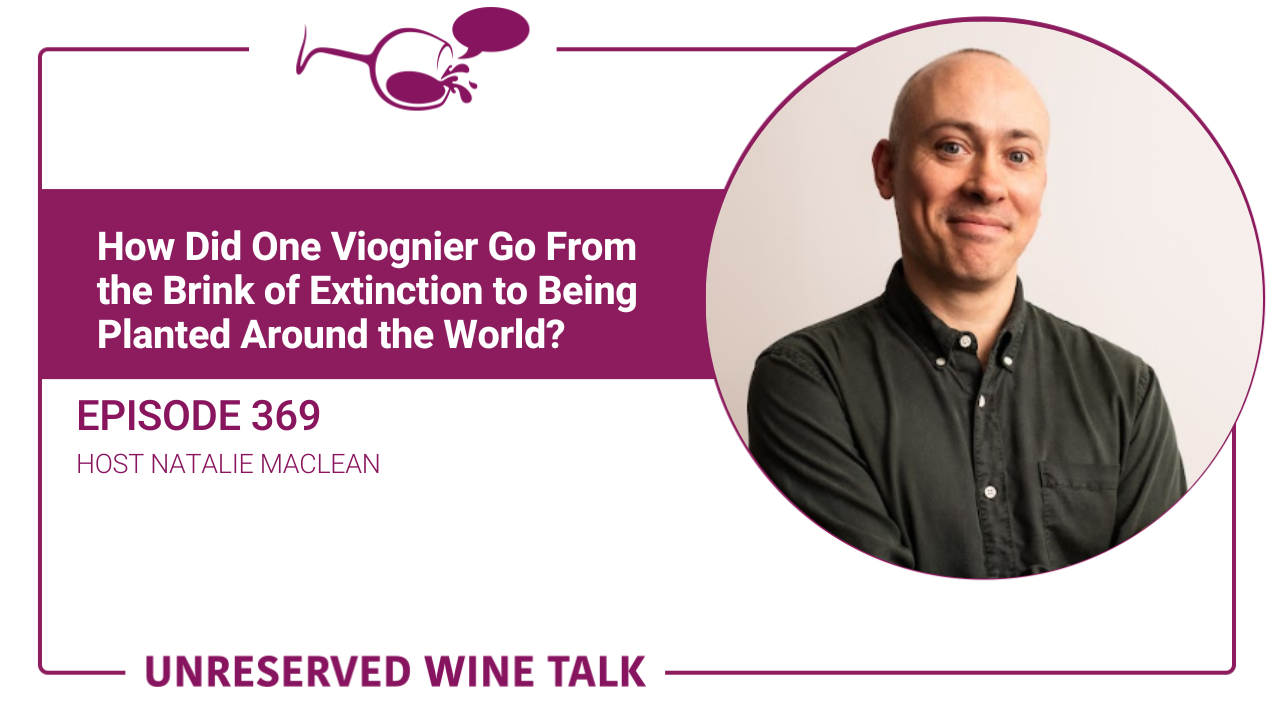
In this episode of the Unreserved Wine Talk podcast, I’m chatting with Matt Walls, author of the terrific new book The Smart Traveller’s Wine Guide to the Rhone Valley.
You can find the wines we discussed here.
Giveaway
Two of you are going to win a copy of Matt Walls’ terrific new book, The Smart Traveller’s Wine Guide to the Rhone Valley.
How to Win
To qualify, all you have to do is email me at [email protected] and let me know that you’ve posted a review of the podcast.
It takes less than 30 seconds: On your phone, scroll to the bottom here, where the reviews are, and click on “Tap to Rate.”
After that, scroll down a tiny bit more and click on “Write a Review.” That’s it!
I’ll choose two people randomly from those who contact me.
Good luck!
Join me on Instagram, Facebook and YouTube Live Video
Join the live-stream video of this conversation on Wednesday at 7 pm eastern on Instagram Live Video, Facebook Live Video or YouTube Live Video.
I’ll be jumping into the comments as we watch it together so that I can answer your questions in real-time.
I want to hear from you! What’s your opinion of what we’re discussing? What takeaways or tips do you love most from this chat? What questions do you have that we didn’t answer?
Want to know when we go live?
Add this to your calendar:

Highlights
- What are the famous galets roulés of Châteauneuf du Pape and what is it like to experience them in person?
- How do the galets affect vineyard work and vine training?
- What is the Mistral wind and why is it both miserable for people and essential for vineyard health?
- Why is Hermitage Hill considered one of the clearest visual explanations of terroir anywhere in France?
- What does tasting Hermitage at the top of the hill reveal about the emotional connection to place and wine?
- How does whole bunch fermentation change the aroma, texture, and alcohol level of Syrah in the northern Rhône?
- How close did Viognier come to extinction after World War II, and who was responsible for saving it in Condrieu?
- What makes Viognier from Condrieu feel different than versions grown in warmer regions?
- How did Château Rayas redefine Châteauneuf-du-Pape?
- Why did the extreme heat of the 2022 vintage affect Rhône wines?
- Why is Tavel better understood as a pale red rather than a modern Rosé?
Key Takeaways
- How did one Viognier go from the brink of extinction to being planted around the world?
- Very close. So there was about 6 or 7 hectares left… about the size of three football pitches. That’s it. That was the only place in the world. I mean, that’s where it comes from. In the 1960s and after the Second World War, a lot of the vineyards died. People couldn’t fetch high prices for wine, so quantity was more important than quality. So people were just planting on the flat, basically where it was easy to farm instead of on the slopes of Condrieu, which are very difficult to grow on. So it got pretty much abandoned. It was down to one man whose name was Georges Vernay from Domaine Georges Vernay, which still exists today, still makes excellent wines. And he rallied the local winemakers. He believed in the grape. He knew how good it could be, and he encouraged people to replant, to rework the vineyards and, and saved the grape. You find it all around the world. And so if it wasn’t for Georges back in the 60s, deciding, no, I want to save this variety, maybe we wouldn’t have it at all, which would be terrible.
- Why is the Mistral one of the most miserable experiences for people, yet a saviour for Rhône vineyards?
- The mistral is a very strong north wind. It whistles down the valley. It can be extremely boisterous. It’s cold north wind. if it’s quite a hot day, it’s never nice. It’s always horrible. Even on a hot day. When it blows hard, it can be quite difficult to stand up in a vineyard. It’s an amazing phenomenon. It’s cold and it’s really dry. So often when it does rain in the southern Rhône and in the northern Rhône, you risk getting vineyard diseases. But the mistral often it blows after it rains. So it will dry out the vineyards. It’s like a natural disinfectant. it means that you can keep your grapes hanging on the vine for longer. So it is a huge benefit.
- Why is working with bush vines so much harder than trellised vineyards?
- You hear about these galets roulés, these rounded stones, but when you see them, just in the vineyards for as far as the eye can see, they’re very striking to see and difficult to walk on. you can quite easily turn your ankle if you’re not careful with what you’re doing. So if you’re in a vineyard of galets, what you’ll see is these bush vines. That’s the most common way of training vines in the southern Rhône, particularly Châteauneuf-du-Pape. You do see a bit of trellising, but with Grenache, you don’t have to… they’re naturally self-supporting. With Syrah, for example, you do have to train it on wires because it just grows like mad, and otherwise it would just be flopping around all over the floor. And you need to lift up the foliage in order to get it exposed to the sun and get the grapes off the ground. Grenache doesn’t grow in such an exuberant fashion. It grows a little bit more slowly, and the trunks get a little bit thicker. But they’re much harder to work as well. So, the thing about those bush vines is that you have to tend them in a 360 degree fashion rather than trellis vines, which you kind of have to work on both sides, but without kind of working around it 360 degrees. But the galets… they are troublesome and they are difficult to move and they take a lot of strength. So, yeah, I wouldn’t like to work on them personally. That takes a lot of work.
Start The Conversation: Click Below to Share These Wine Tips
[tweet_box design=”box_16_at” url=”https://nataliemaclean.com/369″ float=”none” author=”Matt Walls” excerpt=”There’s always something magical about tasting the wine in the vineyard where it was made.@NatalieMacLean”]There’s always something magical about tasting the wine in the vineyard where it was made.[/tweet_box]
About Matt Walls
Matt Walls is an award-winning freelance wine writer, author and consultant who contributes to various UK and international publications such as Club Oenologique and Decanter, where he is a contributing editor. He also judges wine and food competitions, develops wine apps and presents trade and consumer tastings. Matt is interested in all areas of wine, but specialises in the Rhône Valley – he is Regional Chair for the Rhône at the Decanter World Wine Awards.
Resources
- Connect with Matt Walls
- Website: MattWalls.co.uk
- Book: The Smart Traveller’s Wine Guide to the Rhone Valley
- Travel & Events: Rhône Roots
- Instagram: @mrmattwalls
- Twitter: @mattwallswine
- Natalie’s Appearance on CTV’s CP24 Breakfast Show | Make Your Holidays Merry with These 5 Festive Wines and Spirits
- Seedlip Grove 42 – United Kingdom
- King’s Court Estate Sparkling Wine – Niagara
- Chill Street Starry Nights Flavoured Cider – St. Catharine’s, Ontario
- Small Gully Wines The Formula Robert’s Shiraz – Barossa Valley, Australia
- Warm N Cozy Mulled Wine – Ontario
- King’s Court Estate Winery
- Unreserved Wine Talk
- My Books:
- Wine Witch on Fire: Rising from the Ashes of Divorce,Defamation, and Drinking Too Much
- Audiobook:
- Audible/Amazon in the following countries: Canada, US, UK, Australia (includes New Zealand), France (includes Belgium and Switzerland), Germany (includes Austria), Japan, and Brazil.
- Kobo (includes Chapters/Indigo), AudioBooks, Spotify, Google Play, Libro.fm, and other retailers here.
- Wine Witch on Fire Free Companion Guide for Book Clubs
- Audiobook:
- Unquenchable: A Tipsy Quest for the World’s Best Bargain Wines
- Red, White, and Drunk All Over: A Wine-Soaked Journey from Grape to Glass
- Wine Witch on Fire: Rising from the Ashes of Divorce,Defamation, and Drinking Too Much
- My new class, The 5 Wine & Food Pairing Mistakes That Can Ruin Your Dinner And How To Fix Them Forever
Tag Me on Social
Tag me on social media if you enjoyed the episode:
- @nataliemaclean and @natdecants on Facebook
- @nataliemaclean on Twitter
- @nataliemacleanwine on Instagram
- @nataliemaclean on LinkedIn
- Email Me at [email protected]
Thirsty for more?
- Sign up for my free online wine video class where I’ll walk you through The 5 Wine & Food Pairing Mistakes That Can Ruin Your Dinner (and how to fix them forever!)
- You’ll find my books here, including Unquenchable: A Tipsy Quest for the World’s Best Bargain Wines and Red, White and Drunk All Over: A Wine-Soaked Journey from Grape to Glass.
- The new audio edition of Red, White and Drunk All Over: A Wine-Soaked Journey from Grape to Glass is now available on Amazon.ca, Amazon.com and other country-specific Amazon sites; iTunes.ca, iTunes.com and other country-specific iTunes sites; Audible.ca and Audible.com.
Transcript
Natalie MacLean 00:00:00 How did the grape Viognier go from the brink of extinction to being planted around the world? Why is the Mistral one of the most miserable experiences for people yet a savior for Rhone vineyards? Hint the mistral is a very strong wind. And why is working bush vines so much harder than trellis vineyards? In today’s episode, you’ll hear the stories and tips that answer those questions in part two of our chat with Matt Walls, author of the terrific new book The Smart Travelers Wine Guide to the Rhone Valley. You don’t need to have listened to Part One first from last week, but if you missed it, go back after you listen to this. By the end of our conversation, you’ll also discover why Hermitage Hill is considered one of the clearest visual explanations of terroir in France. What tasting Hermitage wine at the top of the hill reveals about the emotional connection between the place and the wine. How whole bunch fermentation changes the aroma, texture and alcohol level of Syrah in the northern Rhone. What makes Viognier from Condrieu feel different from versions grown in warmer regions? How Chateau Rayas redefined Chateauneuf du Pape. Why the extreme heat of the 2022 vintage affected Rome wines. And why Tavel is better understood as a pale red wine rather than a Rosé?
Natalie MacLean 00:01:36 Do you have a thirst to learn about wine? Do you love stories about wonderfully obsessive people, hauntingly beautiful places, and amusingly awkward social situations? Well, that’s the blend here on the Unreserved Wine Talk podcast. I’m your host, Natalie MacLean, and each week I share with you unfiltered conversations with celebrities in the wine world, as well as confessions from my own tipsy journey as I write my third book on this subject. I’m so glad you’re here. Now pass me that bottle, please, and let’s get started.
Natalie MacLean 00:02:18 Welcome to episode 369. So what’s new in the drinks world this week? Well, first of all Merry Christmas Eve. Happy holidays, happy Hanukkah. However you celebrate, December 24th is National Eggnog Day, which gives you full permission to spike that creamy concoction with brandy, rum, whiskey. Do a tiny taste flight where you pair one sip with one bite. Eggnog with, say, nutmeg shortbread. December 25th doubles as National Tamales Day. Pair those crisp Albariño and light Tempranillo wines with your tamales. December 26th is not only Boxing Day, it’s also National Candy Cane Day, which sounds like a perfect excuse to rim a peppermint white chocolate martini. December 27th is National Fruitcake Day, a perfect excuse to crack open that dusting bottle of tawny port or Oloroso sherry and ignore fruitcake altogether people. December 28th is National Box of Chocolate Day. December 30th is Bacon day. Yay! So you can pair those dark chocolate truffles with Canadian ice wine or tawny ports, then swing hard into smoky territory with crisp bacon and a peated whiskey. December 30th is National Bicarbonate of Soda Day. Soda water, arguably the most practical holiday of the season for preempting that New Year’s Eve hangover. And as we cruise toward New Year’s Eve on December 31st, naturally, that’s National Champagne Day. Try pairing your bubbly with oysters or go full decadent with potato chips and caviar. However you celebrate this festive week. You’ve got the calendar on your side.
Natalie MacLean 00:04:02 In marketing moves this week, the social media wine wave is creating some unexpected stars. London wine bars are going viral with Gordon’s Wine Bar in London, UK, established in 1890, seeing a surge in younger patrons desperate to photograph its candlelit cave like atmosphere for Instagram. Meanwhile, a New York wine bar is serving cocktails in intravenous bags. That’s right, IV bags for the ultimate rehydration aesthetic. Sounds like they should switch to water and vitamins on January 1st. The boldest move comes from Samuel Adams, which just dropped a 30% alcohol by volume beer that is so potent it’s legally banned in 15 states, a masterclass in generating forbidden fruit buzz that has spirits lovers hunting for bottles. I got to wonder is that really a beer when it’s 30% alcohol? I’d say it’s a spirit. I’m not sure what the cutoff date is, but I’m sure someone will tell me. At the other end of the alcohol spectrum, the better for you drinks category remains robust. Duckhorn Winery from California just announced a major expansion of their low alcohol featherweight line, betting big that calorie counting won’t stop for Christmas. One Canadian TV spot out of Calgary highlighted a peanut butter agave spirit described by the presenter as a curious oddity, which instantly sparked an online debate over whether it belongs in cocktails or over ice cream
Natalie MacLean 00:05:40. In the what do we just drink file, buckle up because 2025 has delivered some absolutely wild wine stories. First, a 56 year old British woman was arrested in Virginia after allegedly orchestrating a distraction theft at L’Auberge Provencal Inn involving bottles of Domaine de la Romanée-Conti worth over $41,000. According to reports, she posed as a wealthy Canadian businesswoman’s personal assistant, distracting staff with rapid fire questions about American wines while wearing a wig and wool coat as her accomplice was wearing a long overcoat with specialty made pockets sewn inside. Slipped out with eight bottles of DRC. The restaurant owner told the Daily Mail it was so brazen and said he only realized something was wrong when he spotted screw top replacements where his DRC wines had been. Oh no.
Natalie MacLean 00:06:38 Meanwhile, in France, a winemaker was jailed for 18 months after carbon dating hundreds of thousands of bottles of still wine from Spain and France and fraudulently passing them off as Champagne. He’s now banned from ever running a wine company again and prohibited from working in the Champagne industry for at least five years. The counterfeit wine game has gotten so sophisticated that criminal rings are now spending half a million dollars on the same digital printers used by professional producers, making fakes nearly impossible to spot. On a happier note, May-Eliane de Lencquesaing, the former owner of the coveted Chateau Pichon Longueville Comtesse de Laland in Bordeaux just turned 100 years old this year, of course, crediting her daily wine intake for her longevity. Now that’s a vintage worth celebrating.
Natalie MacLean 00:07:2o If you have some wine, news or a quirky story you think I should share on the podcast. Email me at [email protected]. This week on CTV’s CP24 Breakfast Show, we chatted about, well, it’s the season for holiday gift giving.
Natalie MacLean 00:07:47 The first gift bottle is the Seedlip Grove 42, which is a delicious non-alcoholic spirit that’s both smart and sophisticated. It’s a refreshing, citrus forward experience with a vibrant blend of Mediterranean orange and mandarin, complemented by the herbal complexity of lemongrass and a zing of ginger. The spirit provides a breezy, zesty flavour perfect for those seeking a complex non-alc alternative to traditional spirits during the holiday season and beyond. On the palate, there’s a burst of citrus fruit flavours with a tang of bitter orange and mandarin up front, followed by a smooth herbal warmth. The finish is dry and crisp with lingering citrus notes. Seedlip Grove 42 is highly versatile, perfect for creating holiday ready non-alcoholic cocktails. Mix it with tonic water and a twist of lime, and it provides a bright citrus forward serve that’s ideal year round in the winter months. It pairs beautifully with seasonal ingredients like ginger ale and hot apple cider, creating a comforting winter serve. It can also be used as the base for non-alcoholic versions of classic cocktails, like a Negroni or a winter spritz. And how about this for a food pairing, a therapeutic sesame ginger salmon, flaky wild salmon emerges from the oven glistening with a golden glaze of fresh ginger, toasted sesame oil and honey, its edges caramelized to a deep amber. The fish releases aromatic steam, carrying notes of garlic and lemongrass while the flesh flakes away in tender, moist layers. Oh, that melts on your tongue with a delicate sweetness balanced by the sharp bite of the pickled ginger garnish.
Natalie MacLean 00:09:41 Next up, we have the King’s Court Estate sparkling wine that has been aging for 12 years on the lees, the spent yeast cells, which creates a creamy, luxurious texture and a freshly baked bread aroma. King’s Court Estate Winery is a family owned gem in Niagara-on-the-Lake. This wine is made using the traditional Champagne method. Extended lees aging creates layers of brioche, toasted almond, and a gorgeous texture you can’t rush. This is patient winemaking at its finest, producing a sparkling wine that rivals international benchmarks while showcasing Niagara cool climate elegance. This terrific wine offers sumptuous depth and great structure. There were only 258 bottles made of this magnificent wine, so get yours while you can from the winery directly, either by calling them or visiting Kings Court Estate Winery’s website. That’s KingsCourtEstateWinery.ca. I’ll put a link in the show notes. It’s a limited edition on sale now for $99. Totally worth the splurge. It’s usually $125, but get it. I mean, Champagne of this quality would be 2 to 3 times the price. So treat yourself this holiday or even in the new year or someone special.
Natalie MacLean 00:10:42 I also had the winery’s Chill Street Starry Nights flavoured cider made from Niagara apples, blackberries, and Vidal grapes infused with mango flavour. It’s available directly from the winery, but it’s also in the LCBO. And for a food pairing, why not try salon worthy seared scallops. Plump sea scallops achieve a perfect golden brown, translucent and tender texture. Their sweet, briny flesh releases delicate ocean aromas, enhanced by a whisper of brown butter that pools around them, nutty and fragrant, with microgreens adding a fresh, peppery contrast to each luxurious buttery bite.
Natalie MacLean 00:11:39 All right, what’s next? Small Gully Wines. The Formula Robert’s Shiraz from Small Gully Wines in Australia. It’s bold and smooth. Its label indicates that the grapes were grown on magnificent 60-year-old vines. Barossa is home to some of the oldest Shiraz vines in the world, dating back to the 1840s. Holy smokes, those ancient vines produce incredibly concentrated, complex wines. This is a deep, brooding red with waves of blackberry compote, dark chocolate, cracked pepper, and warm spice unfolding in slow, confident layers. The palate is full bodied and plush, with velvety tannins and a long finish that carries a touch of smoky cocoa, giving the wine both power and polish. As a pairing, first impression braised short ribs, fork-tender beef short ribs emerge from hours of slow braising in a glossy, deeply flavoured sauce enriched with red wine, tomatoes, and aromatics. The meat pulls away from the bone in luscious gelatinous strands. Each morsel is coated in the velvety, concentrated braising liquid. The tastes of caramelized onions and herbs are pure comfort, while rendered fat adds silky richness to every bite.
Natalie MacLean 00:12:59 All right. Stay with me. I’m almost losing it myself. Now for our final selection. Warm and cozy mulled wine from Ontario. It’s made from Ontario grapes at Spruce Wood Shores, a family owned and operated winery. You can get the regular size in the LCBO or the very merry party size that’s in Costco. This ready-to-heat mulled wine is like wrapping yourself in a cashmere blanket while watching the snowfall through a frosty windowpane. Or perhaps it’s more like wrapping yourself in a fleece blanket while watching YouTube videos of a snowfall because you couldn’t be bothered to go to the window. I’m not judging. It’s warming and yet has only 8.5% alcohol. The nose opens with a rush of bright orange peel and warming cinnamon that mingles with the deeper notes of clove and freshly grated nutmeg, instantly transporting you to a Christmas market. A pairing: self-care spiced shortbread. Buttery shortbread cookies emerge from the oven with edges kissed golden brown. Their surfaces crackle with cinnamon sugar that sparkles like fresh snow. Each cookie crumbles tenderly on the first bite, releasing a perfume of brown butter and warming spices and the sandy texture melting on your tongue, leaving a trail of sweet, spiced comfort that lingers like a hug.
Natalie MacLean 00:14:25 All right, so a toast to you. Here’s to the drinks we choose with care and to the people we care about. May every bottle we give this holiday season reflect our good wishes, and may every glass remind us that life’s greatest gift is the company we keep. All right. So you can find these wines, of course, on my website, but also on Instagram. I’m at Natalie MacLean Wine. I’m just as theatrical about wine and drinks on upcoming TV shows such as CTV Your morning, CTV’s Breakfast Television, CTV’s CP24 Breakfast Show, CHCH Morning Live and CTV’s The Social. We’ll be chatting about terrific wines and spirits for Valentine’s Day romantic dinners, as well as Galentine’s Day and Bromance Day. I think that’s a thing that celebrates the even more lasting bond of friendship. Then, we’ll be chatting about fresh spring wines. In March, Saint Patrick’s Day wine, beer and spirits, and environmentally sustainable drinks for Earth Hour. Let me know if you’d like your brand featured on these TV segments or future ones, or if you would like to advertise with us through our podcast, newsletter, website, social media or mobile apps, please email me at [email protected].
Natalie MacLean 00:15:46 Back to today’s episode. Two of you will win a copy of Matt’s terrific new book, The Smart Travelers Wine Guide to the Rhone Valley. I also still have one copy of each of Cha McCoy’s Pairing for the People. Elva Ramirez’s Sparkling and Simon Hardy’s The Smart Traveler’s Wine Guide to Switzerland. If you’d like to win a copy of any of these, email me and let me know you’d like to win. Doesn’t matter where you live. I’ll choose the winners randomly from those who contact me at [email protected]. In other bookish news, if you’re reading the paperback or e-book or listening to the audiobook of my memoir, Wine Witch on Fire: Rising from the Ashes of Divorce, Defamation, and Drinking Too Much, a national bestseller and one of Amazon’s best books of the year, I’d love to hear from you. I’ll put a link in the show notes to all retailers worldwide at nataliemaclean.com/369. Okie dokie. On with the show.
Natalie MacLean 00:16:47 The Galet. Forgive my French. The famous pudding stones, those rounded stones that absorb all the heat of Chateauneuf du Pape. They’re described in vivid detail. Can you explain the tactile experience of walking through a Chateauneuf du Pape vineyard, or what the stones feel like underfoot, or even if you’re holding one?
Matt Walls 00:17:05 They’re amazing to see. I think when you see them for the first time, you hear about these truly, these kind of these rounded stones. And they vary in size. I mean, they can be between the size of your fists to maybe even the size of a kind of small cushion or something. But when you actually see them just in the vineyards for as far as the eye can see. They’re visually quite striking.
Natalie MacLean 00:17:25 How did they get formed? Was it the seabed that rounded out these rocks or…?
Matt Walls 00:17:29 No, they came down from the Alps originally. The Rhone rises in Switzerland. It rises in the Alps and then it comes down. It travels west into France and then it goes directly north. And throughout history the Rhone has been much larger and more powerful. And when it was more large and powerful, it brought down huge amounts of material that it tore off the Alps, and it deposited it in various different places around the southern Rhone, mainly in Chateauneuf du Pape. That’s where these things come from originally from the movement of the river, from them grinding against each other and also from just weathering that they kind of achieve this rounded shapes. They’re very striking to see and difficult to walk on. I mean, you can quite easily turn your ankle, I think, if you’re not careful with what you’re doing. And that’s why it’s so difficult to use horses on them, because horses can quite easily break their legs on these big rounded stones.
Natalie MacLean 00:18:19 Okay. And how do they impact the way winemakers work the vines?
Matt Walls 00:18:23 In different ways. If you’re in a vineyard of galets, what you’ll see is these bush vines. That’s the most common way of training vines in the southern Rhone, particularly in Chateauneuf du Pape.
Natalie MacLean 00:18:36 Why is that? Why don’t they do the trellis thing?
Matt Walls 00:18:38 You do see a bit of trellising, but with Grenache you don’t have to. They are naturally self-supporting. With Syrah, for example, you do have to train it on wires because it just grows like mad and otherwise it would just be flopping around all over the floor and you need to lift up the foliage in order to get it exposed to the sun and get the grapes off the ground. Grenache doesn’t grow in quite such an exuberant fashion. It grows a little bit more slowly and the trunks get a little bit thicker. So that’s what you’ll tend to see. But they’re much harder to work as well. The thing about those bush vines is that you have to kind of tend them in a 360 degree fashion rather than trellis vines, which you kind of have to work on both sides, but without working around it 360 degrees. But the galets, they are troublesome and they are difficult to move They take a lot of strength. I wouldn’t like to work on them personally. It takes a lot of work.
Natalie MacLean 00:19:26 I think I’ve heard that they absorb the heat of the sun and then release it at night. Does that help with ripening?
Matt Walls 00:19:32 Yes, basically. This is what they say. And I think there is a degree of truth in it. I mean, if you go in during the day and you pick up the galet, that’s certainly the first layer of galet, they will be quite warm. But if you go in at night and you pick them up, they don’t really feel warm anymore. So, I mean, they may radiate heat for a little while, but I don’t think they kind of keep it stored overnight. I think that’s a bit of a myth. And actually, you know, there’s no problem ripening grapes in the southern Rhone these days. So I don’t think that would really be of much benefit. I think increasingly people are looking for freshness rather than additional warmth and ripening.
Natalie MacLean 00:20:05 That’s true. Let’s talk about another natural phenomenon, the Mistral. The famous wind is strong enough to overturn chairs and tables on cafe terraces. Tell us about a day when the Mistral was blowing particularly hard, or any sort of interactions you’ve had. I’ve heard the Mistral can drive people crazy too, because it just goes on and on and on.
Matt Walls 00:20:25 Oh it does. It’s a nightmare. So the Mistrial is a very strong north wind. So it comes from the north. Whistles down the valley. It’s very dry. It can be extremely boisterous. So sometimes you think to yourself, oh, maybe that should be quite nice. It’s cold north wind if it’s a hot day. It’s never nice. It’s always horrible even on a hot day. It seems to kind of come from every angle. And it always has this kind of horrible, chilling feeling to it, which kind of really gets into your bones. When it blows hard, it can be quite difficult to stand up in a vineyard. I’ve had to go inside because it’s just been impossible to stand. And right when it’s blowing full force, it’s pretty horrible. It’s the kind of wind that if you’re out on a bicycle, you have to cycle. Even though you’re going downhill, you have to cycle, because you wouldn’t just kind of move naturally because it’s that strong. It’s an amazing phenomenon.
Natalie MacLean 00:21:16 And it comes from the north. So is it a cold wind? Like it really cold?
Matt Walls 00:21:20 Yes, it’s cold and it’s really dry. So the dry thing is important. Often what it does rain in the southern Rhone and in the northern Rhone, you risk getting in your diseases, fungal diseases. But what the Mistral does, often it blows after it rains. So what it’ll do, it will dry out the vineyards. It kind of reduces. It’s like a natural disinfectant basically. So it kind of reduces the risk of fungal diseases. So particularly during harvest time when the grapes maybe are almost ready to pick and they have quite thin skins. They can be quite delicate. If you get a lot of rain, you can get rot in your vineyard. But when the Mistral comes, it basically just kind of whistles through, cleans everything up, dries everything out. And it means that you can keep your grapes hanging on the vine for longer. So it is a huge benefit. But just as a human being or working in those conditions, it’s not very nice.
Natalie MacLean 00:22:09 Wow. Now you describe an Andouillette. Andouillette, the pig intestine sausage as quote, acquired taste with ripe, earthy pinky aromas that detractors say smells like feces. Wow, that’s very honest. Did you acquire the taste?
Matt Walls 00:22:31 It did have a ruder word in there eventually before the editor caught it, actually. But, no, I don’t like it. I’m pretty open minded when it comes to food, but there is something particularly kind of intestinal and earth that been nice about them, which I don’t particularly like.
Natalie MacLean 00:22:50 No, I can imagine. Is there any wine that can redeem the dish, or a traditional wine that the people who do like it like to pair it with it?
Matt Walls 00:22:58 Traditionally a kind of a light red, like Pinot noir or something like that, typically.
Matt Walls 00:23:02 Well, barnyard again
Matt Walls 00:23:04 Yes. Exactly. So maybe a kind of bretty Saint-Joseph. Something like that would go quite well with the kind of slightly funky flavours. That’s not for me. It’s not for me.
Natalie MacLean 00:23:15 Let’s go back to Hermitage and the Sacred Hill. You write that to understand the French notion of terroir. All you need to do is stand on the riverbank in the village of Tournon and cast your eyes over the river to the hill of Hermitage. Maybe describe that view for listeners who haven’t seen it. What makes it so visually magical?
Matt Walls 00:23:34 It’s one of my favorite views in the world, actually, just looking over at the Hill of Hermitage. Partly because you realize it’s quite small. It’s like 140 hectares, so it’s the size of one very large Bordeaux estate. And that’s the whole thing. That’s the whole hill of Hermitage. And when you’re there, you could feel the wind coming down the river. So when you look at here, you can see or you can feel that it will be protected from the wind. You can feel the sun. You can see the way that it shines. You’re on the on the south facing slope of the hill again, so you can see how the grapes would ripen. It’s just a very easy way of kind of imagining what makes this terroir special in terms of the wind and the rain. When it does come, it will just drain off. It’s not going to soak up loads of water. You’re going to get this natural concentration. So I think that’s why it is such a great visual illustration of terroir to me. And particularly, having tasted the wines and knowing that they are so delicious as well. Yeah, it’s a beautiful sight.
Natalie MacLean 00:24:31 Well that’s great. And you recommend walking up the Chapelle Saint-Christophe to the top of Hermitage Hill, bringing sturdy footwear, a bottle of Hermitage, of course, stemless glasses and a corkscrew. And probably not a child. What did Hermitage taste like to you atop the hill where it was born?
Matt Walls 00:24:48 Oh, it’s a lovely thing to do. I went up there with a few bottles once with a friend of mine called Ali Cooper. He’s a Master of Wine, and sometimes we go to the region together. We had a day off and we went up there with a with a few whites and reds from the Hermitage. There’s always something magical, I think, about tasting the wine and drinking the wine in the vineyard where the wine is made. Again, it just kind of gives you some kind of feeling of connection between you and the place through the product that’s made there. It’s purely romantic. I don’t think there’s any kind of real vibes at work there, but it just it feels special again. When you’re right at the very top of the hill, the views across the valley and all the way down. So you can see Saint Joseph on the one bank. Further on, you can see St-Péray. You can see the vertical mountains. You see the Rhone River itself. It’s a beautiful place to be.
Natalie MacLean 00:25:34 I think now you also have a section on wine making trends, and you know that more and more of them are using stems and fermentation that goes in and out of fashion and used to stem all their reds, but now they’re incorporating them into a proportion of their top wines. When you taste a wine that’s been fermented with stems versus without, what specific flavours or textures signal their presence to you?
Matt Walls 00:25:58 Often it’s pretty immediately obvious. So it kind of depends. So if a winemaker is using 100% whole bunch in their Syrah, say for example, you could just use a small proportion of the stems, and it might be a little bit harder to discern. But if they’re using 100% whole bunch right from looking at it to begin with, often the colour will be a little bit less deep, so it’ll be slightly paler in color. On the nose, you’ll pick it up straight away, so it tends to be quite herbal. So imagine like crushed bay leaves. Bay leaves like oregano. Also it sometimes has an aroma of slightly a little bit like a cold fireplace like an ashy smell. And sometimes it can have kind of slight juniper elements. So it will have this kind of herbal complexity on the nose. On the palate, you get a slightly different texture. So one of the things that you’ll get from using stems on the palate is this feeling of instead of this very kind of glossy, smooth feel that you might get from de stemmed grapes, you tend to get a slightly more textural feel, almost like kind of little rootlets kind of going into your tongue, as it were.
Natalie MacLean 00:27:04 Rootlets like root tendrils.
Matt Walls 00:27:07 Yes, that’s kind of how it feels. Okay. It feels a little bit more fibrous on the palate. If you’re looking for a very kind of luxurious and smooth and opulent wine, maybe you’re not looking for that kind of slightly fibrous feeling. But I like wines with texture, so I actually find that quite appealing. Another thing they do is reduce alcohol as well. They can reduce the amount of alcohol by up to about half a percent.
Natalie MacLean 00:27:31 By adding stems.
Matt Walls 00:27:33 Yes, it soaks up the alcohol.
Natalie MacLean 00:27:35 Oh, okay.
Matt Walls 00:27:35 So it does two things. One of the things it does is the stems will soak up a bit of the alcohol. And then the stems obviously are discarded later on. And a lot of stems also contain water. So there is a slight diluting effect from the water in the stems. So that’s the two reasons why you tend to get slightly lower alcohol in wines that use a whole bunch.
Natalie MacLean 00:27:54 Fascinating. Viognier had a near death experience. You write that Condrieu was the only place in the world where you could find the Viognier grape after World War Two, and it nearly was lost. How close did Viognier come to extinction?
Matt Walls 00:28:11 Very close. So there was about 6 or 7 hectares left. So about the size of three football pitches. That’s it. That was the only place in the world. I mean, that’s where it comes from. So only originally comes from the northern Rhone. So around in the northern pole of the northern Rhone, that was the only place you could find it in the 1960s. And after the Second World War, a lot of the vineyards died. People couldn’t fetch high prices for wine, so quantity was more important than quality. So people were just planting on the on the flat, basically where it’s easy to farm instead of on the slopes of Condrieu, which are very difficult to grow on. So it got pretty much abandoned. It was really down to one man. His name was Georges Vernay from Domaine Georges Vernay, which still exists today, still makes excellent wines today. And he really kind of rallied the local winemakers. He believed in the grape. He knew how good it could be, and he encouraged people to replant, to rework the vineyards and really kind of saved the grape. And now we find it everywhere, right? You find it in all around the world. And so if it wasn’t for George back in the 60s, deciding I want to save this variety, mybe we wouldn’t have it at all, which would be terrible.
Natalie MacLean 00:29:23 That’s incredible, because it’s such a beautifully, intensely aromatic, some say floral, perfumed. Is it tradition still to put a splash of this white wine grape into the reds in the Rhone?
Matt Walls 00:29:35 You do find it. You can find it in the south as well, but it’s more traditional in the northern Rhone. In Cote-Rotie and Condrieu, they share a border right in the northern part of the northern Rhone. So people do often use some white grapes with their Syrah, but the rules are quite specific. So you have to have your plants planted in amongst your Syrah, so you can’t have a separate plot of Viognier and mix it together and allowed to do that. It’s becoming increasingly rare. So you’re allowed up to 20% Viognier. Well, I’ve maybe tasted that once. 10% is more common or maybe 5%. Once you get to about 10%, it becomes really very obvious. I mean, as you were saying, Viognier is so floral, it’s so perfumed that it becomes almost kind of distracting if there’s too much of it in a Cote-Rotie. And within Cote-Rotie, it’s really only done in kind of in parts of Cote-Rotie in the southern part. You don’t really see it in the northern part, which has different soil. But yeah, you still get it today. I still see that today.
Natalie MacLean 00:30:35 Cool. When you taste Viognier from Condrieu versus Viognier say from California or Australia, other regions, what is the essential quality that is different? They’re all very perfumed. But is there something about Comdrieu? Does it go back to that royal texture that you’re talking about?
Matt Walls 00:30:53 It goes back to the soil. That’s the crucial thing about Condrieu. Certainly the traditional heart of Condrieu are the soils are granite. When you grow wines on granite doesn’t really matter what it is. You tend to get this quite and of tight, upright kind of feel. You get this tension and sometimes a bit of salinity in the wines. And that is what is so crucial to the wines of Condrieu. So you get this perfume, you get these kind of lovely, opulent textures, you get this big kind of bold fruitiness, but that is kind of slightly balanced and counteracted by this sense of tension and sense of salinity in the wine. And that is what makes Condrieu so special to me, and so balanced and so fresh. If you grow it on, say, clay, in a different place, in a warmer place, you’re just going to get all of that opulence and all of that kind of richness, but without necessarily those kind of counteracting salinity or tension or kind of noble, bitter elements which bring the balance. And for me, Condrieu Viognier. For people that don’t know, Condrieu is always made of pure Viognier, and it needs those balancing elements in order to give it a sense of drink ability, I think, for me.
Natalie MacLean 00:32:14 I love that noble bitterness. I know what you’re talking about, especially at the back as you swallow. It’s beautiful. Chateau Rayas, you describe as one of the most revered and mysterious estates in the Rhone Valley, established in 1880 when Albert Reynaud, at the age of 45 by him after he went deaf. What’s the connection between his deafness and the founding of the estate?
Matt Walls 00:32:33 Well, he could no longer work, really, as he was a notary. He was a solicitor. So I guess it just meant that he could no longer really communicate easily with people. So he just decided to go off and do something where he could work by himself. That’s probably why he chose establishing a winery. I’m kind of guessing that’s what I would imagine. And particularly the estate, is that it feels like quite a secret place. It’s very wooded. It’s very kind of closed. It feels quite different to the rest of Chateauneuf du Pape. It almost feels like somewhere you could just go and almost kind of hide away. I suppose that has…
Natalie MacLean 00:33:07 A retreat
Matt Walls 00:33:10 It feels like a kind of retreat. Yeah, exactly.
Natalie MacLean 00:33:13 You describe the wine as pure Grenache, with spellbinding aromas of strawberry, rose, blood orange and herbs that achieves greatness through delicacy rather than power. And that seems to contradict things that we expect from Chateauneuf du Pape. How did Emmanuel Reynaud teach you to taste for delicacy in a region known for power?
Matt Walls 00:33:35 So Emmanuel is an amazing guy, really. And he doesn’t really teach. He just shows, I think. And then it’s up to you really to kind of pick it up. But when you taste with him from barrel, the wines are just incredible. And particularly because the winery itself, or certainly the barrel room, just has these ancient kind of old, almost like gray barrels, which they look like they’re kind of past their best. But then, with his kind of long kind of glass pipettes, he’ll kind of take a little sample and this amazing bright kind of luminous liquid comes out of there. It’s a complete mystery as to how he does it. I’ve asked him so many times, what do you do that’s different? Because obviously what you’re doing is different because these wines are so unique. And he’ll say nothing particular. It’s just the way that he. I’m sure he has some secrets that he doesn’t want to share with anybody. But his wines are very special.
Natalie MacLean 00:34:27 And that reminds me talking about him founding this winery after he went deaf. M. Chaputier, Michel Chaputier, his labels are braille, right?
Matt Walls 00:34:37 Yes. Exactly.
Natalie MacLean 00:34:38 And did he make those for his daughter or who was what was the inspiration there?
Matt Walls 00:34:42 Michel Chaputier owns about a third of the Hill of Hermitage. It’s been in his family for a very long time. Some of the parcels of funds that he bought were bought from a local nobleman called Maurice Monier de la Sizeranne. He was somebody that worked with blind people, and he was the originator of a very early form of Braille. So it’s really in homage to Monier de la Sizeranne which is the name of his blended Hermitage as well, that he started putting Braille labels on his bottles. That’s the original link. But obviously, one of the main reasons he does it is to help be more inclusive to blind people. I mean, that’s the real reason, but I think that was one of the inspirations to start doing it.
Natalie MacLean 00:35:29 Excellent. You say that the 2022 vintage broke several weather records. It was one of the hottest and driest since records began. And yet the wines weren’t, as we would expect, jammy, boozy monsters because vines went into security mode during these extreme conditions and stopped ripening. Did they just shut down or what happened?
Matt Walls 00:35:51 Pretty much. If it becomes too hot and dry, the plants will stop photosynthesizing. They will kind of stop ripening in order to conserve water. That’s basically what happened. So it was surprising when I tasted the 2022. As you mentioned, I was expecting these enormous, great big kind of beastly wines through extreme kind of hot, dry, kind of quite brutal weather. I was expecting quite brutal wines. They really didn’t do that. I’ve just tasted the 2024s. Actually, I came back a couple of weeks ago. I’m just writing that up currently. Again, it’s another vintage with a real sense of kind of lightness and freshness and delicacy about it, which is really nice, actually. It’s quite in contrast to some of these quite big, powerful years we’ve seen coming out of the Rhone.
Natalie MacLean 00:36:37 And Grenache. Let’s go back to that. I love Grenache personally. It doesn’t come from France, but originates in Spain or possibly Sardinia and is still grown quite widely in Spanish regions such as Rioja and where it’s known as Garnacha. How did Grenache become so central to the French Rhone identity when it wasn’t a native grape?
Matt Walls 00:37:00 This is the interesting thing about the southern Rhone, and something which kind of became increasingly clear to me as as I learned more and more about the southern Rhone, is that it’s very much a magpie region. Grenache isn’t originally from the Rhone, it’s from Spain. The three most planted grapes in the southern run of Grenache, Mourvedre and Syrah. Mourvedre, again, it’s originally from Spain. Syrah originally from the northern Rhone, wasn’t grown in the southern Rhone until the mid 1800s. There are some native grape varieties which are becoming increasingly important again now, because people are realizing how well adapted they are to the region. Things like Counoise that you don’t really see elsewhere. So this is kind of interesting magpie kind of a region. And one of the reasons I think that Grenache was so successful in the southern Rhone is that it’s at the limit of ripening. And like so many grapes, it’s at their climatic limit of ripening is when they give their most interesting performance. It’s the same with Syrah and right at the top of the northern Rhone. They suddenly did, until recently, quite struggle to ripen it. That’s when you get more of these kind of floral and spicy aromas, which are more interesting, I think, than just fruit alone.
Natalie MacLean 00:38:15 Yeah. And then you talk about Gigondas. Gigondas is thought to come from the Latin word meaning great pleasure or enjoyment. How perfectly does the wine deliver on that 2000 year old naming promise?
Matt Walls 00:38:28 Often it does a lot. But I think for me it’s the village itself. There is something about the village itself, which is just has such great vibes and you always feel really good when you’re there. For a start, it’s incredibly beautiful. It’s also quite kind of on a bit of a hill. So you’re a little bit shaded from the kind of the heat of the morning sun. And it does create wines which are particularly joyful as well. Yeah, I love it. And the southern Rhone is, as we mentioned before, big. It’s this huge region. And different appellations are really quite different in terroir. Chateauneuf de Pape is a big rolling, quite flat area, quite low down. Gigondas is completely different, relatively mountainous, northwest facing, a little bit shaded, often quite high altitude. And it gives a very different expression because the terroir is completely different.But yeah, I love the ones which are Gigondas.
Natalie MacLean 00:39:18 And do they blend the 13 grapes together in Gigondas or is it mainly 1 or 2 that they use.
Matt Walls 00:39:24 Slightly different rules. Chateauneuf has quite unusual rules of production, given that it was one of the first ones, it kind of gave itself permission to do pretty much whatever it likes. So it depends how you count the grapes. So you could say there’s 13, but if you count all the different kind of colour declination. If you count Grenache noir, Grenache blanc and Grenache gris is three different grapes, for example. There are other declinations of other colours within other grapes, and you get to 18 and Chateauneuf can do whatever it likes. If it wants to make a pure Syrah or a pure Mourvedre or a pure Grenache, if it wants to add some whites in its reds, you can do whatever it likes. It’s very free. The rest of the crus of the southern Rhone are more constrained in what they can do. And in Gigondas, the wines are always really going to be Grenache based, often with some Syrah and Mourvedre. And there’s a few other groups they can use a little bit of here and there, but they tend to be more Grenache, Syrah, and increasingly just a kind of more pure Grenache. Pure Grenache is becoming more fashionable within Gigondas. They’ve recently changed the rules, which allows them to make pure Grenache.
Natalie MacLean 00:40:28 Yes, I find those so beautiful, like liquid velvet, liquid silk. The Gigondas are so good. Now let’s talk about Tavel in the Rhone Valley. It only produces Rosé, correct?
Matt Walls 00:40:42 Exactly. Yes. It’s the only appellation in the Rhone which makes 100% rosé wine.
Natalie MacLean 00:40:49 And deliberately from the start. So are they using Syrah? Grenache? Or can they choose what grapes they want to use?.
Matt Walls 00:40:57 Yes. They’re a little bit freer as well. They came. So Tavel was established at pretty much the same time, one day difference from Chateauneuf du Pape. It goes back to 1936 when there were a little bit more lax in terms of the rules. They tend to use a lot of Grenache. Increasingly, this goes quite a bit of Syrah used there in more recent years. One really important grape variety there is Cinsault. Cinsault is a grape, which it’s quite big grapes. It’s quite thin skinned. It doesn’t give a lot of colour, but it gives this lovely kind of floral perfume and it gives a lot of fluidity to the wines, a lot of juice in the berries, and it doesn’t give much colour. It’s a bit like Grenache in that way. Grenache is always quite pale as well. It’s Syrah which gives colour and Mourvedre. When you’re using a lot of Grenache and Cinsault, you’re going to end up with a wine which is a little bit more pale in colour. And in many ways Tavel is. Is it a rosé? I don’t know. I mean, some people would describe it as a Claret, which is like a pale red. And for me it is a different thing. I think, describing it as a Rosé. Today, our idea of what a Rosé is quite narrow. You know, we think about kinds of very pale, very dry wines. That wasn’t always the way with Rosé. Rosé used to be a broader church. It’s more helpful to think of Tavel as almost like some kind of space between Rosé and red. It’s like a pale red, really.
Natalie MacLean 00:42:15 That’s interesting because it’s my go to personally. I drink more Tavel Rosé than any other wine. Maybe I shouldn’t admit that being a Canadian, I just find it has all the flavour of a red wine without the heavy oak or tannins. And now it can be alcoholic. But I never feel that because it’s chilled. I find it incredible. Château d’Aqueria is one of my favourite. I don’t know if you’ve tried that one.
Matt Walls 00:42:38 Yes, absolutely. They’re very, very good. They were bought by Guigal few years ago. And they’ve slightly changed their range, but the wines are still brilliant. I love that wine. And they age really well as well. I mean, I don’t know if you’ve ever tried an older Tavel. They do interesting things. As they get older.
Natalie MacLean 00:42:54 What happens?
Matt Walls 00:42:55 They take on this kind of slightly almost like a maderized flavour, like a kind of slightly like a touch of burnt sugar. And they take on other kind of spices, like roasted spices, sometimes little gingery notes. They do all kinds of things, like kind of potpourri, dried rose petals. It depends on the wine. They are famously extremely long lived. And you can still find Tavels that go back to, Rosés that go back to the 1960s, 1950s that are still really good today. They age amazingly well.
Natalie MacLean 00:43:24 Well, I always thought that better finish this off within the vintage like all Rosés, but I’m going to experiment with that. I’m going to age some of them.
Matt Walls 00:43:32 So keep a couple back. Keep a couple back for like eight years or so. And then try them then.
Natalie MacLean 00:43:36 That will be interesting if I can resist. I’ll just have to keep well stocked on the current vintage. But the madness, the craze for the palest rosé from Provence was that in I guess that in the 2010s. Did that really put a dent into Tavel sales?
Matt Walls 00:43:55 Yes, absolutely. I mean, it was always this kind of famously dark colour. And in fact, in the rules of production, it has to be dark. And if it’s not dark enough, then you’re not allowed to call it Tavel.
Natalie MacLean 00:44:05 OK.
Matt Walls 00:44:06 It has to be dark, by law has to be dark, which is made life very difficult for the winemakers of Tavel. And it’s kind of sad really, because great Tavel, as you know, can be amazing. But there’s been a bit of a revolution over the past 20 years or so. There’s this particular guy called Eric Pfifferling and his estate called Domaine de l’Anglore, and now his two sons are involved as well. He really decided to go completely back to basics to talk to all of the the monks at Chateau Manessy which was this old Tavel producer and some of the really old winemakers within the village, to get all of the info on how Tavel used to be made. And then he started making his wine that way, because I think Tavel had become quite a technical wine, quite a manipulated wine, and he wanted to kind of go back to basics. He’s kind of created this cult wine, really, which is if you like to have a you must try a Chateau de lAnglore. It’s amazing.
Natalie MacLean 00:45:02 I will definitely look for it.
Matt Walls 00:45:03 And lots of people now go and work with the Pfifferlings. They learn how they do it and they set up on their own. And now there’s increasing numbers of little kind of estates popping up, making wine in this new old way, which is completely delicious. I’m feeling pretty optimistic about the future of Tavel.
Natalie MacLean 00:45:18 Oh that’s great. And by extension, how are you feeling about the future of the Rhone?
Matt Walls 00:45:22 About the future of the Rhone? Optimistic. A bit worried about climate change, if I’m honest. I think the winemakers down there are as well. Fortunately, there’s a lot of different grape varieties that people can play with to help mitigate things in the short term. But, this is something which the whole world is facing. It’s not just the Rhone. But, broadly speaking, the wines are delicious. They’re getting better and better. The whites are getting better and better. So yeah, pretty optimistic I would say.
Natalie MacLean 00:45:53 Very good. And what would be your top two tips for someone who’s going to visit the Rhone? They are wine lovers. So what would you advise?
Matt Walls 00:46:02 Look up the best markets. The markets can be great fun, not just for food, but they sell all kinds of different things. Find out where the best markets are. Find out the days that they’re on. Remember to take cash because a lot of people don’t use cards. Take bags, big bags because you’re going to buy a lot of stuff. So that’s good. That would be one thing. Outside of the markets, what would be another thing to do when you’re in the Rhone? Visit some wineries. Figure out which styles you like the most. Try a whole bunch of different wines. Pinpoint one that you like, whether you’re tasting it in a restaurant or a cafe or a hotel or whatever. Look on the back label. Find out where it is, go and visit it. And I would say that could be a fun adventure.
Natalie MacLean 00:46:43 That’s a fun way to do it. Yeah, absolutely. And to wrap up, if you could share a bottle of wine with anyone living or dead outside the wine world, who would that be and what would the wine be?
Matt Walls 00:46:54 I’ve recently found out that one of my musical heroes is really into wine, which I didn’t know until very recently. So it’s a guy called Richie Hawtin. So he is one of the most famous techno DJs. He also is known as Plastic Man and created loads of really seminal techno tunes back in the 90s. And I’ve recently found out that he is really big into Saké. And he also does Saké tastings. He does kind of techno and Saké now, so I would love to meet him. But there’s something quite techno about Saké and its kind of purity as well so I kind of get it. So yeah, I would love to share a bottle with him. Maybe a bottle of saké. He could teach me a little bit about that, which is something I don’t know a lot about. So yeah, that’d be cool.
Natalie MacLean 00:47:35 That’d be cool. Is there anything we haven’t covered that you’d like to mention?
Matt Walls 00:47:39 That one thing we haven’t mentioned is my new kind of travel and events company, which I set up last year. It’s called Rhone Routes. If any of your listeners wants to be on the mailing list, they can just go to rhoneroutes.com. And I do events in London and I’ll be doing some tastings this year coming up. I do tours in the Rhone, so if that sounds tempting to any of your listeners, then they can just sign up onto the newsletter at rhoneroutes.com
Natalie MacLean 00:48:04 Wonderful. I’m sure it will be appealing, and we’ll also put that link in the show notes and where we can find you online and your book through Academie du Vin, the Travelers’ Wine Guide to the Rhone Valley and your other book and your website and all the rest of it. So yes, absolutely. Matt, this has been wonderful. Thank you so much for sharing all your rich knowledge of this region. It’s just we’ve only touched the tip of it. But you’ve given me some things I want to try. I’m going to age to Tavel. I’m going to try that other wine you mentioned. I’ll email for the spelling of it something. So you’ve opened my eyes to a lot of things. So thank you.
Matt Walls 00:48:41 Great. It’s been a great pleasure. Thanks for having me, Natalie.
Natalie MacLean 00:48:43 All right. Cheers, Matt. But I’ll say goodbye for now. And thanks again.
Natalie MacLean 00:48:53 Well, there you have it. I hope you enjoyed our chat with Matt. Here are my takeaways. Number one. How did Viognier go from the brink of extinction (oh) to being planted around the world (yay!). Well, as Matt explains, it was very close. There was only 6 or 7 hectares left of Viognier in the whole world, and that was in Condrieu in the 1960s. After the Second World War, a lot of vineyards died. People couldn’t fetch high prices for wine, so quantity was far more important than quality. People were just planting on the flatlands, where it was easy to farm instead of on the slopes of Condrieu, which are very difficult to grow on. So Viognier pretty much got abandoned. It was down to one man, whose name was Georges Vernay from Domaine Georges Vernay, which still exists today and still makes excellent wines, according to Matt. This winemaker rallied the local winemakers. He believed in the grape. He knew how good it could be, and he encouraged people to replant and reworked the vineyards and saved the grape in the day. Now you can find it around the world.
Natalie MacLean 00:49:54 Number two. Why is the Mistral one of the most miserable experiences for people yet a saviour for the Rhone vineyards? As Matt explains, the Mistral is a very, very strong north wind. It whistles down the Rhone valley. It can be extremely boisterous, it’s cold and even if it’s a hot day, it’s not a relief. It’s horrible. As he says, it blows so hard it can be difficult to stand up in a vineyard. But it’s an amazing phenomenon. It’s cold and it’s dry. So often after it rains in the Rhone, you can risk getting vineyard disease. But the Mistral often comes in right after the rain and it will dry out the vineyards completely. It’s like a natural disinfectant, Matt explains. So you can keep your grapes hanging longer on the vine, and that is a huge benefit.
Natalie MacLean 00:50:48 And number three. Why is working with bush vines so much harder than trellised vineyards? Matt explains, you hear about the galete roulés, the round stones, but when you see them in the vineyard, as far as the eye can see, they’re very striking and difficult to walk on. You can easily turn your ankle if you’re not careful. Amongst all these galete or rounded stones, you see bush vines. It’s the most common way of training vines in the southern Rhone, particularly Chateauneuf du Pape. You see some trellises with Grenache, but you really don’t have to. He says they’re naturally self-supporting. With Syrah, though, you do have to train it on wires because it grows like mad and it would be just flopping all around the floor. And you’d need to lift up the foliage and get the grapes off the ground to get the sun. But Grenache doesn’t grow in such an exuberant fashion. It grows slowly. The trunks get thicker, but they’re also much harder to work. So the thing about bush vines is that you have to tend them in a 360 degree fashion, rather than trellis vines, which you just work on two sides. As Matt says, it’s a lot of work, but worth it.
Natalie MacLean 00:51:55 If you missed episode 221, go back and take a listen. I chat about the Chateauneuf du Pape region in Rome with author Adam McHugh. I’ll share a short clip with you now to whet your appetite.
Adam McHugh 00:52:10 I was on a wine tour with a guy named Antoine. Chateauneuf du Papa had been one of my favourite wines before I got to this area, and it was the climax of this entire trip for me. So you have all these little trees coming out of these huge round rocks. I didn’t really understand that there was actually soil under there at the time. I thought it was just rock all the way down. And so I asked Antoine, how in the world can you grow anything out of these rocks? And he sort of winked. And he said, making wine is like squeezing blood from a stone. Not only is that a revelatory phrase for me, there’s miracle, there’s renewal, there’s resurrection in that. I was searching for meaning in that trip. I kind of felt like it raised me from the dead.
Natalie MacLean 00:53:02 You won’t want to miss next week when we’ll chat with Doctor Wes Pearson, a senior research scientist at the Australian Wine Research Institute in Adelaide. We’ll chat about Australian wine as well as advances in non-alcoholic wine. He’ll join us from his home in the McLaren Vale. If you liked this episode or learned even one teensy tiny thing from it, please email or tell a friend about the podcast this week, especially someone you know who be interested in learning more about the wines of the Rhone Valley or planning a trip to the region. Its easy to find the Unreserved Wine Talk podcast, just tell them to search for that title or my name Natalie MacLean Wine on Apple Podcasts, Spotify, their favourite podcast app or they can listen to the show on my website at nataliemaclean.com/podcast. Email me if you have a sip, tip, question, or if you’d like to win one of seven copies of the books I have to give away. I’d also love to hear your thoughts on this episode, or if you’ve read my book or are listening to it. Email me at [email protected]. In the show notes, you’ll find a link to take a free online wine and food pairing class with me called The Five Wine and Food Pairing Mistakes That Can Ruin Your Dinner and How to Fix Them Forever at nataliemaclean.com/class. And that is all in the show notes at Natalie MacLean 369. Thank you for taking the time to join me here. I hope something great is in your glass this week. Perhaps a Viognier that almost didn’t make it into your glass.
Natalie MacLean 00:54:40 You don’t want to miss one juicy episode of this podcast, especially the secret full bodied bonus episodes that I don’t announce on social media. So subscribe for free now at Natalie MacLean. Com forward slash meet me here next week. Cheers.