






Introduction
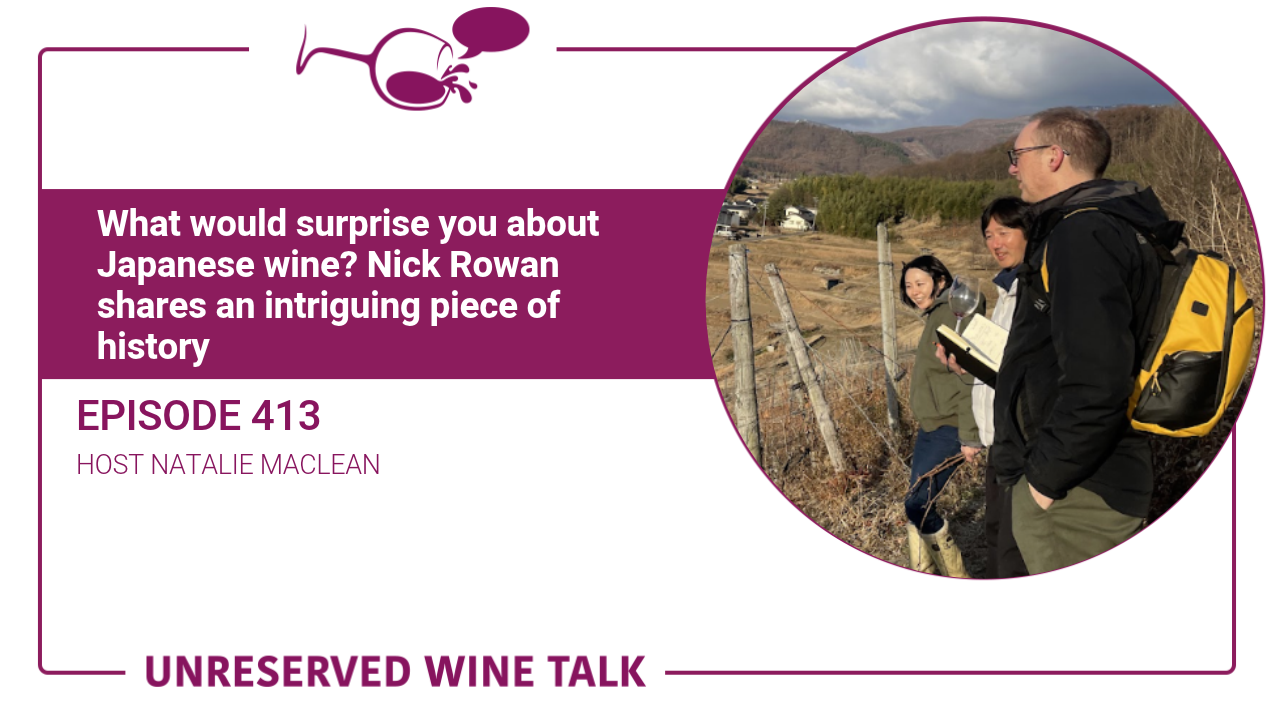
What would surprise you about Japanese wine? How has climate change transformed Japan’s once-frigid Hokkaido into one of its most promising wine regions? How did a chance encounter in a Japanese wine bar lead to a winemaker rediscovering a wine he’d almost forgotten making? How did a 13-year-old samurai smuggled out of Japan become California’s celebrated Wine King?
In this episode of the Unreserved Wine Talk podcast, I’m chatting with Nick Rowan.
You can find the wines we discussed here.
Join me on Instagram, Facebook and YouTube Live Video
Join the live-stream video of this conversation on Wednesday at 7 pm eastern on Instagram Live Video, Facebook Live Video or YouTube Live Video.
I’ll be jumping into the comments as we watch it together so that I can answer your questions in real-time.
I want to hear from you! What’s your opinion of what we’re discussing? What takeaways or tips do you love most from this chat? What questions do you have that we didn’t answer?
Want to know when we go live?
Add this to your calendar:

Highlights
- What makes Japan’s wine world surprisingly small, even with regions hundreds of kilometres apart?
- Why did Japanese wines once have a reputation for tasting artificially sweet and how have they since evolved?
- What makes Japan’s wine industry so much more diverse than most wine lovers realize?
- Why are some of the world’s lesser-known wine regions attracting adventurous wine lovers?
- How are Japanese wineries using animals to manage their vineyards and support local communities?
- What archaeological evidence suggests people in Japan made wine thousands of years ago?
- Why do Japan’s geography and climate have more in common with New Zealand than with many traditional European wine regions?
- Why is Japanese wine production relatively small and what challenges does that create?
- How is climate change transforming Japan’s wine regions?
- How did a 13-year-old samurai smuggled out of Japan become California’s celebrated Wine King?
- What makes Japan’s climate challenging for growing traditional European wine grapes?
- What gives the delicate, understated Koshu grape its distinctive character?
Key Takeaways
- What would surprise you about Japanese wine?
- The Japanese were getting drunk on grape juice about 5 or 6000 years ago. They haven’t got the exact date. But in the north, in Mori Prefecture, they found an archaeological site. I first discovered this in the book Japanese Drinks. the authors touched on it and it was really hard to find the information, even googling and reaching out to them just to find more. It’s Sanai Moriyama. And they found these pits where they had been fermenting the grapes. And then there was debate. Well, was it on purpose or accident? And because of this specific fruit fly remains that they found in it, that only happens when it’s been fermenting on a certain scale. They’re able to say they were doing it intentionally.
- How has climate change transformed Japan’s once-frigid Hokkaido into one of its most promising wine regions?
- Hokkaido is a northern island and that was not always part of Japan. So historically and ethnically they have been quite different. And the laws have been different up there. So it was difficult to consistently ripen grapes each year because it was just too cold. It’s subarctic, it could be -30, 40 degrees in some places, and they bury the vines under snow or under the earth. You know, they literally bury them and resurface them. But with global warming consistently year on year, you can get good grapes. And now it’s one of the best areas in Japan to grow certain grapes. So they’re the three hotspots. You’ve got the centre, Yamanashi, you’ve got Nagano, which people know the Olympics and the snow monkeys are there and internationally known. And then Hokkaido being very famous for skiing up in the north.
- How did a chance encounter in a Japanese wine bar lead to a winemaker rediscovering a wine he’d almost forgotten making?
- One of our first trips with my partner Amanda, we were in a wine bar in Yamanashi in Kofu. We like to get there early. We like to have a bit of time to relax, speak with the owner and there was one guy sitting at the bar. The owner was there and I said, look, what have you got that’s available by the glass? I said, Chi winery. I’m sure I’ve got a bottle of their orange wine at home. He says, no, they don’t do orange wine. He said, I’m pretty sure I’ve got a bottle. And he’s like, no. And he looks up at the guy at the bar and shakes his head no. I flicked through my phone. I said, look, it’s in my fridge in England at the moment. And his face drops and the guy at the bar, his face drops. He was the winemaker and he had completely forgotten about it. He made 400 bottles about three years previously, and I had picked up two at a wine market in Tokyo that we stumbled across, and they just happened to be at home, it happened to be in the fridge.
About Nick Rowan
Nick Rowan spent his early 20s in rural Japan, blissfully unaware of Japanese Wine. Having spent over a decade deep-diving into the world of wine, developing an interest in lesser-known grapes and wine regions, he has combined the two in this, his first book. He lives in Berkshire, UK, with his partner who has put up with his wine obsession the whole time. They both wish they had a pet cat.
Resources
- Connect with Nick Rowan
- Unreserved Wine Talk | Episode 253: An Emotional Guide to Wine + How to Get a Solid Wine Education with Jane Lopes
- My Books:
- Wine Witch on Fire: Rising from the Ashes of Divorce,Defamation, and Drinking Too Much
- Audiobook:
- Audible/Amazon in the following countries: Canada, US, UK, Australia (includes New Zealand), France (includes Belgium and Switzerland), Germany (includes Austria), Japan, and Brazil.
- Kobo (includes Chapters/Indigo), AudioBooks, Spotify, Google Play, Libro.fm, and other retailers here.
- Wine Witch on Fire Free Companion Guide for Book Clubs
- Audiobook:
- Unquenchable: A Tipsy Quest for the World’s Best Bargain Wines
- Red, White, and Drunk All Over: A Wine-Soaked Journey from Grape to Glass
- Wine Witch on Fire: Rising from the Ashes of Divorce,Defamation, and Drinking Too Much
- My new class, The 5 Wine & Food Pairing Mistakes That Can Ruin Your Dinner And How To Fix Them Forever
Tag Me on Social
Tag me on social media if you enjoyed the episode:
- @nataliemaclean and @natdecants on Facebook
- @nataliemaclean on Twitter
- @nataliemacleanwine on Instagram
- @nataliemaclean on LinkedIn
- Email Me at [email protected]
Thirsty for more?
- Sign up for my free online wine video class where I’ll walk you through The 5 Wine & Food Pairing Mistakes That Can Ruin Your Dinner (and how to fix them forever!)
- You’ll find my books here, including Unquenchable: A Tipsy Quest for the World’s Best Bargain Wines and Red, White and Drunk All Over: A Wine-Soaked Journey from Grape to Glass.
- The new audio edition of Red, White and Drunk All Over: A Wine-Soaked Journey from Grape to Glass is now available on Amazon.ca, Amazon.com and other country-specific Amazon sites; iTunes.ca, iTunes.com and other country-specific iTunes sites; Audible.ca and Audible.com.
Transcript
Natalie McLean 00:00:00 What would surprise you about Japanese wine? How has climate change transformed Japan’s once frigid Hokkaido region into one of its most promising wine regions? How did a chance encounter in a Japanese wine bar lead to a winemaker rediscovering a wine he’d almost forgotten making? And how did a 13 year old samurai who was smuggled out of Japan become California’s celebrated wine king? In today’s episode, you’ll hear the stories and tips that answer those questions in our chat with Nick Rowan. By the end of our conversation, you’ll also discover what makes Japan’s wine world surprisingly small, even with regions hundreds of kilometers apart. Why? Japanese wines once had a reputation for tasting artificially sweet, and how they have since evolved. What makes Japan’s wine industry so much more diverse than most wine lovers realize? Why some of the world’s lesser known wine regions are attracting Adventurous wine lovers. How Japanese wineries are using animals to manage their vineyards and support local communities. What archaeological evidence suggests. People in Japan made wine. Thousands of years ago. Why Japan’s geography and climate have more in common with New Zealand than with many traditional European wine regions.
Natalie McLean 00:01:19 Why? Japanese wine production is relatively small and the challenges this creates. What makes Japan’s climate challenging for growing traditional European wine grapes, and what gives the delicate, understated Koshu grape its distinctive character?
Natalie McLean 00:01:41 Do you have a thirst to learn about wine? Do you love stories about wonderfully obsessive people, hauntingly beautiful places, and amusingly awkward social situations?
Natalie McLean 00:01:53 Well, that’s the blend here on the unreserved Wine Talk podcast. I’m your host, Natalie McLean, and each week I share with you unfiltered conversations with celebrities in the wine world, as well as confessions from my own tipsy journey as I write my third book on this subject. I’m so glad you’re here. Now pass me that bottle, please, and let’s get started. Welcome to episode 413. So what’s new in the drinks world this week? In fur, feathers and fermentation. 13 Napa Valley winemakers have posed with their cats for a 2027 charity calendar. It’s called The Real Cat Men of Napa Valley. Proceeds go to Jamison Humane, a local animal welfare group.
Natalie McLean 00:02:45 Marc Mondavi of C Mondavi and family poses with Mozzie. Chris Marisol of Marisol Vineyard publicly thanked his cat Chip for helping him achieve his dreams. The launch party is November 15th in downtown Napa. Every ticket comes with a calendar. 12 months of Cabernet and catnip. Wow. Meanwhile, at Colorado, Brewer is promoting its seasonal slasher IPA beer with a wonderfully specific search for people legally named Michael Meyers. The stunt ties into Halloween The Game, a new horror video game in which players can become the fictional Michael Meyers or try to survive him. Winners get the cash equivalent of a year’s beer and a copy of the game. And no, this isn’t the Canadian comedian Mike Myers, although his birth certificate name is Michael Myers, which feels like a missed casting opportunity. In Connecticut, the Speakeasy Halloween cocktail bar returned October 16th with seven themed cocktails, including The Cursed Orchard, Practical Black Magic, and The Spooky Slushie. There’s also a selection of candy apples with no razor blades. Whiskey is going to space. Doctor Jill Bellot of University of Glasgow School of Engineering leads the project.
Natalie McLean 00:04:04 A miniature satellite called the CubeSat will carry a ten milliliter of whiskey making fluid into orbit in 2028. It could keep working for up to five years. An artificial tongue built by Doctor Alastair Clark will taste for tiny changes in the samples. Terpenes, a sliver of cask wood, rides along two in orbit. The temperature swings with every 90 minute trip around the Earth. The team wants to see whether the wood breathes faster up there than in a warehouse, and if it does, the angel’s share may need a new address. And speaking of whiskey, Alberta’s Whiskey Act is giving Canada’s legal community a buzz. And not just because it tightens the rules for what counts as an Alberta whiskey, but also because the government used artificial intelligence to help draft the legislation. A first in Canada. AI analyzed data and built the building blocks of the legislation, but the final product combined humanize with the AI program. The subject matter made it a good test case because, quote, there is no lives that are going to be lost according to legislatures.
Natalie McLean 00:05:12 I don’t think they’re counting the quality of life, though. So the next time you see an Alberta whiskey bottle, raise a glass to the human machine tag team that wrote the rulebook. A man in Belgium set a world record by balancing a standard glass of Pinot noir wine on his head while running a full marathon. He managed to complete the entire European race without spilling a single drop. Winston Churchill drank Paul Roget champagne for more than 50 years. He met Odette Paul Rocher at a victory party at the British Embassy in Paris after the war, and they became lifelong friends. He even named a favourite racehorse after her when he died in 1965. Paul Rogers added a black border to the labels of its white foil champagne shipped to Britain. Today that border is navy blue. Since 1984, the house’s top cuvée has carried his name. Churchill liked to borrow a line from Napoleon about champagne in victory. You deserve it. In defeat, you need it. Here’s a weird but wonderful science fact. Solar panels may help vines get through a heat wave.
Natalie McLean 00:06:21 A French company making movable panels mounted above vineyard trellises published results from trials in southern France in 2024. Chardonnay under the panels yielded 60% more than the uncovered vines. Wines from the covered vines had about 1.5% less alcohol. The panels tilted to shade the vines in brutal heat. Then they swung open to let the light in during other parts of the day. They cut frost drops by about four degrees Celsius, and they saved about 20 to 70% of the water. It’s nice to know that vines get sunglasses too. And one more scientific fact for your curious mind. Mixing your favorite spirits with diet soda gets you intoxicated significantly faster than mixing them with regular pop. Clinical pharmacology researchers found that your stomach recognizes real sugar as food, slowing down digestion and keeping the alcohol in your stomach where natural enzymes break it down. Because diet mixers contain zero calories. Your stomach empties the liquor straight into the small intestine, pushing your blood alcohol concentration up to 25% higher than the identical rum and sugary cola. Your food and drink calendar is chock full this week.
Natalie McLean 00:07:40 October 28th is National Chocolate Day. The Aztecs in Mexico prized cacao seeds so highly that they used them as money. Prices for goods such as turkey or rabbit were counted in beans. Money really did grow on trees and bean counters. We know where the term now comes from. Legend held that chocolate was a gift from the feathered Serpent, god of wisdom. Montezuma is said to have drunk it as a bitter, frothy drink called X. Chuckle sugar came later, courtesy of the Spanish. October 28th is also Wild Foods Day. No one knows who started it. Foragers have an old saying worth remembering, especially when it comes to mushrooms. Everything’s edible once. October 29th is International Carignan Day, held on the last Thursday of October. The grape likely began in Aragon, Spain, near the town of Kanina, which might have given it its name in Rioja. The same grape goes by Manolo. Carignan was once the workhorse grape of southern France prized for its huge yields. By the 1980s, it was France’s most planted wine grape.
Natalie McLean 00:08:50 A European vine poll programme then cut vineyards dramatically. The survivors turned out to be real treasures. Kiernan vines can live to more than 100 years old. Old bush vines give far more concentrated fruit than young, high cropping ones in Chile’s Molle Valley. A group of growers called vino are now champions of old dry farmed Carignan. October 29th is also Makgeolli Day in Korea, held the last Thursday of October. It marks the season when makgeolli is brewed with newly harvested rice. Makgeolli is often called Korea’s oldest alcoholic drink, dating it to its Three Kingdoms era. It’s cloudy, lightly fizzy, and usually 6 to 9% alcohol. Brewers ferment rice with Newark, a dry cereal cake full of helpful molds. October 29th is also National Oatmeal Day. Samuel Johnson’s 1755 dictionary defined oats as a grain, which in England is generally given to horses, but in Scotland feeds the people. A Scot reportedly replied that this explained England’s fine horses and Scotland’s fine men are high. October 30th is National Candy Corn Day. It dates back to the 1800s.
Natalie McLean 00:10:09 George Ringer, who worked at the wonderful Candy Company in Philadelphia, is credited with inventing it. Workers layered the three colors by hand. In 1898, the Görlitz candy company, now called Jelly Belly, sold it as chicken feed. A 1920s box showed a rooster and the motto of the King of the candy corn fields. Americans buy more than £35 million of candy corn a year, and some of it is even eaten, even less digested. October 30th is also National Breadstick Day, held on the last Friday of October. And in related carb news, October 30th is also by a doughnut day. Credit for that hole usually goes to Hanson Gregory, a Maine sea captain. Around 1847, at about age 16, he punched a hole in the middle so the dough would fry evenly. At 85, Hanson told The Washington Post that he did it to avoid indigestion. A later legend claims he speared a doughnut on his ship’s steering wheel during a storm. In 1941, the National Dunkers Association. Now there’s a wild group voted his version the winner.
Natalie McLean 00:11:24 Did you know that October 31st is Halloween? I bet you didn’t know, though. It grew from the Gaelic festival called Samhain, which means summer’s end marking the end of the harvest and the start of winter. And just because I’m Scottish and Irish, I’m gonna tarry a little jiff on this. So this festival ran from sunset on October 31st to sunset November 1st. Samhain marked the start of the dark half of the year, and the Irish word for November is still Samhain. On the farm. This was the end of the grazing season. Cattle came down from the summer pastures, farmers slaughtered the animals they couldn’t feed through the winter, and communities gathered to feast. Some believe the boundary or veil between our world and the Otherworld thinned at Samhain. The faerie folk could cross over more easily. Spirits of the dead were thought to return home, and families set a place at the table for them. Some left food and drink outside the door. Fire played a big role in some households. They put out their hearth fires and then relit them from a communal bonfire for protection during the winter.
Natalie McLean 00:12:34 In later centuries, people in Ireland and Scotland went door to door in costume. This was called gazing or mugging. They recited verses or performed in exchange for food. This disguise may have helped them blend in with the wandering spirits, and this custom is also the root of trick or treating. Carved turnips with ghoulish faces served as lanterns. Irish and Scottish immigrants brought that custom to North America in the 1800s. Pumpkins were bigger and easier to carve, and they soon took over. Apple bobbing was another tradition in Scotland. It’s called ducking for apples, from the Scots word meaning to dip. Some players drop a fork from their teeth to spear an apple. Players who took too long got a helpful push into the bucket themselves. In the ninth century, the church set All Saints Day on November 1st. All Souls Day followed on November 2nd. Historians debate whether Rome picked the date to absorb Sauron. The evening before became All Hallows Eve. That gives us the word Halloween. Today, Neopagans and Wiccans celebrate Samhain as a major festival.
Natalie McLean 00:13:45 Conveniently. October 31st is also National Caramel Apple Day and National Candy Apple Day. Not sure I get the difference, but whatever. Candy maker William Cobb of Newark, new Jersey, is said to have invented the red candy apple in 1908. He dipped his apples in cinnamon Christmas candy and sold them from his widow for $0.05 each. Caramel apples came later. Craft employee Dan Walker is credited with them in the 1950s after melting down leftover Halloween caramels. You got to do something with them if you don’t want to break your enamel eating them. November 1st is World Vegan Day. The Vegan Society was founded in London in November 1944. Co-Founder Donald Watson built the word vegan from the first three and last two letters of the word vegetarian. Not every wine is vegan. Some winemakers clear their wine or clarify it with egg whites, gelatin, milk protein, or is in glass, which comes from fish bladders. Many wine labels never mention it. November 1st is also National Calzone Day. Calzone or calzone comes from Naples, Italy, in the 1700s.
Natalie McLean 00:14:59 It means trouser leg in Italy. It lets people eat pizza while walking. It’s also National Hong Kaku Soju Day and a warmer day in Japan. My apologies if I am really butchering these words. It marks the time of the year when distillers have the season’s first shochu ready. Shochu can be made from barley, sweet potato, rice or even brown sugar. November 1st is Zeno Mavra day, winemakers of northern Greece, chose November 1st because it marks the end of Cinnamon Row harvest. The number one also reflects its rank as the region’s top grape. The word cinnamon row means sour black in Greek. Its firm tannins and high acidity lead many sommeliers to call it Greece’s answer to Italy’s Nebbiolo grape. Wine lovers often describe aromas of sun dried tomato and olive. November 2nd is National Deviled Egg Day. Wealthy Romans serve boiled eggs with spicy sauces to start their banquets, and it’s the start of International Sherry Week, which runs through November 8th. Sherry ranges from dry manzanilla to fino to nutty, amontillado rich oloroso and rare palo cortado.
Natalie McLean 00:16:18 Pedro Examinees sits at the sweet end as it’s dark and sticky as molasses. November 3rd is National Sandwich Day, which honors John Montagu, the fourth Earl of sandwich. The popular story says he asked for beef between two slices of toasted bread so he could keep gambling without leaving the card table. Thanksgiving may be over, but we’ve got another big turkey dinner on the horizon, plus lots of holiday toast to make. So I’m going to share with you some tips from recent segment on Citi TV’s Breakfast television, where we talked about Thanksgiving. Often this is the time of year where someone is expected to stand up and give a toast. Most of us mumble something into our glasses and sit right back down. So who better to help us than the toast is with the mostest anyway? All right, so that was their intro. Thanksgiving is the one dinner of the year where the speech has more critics than the turkey. Not to worry, though, because I have a toast for every poor. Borrow them during the holiday season and they’ll carry you right through New Year’s Eve.
Natalie McLean 00:17:26 We’re starting with Castellano del Diablo Reserva Cabernet Sauvignon from Central Valley, Chile. More than a century ago, Don Melchor Concha Toro hid his finest wines in a cellar behind a wrought iron gate. Then bottles started disappearing. So he spread a rumor that the devil lived down there to scare away thieves. Every echo in that cellar made the story bigger and gave the wine its name. Casa del Diablo. The cellar of the devil. It went on to become one of Chile’s best known wine brands around the world. And now that we’re in the spooky season, it’s a perfect seasonal pick, too. It’s got these really attractive aromas of cassis, cherry and ripe plum. It’s medium bodied and smooth with a long finish, and it’s a terrific wine for under $15. It would be so good with herb roasted turkey thighs, bacon pan gravy and a big scoop of sage stuffing. So here’s our first toast, The one we say before we start eating. Here’s to the cook. The table and the toast. Here’s to elastic waistbands.
Natalie McLean 00:18:31 We love you the most. Next up is Toi Reserve Sauvignon Blanc, 2025 from Marlborough, New Zealand. Now on the label, it looks like toi toi toi, but it’s pronounced toi. This is a crisp white from New Zealand. Toys. Family is a family owned winery, named after the native flowering grass that thrives in different landscapes and grows to more than three feet tall. The grass inspired them to make wines that express where they grow. This reserve comes from several blocks of their Cal Rossi vineyard in the Marlborough’s outer valley. They bought the vineyard in 2022 and chose these parcels as their top expression of the 2025 vintage. The grapes were picked in the cool of the evening to keep them fresh. There are lovely lime and fresh green herb aromas on the nose of this wine. Just a hint of jalapeno. Then comes nectarine and subtle coastal notes, and it finishes with a crisp herbal snap. There you go. Most of the wine is made in stainless steel, but a small portion, 8%, is fermented in barrel, which adds texture while keeping the lively marble character.
Natalie McLean 00:19:39 Reserve doesn’t mean heavier. Oaky. The wine is still lively, unmistakable from Marlborough. It’s only 2495 at the Lcbo and I rated it 96 points. Woo! Serve it chilled around 8 to 10 degrees. It would be wonderful with golden crackling roast turkey breast and green beans tossed in lemon and garlic. And here’s the toast that gets passed from one gathering to the next. May those who love us, love us. May the rest have a change of heart. And if not that, a turn of the ankle so we can tell them apart. Next up we have three lovely VK rosé wines from Vineland Estates on the Niagara Escarpment. The labels have a fresh new look, but the same great wines are inside. We’re focusing on the full bloom rosé, but there’s also spring petal and bubbly blossom right beside it. Full bloom is only 1795 at the winery and online, and you’ll also find it at a fine food stores in Toronto. The deep color shows you its rich taste before you even take a sip.
Natalie McLean 00:20:42 Wild strawberry and raspberry notes mingle with some citrus. It’s pleasantly dry with juicy acidity. The fruit and citrus keep it grounded yet exciting. Spring petal is light and sprightly with strawberry and rhubarb, and it’s a lovely bottle to bring along to a dinner. Bubbly blossom brings fine bubbles and raspberries, and it’s made for appetizers. These rosés would pair beautifully with an extra, extra big bowl of cranberry sauce. Because, let’s be honest, most of us eat turkey as an excuse to double down on cranberry sauce, and these wines leave us wanting for nothing. So here’s the toast. May you live as long as you want and never want as long as you live. And we’ve got one more. And this is a Zahedi Vineyards, the Paradise from Okanagan Valley, B.C.. We’re finishing big with our last bottle. When founder Mike Izard first tasted this blend from the barrel. He said, this wine is Paradise. So he named it the Paradise after the Farsi word that gave us the English word for Paradise. It also translates as walled garden.
Natalie McLean 00:21:46 It’s a wine for close company so everyone can find their own version of Paradise in the glass. The wine is aged mostly in French and American oak, with a touch of Hungarian. That Hungarian oak works beautifully with Persian spices. It’s a blend of Cabernet Franc and Merlot. From the warm slopes of Oliver and Osoyoos, the cinnamon herbs and black olive tapenade open up to blackberry and plum aromas. The tannins are firm. The finish lingers as long as your guests will give it and them a little time to breathe. It will be lovely with whole roasted squash stuffed with wild mushrooms and wild rice, finished with pomegranate seeds and a drizzle of tahini. And let’s raise the Paradise for a last toast. Count your age by friends, not years. Count your life in smiles, not tears. On Instagram, I’m at Natalie McLean wine. Come for the toast. Stay for the tasting and on CTV Atlantic. We also talked about Thanksgiving, Friendsgiving and Come Over October, a movement that encourages us to put down our phones and invite the people who matter most to come over and share a glass of wine.
Natalie McLean 00:22:58 I think a Friendsgiving like Thanksgiving without a seating chart, it’s a bit more informal and that’s why I come over. October pairs so well with it. Just open your door and open a bottle. The first wine is from Magnetic Hill Winery in Moncton, named for Magnetic Hill, where cars seemed to roll uphill on their own. The Everett family is known for their fruit wines, but they also grow grapes to make traditional sparkling red and white wines. Their son, Zach Everett, backpacked through Europe and came home wanting to plant vines. Today he makes this wine from Osceola muscat, a beautifully aromatic white wine grape. Visiting this winery is a must. You can watch ballet by the ocean, enjoy a four course meal on the ocean floor at low tide, and stay in their beautifully restored 1867 guest house. All of today’s wines that I’m mentioning on this show are sold at the wineries and in liquor stores in their home provinces. You can also order them directly and have them shipped to your door across Canada. And when you do, you’re supporting a local family farm that in turn invests back in the places where we live.
Natalie McLean 00:24:05 Osceola by the sea has aromas of lemon peel and apple with tropical notes. It’s gently off dry with a light spritz and vibrant Acidity. You get a salty sea breeze finish and it would be terrific with many lobster rolls on the back porch. What grows together goes together. I also had a second bottle from Magnetic Hill called mystique. Is there any flavor more iconic for Thanksgiving or Friendsgiving than cranberry? This wine goes back to the family’s roots. The Everett’s were strawberry farmers who bought an old house in Moncton, and that’s when they started making fruit wine. Mystique is one of the original fruit wines they make every year. Every cranberry is grown on their farm or within 50km of it. Their first goal was 5000 bottles a year, and today they make 150,000 fruit. Wine is where they started, but not where they stopped. The wine is bright and tart, with juicy cranberry and notes of cherry and raspberry. Serve it chilled. It’s only $15.50. Top it up with a splash of soda and you’ve got a spritzer for the whole crowd.
Natalie McLean 00:25:09 This would be wonderful with maple glazed ham on a potluck table. Now we’re crossing into Nova Scotia with modern tidal. Bay from Canning, Nova Scotia. Tidal Bay is Nova Scotia’s own Appalachian, and it’s one of a kind in North America. Most Appalachians are defined by a place. Tidal bay is defined by a style. It’s made only from Nova Scotia grapes. It stays at 11% alcohol or less, and each winery puts its own spin on the blend. An estate winery sits on the shore of Minus Basin near Canning. Winemaker Simon Refuse beautifully blends Lac de Blanc, several blanc and Muscat grapes. It leans towards citrus and green apple with crisp acidity and a cool coastal minerality. It’s like the ocean in your glass, and this is the glass to sip slowly as the conversation warms up. It would be terrific with a thick broth of seafood chowder by the fire, and we finish with a read from Annapolis Valley, Planter’s Ridge, quintessence, red Planters Ridge is in Port Williams in a timber frame barn that’s more than 150 years old.
Natalie McLean 00:26:15 Nova Scotia is famous for its crisp whites and sparkling wines. Planters Ridge is showing the world that it makes serious reds, too. Quintessence is their signature red, a blend of three cool climate grapes Lucy, Coleman, Castille and Marquette. It’s dry and full bodied. Dark berries and cedar on the nose lead to blackberry, pepper and dark plum with a long, smooth finish. Wouldn’t this be delicious with wild mushroom risotto at the harvest table? Here’s to open doors, open bottles and open hearts. Come over October. On Instagram, I’m at Natalie McLean. Come for the maritime wine. Stay for the memories they make. And on CTV Vancouver. We also talked about Come Over October, which invites us to put down our screens and pull up a chair. The idea is simple open your door. Make room for one more and share a glass with the people around you. We are mammals meant for friction maxing in real life. And yet we’re suffering from an epidemic of loneliness. A bottle can be an invitation, an excuse to get together.
Natalie McLean 00:27:23 As in, I have this fabulous wine from the Okanagan or Niagara or Nova Scotia that I really want to share with you. The wine just helps us linger a little longer at the table. Less scrolling. More storytelling. Why is this so important now when we see each other less than we once did in 1986, nearly half of us saw a friend on any given day today. It’s fewer than 1 in 5 of us. Just like birthdays and holidays come over, October is a nudge to get together more often. Many bottles have been bookmarks in my life. That’s because smell is wired to memory like no other, since I can still remember every detail from years ago, such as, bizarrely, what everyone was wearing. The wines aged beautifully. Many of my outfits did not. What are some easy ways you can take part? Pull up an empty chair at your table or on your porch. No need to cook or be fancy. Just put out some Canadian cheeses to keep you away from the oven, as I’ve often been advised to do.
Natalie McLean 00:28:22 My grandfather kept a chair beside him on the porch. Neighbors would drop by and drop into it. Unexpected, uninvited, yet always welcome. Well, mostly try the long table. Invite people who’d never otherwise meet a neighbor, a co-worker, a friend of a friend. Come over. October’s for everyone, whether you drink wine or not, so keep alcohol free. Options on hand to the spotlight is on Canadian wines. So what would you recommend? Canadians choose our own wine. About 30% of the time, the French drink their own wine 83% of the time. The French don’t call that patriotism. They call it dinner. So the first one I recommended was the Azadi Vineyards. Shiraz, I’ve already told you about the Paradise, but this is from a brand new winery in Kelowna, high above Okanagan Lake. The name nods to the ancient Persian city famous for its gardens and poets. The winery says that this is best shared with new friends sharing old stories. And that’s the whole idea. The point isn’t what’s on the table, it’s who’s around it.
Natalie McLean 00:29:30 And for the longer table, I suggest the Township seven Interlude Cabernet Sauvignon crafted in British Columbia. My favorite idea is the long table. A hard winter freeze wiped out most of the Okanagan crop in January 2024, so the team brought in grapes from trusted growers and made wine and Narmada. And finally, I recommended Poplar Grove. The Legacy 2015. Poplar Grove is one of the five original wineries on the Narmada bench. Tony and Barb holler farm it with their four sons from estate vines. It’s their flagship wine, a ten year release that spent a decade in the cellar, and their family motto says it best. Great wine brings it together. And on TMS two, the new national daytime show on global, we also chatted about Come Over October. Yeah, we were done. So I’m not going to repeat some of the same things I’ve already said for the other shows. I’m just going to skip to some of the stuff that was different. All right, so including the wines I recommended starting on the East Coast, I grew up outside of Halifax, so this one’s close to my heart.
Natalie McLean 00:30:41 Benjamin Bridge Winery sits in the Gasparo Valley, where the Bay of Fundy tides shaped the growing season. Gerry McConnell and Darragh Gordon founded it in 1999 and their twin daughters, Ashley and Devon now lead the team. The first release of Nova seven, in 2007 sold out in a matter of hours. That’s not a launch. That’s a province wide kitchen party. We call a ceilidh down home. It’s lightly sparkling in just 6.5% alcohol. It would be divine with pan seared scallops. I also recommended the Organised Crime Winery’s Cuvée Christina Sacred Series Chardonnay from Niagara on the beam’s Bill bench. The name Organized Crime comes from a feud in the early 1900s between two local Mennonite congregations over a pipe organ. One congregation felt the other was being prideful by playing the organ during services, so they stole it and threw it down an embankment. It may be the only heist in history committed for the sake of peace and quiet. Anya runs the family winery with her husband, Edward. This chardonnay carries the name of her late mother, Christina.
Natalie McLean 00:31:51 The winery has been named one of Canada’s top ten small wineries six times at the National Wine Awards. This wine is gorgeous aromas of baked spice, apple and lemon curd. It’s a splurge worthy white for a cozy night in, and I can imagine it with lobster and drawn butter. And we finished out west with the Zadeh Vineyards, the Paradise which I’ve already told you about. Back to today’s episode. Speaking of the spooky season, if you’re reading the paperback or e-book or listening to the audiobook of my memoir, Wine Witch on Fire rising from the Ashes of Divorce, defamation, and Drinking Too Much, a national bestseller and one of Amazon’s best books of the year, I’d love to hear from you at Natalie at Natalie mclean.com. There’s also a terrific free guide for book clubs. I’ll put a link in the show notes to all retailers worldwide at. Natalie McLean 4413. Okay, on with the show. Nick Rowan spent his early 20s in rural Japan, blissfully unaware of Japanese wine, having spent over a.
Natalie McLean 00:32:58 Decade deep diving into the world of wine and developing an interest in lesser known grapes and wine regions, he has combined his two passions in his first book, which is entitled Japanese Wine History, regions, Wineries and Cheese, and he joins us now from his home in Cookham, England. Nick, we’re so glad you could be here with us. Welcome.
Nick Rowan 00:33:19 Thank you very much, Natalie. It’s great to be here.
Natalie MacLean 00:33:21 All right. Cheers. I’m really fascinated by Japanese wine. I know practically nothing except for what I’ve read in your books. But before we dive into that, let’s start with maybe a couple of your memorable wine moments. They may not be related to Japan, and that’s fine. Okay, maybe you can tell me about a forgotten wine.
Nick Rowan 00:33:41 Sure. I have a knack throughout my life of finding small world stories, no matter where I am. And one of our first trips with my partner Amanda, we were in a wine bar in Yamanashi, in Corfu. We liked to get there early.
Nick Rowan 00:33:53 We like to be have a bit of time to relax, speak with the owner. And there was one guy sitting at the bar. The owner was there and I said, look, what have you got that’s available by the glass? And he lines a load up and I said, I chi winery. He said, that rings a bell. I’m sure I’ve got a bottle of their orange wine at home. He says, no, they don’t do orange wine. He said, I’m pretty sure I’ve got a bottle. And I he’s like, no. And he looks up at the guy at the bar and shakes his head. No. I flicked through my phone. I said, look, it’s in my fridge. But in England at the moment, and his face drops and the guy at the bar, his face drops. He was the winemaker and he had completely forgotten about it. He made wow, 400 bottles about three years previously, and I had picked up two at a wine market in Tokyo that we stumbled across, and they just happened to be at home.
Nick Rowan 00:34:42 It happened to be in the fridge. I didn’t drink it before going out, so they were really excited. He’s got a very dry sense of humor. He’s like, yeah, don’t touch it, it’s gonna be gone. He did it on commission for an actual wine bar elsewhere in Japan, so don’t forgot about it. And I managed to get it back to the wine bar. Owner was excited by it. There’s an annual Koshu of Japan tasting every year in London, so I was able to bring my bottle to give to his friend, to take home and give to him, and he opened it on the eighth anniversary of his wine bar, which was also the eighth year of the vintage. So that was great. And I’ve got a little Instagram story.
Natalie MacLean 00:35:19 That’s it. Yeah, absolutely. That’s incredible. You remember his wine better than he remembers making it. So that’s okay. Now you’ve got another story I think, about a winemakers daughter. That sounds juicy. It’s going.
Speaker 5 00:35:33 On there.
Nick Rowan 00:35:34 No, that was on the same trip lesson a week or two, just before we were in Corfu. On the first night, we stayed just at the base of Mount Fuji, which we couldn’t see in the drive. It was foggy and we woke up the next day. This fantastic view of Fuji and the night before we had been just walking around town. We weren’t ready to go to bed. We thought, let’s just find someone that might be open. And it was like a hotel, hostel, pizza place. They had some wines, very reasonable price, like £20. That’s like less than $30. So we got a bottle of this wine. This is lovely stuff. First night, first bottle of wine in the trip. This is going well. And about a week later, we were in a restaurant in Sapporo called French Panda, which has pandas everywhere. Craziest place. Sitting at the counter. And a couple arrived a little bit after us and they sat beside us, and the lady with the server was recommending a bottle of wine to them, and showed them this same wine that we had on the first night.
Nick Rowan 00:36:30 And the Irish in me talking with anybody is close enough to speak to, and just the wine lover in me wanted to make sure that if someone isn’t sure about the wine, that they feel comfortable, that they’ve made the right choice. And I’m like, yeah, that’s a great wine. We loved it. It’s the first bottle of wine we had on our trip, and the girl behind the counter who Who’s serving? Her face drops. Turns out that’s her parents winery. They made the wine and she was just recommending it. And that was the wine that we just recognized it from the label. Loved it. It was a Koshu from Yamanashi, from Kazan. They’re great. So again, we’ve kept in touch. And when she went to study in Austria and Germany, I was able to put her in touch with friends who were able to guide her and how things work was finding accommodation and navigating the landscape over there. So it was great.
Natalie MacLean 00:37:14 Oh that’s fantastic. The world is small, but the wine world is even smaller.
Natalie MacLean 00:37:18 You never know who you’re talking to. It’s a good thing to keep in mind. Now, Nick, you mentioned that your first taste of Japanese wine was in 1998, when you were an assistant language teacher with the Japanese Exchange and Teaching Program north of Tokyo. Take us back to that moment where, like, where were you exactly? And what did the wine taste like.
Nick Rowan 00:37:40 Tasting sitting on the floor of either my apartment or someone else’s apartment. And I think, okay, it was I didn’t know about wine other than it was interesting and I didn’t know anything about it. We drank beer back then and it was cheaper and someone, myself or someone else had brought it. It was a Japanese wine. And yeah, it wasn’t quite to my tastes at the time. It probably wouldn’t be today. Now, looking back on it, I know several things. One is that Japanese winemaking has come on a long way, and two, that it was made from a Vetus labrusca grape. Now, those are from North America that you might be familiar with most Europeans.
Nick Rowan 00:38:17 Yeah, most Europeans are.
Natalie MacLean 00:38:19 I think you could.
Speaker 5 00:38:19 Say.
Nick Rowan 00:38:21 It’s for making wine. Vini feta. Right. So Vitis labrusca is it’s one of those things that it’s like we can grow it. I said, yeah, just because you can’t. Doesn’t mean you should. But it it copes very well in the Japanese climate, which is hot and humid. So these big thick skin that you literally slip off, it works well. But there’s this foxy flavor. It for me, it always tasted artificially like artificial sweets, which interestingly, it’s the same chemical that is used even though it’s natural for sweets for sweet drinks. So that’s why it tastes very confected. That would have been a bit labrusca grape of some sort, whether imported or whether Japanese. And that was the first one I had, and I didn’t have another for about 20 years, I think, and not.
Speaker 5 00:39:02 For scarring.
Nick Rowan 00:39:03 Mostly because I couldn’t find them. They’re just they’re very difficult to source.
Speaker 5 00:39:07 Okay.
Natalie MacLean 00:39:08 After much therapy, you.
Speaker 5 00:39:09 Got back to Japanese wines.
Natalie MacLean 00:39:12 So you spent decades in a corporate career doing market research and presentations before turning to wine. What was the moment you knew when you wanted to devote your career to wine?
Nick Rowan 00:39:21 It was. The industry I was in is changing, and I lost my job about nearly three years ago now. I hope my in-laws aren’t watching this. I don’t know.
Speaker 5 00:39:31 I don’t know. Okay, I took some time.
Nick Rowan 00:39:34 Off, got into wine and thought, look, what am I going to do with wine? There’s a lot of noise out there. Everyone wants to write about the big names, and there’s absolutely nothing I can add to that. I don’t have any more expertise than anybody else, and I don’t want to just do the same thing of teaching beginners things that they want to know. And then I realized through my trips to Japan that I had started to build up a knowledge of Japanese wines, and even local organizations weren’t really able to give me the answers to questions I was asking.
Nick Rowan 00:40:01 And I felt I could write something of a Japanese wines. And I had a friend in, actually, I’d met on a Facebook group whose name is Johnny Toppan. He is from Northern Ireland as well. His father is from Zambia and he ended up going to Japan about one hour’s drive from where I lived just a few years later, and he ended up in London as well, and he ended up establishing the first ever vineyard in Zambia with Japanese partners. It’s organic and natural, and he had put in my mind writing a book about natural wines in Japan. And I thought, look, if you’re going to write something about natural wines in Japan, you’re going to want to know more about wines in Japan. You want to know something with the wider context, but it put the idea in my head and I’d been out to like the bulgogi every two years big Burgundy festival, and I found myself sitting at a table with a couple of masters of wine. Had a few drinks and talked about writing a book and they’re like, yeah, I don’t do that.
Nick Rowan 00:41:00 There’s no money in it. You make a name. So that’s really that just wouldn’t get out of my head. I started writing with Japanese wine and I reckon it’s like Forrest Gump. He went out for a jog, and he ended up doing a million marathons, and I didn’t know what I was going to write, what I was going to do, what I was going to get to. And I decided ultimately, do the light, just plant out the landscape and map out the landscape. So, you know, every region, every winery, the evolution of the wineries, the wine styles, who’s the biggest, who are the funkiest, who are the off piste? Who are the top? And you’d really map that out so that anybody interested in it going forward has something to refer back to.
Natalie MacLean 00:41:36 Oh that’s great. Yeah, it’s a good comprehensive overview of what’s going on in the country wine wise. Now, in your book, you profile 721 Japanese wine producers, 130 grapes, including 82 that are unique to Japan, and list 384 bars and restaurants.
Natalie MacLean 00:41:54 How many wineries did you end up visiting in person? How long did all this research make?
Nick Rowan 00:41:59 Not all of them. Okay, bought and translated pretty much every book that’s been written and about Japanese wines in the last decade. A lot has changed and.
Speaker 5 00:42:08 A lot of beginning.
Nick Rowan 00:42:09 In Japanese. Yes.
Speaker 5 00:42:11 Oh, okay. Okay.
Natalie MacLean 00:42:13 But in English, no.
Nick Rowan 00:42:14 No, there’s a Japanese Drinks which has a chapter on Japanese wine, which mostly talks about the history of ancient history through to older history. And there’s one bilingual book that was written. It’s a really good introduction. It was written in 2018, I think, and that’s where Hokkaido got 4 or 5 pages at the end with 1 or 2 wineries mentioned. And now it’s the most dynamic, exciting place in Japan. That’s how much has changed. It’s a moving target, and it’ll be interesting to see how out of date my book becomes and how quick. But because it’s a print on demand due to the publishing nature, it’s something I can update at any point.
Speaker 5 00:42:50 That’s good.
Natalie MacLean 00:42:51 Oh, I know because most books are out of date. Unless you’re writing fiction the day they’re published, especially in the world of wine. So that’s a good thing, that you have that connection. And before we go further, your blog is known as Wine Fog, too. Geez. What’s the story behind that? Why did you name it Wine Fog? Are you in a daze in the.
Speaker 5 00:43:10 Fog about it?
Nick Rowan 00:43:12 And anything you wanted to associate with it? It’s. It really came from Phileas Fogg. I was a traveler. I’ve traveled a lot with work and for pleasure. And I’m more interested in lesser known wine regions because for me, that’s exciting. Just uncharted territory. I went to Andorra, mapped out all all six producers in Andorra. Even they thought I was crazy. I just wanted to go and understand it. And when I think I understand enough to explain. I’ll write about it. So I thought. I’m kind of the Phileas Fogg of the wine world, right?
Natalie MacLean 00:43:39 And Phileas Fogg, is that Charles Dickens character?
Nick Rowan 00:43:42 No, that’s Jules Verne.
Nick Rowan 00:43:43 80 days around the world.
Natalie MacLean 00:43:45 In 80.
Speaker 5 00:43:46 Days or whatever. So. Yeah. Okay.
Nick Rowan 00:43:48 The logo was meant to be a balloon until someone said, why is it a torch for your logo? I’m like, oh, no.
Speaker 5 00:43:53 It doesn’t look like a torch, a flashlight.
Nick Rowan 00:43:55 So it was the idea of just going around the world doing intrepid stuff, and then we liked the idea of being in a fog where you’re drinking and having a bit of a mind fog the next.
Speaker 5 00:44:03 Day.
Nick Rowan 00:44:04 Whatever you want.
Natalie MacLean 00:44:05 That’s good. I like the double meanings of words. So what’s the most interesting thing someone has said about your book so far?
Nick Rowan 00:44:11 The Walnut I liked Jamie Goode. I met him at a wine fair. I brought the copy along and he eventually reviewed it and I said, look, thanks for your review, but can I quote you what you said verbally? He just looked at it. This is insane.
Speaker 5 00:44:24 Yep. And I just want to say, this is insane.
Nick Rowan 00:44:28 Jamie.
Speaker 5 00:44:29 That was the best.
Natalie MacLean 00:44:31 So he just thought you were insane for tackling such a big topic.
Nick Rowan 00:44:35 He flicked through because he, I think more than anybody else in the wine world, he knows the most. He’s been out for decades. I still find blog articles from him from ten, 15 years ago of obscure wineries that he visited because he has that same love of everything natural, top end, low end, small, big scale. And that’s something that resonates with me as well. Rather than just trying to trophy hunt and talk about the big names. So yeah, that was great. I wanted to get it in front of him because he’s actually better connected out there than I am. I couldn’t get in touch with some people I wanted to before the book was published, and he knows them personally as well. But yeah, he can get the word out there.
Natalie MacLean 00:45:11 Oh that’s great. And what was the most difficult part of writing this book?
Nick Rowan 00:45:15 The quantity, the sheer volume of it.
Speaker 5 00:45:17 Yeah.
Natalie MacLean 00:45:17 The scope.
Speaker 5 00:45:18 Yeah.
Nick Rowan 00:45:18 Every winery. I had to read up the backstory through numerous articles and books, sometimes speaking with the wineries that I visited or Instagram messaging. Yeah, depending on what worked. Then I had to check every winery. Name. Winemaker. Name. Instagram account. Facebook account. The website address. The price range are about ten data points for every winery. And when you multiply it by 7700, that’s about 7000 points that I had to double triple check. So that alone was just crazy. I have a database and then they have a tendency of changing their mind quite a lot and saying, I’ve got an Instagram account of it might be Sarto or Wine Naked. No, I’m going to change it tomorrow to Wine Sato Company. So suddenly they’ve just changed their Instagram handle. You go, what’s happened here? And then a month later they said, no, it’s Sato. Wine works better. So as part of my drive to update it in future and keep it live, I’ve created an online map. It’s going to be subscription only and that has every winery with their social media accounts directions.
Nick Rowan 00:46:19 I have all the venues, plus more that didn’t fit in the book. All the Japanese winemakers around the world, there’s about 30 of them and that I can update the social media. If people tell me, look, this is wrong, or if I find out, I can change that almost immediately. And if you own the book and you subscribe, you will then get access to the book entry on each winery. So when you click it, you can read about it. So if you’re traveling there, you don’t have to carry this 1.5 kilo tome.
Speaker 5 00:46:46 Yeah. Oh that’s that’s.
Natalie MacLean 00:46:49 Definitive. If you’re going to go visit Japan and you’re a wine lover, this is the book to have. Now, if someone buys the book directly from your website where you do sell it, in addition to it’s available on Amazon and all the other places, but you’ll add a custom wine stain made with a specific Japanese wine of their choice. Yes, you get that idea. And what have you done so far?
Nick Rowan 00:47:10 Like all my best ideas, that was walking home tipsy from my local wine bar and realizing that Amazon took a huge chunk off the top.
Nick Rowan 00:47:18 And then they take their printing cost and then they take foreign transaction fees. So in Japan, for example, the book is quite pricey for Japanese, even though it’s five books and one. Essentially, it’s about as low as I can go because Amazon takes like Amazon and the tax guy take away 70% or more. Right.
Speaker 5 00:47:34 So that’s rough. So I thought if it’s.
Nick Rowan 00:47:36 If I can sell directly in Europe and North America by ship, then it’s easier for me. I can if I break even, I’ll be delighted by the end of the whole project. And I thought, how do I drive people towards me to buy it? I can sign it. That helps, I thought. I’ve got 2030 bottles of Japanese wine in my cellar, some quite rare grapes, some quite rare wines. I thought, well, my logo is that wine? Splat! So what if I just make a thunk and put a wine splat in the book? And I love it. I just made me laugh and I thought, I’m gonna do it.
Nick Rowan 00:48:06 And some people love it and some people are like, oh no, no, no, no problem. They just thought it’s just a fun thing. And if people buy directly from me, it means I can also check the quality control before it’s packed and sent out the door and sign it, dedicate it. And yeah, I know who’s bought the book, and I, I’ve kept in touch with quite a few people who have bought it when they tell me that new things or ask me any questions, I’m more than happy to answer and interact with them.
Natalie McLean 00:48:29 That’s great. That’s great. Now another creative idea you had was in the appendix. You have listings of the best winery animals and pets. So tell us about the most memorable animal or pet you encountered at a winery.
Nick Rowan 00:48:42 Yeah, I think I, I pitched that wrong. Somebody else in a major Japanese publication was like, is it true you have pets at the back of your book? I’m like, there are books called Winery Dogs in Australia, in Japan as well, Winery Dogs.
Nick Rowan 00:48:54 And it was really an extension of I just made a list of wineries and what themes were overarching, like female led wineries or natural wineries or foreigners owning wineries, because not for me. Sometimes someone who goes, if a Korean goes there, I would love to meet the only Korean guy making wine. Why not? That’s great. And there was one winery. He was using a horse to plow the field. Actually, another one uses retired racehorses, gives them a new lease of life and has them.
Speaker 5 00:49:21 That’s great.
Nick Rowan 00:49:22 Then the money goes to to help fund that. Then there’s chickens and some that eat the insects. There’s sheep and goats that are grazing and eating the weeds. And the Japanese say, yeah, that’s our that’s our weed control, or they’re our gardeners. And there’s a lot that really love cats or really love dogs. They’ve got the dog book and one that really resonated with me. We went out to see them in a specific part of Chattanooga. I think it’s an enzyme. Or they’re just on the border of Yamanashi City.
Nick Rowan 00:49:49 It’s a few meters apart, and they love animals, and they’ve taken a lot of strays on. They’ve taken their dog, they had a lot of pets, and they say tasting is free, but please just donate something to the charity for animals. And they were wonderful. I love that there’s another winery. I can’t remember offhand, the prefecture. And they do it just for the cat sanctuary down the road. They say all the profits go to the cat sanctuary. And look, I know about wine. I know what I like, and I go to an unknown area, even in Europe. And I look at the shelves and I have no idea what I’m looking at. And I’ll be honest, if it’s a funky label, I’ll probably buy that. Because if there’s nothing else to judge you on, you’re going to have a laugh round a table, a board, a colleague is my dad loves them. Got that for Christmas. So I thought, if you’re going to Japan and you want to buy a friend a bottle of wine and they love cats, I hear some cats in the label, right? If you love goats, here’s one of the goats suspended with hot air balloons.
Nick Rowan 00:50:41 Why not another? And just another thing to help you choose a wine, no matter how arbitrary. But that’s how people choose. Even wine lovers. Yeah. Fluffy squirrel. Cute iguana.
Natalie McLean 00:50:53 I’ve been there. And what’s the most fascinating or surprising piece of Japanese wine trivia that really tends to delight friends and dinner guests when you share it or surprise them?
Nick Rowan 00:51:04 I think, as you said in the introduction, that Japanese were getting drunk on grape juice about six, five, 6000 years ago. They haven’t got the exact date. But right in the north, in our Mori Prefecture, they found an archaeological site. And this is. I first discovered this in the group in the in the group in the book Japanese Drinks, and the authors touched on it and it was really hard to find the information, even googling and reaching out to them just to find more. It’s Sunny Moriyama, I think it’s called, and they found these pits where they had been fermenting the grapes. And then there was debate. It wasn’t on purpose or accident.
Nick Rowan 00:51:40 And because of this specific fruit fly remains that they found in it. That only happens when it’s been fermenting. On a certain scale, I think I’m getting this right.
Natalie McLean 00:51:50 That’s interesting story anyway.
Speaker 6 00:51:52 Yeah, they were able to say no. They were doing it intentionally.
Nick Rowan 00:51:54 Like having lived in Japan and burned out in Japan, especially the North. They like their drink. So. Yeah. I couldn’t believe it.
Natalie McLean 00:52:00 Yeah, yeah. For sure. Yeah, that is interesting. Before we keep diving into Japanese wine, maybe let’s just step back. For those who are fuzzy on exactly where Japan is on the globe. Tell us where it is in relation to some other countries or continents. And then you can give us an overview of where the wine regions are within Japan and prefecture. Is that means county or.
Nick Rowan 00:52:23 Province like a county or a province? Yeah. Okay. Yeah, okay. I think French used prefecture as well. So it’s similar to that. It’d be like US state maybe. Okay.
Nick Rowan 00:52:32 Okay. But smaller. Yeah. Look, I’m looking at a European map where we’re clearly the center of the world, where China is the center of their world. Literally Middle Kingdom. You look right. Go far east and you fall off the edge. That’s Japan. So it’s just off the east coast of China, touching Taiwan, which is where the native Japanese originally came from, China through the Korean Strait. Did I say Taiwan? Korea through the Korean Strait over to Kyushu, which is one of the southernmost islands. And then they populated the region. And it’s it we call it the land of the Rising Sun, because in the east, that’s the first one of the first places that gets the sun. Maybe New Zealand a bit ahead of it. It’s also in Japanese, and I do a bit in Japanese language at the end of the book. It is son. Origin is my home. That is land of the rising sun. So even in Japanese, that’s what they call it. Now it’s.
Nick Rowan 00:53:24 I compare it to New Zealand in several ways. One, they wanted to make wine. Everyone starts with Bordeaux. It had has had it’s prestigious and they wanted to try and replicate that. The climate just isn’t up for it. But many Japanese, they go and they study in Bordeaux. Then they started to get a bit more domain style wineries where they wanted to grow their own grapes, which wasn’t possible initially because of land ownership laws. They trained in Burgundy and from there guys Anaheim and Vienna. So that bit closer to their climate, which is is quite far north. Its southernmost point is probably touching in Bordeaux. The northernmost is Alsace or further north. I need to look at them up again. But it was one wine vineyard manager, actually, in Hokkaido, he said, look, I went out and I studied in Australia because I wanted to make wine. And I came back and I knew a lot about winemaking and thought, this is nothing like Japan. What have I just done? That’s hot and dry.
Nick Rowan 00:54:17 We’re cold and soggy. So I went to New Zealand and I learned again that it’s much more like us. And when you actually take it, if you take New Zealand and flip it upside down as it would be in the Northern hemisphere, it roughly aligns with Japan. It’s a volcanic island. It’s over several islands. There’s a lot it’s got in common. Japan, they’ve got their volcanoes. They’re earthquakes. There are cool climates. They’re mountains. So I think it’s one of the closest comparisons you can make. But it’s not identical.
Natalie McLean 00:54:46 No. Sure. Absolutely. And is the production about the same as Japan like roughly? I know it varies every year, but how much wine does Japan produce? And we’re not talking saké, but wine.
Nick Rowan 00:54:57 Less, less and less like the rest of the world. But the majority of it is what’s called domestic wine. So before they made wine and that could be from imported grapes, imported frozen grape must or domestically grown grapes. So at the moment. There’s been a huge decline in the last few years.
Nick Rowan 00:55:14 The latest official statistics for 2024 were released two months ago and that has shown a big decline. But that’s from the domestic wine from imported grapes. They’re just not importing that bulk anymore usually. Why is that? I think this is not as much market for it. You can import Chilean wine. That’s decent. You don’t need to import Chilean wine and rebrand it as your own. Right. And that was usually cheap supermarket plonk that was doing that. But the domestic production it’s this stable struck a little bit up. And that’s about a third of production now before it was about a fifth. So they made they processed 30 million tonnes. Now I did translate that into bottles and I’ve lost it. They made 2030 million tonnes of grapes. Out of that, 10 million was from domestic.
Natalie McLean 00:56:04 And how does that compare to say, New Zealand’s like is that a fifth of the production?
Nick Rowan 00:56:08 It is about a fifth. You’re spot on that? Yeah. Yes. Okay. Fifth or sixth? It’s somewhere between Greece and Switzerland.
Nick Rowan 00:56:15 If I look at the Ivy. The organization of international Ivy. Their statistics, their statistics don’t always align with Japan for various reasons that you know, what you make isn’t the same as what you sell, because you got to store it for a year or two years, etc. but it’s somewhere around the Swiss Greek North Macedonia area in production. It’s not huge, which also explains why not a lot of it is exported. And when I speak to some Japanese winemakers, they’re like, I want to export. And I go, do you want to export? Because you need to know I can sell everything. So is it just for the prestige? Like, yeah, pretty much honest about it. They just want to be able to say, I’m exporting, I’m selling in London. And I was like, yeah, right. Japan’s a good market for you guys. Stick with it. I’d love to see more of it here, but I’d love them to focus on their core customers as well and not get sidetracked.
Nick Rowan 00:57:02 I spent my career on exports and it can be difficult and frustrating.
Natalie McLean 00:57:06 Yeah, okay, that gives us a good picture. And then whereabouts in the country are the vineyards tend to be in the south of the country, along the coast, up north. Is it in the. I should know this. The Lord northern or southern hemisphere? Is it in the northern hemisphere?
Nick Rowan 00:57:20 Yeah, yeah, it’s the north.
Natalie McLean 00:57:22 From New Zealand. Yeah. That’s right.
Nick Rowan 00:57:24 So if you think of Japan as a boomerang, though, what? Why is this good. Reflect on my screen. That looks about right. Okay. Okay. In the on the point of the boomerang is kind of Tokyo ish. Now, when you move in, that’s the highest mountain range. Fuji and the Japanese Alps. That’s where. That’s the heartland. People will argue as that really were the first. Grapes were the first. You’re going back hundreds of years and we’ll never know. But really the heartland where most vineyards are is in Yamanashi.
Nick Rowan 00:57:52 That’s in the basin at the bottom of Mount Fuji and inland. It’s protected a little from the worst of the elements by that mountain range. That stops the the hurting, the typhoons. It stops less earthquake prone, perhaps no risk of tsunami that far inland. But as the temperatures have risen, the vineyards have moved up the side of the slopes to higher altitude and also to higher altitudes. In Nagano, which is just next door, north west ish, a little bit because Yamanashi is roughly about 450 to 650m above altitude, it goes from 250 to, I think, nearly a kilometer in certain bits. But I’d say Nagano was probably about 300 higher than that across the board, 750 average. It can go to over 1000.
Natalie McLean 00:58:39 and level.
Nick Rowan 00:58:40 Okay. So it’s moving further north because that’s cooler into Hokkaido. Hokkaido was the Northern Ireland. And that was not always part of Japan. So historically there have been quite different. Ethnically they’ve been quite different. And the laws have been different up there. So it was difficult to consistently ripen grapes each year because it was just too cold.
Nick Rowan 00:58:59 If subarctic could be -30, 40 degrees in some places and they bury the vines under snow or under the earth. They literally bury them and resurface them. But with global warming consistently year on year, you can get good grapes. And now it’s one of the best areas in Japan to grow certain grapes. So they’re the three hotspots. You’ve got the center Yamanashi, you’ve got Nagano, which people know the Olympics or the snow monkeys are there and internationally known. And then Hokkaido getting very famous for skiing up in the north.
Natalie McLean 00:59:28 Okay, that gives us a good overview. Now you share the story of maybe you can pronounce it. Can I, Nagamasa Nagasawa?
Nick Rowan 00:59:36 That’s very good. Yeah.
Natalie McLean 00:59:37 Oh, okay. Very nervous about my pronunciations here. So he was one of 15 young samurai smuggled out of Japan in 1865. He was just 13 years old, and he went to study in Britain. And then he went on to become the wine king of California at Fountain Grove Winery in Santa Rosa. And he was called the Robert Mondavi of his time.
Natalie McLean 00:59:59 How did you discover his story and what has since happened to his winery.
Nick Rowan 01:00:03 I first came across that I think the first time I read it was in the book Japanese Drinks. They covered that quite extensively, and I tried to just bring it down to a few paragraphs and put it in the context of the wider Japanese wine history. And yeah, it was interesting. I did a lot of digging into specific dates. And who was the first Japanese winemaker? It gets very fuzzy and everyone wants to be the first, but I like the way you introduced it at the start, which is the first international, internationally recognized Japanese winemaker. I’m going to use that, I like it. I was scratching my head about how to refer to it, and I came up with the best expression. I thought, it’s a great story. It starts with before Japan opened up, the Brits and foreigners were in a few. British didn’t get out of their way, for some samurai ended up getting their head chopped off and it was an international incident.
Nick Rowan 01:00:51 British sent over the Navy. It came to a standstill with a Satsuma samurai. Who were the rebels? They were like the the wild Bill Hickok. They were the rebels of the samurai. They eventually made up and as part of the making up they gave the British some Satsuma oranges, which is why in Britain we still call mandarin oranges Satsuma, which I learned because I never knew. What’s the difference in Satsuma mandarin?
Natalie McLean 01:01:12 And how do you say it?
Nick Rowan 01:01:13 Satsuma, Satsuma.
Natalie McLean 01:01:15 Satsuma.
Nick Rowan 01:01:16 Oh.
Natalie McLean 01:01:17 And what’s the difference between them and Mandarin? Do they look similar?
Nick Rowan 01:01:20 These thing. It’s just the British received them from the Satsuma clan. So called. Exactly. Okay. They call them Mikan in Japan. So the British and the Satsuma, they made up. And the Satsuma realized the world was changing. They had to internationalize. Japan wasn’t doing that. And it was illegal to leave at the time. So they said the British, could you take some of our students? Maybe we’ll take some of our students on an exploratory mission around the coast of Japan for their studies.
Nick Rowan 01:01:45 And if we ship them onto your boat, could you take them abroad to England so they can learn what the real world is like? So they were smuggled out. The British helped them and they were brought. Initially, I think he ended up in Edinburgh. One of the team ended up being an international assassin. I here I remember the international assassin. He was an assassin. I don’t know any more about that, but I’ve heard other people say it’s like I’ve got to look into this one. I think he brought some cashew vines with him, because there’s now a court show in California, and I’ve heard that came from Kyushu when he came across on the boats. But from Scotland, he moved to New York. He became one of the youngest students ever in. He’s at Cornell. Harvard. Oh, I’m gonna embarrass myself in one of the Ivy leagues.
Natalie McLean 01:02:25 Closer to Harvard or sorry, to Cornell is Ithaca, New York, so I don’t know. Massachusetts. Boston. That would be Harvard.
Nick Rowan 01:02:33 But yeah.
Natalie McLean 01:02:34 He went to one of the Great Lakes.
Nick Rowan 01:02:36 Yeah, he was impressed. And one of the youngest students, he joined a cult run by a guy who then taught him to make wine as part of the whole commune. And then they moved to California and they set up Fountain Grove. I think they had a fountain grove in New York, or maybe not, but in California they set up Fountain Grove Winery or Find Vineyards, and they had this red barn and it grew and grew and he ended up. He introduced Pinot noir to California when everyone was still using Zinfandel. He was one of the first to do this. He was the biggest name and they used to call him the Wine King. Thinking that samurais were royalty, where samurais were just, they glorified civil servants. Or towards the end, in the time they were like 50 different samurai. The samurai were the class. So each prefecture was ruled by a family clan and that was the samurai clan. So Satsuma were that part of Kumamoto, I believe, in southern Kyushu.
Natalie McLean 01:03:29 So they were the nobility.
Nick Rowan 01:03:30 Of sort of the same. In England. You would have Lord Warwick in charge of Warwickshire, or Lord Mountbatten in charge of Mountbatten, if that’s the place. Yeah. So a bit like that. But over the years, especially after the Satsuma had an uprising shortly after he escaped with the emperor, and that was the end of the samurai. They just quashed it and said, no more feudal system. Central government were going to have a central army and national army, and they ended up just becoming civil servants. And it changed a lot over the years from what we think of the noble warriors. And much like knights have, from Sir Galahad to Sir Ian McKellen, once knights in shining armor, the now in the stage is different.
Natalie McLean 01:04:08 That’s true. Now, apparently you write that he also hosted lavish dinners where the wine flowed freely during prohibition. Yeah. And he was awarded the order of the Rising Sun by Emperor Teseo.
Nick Rowan 01:04:21 He was active during the prohibition. And.
Nick Rowan 01:04:23 Yeah, that’s in America. I think there were more grapes growing during prohibition than there were outside prohibition, because they were often sold as here’s grapes and here’s how I do not mix them with water and sugar, because that could end up being alcoholic and you don’t want that. So he was still involved with that. And yeah, I think eventually, posthumously. But after he died, I think he got the order of the Rising Sun. But he was the biggest name. But unfortunately, with the world wars and the laws at the time in America, he was unable to pass on his land to any of his descendants. They weren’t. They were too young or they weren’t citizens. And they ended up going from pillar to post to being part for cattle land. But Ridge Vineyards, who did the Montebello range in the 1940s, they transferred some of his original vines, apparently, and that’s under their Montebello heritage vines range, which I believe is Cabernet Sauvignon.
Natalie McLean 01:05:16 That’s fabulous wines. Oh my goodness. Yeah, I.
Nick Rowan 01:05:19 Think that was in 1948. They say they date back to now, whether that’s when they transplanted them or whether I’ve totally misunderstood the dates. I count again, something I’d have to look into further. But I have to draw the line so many times saying, you know what? I’ve got enough information. I have to move on in the book, otherwise I get nowhere.
Natalie McLean 01:05:36 Yeah, you’ll just be stuck down a research rabbit hole. But yeah. No. That’s interesting. I hadn’t heard of that crossover. So from samurais and knights and assassins to ninjas, you point out in your book that the famous black ninja outfit is just a theatrical convention. Real ninjas dressed inconspicuously to blend in. So were there any other myths about Japan that you found yourself debunking in this sort of wine context, or adjacent to it?
Nick Rowan 01:06:04 Oh, that’s a good question, because I’ve lived there and I’m familiar with it and certain things I’m more familiar with, so maybe I don’t know what other people’s misconceptions are. Maybe that samurai role is fierce warriors throughout history.
Nick Rowan 01:06:19 Yeah, that’s a.
Natalie McLean 01:06:19 Change from the shows we watched recently. Oh, they were all warrior class. But yeah.
Nick Rowan 01:06:23 There’s a great movie called The Twilight Samurai Cassowary, and it’s about a single father samurai at the end of the samurai era where it’s falling to pieces, and a lot of it was shot in the village that I used to live in. So my friends were sending me camera phones and here they are acting. Here’s a famous person acting. So that was quite cool. And that’s a really good one to watch if you want to see what it was like towards the end of the samurai era of just poverty, because they weren’t rich, they were just trying to scrape by to get money was the merchants that were the rich class. But like everything else.
Natalie McLean 01:06:54 Just the name of that. It’s a movie or a TV series.
Nick Rowan 01:06:56 It’s a movie called Twilight Samurai. It’s over 20 years old, I know.
Natalie McLean 01:07:00 Okay.
Nick Rowan 01:07:01 But 2002, I think it came out. Yeah, it’s very sweet for that.
Nick Rowan 01:07:05 It’ll be old, grainy VHS quality you ever see on YouTube.
Natalie McLean 01:07:09 Even more authentic. Yeah. Okay. Now you wince when people mispronounce Koshu as Koshu. There, I did it. Or Kyoto as Kyoto. So give us tell us what the correct pronunciations are of these two keywords, and then just tell us what they are. Grapes, vines, whatever. Yeah.
Nick Rowan 01:07:26 Koshu and Kyoto. So Koshu is like, it’s posh or a posh like a badam Koshu like kosh kosh.
Natalie McLean 01:07:34 Yeah.
Nick Rowan 01:07:35 I said kosh. Often Japanese will just leave the last you depending on the sound to go kush. Let’s cost you. Let’s say cost you.
Natalie McLean 01:07:41 Can you tell me how to pronounce it? But it doesn’t mean. Gosh.
Nick Rowan 01:07:43 No, no, no, it Koshu means. What does it mean? It was the name of Yamanashi Prefecture. It Translating it doesn’t really mean the same as it has it over time. Kyoto is the same as Tokyo, but backwards almost. It’s the same. It’s the same cure as Tokyo, which means capital.
Nick Rowan 01:07:57 And the symbol looks like a Japanese lantern. I put an image of that. Tokyo is eastern capital. Same as Beijing as northern capital, with north cut. So Tohoku that we know from the Tohoku earthquake is the same toll as Tokyo. And Kyoto is the same kyo as Tokyo. It’s geographical. We have the north west and north east, and basically that’s it. So I hear people go in Kyoto. I’m like, oh, no one knows Kyoto. It’s like we would say, you’re going to talk you all Tokyo. It’s the same as you say, Tokyo and Kyoto. Yeah. Cure Kyoto.
Natalie McLean 01:08:31 It’s got it. Yeah. No, that’s good to know.
Nick Rowan 01:08:34 In Japanese, Kai is the name for Yamanashi Prefecture, and that is ka ka and e. It’s very phonetic. So any time they would say chi, that is two specific characters, Kat and E, but Kyo was one character like compound, but it’s always cool.
Natalie McLean 01:08:52 Okay, great. I look forward to correcting other people who don’t know this yet.
Nick Rowan 01:08:56 Step off my.
Natalie McLean 01:08:56 Soapbox. Now you describe the Kyosho culture. I’ve learned nothing. Koshu grape on the vine is cherry blossom pink, yet restrained and elegant in the glass. Nothing showy or flamboyant. Is that restraint? The most Japanese thing about Japanese wines, or just this particular one?
Nick Rowan 01:09:18 There is a lot of restraint, depending on the winemaker, but just the climate in general. It’s wet, it’s very soggy, and flavors are going to be diluted because the grapes will inflate. And it’s just the nature of the climate, the heat as well. It just means that red grapes struggle to ripen because the nighttime temperatures sometimes don’t come below 30. That’s 9593 ish Fahrenheit.
Natalie McLean 01:09:41 So they don’t get that big diurnal fluctuation that you get in some wine. Summers are.
Nick Rowan 01:09:46 Brutal. I remember where I was living in Akita. It was 36 to 30, 36°C. So what’s that? Over 100 and 100% relative humidity. Couldn’t get any more humid. It was unbearable. So the grapes don’t fare well in that kind of environment, apart from specific microclimates, but Japanese in general.
Nick Rowan 01:10:07 There’s more appreciation for more delicate flavors, more subtle aesthetics, not everywhere, but in general, I would say they do. But there are, of course, the guys I call them the globally. I call them the blazer wearing winemakers because for me, a winemaker has dirt under his fingernails. He’s wearing boots and a one piece. He’s not clean cut with brass buttons and a blazer. That’s the that’s the marketing guy or the guy that funded it that gets everyone to work.
Natalie McLean 01:10:30 And if it happens to be a gal, she doesn’t have a nice manicure.
Nick Rowan 01:10:34 There are those wineries and they try to get the big Bordeaux style wines. I think most of the world is has always aimed for that, and they soon learn. That’s why people want to buy a Bordeaux. To buy Bordeaux. Find out what grows best in your environment. I’m on my soapbox again here. Find out what grows well with where you are, and find out what you can do best with it. Don’t just look at them and say, we want to do that.
Nick Rowan 01:10:59 That’s not where it is, but that’s it. Japanese have always just taken anything from around the world and made it their own, unmistakably their own. So what we think is Japanese food like ramen and gyoza are actually from China. We have chicken katsu. Katsu is just how they say cutlet. It came from Europe. It’s. But they make it their own. Yeah. So I can’t be too tough or I can’t be too cynical about it because good things result from it. Sure.
Natalie McLean 01:11:23 Especially if they add their own signature to it.
Speaker 7 01:11:30 Well, there you have it. I hope you enjoyed our chat with Nick. Here are my takeaways. What would surprise you about Japanese wine? As Nick explains, The Japanese were getting drunk on grape juice 5 or 6000 years ago. Especially in the north, the Mori Prefecture. They found an archaeological site indicating this. They found pits where they had been fermenting grapes. Was it on purpose or by accident? But because they found a specific fruit fly that remains, and that only happens when there’s been fermentation happening at scale, they were able to say they were doing this intentionally.
Speaker 7 01:12:09 Number two, how is climate change transformed Japan’s once frigid Hokkaido region into one of its most promising wine regions? Hokkaido is a northern island, and it was not always part of Japan, so historically and ethnically, it’s always been quite different. So have the laws been it’s consistently cold, so it’s hard to ripen grapes there. It can be subarctic, so it can be -30 to 40 degrees in places. And they have to bury the vines under snow or earth. It reminds me of Prince Edward County in Ontario, but with global warming consistently year after year, you now get good ripened grapes. And number three, how did a chance encounter at a Japanese wine bar lead to a winemaker rediscovering a wine he’d almost forgotten making? I like Nick’s story about his trip to a wine bar in Kofu, and he was relaxing there and he asked the owner, what have you got by the glass? He was looking for Chai Winery and mentioned that he had a bottle of their orange wine at home, and the owner disagreed.
Speaker 7 01:13:13 He looks up at another guy at the bar who shakes his head no. So Nick flicked through his iPhone and said, here, it’s in my fridge in England at the moment. The owner’s face drops in the guy at the bar. His face drops because he was the winemaker and had forgotten about the wine. He made 400 bottles of it. I guess they could all raise a glass to that. If you missed episode 253, go back and take a listen. I chat with author Jane Lopez about an emotional guide to wine and how to get a solid wine education. I’ll share a short clip with you now to whet your appetite.
Speaker 8 01:13:48 It was the combination of all that went offered because wine can be very academic, very intellectual, you know? I remember a lot of nights coming home from my job at the retail store and pulling out a wine book, but I really liked that that knowledge was connected to an experience, a sensory experience. I could study the wines of the northern Rhone and the soil type, and the winemaking and the attributes of the Shiraz grape.
Speaker 8 01:14:12 And then I could taste that in a glass. That to me was very exciting. And I also really loved the social aspects of it. When it came down to spending my 20s in a library, or talking to people and serving great wine and pairing it with food, and the latter seemed a lot more appealing.
Speaker 7 01:14:29 Absolutely. I’m with you on that, because wine does get you out of your head all the time, if you’re inclined to be there and get you reconnected with your senses and your body and the emotions.
Speaker 8 01:14:38 Absolutely.
Speaker 7 01:14:44 You won’t want to miss next week when we continue our chat with Nick Rowan. Do you know someone who would be interested in learning more about the wines of Japan? Please let them know about the podcast. Email or text them now while you’re thinking about it, it’s easy to find the Unreserved Wine Talk podcast. Just tell them to search for that title or my name. Natalie McLean wine on YouTube, Apple Podcasts, Spotify, their favorite podcast app or they can listen to the show on my website at Natalie McLean podcast.
Speaker 7 01:15:14 Email me if you have a question or if you’d like to win one of six drinks books I have to give away. I’d also love to hear your thoughts on this episode, or if you’ve read my book or are listening to it. Email me at Natalie at Natalie mclean.com. In the show notes, you’ll find a link to take a free online food and wine pairing class with me called the five Food and Wine Pairing Mistakes That Can Ruin Your Dinner and How to Fix Them Forever. At Natalie McLean Comm class. And that is all in the show notes. Everything you need. Natalie McLean 413. Thank you for taking the time to join me here. I hope something great is in your glass this week. Perhaps a wine from Japan.
Natalie McLean 01:16:00 You don’t want to miss.
Speaker 9 01:16:02 One juicy episode of this podcast, especially the secret full bodied bonus episodes that I don’t announce on social media. So subscribe for free now at Natalie McLean. And meet me here next week. Cheers.