






Introduction
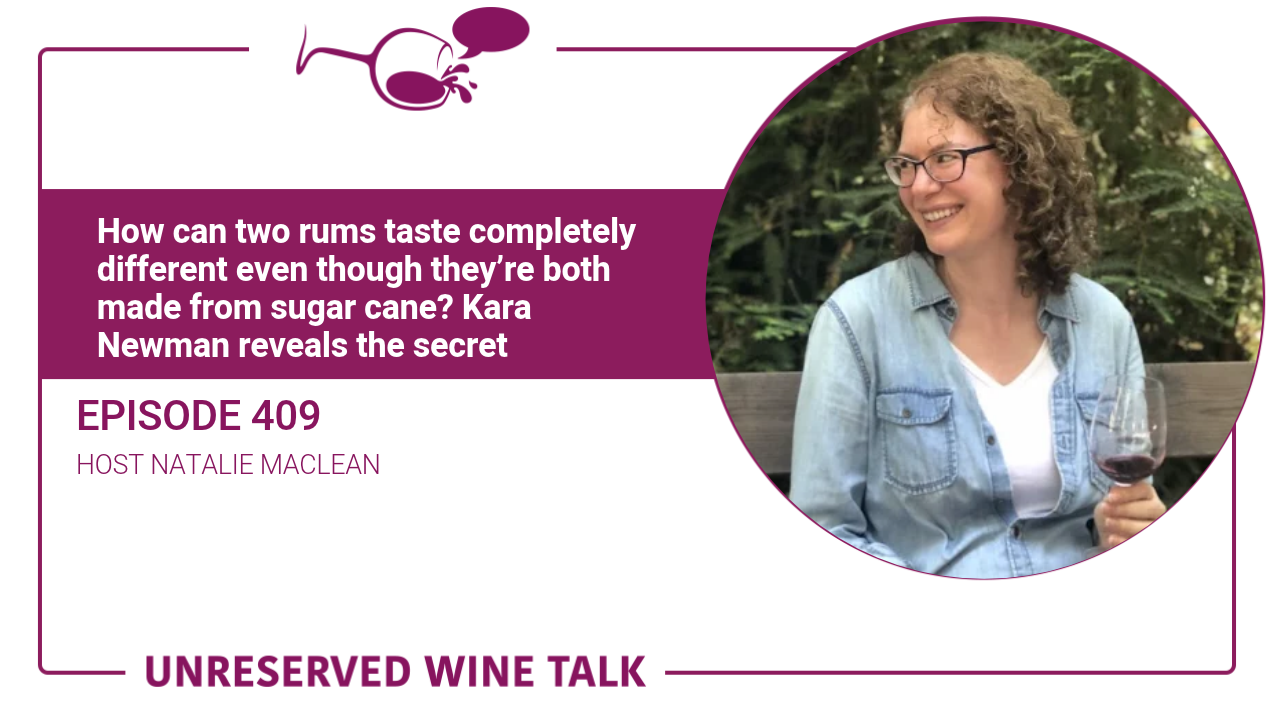
How can two rums taste completely different even though they’re both made from sugar cane? What makes Jamaican rum so famously funky, and what does a dunder pit have to do with it? How does the type of ice you use change the strength, temperature, and texture of a cocktail?
In this episode of the Unreserved Wine Talk podcast, I’m chatting with Kara Newman, the author of eight cocktail books.
You can find the wines we discussed here.
Giveaway
One of you is going to win a copy of one of Kara Newman’s The Cocktail Cabinet.
How to Win
To qualify, all you have to do is email me at [email protected] and let me know that you’ve posted a review of the podcast.
It takes less than 30 seconds: On your phone, scroll to the bottom here, where the reviews are, and click on “Tap to Rate.”
After that, scroll down a tiny bit more and click on “Write a Review.” That’s it!
I’ll choose one person randomly from those who contact me.
Good luck!
Join me on Instagram, Facebook and YouTube Live Video
Join the live-stream video of this conversation on Wednesday at 7 pm eastern on Instagram Live Video, Facebook Live Video or YouTube Live Video.
I’ll be jumping into the comments as we watch it together so that I can answer your questions in real-time.
I want to hear from you! What’s your opinion of what we’re discussing? What takeaways or tips do you love most from this chat? What questions do you have that we didn’t answer?
Want to know when we go live?
Add this to your calendar:

Highlights
- How did writing about stocks, bonds, and commodities eventually lead Kara to a career covering cocktails and spirits?
- Why does Kara see cocktail recipes as a starting point rather than a strict set of instructions?
- How does writing cocktail recipes on individual cards change the way Kara approaches storytelling?
- How can two rums taste so dramatically different when they’re both made from sugar cane?
- Why did early Tiki pioneers blend multiple styles of rum into a single cocktail?
- How did the fierce rivalry between Don the Beachcomber and Trader Vic help shape Tiki cocktail culture?
- What gives rhum agricole its distinctive grassy, funky character?
- What exactly makes Jamaican rum so funky, and what does a dunder pit have to do with it?
- Why does the Three Dots and a Dash cocktail literally wear its name in its garnish?
- Why did Don the Beachcomber impose a two-drink limit on his famously potent Zombie cocktail?
- How does the type of ice you use change a cocktail?
- Why should you stop thinking of rum as one category from one part of the world?
Key Takeaways
- How can two rums taste completely different even though they’re both made from sugar cane?
- Rum is one of the more complex categories, because it can be made anywhere in the world and there are lots of different styles. there aren’t a whole lot of regulations as opposed to, say, bourbon, where it’s made in the US, using corn primarily, and it’s aged in oak barrels, American oak barrels, previously charred, never before used. When it comes to rum, other than the fact that it’s made using sugar cane, it gets really wild from there. It could be raw sugar cane juice, in which case it’s rhum agricole or rhum agricole style, and that can be really vegetal, grassy, funky, bright. Or it can be made with molasses, which is a byproduct of sugar cane or blackstrap, which is then a byproduct of molasses. And then it’s how it’s fermented. It’s how it is aged. It’s how it’s finished, how it’s blended. How it’s how it’s distilled, the type of still used. It’s really kind of magical.
- What makes Jamaican rum so famously funky, and what does a dunder pit have to do with it?
- Last year, I got to fulfill one of my spirits bucket list adventures. And I went to Jamaica, and I saw a dunder pit. It is where all the sugar is fermented before it’s even distilled. It goes into literally a giant pit, it’s called a muck pit. And it looks just like it sounds. It is mucky. It is brown. It looks really unappetizing. It’s hard to believe that so many delicious flavours… Oh my God. It smells so pungent. It’s like a combination of aged cheese and molasses and there are all kinds of wild stories about people finding, you know, bat heads in the dunder pits. I mean, it’s crazy. It looks really unappetizing. It smells like it could just knock you right off your bar stool. But it’s one of the secret ingredients to creating these funky ester-forward rums. And then the second trick, apparently, is distillation. They use copper pot stills to prevent all that funk being cleaned out. You want to preserve that funk. It doesn’t sound delicious, but it is.
- How does the type of ice you use change the strength, temperature, and texture of a cocktail?
- N: The rum deck has a detailed guide to ice, which is really nifty. Basic cubes, large cubes and crushed ice, with the observation that crushed ice has a snowy appearance that melts rapidly. The Zombie, the Jet Pilot, and several other drinks specify crushed ice. So what does the rapid melt contribute to these drinks beyond dilution?
- K: These are strong drinks and you want them to be diluted. But it’s also about chill and about texture. For stronger drinks, you definitely want to stay cold for as long as possible and having the ice melt, it’ll help. I think a larger cube would keep it colder longer. But you’re you’re trying to hit the sweet spot, make sure that it’s not too strong, make sure that it’s cold enough to enjoy, and then there’s also the texture of the drink. Before it completely melts it has a snowy or pebbled ice quality, and then as the drink evolves, it’s more sippable, for lack of a better word.
About Kara Newman
Kara Newman reviews spirits for Wine Enthusiast magazine, where she’s also a writer-at-large covering cocktails, spirits and bar culture, from Cuban rum to the world’s tiniest two-seat bar. Her work also appears in publications including Afar, Bloomberg Pursuits, Food & Wine, PUNCH, and the Wall Street Journal and BBC Travel. She’s the author of seven cocktail books — soon to be eight!
Resources
- Connect with Kara Newman
- Unreserved Wine Talk| Episode 392: What makes a well-made Mint Julep Cocktail much more complex than you expect? James Chatto reveals the secret
- My Books:
- Wine Witch on Fire: Rising from the Ashes of Divorce,Defamation, and Drinking Too Much
- Audiobook:
- Audible/Amazon in the following countries: Canada, US, UK, Australia (includes New Zealand), France (includes Belgium and Switzerland), Germany (includes Austria), Japan, and Brazil.
- Kobo (includes Chapters/Indigo), AudioBooks, Spotify, Google Play, Libro.fm, and other retailers here.
- Wine Witch on Fire Free Companion Guide for Book Clubs
- Audiobook:
- Unquenchable: A Tipsy Quest for the World’s Best Bargain Wines
- Red, White, and Drunk All Over: A Wine-Soaked Journey from Grape to Glass
- Wine Witch on Fire: Rising from the Ashes of Divorce,Defamation, and Drinking Too Much
- My new class, The 5 Wine & Food Pairing Mistakes That Can Ruin Your Dinner And How To Fix Them Forever
Tag Me on Social
Tag me on social media if you enjoyed the episode:
- @nataliemaclean and @natdecants on Facebook
- @nataliemaclean on Twitter
- @nataliemacleanwine on Instagram
- @nataliemaclean on LinkedIn
- Email Me at [email protected]
Thirsty for more?
- Sign up for my free online wine video class where I’ll walk you through The 5 Wine & Food Pairing Mistakes That Can Ruin Your Dinner (and how to fix them forever!)
- You’ll find my books here, including Unquenchable: A Tipsy Quest for the World’s Best Bargain Wines and Red, White and Drunk All Over: A Wine-Soaked Journey from Grape to Glass.
- The new audio edition of Red, White and Drunk All Over: A Wine-Soaked Journey from Grape to Glass is now available on Amazon.ca, Amazon.com and other country-specific Amazon sites; iTunes.ca, iTunes.com and other country-specific iTunes sites; Audible.ca and Audible.com.
Transcript
Natalie MacLean 00:00:00 How can two rums taste completely different, even though they’re both made from sugarcane? What makes Jamaican rum so famously funky, and what does a Dunder Pitt have to do with it? And how does the type of ice you use change the strength, temperature, and texture of a cocktail? In today’s episode, you’ll hear the stories and tips that answer those questions in our chat with Karen Newman, author of eight Cocktail books. By the end of our conversation, you’ll also discover how writing about stocks, bonds, and commodities eventually led Cara to a career covering cocktails and spirits. Why? Cara sees cocktail recipes as a starting point, rather than a strict set of instructions. How writing cocktail recipes on individual cards changes the way Cara approaches storytelling, how the fierce rivalry between Don the Beachcomber and Trader Vic helped shape tiki cocktail culture. Why Don the Beachcomber imposed a two drink limit of his famously potent zombie cocktail. Why the three Dots on a Dash cocktail literally wears its name in its garnish, and why you should stop thinking of rum as one category from one part of the world.
Natalie MacLean 00:01:23 Do you have a thirst to learn about wine? Do you love stories about wonderfully obsessive people, hauntingly beautiful places, and amusingly awkward social situations? Well, that’s the blend here on the Unreserved Wine Talk podcast. I’m your host, Natalie MacLean, and each week I share with you unfiltered conversations with celebrities in the wine world, as well as confessions from my own tipsy journey as I write my third book on this subject. I’m so glad you’re here. now. Pass me that bottle, please, and let’s get started.
Natalie MacLean 00:02:04 So what’s new in the drinks world? Well, this week in.
Natalie MacLean 00:02:07 Fur, feathers and.
Natalie MacLean 00:02:08 Fermentation.
Natalie MacLean 00:02:09 A.
Natalie MacLean 00:02:09 Wine bar in Tokyo, Japan, has introduced a feline sommelier program where rescued shelter cats wear tiny silk bow ties and sit on velvet stools beside tables to provide friendly companionship during tasting flights. A vineyard in the Barossa Valley, Australia, brought in a herd of miniature baby doll sheep to trim grass between vine rows, equipping each sheep with a tiny high visibility vest so tractor drivers can spot them in the morning fog rather than mow right over them.
Natalie MacLean 00:02:43 Meanwhile, a restaurant guest returned a bottle claiming it was off, prompting an overzealous sommelier to follow her to the door and insist that five staff members tasted it and found it perfect Only for the guest to turn and hand him her business card, showing that she owned the winery. The palace walls in Florence, Italy, have little hatches cut into them, built for selling wine. Locals call them bucket del vino, wine windows. Noble families carved them in stone in the 1600s to sell wines straight from the cellar. Some earn their keep through the plague years when a contactless pour kept buyer and seller apart. Most sat shuttered for centuries. Then the 2020 pandemic handed them a new second life, pouring spritzes and gelato. A medieval workaround came back into style, and a French wine grower in the Loire Valley responded to heavy spring floods by paddling a kayak through his vineyard to prune the vines. Speaking of wet vineyards, the harvest in Nova Scotia so far this year has been very soggy. Rain has come every few days all summer.
Natalie MacLean 00:03:57 The season has been running 7 to 10 days behind. The last two vintages they haven’t started picking yet. By September 14th, the rain had split. Grape skins and raised disease pressure. Some growers picked Osceola muscat early because of the splitting. Taking precautions against mildew. In Ontario. Niagara. Vintage of selective picking. After a summer of heavy rain and flooding has started. Thicker skinned grapes like Cabernet Sauvignon, Merlot, Petit Verdot, Vidal and Chardonnay tend to handle a wet season better. The rain did leave Niagara with a healthy canopy of leaves. Growers are happy with sugar levels so far. In British Columbia, many wineries have set a record for their earliest pick ever, starting in late August. Yields are high, though they’re not quite as high as last year. Then there’s the smoke. This summer, the Bald Range wildfire burned near Summerlin, forcing more than 20,000 people from their homes. The fire itself touched only some vineyards. The bigger threat is smoke taint. When grapes sit in wildfire smoke, their skins absorb compounds from it and you can’t see or taste damage.
Natalie MacLean 00:05:06 On the vine, it shows up later once the grapes become wine as flavors like ash, burnt rubber and a medicinal note. That’s why a winery can lose a crop that looks perfect. Silvera Wines in Summerland expects the harvest to drop from 60 tons to just six. Dirty laundry. Winery expects production to fall from 50,000 cases to just 40,000. No wine will be made from smoke affected grapes since every BC, VQA must pass a tasting panel. Chandon Winery in Napa Valley, California, started picking grapes for sparkling wine on July 21st. That’s the earliest first picking in its 53 year history. Some California wineries now press the grapes right in the vineyard via a trailer mounted presses up and down the West coast. The juice goes straight into the tanker trucks for the drive to the winery, which saves trucking costs and delivers fresher juice. These mobile presses can handle up to 150 tonnes a night, pressing straight into the tanker in the field. Some B.C. wineries are starting to experiment with them. And finally, Burgundy is having a record early picking.
Natalie MacLean 00:06:20 The wine board there said no one in living memory or on historical record can recall Burgundy harvesting so early. Cremona de Bourgogne started picking in the Mackinaw on August 8th. The crop is smaller, but the quality is good. And for your calendar this week, Niagara Grape and Wine Festival is running right now in Saint Catherine’s from September 11th through the 27th. It’s the oldest and largest wine festival in Canada. It’s been going since 1952, back when Niagara still leaned on Concord grapes and fortified wines. The Grand Parade anchors the two weeks downtown. The real draw for wine, folks is the Discovery Pass as self-drive tasting route across the peninsula. September 30th is National Hot Mulled Cider Day. It’s the unofficial autumn observance built around cider warmed with spices like cinnamon, cloves, nutmeg. In colonial times, cider was safer to sip than water. The practice of mulling reaches all the way back to Roman times. Soldiers warmed, spiced wine to get through the northern winters. The day also nods to Applejack, the American apple brandy that gave the word jacking its name.
Natalie MacLean 00:07:35 Applejack dates back to the 1600s. Colonialists would leave hard cider barrels outside overnight to freeze, skimming off the ice, concentrated skimming off the ice, concentrated what was left into something far stronger. October 1st is World Saki Day. Japan established it in 1978. October traditionally marks the start of the new Saki brewing season once the rice harvest is in. International Coffee Day shares this date. The International Coffee Organization launched its first official celebration in on October 1st, 2015. It’s now marked in dozens of countries. October 3rd is by a stranger a drink day. It’s a celebration of camaraderie, honoring the oddly beautiful art of meeting strangers in dimly lit bars or brightly lit coffee shops. The next morning, October 4th, is National Vodka Day. The reason it falls on the fourth is undocumented. Despite years of celebration. The name comes from the Slavic word voda, meaning little water. Poland and Russian both claim it from the late Middle Ages. Neither can prove it. In 14th century Europe, Vodka was prescribed as medicine.
Natalie MacLean 00:08:49 It overtook bourbon as America’s favorite spirit in the 1970s. Today, it makes up roughly 20 to 25% of North American spirit sales. Munich’s Oktoberfest also winds down around this date. The festival began in 1810, and it marked the wedding of Crown Prince Ludwig of Bavaria to Princess Therese. The whole city was invited and it’s run most years since. October 5th is Veronika World Day. Veronika is a deeply colored Balkan red grape. It’s tied to Montenegro and it’s grown widely in North Macedonia. The name means black stallion international. Scottish Gin Day also lands on this date. Scotland is one of the world’s biggest gin producing nations. Much of the gin is sold. Much of the gin sold as British is distilled north of the border. October 6th is National Orange Wine Day. Orange wine comes from white grapes fermented on their skins. That skin contact gives it the color. No oranges were harmed or destroyed in the process. Despite the name for your weird but wonderful scientific facts of the week, wine grapes contain over 800 aromatic compounds, and human noses detect distinct notes like green bell pepper.
Natalie MacLean 00:10:07 Because grapevines naturally synthesize identical chemical molecules like methoxy pi resigns as the fruit matures. Lipstick can kill a beer’s foam because oils disrupt the protein network that keeps those bubbles intact. Scientists studying lager have estimated that a single glass can generate hundreds of thousands of bubbles, depending on the temperature. Dissolved carbon dioxide nucleation points in the glass and color of lipstick. Speaking of bubbles, those giant champagne bottles carry the names of biblical kings. There’s a whole letter to the sizes. A Jeroboam holds four regular bottles. A real bone holds six. Methuselah is eight. A Shalmaneser jumps to 12. Balthasar 16. And Nebuchadnezzar, which I just love saying as much as trucking. Baron Nebuchadnezzar tops the run at 20. That’s a fair stretch of the Old Testament to haul to a party. Back to today’s episode. Congratulations to Don Bogart from Ontario, who has won a copy of How to Sound Wine Smart by Maurice Chevalier. I still have six books from various guests to give away, so email me if you’d like to win.
Natalie MacLean 00:11:26 Natalie at Natalie MacLean. And if you’re reading the paperback or e-book or listening to the audiobook of my memoir, why switch on Fire Rising from the Ashes of Divorce, defamation, and Drinking Too Much, a national bestseller and one of Amazon’s best books of the year. I’d love to hear from you at Natalie at Natalie MacLean dot com. There’s a terrific free guide for book clubs. I’ll put a link in the show notes to all retailers worldwide at Natalie MacLean. Com for 409. Okay, on with the show.
Natalie MacLean 00:12:02 Karen Newman reviews.
Natalie MacLean 00:12:04 Spirits.
Natalie MacLean 00:12:04 For The Wine.
Natalie MacLean 00:12:05 Enthusiast magazine, where she’s also a.
Natalie MacLean 00:12:08 Writer.
Natalie MacLean 00:12:08 At large covering cocktails, spirits and bar culture from Cuban rum to the world’s tiniest two seat bar. I have to ask you about that. Her work also appears in publications such as AFA, Bloomberg Pursuits, Food and Wine, punch, and The Wall Street Journal, and BBC travel. She’s the author of seven cocktail books, soon to be eight, and she joins us now from her office in New York City.
Natalie MacLean 00:12:32 Carol, we’re so glad to have you here with us. Thank you for joining us.
Kara Newland 00:12:36 So glad to be here, Natalie.
Natalie MacLean 00:12:37 All right. Great. So before we dive into your drink Dex. Tell us about your passion for railway travel. What? What drew you to that in the first place? And what do you love about it now?
Kara Newland 00:12:49 Okay, this is a relatively new passion, but honestly, a lot of the same things that also drew me to drinks and food also drew me to to railway travel. I think it’s really about the the people and the history and just the fact that you’re experiencing something that’s almost it can be almost of another time, but it also can be very modern and rooted in where we are right now.
Natalie MacLean 00:13:13 And what is it about the slow aspect of that of train travel that you enjoy? Is it just time to think or just it’s so much the opposite of our busy lives? What’s the appeal there?
Kara Newland 00:13:25 It’s also, again, similar to drinks. I love that it has this kind of analog ness to it.
Kara Newland 00:13:31 You are just like, you have a drink in your hand and you’re right there on a train. You’re with other people, you’re watching the you’re watching the the scenery go by if you’re on, if you’re lucky enough to be on a fancy kind of train, maybe there’s a bar car or a dining car and it’s just another way to connect. And we just spent so much time rushing all the time we fly. We need to make our connecting flight. We need to be at the airport. We need to go through TSA. There’s just something I find slower and gentler about railway travel that’s really appealing to me right now. And there are just so many also new lines coming out. There are new places to go that we really couldn’t have have gone in the past ten years, but we could have done 100 years ago. And that’s appealing to to me.
Natalie MacLean 00:14:16 Yeah, that’s great. What are a couple of the newer places we can now get to by train that we couldn’t say, I don’t know, 5 or 10 years ago.
Kara Newland 00:14:23 I mean, for example, there’s a newer route that just came back between New Orleans and Mobile, Alabama, and I was called the Carnival Line. I can’t remember exactly, but the point is that I wrote it right before Mardi Gras. I think I held the Mardi Gras line, and I took it from New Orleans to. To mobile. And it’s a line that had been out of commission for years, but it goes right along the Gulf. There’s beautiful scenery. You can see the little towns as you go by, and the train stops in several small towns along the way. So you could, in theory, get off and explore those towns or just head straight on to mobile, which has its own form of Mardi Gras. And it’s just a really it’s nice that it came back.
Natalie MacLean 00:15:05 Yeah. And you were also still able to loop this back into drinks. So what’s the connection between train travel and drinks? You mentioned bar cars, so you got a memorable experience with that.
Kara Newland 00:15:17 Well in this case I don’t think there was that much of a connection really.
Kara Newland 00:15:20 The connection was the fact that Mardi Gras, wherever you’re celebrating it, I think these days, is so entwined with drinks culture. I’ve also seen this as unrelated. I’ve seen more people bringing their own little drinks setups on board and trying to recreate their own little romantic scene in their seat, with nice looking glassware and other things that wouldn’t make it through TSA. That’s true. Drinks and flasks. Little garnishes to carve at your seat. Right. Right.
Natalie MacLean 00:15:48 Oh that’s great, I love that. Yeah, it just seems more human. Every time I take the train, I think, why aren’t I taking the train more often? It’s just no one’s rush. No one’s pushed and shoved into little.
Kara Newland 00:16:00 Tiny.
Natalie MacLean 00:16:00 Seats with your knees at your face. Okay. Carrie started out covering financial markets for a Columbia University Press book, The Secret Financial Life of Food, before pivoting to cocktail books. So how does a food economist end up writing about the structure? Say, of a daiquiri?
Kara Newland 00:16:18 The long way of explaining how I got into food and drinks.
Kara Newland 00:16:22 I originally spent several years writing about stocks and bonds and then eventually commodities markets as financial reporter. And for me, the transition really began when I was Reading about agricultural markets and thinking about them as food items rather than financial items. So I’d be reading about safe pork bellies and thinking. I think I’d really rather be writing about bacon, which comes from pork bellies, and definitely. Or I’d be reading about frozen orange juice futures or coffee futures and thinking, I really would rather be writing about these and thinking about these. And that really led me to writing that book, The Secret Financial Life of Food, which was about the history of agricultural commodities. And from there, it just kind of led me down the road to culinary history, and then food in general, and then drinks and cocktails was really right around the time the whole cocktail renaissance was really opening up, and there was just so much going on. There were all these new bars opening and new drinks being invented and new distilleries opening up, and it was just a really fruitful feel to be covering at the time, and it still is today, even though now times have changed and distilleries are closing and consolidating, and it’s harder for bars and restaurants to make a living, and people are drinking less and economic times are a little tougher.
Kara Newland 00:17:51 But things are cyclical. But there’s always something to write about. That’s the good news. Whether it’s new things, whether it’s the evolution of drink, ways of economic pathways, there’s always something to write about. That’s what makes it all so exciting.
Natalie MacLean 00:18:06 That’s true, that’s true. That’s why I love this podcast. Getting to talk to people like you and always a new topic. And as you say, drink way. I love the way you put that. You’ve written eight cocktail books now. So how has your relationship with the recipe format, especially of cocktails, changed over that time, or has it has it?
Kara Newland 00:18:25 I don’t know if that is actually changed. I take that back. It has changed. I think when I started I really regarded recipes as very specific instructions. These are the recipes. These are the guidelines. And you follow them. And when you’re done you get a drink. And these days I think it’s more a place to start. I think people understand more about recipes than ever before, and in part that’s because we have access to so much online.
Kara Newland 00:18:53 People can watch a TikTok video and someone will show you how to do a recipe. You don’t just have to read it on the page. It’s not as static as it used to be, and I think people are more comfortable taking recipes as a starting point for jumping off and making their own tweaks to a recipe. I think people understand that it’s flexible, and I think when I’m writing recipes these days, I’m more likely to try to cram a little extra into the head notes about ways to change that things up to suit your taste in your preferences.
Natalie MacLean 00:19:24 That’s a great way to approach it, to customize or individualize your taste. Over the past few years, you’ve been writing the cocktail cabinet series of drink decks of cards that have spanned eight spirits whisky, gin and so on. Drink styles. The spirits, the aperitif. These are card decks though, rather than books with narrative chapters. So what did that physical format? It’s pretty tight because each card gives you about 60 to 80 words of backstory. What did that force you to do as a writer? That the traditional book doesn’t always.
Kara Newland 00:19:56 For starters, so much less space? I really had to keep everything very tight. There weren’t really head notes or room to put any kind of what’s called front matter there. There was an extra card that was referred to as a technique card, where I was able to explain as briefly as possible. Here’s what the different types of rum are, or here’s what you need to know about glassware or ice. And it had to be like real like fast bite size, which is fine. These days. People have shorter attention spans anyway. And what I do love about the whole card deck format is although I love books, I will always love books. It can be a little crazy making when you have like a book and you try to open it and it won’t stay open on the page.
Natalie MacLean 00:20:41 And if you’re trying to make a cocktail, yeah.
Kara Newland 00:20:42 And you’re trying to weigh it down or, or you’re putting something in as a bookmark. But I love that the cards, you can just put them down on the table and they stay there.
Kara Newland 00:20:51 Or I love the serendipity that you can just pull one out of the deck and make it. And I think also that’s another difference between a card deck and a book. You have to understand that anything can be shuffled around there. You can’t really rely on a reader to to be able to follow a specific sequence that you set out for them. They are choosing their own adventure, and as the writer, you have to be prepared that everything needs to stand alone.
Natalie MacLean 00:21:18 Yeah, like a box of chocolates.
Kara Newland 00:21:21 Exactly.
Natalie MacLean 00:21:21 Pick what you want. And. Yeah. So maybe give us an example of a drink where you were really torn about what to include and what to leave out. I don’t know, do you have an example because of that space constriction?
Kara Newland 00:21:33 I think in the the REM decks in particular, there are a lot of tiki drinks, tropical drinks that date back to to the beginning of tiki history. And there’s so much to tell. A lot of those really just had to be streamlined, and I couldn’t tell the whole story of Trader Vic versus Don the Beachcomber and their fierce, bitter rivalry.
Kara Newland 00:21:57 Who created which drinks? Who really created the Mai Tai? That’s really just fiercely debated. So a lot of that really had to be left on the cutting room floor. And I’ll say, for anyone who wants to learn more, Jeff Beach Bum Barry wrote a series of excellent books about the history of Tiki. He did a lot of deep dive research, uncover the drinks, a lot of the drinks that we know he really rediscovered for us.
Natalie MacLean 00:22:20 So okay, so we’ll put a link to his books then in the show notes as well.
Kara Newland 00:22:24 Oh, excellent. Yes.
Natalie MacLean 00:22:25 Yeah. Okay. Yeah, that that must be excruciating. Especially if you love research and you love stories in the back story. The human element. It’s got to be hard to leave that stuff out. So the the cards sit inside a box on someone’s home bar and get handled. Drink, buy, drink, not read, cover to cover. If we said, does that change how you think about storytelling? Or is it basically just every every card has to be its own little standalone story.
Kara Newland 00:22:49 I think each drink has to be its own little standalone story. There’s no room to really give a trajectory other than saying this is a deck of drinks that all include rum.
Natalie MacLean 00:23:02 Sure.
Kara Newland 00:23:03 Sure. Yeah. It’s hard to direct.
Natalie MacLean 00:23:05 Go now to card 32, please.
Kara Newland 00:23:09 Yeah, that would be fun. I remember those choose your own adventure books where really you could direct somebody to another page. That would have been a fun concept to include.
Natalie MacLean 00:23:16 Yeah. Okay. So let’s talk about the rum deck in more depth here. The deck opens with the taxonomy of rum styles. So white age gold, Blackstrap agricole over proof and spiced. And you write that rum can be made anywhere in the world, and that often that’s where the commonalities end. So give us an example. The most extreme one you can think of how different two rums can taste from each other.
Kara Newland 00:23:40 They can be very different. And you could wind up with very different daiquiris. For example, I think of blackstrap rum, which tastes like drinking straight molasses, almost.
Kara Newland 00:23:50 So that very earthy dark flavor, hints of dark chocolate or coffee, espresso. And on the other hand, maybe like a Jamaican rum, a Jamaican aged rum, which maybe has a lot of esters to it. It’s it’s more it’s light, it’s a little funky. There’s a lot of tropical fruit. Those are very different daiquiris. If you’ve got something that tastes almost like molasses versus something that has a hint of tropical fruit to it.
Natalie MacLean 00:24:17 And what’s making that difference? Maybe it’s many factors, but are there a couple of really important factors that will give you yield you such a like a deep, dark rum versus a lighter one or a spicy one.
Kara Newland 00:24:31 Yeah, there’s a lot of factors. I think rum is one of the more complex categories, because it can be made anywhere in the world, and there are lots of different styles. And when you come down to it, there aren’t a whole lot of regulations as opposed to, say, bourbon, where it’s made in the US using corn primarily, and it’s aged in oak barrels.
Kara Newland 00:24:53 American oak barrels previously charred, never before used. That’s really a very specific flavor profile. It gets very narrow when it comes to rum. Other than the fact that it’s made using sugar cane. It gets really wild from there. It could be raw sugar cane juice, in which case it’s a rum agricole or rum agricole style. And that can be really vegetal, grassy, funky, bright, or it can be made with, with molasses, which is a byproduct of sugar cane or blackstrap, was then a byproduct of molasses. And that’s just one part of the spectrum. And then it’s how it’s fermented. It’s how it is aged. It’s how it’s how it’s finished, how it’s blended. There’s just house distilled, the type of still used. There’s so much. It’s really an incredibly complex group of rums. But that’s why Trader Vic and and on Beach, that’s why the tiki guys managed to find ways to blend them into these meticulous, secret mini recipes. Almost one of I think the the quote is what one rum can’t do? Three rums can or three rums can do it.
Kara Newland 00:26:05 One rum can’t. I might be flipping the quote, but it’s really kind of magical.
Natalie MacLean 00:26:09 Yeah. Tell her. Tell us briefly who Trader Vic was.
Kara Newland 00:26:13 Okay, okay, this is a longish story, but yeah, there’s so much. Okay, to start off, trader, I have some notes. I couldn’t get all the dates right unless I made sure I had all of it in front of me. So pardon me if I can’t. No worries. Look down for a minute or two. The first one was Don the Beachcomber. That was Ernest Gant. He opened his first location in 1934. He was the one who actually traveled to the South Pacific. He brought back what was considered Polynesian recipes, and he really was the one who came first. He created the zombie. He created the pearl diver. Three dots and a dash a lot. The ones we know. He created it. And he was also really smart in that he was famously secretive about his drinks. And he would he would not tell a lot of his bartenders what was in the drinks.
Kara Newland 00:26:58 He would just label them with instructions bottle one, bottle two, bottle three. Things were often pre-mixed. He created a lot of syrups that we know today. But then Trader Vic Victor Bergeron came along later. He was a fan of Don the Beachcomber, and he was pretty open about his admiration for Don the Beachcomber. He opened a bar called Hacky Dinks in Oakland. So you have one who’s in Los Angeles and one who’s closer to San Francisco. And he was I think his famous comment was I felt I could do it better. So he took a lot of dumb the Beachcombers concepts and tried to reinvent them and prove them if they could do that. And then in 1937, he’s changed hanky dinks into Trader Vic’s, and that’s when everything starts to heated. They both opened lots of different chains. They were they were really just butting heads. And there’s also a lot of rivalry between who created, say, the Mai Tai, one of the most famous tiki drinks, tropical drinks, and Berger. Bergeron said that he created the Mai tai and his famous comment was anybody who says I didn’t create this drink is a sticker.
Natalie MacLean 00:28:08 So laying down the gauntlet?
Kara Newland 00:28:11 Absolutely. Yeah. They really had a bitter rivalry and they would poach employees from one another. It’s really something else. And again, I’ll direct people back to Jeff Beach, Bradbury’s books, if they really want to read more about it. He’s got all the details.
Natalie MacLean 00:28:25 That sounds juicy, but that just gives us a bit of context for some of the drinks that we’ll chat about here. So the Thai punch card says that Thai or is it Thai t punch t the cheek? Petite is Creole French. Yes, I should know that being in Canada is Creole for petite. The drink that hails from Martinique. So it’s only fitting that rum from the island should be used. What does Martinique Martinique Agricole rum bring to that drink that no other style can replicate in that cocktail?
Kara Newland 00:28:57 It’s that bright, funky. It’s the agriculture rum from Martinique and Guadeloupe and a few other places too, that’s made from sugar cane juice, fresh pressed sugar cane juice. And it really develops these very bright tropical fruit funky flavors.
Kara Newland 00:29:13 It’s hard to describe. I wish I could give a little taste to everybody watching or listening because it’s hard to describe, really, but it’s so unique. There really is nothing else quite like it. And it’s very different from others that taste more like brown sugar instead.
Natalie MacLean 00:29:28 And I hear the word funky in the wine world too. What does funky mean to you? How do you describe it to someone if you can’t give them a taste of what a funky rum is? Is it just different or surprising or again?
Kara Newland 00:29:45 It’s a hard one to describe. I think it might be. Yeah. I’ll tell you a different story instead. So last year, I got to fulfill one of my spirit’s bucket list adventures, and I went to Jamaica, and I saw a gender pit, and, oh, the gender pit. It’s. I’m getting a little ahead of myself. That’s okay. It’s so exciting. This is how the flavors are developed in Jamaican most Jamaican rums. Funky is a euphemism for hi ester rum, and these.
Kara Newland 00:30:18 These esters are developed in Jamaican rum. They’re developed in something called a dunder pit. It is where all the the sugar is fermented before it’s even distilled. It goes into this, literally a giant pit. It’s called a muck pit. And it looks just like it sounds. It is mucky. It is brown. It looks really unappetizing. It’s hard to believe that. So many delicious flavors. Oh my.
Natalie MacLean 00:30:43 God.
Kara Newland 00:30:44 And it’s. It smells so pungent. It’s okay. It’s like a combination of, like, aged cheese and molasses and.
Natalie MacLean 00:30:56 Oh, okay.
Kara Newland 00:30:57 There there are all kinds of wild stories about people finding, you know, fat heads in the the dunder pits. It’s crazy. It’s. Wow. It looks really unappetizing. It smells like it could just knock you right off your bar stool. But it’s one of the secret ingredients to creating these these funky Easter forward rums. What’s developing are those those esters? And then the second trick, apparently is distillation. They use a copper pot stills to prevent it all being cleaned out.
Kara Newland 00:31:31 You want to preserve that funk, you want to keep it. And it’s it doesn’t sound delicious, but it is. I promise it is.
Natalie MacLean 00:31:40 And so copper helps to preserve the that metal helps to preserve the flavors as opposed to some other type of metal.
Kara Newland 00:31:48 The metal and also the shape of the the still and a few other things too. But for example, steel column stills, which are long and tall, are used often to create more, more neutral spirits like vodka or gin or anything else that where you’re trying to create really almost like a clean, light style spirit. And the copper pot stills and the round structure of the body of the still helps encourage things to stay more, more robust. That’s the easier, right? I’m trying not to get too technical.
Natalie MacLean 00:32:20 No. That’s great. I appreciate that because this is definitely not my area, but it’s fascinating. Okay, so I love the title of this drink. The three Dots in a Dash uses Agricole rum because Dawn beach specifically chose it for its grassy, funky character, and he created it as a wartime drink in the 40s.
Natalie MacLean 00:32:39 Is that correct?
Kara Newland 00:32:40 I believe so, yes. Yeah. That’s a fun drink where the three dots on the dash are right in the garnish. Three cherries and the chunk of pineapple represents a dash, and he’s just all skewered together. And then you see three dots on a dash.
Natalie MacLean 00:32:53 Three dots. Is that the one that’s meant to be Morse code? Yes. Secret sauce. Okay. Does it mean something? Three dots in a dash in Morse code? I don’t even know Morse code.
Kara Newland 00:33:03 I should know that I don’t know. Top of my head.
Natalie MacLean 00:33:05 Probably means pass me the drink or fill me up. Top me up. I’m just gonna. Let’s just assume. Cool. And then you describe the zombie as containing a quote whopping four ounces of rum, and a note that Dom Beach placed a two drink limit on the menu, with the warning that anyone who had more than that would be like The Walking Dead, the zombie. Have you ever tested his hypothesis?
Kara Newland 00:33:28 Absolutely not.
Speaker 4 00:33:31 Oh come on.
Kara Newland 00:33:33 I value my longevity in this business. No, I’m.
Natalie MacLean 00:33:37 Everything for research, then.
Kara Newland 00:33:39 No, I’m not tested. That. And at the same time, if I’m tasting spirits, I’m actually tasting them. I’m spitting them. I’ll be there for a while longer doing this.
Natalie MacLean 00:33:47 Yes, that’s what I do in the wine world too. So. Yeah. Okay. The bottom deck has a detailed, detailed guide to ice, which is really nifty. Basic cubes, large cubes, and crushed ice with the observation that crushed ice has a snowy appearance that melts rapidly, the zombie, the jet pilot, and several other drinks specify crushed ice. So what does the rapid milk contribute to these drinks beyond dilution? If anything.
Kara Newland 00:34:14 It is definitely first and foremost dilution. I mean, these are strong drinks and you want them to be diluted, but it’s also about chill and about texture. Okay. For stronger drinks you are you definitely want to stay cold for as long as possible, and having the ice melt in, it’ll help.
Kara Newland 00:34:32 I think a larger cube would keep it colder longer, but you’re trying to hit the sweet spot. Make sure that it’s not too strong. Make sure that it’s cold enough to enjoy. And then there’s also the texture of the drink, both before it completely melts in, when it has that snowy or pebbled ice quality. And then as the drink evolves, it’s more skippable, for lack of a better word.
Natalie MacLean 00:34:54 That makes sense. The rum deck covers the geography of rum, from Martinique to Jamaica to Barbados to Haiti to Puerto Rico, and each island produces something distinct. What do you hope this deck does for how people think of rums geography when they walk into the liquor store.
Kara Newland 00:35:10 I would love for people to realize that not all rum comes from the Caribbean. Okay. And yeah. And that it’s made differently in lots of different places, and that it is made in lots of different places. Rum is made in Thailand. Really quite good rum too, in Thailand. It’s made in South America. It’s made everywhere.
Kara Newland 00:35:30 I’ve been trying some really excellent rums from Mexico that are just knocking my socks off, and it’s. I would love for people to travel and be able to try rum wherever they go.
Natalie MacLean 00:35:41 Absolutely. And what knocks your socks off about a rum? Like, I know you’re an expert in it, but how? What stands out when you go, wow, that’s a great rum.
Kara Newland 00:35:51 I mean, it depends on the the rum itself and what style is supposed to be. I love a rum that speaks of a sense of place. I love any spirit that speaks of a sense of place. And if it’s something that’s really demonstrating the character of where it’s made and the style it’s supposed to be. I love a brand with some complexity to it. Something that smells great obviously tastes great. Maybe has a really long finish that keeps you thinking about it even after you’ve swallowed it. That’s something really intriguing to me.
Natalie MacLean 00:36:25 Sure. Definition of a great wine as well. That long finish. So you’ve been covering spirits and cocktails for two decades.
Natalie MacLean 00:36:32 What’s the biggest misconception that even experienced drinkers still have about rum? Clearly, one would be that it’s just from the Caribbean, but is there another one that you’d like to dispel?
Kara Newland 00:36:43 Well, yeah, that is that it all comes from the Caribbean. That is all the same. Yeah, those are really the the two big ones. It’s just such a huge I keep saying the same thing over and over again. I’m sorry, but it’s okay. It comes from so many different places and it’s just so expressive. It can taste like brown sugar and spice or it can taste like tropical fruit. Like almost like a banana. Like a really ripe banana. It’s it’s quite amazing.
Natalie MacLean 00:37:12 Yeah. It’s not just all caramel, spiced caramel or whatever.
Kara Newland 00:37:16 Right.
Natalie MacLean 00:37:17 All right, so your deck carries a lot of tiki history through drinks like Jet Pilot, the Jungle bird, the scorpion and the zombie. And you note that the jet pilot card looks very similar to the zombie. And it’s not a coincidence how much recipe theft was happening between tiki bars in the 40s and 50s.
Natalie MacLean 00:37:34 Were they all just at first? You’re saying Trader Vic was an admirer of Dawn? But after that, was it all at war? Just trying to steal each other’s recipes or what was going on?
Kara Newland 00:37:46 Oh, I’m sure Don the Beachcomber really was the the original for so many drinks and for the concept as well. And then Trader Vic really took it and popularized it and made a chain out of it where, you know, where everybody knew what it was. Everyone’s heard of Trader Vic’s. It’s even still around. There’s even a New York. There was a New York City Trader Vic’s in the Plaza Hotel for a time. It’s no longer there, but the jet pilot. That’s a perfect example. That was definitely noted as. Yeah, that was definitely a lot like the Sophie. There was definitely a lot of back and forth. Yeah, a lot of the drinks look similar when you put in next to one another, so that’s also fun. I think when you have a deck of cards and you can do that, you can actually say, take this one and put the jet pilot next to the zombie, and you can see the similarity as opposed to just go back to page 34 and.
Kara Newland 00:38:35 Right. Maybe they will, maybe they won’t.
Natalie MacLean 00:38:36 Yeah. That’s true. That’s true. See how they borrow from each other or get inspiration from each other.
Kara Newland 00:38:42 There you go.
Natalie MacLean 00:38:43 Inspiration. Yes. So the Mary Pickford card describes the cocktail as appearing demure, but in fact having a bit of a kick and adds the same might be said of Pickford. What do you know about the original Mary Pickford? Was that back in the Charlie Chaplin days, the silent movies? Okay, which would have been, I don’t know.
Kara Newland 00:39:02 She was her business partner for a time, too.
Natalie MacLean 00:39:05 Oh, there you go. Well, she definitely had a a kick to her, but did you know anything about her, or did you come across anything interesting about her in your research?
Kara Newland 00:39:14 I didn’t know a whole lot about her before, but yeah, I did get to do a little research on her. She was tough. She was a tough one. She rose to fame at a time when there really wasn’t a template for what she did.
Kara Newland 00:39:26 She was the first silent screen star.
Natalie MacLean 00:39:29 And they called her America’s sweetheart. Or was that somebody else? That was. No, that was her.
Kara Newland 00:39:33 That was America’s sweetheart. Yeah. Okay. Before her there, there were not films, silent toffees or otherwise. It was a new media format. Everyone was radio before. That’s kind of wild to think about. And she created a studio with with Chaplin and Douglas Fairbanks and and D.W. Griffith that was United Artists. She created United Artists, which was okay. Yeah, yeah, it was one of the first studios. And I, the studio bosses were none too pleased about it either. The the comment was, it’s the lunatics running the asylum.
Natalie MacLean 00:40:04 I’m sure.
Kara Newland 00:40:04 That’s.
Natalie MacLean 00:40:05 Where the.
Kara Newland 00:40:06 Yeah, because they’re like, the artists are going to start their own studio. Are they crazy? Exactly. And then in 1920, she divorced her husband to marry Douglas Fairbanks. Okay. And that was at a time when women really weren’t getting divorced. And here was someone in the public eye who was getting getting divorced, getting remarried, and they became Hollywood royalty.
Kara Newland 00:40:27 So I liked seeing that she was she was America’s sweetheart, but she was not saccharine sweet. Even though the drink named for her is actually quite sweet.
Natalie MacLean 00:40:37 Is it? Tell us about the drink. What’s it? What are they?
Kara Newland 00:40:40 Pineapple juice. Grenadine. Rum. Yeah.
Natalie MacLean 00:40:43 It’s sweet. Yeah. Yeah. Okay.
Kara Newland 00:40:45 Yeah, it can be, but it’s a tasty kind of sweet.
Natalie MacLean 00:40:48 You gotta garnish it with a hot pepper or something. I don’t know. Give it a kick. Unexpected kick. So what’s the cocktail that was? Oh, yeah. What’s the cocktail that was invented at a Cairo hotel during World War two that ended up being called the Suffering Bastard. And why did they call it that? Or was it just fatalities of war?
Kara Newland 00:41:08 Okay, so here’s a drink that I would have loved to have put in the rum deck. And in the end, there are two different versions of The Suffering Bastard and the original, which was created by Joe Asylum, who is an interesting character.
Kara Newland 00:41:24 It’s not made with rum, though you can’t put it in a rum deck. His original is made with with bourbon and gin and the lime juice, and is topped with ginger beer. So it’s a good drink, and he was rightly famous for it, but it doesn’t belong in a book about a card deck. About rum? Sure. So I went with a different version instead. So Joe Salem was an interesting character. He was born in Egypt. He studied chemistry in France, and the point was, he was supposed to go to his family’s pharmacy business. And when he decided that wasn’t for him. He became a bartender instead. There’s some some chemistry aspects to to both jobs. During World War Two, his father was at the epicenter of the the African, the North African Campaign. It became a real hotspot for military brass and politicians and the press. And his original drink really became very well known. And then in his later years, he moved to the Caribbean and he was working with the Caribbean hotel chain at the Caribbean hotel chain, the Hilton hotel chain, until he died in 2004.
Kara Newland 00:42:31 He’s very recent cocktail history, but it’s an important part of cocktail history.
Natalie MacLean 00:42:35 Absolutely. So what did you end up using in the deck instead of that drink?
Kara Newland 00:42:39 It was a rum, a different version, a rum based version. But it wasn’t the the original. It’s a very good one also. But originally the drink was called the Suffering Bar Steward. And and apparently you had enough of them. You started slurring and howling while suffering. Bastard.
Natalie MacLean 00:42:55 Bastard.
Kara Newland 00:42:55 Which apparently is how you felt if you had too many of them too.
Natalie MacLean 00:42:59 I like that. I like that.
Natalie MacLean 00:43:06 Well, there you have it. I hope you enjoyed our chat with Kara. Here are my takeaways. Number one, how can two rums taste completely different even though they’re both made from sugarcane? As Cara explains, rum is one of the most complex drinks categories because it can be made anywhere in the world, and there are lots of different styles. There aren’t a lot of regulations as opposed to, say, bourbon made in the US, using corn primarily for the mash.
Natalie MacLean 00:43:32 It’s aged in oak barrels that are previously charred or never used before. When it comes to run. Other than the fact that it’s made using sugar cane, it really gets wild, she says. It can be raw sugar cane juice, in which case it’s rum agricole or rum agricole style that can taste really vegetal, grassy, funky or bright. It can be made with molasses, a byproduct of sugar cane or blackstrap, which is a byproduct of molasses. And then there’s how it’s fermented, aged, finished, blended, distilled, the type of still used. It’s really kind of magical, she says. Number two, what makes Jamaican rum so famously funky? And what does a Dunder Pitt have to do with it? Last year, Cara got to fulfill one of her spirits bucket list adventures. She went to Jamaica and saw a dunder pit, and that’s where all the sugar is fermented. Before it’s distilled, it goes into a giant pit called a muck pit. It looks like it sounds. She says.
Natalie MacLean 00:44:36 It’s mucky, it’s brown. It’s really unappetizing. And it’s hard to believe that so many delicious flavors come from this pit. It smells very pungent, oily of aged cheese and molasses. And there’s all kinds of wild stories about people finding fat heads. Oh, it looks and sounds and smells unappetizing, but it’s one of the secret ingredients to creating these funky, straightforward rums. And then the second trick, apparently, is distillation. They use copper pot stills to prevent all that funk from being cleaned out. It doesn’t sound delicious, but it is, she reassures us. And finally, number three, how does the type of ice you use change the strength, temperature, and texture of a cocktail? Cara’s Rum Deck has a detailed guide to ice, which is really cool. Basic cubes, large ones, crushed ice with the observation that crushed ice has a snowy appearance that melts rapidly. The zombie, the jet pilot, and several other drinks specify crushed ice. So what does that contribute to drinks? Well, of course, as Cara explains, with strong drinks you want them to be diluted, but it’s also about chill and texture.
Natalie MacLean 00:45:52 You definitely want those drinks to stay cold for as long as possible, and having the ice melt it will help. A large cube would keep it colder longer, but you’re trying to hit that sweet spot between making sure it’s not too strong and making sure it’s cold enough to enjoy, and then there’s also the texture of the drink. So before it melts completely, it has a snowy or pebbled ice quality for texture, but then the drink evolves and it becomes more skippable. All right, so if you missed episode 392, go back and take a listen. I chat about what makes a well-made mint julep cocktail more complex than you’d expect, and we chat about that with James Chatto. You won’t want to miss next week when we chat with John Boynton, president of Artery Wines Canada, the country’s leading wine company that owns brands such as Enniskillen, Jackson Triggs, Le Clos Jourdan and Sandbanks, among others. We’ll chat about how the movement come over. October is changing the way we gather and connect the new category of fresh set wines and major trends in the wine industry.
Natalie MacLean 00:47:00 We’ll continue with part two of our chat with Cara the following week. Do you know someone who’ll be interested in learning more about spirits and cocktails? Please let them know about the podcast. Email or text them now while you’re thinking about it. It’s easy to find the Unreserved Wine Talk podcast. Just tell them to search for that title or my name Natalie MacLean wine on YouTube, Apple Podcasts, Spotify, their favorite podcast app or they can listen to the show on my website at Natalie MacLean. Com podcast. Email me if you have a SIP tip question or if you’d like to win one of six drinks books I have to give away. I’d also love to hear your thoughts on this episode, or if you’ve read my book or are listening to it. Email me at Natalie at Natalie MacLean. Com. In the show notes, you’ll also find a link to take a free online food and wine pairing class with me called the five Wine and Food Pairing Mistakes That Can Ruin Your Dinner and How to Fix Them Forever at Natalie MacLean.
Natalie MacLean 00:47:56 And that’s all in the show notes at Natalie MacLean 409. Thank you for taking the time to join me here. I hope something great is in your glass this week. Perhaps a Jamaican rum neat or a jet pilot cocktail? You don’t want to miss.
Speaker 5 00:48:19 One juicy episode of this podcast, especially the secret full bodied bonus episodes that I don’t announce on social media. So subscribe for free now at Natalie MacLean. Forward slash meet me here next week. Cheers!