






Introduction
What might surprise you about the amount of research on organic versus conventional farming when it comes to winemaking? Why are many strong opinions in wine accepted without much challenge or push for validation? Why are traditional wine regions being forced to balance heritage with visibility and branding in today’s market?
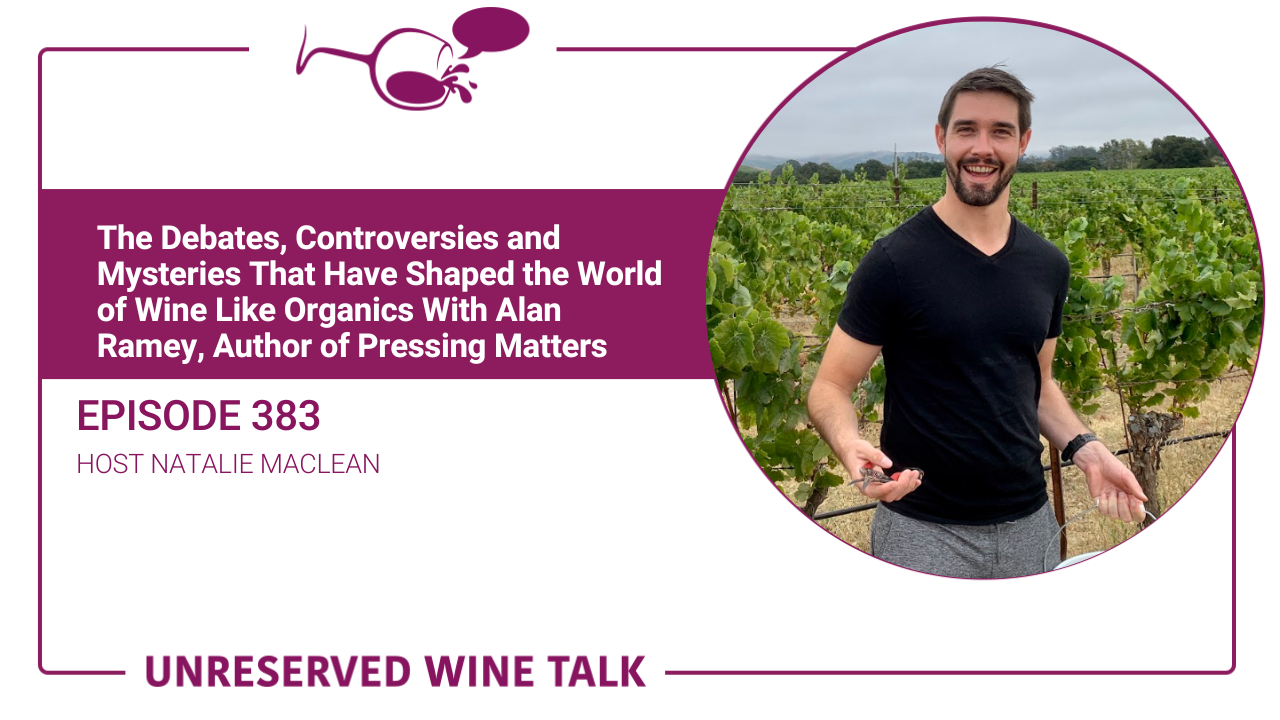
In this episode of the Unreserved Wine Talk podcast, I’m chatting with Alan Ramey, author of the new book, Pressing Matters: The Debates, Controversies and Mysteries that have Shaped the World of Wine.
You can find the wines we discussed here.
Giveaway
Two of you are going to win a copy of Alan Ramey’s terrific new book, Pressing Matters: The Debates, Controversies and Mysteries that have Shaped the World of Wine.
How to Win
To qualify, all you have to do is email me at [email protected] and let me know that you’ve posted a review of the podcast.
It takes less than 30 seconds: On your phone, scroll to the bottom here, where the reviews are, and click on “Tap to Rate.”
After that, scroll down a tiny bit more and click on “Write a Review.” That’s it!
I’ll choose two people randomly from those who contact me.
Good luck!
Join me on Instagram, Facebook and YouTube Live Video
Join the live-stream video of this conversation on Wednesday at 7 pm eastern on Instagram Live Video, Facebook Live Video or YouTube Live Video.
I’ll be jumping into the comments as we watch it together so that I can answer your questions in real-time.
I want to hear from you! What’s your opinion of what we’re discussing? What takeaways or tips do you love most from this chat? What questions do you have that we didn’t answer?
Want to know when we go live?
Add this to your calendar:

Highlights
- What makes Pressing Matters different from more traditional wine books?
- What was it like interviewing experts who strongly disagreed with each other?
- How did growing up in a scientifically rigorous winery shape Alan’s skepticism toward certain claims in the wine world?
- Why is the wine industry full of strong opinions despite limited scientific validation?
- What did Alan discover about the lack of definitive research behind the organic versus conventional farming debate?
- Why did Alan move away from his original career path in diplomacy?
- How did studying and tasting wine at Oxford and Cambridge reshape his view of wine as a multidisciplinary field?
- How has debate training influenced the way Alan evaluates claims about wine?
- Why do different wine cultures tolerate or reject elements like oxidation differently?
- What did working harvests in Chile and Burgundy reveal to Alan about the diversity within regions?
- Can winemaking decisions override terroir?
- How much of terroir is shaped by natural factors versus historical, political, and economic decisions?
- Why do classification systems and appellation rules often reflect power and economics as much as quality?
Key Takeaways
- What might surprise you about the amount of research on organic versus conventional farming when it comes to winemaking?
- The organic chapter was probably the most difficult because there’s so many papers written on it with so many different subfields of science.There was one gentleman I spoke to who said we would never use synthetic fertilizer because of the CO2 emissions that brings as a byproduct of the fossil fuel industry and so therefore that’s obviously the most environmentally damaging. I talked to another gentleman who hates organics, and he said, well, if you use these really ineffective organic treatments, you have to do so many more spray passes. You have to hire way more people. You have to use more machinery, way more tractor passes, and it’s obvious that that creates more emissions. so it seems like there was just a lot of belief without necessarily the surety that backs it up.
- Why are many strong opinions in wine accepted without much challenge or push for validation?
- It was difficult, and I’d say that was one of the things that also inspired me to write the book, is that it seems like the barrier to entry for opinion in wine is quite low. It’s quite easy to have an opinion and assuming you’re a sommelier at a certain restaurant or a winemaker at a certain winery, there’s often not a lot of pushback because there’s a sense of knowledge with those positions. But being born on the inside, I often found that you do see people saying things without that validation. And so I was interested in getting into those other aspects.
- Why are traditional wine regions being forced to balance heritage with visibility and branding in today’s market?
- The moment you get a place-based wine and people realize that that is a value creation, that you can charge more money for it, it’s more interesting to sommeliers, you get more cultural cachet. Of course, people want to copy that. And so there’s so many new either AVAs in the United States or DOCGs in Italy or other place-based constrictions in the world. And I think Andrea Zappalagli in the UK, did some interesting work where he said there’s all these almost ghost regions in Italy where almost no wine is made and just created it because there was a good marketing thing at the time, but it didn’t actually have the historical stature to have something that was distinctive. And I think in a world where there’s more and more “special places,” I think that begs the question, if everything is special, then nothing is special. And that means that the regions that do have that history, or anyone who wants to be gotten their attention of needs to fight that much further in the wine marketplace to gain that attention.
About Alan Ramey
Alan Ramey comes from a vintner family in the Sonoma/Napa area north of San Francisco, California. He is currently co-president of the family winery, Ramey Wine Cellars. He learned wine making as an apprentice to his father, one of the most famous winemakers in the US, and has also studied wine making and apprenticed in Chile and France, including harvests at Veramonte in Casablanca and Méo-Camuzet in Burgundy. While studying for his MBA at Cambridge University he was selected to join the blind wine tasting team, competing around Europe. He is a board member for the California Wine Institute and is active in the wine community. Alan was on his high school and college debate teams and during his study abroad year at Oxford he won the ‘best new debater of the year’ competition.
Resources
- Connect with Alan Ramey
- Unreserved Wine Talk | Episode 159: Cosmo’s Sex & the City, Champagne, Whisky Women in Mallory O’Meara’s Girly Drinks
- My Books:
- Wine Witch on Fire: Rising from the Ashes of Divorce,Defamation, and Drinking Too Much
- Audiobook:
- Audible/Amazon in the following countries: Canada, US, UK, Australia (includes New Zealand), France (includes Belgium and Switzerland), Germany (includes Austria), Japan, and Brazil.
- Kobo (includes Chapters/Indigo), AudioBooks, Spotify, Google Play, Libro.fm, and other retailers here.
- Wine Witch on Fire Free Companion Guide for Book Clubs
- Audiobook:
- Unquenchable: A Tipsy Quest for the World’s Best Bargain Wines
- Red, White, and Drunk All Over: A Wine-Soaked Journey from Grape to Glass
- Wine Witch on Fire: Rising from the Ashes of Divorce,Defamation, and Drinking Too Much
- My new class, The 5 Wine & Food Pairing Mistakes That Can Ruin Your Dinner And How To Fix Them Forever
Tag Me on Social
Tag me on social media if you enjoyed the episode:
- @nataliemaclean and @natdecants on Facebook
- @nataliemaclean on Twitter
- @nataliemacleanwine on Instagram
- @nataliemaclean on LinkedIn
- Email Me at [email protected]
Thirsty for more?
- Sign up for my free online wine video class where I’ll walk you through The 5 Wine & Food Pairing Mistakes That Can Ruin Your Dinner (and how to fix them forever!)
- You’ll find my books here, including Unquenchable: A Tipsy Quest for the World’s Best Bargain Wines and Red, White and Drunk All Over: A Wine-Soaked Journey from Grape to Glass.
- The new audio edition of Red, White and Drunk All Over: A Wine-Soaked Journey from Grape to Glass is now available on Amazon.ca, Amazon.com and other country-specific Amazon sites; iTunes.ca, iTunes.com and other country-specific iTunes sites; Audible.ca and Audible.com.
Transcript