






Introduction
Should wine competitions give judges the option to say that none of the wines in a category deserve a medal? Why have some classic regions become inaccessible while others remain within reach for wine drinkers? What does it mean for a wine to gain wisdom as it ages?
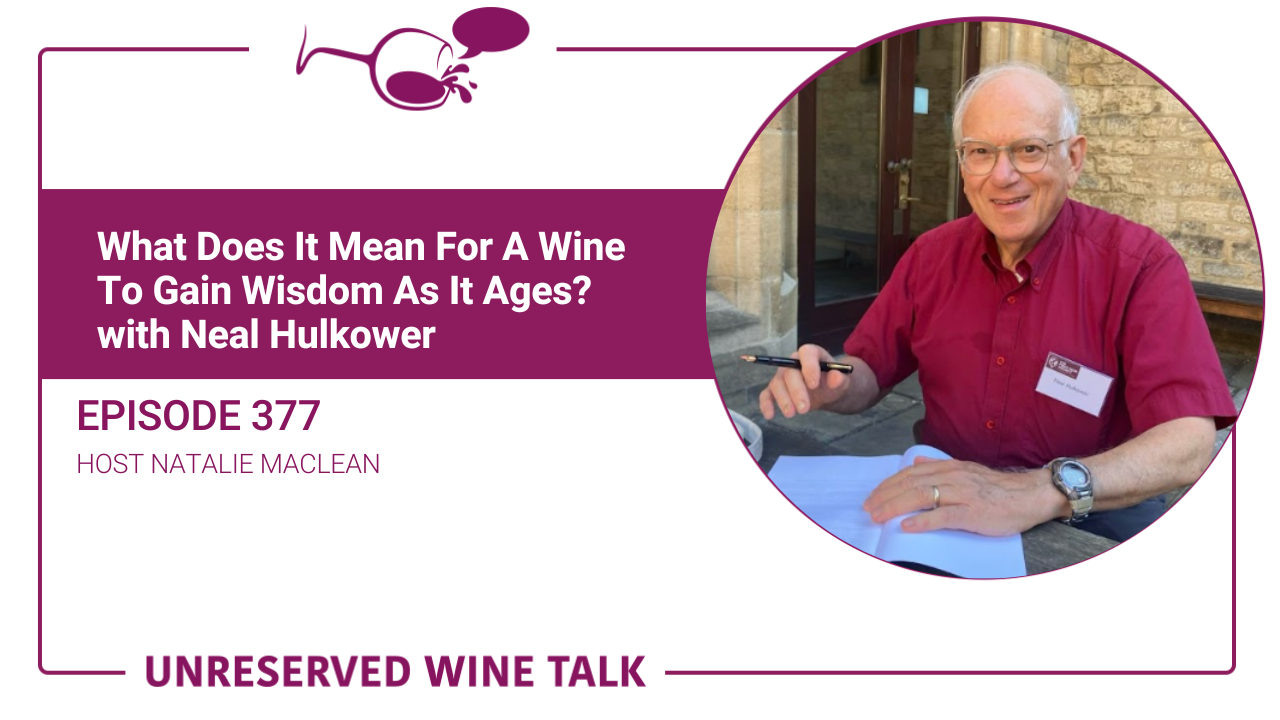
In this episode of the Unreserved Wine Talk podcast, I’m chatting with Neal Hulkower, a PhD rocket scientist, who has just published his first book, Grape Explications.
You can find the wines we discussed here.
Giveaway
Three of you are going to win a copy of Neal Hulkower’s terrific new book, Grape Explications.
How to Win
To qualify, all you have to do is email me at [email protected] and let me know that you’ve posted a review of the podcast.
It takes less than 30 seconds: On your phone, scroll to the bottom here, where the reviews are, and click on “Tap to Rate.”
After that, scroll down a tiny bit more and click on “Write a Review.” That’s it!
I’ll choose three people randomly from those who contact me.
Good luck!
Join me on Instagram, Facebook and YouTube Live Video
Join the live-stream video of this conversation on Wednesday at 7 pm eastern on Instagram Live Video, Facebook Live Video or YouTube Live Video.
I’ll be jumping into the comments as we watch it together so that I can answer your questions in real-time.
I want to hear from you! What’s your opinion of what we’re discussing? What takeaways or tips do you love most from this chat? What questions do you have that we didn’t answer?
Want to know when we go live?
Add this to your calendar:

Highlights
- What was one biostatistician’s objection to the way wine competitions were scored?
- Why does Neal fundamentally disagree with the view that some judges’ opinions should carry more weight?
- What are the Power of None and the Stars and Bars method and how do they change the way judges assess competitors?
- Why did Neal apply these ranking methods to historic tastings like the Judgment of Paris, and what did the results reveal?
- What did revisiting his tasting notebooks from the 1960s and 1970s reveal about wine prices, aging, and accessibility?
- How did Neal set a personal ceiling on wine price, and how does that shape what he considers drinkable?
- Why have some classic wines remained attainable while others are now priced out of affordability?
- How did opening a carefully chosen older bottle reinforce Neal’s belief that wine can gain wisdom as it ages?
Key Takeaways
- Should wine competitions give judges the option to say that none of the wines in a category deserve a medal?
- Natalie: It seems to me sometimes wine competitions give a medal to everybody just for participating, right? So if it’s a weak category, you’re going to get a gold if you’re the best in a weak category, whereas this, it seems, would say, actually, nobody measured up. There shouldn’t be medals given out for this one.
- Neal: Yes, that’s precisely what it can do. You should be able to say none as your option, that you don’t want to vote for any, and then have everybody else ranked underneath that either equally or, you know. So the paper that I wrote with my friend John Netrower, who got me into wine, examines that in great detail and the implication. suppose that the judge who ranked the wine in the 60s really didn’t like any of them, but was compelled to rank them. He could put in none as a first and rank the others underneath. Whereas those in the 90s would have none at the bottom because they liked all of them. in the 70s might have none in between. And then you aggregate and none turns up where it is. And then the overall ranking.
- Why have some classic regions become inaccessible while others remain within reach for wine drinkers?
- Neal: These notebooks, provided me remarkable data on my tasting history between 1969, 1979 and I said, gee, I drank some fabulous stuff back then, you know, classified growths, aged Burgundies. You know, you could pick up a 25 year old Burgundy for $19. Granted it’s still a lot of money, but still. And I said, wonder if, first of all, if any of those wines are still available and if so, what would they cost? And if not, is there something similar that’s out there, similar age that I could afford? I did an analysis. I went through Wine Searcher again to see what was available, how much it cost. Did all of my descriptive statistics and then I also had my current inventory, which I keep in a spreadsheet. And I looked at the maximum price I paid for a bottle of wine, and I said, okay, that represents the limit. Empirically, this is the most I paid, and that’s the most I’m willing to pay. And then I took a look to see what else was available that was at that or below that price. Turned out there was some. Anything that wasn’t exactly what I had, I looked for something of comparable age for when I had it, and I and I did the same kind of thing. I looked to see if it fell under that number.
- Natalie: So what was your conclusion with the presentation? What can I still afford to drink? Not much or… It doesn’t have to be specific, but I just have this vision that Bordeaux, Burgundy, they’ve all gone crazy, even in the last 5 to 10 years.
- Neal: More than I expected but German wines don’t.
- What does it mean for a wine to gain wisdom as it ages?
- Neal: One of the things that changed in my palate over the year is that I don’t crave fruit. I prefer savoury elements to a wine or things like truffle, umami characteristics and so on. There’s a word I use for one. I’ve seen somebody else use it too. especially ones that are venerable. Wisdom. The wine acquires wisdom. It’s not brash. It’s not in your face. It says, Sit with me for a while and let’s have an olfactory conversation. Watch me as I change.
About Neal Hulkower
Neal D. Hulkower is an applied mathematician and freelance writer living in McMinnville, Oregon. His first contributions to a wine publication appeared in the early 1970s. Since 2009, he has been writing regularly about wine-related topics for academic, trade, and popular publications including the Journal of Wine Research, the Journal of Wine Economics, American Wine Society Wine Journal, Oregon Wine Press, Practical Winery & Vineyard, Wine Press Northwest, the Slow Wine Guide USA, and The World of Fine Wine and on wine-searcher.com, trinkmag.com, and guildsomm.com. Neal is a member of the American Wine Society, the American Association of Wine Economists, and the Circle of Wine Writers. His first book, Grape Explications, was released in 2025. He can occasionally be found pouring some of Oregon’s finest in a tasting room at the top of the Dundee Hills.
Resources
- Connect with Neal Hulkower
- Natalie MacLean’s Appearance on
- Unreserved Wine Talk
- My Books:
- Wine Witch on Fire: Rising from the Ashes of Divorce,Defamation, and Drinking Too Much
- Audiobook:
- Audible/Amazon in the following countries: Canada, US, UK, Australia (includes New Zealand), France (includes Belgium and Switzerland), Germany (includes Austria), Japan, and Brazil.
- Kobo (includes Chapters/Indigo), AudioBooks, Spotify, Google Play, Libro.fm, and other retailers here.
- Wine Witch on Fire Free Companion Guide for Book Clubs
- Audiobook:
- Unquenchable: A Tipsy Quest for the World’s Best Bargain Wines
- Red, White, and Drunk All Over: A Wine-Soaked Journey from Grape to Glass
- Wine Witch on Fire: Rising from the Ashes of Divorce,Defamation, and Drinking Too Much
- My new class, The 5 Wine & Food Pairing Mistakes That Can Ruin Your Dinner And How To Fix Them Forever
Tag Me on Social
Tag me on social media if you enjoyed the episode:
- @nataliemaclean and @natdecants on Facebook
- @nataliemaclean on Twitter
- @nataliemacleanwine on Instagram
- @nataliemaclean on LinkedIn
- Email Me at [email protected]
Thirsty for more?
- Sign up for my free online wine video class where I’ll walk you through The 5 Wine & Food Pairing Mistakes That Can Ruin Your Dinner (and how to fix them forever!)
- You’ll find my books here, including Unquenchable: A Tipsy Quest for the World’s Best Bargain Wines and Red, White and Drunk All Over: A Wine-Soaked Journey from Grape to Glass.
- The new audio edition of Red, White and Drunk All Over: A Wine-Soaked Journey from Grape to Glass is now available on Amazon.ca, Amazon.com and other country-specific Amazon sites; iTunes.ca, iTunes.com and other country-specific iTunes sites; Audible.ca and Audible.com.
Transcript
Natalie MacLean 00:00:00 Should wine competitions give judges the option to say that none of the wines in a category deserve a medal? Why have some classic wine regions become inaccessible while others remain within reach price wise for wine drinkers? And what does it mean for a wine to gain wisdom as it ages? In today’s episode, you’ll hear the stories and tips that answer those questions. In part two of our chat with Neil Hulk Hour. You don’t need to have listened to part one from last week first, but if you missed it, go back and have a listen after you finish this one. By the end of our conversation, you’ll also discover one biostatistician objection to the way wine competitions are scored. Why? Neil fundamentally disagrees with the idea that some judges opinions should carry more weight than others. Why? He applied these ranking methods to historic tastings like The Judgement of Paris and what those results revealed. What revisiting his tasting notebooks from the 1960s and 70s revealed about wine prices, aging and accessibility, and how Neal set a personal ceiling on wine prices and how that shapes what he considers drinkable.
Natalie MacLean 00:01:17 Do you have a thirst to learn about wine? Do you love stories about wonderfully obsessive people, hauntingly beautiful places, and amusingly awkward social situations? Well, that’s the blend here on the Unreserved Wine Talk podcast. I’m your host, Natalie MacLean, and each week I share with you unfiltered conversations with celebrities in the wine world, as well as confessions from my own tipsy journey as I write my third book on this subject. I’m so glad you’re here. Now pass me that bottle, please, and let’s get started.
Natalie MacLean 00:01:59 Welcome to episode 377. First, let’s talk holidays for your calendar. This week kicks off with February 18th National Drink Wine Day. Pop that bottle you’ve been saving. Host a blind tasting with friends or try one grape three textures flight with still sparkling and desert versions of the same variety. Fun fact vermouth is technically a wine, not a spirit, so that counts. February 19th is National Chocolate Mint Day, which calls for grasshopper cocktails or a late harvest Riesling alongside your after dinner mints. February 20th doubles as National Cherry Pie Day and National Muffin Day.
Natalie MacLean 00:02:40 Turn muffins into pairings by matching blueberry with off dry Riesling. They seem to have off dry Riesling on the brain. Chocolate chip with ruby port or a savory cheddar chive with brisk cider. February 21st is National Sticky Bun Day. The perfect excuse for a late afternoon coffee and ice wine moment. February 22nd brings National Margarita Day. Go beyond the Frozen Blender Classic with a mezcal version for smoky depth, a spicy, jalapeno infused rim with Tajin or a hyper Canadian snowbank margarita with a salted maple rim. Host a margarita flight with progressively weirder Canadian twists like dill pickle brine or kalamata rims. Trivia time. Margarita is Spanish for daisy, and the drink is likely a riff on a Victorian cocktail. February 23rd is National Banana Bread Day. I love banana bread. Whenever I’m traveling, the way I treat myself as I go to Starbucks for one other overpriced banana bread. Anyway, it pairs beautifully with aged rum, cream liqueur, and coffee or tawny style dessert wine. It’s also National Cupcake Day, so match prosecco with red velvet or Moscato with a lemon curd.
Natalie MacLean 00:03:57 February 24th. Wraps up the week with National Tortilla Chip Day and World Bartender Day. So do a global dip tour, matching each dip to a different beer style or a crisp. Albano and tip your bartender generously. What’s new in the drinks world? Brock University’s Kobe Institute is pioneering research into the Itasca grape, a cold hardy hybrid designed to maintain premium quality despite extreme weather swings at this week’s Wine Paris Fair. Doctor Jose Alamos announced a DNA discovery connecting a grape variety between Turkey and Hungary across three centuries. The research from Pacelli Winery revealed genetic links nobody expected. The grape is colloquial and almost extinct. Turkish variety from the Thrace region. The DNA profiling revealed the grape is genetically identical to ferment, Hungary’s iconic white grape responsible for the legendary wines of Tokai. The historical connection is fascinating. After Francis the Second Rakoczi lost the Hungarian War of Independence against the Habsburgs in 1708. He fled to the Ottoman Empire and lived in exile in Turkish Thrace for 18 years with a large Hungarian entourage. The theory is that the nobles brought ferment vine cuttings from Tokay.
Natalie MacLean 00:05:26 During this exile, the winery rescued Rocco from near extinction over the past 20 years, finding just a handful of forgotten vines in farmers vineyards. They’ve been making this varietal wine since 2009. Despite being genetically identical, Rocco and Ferment taste different today. The Mediterranean climate and the calcareous soils of Turkish Thrace versus the continental climate and volcanic soils of Tokai. Create distinctive wines. Plus, after three centuries apart. Both varieties have likely accumulated somatic mutations. Oh, I love saying that. Somatic mutations bodily. So meanwhile, a bizarre climate anomaly has been reported in the Alexander Valley of California, where the first grape bug break of 2026 occurred in late January, leaving growers scrambling to protect tender shoots from the unpredictable February frosts. Major cocktail trends for the year include flash carbonation of entire cocktails, not just adding bubbles to one ingredient, but carbonated the whole drink. Milk punches made with yogurt and clotted cream garnishes are gravitating toward purposeful and bold, like fresh baked bread infused with fortified blueberries and strawberry fruit crisps made by local pastry chefs.
Natalie MacLean 00:06:51 Archaeological chemists recently analyzed 9000 year old clay shards from a Chinese village and discovered traces of the world’s oldest cocktail, a fermented blend of rice, honey and hawthorn fruit that would have packed about a 10% alcoholic punch. In a move to modernize the sad solo drink. A high end tech bar in Las Vegas has debuted a robotic bartender that uses facial recognition to detect unhappy customers and proactively suggests a cheer up cocktail with a personalized joke on the side. Just me and my AI. On social media, fans are buzzing over a quirky post from the Boutique Spirits distillery in Revelstoke, B.C. they used a hidden camera to show a local beer judging of their botanical waste, a humorous nod to their sustainability efforts. They’ve gained a huge following for capturing local wildlife interacting with the distillery surroundings. The judging video was a witty way to highlight their circular economy. They often compost their spent gin botanicals like juniper, citrus and mountain herbs or provide them to local farmers. In the post, the bear is seen meticulously sniffing out the spent mash pile.
Natalie MacLean 00:08:08 A Russian distillery has released a limited edition vodka specifically designed not to freeze until it hits -27°C, and it’s marketed as tundra proof. For those who prefer their shots served at Arctic temperatures in other extremes, the world’s strongest beer, Snake venom, currently clocks in at a staggering 67.5% alcohol by volume so high that the brewery actually puts a yellow warning label on the neck, advising drinkers not to exceed 135 mil measure per sitting. That’s equivalent to only two teaspoons. In a bizarre case of breathalyzer physics. A student party in Maryland was so saturated with alcohol vapors that the air inside the house itself tested positive on a police breath sensing device. Did you know that the human body can actually produce its own alcohol? It’s called endogenous ethanol production, where the bacteria in your gut ferment carbohydrates into tiny amounts of booze. So technically, you’re always a little bit spirited, even when you’re stone cold sober. Then there is a rare condition called auto brewery syndrome, where a person’s own gut microbes ferment the carbohydrates they eat with enough ethanol to cause a measurable intoxication, effectively turning their body into a tiny internal brewery.
Natalie MacLean 00:09:35 It is vanishingly rare and more medical mystery than party trick, but the idea that some people could, in theory, get tipsy from a bowl of pasta without a drop of wine makes for an irresistible reminder that biology can outwitted even the wildest cocktail menu. Researchers have discovered that up to 70% of the wine’s final characters shaped during fermentation, long before any aging begins, and different yeast strains can alter a wine’s aromatic profile by as much as 40%. That means microscopic fungi doing the work in those tanks have more influence on what you smell and taste than almost anything else. The yeast are the real winemakers. New research published in Microbial Biotechnology must get a subscription to that explores how winemakers might design custom yeast communities using synthetic meta genomes to precisely engineer flavor profiles. They argue that understanding the ecological dynamics of fermentation could unlock genetic potential for developing entirely new wine styles on upcoming TV shows will be chatting about fresh wines for spring. Saint Patrick’s Day beer and spirits, and environmentally sustainable drinks for Earth Hour and Earth Day, as well as those for Easter, Mother’s Day and Father’s Day.
Natalie MacLean 00:10:56 Let me know if you’d like your brand featured on these TV segments or future ones, or if you’d like to advertise with us through our podcast, newsletter, website, social media or mobile apps, please email me at Nathalie at Natalie MacLean dot com. I’m sharing more tips and tips on Instagram at Natalie MacLean Wines. Join me there for more of the weird and wonderful. Back to today’s episode. Three of you will win a copy of Neil’s new book. If you’d like to win, just email me and let me know you’d like to win. It doesn’t matter where you live, I’ll choose three winners randomly from those who contact me. Keep these books for yourself or give them as gifts. If you’re reading the paperback or e-book or listening to the audiobook of my memoir, wine Witch on Fire rising from the ashes of divorce, defamation and drinking Too Much, a national bestseller in one of Amazon’s Best Books of the year. I’d love to hear from you at Natalia Natalie MacLean. Com. I’ll put a link in the show notes to all retailers worldwide at Natalie MacLean.
Natalie MacLean 00:11:54 Com forward slash 377. Okay, on with the show. And now back to that board. A Yale statistician, Dominic Fischetti, launched a heated attack on using the Board of County Wine Competitions. What did he disagree with there? Why did he say it wasn’t the right way to choose winners and losers?
Neal Hulkower 00:12:19 So he was. Unfortunately, he died. Very sad. I really like the guy. He’s a biostatistician. I’m a mathematician. We’re not cut from the same cloth. Exactly. And he, in fact, had written about the judgment of Paris and analyzed the scores. As a the statistician came up with the conclusion that there was essentially no difference between the first and second place. I actually mentioned his work in my paper, but what he doesn’t like. Let me give you a version of his example, which I think is absolutely brilliant to show the distinction between his perspective and one that’s strictly ordinal. He has an example where he has five tasters, scored three wines, one of them has scores in the 60s, one two in the 70s and two in the 90s.
Neal Hulkower 00:13:20 Those clearly show three different levels of goodness for the wines. If you convert those to rankings and use Borda, that intensity of preference disappears.
Natalie MacLean 00:13:38 Write that this one is so much better than that one, the one that was scored in the 90s.
Neal Hulkower 00:13:43 The guys who ranked in the 90s thought so much more of those wines than the guys in the 70s, and so much more of it than the guys in the 60s. That information is lost now. He was of the school that there were people whose opinion should count more. I’m not. And so there was some difference there. But in dealing with his objection, which is it’s a reasonable objection. There are two different things that I suggested over time. One is you can actually introduce with board, and I wrote a separate peer reviewed paper on this called The Power of None. You can introduce none as an option and you can insert that anywhere in the ranking.
Natalie MacLean 00:14:33 What does the non mean like zero like.
Neal Hulkower 00:14:36 Well, let’s talk in terms of political candidates without mentioning names because it’s a little bit easier.
Neal Hulkower 00:14:43 Suppose you have a slate of candidates that you have to choose from, and you don’t like any of them, but you’re in a jurisdiction where you have to rank them, because we have that now in the United States. Poorly done, but we have it. You should be able to say none as your option.
Natalie MacLean 00:15:00 That you don’t want to vote for.
Neal Hulkower 00:15:01 Anymore. You don’t want to take them and then have everybody else ranked underneath that. So the paper that I wrote with my friend John Nightcrawler, who got me into wine, examines that in great detail. And then the implication generically. It doesn’t specifically call out elections, but it can also be used for wine. So suppose that the judge who ranked the one in the 60s really didn’t like any of them, but was compelled to rank them. He could put in none as a first and rank the others underneath, whereas those in the 90s would have none at the bottom because they liked all of them. Right? Guys in the 70s might have none in between.
Neal Hulkower 00:15:43 And then you aggregate and none turns up where it is and the overall ranking.
Natalie MacLean 00:15:49 And because if there were three judges who said none for all of them, would that avoid wine competitions? Not giving. It seems to me sometimes wine competitions give a medal to everybody just for participating. Right. So if it’s a weak category, you’re going to get a gold if you’re the best in a weak category. Whereas this, it seems, would say actually nobody measured up. There shouldn’t be medals given out for this one.
Neal Hulkower 00:16:13 That’s precisely what it can do. I don’t know if you want to get into this now, but very recently in this past year, a wine economist colleague of mine, Geoff Boddington, came up with, I think, a brilliant way to handle this. And it’s called Stars and Bars. Let’s go back with a very simple example. Let’s say that there are three judges and using the board account. There’s a wine that gets a total Borda score of nine. So how can you get to nine? Each one gave it a board, a score of three.
Neal Hulkower 00:16:50 You could have a board, a score of one, one and seven. You could get four for five and zero. You’re getting.
Natalie MacLean 00:17:02 Everybody down to an average or.
Neal Hulkower 00:17:04 Whatever. Yeah, but what’s really important here, what was the thing that Dom was objecting to? He was objecting to the fact that a ranking is simply that it doesn’t give you any sense of the strength of preference with that ranking. So none works. Sorta. You still have the issue of strength of preference, although the place and the final ranking is a strength of preference. What’s nice about stars and bars, and the analysis that Jeff came up with, is that it adds a second dimension beyond simply the ranking, and that dimension is the strength of preference. If all three of them gave that wine. Three that’s stronger than if two of them gave one and one gave seven. There’s a spread there, which means, yeah, the one guy who might be a super taster or not. Again, I don’t believe in it, but some folks do really love that one.
Neal Hulkower 00:18:07 The others too said no, doesn’t do it for me. So there’s a wider distribution. If you had two twos and a five, that’s a little tighter. You get the picture that if you look at how that ranking of nine is arrived at and how it can be arrived at, that gives you another piece of information that can help you appreciate how strong a preference that one was appreciated by the judges.
Natalie MacLean 00:18:38 Fascinating. Wow. And here I thought.
Natalie MacLean 00:18:42 You were.
Neal Hulkower 00:18:43 Right.
Natalie MacLean 00:18:44 It’s like, yes, I did, I understand it.
Neal Hulkower 00:18:46 Yeah, it’s not that hard.
Natalie MacLean 00:18:47 I almost don’t want to touch it, though.
Natalie MacLean 00:18:49 Oh.
Natalie MacLean 00:18:50 No, I get it.
Natalie MacLean 00:18:51 I get it, I hear you.
Natalie MacLean 00:18:52 Okay, I’m more of a lit major, but anyway, so you you applied that as well to the judgment of Paris, the Borda method, and got similar results. But let’s go on to the conference where you received one of the three coveted Christophe Barron prizes for best conference presentation in Tbilisi, Georgia.
Natalie MacLean 00:19:16 The country, not the state it was. What? Can I still afford to drink now? What was this? This was a different topic, correct?
Neal Hulkower 00:19:24 I bounced around a lot. I joked that I have a short attention span, but it can be. That can be disproven. So these notebooks here that I talk about provided me remarkable data on my tasting history between 1969 and 1979. I drank some fabulous stuff back then. Classified growths, aged burgundies. You know, you could pick up a 25 year old Burgundy for $19. The grant is still a lot of money, but still. And I said, wonder if, first of all, if any of those wines are still available and if so, what? What would they cost? You know? And if not, is there something similar that’s out there, similar age that I could afford? So this was originally an article that I wrote for Wine Searcher, and it came out under the name of, I think, the cost of tasting wine history or something like that.
Neal Hulkower 00:20:25 And he said, gee, it’s kind of fun. I like my title better than the one that was given, but.
Natalie MacLean 00:20:31 I do too.
Neal Hulkower 00:20:33 Yeah, and I like giving talks at the Wine Economist meeting. I said, maybe I should do this, so I wrote it up. Covid hit. The meetings were cancelled. I didn’t go to Vienna like a, you know. And so I dug it out, did another talk where I used border to look at the tasting that resulted in Domaine Drouin happening in Oregon. And so I had two talks in Tbilisi. I did an analysis. I went through Wine Searcher again to see what was available, how much it cost, did all of my descriptive statistics. And then I also had my current inventory, which I keep in a spreadsheet. And I looked at the maximum price I paid for a bottle of wine and I said, okay, that represents the limit. Empirically, this is the most I paid and that’s the most I’m willing to pay. And then I took a look to see what else was available that was at that or below that price.
Neal Hulkower 00:21:35 Turned out there was some anything that wasn’t exactly what I had, and it could have been because it would have been over the hill or too expensive. Or I looked for something of comparable age for when I had it, and I did the same kind of thing. I looked to see if it fell under that number.
Natalie MacLean 00:21:55 Wouldn’t they have all increased though? Wines of at least decent wines of the vintage you had in your stockpile? Wouldn’t they have all gone up?
Neal Hulkower 00:22:03 Yeah, but there were a couple that didn’t. And also, I’m sure you’re familiar with Wine Searcher. That’s a dynamic website, so you can go back an hour later and things change. When I wrote the article, I did the analysis. And then when I did the presentation, I went back and did the analysis all over again. Things Indeed it changed that truck and beyond ourselves, which of course could survive the number of years was instead of 85 or $200. I think initially was $3,600. And then when I looked at it again, it had dropped a little bit, possibly because it was fading.
Neal Hulkower 00:22:44 I don’t know. That’s not what I would pay for a bottle of wine.
Natalie MacLean 00:22:48 So did that make you say I should never open it or that?
Neal Hulkower 00:22:52 Well, I think you should open it because it could be, you know, 59. That’s a long time ago. It could be. Yeah, it could be going down. I mean, it would it would still be awfully good. But we did, by the way, have a bottle of that 70. O’Brien to celebrate the publication of the paper, I was actually able to acquire one that was in good shape for a reasonable amount of money. It was 39 years old when we opened it. And I still have the bottle. And I framed it along with my the reprint of the article and then my friend John’s comments on it. It was terrific, but it was definitely starting its decline.
Natalie MacLean 00:23:34 Oh, Bette, how much did you have to pay for it?
Neal Hulkower 00:23:36 I think it was 200 or something like that. It wasn’t outrageous. Yeah, it was not outrageous.
Neal Hulkower 00:23:42 Yeah, I was shocked.
Natalie MacLean 00:23:43 So what was your conclusion with the presentation? What can I still afford to drink? Not much. Or what was the.
Neal Hulkower 00:23:50 More than I expected.
Natalie MacLean 00:23:51 I just have this vision that Bordeaux, Burgundy, they’ve all gone crazy even in the last 5 or 10 years.
Neal Hulkower 00:23:57 German wines don’t. And again, using that thing. Well, you know, what would it cost for me to get a 15 year old claret or German wines versus the one that I had when it was 15 years old? But it was from, I don’t know, 1947 or whatever it was, but I used that also. And there was there was enough, you know, there was enough. There was still some things that I didn’t. I won’t touch. The most expensive bottle of wine I ever paid for was a a wine to celebrate my 75th birthday, which was in 24. I happened to be in London at Hedonism Wine, doing some research for an article on Chardonnay, Oregon Chardonnay.
Natalie MacLean 00:24:43 And what’s Hedonism wine.
Natalie MacLean 00:24:44 Is it a wine shop?
Neal Hulkower 00:24:45 It’s a wine shop in Mayfair. and if you’re ever there, you should go.
Natalie MacLean 00:24:50 Yeah. It’s beautiful. Neighborhood two Mayfair is quite hoity posh, as they.
Natalie MacLean 00:24:54 Say, quite posh.
Neal Hulkower 00:24:56 And two storeys. And I’m done, you know, doing the interviews for my, my thing. And I said, do you happen to have any 40 nines that will not require me mortgaging my house? And so they popped up on the screen and there was this 70 that was in fact £250. I said, Okay. and they pulled up two of them, and we sitting there looking at them at the college and so on, and I pick one bottle. that translates to $316.
Natalie MacLean 00:25:31 American.
Natalie MacLean 00:25:31 And.
Neal Hulkower 00:25:32 A.
Natalie MacLean 00:25:32 30%.
Natalie MacLean 00:25:33 Canadian.
Neal Hulkower 00:25:33 Not, Canadian. And we got it. And again, we wish we got in both because it was fabulous.
Natalie MacLean 00:25:41 Oh, wow.
Natalie MacLean 00:25:43 And the college, that’s the part the the oxygen space between the cork and the where the wine comes up to on the shoulder of the bottle.
Natalie MacLean 00:25:51 How is that?
Neal Hulkower 00:25:52 It was that. There was. It was well above the. It was practically normal.
Natalie MacLean 00:25:59 Oh, okay. Great. Because that will give you an indication of oxidation if there is any.
Neal Hulkower 00:26:02 Yeah, that’s my sole criterion. Well, pretty much my sole criteria. Now when I’m buying something old because I got burned for my 70th birthday, I got one where it was too low and the wine was we choked it down, but it was pretty much gone. we should have gotten both. The wine was acquired from the cellar of a collector who probably got it when it was released.
Natalie MacLean 00:26:27 Great. Provenance.
Natalie MacLean 00:26:28 Yeah, yeah, 1951.
Neal Hulkower 00:26:31 We picked the one with ever so slightly higher fill. And we should have just bought both because there’s enough life there for at least another. I’d say another five years could have made it to my 80th.
Natalie MacLean 00:26:45 Well, but.
Natalie MacLean 00:26:46 The memories will last till then. Or longer.
Natalie MacLean 00:26:48 Yeah, yeah.
Neal Hulkower 00:26:49 The wine held up. We didn’t decant it. We got the cork out intact, which took about ten minutes.
Natalie MacLean 00:26:56 Oh, really? Did you use those that tong? Kind of. I forget what they’re called. That specialty.
Natalie MacLean 00:27:00 Cork.
Neal Hulkower 00:27:01 They call it a Durand.
Natalie MacLean 00:27:02 Oh that’s.
Natalie MacLean 00:27:03 Right.
Neal Hulkower 00:27:03 But rather than paying $150 for a Durand, I saved the screw from a rabbit thing contraption that I had slipped it Bit into that which you hang shades up with. Those are the wings manually screwed it in, and I was working with a colleague from the tasting room who was stronger than I am, and then we went around with an ISO, which is how a Durand works, right?
Natalie MacLean 00:27:32 Only an aerospace engineer could come.
Natalie MacLean 00:27:34 Up with that. You know, it was.
Neal Hulkower 00:27:36 It worked. It worked and it didn’t. And I saved $150.
Natalie MacLean 00:27:40 For.
Neal Hulkower 00:27:41 Bottles of wine. You know, you usually worry about a wine that old decaying it actually over the hour got a little better. Really. By the time it was gone. It was it was pretty damn good.
Natalie MacLean 00:27:57 Oh, and was it mainly structure, tannin and acid or did it have any fruit left?
Neal Hulkower 00:28:02 It had complexity.
Neal Hulkower 00:28:04 One of the things that changed in my palate over the year is that I don’t crave fruit. I prefer savoury elements to a wine or things like truffle.
Natalie MacLean 00:28:16 Right. You know.
Natalie MacLean 00:28:18 Mushroom, the forest floor. Those things that come through over time.
Natalie MacLean 00:28:22 Yeah, yeah.
Neal Hulkower 00:28:22 Umami characteristics and so on. This had that. There’s a word I use for one. I’ve seen somebody else use it too. Especially ones that are venerable wisdom. The wine acquires wisdom. Yeah. It’s not brash. It’s not in your face. It says sit with me for a while and let’s have a olfactory conversation. Watch me as I change. And this one did that as fragile as it might have been. It changed. It came back to the beginning of conversation, and then it went someplace else, and so on. I love older wines, and I’m aging Oregon Pinos now, which can age fabulously well.
Natalie MacLean 00:29:12 How long can they? I mean, it has to be well made, but what’s the potential there for well-made organ, you know?
Neal Hulkower 00:29:18 Oh, 20, 30 years.
Natalie MacLean 00:29:20 Really?
Neal Hulkower 00:29:20 I’m drinking elevens now, which was a cool vintage. I recently had a ten. That was fabulous. The oldest one recently was 20 years old and oh five was drinking just great.
Natalie MacLean 00:29:33 Is that mainly because of the acidity.
Neal Hulkower 00:29:35 Acidity and tannins? Right. The structural elements are required. The two and they change character. You know, they get wise. Oregon generally has more fruit than Burgundy, although not as much as California. There are savory elements, especially if you do things like whole cluster fermentation. So the fruit becomes drier, muted, and all of these other beautiful elements come up.
Natalie MacLean 00:30:04 That sounds marvellous. It is that descriptor which I love, wisdom. It’s kind of almost seemingly the opposite of another term you came up with in your Devil’s Wine glossary, a cheeky sort of tongue in cheek definitions of wine. I probably not get this right, but Kaleido Fact is that collateral fact.
Neal Hulkower 00:30:24 It’s a word, that colloidal fact that gets a word that I coined. And so far, I’m the only one who uses it.
Neal Hulkower 00:30:31 I put it out there. I wrote an article that ended up in the book. Again, you know, being a mathematician and being anal about precision in language, because in math, the first thing you do before you try to prove theorems or come up with anything else is have an explicit definition of something unambiguous, unambiguous. So people would describe an aroma as kaleidoscopic. Well, I’m sorry, Scott applies to eyesight a kaleidoscope. You turn for eyesight. So I he said, what would it be? As the aroma changes. So I came up with this Franken ward, you know.
Natalie MacLean 00:31:16 Yes. You’re putting them.
Natalie MacLean 00:31:17 Together.
Neal Hulkower 00:31:17 Well, put them together. Or one actually is of Greek origin and the other is Roman or Latin origin. I banged them together and it sounded good.
Natalie MacLean 00:31:27 Yeah.
Neal Hulkower 00:31:27 And then I wrote an article about it which ended up in the book, and I used it from time to time. For a while I was, I was a, fuel coordinator for the Slow Wine guide, which forced me as hard as it was to taste at various wineries.
Neal Hulkower 00:31:45 and I’ve dropped that term when I’ve had a wine that really stood out in the fact that the nose changed so dramatically over, over time. It just made it interesting.
Natalie MacLean 00:31:59 Yeah, yeah. I love the work. Claudio.
Neal Hulkower 00:32:02 Factor tactic.
Natalie MacLean 00:32:03 You can use.
Neal Hulkower 00:32:04 It if you want.
Natalie MacLean 00:32:05 To.
Natalie MacLean 00:32:05 Thank you if I can remember how to say it correctly, and then I’ll have to like footnote it to give you credit. The way they do in academic papers.
Natalie MacLean 00:32:13 Right.
Natalie MacLean 00:32:13 What are maybe 1 or 2 other definitions that you came up with in the Devil’s Wine glossary that you like?
Neal Hulkower 00:32:21 Well, there’s a word that isn’t in the glossary word war I used when I was describing British wine writing. That is.
Natalie MacLean 00:32:33 How do you spell that?
Neal Hulkower 00:32:34 Well, it’s word with war afterwards. It’s like terroir, only it’s word war.
Natalie MacLean 00:32:40 Oh, okay.
Natalie MacLean 00:32:41 Word war. Okay.
Neal Hulkower 00:32:43 The other words in the Devil’s dictionary are not original to me. There’s an article in there in defense of describing wines as feminine, masculine and sexy.
Neal Hulkower 00:32:54 Yeah. So those words are in the devil’s dictionary.
Natalie MacLean 00:32:58 And you say you included them because I don’t know, you like to poke the bear, or at least professional offence takers. So what is your take on describing wines as masculine or feminine?
Neal Hulkower 00:33:10 I don’t like to tell anybody what to do, and the article talks about why I finally had to write that piece. There had been a piece in Wine Searcher that I found irritating, but chose to ignore it because everybody is entitled to their opinion. What really pushed me over the edge is when there was this whole session for the Wine Writers Seminar, which was held once a year in Napa. I don’t know if you know about it.
Natalie MacLean 00:33:44 I do at Meadowood. Yeah.
Neal Hulkower 00:33:45 Yeah, precisely. And during Covid, they put it online so anybody can attend. And they dedicated an entire session to picking apart people’s choice of words. It was to cancel cultural ish for my taste.
Natalie MacLean 00:34:07 yes.
Neal Hulkower 00:34:09 It was too much like, oh, you can’t use that word because it offends somebody.
Neal Hulkower 00:34:15 You have to be mindful of the fact that the world is bigger, and we have folks who don’t know what gooseberries taste like or people who don’t. One of the one of the panelists said, I’m uncomfortable about talking about sex. Fine. I’m not talking about sex. I’m talking about wine and describing it as sexy because it’s sensuous.
Natalie MacLean 00:34:43 It it’s.
Natalie MacLean 00:34:44 Sensual.
Natalie MacLean 00:34:45 You know?
Neal Hulkower 00:34:47 or you know, what is female? What is the feminine wine mean? what is a masculine wine mean? You know, especially now when people are trying to mix up genders or divide them and so on. And I said, I thought to myself, enough, you write you. I’ll write me. If you use a word that I’m unfamiliar with or uncomfortable with, either, I’m obliged to go look up the fruit that you’re using to describe it with, or I say, okay, that’s your opinion, and this is mine. We use typically we use words metaphorically, right? I also have a thing about minerality, as you probably.
Natalie MacLean 00:35:35 I don’t like that term at all. And several people have been on the podcast talking about it and how just how faux science and everything else it is. But it’s a metaphor.
Natalie MacLean 00:35:45 It’s a metaphor.
Natalie MacLean 00:35:45 If you want to use it as a metaphor, fine.
Neal Hulkower 00:35:48 And that’s fine. But really, you’re obliged to tell me what it’s a metaphor of, right? But what? The feminine masculine. After the article came out, I had somebody asked to be removed from my list who called me a toxic male, which is it couldn’t be further, further from the truth. I have two smart, beautiful daughters, and my department at the Mitr Corporation had 40% women who were brilliant. I’m the antithesis of a toxic male, so I removed her from my list because that’s her right? But I also had people love the article, and it wasn’t just folks on the right. It was folks in the tasting room who I would bring it up to and and so on. The bottom line in all of this wine language and I, I have issues with tasting notes anyways.
Neal Hulkower 00:36:46 But but if you’re going to write them right, you, you know right how you want to convey it, realize that you may or may not resonate with somebody. People who are wrapping the whole world in political context. They get to do that, but it’s not your job to cater to that. If they want to take offense on, you know, on behalf of the nameless masses, that’s their right. But it should not prevent you from using a term that’s meaningful to you, you know, that can convey at least your metaphor. When I say masculine, I have some specific notions. When I say feminine, I do. When I say sexy, there’s a sultry ness to the wine that I can. It’s either tactical or olfactory or, you know, olfactory or something.
Natalie MacLean 00:37:41 Yeah. No, I yeah, I addressed that in my book as well because as you know, you reviewed my book and, you know, I think there is. Thank you. And I think there’s a difference between when we’re talking about a wine, we’re talking about a person to.
Natalie MacLean 00:37:55 So and we get a little bit mixed up with the two. That the language can be different in different situations. But let’s talk about something that I don’t want to miss because this time has flown. Neil, you are very much an advocate for social justice. So Jesus, Gillian asks you to write the original article about this big acronym. I don’t even know if you say it like this, but ahi veo y. So the Association of hispanica Hispanics de la the wine industry in Oregon, and the idea was to educate vineyard workers to improve their station in life. Tell us your involvement with that organization and what it does.
Neal Hulkower 00:38:40 This is with great pleasure. I love that organization. By the way, the acronym I voy is Spanish for I go. Okay, so that’s how I think Jesus came up with it. Jesus Guillen was a winemaker white Rose, which is the winery that I work at in the tasting room, and we became very, very close friends. His brother works in the tasting room.
Neal Hulkower 00:39:05 He was a brilliant winemaker, fabulous guy, and he and two other, Hispanic folks in the wine industry, Sofia Torres McKay and Miguel Lopez, sat down one day and said, okay, we made it in the wine industry. How can we help the folks, the vineyard stewards, the folks who work in the field without whom there would be no wine, and they came up with the organization, the purpose of which is to introduce them through education to the full picture of the industry that they are the foundation of.
Natalie MacLean 00:39:50 Right.
Neal Hulkower 00:39:50 And I became involved because I was doing wine writing. He was a fan of my writing, and they decided at one point that they wanted to get publicity for the idea, to see if they could use that to gel to actually cause the organization to be birthed. And they wrote to Hilary Berg, who was the editor of the Oregon Wine Press at the time, and said, we wanted to do an article on this. And she said, sure, it should be somebody who can speak Spanish and so on, and I don’t speak Spanish, although I tried to learn some.
Neal Hulkower 00:40:30 And Jesus said, I want Neal to write it, and that’s how I started. So it’s a very famous photographer, Andrea Johnson, who’s Oregon based, who was commissioned to do the photography. I wrote the first piece, which was published under the title Breaking Down walls, but it introduced the idea it gave. We did beautiful profiles of each of the founders. Unfortunately, this was in 2018. Came out in August of 2018. In November of 2018, Jesus fell sick with a rapidly spreading form of cancer called soft tissue carcinoma or something like that, and died six weeks later. He was 38.
Natalie MacLean 00:41:24 Oh my goodness.
Neal Hulkower 00:41:25 Before the organization actually came into being, I was tasked with writing his obituary, which is also in the book. The idea percolated. His widow, Juliana picked up the mantle and the three of them. Finally, a little less than a year. Well, about a year after he died. I think incorporated. There was then a fundraiser for it, which I covered and wrote, and the first class happened right when Covid hit.
Natalie MacLean 00:42:01 Oh, wow.
Neal Hulkower 00:42:03 it started and then it stopped just before they graduated. But I covered all of this, and all of the articles are in the book. I was taken because this was a case of paying it forward, of not looking for handouts, not playing the victim, but playing the victor. We’re going to take control of these the circumstances. We’re going to do the best thing you can for people, which is give them some education and let them pick where they wanted to be.
Natalie MacLean 00:42:46 Sure.
Neal Hulkower 00:42:47 The organization has become wildly successful. It’s gotten.
Natalie MacLean 00:42:51 A lot.
Neal Hulkower 00:42:52 Lots of press. I was on the board. Up until a year ago, November, I dropped off because the book was going to come out. I also travel a lot. And so I said, okay, I’m going to go, you know, I’m going to leave it to something else. But I still as a sort of emeritus board member, I’m kept apprised of what’s going on. I turned the writing when I became a board member.
Neal Hulkower 00:43:20 I turned the writing over to Greg Norton, who does the coverage for Oregon Wine Press now.
Natalie MacLean 00:43:26 Oh, terrific. That’s a great story.
Natalie MacLean 00:43:29 Yeah.
Neal Hulkower 00:43:30 I just love the organization.
Natalie MacLean 00:43:33 Absolutely, Neal, we’re going to have to do part two because.
Natalie MacLean 00:43:36 I haven’t gotten to.
Natalie MacLean 00:43:37 Half the questions. But I do have to wrap this up. But your book is fantastic for anyone who wants to just dive in. It’s kind of like a box of chocolates, but nice wine. A great wine theme. You have so much history and wisdom and knowledge. I highly recommend your book Great Expectations which has just been published. Where can we find you and your book online? Neil?
Neal Hulkower 00:44:02 So you can just Google me? I’m not hard to find. I have a LinkedIn page that has my contact information. Email is best. I always answer email. I make sure that I pull it out of the spam folder. The book is available worldwide. You can order it at your bookstore. You can. I’d like to give a shout out to Academy Duval Library, which carries the hardback.
Neal Hulkower 00:44:30 It’s available on Amazon. You can order it directly from Ingram Spark, so it’s not hard.
Natalie MacLean 00:44:38 To find.
Natalie MacLean 00:44:38 Places. Yes, all the online bookstores and you can go to your local bookseller to and order it.
Natalie MacLean 00:44:45 Yep.
Natalie MacLean 00:44:45 Yeah. Absolutely. Neil, this has been such a pleasure. I love connecting with you. We’ve exchanged emails over the years, but this has been a great conversation. So best of luck with the book. We have to pick this up though. There’s so many things I still want to ask you, but I’m sure the book will go well and I’ll say cheers for now.
Natalie MacLean 00:45:04 Take care.
Natalie MacLean 00:45:05 Okay, bye.
Natalie MacLean 00:45:05 Thank you.
Natalie MacLean 00:45:06 Thanks. Well, there you have it. I hope you enjoyed our chat with Neil. Here are my takeaways. Should wine competitions give judges the option to say that none of the wines in the category deserve a medal? According to Neil, you should be able to say none is your option, that you don’t want to vote for any, and then have everybody else ranked underneath that, either equally or otherwise.
Natalie MacLean 00:45:34 The paper he wrote with his friend John Netra, who got him into wine, examines that in great detail. Suppose a judge who ranked a wine in the 60s really didn’t like any of them, but was compelled to rank them. He could put in none as first and rank the others underneath, whereas those in the 90s would have none at the bottom because he liked all of them. In the 70s there might be none in between. And then you aggregate and none turns up where it is, and then you have your overall ranking number two. Why have some classic wine regions become inaccessible price wise, while others remain within reach for wine drinkers? As Neal explains, the notebooks provided him remarkable data on his tasting history. Between 1969, when he began and the present, he was able to drink fabulous wines like the classified Bordeaux growths. A 25 year old Burgundy for $19 was still a lot of money, but in today’s dollars, still relatively affordable. So he wondered if any of those wines were still available and what would they cost today? He went through wine Searcher to see what was available and did all his descriptive statistics.
Natalie MacLean 00:46:52 He also looked at his current inventory, and basically where he netted out is that most of those classic wines are unaffordable, but Germany is the one where it remains accessible. The prices haven’t gone crazy. And number three, what does it mean for a wine to gain wisdom as it ages? I love how Neal explains this, that a wine gains savory elements like truffle, umami, etc. it’s not brash, it’s not in your face. It says, sit with me for a while and let’s have an olfactory conversation. Watch me as I change. That’s lovely. Poetic. Statistically poetic. If you missed episode 244, go back and take a listen. I chat about should you buy wines based on competition medals with Doctor Winnie Bowman, Cape master from South Africa? I’ll share a short clip with you now to whet your appetite.
Dr. Winnie Bowman 00:47:45 That’s what’s interesting for me about competitions, is that our tastes different flavors. It expands my own tasting memory for when I taste South African varieties. It also reminds me of the quality of our wines and whether we are actually on a par with the world.
Natalie MacLean 00:48:05 You don’t wear the same perfume every day or you accommodate to it sort of cellar palate. You’re trying different flavors, scents, aromas. You won’t want to miss. Next week when we chat with Sarah Heller, master of wine, on the shape and texture of wine. To give you a taste of future guests, we’ll have Michael Finnerty on pairing wine and cheese. Doctor Charles Knowles, who has published a bestselling memoir, Why We Drink Too Much. Marisol de la Fuente on the wines of Argentina. Alan Ramey, author of the new book on pressing matters about starting a career journey into the wine world, and Nicole and Ramon Bassett on Tasting Victory, the life and wines of the world’s favorite sommelier, Gerard Bessette. Do you have a question for any of our guests? Please let me know. Do you know someone who be interested in learning more about tasting wine, especially wines that can rock your world? Please let them know about this podcast. Email or text them now while you’re thinking about it. It’s easy to find the Unreserved Wine Talk podcast.
Natalie MacLean 00:49:07 Just tell them to search for that title or my name Natalie MacLean Wine on Apple Podcasts, Spotify, their favorite podcast app, or they can listen to the show on my website at Natalie MacLean. Podcast. Email me if you have a question, or you’d like to win one of three copies of the books I have to give away. I’d also love to hear your thoughts on this episode, or if you’ve read my book or are listening to it. Email me at Natalie at Natalie MacLean dot com. In the show notes, you’ll find a link to take a free online food and wine pairing class with me called the five Wine and Food Pairing Mistakes That Can Ruin Your Dinner and How to Fix Them Forever at Natalie MacLean. And that is all in the show notes my friend at Natalie MacLean 377. Thank you for taking the time to join me here. I hope something great is in your glass this week. Perhaps a wine that engaged you in an old factory conversation?
Natalie MacLean 00:50:06 You don’t want to miss one juicy episode of this podcast, especially the secret full bodied bonus episodes that I don’t announce on social media.
Natalie MacLean 00:50:16 So subscribe for free now at Natalie MacLean dot com forward slash. Meet me here next week. Cheers.