Introduction
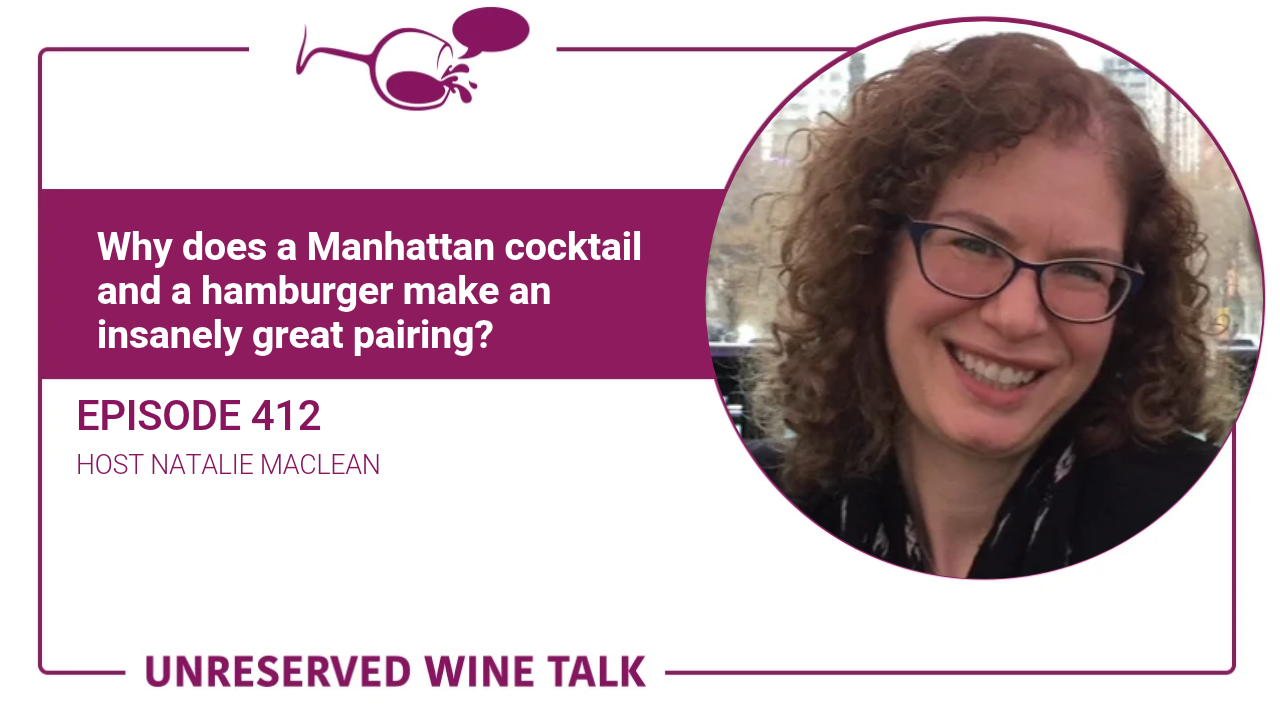
Why does a Manhattan cocktail and a hamburger make an insanely great pairing? Can strongly brewed black tea really scratch the itch for whiskey in a non-alcoholic Old Fashioned? How did the arrival of drinking straws make new types of cocktails possible?
In this episode of the Unreserved Wine Talk podcast, I’m chatting with Kara Newman, the author of eight cocktail books.
You can find the wines we discussed here.
Giveaway
Three of you are going to win a copy of one of Kara Newman’s terrific drink decks.
How to Win
To qualify, all you have to do is email me at [email protected] and let me know that you’ve posted a review of the podcast.
It takes less than 30 seconds: On your phone, scroll to the bottom here, where the reviews are, and click on “Tap to Rate.”
After that, scroll down a tiny bit more and click on “Write a Review.” That’s it!
I’ll choose three people randomly from those who contact me.
Good luck!
Join me on Instagram, Facebook and YouTube Live Video
Join the live-stream video of this conversation on Wednesday at 7 pm eastern on Instagram Live Video, Facebook Live Video or YouTube Live Video.
I’ll be jumping into the comments as we watch it together so that I can answer your questions in real-time.
I want to hear from you! What’s your opinion of what we’re discussing? What takeaways or tips do you love most from this chat? What questions do you have that we didn’t answer?
Want to know when we go live?
Add this to your calendar:

Highlights
- Why has Audrey Saunders’ Old Cuban endured as a modern classic while so many other cocktails have disappeared?
- What happens when you replace the gin in a Negroni with a funky Jamaican rum?
- What does setting a cocktail on fire actually add beyond the theatrics?
- Is a Manhattan and a burger the ultimate food and cocktail pairing?
- Have low and no-alcohol drinks have become too important for the drinks world to ignore?
- How can aquafaba recreate the frothy texture of egg whites in a cocktail?
- Why does the order of a dry shake and wet shake matter when making a frothy cocktail?
- How can acid phosphate create the tartness of citrus without adding lemon or lime?
- Why is balancing sweetness one of the hardest challenges when creating a great non-alcoholic cocktail?
- Can strongly brewed tea really scratch the itch for whiskey in a non-alcoholic Old Fashioned?
- How did early drinking straws make ice-filled cocktails like the Sherry Cobbler easier to enjoy?
- What does Kara think the zero-proof spirits industry still needs to get right?
Key Takeaways
- Why does a Manhattan cocktail and a hamburger make an insanely great pairing?
- This is one of my favorite pairings. I just think they go so perfectly. There’s just something about it. A Manhattan is made with whiskey and it really just perfectly cuts the richness of a burger. And at the same time, a burger is so substantial, it really just fortifies you for drinking a Manhattan. They really just meld perfectly I think. There’s something about the sweet vermouth, and the Manhattan kind of gives you more of like a red wine with a burger kind of feeling. There’s a splash of bitters, perhaps, and that kind of sets you up for the next bite. I could do that all the time. I wouldn’t say no to a martini and a burger either, but I do think a Manhattan and a burger go together.
- Can strongly brewed black tea really scratch the itch for whiskey in a non-alcoholic Old Fashioned?
- N: The Faux Fashioned is built on strongly brewed black tea rather than whiskey, finished with maple syrup and Ango bitters. How close does it come to drinking an Old Fashioned?
- K: If I’m being really honest, not that close. Honestly, I don’t think it’s ever going to. I mean, tea is a completely different animal but it has some similarities with whiskey. It has some tannins. There are certain types of teas that are fermented, like oolong the tea leaves are fermented and that’s kind of similar to how whiskey is made too. It has different strengths, different colors, different flavors. There are some similarities to whiskey. But is this drink going to completely approximate an Old Fashioned? No, no it’s not. I want to be honest about that. I don’t want to say that it’s going to be exactly the same, but I like to think that maybe it’ll sort of kind of scratch the itch in some way. You can sort of squint and maybe see an Old Fashioned, but I would never say that it’s exactly the same. I’d be lying if I said that.
- How did the arrival of drinking straws make new types of cocktails possible?
- N: So the Sherry Cobbler cocktail is notable for having been among the first drinks to feature both a straw and ice. When did drinking straws arrive and how did they change the way people consume cocktails other than the obvious, through us straw.
- K: So we’re talking about the 1830s here, but we’re not talking about plastic straws or paper straws like we know them today. We’re talking about using something like a long piece of pasta to sip through. Or straw of rye grass, which might be hollow in the middle. But what this did is it allowed people to drink these icy drinks without hurting their teeth. This is really where ice first really got into drinks, when you’re first serving drinks on the rocks. The Cobbler, it’s almost entirely ice. It’s like pebbled cobbles of ice with some spirit or some juice and you could not drink that straight up and not hurt your teeth without a straw.
About Kara Newman
Kara Newman reviews spirits for Wine Enthusiast magazine, where she’s also a writer-at-large covering cocktails, spirits and bar culture, from Cuban rum to the world’s tiniest two-seat bar. Her work also appears in publications including Afar, Bloomberg Pursuits, Food & Wine, PUNCH, and the Wall Street Journal and BBC Travel. She’s the author of seven cocktail books — soon to be eight!
Resources
- Connect with Kara Newman
- Unreserved Wine Talk
- My Books:
- Wine Witch on Fire: Rising from the Ashes of Divorce,Defamation, and Drinking Too Much
- Audiobook:
- Audible/Amazon in the following countries: Canada, US, UK, Australia (includes New Zealand), France (includes Belgium and Switzerland), Germany (includes Austria), Japan, and Brazil.
- Kobo (includes Chapters/Indigo), AudioBooks, Spotify, Google Play, Libro.fm, and other retailers here.
- Wine Witch on Fire Free Companion Guide for Book Clubs
- Audiobook:
- Unquenchable: A Tipsy Quest for the World’s Best Bargain Wines
- Red, White, and Drunk All Over: A Wine-Soaked Journey from Grape to Glass
- Wine Witch on Fire: Rising from the Ashes of Divorce,Defamation, and Drinking Too Much
- My new class, The 5 Wine & Food Pairing Mistakes That Can Ruin Your Dinner And How To Fix Them Forever
Tag Me on Social
Tag me on social media if you enjoyed the episode:
- @nataliemaclean and @natdecants on Facebook
- @nataliemaclean on Twitter
- @nataliemacleanwine on Instagram
- @nataliemaclean on LinkedIn
- Email Me at [email protected]
Thirsty for more?
- Sign up for my free online wine video class where I’ll walk you through The 5 Wine & Food Pairing Mistakes That Can Ruin Your Dinner (and how to fix them forever!)
- You’ll find my books here, including Unquenchable: A Tipsy Quest for the World’s Best Bargain Wines and Red, White and Drunk All Over: A Wine-Soaked Journey from Grape to Glass.
- The new audio edition of Red, White and Drunk All Over: A Wine-Soaked Journey from Grape to Glass is now available on Amazon.ca, Amazon.com and other country-specific Amazon sites; iTunes.ca, iTunes.com and other country-specific iTunes sites; Audible.ca and Audible.com.
Transcript
Natalie McLean 00:00:00 Why does a Manhattan cocktail and a hamburger make an insanely great pairing? Can strongly brewed black tea really scratch the itch for whiskey in a nonalcoholic, old fashioned cocktail? And how did the arrival of drinking straws make new types of cocktails possible? In today’s episode, you’ll hear the stories and tips that answer those questions in part two of our chat with Karen Newman, author of eight Cocktail Books. You don’t Need to have listened to part one first before listening to this one, but if you missed it, go back after you finish this episode. By the end of our conversation, you’ll also discover why Audrey Saunders old Cuban cocktail has endured as a modern classic, while so many other drinks have disappeared. What happens when you replace the gin in an array with a funky Jamaican rum? What’s setting a cocktail on fire adds beyond the theatrics? Why low and no alcohol? Drinks have become too important for the drinks industry to ignore how Aqua Faba can recreate the frothy texture of egg whites in a cocktail. Why? The order of a dry shake and wet shake matters when making a frothy cocktail.
Natalie McLean 00:01:10 How acid phosphate can create the tartness of citrus without adding lime or lemon. Why? Balancing sweetness is one of the hardest challenges when creating a great non-alcoholic cocktail, and what Cara thinks the zero proof spirits industry still needs to get right. Do you have a thirst to learn about wine? Do you love stories about wonderfully obsessive people, hauntingly beautiful places, and amusingly awkward social situations? Oh, that’s the blend here on the Unreserved Wine Talk podcast. I’m your host, Natalie McLean, and each week I share with you unfiltered conversations with celebrities in the wine world, as well as confessions from my own tipsy journey as I write my third book on this subject. I’m so glad you’re here. Now pass me that bottle, please, and let’s get started. Welcome to episode 412. So what’s new in the drinks world? Well, this week in fur, feathers and fermentation and fiber optics, Shadow Smith Lafitte in France has deployed a four legged robotic dog named Vidi Bot, equipped with electronic aroma sensors to walk through vineyard rows and sniff out fungal fine diseases long before human eyes can spot them.
Natalie McLean 00:02:42 Bow wow. Meanwhile, an Australian winery trialled automated drone delivery that lowers chilled bottles of wine directly onto picnic blankets via tiny parachutes, though one runaway drone accidentally dropped a bottle into the middle of a mob of curious wild kangaroos. Luckily, kangaroos come with a built in wine tote. King Charles the Third, the current monarch of England, converted his 1970 Aston Martin DBX six Volante sports car at Highgrove Estate in Gloucestershire to run entirely on bioethanol fuel distilled from surplus English white wine and whey byproduct from cheesemaking. Finally, a car that comes with its own wine and cheese pairing, Italy has a new record for the biggest wine theft in its history overnight. On Sunday, October 4th, thieves broke into the Marchesa Antinori cellar in Tuscany. The Antinori family has made wine since 1385. I was interviewed by CBC about the story this week. The thieves switched off alarms and disabled cameras inside and around the building. They drove in two large trucks and loaded the trucks using antennas. Own forklifts. About 30,000 bottles vanished. Worth approximately €5 million.
Natalie McLean 00:04:01 Every bottle came from the 2023 vintage of Celaya, Teague, Danilo and Guadalupe Tasso. Roughly 10,000 of them were Celaya. The Celaya loss in particular is staggering. Antinori makes only 60,000 bottles of it a year on average, so about a sixth of the vintage disappeared into the night. Most famous wine heists target a few rare bottles. This one was about volume, Antinori CEO said. It’s theft. Insurance doesn’t cover a loss this size. He suspects the same well-prepared gang has hit other Italian wineries in recent months. Masked intruders also used winery forklifts to take 3000 bottles of Barolo. Police suspect a specialized black market wine ring is stealing rare labels to order for wealthy international clients. Winemakers in Piedmont and Tuscany are now putting heavy duty steering locks on their warehouse machinery. Antinori is warning customers about offers outside its official channels. So if someone offers you a case of 2023, Celaya, from the back of a van, declined politely, as I told CBC. Fine wine packs a lot of value into a small space.
Natalie McLean 00:05:19 A single case can be worth thousands of dollars. It doesn’t spoil. Thieves can sit on it for years before selling it. And unlike a painting, a case of wine isn’t one of a kind. Once it’s split up and resold, it’s hard to trace. Canada has not seen anything close to this. Our biggest theft was at Blackwood Lane Winery in B.C.. Thieves broke the gate lock and took 5200 bottles, worth about $200,000. Ontario’s costliest wine crime wasn’t a theft. Vandals drained about 250,000l from Pelee Island Winery’s tanks in Kingsville. The wine was worth about $3.3 million. Our most famous food heist was maple syrup. Quebec thieves made off with millions of dollars worth of it. The Canadian liquor system makes big wine heists more difficult. In most provinces. The liquor board controls most retail sales, so a stolen truckload has very few places to go. Meanwhile, in Ontario, an October 13th analysis by Michael Armstrong at Brock University in Saint Catherine’s found the Lcbo dividend to the province fell 358 million to $1.8 billion.
Natalie McLean 00:06:34 A store sales dropped 17% and roughly 6700 convenience and grocery stores joined the retail mix selling alcohol. The Lcbo is also still warehousing $79 million worth of unsold American bottles. The Toasts, Not Tariffs Coalition says American wine exports to Canada have fallen 87% since provinces cleared their shelves in March 2025. That’s a sales drop from about US $456 million to US 60 million. Meanwhile, VQA sales at the Lcbo topped 264 million in the past 12 months, finishing March 31st, 2026. That’s up 43.7%. The spirit side of the business is bracing. Canada shipped $948 million in spirits to the US in 2025, and more than 90% of Canadian spirits producers depend on the US market now blocked by the ongoing tariff war. The spirits industry adds about $5.8 billion to Canada’s GDP and supports nearly 48,000 full time jobs south of the border. Some Americans want our bottles back. The Wine and Spirits Shippers Association said on October 9th that the Liberty Justice Center plans to challenge the US ban on Canadian alcohol in court later this month. The case would take aim at section 38 of the Tariff Act of 1930.
Natalie McLean 00:08:07 That’s the century old law behind the ban. And for your weird but wonderful scientific fact of the week. Researchers studying oak barrel aging found that oak wood undergoes a natural chemical transformation called wood thermal during charring, which releases vanillin and lactones while creating microscopic charcoal filters that actively absorb the harsh sulfur compounds from aging wine and spirits. And for your calendar. October 21st is Apple Day. The British charity Common Ground launched it in 1990 with a celebration at London’s Covent Garden. An apple a day keeps the doctor away. And an apple a day in a cider glass keeps nobody away. It’s also National Mezcal Day. Tequila must come from the blue agave plant. Mezcal can come from about 40 kinds of agave, many of them wild. The hearts are traditionally roasted underground in stone lined pits, which gives mezcal its smoky character. All mezcal is 100% agave. Coming from nine Mexican states in 2022, Mexico exported 6.4 million liters of mezcal, and the US took 5.5 million of them. October 22nd is National Nut Day. The walnut is often called the oldest known tree food, eaten as far back as 7000 BCE.
Natalie McLean 00:09:34 Old time healers believed its wrinkled kernel could treat ailments of the mind because it looks like a tiny brain Botanically, many famous nuts aren’t. Nuts. An almond is the seed of a fruit related to the peach. A peanut is a legume closer to a pea. A cashew hangs off the bottom of a fruit called a cashew apple. Cola drinks take their name from the kola nut, their original source of flavor and caffeine. So next time someone calls you a nut, ask for the botanical evidence. October 23rd is Champagne Day, held every year on the fourth Friday of October. Only sparkling wine from the champagne region of France gets to use that name. One widely quoted estimate puts about 49 million bubbles in a standard 750ml bottle. The pressure behind them is roughly three times the typical car tire. That’s why the little wire cage over the cork exists. It’s called a mullet from the French word for muzzle. Adolph Jackson invented it in 1844. Before that quarks had a habit of escaping. October 23rd is National Boston Cream Pie Day.
Natalie McLean 00:10:45 It was created at Boston’s Parker House hotel in 1856. Massachusetts made it the official state dessert in 1996. It’s a cake. It’s not a pie. Nobody in Boston has ever corrected the name. October 23rd brings Mole Day as well. For chemists, it runs from 602 in the morning to 602 at night in honor of Avogadro’s number, 6.02 times ten to the 23rd, which represents the number of constituent particles such as atoms, molecules and ions in one mole of substance. It connects the microscopic world of individual atoms and molecules to the macroscopic world of grams and leaders that we can measure in a lab. It’s named after the Italian scientist Amedeo Avogadro. And yes, I just lost me as well with all of that explanation anyhow. It has nothing to do with the Mexican sauce. Celebrate both anyway. October 24th is World Tripe Day, celebrating the edible lining and muscular wall of the stomach from ruminant animals, most commonly cattle and sheep, though it could also be pigs, goats, deer and buffalo tripe. The dish tripe turns up in kitchens everywhere, from alla Romana in Italy to Menudo in Mexico to and Villette in France.
Natalie McLean 00:12:09 Florence has the most famous version. La prodotto tripe from the cow’s fourth stomach is simmered and stuffed into a bun. It sold from street carts across the city for stomachs, and the cow still never gets a lunch break. October 24th is also National Bologna Day or Bologna, however you want to say it. The sausage takes its name from Bologna, Italy, home of the mortadella. October 25th is world past a day. Italy is credited with more than 600 pasta shapes. That’s roughly one for every excuse to skip the salad. October 26th is National Pumpkin Day. A pumpkin is botanically a fruit, a type of berry. So pumpkin pie is fruit pie. You’re welcome. Pumpkins have Canadian roots in the history books. Explorer Jacques Cartier reported finding grew melon big melons along the Saint Lawrence River in the 1500s. English speakers called them Pompei onions, and over time, pompano became pumpkin. The jack o lantern started with an older Irish custom of carving turnips. Immigrants to North America found pumpkins much easier to carve, and it may be the only pumpkin tradition that doesn’t require cinnamon.
Natalie McLean 00:13:25 Merciful Thanksgiving may be over, but I’m going to share some turkey tips that will be useful for you for the next Big Bird dinner coming up in December on CTV’s Cp24. We chatted about Friendsgiving and come over October along with Thanksgiving. Come over October is a global movement that’s changing how we gather. It invites us to break free from scrolling on our phones and rediscover the magic of real connection by having the people who matter most come over, pull up a chair, invite someone over, open a bottle, preferably in that order. So we pulled up a few chairs and each was waiting for a different guest who deserves their own drink. First up, Toi Toi Reserve Sauvignon Blanc from Marlborough, New Zealand and Toi Toi is Maori, so that’s how it’s pronounced. But on the bottle it looks like trois trois toi t o toi. This is for the friend you’ve been meaning to catch up with. It’s been too many months, so pour them something worth the wait. Toi toi is a family owned New Zealand winery, named after the native flowering grass that grows to over three feet tall and thrives in all kinds of landscapes.
Natalie McLean 00:14:34 It inspired the family to make wines that taste of where they grow. This reserve comes in several blocks of their Cal Rossi vineyard in Marlborough’s Alatorre Valley. They bought the vineyard in 2022, and these are the parcels they chose as their top expression for the 2025 vintage. The grapes were picked in the cool of the evening to keep them fresh. Most of the wine was made in stainless steel, but a small amount 8% was fermented in barrel for texture and complexity. Reserve, though, doesn’t mean heavy or oaky. This wine is still lively, unmistakable. Marlborough Sauvignon Blanc. It’s only 24.95 at the Lcbo and other liquor stores, and I rated it 96 points. Woo! You’ll get lime, fresh green herbs and a hint of jalapeno. Then comes the nectarine with a subtle coastal note. It’s bright and refreshing, with enough texture to hold its own beside the meal. Serve it a chilled around 8 to 10 degrees. It’s a lovely white for the Friendsgiving come over October table. How about a warm goat cheese salad with roasted beets when you finally get to catch up with your friend? Next up, the Monon Autumn Collection and Monon Coffee Collection from France.
Natalie McLean 00:15:46 This might surprise you. Let’s invite over your barista or your bartender, the one person who knows your tastes better than most of your friends do. Baristas and bartenders have trusted Monon for generations. George Monon started the company in France in 1912. He loved hosting family dinners, and he wanted the drinks to taste as good as the food. Three generations later, Monon is still a family company and now you can make cafe quality drinks at home. The Monon Autumn collection has five mini bottles to flavor up to 15 drinks, including pumpkin pie, cinnamon bun, caramel apple butter cranberry and brown butter toffee. The morning coffee collection features cafe classics including caramel. Amaretto, hazelnut, Irish cream and vanilla to elevate any coffee experience. Together, these two collections provide a versatile assortment for flavor discovery in hot and iced beverages, mocktails, coffees, and desserts. They also make a lovely host gift. They are adorable. I mean, you should look at the show notes and see them. They’re beautiful little gift packs and they’re easy to take with you when you travel during the holidays.
Natalie McLean 00:16:55 They have no gluten, dairy, or alcohol. They’re non-GMO, kosher, and only $18 each. At Monon, the Monon Hazelnut Iced Coffee cocktail that I created on the set is made from espresso and Monon hazelnut syrup over ice with cold milk. It’s nutty with a rich, caramelized finish. Add pumpkin pie syrup to half and half and club soda, and you’ve got a pumpkin pie. Cream soda. For a toast, stir in a little caramel apple butter into a glass of sparkling wine, or use sparkling apple cider for anyone who isn’t drinking. Either way. Pour it with apple crisp at the kitchen island. And for our third guest were pouring them the Good Earth Big Fork Red from Four Mile Creek in Ontario. It’s a VQA wine and this is for your next door neighbor. Come over. October is all about supporting local. My grandfather always had an extra chair beside him on the porch. Neighbors would drop by and sit on it. Unexpected, uninvited, yet always welcome. Mostly. Always. The Good Earth was one of Niagara first farm to table wineries.
Natalie McLean 00:18:02 It started as a small working farm where food always came first. The Big Fork name says it all. This read was made for a full table. It’s a blend of Cobb, Frank, and Merlot. The Merlot comes from 30 year old vines and the grapes were picked and sorted by hand. Each grape was fermented on its own in small open tanks. The wine then spent more than 16 months in French oak, and only 410 cases were made. The winery’s restaurant is on Open Table’s list of Canada’s top 100 restaurants. The Good Earth is part of the Carmen’s Group family, which also runs boutique hotels, so it makes it an easy weekend getaway. It’s only $24 at the winery and online and can be shipped right to your doorstep. It arrives at the Lcbo for the first time early next year, and their Gamay, which is also lovely, is coming into vintages. Lcbo on October 24th. Choosing a Canadian bottle supports the wineries, hotels, restaurants and communities behind it. Canadians choose domestic wine only 30% of the time.
Natalie McLean 00:19:05 The French drink their own wine 83% of the time we have room to grow. The Good Earth shows what’s at stake with a farm, restaurant and hotels all behind one bottle. On the nose you’ll get these luscious aromas ripe blackberry, raspberry and plum, toasty oak, caramel, and baking spice sit underneath. It’s smooth with enough weight and grip for the holiday meal. I’d love it beside a bubbling pan of lasagna on a long table set for 12. It’s come over October, so pull up one more chair and let’s raise a glass. Here’s to open doors, open bottles and open hearts. On Instagram, I’m at Natalie McLean wine. Come for the comfy chairs. Stay for the kitchen. Cheers. I was also on CTV’s The Social, chatting about Thanksgiving wines and Cynthia had an interesting challenge. She loves all the flavors on the table, but she struggles to pair one wine with everything. So she asked me what I’d suggest, and my snippy little answer was we piled turkey, cranberry stuffing, mashed potatoes, and gravy onto one plate, and then we look at wine as though it’s the one being difficult.
Natalie McLean 00:20:15 We don’t need one wine that does everything. We just need a few good bottles that get along with the whole table, like the aunt who cracks everyone up with a good joke. The first wine I recommended was the Elevation Saint Urban Vineyard. Riesling, Ontario is actually a Riesling powerhouse because Riesling, the grape, loves a cool climate and Niagara is happy to oblige. Many of us think of Riesling as sweet. This elevation Riesling does have a touch of natural fruit sweetness, but far less than you think it does. It also has this balancing bright acidity. Think of lemonade. The lemons cut the sugar. The taste of this elevation Riesling takes me right back to my grandmother’s kitchen before Thanksgiving and Christmas dinners. I remember the cranberry sauce slowly simmering on her stove, and that zing is exactly what I love in this wine. There’s a great story behind this bottle. Back in 1979, a German wine grower took vine cuttings from his family’s estate on the Moselle in his suitcase across the Atlantic and planted them in Niagara.
Natalie McLean 00:21:21 They’ve been in the ground now almost 50 years. Next up, the love block Sauvignon Blanc from New Zealand. It’s also from the Marlborough region. Love block is certified organic with very low sulfur. Their tea bottling even swapped sulfur for green tea, a natural preservative and antioxidant. Love block is owned and run by the married couple Erica and Kim Crawford. They built the famous Kim Crawford brand and sold it. Then they started over from scratch, farming organically in Marlborough. This is their labor of love, thus love block. This one’s close to my heart. My mom raised me on her own and she was a school teacher. So every Christmas and Thanksgiving we’d go home to her parents in Cape Breton. We created our own tradition lobster sandwiches with lots of mayo at lunch. A crisp Sauvignon blanc would be perfect with them. It’s bright and zesty, with white peach and a fresh herbal snap. All right. Next we have the Mouton Cadet Rouge from France. It’s from Bordeaux. Turkey can be gobbling good with a juicy red like Mouton Cadet.
Natalie McLean 00:22:30 It’s a blend of Merlot, Cabernet Sauvignon and Cabernet Franc. It’s supple and ripe, with soft tannins and dark fruit. No need to decant. Just pour and pass. Serve it with the stuffing, the dark meat and the gravy. On the bottle you’ll see the fare for life label. It’s a fair trade certification. And most of us know fair trade from coffee and cocoa. Mouton cadet brought it to Bordeaux. They wanted sustainability to include people, not just the planet. And their long term goal is to create a more humane Bordeaux. Canada is the first country outside of France where they’ve launched the certified Wine. Behind the label is a community of more than 100 growers. They get long term contracts that they can depend on and fair prices. 1% of the wine sales goes into a fund that they decide how to use. If you go back a few episodes, I actually dove into this topic with two people from the winery, and it’s worth the listen. It’s a great story. Next up, the Tomasi Passo Valpolicella from Italy.
Natalie McLean 00:23:36 A great read doesn’t have to break the bank. The Tomas Raposo Valpolicella gives you a seriously rich read without the seriously rich price tag. It’s under $30. The Tomasi family have made wine near Verona since 1902. That’s four generations. So I guess the trial phase is over. They’re Amarante royalty, one of Italy’s great red wine families. And Moroni is their big famous rich. Red Paso is sometimes referred to as Baby Moroni. Once the Moroni is made, they repass. That’s where Paso. This wine over the amaranth skins. Nothing is wasted. It picks up the richness and the spice. The Tomasi family was among the first to put the word repast on the label in the mid 1990s. This full bodied, rich red has cherry black pepper aromas and silky tannins. And finally, we have the Township seven Interlude Cabernet Sauvignon from BC. It has a terrific story. In January 2024, a brutal cold snap hit the Okanagan and the temperature dropped to -27 degrees. It wiped out most of the crops within eating grapes.
Natalie McLean 00:24:49 Many wineries would have had to close their doors and people would have lost their jobs, so they looked across the border. Township seven brought in fruit from Washington state. Their winemaker, Mary McDermott, worked hand in hand with a Washington winery, and she visited those wineries frequently the way she tend her own. Then she brought the grapes home to Narmada and made the wine there. That’s why it’s called the interlude series. It was the bridge until B.C. vines came back from the frieze. The wine industry shows what good neighbours can do, even when there’s a border, and a lot of nonsense between them. This is a structured read with BlackBerry and a little spice. It’s ready for whatever’s at the center of your table, including indecision. Let’s be honest, we’re not all carving turkey. Some tables have a goose. Some have a roast. Others have duck, which is usually accompanied by a 15 minute explanation of why turkey is overrated for Thanksgiving and Christmas. Back to today’s episode. One of you will win a copy of Kara’s The Cocktail Cabinet.
Natalie McLean 00:25:52 If you’d like to win. Please email me and let me know. It doesn’t matter where you live, I’ll choose one winner randomly from those who contact me at Natalie at Natalie mclean.com. Keep it for yourself or give it as a gift. Congratulations to David Band from Fife, Scotland, who has won a copy of Sherry? Malign, misunderstood and magnificent by Ben Hawkins. If you’re reading the paperback or e-book or listening to the audiobook of my memoir, why switch on Fire Rising from the Ashes of Divorce, defamation, and Drinking Too Much, a national bestseller and one of Amazon’s best books of the year? I’d love to hear from you at Natalie at Natalie mclean.com. There’s a terrific free guide for book clubs. I’ll put a link in the show notes to all retailers worldwide at Natalie McLean. Com forward slash for 12. Okay, on with the show.
Kara Newman 00:26:47 So let’s talk about the old Cuban that was created by Audrey Saunders in 2001 at Bemelmans Bar, and went on to become the bestseller for Pegu Clubs or Pegu Clubs.
Kara Newman 00:27:00 Entire Pegu Club the entire 15 years. Why did that drink have such staying power when so many modern classics are forgotten in a few years. What was it about that cocktail?
Multiple Speakers 00:27:11 Well, I think there are two different aspects to that. Number one, it’s a really good drink. It’s a kind of drink that it’s not too hard to make. It’s accessible to understand. It’s rum, it’s champagne, it’s lime juice, it’s delicious. It’s crush able. It sounds rum, champagne mint. It’s a great drink. But I think, on the other hand, it’s also because Audrey Saunders and Peggy Club was such a force. Audrey is still a force. Even if she’s no longer running Pegu Clubs. It’s now close, but she really was one of the main drivers of the the cocktail renaissance of the the 2000. She really was at the centre of it, and people really respected her and came to her. And I’m not surprised and I’m not sorry that drink really became one of our modern classics,
Kara Newman 00:27:59 Good.
Kara Newman 00:28:00 Yeah, it sounds great. Now, the Kingston Negroni was created by a bartender named Joe Schmo. Okay, and the deck recommends a funky Jamaican rum to hold its own against the Campari. So how do you you think that you needed that funky quality then to balance out the strength of the Campari? Is that what you’re getting at there?
Multiple Speakers 00:28:24 Yeah. Oh, it’s such a good drink too, Okay. If you like a regular Negroni and I do, it becomes a whole different drink with the rum. It still has that. That bittersweet quality and that really attractive ruby red color that you find in the regular Negroni. It’s just so eye catching. But in the case of Negroni, it just it’s elevated to a whole other level. It’s got this. I don’t want to overuse the word funky. It’s it has more complexity. It the rum just pops in the drink in a way that it doesn’t. In a boulevard or a Negroni. The spirit just fades to the background. You’re drinking a case of Negroni.
Multiple Speakers 00:29:03 You know the rum is in there and you know that it’s a Jamaican rum.
Kara Newman 00:29:07 Oh that’s great. Maybe it’s more. I don’t know. Reaching, stretching here for metaphors. But like in an orchestra, your bassline is helping your flutes. And it’s all more complex when you’ve got it all working together. The harmonies between the flavours.
Multiple Speakers 00:29:22 That’s an excellent metaphor. Yeah, it’s the bass drum you’re going to. You can’t miss it.
Kara Newman 00:29:27 Steady and smooth and deep and rich. But then you’ve got the the other one. The whatever. Piccolo coming in there. Now I always get this. Is it Angostura? Angostura. Okay. The Angostura.
Multiple Speakers 00:29:42 You can just call it and go if you want.
Kara Newman 00:29:44 Oh, good. Is that what the cool kids who don’t want to pronounce it? So the ego colada calls for 1.5oz of Angus bitters. More than a full shot, which is a lot when we’re talking bitters. Zach Overman created it for the now closed Fort Defiance bar in Brooklyn. As you share with us in your deck for the weekly Tiki Nights.
Kara Newman 00:30:07 So, beyond curiosity, why would someone keep drinking this cocktail? Is it just because they love the whole full on bitter taste?
Multiple Speakers 00:30:16 You don’t like bitter flavors, right? Am I getting that? Am I reading that right?
Kara Newman 00:30:20 So I’m what you call. Yes. You’re right. A super taster. So I have a distinct aversion to bitter. It’s not super tasty. I know it’s a misnomer. It doesn’t mean bitter taste, but it means you have a super sensitivity to bitter. So. Yes. Sorry. My biases are coming through strongly. Apparently so. I guess if you liked bitter, this would be great.
Multiple Speakers 00:30:44 If you like bitter, it’s a really great drink.
Kara Newman 00:30:46 Okay.
Multiple Speakers 00:30:47 It is a lot. I will be honest. It’s not something I would reach for every day, but has bitterness, it has spice, it has complexity. And when you mix it with other ingredients, it does kind of take it down a notch. And it’s not the only drink out there that has this level of bitters, too.
Multiple Speakers 00:31:03 There’s also a drink called the Trinidad Sour that also has an ounce and a half. And it you add a little sweetness, you add a little sour, a little something else for texture, maybe egg whites. And it’s really quite palatable, but it is not for everyone. I think you’ve made that abundantly clear.
Kara Newman 00:31:19 And I haven’t even tasted it. Great.
Multiple Speakers 00:31:22 I would love to be in the room when you do.
Kara Newman 00:31:24 Oh yeah, like one of those babies tasting a lemon for the first time. Yeah, that would be fun. So the Kill Devil cocktail ends up with a step that involves setting the drink on fire and a note from use to, say, make sure the flame is out before taking a sip. That’s wise. What does lighting a floating coin of lime soaked in over proof rum due to the drink?
Multiple Speakers 00:31:50 First of all, it makes it look fantastic.
Kara Newman 00:31:52 Yeah.
Multiple Speakers 00:31:52 I’ll bet.
Kara Newman 00:31:53 Very theatrical. Yeah.
Multiple Speakers 00:31:55 Very theatrical. Honestly, it’s a drink you might be more likely to order at a bar than to make it home, but it’s still something fun to to try.
Multiple Speakers 00:32:03 Maybe once, maybe twice. But what it does is it creates a caramelized flavor. And yeah, it’s going to caramelize the oils in the lime. And it’ll also add a little bit of a pop to the the rest of the drink as well. That’s just fun.
Kara Newman 00:32:21 Yeah. Oh, it sounds like fun.
Multiple Speakers 00:32:23 It’s not going to set the world on fire.
Kara Newman 00:32:25 But it just might if you put your hair too close to her. You’re wearing polyester. I don’t know.
Multiple Speakers 00:32:31 A poor choice of words.
Kara Newman 00:32:34 And I’m intrigued by this because you wrote a whole article about it. But why do you believe the Manhattan cocktail and the burger are the ultimate pairing?
Multiple Speakers 00:32:42 Oh, okay. Different topics. Yes, I do believe this. I firmly believe this. Yeah, this is one of my favorite pairings. I just think they go so perfectly. There’s just something about it. It’s the A Manhattan is made by whiskey, and it really just perfectly cuts the richness of a burger. And at the same time, a burger is so substantial it really just fortifies you for a drink in Manhattan.
Multiple Speakers 00:33:06 And they just they really just meld perfectly. I think there’s something about the sweet vermouth in the Manhattan kind of gives you more of, like a red wine with a burger kind of feeling that there’s a splash of bitters, perhaps, and that kind of sets you up for the next bite. It’s just I could do that all the time. I wouldn’t say no to a martini and a burger either, but I do think a Manhattan and a burger go together.
Kara Newman 00:33:31 Okay. All right. Let us get to your low and no deck. The hot topic these days. So what made you the right person to write this low and low deck, given your reputation and your career has been built on very full strength kinds of spirits?
Multiple Speakers 00:33:46 It has. But honestly, this moment know and love is very important to all of us. It’s an important function of bar menus. Right now I’m seeing more low and no spirits bottlings. I’ll be reviewing zero proof spirits for wine enthusiasts starting in the fall.
Kara Newman 00:34:06 Okay.
Multiple Speakers 00:34:07 You’ve heard your first.
Multiple Speakers 00:34:08 Yes, and I think just everyone should be paying more attention to them right now. It’s an increasing segment of the drinks market. Right now. People are drinking less, drinking better. People want to have options that are beyond just full strength and over proof. And yeah, I think to not pay attention to it would be absolutely foolish.
Kara Newman 00:34:31 Yeah, absolutely. It’s growing so quickly and the technology has improved. Just the choices, the quality. It’s all coming together, I think, in a great way. So the Dex introductory card lists building blocks from juices and teas to Aqua Faba, the liquid from a can of chickpeas, which is intriguing. Maybe give us an example of a cocktail that uses Aqua Faba and what it’s substituting, and what it gives to the taste of the cocktail.
Multiple Speakers 00:35:01 Okay, so Aqua faba is the liquid from a can of chickpeas, as you’ve already said. And it’s it has a quality a frothy quality. When it’s shaken with ice. It seems so weird. But it is.
Multiple Speakers 00:35:16 It’s when it’s emulsified into something that kind of looks like egg whites and drinks. Kind of like egg whites. That’s you could use it in, say, a whiskey sour, for example, instead of egg whites. But that said, I didn’t want to put a lot of brand names into the deck. But there’s another product that I like better. There are a lot of vegan foams these days that can be used instead, and then it doesn’t have the slippery quality of chickpeas. Or maybe you’re someone who can’t consume them for whatever reason. Or there’s one called fiefdom, created by five brothers, and that’s also a vegan, egg free cocktail farmer. So if someone were looking for some could just do a search for cocktail farmers. And there are other brands too. I’d probably recommend that instead of Aqua Hubba, but Aqua Faba is something that’s readily available. But you can. You probably have a can of chickpeas in your pantry. It’s it’s something everyone can have access to.
Kara Newman 00:36:15 Yeah. No, it’s a great idea.
Kara Newman 00:36:17 And so in the pinch hitter cocktail you’re using the Aqua Faba or the this juice from the the chickpeas instead of egg whites. But what would you say to home drinkers who balk at that substitution. How would you talk them into trying it?
Multiple Speakers 00:36:33 Well, I’d say if you have it, it’s accessible. It’s easy. You don’t have to. You could use an egg white and they’ll be fine. Or a cocktail farmer and that’ll be fine. Or you can take that card out of your deck and throw it out the window, and that’s fine too. It’s your dream. You get to enjoy it however you want.
Kara Newman 00:36:49 Yeah. You’re not going to fight over the cocktails. Okay. This one’s intriguing. I like these interesting different substitutions here. Now the pineapple. Ramos or Ramos cocktail.
Multiple Speakers 00:37:01 Ramos. Gin.
Kara Newman 00:37:03 Okay.
Multiple Speakers 00:37:03 Right. No gin. The Ramos. No gin fizz.
Kara Newman 00:37:06 Okay. The. No gin in the low and no deck. Calls for a dry shake. So shaking without ice first to emulsify the egg white and says it should be shaken twice.
Kara Newman 00:37:15 Why does the shaking sequence matter so much in an egg white drink?
Multiple Speakers 00:37:20 Okay, so what you’re doing is you’re emulsifying the egg whites first. So the dry shake. No ice. You do that first to to froth up the the egg whites. And then you add the ice. That’s the wet shake. Ice is made up part. So wet shake then chills it. You could do it the other way around, but you’re going to wind up with a deflated froth. It’ll still taste okay. You’re not going to ruin the drink, but it won’t have that that frothy fluffy to it, right? Yeah. Okay. That texture.
Kara Newman 00:37:50 Okay. That makes sense. And what is another ingredient? You name is acid phosphate. So when and where would you use that. Maybe in a drink. Example.
Multiple Speakers 00:38:00 Okay I’ll give another recommendation for that too. I would recommend that readers pick up a book called Fix the Pumps by Darcy O’Neill, and that’s about the history of the soda fountain, and which was a place that acid phosphate was used.
Multiple Speakers 00:38:15 And Darcy also has has a website called Art of drink. I think it is where he sells acid phosphate, and that’s where I got a lot of my information about it. So basically it’s diluted phosphoric acid. This is coming from Darcy O’Neill’s side. It’s a partially neutralized solution made with salts of calcium, magnesium and potassium and has a solution. The solution has a pH of 2.0, which is about the same as a freshly squeezed lime. So point is that it adds tartness without having to actually add citrus. So okay, you can use it to enhance the tartness of citrus. You can use it in a drink to create tartness without it. Say if you had an allergy or you just didn’t want that particular lemon or lime flavor, or, I don’t know, maybe you’re in a timeline, as we all are, where things are getting very expensive and maybe the price of limes have gone through the roof. You can use acid phosphate instead of lime and a makeshift daiquiri, for example, but it’s a very useful tool to have do.
Multiple Speakers 00:39:22 Is it required? No, but it’s useful.
Kara Newman 00:39:26 Okay. Interesting. And so the Japanese thirst killer cocktail traces back to the 1950s. The Dispensers formulary, or soda water guide, is built around acid phosphate, which, as you’re saying, soda fountains used to use for tartness. And so did you say there was another alternative to acid phosphate? Or is that that’s the alternative to citrus?
Multiple Speakers 00:39:49 There are lots of them. There’s a new product called Super Asawa saw A that is a non citrus sour product. That’s liquid. It’s shelf stable. I think a lot of bartenders are using it these days. That’s just one of many souring agents. Like I don’t know if there’s a right word for it. If you’ve got bittering agents sweetening agents, why not? Souring agents should maybe just join the term.
Kara Newman 00:40:13 That makes sense. Yes. Yeah. It’s yours. You’ve just coined it. You heard it. Here. This will be the copyright instance. So your deck includes both zero proof drinks like the no ito and low alcohol by volume drinks like the Aperol Spritz and the Americano in the same box.
Kara Newman 00:40:31 Where do you draw the line between low and no. Or does that distinction matter? I guess it does matter to the person holding the glass if they truly want no alcohol. But where’s. Where do you draw the line between low and.
Multiple Speakers 00:40:43 No no, no is no no.
Kara Newman 00:40:45 Zero zero.
Multiple Speakers 00:40:46 Yeah, I think maybe if anything you could do like a dash of bitters and still call it. No, but there are people who absolutely do not want it or had allergies. And there are non-religious bitters available now. Right, exactly. It’s an option that you should have if you’re just trying to find something that’s a bit lighter, more refreshing. I think of that as as low. A full proof spirit is, let’s say, if that’s 40% ABV, and let’s say you’ve diluted that into a into a tall drink, maybe that becomes 20% ABV. I think for me, I wasn’t working with any kind of specific measurement, but I think somewhere around 15 to 20% ABV.
Kara Newman 00:41:40 Okay. Oracle.
Multiple Speakers 00:41:41 Yeah.
Multiple Speakers 00:41:42 Is probably where. Maybe a low.
Kara Newman 00:41:43 Drink. Okay. And the no hito card, attributed to drinks instructor Tammy Coxon, quotes her advice that it’s less about what’s in it and more about the technique, and she says you must follow the directions precisely in order to make it great. What’s the single most common technique mistake people make when building a no alcohol drink at home, whether it’s this one or another one?
Multiple Speakers 00:42:05 Can I just say that drink is so smart? I couldn’t I couldn’t believe what Tammy did that she was actually able to figure out through through constant repetition, that if you do it this way first, you’ll get the oils from the limes and it won’t be completely washed out by adding the soda too early. It’s such a brilliant, precise recipe. Yeah. It’s amazing. If I were to say try one drink from the deck, I’d say try that one.
Kara Newman 00:42:28 Okay.
Multiple Speakers 00:42:29 But I think that the one technique that’s hardest to to master in in non outranks is it’s hard to find a drink.
Multiple Speakers 00:42:37 That’s not completely sure. Because the one thing that not the one thing, one of the things that alcohol provides to a drink is it provides a counterbalance to sugar and sour flavors. It really provides a lot of ballast and it cuts through a lot of the sweetness. Or you might even say the sweetness tempers to the alcohol, sure, but a lot of non health drinks. It’s like Shirley Temple right down the line.
Kara Newman 00:43:05 Very sweet. Too sweet.
Multiple Speakers 00:43:06 So that’s the hardest thing to master
Kara Newman 00:43:08 Okay. And what how do you advise mastering it. Are you just looking for those botanical botanicals or bitters or something? Making sure you’re always trying to get the I don’t know, the balance, right? Somehow with other ingredients?
Multiple Speakers 00:43:24 Yeah. It’s hard. In some cases it was more, more tannic flavors like tea or lightning with bubbles. And one of the things I didn’t get to do with the deck of cards was I deliberately stayed away from brand names for this. I really wanted it to be as accessible to as many people as possible, and not everybody has access to certain grants.
Multiple Speakers 00:43:47 But again, there are so many new products coming to market all the time, and there are a lot of non distillates that are really useful for providing the kind of counterpoint. Or there’s an amaro that I like called Pathfinder that is non alc and mixes really well, and I would have loved to include it in a couple of the the recipes here. But if someone were trying to find something at home to mess with, I might steer them in that direction.
Kara Newman 00:44:15 Okay, okay. I love the name of this, the Cosmo. Not I love that thought. There is ellipsis. There uses the orange, uses orange marmalade as a substitute for Cointreau. And that’s a conceptual leap I love it. How did how do you train yourself to think about flavor functions? The flavor function of an ingredient rather than the ingredient itself to make that leap. And maybe it’s not. I don’t know. I think it is a leap, even though I might know. You’re right. Cointreau is orange marmalade anyway.
Multiple Speakers 00:44:46 No, you’re totally right.
Multiple Speakers 00:44:47 They’re not the same thing at all. Cointreau is a usually a cognac based orange liqueur or other similar orange liqueurs ta, ta, ta, etc., etc.. And marmalade? No, not the same thing at all. But it’s I think it’s as close as you’re going to get in terms for a drink like this. You try to create some sort of heft and I keep going back to the word complexity, but I think marmalade has a bitter sweetness.
Kara Newman 00:45:16 It does. Yeah. Has that edge to it.
Multiple Speakers 00:45:18 And there’s a pectin in it also that worked really well in doing a non health drink. It gave it a little bit of body so it wasn’t completely thin.
Kara Newman 00:45:27 No I think that’s brilliant. Now You’ve Got the Foe Fashioned is built on strongly brewed black tea rather than whiskey, finished with maple syrup and Angus bitters. How close does it come to drinking an old fashioned?
Multiple Speakers 00:45:41 Okay, so, Natalie, if I’m being really honest, not that close. Okay, honestly, I don’t think it’s ever going to.
Multiple Speakers 00:45:49 Tea is a completely different animal, but it has some some similarities with whiskey. It has some some tannins. There are certain types of teas that are fermented like oolong. The tea leaves are fermented and that’s similar to how whiskey is made to. It has different strengths, different colors, different flavors. There are some similarities to whiskey, but is this drink going to completely approximate an old fashioned? No, no it’s not. I want to be honest about that. I don’t want to say that it’s going to be exactly the same, but I like to think that maybe it’ll sort of kind of scratch the itch in some way. You can squint and maybe see an old fashioned, but I would never say that it’s exactly the same. No, I’d be lying if I said that.
Kara Newman 00:46:35 Yeah. Oh, no. It’s a good attempt, though. Now, the bamboo cocktail was created by German bartender Louis Louis Pinger at the Grand Hotel in Yokohama, Japan, in the late 19th century. What does a German bartender do in Yokohama in 1895? Or why was he there? And why was he inventing cocktails for Americans there?
Multiple Speakers 00:46:57 Okay, I had to do a little research to answer this one.
Multiple Speakers 00:47:00 Okay. At the Grand Hotel in Yokohama was owned by a group of Americans. So? And so they were in the military. They were stationed Japan at the time, and they brought Ebinger over to recreate some of their favorite cocktails. Obviously they were. I guess they were homesick and they wanted a taste of home. So they brought over a bartender. And Ebinger had worked in San Francisco around the same time that Jerry Thomas had worked there, and Jerry Thomas was an American bartender who operated saloons in New York. And he was really known as the the father of mixology. And I can I can recommend another book that’s Dave one drinks book. Imbibe is all about the history of Thomas and his contributions to American drinks, so I’d recommend definitely getting that one too.
Kara Newman 00:47:52 Oh wow, we’re getting a reading list in addition to your decks. Make sure you keep promoting your decks to.
Multiple Speakers 00:48:00 The cocktail decks, too. Yes, yes, but there’s just so much about history and people.
Kara Newman 00:48:05 So many.
Multiple Speakers 00:48:06 Drinks, their stories.
Kara Newman 00:48:07 They are. Which is fantastic. I love this now the Calamar. Oh my goodness. Oh there you go. Kalamazoo originated in in 1920s Spain. But you write that its popularity traces to a Basque festival in the 1970s, where organizers had leaders of wine that tasted so bad it couldn’t be served by its own or on its own. What is the etiquette around mixing wine with cola today in Spain? Would Spanish winemakers be aghast at that kind of practice, or.
Multiple Speakers 00:48:40 I don’t know. I don’t really have a good answer for this one. I know that this is it’s an iconic drink. It’s a well-known drink. It’s considered a really welcome refresher. I haven’t surveyed Spanish winemakers. I imagine it depends on the wine, I suppose, for table wine. Sure. I think for something really important, I imagine it would not be their first choice.
Kara Newman 00:49:07 Sure.
Multiple Speakers 00:49:08 You probably know more winemakers than I do. How do you imagine they would react?
Kara Newman 00:49:12 They’re very sensitive people, so they react like I do to bitter, probably, I don’t know, but it sounds like a fun way to cover up terrible wine if you still wanted to have fun.
Multiple Speakers 00:49:23 So don’t drink. It really is refreshing.
Kara Newman 00:49:25 Okay, there you go. So the sherry cobbler cocktail is notable for having been one of, or among the first drinks to feature both a straw and ice. When did drinking straws arrive, and how did they change the way people consume cocktails other than the obvious through us straw.
Multiple Speakers 00:49:44 So we’re talking about the 1830s here, but we’re not talking about like plastic straws or paper straws like we know them today. Oh, okay. We’re talking about using something like a long piece of pasta to sift through or. Yeah, or straw of rye grass that might be hollow in the middle. And but really what this did is it allowed people to drink these icy drinks without hurting their teeth. This is really where ice first really got into drinks. When you’re first serving drinks on the rocks and the cobbler, it’s almost entirely ice. It’s like pebbled cobbles of ice with some spirit or some some juice, and you could not drink that straight up and not hurt your teeth.
Multiple Speakers 00:50:28 You need a straw.
Kara Newman 00:50:29 The ice would be right on your teeth, giving you one of those ice cream headaches or whatever. Ice headaches.
Multiple Speakers 00:50:34 Right? Right. And I don’t think they had fluoride the way we did in the 1830s. So I think you had a lot of maybe not so healthy teeth reacting to.
Kara Newman 00:50:44 Be really.
Multiple Speakers 00:50:44 Sensitive.
Kara Newman 00:50:45 Yeah. Okay. Neat backstory. Now, the lemon, lime and bitters card describes the drink as Australia’s unofficial national drink linked to golf clubs. What’s the history of golf club drinking culture in Australia or beyond? What are the associations there?
Multiple Speakers 00:51:03 All right, I can tell you right of Brett. Natalie, I have absolutely no knowledge of of golf drinking culture in Australia. No idea.
Kara Newman 00:51:11 Specific. Yeah.
Multiple Speakers 00:51:13 No, but what I can tell you is that for for these decks of cards. My editor is Australian and she was the one who put me onto the string when we were putting together the initial list. I will look behind the scenes when we were putting together the initial list of drinks that wears the LLB like that, and it’s the lemon lime bitters.
Multiple Speakers 00:51:32 It’s iconic there, and as an American, I’d never heard of it. And now I’m seeing it all over the place now that I’ve heard of it, like roll top parties and things like that. I’ve seen a canned version. It’s delicious and it’s entirely new to me. And that’s one of the things I can say about this project. As a result of working with this editor on this project, I now know what a lemon like bitters is, and I’m sharing the gospel with the world.
Kara Newman 00:51:58 There you go. It sounds delicious. It really does sound refreshing. So what do you think is the new frontier for zero proof mixing and cocktails? Where do you think it’ll go next, or what do you think bartenders haven’t yet cracked the code for?
Multiple Speakers 00:52:12 I definitely think we’re going to see more of it. Lots more of it. Unfortunately, I’ve found that a lot of distillates are not. Distillates are not terrific proxies for what we have. A lot of them are just frankly, not that good. I hate saying that, but I think that’s the code that we need to crack next.
Multiple Speakers 00:52:33 Maybe that is where we’re going next. Really move that to the next level. I would love to find if we’re talking about rum drinks, it would be great to find a non rum that I love and could mix it to a non elf daiquiri. I had yet to find something I would want to drink that much of.
Kara Newman 00:52:52 And is it just the technology needs to get better at removing the alcohol if it’s a D alkaline rum or is it something else?
Multiple Speakers 00:53:02 I don’t know.
Kara Newman 00:53:03 I know.
Multiple Speakers 00:53:03 I know, I just know that we’re not there yet. Right. I would love. I’d like to think that we will get there. I think we’re getting closer. I know we’re getting closer.
Kara Newman 00:53:12 Yeah, I’m sure with the way technology leaps ahead. All right. Lightning round in the museum of Karen Newman. Which three objects would be on the central display?
Multiple Speakers 00:53:23 Oh, gosh. okay. I have had some problems with this one. Okay.
Kara Newman 00:53:28 Oh, okay. Great.
Multiple Speakers 00:53:30 This is one of my favorites.
Multiple Speakers 00:53:31 It says deadlines amuse me, and this is one of my touch points. I bought this so long ago when I was first getting into to journalism, and it’s just a I think it’s a good reminder that I don’t get fazed by deadlines anymore. My first job was again writing wire service copy. That was, I’d be writing four dispatches a day about the stock market. And then today, that’s certainly automated. It’s probably even gone into AI world by now. But still, deadlines don’t faze me. I laugh in the face of it. Good guys amuse me. Number two, this little item. Okay, it.
Kara Newman 00:54:09 Is.
Multiple Speakers 00:54:11 It is an antique stapler that doesn’t use staples. It just punches a little indentation. It belonged to my grandfather, my great grandfather, and I just try to keep it as kind of a token that there are lots of different ways to solve problems. Not everything. Yeah, not everything needs a staple. And it’s just nice to have something old and analog on my desk.
Multiple Speakers 00:54:36 And then the third thing, this is my book shake, stir, sip. There’s a Negroni on the cover, and it’s a book about equal parts cocktails, and it’s the one that has sold the most and continues to sell. And it’s just I’ve left the design of it, and I know I should be talking more about the decks of cards, but I still love books too, and I love that one in particular.
Kara Newman 00:55:00 Yeah, we’ll link to both the decks and your books in the show notes. Now, if you could. Absolutely. If you could share a spirit or a cocktail with anyone outside the drinks world, living or dead? Who would that be? And what would the drink be?
Multiple Speakers 00:55:14 Oh, I have a lot of questions for Trader Beck. Yeah.
Kara Newman 00:55:16 That would be the first one that you’d ask him.
Multiple Speakers 00:55:18 I would, I want to ask him who really created the Mai Tai. And I guarantee you, I’m not getting a straight answer.
Kara Newman 00:55:24 No.
Multiple Speakers 00:55:25 I’d be fun to ask, too.
Kara Newman 00:55:27 Sure, that’d be great. And if you could put up a billboard in downtown Manhattan, what would it say?
Multiple Speakers 00:55:33 I think it would just say be kind. I don’t think we have enough kindness in the world these days. Nice.
Kara Newman 00:55:39 Nice. As as we wrap up our conversation. Kara, it’s been terrific. Is there anything we haven’t covered that you’d like to mention?
Multiple Speakers 00:55:46 Nothing in particular. I’m just. First, I’m happy to have a chance to talk with you. You and I go deep. We’ve known each other professionally for a really long time now that I think about it. Yeah. That’s true. one of my first books was promoted by reaching out to people who at the time were bloggers, and we were throwing blog parties to help promote books. And I remember listening to your podcasts and I don’t even know if they were called podcast back then, and it’s amazing how the professional world really does come full circle. I’m so honored to be a part of your production today.
Kara Newman 00:56:22 Oh, thank you Kara.
Kara Newman 00:56:24 This has been wonderful. I love the stories. All this and especially it opens up this new world of cocktails. Makes me thirsty and eager to try some of these. From the mojito to maybe the old Cuban eye. Those are just top of my list.
Multiple Speakers 00:56:37 Those are two good ones you picked out okay.
Kara Newman 00:56:39 Your enthusiasm for them is directing me there for sure. So how can people best find you online? Your books, I’m sure, are on all the bookseller sites. And the Dex is there. Are there any other links you want to mention?
Multiple Speakers 00:56:53 I like to support independent bookstores, so if someone wants to go to bookshop. Com to find the books, they’re there or go to a local store near you. We love to support the Indies and to find me. I think I’m on Instagram more than any other platform right now. I’m there. I’m Numan underscore Kara. Okay. Or you can find my website. Cara Newman.
Kara Newman 00:57:14 Okay, perfect. And again we’ll link to that in the show notes.
Kara Newman 00:57:17 So thank you so much Cara. This has been wonderful. Loved it. Love reconnecting with you. We’ll have to do it in person next time over a mitai or something.
Multiple Speakers 00:57:26 Yes, please.
Kara Newman 00:57:27 Yes, that’d be fun. Cheers for now. And I really appreciate this.
Multiple Speakers 00:57:31 Thank you.
Natalie McLean 00:57:38 Well, there you have it. I hope you enjoyed our chat with Cara. Here are my takeaways. Number one, why does a Manhattan cocktail and a hamburger make an insanely great pairing? As Cara explains, they just go together so perfectly. There’s just something about it. A Manhattan is made with whiskey, and it just perfectly cuts the richness of a burger. And at the same time, a burger is so substantial that it really just fortifies you for drinking a Manhattan. They milled perfectly. And there’s something about the sweet vermouth and the Manhattan that gives you more of a a red wine texture and depth. With that burger, there’s a splash of bitters, and that kind of sets you up for the next bite.
Natalie McLean 00:58:18 Now, Cara added quickly, she would not say no to a martini in a burger, but she does think the Manhattan and burger are the ultimate number two. Can a strongly brewed black tea really scratch the itch for a whiskey in a nonalcoholic, old fashioned cocktail? Cara says if she’s being honest and we want her to be not that close. Tea is a completely different animal, she explains, but it has some similarities with whiskey. It has tannins, and there are certain types of teas that are fermented like oolong, and it’s similar to how whiskey is made. It has different strengths, colors and flavors. As she says, you can kind of squint and maybe see an old fashioned, But she would never say they’re exactly the same. And number three, how did the arrival of drinking straws help make new types of cocktails possible? So the sherry cobbler cocktail is notable to be among the first drinks to feature both straw and ice. As Cara explains, we’re talking about the 1830s, so we’re not talking about plastic straws or paper straws as we know them today.
Natalie McLean 00:59:26 They were using something like a long piece of pasta to sift through, or even ryegrass that might be hollow in the middle. But what it did is it allowed people to enjoy icy drinks without hurting their teeth. The cobbler is almost entirely ice. It’s like pebbled cobbles of ice with some spirit or some juice, so you can’t drink that straight up unless you have a straw. If you missed episode 399, go back and take a listen. I chat with Caitlin Stewart about how it feels competing against the world’s best bartenders to make six cocktails in six minutes in front of a large audience. You won’t want to miss next week when we chat with Nick Rowan, author of Japanese Wine History, regions, Wineries and Cheese. He’ll join us from his home in England. Do you know someone who’d be interested in learning more about cocktails? Please let them know about the podcast. Email or text them now while you’re thinking about it. It’s easy to find the Unreserved Wine Talk podcast. Just tell them to search for that title or my name.
Natalie McLean 01:00:26 Natalie McLean wine on YouTube, Apple Podcasts, Spotify, their favorite podcast app or they can listen to the show on my website at Natalie McLean podcast. Email me if you have a question or if you’d like to win one of six drinks books I have to give away. I’d also love to hear your thoughts on this episode, or if you’ve read my book or are listening to it. Email me at Natalie at Natalie McLean. In the show notes, you’ll also find a link to take a free online food and wine pairing class with me called The five Wine and Food Pairing Mistakes That can Ruin Your Dinner. And alas, how to fix them forever at Natalie McLean. And that is all in the show notes at Natalie McLean 412. Thank you for taking the time to join me here. I hope something great is in your glass this week. Perhaps a Manhattan with a juicy burger?
Multiple Speakers 01:01:26 You don’t want to miss one juicy episode of this podcast, especially the secret full bodied bonus episodes that I don’t announce on social media.
Multiple Speakers 01:01:35 So subscribe for free now at Natalie McLean forward slash. Subscribe. Meet me here next week. Cheers.
Automatically Transcribed With Podsqueeze
Natalie McLean 00:00:00 Why does a Manhattan cocktail and a hamburger make an insanely great pairing? Can strongly brewed black tea really scratch the itch for whiskey in a nonalcoholic, old fashioned cocktail? And how did the arrival of drinking straws make new types of cocktails possible? In today’s episode, you’ll hear the stories and tips that answer those questions in part two of our chat with Karen Newman, author of eight Cocktail Books. You don’t Need to have listened to part one first before listening to this one, but if you missed it, go back after you finish this episode. By the end of our conversation, you’ll also discover why Audrey Saunders old Cuban cocktail has endured as a modern classic, while so many other drinks have disappeared. What happens when you replace the gin in an array with a funky Jamaican rum? What’s setting a cocktail on fire adds beyond the theatrics? Why low and no alcohol? Drinks have become too important for the drinks industry to ignore how Aqua Faba can recreate the frothy texture of egg whites in a cocktail. Why? The order of a dry shake and wet shake matters when making a frothy cocktail.
Natalie McLean 00:01:10 How acid phosphate can create the tartness of citrus without adding lime or lemon. Why? Balancing sweetness is one of the hardest challenges when creating a great non-alcoholic cocktail, and what Cara thinks the zero proof spirits industry still needs to get right. Do you have a thirst to learn about wine? Do you love stories about wonderfully obsessive people, hauntingly beautiful places, and amusingly awkward social situations? Oh, that’s the blend here on the Unreserved Wine Talk podcast. I’m your host, Natalie McLean, and each week I share with you unfiltered conversations with celebrities in the wine world, as well as confessions from my own tipsy journey as I write my third book on this subject. I’m so glad you’re here. Now pass me that bottle, please, and let’s get started. Welcome to episode 412. So what’s new in the drinks world? Well, this week in fur, feathers and fermentation and fiber optics, Shadow Smith Lafitte in France has deployed a four legged robotic dog named Vidi Bot, equipped with electronic aroma sensors to walk through vineyard rows and sniff out fungal fine diseases long before human eyes can spot them.
Natalie McLean 00:02:42 Bow wow. Meanwhile, an Australian winery trialled automated drone delivery that lowers chilled bottles of wine directly onto picnic blankets via tiny parachutes, though one runaway drone accidentally dropped a bottle into the middle of a mob of curious wild kangaroos. Luckily, kangaroos come with a built in wine tote. King Charles the Third, the current monarch of England, converted his 1970 Aston Martin DBX six Volante sports car at Highgrove Estate in Gloucestershire to run entirely on bioethanol fuel distilled from surplus English white wine and whey byproduct from cheesemaking. Finally, a car that comes with its own wine and cheese pairing, Italy has a new record for the biggest wine theft in its history overnight. On Sunday, October 4th, thieves broke into the Marchesa Antinori cellar in Tuscany. The Antinori family has made wine since 1385. I was interviewed by CBC about the story this week. The thieves switched off alarms and disabled cameras inside and around the building. They drove in two large trucks and loaded the trucks using antennas. Own forklifts. About 30,000 bottles vanished. Worth approximately €5 million.
Natalie McLean 00:04:01 Every bottle came from the 2023 vintage of Celaya, Teague, Danilo and Guadalupe Tasso. Roughly 10,000 of them were Celaya. The Celaya loss in particular is staggering. Antinori makes only 60,000 bottles of it a year on average, so about a sixth of the vintage disappeared into the night. Most famous wine heists target a few rare bottles. This one was about volume, Antinori CEO said. It’s theft. Insurance doesn’t cover a loss this size. He suspects the same well-prepared gang has hit other Italian wineries in recent months. Masked intruders also used winery forklifts to take 3000 bottles of Barolo. Police suspect a specialized black market wine ring is stealing rare labels to order for wealthy international clients. Winemakers in Piedmont and Tuscany are now putting heavy duty steering locks on their warehouse machinery. Antinori is warning customers about offers outside its official channels. So if someone offers you a case of 2023, Celaya, from the back of a van, declined politely, as I told CBC. Fine wine packs a lot of value into a small space.
Natalie McLean 00:05:19 A single case can be worth thousands of dollars. It doesn’t spoil. Thieves can sit on it for years before selling it. And unlike a painting, a case of wine isn’t one of a kind. Once it’s split up and resold, it’s hard to trace. Canada has not seen anything close to this. Our biggest theft was at Blackwood Lane Winery in B.C.. Thieves broke the gate lock and took 5200 bottles, worth about $200,000. Ontario’s costliest wine crime wasn’t a theft. Vandals drained about 250,000l from Pelee Island Winery’s tanks in Kingsville. The wine was worth about $3.3 million. Our most famous food heist was maple syrup. Quebec thieves made off with millions of dollars worth of it. The Canadian liquor system makes big wine heists more difficult. In most provinces. The liquor board controls most retail sales, so a stolen truckload has very few places to go. Meanwhile, in Ontario, an October 13th analysis by Michael Armstrong at Brock University in Saint Catherine’s found the Lcbo dividend to the province fell 358 million to $1.8 billion.
Natalie McLean 00:06:34 A store sales dropped 17% and roughly 6700 convenience and grocery stores joined the retail mix selling alcohol. The Lcbo is also still warehousing $79 million worth of unsold American bottles. The Toasts, Not Tariffs Coalition says American wine exports to Canada have fallen 87% since provinces cleared their shelves in March 2025. That’s a sales drop from about US $456 million to US 60 million. Meanwhile, VQA sales at the Lcbo topped 264 million in the past 12 months, finishing March 31st, 2026. That’s up 43.7%. The spirit side of the business is bracing. Canada shipped $948 million in spirits to the US in 2025, and more than 90% of Canadian spirits producers depend on the US market now blocked by the ongoing tariff war. The spirits industry adds about $5.8 billion to Canada’s GDP and supports nearly 48,000 full time jobs south of the border. Some Americans want our bottles back. The Wine and Spirits Shippers Association said on October 9th that the Liberty Justice Center plans to challenge the US ban on Canadian alcohol in court later this month. The case would take aim at section 38 of the Tariff Act of 1930.
Natalie McLean 00:08:07 That’s the century old law behind the ban. And for your weird but wonderful scientific fact of the week. Researchers studying oak barrel aging found that oak wood undergoes a natural chemical transformation called wood thermal during charring, which releases vanillin and lactones while creating microscopic charcoal filters that actively absorb the harsh sulfur compounds from aging wine and spirits. And for your calendar. October 21st is Apple Day. The British charity Common Ground launched it in 1990 with a celebration at London’s Covent Garden. An apple a day keeps the doctor away. And an apple a day in a cider glass keeps nobody away. It’s also National Mezcal Day. Tequila must come from the blue agave plant. Mezcal can come from about 40 kinds of agave, many of them wild. The hearts are traditionally roasted underground in stone lined pits, which gives mezcal its smoky character. All mezcal is 100% agave. Coming from nine Mexican states in 2022, Mexico exported 6.4 million liters of mezcal, and the US took 5.5 million of them. October 22nd is National Nut Day. The walnut is often called the oldest known tree food, eaten as far back as 7000 BCE.
Natalie McLean 00:09:34 Old time healers believed its wrinkled kernel could treat ailments of the mind because it looks like a tiny brain Botanically, many famous nuts aren’t. Nuts. An almond is the seed of a fruit related to the peach. A peanut is a legume closer to a pea. A cashew hangs off the bottom of a fruit called a cashew apple. Cola drinks take their name from the kola nut, their original source of flavor and caffeine. So next time someone calls you a nut, ask for the botanical evidence. October 23rd is Champagne Day, held every year on the fourth Friday of October. Only sparkling wine from the champagne region of France gets to use that name. One widely quoted estimate puts about 49 million bubbles in a standard 750ml bottle. The pressure behind them is roughly three times the typical car tire. That’s why the little wire cage over the cork exists. It’s called a mullet from the French word for muzzle. Adolph Jackson invented it in 1844. Before that quarks had a habit of escaping. October 23rd is National Boston Cream Pie Day.
Natalie McLean 00:10:45 It was created at Boston’s Parker House hotel in 1856. Massachusetts made it the official state dessert in 1996. It’s a cake. It’s not a pie. Nobody in Boston has ever corrected the name. October 23rd brings Mole Day as well. For chemists, it runs from 602 in the morning to 602 at night in honor of Avogadro’s number, 6.02 times ten to the 23rd, which represents the number of constituent particles such as atoms, molecules and ions in one mole of substance. It connects the microscopic world of individual atoms and molecules to the macroscopic world of grams and leaders that we can measure in a lab. It’s named after the Italian scientist Amedeo Avogadro. And yes, I just lost me as well with all of that explanation anyhow. It has nothing to do with the Mexican sauce. Celebrate both anyway. October 24th is World Tripe Day, celebrating the edible lining and muscular wall of the stomach from ruminant animals, most commonly cattle and sheep, though it could also be pigs, goats, deer and buffalo tripe. The dish tripe turns up in kitchens everywhere, from alla Romana in Italy to Menudo in Mexico to and Villette in France.
Natalie McLean 00:12:09 Florence has the most famous version. La prodotto tripe from the cow’s fourth stomach is simmered and stuffed into a bun. It sold from street carts across the city for stomachs, and the cow still never gets a lunch break. October 24th is also National Bologna Day or Bologna, however you want to say it. The sausage takes its name from Bologna, Italy, home of the mortadella. October 25th is world past a day. Italy is credited with more than 600 pasta shapes. That’s roughly one for every excuse to skip the salad. October 26th is National Pumpkin Day. A pumpkin is botanically a fruit, a type of berry. So pumpkin pie is fruit pie. You’re welcome. Pumpkins have Canadian roots in the history books. Explorer Jacques Cartier reported finding grew melon big melons along the Saint Lawrence River in the 1500s. English speakers called them Pompei onions, and over time, pompano became pumpkin. The jack o lantern started with an older Irish custom of carving turnips. Immigrants to North America found pumpkins much easier to carve, and it may be the only pumpkin tradition that doesn’t require cinnamon.
Natalie McLean 00:13:25 Merciful Thanksgiving may be over, but I’m going to share some turkey tips that will be useful for you for the next Big Bird dinner coming up in December on CTV’s Cp24. We chatted about Friendsgiving and come over October along with Thanksgiving. Come over October is a global movement that’s changing how we gather. It invites us to break free from scrolling on our phones and rediscover the magic of real connection by having the people who matter most come over, pull up a chair, invite someone over, open a bottle, preferably in that order. So we pulled up a few chairs and each was waiting for a different guest who deserves their own drink. First up, Toi Toi Reserve Sauvignon Blanc from Marlborough, New Zealand and Toi Toi is Maori, so that’s how it’s pronounced. But on the bottle it looks like trois trois toi t o toi. This is for the friend you’ve been meaning to catch up with. It’s been too many months, so pour them something worth the wait. Toi toi is a family owned New Zealand winery, named after the native flowering grass that grows to over three feet tall and thrives in all kinds of landscapes.
Natalie McLean 00:14:34 It inspired the family to make wines that taste of where they grow. This reserve comes in several blocks of their Cal Rossi vineyard in Marlborough’s Alatorre Valley. They bought the vineyard in 2022, and these are the parcels they chose as their top expression for the 2025 vintage. The grapes were picked in the cool of the evening to keep them fresh. Most of the wine was made in stainless steel, but a small amount 8% was fermented in barrel for texture and complexity. Reserve, though, doesn’t mean heavy or oaky. This wine is still lively, unmistakable. Marlborough Sauvignon Blanc. It’s only 24.95 at the Lcbo and other liquor stores, and I rated it 96 points. Woo! You’ll get lime, fresh green herbs and a hint of jalapeno. Then comes the nectarine with a subtle coastal note. It’s bright and refreshing, with enough texture to hold its own beside the meal. Serve it a chilled around 8 to 10 degrees. It’s a lovely white for the Friendsgiving come over October table. How about a warm goat cheese salad with roasted beets when you finally get to catch up with your friend? Next up, the Monon Autumn Collection and Monon Coffee Collection from France.
Natalie McLean 00:15:46 This might surprise you. Let’s invite over your barista or your bartender, the one person who knows your tastes better than most of your friends do. Baristas and bartenders have trusted Monon for generations. George Monon started the company in France in 1912. He loved hosting family dinners, and he wanted the drinks to taste as good as the food. Three generations later, Monon is still a family company and now you can make cafe quality drinks at home. The Monon Autumn collection has five mini bottles to flavor up to 15 drinks, including pumpkin pie, cinnamon bun, caramel apple butter cranberry and brown butter toffee. The morning coffee collection features cafe classics including caramel. Amaretto, hazelnut, Irish cream and vanilla to elevate any coffee experience. Together, these two collections provide a versatile assortment for flavor discovery in hot and iced beverages, mocktails, coffees, and desserts. They also make a lovely host gift. They are adorable. I mean, you should look at the show notes and see them. They’re beautiful little gift packs and they’re easy to take with you when you travel during the holidays.
Natalie McLean 00:16:55 They have no gluten, dairy, or alcohol. They’re non-GMO, kosher, and only $18 each. At Monon, the Monon Hazelnut Iced Coffee cocktail that I created on the set is made from espresso and Monon hazelnut syrup over ice with cold milk. It’s nutty with a rich, caramelized finish. Add pumpkin pie syrup to half and half and club soda, and you’ve got a pumpkin pie. Cream soda. For a toast, stir in a little caramel apple butter into a glass of sparkling wine, or use sparkling apple cider for anyone who isn’t drinking. Either way. Pour it with apple crisp at the kitchen island. And for our third guest were pouring them the Good Earth Big Fork Red from Four Mile Creek in Ontario. It’s a VQA wine and this is for your next door neighbor. Come over. October is all about supporting local. My grandfather always had an extra chair beside him on the porch. Neighbors would drop by and sit on it. Unexpected, uninvited, yet always welcome. Mostly. Always. The Good Earth was one of Niagara first farm to table wineries.
Natalie McLean 00:18:02 It started as a small working farm where food always came first. The Big Fork name says it all. This read was made for a full table. It’s a blend of Cobb, Frank, and Merlot. The Merlot comes from 30 year old vines and the grapes were picked and sorted by hand. Each grape was fermented on its own in small open tanks. The wine then spent more than 16 months in French oak, and only 410 cases were made. The winery’s restaurant is on Open Table’s list of Canada’s top 100 restaurants. The Good Earth is part of the Carmen’s Group family, which also runs boutique hotels, so it makes it an easy weekend getaway. It’s only $24 at the winery and online and can be shipped right to your doorstep. It arrives at the Lcbo for the first time early next year, and their Gamay, which is also lovely, is coming into vintages. Lcbo on October 24th. Choosing a Canadian bottle supports the wineries, hotels, restaurants and communities behind it. Canadians choose domestic wine only 30% of the time.
Natalie McLean 00:19:05 The French drink their own wine 83% of the time we have room to grow. The Good Earth shows what’s at stake with a farm, restaurant and hotels all behind one bottle. On the nose you’ll get these luscious aromas ripe blackberry, raspberry and plum, toasty oak, caramel, and baking spice sit underneath. It’s smooth with enough weight and grip for the holiday meal. I’d love it beside a bubbling pan of lasagna on a long table set for 12. It’s come over October, so pull up one more chair and let’s raise a glass. Here’s to open doors, open bottles and open hearts. On Instagram, I’m at Natalie McLean wine. Come for the comfy chairs. Stay for the kitchen. Cheers. I was also on CTV’s The Social, chatting about Thanksgiving wines and Cynthia had an interesting challenge. She loves all the flavors on the table, but she struggles to pair one wine with everything. So she asked me what I’d suggest, and my snippy little answer was we piled turkey, cranberry stuffing, mashed potatoes, and gravy onto one plate, and then we look at wine as though it’s the one being difficult.
Natalie McLean 00:20:15 We don’t need one wine that does everything. We just need a few good bottles that get along with the whole table, like the aunt who cracks everyone up with a good joke. The first wine I recommended was the Elevation Saint Urban Vineyard. Riesling, Ontario is actually a Riesling powerhouse because Riesling, the grape, loves a cool climate and Niagara is happy to oblige. Many of us think of Riesling as sweet. This elevation Riesling does have a touch of natural fruit sweetness, but far less than you think it does. It also has this balancing bright acidity. Think of lemonade. The lemons cut the sugar. The taste of this elevation Riesling takes me right back to my grandmother’s kitchen before Thanksgiving and Christmas dinners. I remember the cranberry sauce slowly simmering on her stove, and that zing is exactly what I love in this wine. There’s a great story behind this bottle. Back in 1979, a German wine grower took vine cuttings from his family’s estate on the Moselle in his suitcase across the Atlantic and planted them in Niagara.
Natalie McLean 00:21:21 They’ve been in the ground now almost 50 years. Next up, the love block Sauvignon Blanc from New Zealand. It’s also from the Marlborough region. Love block is certified organic with very low sulfur. Their tea bottling even swapped sulfur for green tea, a natural preservative and antioxidant. Love block is owned and run by the married couple Erica and Kim Crawford. They built the famous Kim Crawford brand and sold it. Then they started over from scratch, farming organically in Marlborough. This is their labor of love, thus love block. This one’s close to my heart. My mom raised me on her own and she was a school teacher. So every Christmas and Thanksgiving we’d go home to her parents in Cape Breton. We created our own tradition lobster sandwiches with lots of mayo at lunch. A crisp Sauvignon blanc would be perfect with them. It’s bright and zesty, with white peach and a fresh herbal snap. All right. Next we have the Mouton Cadet Rouge from France. It’s from Bordeaux. Turkey can be gobbling good with a juicy red like Mouton Cadet.
Natalie McLean 00:22:30 It’s a blend of Merlot, Cabernet Sauvignon and Cabernet Franc. It’s supple and ripe, with soft tannins and dark fruit. No need to decant. Just pour and pass. Serve it with the stuffing, the dark meat and the gravy. On the bottle you’ll see the fare for life label. It’s a fair trade certification. And most of us know fair trade from coffee and cocoa. Mouton cadet brought it to Bordeaux. They wanted sustainability to include people, not just the planet. And their long term goal is to create a more humane Bordeaux. Canada is the first country outside of France where they’ve launched the certified Wine. Behind the label is a community of more than 100 growers. They get long term contracts that they can depend on and fair prices. 1% of the wine sales goes into a fund that they decide how to use. If you go back a few episodes, I actually dove into this topic with two people from the winery, and it’s worth the listen. It’s a great story. Next up, the Tomasi Passo Valpolicella from Italy.
Natalie McLean 00:23:36 A great read doesn’t have to break the bank. The Tomas Raposo Valpolicella gives you a seriously rich read without the seriously rich price tag. It’s under $30. The Tomasi family have made wine near Verona since 1902. That’s four generations. So I guess the trial phase is over. They’re Amarante royalty, one of Italy’s great red wine families. And Moroni is their big famous rich. Red Paso is sometimes referred to as Baby Moroni. Once the Moroni is made, they repass. That’s where Paso. This wine over the amaranth skins. Nothing is wasted. It picks up the richness and the spice. The Tomasi family was among the first to put the word repast on the label in the mid 1990s. This full bodied, rich red has cherry black pepper aromas and silky tannins. And finally, we have the Township seven Interlude Cabernet Sauvignon from BC. It has a terrific story. In January 2024, a brutal cold snap hit the Okanagan and the temperature dropped to -27 degrees. It wiped out most of the crops within eating grapes.
Natalie McLean 00:24:49 Many wineries would have had to close their doors and people would have lost their jobs, so they looked across the border. Township seven brought in fruit from Washington state. Their winemaker, Mary McDermott, worked hand in hand with a Washington winery, and she visited those wineries frequently the way she tend her own. Then she brought the grapes home to Narmada and made the wine there. That’s why it’s called the interlude series. It was the bridge until B.C. vines came back from the frieze. The wine industry shows what good neighbours can do, even when there’s a border, and a lot of nonsense between them. This is a structured read with BlackBerry and a little spice. It’s ready for whatever’s at the center of your table, including indecision. Let’s be honest, we’re not all carving turkey. Some tables have a goose. Some have a roast. Others have duck, which is usually accompanied by a 15 minute explanation of why turkey is overrated for Thanksgiving and Christmas. Back to today’s episode. One of you will win a copy of Kara’s The Cocktail Cabinet.
Natalie McLean 00:25:52 If you’d like to win. Please email me and let me know. It doesn’t matter where you live, I’ll choose one winner randomly from those who contact me at Natalie at Natalie mclean.com. Keep it for yourself or give it as a gift. Congratulations to David Band from Fife, Scotland, who has won a copy of Sherry? Malign, misunderstood and magnificent by Ben Hawkins. If you’re reading the paperback or e-book or listening to the audiobook of my memoir, why switch on Fire Rising from the Ashes of Divorce, defamation, and Drinking Too Much, a national bestseller and one of Amazon’s best books of the year? I’d love to hear from you at Natalie at Natalie mclean.com. There’s a terrific free guide for book clubs. I’ll put a link in the show notes to all retailers worldwide at Natalie McLean. Com forward slash for 12. Okay, on with the show.
Kara Newman 00:26:47 So let’s talk about the old Cuban that was created by Audrey Saunders in 2001 at Bemelmans Bar, and went on to become the bestseller for Pegu Clubs or Pegu Clubs.
Kara Newman 00:27:00 Entire Pegu Club the entire 15 years. Why did that drink have such staying power when so many modern classics are forgotten in a few years. What was it about that cocktail?
Multiple Speakers 00:27:11 Well, I think there are two different aspects to that. Number one, it’s a really good drink. It’s a kind of drink that it’s not too hard to make. It’s accessible to understand. It’s rum, it’s champagne, it’s lime juice, it’s delicious. It’s crush able. It sounds rum, champagne mint. It’s a great drink. But I think, on the other hand, it’s also because Audrey Saunders and Peggy Club was such a force. Audrey is still a force. Even if she’s no longer running Pegu Clubs. It’s now close, but she really was one of the main drivers of the the cocktail renaissance of the the 2000. She really was at the centre of it, and people really respected her and came to her. And I’m not surprised and I’m not sorry that drink really became one of our modern classics,
Kara Newman 00:27:59 Good.
Kara Newman 00:28:00 Yeah, it sounds great. Now, the Kingston Negroni was created by a bartender named Joe Schmo. Okay, and the deck recommends a funky Jamaican rum to hold its own against the Campari. So how do you you think that you needed that funky quality then to balance out the strength of the Campari? Is that what you’re getting at there?
Multiple Speakers 00:28:24 Yeah. Oh, it’s such a good drink too, Okay. If you like a regular Negroni and I do, it becomes a whole different drink with the rum. It still has that. That bittersweet quality and that really attractive ruby red color that you find in the regular Negroni. It’s just so eye catching. But in the case of Negroni, it just it’s elevated to a whole other level. It’s got this. I don’t want to overuse the word funky. It’s it has more complexity. It the rum just pops in the drink in a way that it doesn’t. In a boulevard or a Negroni. The spirit just fades to the background. You’re drinking a case of Negroni.
Multiple Speakers 00:29:03 You know the rum is in there and you know that it’s a Jamaican rum.
Kara Newman 00:29:07 Oh that’s great. Maybe it’s more. I don’t know. Reaching, stretching here for metaphors. But like in an orchestra, your bassline is helping your flutes. And it’s all more complex when you’ve got it all working together. The harmonies between the flavours.
Multiple Speakers 00:29:22 That’s an excellent metaphor. Yeah, it’s the bass drum you’re going to. You can’t miss it.
Kara Newman 00:29:27 Steady and smooth and deep and rich. But then you’ve got the the other one. The whatever. Piccolo coming in there. Now I always get this. Is it Angostura? Angostura. Okay. The Angostura.
Multiple Speakers 00:29:42 You can just call it and go if you want.
Kara Newman 00:29:44 Oh, good. Is that what the cool kids who don’t want to pronounce it? So the ego colada calls for 1.5oz of Angus bitters. More than a full shot, which is a lot when we’re talking bitters. Zach Overman created it for the now closed Fort Defiance bar in Brooklyn. As you share with us in your deck for the weekly Tiki Nights.
Kara Newman 00:30:07 So, beyond curiosity, why would someone keep drinking this cocktail? Is it just because they love the whole full on bitter taste?
Multiple Speakers 00:30:16 You don’t like bitter flavors, right? Am I getting that? Am I reading that right?
Kara Newman 00:30:20 So I’m what you call. Yes. You’re right. A super taster. So I have a distinct aversion to bitter. It’s not super tasty. I know it’s a misnomer. It doesn’t mean bitter taste, but it means you have a super sensitivity to bitter. So. Yes. Sorry. My biases are coming through strongly. Apparently so. I guess if you liked bitter, this would be great.
Multiple Speakers 00:30:44 If you like bitter, it’s a really great drink.
Kara Newman 00:30:46 Okay.
Multiple Speakers 00:30:47 It is a lot. I will be honest. It’s not something I would reach for every day, but has bitterness, it has spice, it has complexity. And when you mix it with other ingredients, it does kind of take it down a notch. And it’s not the only drink out there that has this level of bitters, too.
Multiple Speakers 00:31:03 There’s also a drink called the Trinidad Sour that also has an ounce and a half. And it you add a little sweetness, you add a little sour, a little something else for texture, maybe egg whites. And it’s really quite palatable, but it is not for everyone. I think you’ve made that abundantly clear.
Kara Newman 00:31:19 And I haven’t even tasted it. Great.
Multiple Speakers 00:31:22 I would love to be in the room when you do.
Kara Newman 00:31:24 Oh yeah, like one of those babies tasting a lemon for the first time. Yeah, that would be fun. So the Kill Devil cocktail ends up with a step that involves setting the drink on fire and a note from use to, say, make sure the flame is out before taking a sip. That’s wise. What does lighting a floating coin of lime soaked in over proof rum due to the drink?
Multiple Speakers 00:31:50 First of all, it makes it look fantastic.
Kara Newman 00:31:52 Yeah.
Multiple Speakers 00:31:52 I’ll bet.
Kara Newman 00:31:53 Very theatrical. Yeah.
Multiple Speakers 00:31:55 Very theatrical. Honestly, it’s a drink you might be more likely to order at a bar than to make it home, but it’s still something fun to to try.
Multiple Speakers 00:32:03 Maybe once, maybe twice. But what it does is it creates a caramelized flavor. And yeah, it’s going to caramelize the oils in the lime. And it’ll also add a little bit of a pop to the the rest of the drink as well. That’s just fun.
Kara Newman 00:32:21 Yeah. Oh, it sounds like fun.
Multiple Speakers 00:32:23 It’s not going to set the world on fire.
Kara Newman 00:32:25 But it just might if you put your hair too close to her. You’re wearing polyester. I don’t know.
Multiple Speakers 00:32:31 A poor choice of words.
Kara Newman 00:32:34 And I’m intrigued by this because you wrote a whole article about it. But why do you believe the Manhattan cocktail and the burger are the ultimate pairing?
Multiple Speakers 00:32:42 Oh, okay. Different topics. Yes, I do believe this. I firmly believe this. Yeah, this is one of my favorite pairings. I just think they go so perfectly. There’s just something about it. It’s the A Manhattan is made by whiskey, and it really just perfectly cuts the richness of a burger. And at the same time, a burger is so substantial it really just fortifies you for a drink in Manhattan.
Multiple Speakers 00:33:06 And they just they really just meld perfectly. I think there’s something about the sweet vermouth in the Manhattan kind of gives you more of, like a red wine with a burger kind of feeling that there’s a splash of bitters, perhaps, and that kind of sets you up for the next bite. It’s just I could do that all the time. I wouldn’t say no to a martini and a burger either, but I do think a Manhattan and a burger go together.
Kara Newman 00:33:31 Okay. All right. Let us get to your low and no deck. The hot topic these days. So what made you the right person to write this low and low deck, given your reputation and your career has been built on very full strength kinds of spirits?
Multiple Speakers 00:33:46 It has. But honestly, this moment know and love is very important to all of us. It’s an important function of bar menus. Right now I’m seeing more low and no spirits bottlings. I’ll be reviewing zero proof spirits for wine enthusiasts starting in the fall.
Kara Newman 00:34:06 Okay.
Multiple Speakers 00:34:07 You’ve heard your first.
Multiple Speakers 00:34:08 Yes, and I think just everyone should be paying more attention to them right now. It’s an increasing segment of the drinks market. Right now. People are drinking less, drinking better. People want to have options that are beyond just full strength and over proof. And yeah, I think to not pay attention to it would be absolutely foolish.
Kara Newman 00:34:31 Yeah, absolutely. It’s growing so quickly and the technology has improved. Just the choices, the quality. It’s all coming together, I think, in a great way. So the Dex introductory card lists building blocks from juices and teas to Aqua Faba, the liquid from a can of chickpeas, which is intriguing. Maybe give us an example of a cocktail that uses Aqua Faba and what it’s substituting, and what it gives to the taste of the cocktail.
Multiple Speakers 00:35:01 Okay, so Aqua faba is the liquid from a can of chickpeas, as you’ve already said. And it’s it has a quality a frothy quality. When it’s shaken with ice. It seems so weird. But it is.
Multiple Speakers 00:35:16 It’s when it’s emulsified into something that kind of looks like egg whites and drinks. Kind of like egg whites. That’s you could use it in, say, a whiskey sour, for example, instead of egg whites. But that said, I didn’t want to put a lot of brand names into the deck. But there’s another product that I like better. There are a lot of vegan foams these days that can be used instead, and then it doesn’t have the slippery quality of chickpeas. Or maybe you’re someone who can’t consume them for whatever reason. Or there’s one called fiefdom, created by five brothers, and that’s also a vegan, egg free cocktail farmer. So if someone were looking for some could just do a search for cocktail farmers. And there are other brands too. I’d probably recommend that instead of Aqua Hubba, but Aqua Faba is something that’s readily available. But you can. You probably have a can of chickpeas in your pantry. It’s it’s something everyone can have access to.
Kara Newman 00:36:15 Yeah. No, it’s a great idea.
Kara Newman 00:36:17 And so in the pinch hitter cocktail you’re using the Aqua Faba or the this juice from the the chickpeas instead of egg whites. But what would you say to home drinkers who balk at that substitution. How would you talk them into trying it?
Multiple Speakers 00:36:33 Well, I’d say if you have it, it’s accessible. It’s easy. You don’t have to. You could use an egg white and they’ll be fine. Or a cocktail farmer and that’ll be fine. Or you can take that card out of your deck and throw it out the window, and that’s fine too. It’s your dream. You get to enjoy it however you want.
Kara Newman 00:36:49 Yeah. You’re not going to fight over the cocktails. Okay. This one’s intriguing. I like these interesting different substitutions here. Now the pineapple. Ramos or Ramos cocktail.
Multiple Speakers 00:37:01 Ramos. Gin.
Kara Newman 00:37:03 Okay.
Multiple Speakers 00:37:03 Right. No gin. The Ramos. No gin fizz.
Kara Newman 00:37:06 Okay. The. No gin in the low and no deck. Calls for a dry shake. So shaking without ice first to emulsify the egg white and says it should be shaken twice.
Kara Newman 00:37:15 Why does the shaking sequence matter so much in an egg white drink?
Multiple Speakers 00:37:20 Okay, so what you’re doing is you’re emulsifying the egg whites first. So the dry shake. No ice. You do that first to to froth up the the egg whites. And then you add the ice. That’s the wet shake. Ice is made up part. So wet shake then chills it. You could do it the other way around, but you’re going to wind up with a deflated froth. It’ll still taste okay. You’re not going to ruin the drink, but it won’t have that that frothy fluffy to it, right? Yeah. Okay. That texture.
Kara Newman 00:37:50 Okay. That makes sense. And what is another ingredient? You name is acid phosphate. So when and where would you use that. Maybe in a drink. Example.
Multiple Speakers 00:38:00 Okay I’ll give another recommendation for that too. I would recommend that readers pick up a book called Fix the Pumps by Darcy O’Neill, and that’s about the history of the soda fountain, and which was a place that acid phosphate was used.
Multiple Speakers 00:38:15 And Darcy also has has a website called Art of drink. I think it is where he sells acid phosphate, and that’s where I got a lot of my information about it. So basically it’s diluted phosphoric acid. This is coming from Darcy O’Neill’s side. It’s a partially neutralized solution made with salts of calcium, magnesium and potassium and has a solution. The solution has a pH of 2.0, which is about the same as a freshly squeezed lime. So point is that it adds tartness without having to actually add citrus. So okay, you can use it to enhance the tartness of citrus. You can use it in a drink to create tartness without it. Say if you had an allergy or you just didn’t want that particular lemon or lime flavor, or, I don’t know, maybe you’re in a timeline, as we all are, where things are getting very expensive and maybe the price of limes have gone through the roof. You can use acid phosphate instead of lime and a makeshift daiquiri, for example, but it’s a very useful tool to have do.
Multiple Speakers 00:39:22 Is it required? No, but it’s useful.
Kara Newman 00:39:26 Okay. Interesting. And so the Japanese thirst killer cocktail traces back to the 1950s. The Dispensers formulary, or soda water guide, is built around acid phosphate, which, as you’re saying, soda fountains used to use for tartness. And so did you say there was another alternative to acid phosphate? Or is that that’s the alternative to citrus?
Multiple Speakers 00:39:49 There are lots of them. There’s a new product called Super Asawa saw A that is a non citrus sour product. That’s liquid. It’s shelf stable. I think a lot of bartenders are using it these days. That’s just one of many souring agents. Like I don’t know if there’s a right word for it. If you’ve got bittering agents sweetening agents, why not? Souring agents should maybe just join the term.
Kara Newman 00:40:13 That makes sense. Yes. Yeah. It’s yours. You’ve just coined it. You heard it. Here. This will be the copyright instance. So your deck includes both zero proof drinks like the no ito and low alcohol by volume drinks like the Aperol Spritz and the Americano in the same box.
Kara Newman 00:40:31 Where do you draw the line between low and no. Or does that distinction matter? I guess it does matter to the person holding the glass if they truly want no alcohol. But where’s. Where do you draw the line between low and.
Multiple Speakers 00:40:43 No no, no is no no.
Kara Newman 00:40:45 Zero zero.
Multiple Speakers 00:40:46 Yeah, I think maybe if anything you could do like a dash of bitters and still call it. No, but there are people who absolutely do not want it or had allergies. And there are non-religious bitters available now. Right, exactly. It’s an option that you should have if you’re just trying to find something that’s a bit lighter, more refreshing. I think of that as as low. A full proof spirit is, let’s say, if that’s 40% ABV, and let’s say you’ve diluted that into a into a tall drink, maybe that becomes 20% ABV. I think for me, I wasn’t working with any kind of specific measurement, but I think somewhere around 15 to 20% ABV.
Kara Newman 00:41:40 Okay. Oracle.
Multiple Speakers 00:41:41 Yeah.
Multiple Speakers 00:41:42 Is probably where. Maybe a low.
Kara Newman 00:41:43 Drink. Okay. And the no hito card, attributed to drinks instructor Tammy Coxon, quotes her advice that it’s less about what’s in it and more about the technique, and she says you must follow the directions precisely in order to make it great. What’s the single most common technique mistake people make when building a no alcohol drink at home, whether it’s this one or another one?
Multiple Speakers 00:42:05 Can I just say that drink is so smart? I couldn’t I couldn’t believe what Tammy did that she was actually able to figure out through through constant repetition, that if you do it this way first, you’ll get the oils from the limes and it won’t be completely washed out by adding the soda too early. It’s such a brilliant, precise recipe. Yeah. It’s amazing. If I were to say try one drink from the deck, I’d say try that one.
Kara Newman 00:42:28 Okay.
Multiple Speakers 00:42:29 But I think that the one technique that’s hardest to to master in in non outranks is it’s hard to find a drink.
Multiple Speakers 00:42:37 That’s not completely sure. Because the one thing that not the one thing, one of the things that alcohol provides to a drink is it provides a counterbalance to sugar and sour flavors. It really provides a lot of ballast and it cuts through a lot of the sweetness. Or you might even say the sweetness tempers to the alcohol, sure, but a lot of non health drinks. It’s like Shirley Temple right down the line.
Kara Newman 00:43:05 Very sweet. Too sweet.
Multiple Speakers 00:43:06 So that’s the hardest thing to master
Kara Newman 00:43:08 Okay. And what how do you advise mastering it. Are you just looking for those botanical botanicals or bitters or something? Making sure you’re always trying to get the I don’t know, the balance, right? Somehow with other ingredients?
Multiple Speakers 00:43:24 Yeah. It’s hard. In some cases it was more, more tannic flavors like tea or lightning with bubbles. And one of the things I didn’t get to do with the deck of cards was I deliberately stayed away from brand names for this. I really wanted it to be as accessible to as many people as possible, and not everybody has access to certain grants.
Multiple Speakers 00:43:47 But again, there are so many new products coming to market all the time, and there are a lot of non distillates that are really useful for providing the kind of counterpoint. Or there’s an amaro that I like called Pathfinder that is non alc and mixes really well, and I would have loved to include it in a couple of the the recipes here. But if someone were trying to find something at home to mess with, I might steer them in that direction.
Kara Newman 00:44:15 Okay, okay. I love the name of this, the Cosmo. Not I love that thought. There is ellipsis. There uses the orange, uses orange marmalade as a substitute for Cointreau. And that’s a conceptual leap I love it. How did how do you train yourself to think about flavor functions? The flavor function of an ingredient rather than the ingredient itself to make that leap. And maybe it’s not. I don’t know. I think it is a leap, even though I might know. You’re right. Cointreau is orange marmalade anyway.
Multiple Speakers 00:44:46 No, you’re totally right.
Multiple Speakers 00:44:47 They’re not the same thing at all. Cointreau is a usually a cognac based orange liqueur or other similar orange liqueurs ta, ta, ta, etc., etc.. And marmalade? No, not the same thing at all. But it’s I think it’s as close as you’re going to get in terms for a drink like this. You try to create some sort of heft and I keep going back to the word complexity, but I think marmalade has a bitter sweetness.
Kara Newman 00:45:16 It does. Yeah. Has that edge to it.
Multiple Speakers 00:45:18 And there’s a pectin in it also that worked really well in doing a non health drink. It gave it a little bit of body so it wasn’t completely thin.
Kara Newman 00:45:27 No I think that’s brilliant. Now You’ve Got the Foe Fashioned is built on strongly brewed black tea rather than whiskey, finished with maple syrup and Angus bitters. How close does it come to drinking an old fashioned?
Multiple Speakers 00:45:41 Okay, so, Natalie, if I’m being really honest, not that close. Okay, honestly, I don’t think it’s ever going to.
Multiple Speakers 00:45:49 Tea is a completely different animal, but it has some some similarities with whiskey. It has some some tannins. There are certain types of teas that are fermented like oolong. The tea leaves are fermented and that’s similar to how whiskey is made to. It has different strengths, different colors, different flavors. There are some similarities to whiskey, but is this drink going to completely approximate an old fashioned? No, no it’s not. I want to be honest about that. I don’t want to say that it’s going to be exactly the same, but I like to think that maybe it’ll sort of kind of scratch the itch in some way. You can squint and maybe see an old fashioned, but I would never say that it’s exactly the same. No, I’d be lying if I said that.
Kara Newman 00:46:35 Yeah. Oh, no. It’s a good attempt, though. Now, the bamboo cocktail was created by German bartender Louis Louis Pinger at the Grand Hotel in Yokohama, Japan, in the late 19th century. What does a German bartender do in Yokohama in 1895? Or why was he there? And why was he inventing cocktails for Americans there?
Multiple Speakers 00:46:57 Okay, I had to do a little research to answer this one.
Multiple Speakers 00:47:00 Okay. At the Grand Hotel in Yokohama was owned by a group of Americans. So? And so they were in the military. They were stationed Japan at the time, and they brought Ebinger over to recreate some of their favorite cocktails. Obviously they were. I guess they were homesick and they wanted a taste of home. So they brought over a bartender. And Ebinger had worked in San Francisco around the same time that Jerry Thomas had worked there, and Jerry Thomas was an American bartender who operated saloons in New York. And he was really known as the the father of mixology. And I can I can recommend another book that’s Dave one drinks book. Imbibe is all about the history of Thomas and his contributions to American drinks, so I’d recommend definitely getting that one too.
Kara Newman 00:47:52 Oh wow, we’re getting a reading list in addition to your decks. Make sure you keep promoting your decks to.
Multiple Speakers 00:48:00 The cocktail decks, too. Yes, yes, but there’s just so much about history and people.
Kara Newman 00:48:05 So many.
Multiple Speakers 00:48:06 Drinks, their stories.
Kara Newman 00:48:07 They are. Which is fantastic. I love this now the Calamar. Oh my goodness. Oh there you go. Kalamazoo originated in in 1920s Spain. But you write that its popularity traces to a Basque festival in the 1970s, where organizers had leaders of wine that tasted so bad it couldn’t be served by its own or on its own. What is the etiquette around mixing wine with cola today in Spain? Would Spanish winemakers be aghast at that kind of practice, or.
Multiple Speakers 00:48:40 I don’t know. I don’t really have a good answer for this one. I know that this is it’s an iconic drink. It’s a well-known drink. It’s considered a really welcome refresher. I haven’t surveyed Spanish winemakers. I imagine it depends on the wine, I suppose, for table wine. Sure. I think for something really important, I imagine it would not be their first choice.
Kara Newman 00:49:07 Sure.
Multiple Speakers 00:49:08 You probably know more winemakers than I do. How do you imagine they would react?
Kara Newman 00:49:12 They’re very sensitive people, so they react like I do to bitter, probably, I don’t know, but it sounds like a fun way to cover up terrible wine if you still wanted to have fun.
Multiple Speakers 00:49:23 So don’t drink. It really is refreshing.
Kara Newman 00:49:25 Okay, there you go. So the sherry cobbler cocktail is notable for having been one of, or among the first drinks to feature both a straw and ice. When did drinking straws arrive, and how did they change the way people consume cocktails other than the obvious through us straw.
Multiple Speakers 00:49:44 So we’re talking about the 1830s here, but we’re not talking about like plastic straws or paper straws like we know them today. Oh, okay. We’re talking about using something like a long piece of pasta to sift through or. Yeah, or straw of rye grass that might be hollow in the middle. And but really what this did is it allowed people to drink these icy drinks without hurting their teeth. This is really where ice first really got into drinks. When you’re first serving drinks on the rocks and the cobbler, it’s almost entirely ice. It’s like pebbled cobbles of ice with some spirit or some some juice, and you could not drink that straight up and not hurt your teeth.
Multiple Speakers 00:50:28 You need a straw.
Kara Newman 00:50:29 The ice would be right on your teeth, giving you one of those ice cream headaches or whatever. Ice headaches.
Multiple Speakers 00:50:34 Right? Right. And I don’t think they had fluoride the way we did in the 1830s. So I think you had a lot of maybe not so healthy teeth reacting to.
Kara Newman 00:50:44 Be really.
Multiple Speakers 00:50:44 Sensitive.
Kara Newman 00:50:45 Yeah. Okay. Neat backstory. Now, the lemon, lime and bitters card describes the drink as Australia’s unofficial national drink linked to golf clubs. What’s the history of golf club drinking culture in Australia or beyond? What are the associations there?
Multiple Speakers 00:51:03 All right, I can tell you right of Brett. Natalie, I have absolutely no knowledge of of golf drinking culture in Australia. No idea.
Kara Newman 00:51:11 Specific. Yeah.
Multiple Speakers 00:51:13 No, but what I can tell you is that for for these decks of cards. My editor is Australian and she was the one who put me onto the string when we were putting together the initial list. I will look behind the scenes when we were putting together the initial list of drinks that wears the LLB like that, and it’s the lemon lime bitters.
Multiple Speakers 00:51:32 It’s iconic there, and as an American, I’d never heard of it. And now I’m seeing it all over the place now that I’ve heard of it, like roll top parties and things like that. I’ve seen a canned version. It’s delicious and it’s entirely new to me. And that’s one of the things I can say about this project. As a result of working with this editor on this project, I now know what a lemon like bitters is, and I’m sharing the gospel with the world.
Kara Newman 00:51:58 There you go. It sounds delicious. It really does sound refreshing. So what do you think is the new frontier for zero proof mixing and cocktails? Where do you think it’ll go next, or what do you think bartenders haven’t yet cracked the code for?
Multiple Speakers 00:52:12 I definitely think we’re going to see more of it. Lots more of it. Unfortunately, I’ve found that a lot of distillates are not. Distillates are not terrific proxies for what we have. A lot of them are just frankly, not that good. I hate saying that, but I think that’s the code that we need to crack next.
Multiple Speakers 00:52:33 Maybe that is where we’re going next. Really move that to the next level. I would love to find if we’re talking about rum drinks, it would be great to find a non rum that I love and could mix it to a non elf daiquiri. I had yet to find something I would want to drink that much of.
Kara Newman 00:52:52 And is it just the technology needs to get better at removing the alcohol if it’s a D alkaline rum or is it something else?
Multiple Speakers 00:53:02 I don’t know.
Kara Newman 00:53:03 I know.
Multiple Speakers 00:53:03 I know, I just know that we’re not there yet. Right. I would love. I’d like to think that we will get there. I think we’re getting closer. I know we’re getting closer.
Kara Newman 00:53:12 Yeah, I’m sure with the way technology leaps ahead. All right. Lightning round in the museum of Karen Newman. Which three objects would be on the central display?
Multiple Speakers 00:53:23 Oh, gosh. okay. I have had some problems with this one. Okay.
Kara Newman 00:53:28 Oh, okay. Great.
Multiple Speakers 00:53:30 This is one of my favorites.
Multiple Speakers 00:53:31 It says deadlines amuse me, and this is one of my touch points. I bought this so long ago when I was first getting into to journalism, and it’s just a I think it’s a good reminder that I don’t get fazed by deadlines anymore. My first job was again writing wire service copy. That was, I’d be writing four dispatches a day about the stock market. And then today, that’s certainly automated. It’s probably even gone into AI world by now. But still, deadlines don’t faze me. I laugh in the face of it. Good guys amuse me. Number two, this little item. Okay, it.
Kara Newman 00:54:09 Is.
Multiple Speakers 00:54:11 It is an antique stapler that doesn’t use staples. It just punches a little indentation. It belonged to my grandfather, my great grandfather, and I just try to keep it as kind of a token that there are lots of different ways to solve problems. Not everything. Yeah, not everything needs a staple. And it’s just nice to have something old and analog on my desk.
Multiple Speakers 00:54:36 And then the third thing, this is my book shake, stir, sip. There’s a Negroni on the cover, and it’s a book about equal parts cocktails, and it’s the one that has sold the most and continues to sell. And it’s just I’ve left the design of it, and I know I should be talking more about the decks of cards, but I still love books too, and I love that one in particular.
Kara Newman 00:55:00 Yeah, we’ll link to both the decks and your books in the show notes. Now, if you could. Absolutely. If you could share a spirit or a cocktail with anyone outside the drinks world, living or dead? Who would that be? And what would the drink be?
Multiple Speakers 00:55:14 Oh, I have a lot of questions for Trader Beck. Yeah.
Kara Newman 00:55:16 That would be the first one that you’d ask him.
Multiple Speakers 00:55:18 I would, I want to ask him who really created the Mai Tai. And I guarantee you, I’m not getting a straight answer.
Kara Newman 00:55:24 No.
Multiple Speakers 00:55:25 I’d be fun to ask, too.
Kara Newman 00:55:27 Sure, that’d be great. And if you could put up a billboard in downtown Manhattan, what would it say?
Multiple Speakers 00:55:33 I think it would just say be kind. I don’t think we have enough kindness in the world these days. Nice.
Kara Newman 00:55:39 Nice. As as we wrap up our conversation. Kara, it’s been terrific. Is there anything we haven’t covered that you’d like to mention?
Multiple Speakers 00:55:46 Nothing in particular. I’m just. First, I’m happy to have a chance to talk with you. You and I go deep. We’ve known each other professionally for a really long time now that I think about it. Yeah. That’s true. one of my first books was promoted by reaching out to people who at the time were bloggers, and we were throwing blog parties to help promote books. And I remember listening to your podcasts and I don’t even know if they were called podcast back then, and it’s amazing how the professional world really does come full circle. I’m so honored to be a part of your production today.
Kara Newman 00:56:22 Oh, thank you Kara.
Kara Newman 00:56:24 This has been wonderful. I love the stories. All this and especially it opens up this new world of cocktails. Makes me thirsty and eager to try some of these. From the mojito to maybe the old Cuban eye. Those are just top of my list.
Multiple Speakers 00:56:37 Those are two good ones you picked out okay.
Kara Newman 00:56:39 Your enthusiasm for them is directing me there for sure. So how can people best find you online? Your books, I’m sure, are on all the bookseller sites. And the Dex is there. Are there any other links you want to mention?
Multiple Speakers 00:56:53 I like to support independent bookstores, so if someone wants to go to bookshop. Com to find the books, they’re there or go to a local store near you. We love to support the Indies and to find me. I think I’m on Instagram more than any other platform right now. I’m there. I’m Numan underscore Kara. Okay. Or you can find my website. Cara Newman.
Kara Newman 00:57:14 Okay, perfect. And again we’ll link to that in the show notes.
Kara Newman 00:57:17 So thank you so much Cara. This has been wonderful. Loved it. Love reconnecting with you. We’ll have to do it in person next time over a mitai or something.
Multiple Speakers 00:57:26 Yes, please.
Kara Newman 00:57:27 Yes, that’d be fun. Cheers for now. And I really appreciate this.
Multiple Speakers 00:57:31 Thank you.
Natalie McLean 00:57:38 Well, there you have it. I hope you enjoyed our chat with Cara. Here are my takeaways. Number one, why does a Manhattan cocktail and a hamburger make an insanely great pairing? As Cara explains, they just go together so perfectly. There’s just something about it. A Manhattan is made with whiskey, and it just perfectly cuts the richness of a burger. And at the same time, a burger is so substantial that it really just fortifies you for drinking a Manhattan. They milled perfectly. And there’s something about the sweet vermouth and the Manhattan that gives you more of a a red wine texture and depth. With that burger, there’s a splash of bitters, and that kind of sets you up for the next bite.
Natalie McLean 00:58:18 Now, Cara added quickly, she would not say no to a martini in a burger, but she does think the Manhattan and burger are the ultimate number two. Can a strongly brewed black tea really scratch the itch for a whiskey in a nonalcoholic, old fashioned cocktail? Cara says if she’s being honest and we want her to be not that close. Tea is a completely different animal, she explains, but it has some similarities with whiskey. It has tannins, and there are certain types of teas that are fermented like oolong, and it’s similar to how whiskey is made. It has different strengths, colors and flavors. As she says, you can kind of squint and maybe see an old fashioned, But she would never say they’re exactly the same. And number three, how did the arrival of drinking straws help make new types of cocktails possible? So the sherry cobbler cocktail is notable to be among the first drinks to feature both straw and ice. As Cara explains, we’re talking about the 1830s, so we’re not talking about plastic straws or paper straws as we know them today.
Natalie McLean 00:59:26 They were using something like a long piece of pasta to sift through, or even ryegrass that might be hollow in the middle. But what it did is it allowed people to enjoy icy drinks without hurting their teeth. The cobbler is almost entirely ice. It’s like pebbled cobbles of ice with some spirit or some juice, so you can’t drink that straight up unless you have a straw. If you missed episode 399, go back and take a listen. I chat with Caitlin Stewart about how it feels competing against the world’s best bartenders to make six cocktails in six minutes in front of a large audience. You won’t want to miss next week when we chat with Nick Rowan, author of Japanese Wine History, regions, Wineries and Cheese. He’ll join us from his home in England. Do you know someone who’d be interested in learning more about cocktails? Please let them know about the podcast. Email or text them now while you’re thinking about it. It’s easy to find the Unreserved Wine Talk podcast. Just tell them to search for that title or my name.
Natalie McLean 01:00:26 Natalie McLean wine on YouTube, Apple Podcasts, Spotify, their favorite podcast app or they can listen to the show on my website at Natalie McLean podcast. Email me if you have a question or if you’d like to win one of six drinks books I have to give away. I’d also love to hear your thoughts on this episode, or if you’ve read my book or are listening to it. Email me at Natalie at Natalie McLean. In the show notes, you’ll also find a link to take a free online food and wine pairing class with me called The five Wine and Food Pairing Mistakes That can Ruin Your Dinner. And alas, how to fix them forever at Natalie McLean. And that is all in the show notes at Natalie McLean 412. Thank you for taking the time to join me here. I hope something great is in your glass this week. Perhaps a Manhattan with a juicy burger?
Multiple Speakers 01:01:26 You don’t want to miss one juicy episode of this podcast, especially the secret full bodied bonus episodes that I don’t announce on social media.
Multiple Speakers 01:01:35 So subscribe for free now at Natalie McLean forward slash. Subscribe. Meet me here next week. Cheers.