Introduction
How can a bottle of wine become the invitation, slow down the moment, and create space for real conversation? Why does the wine industry need to look beyond wine itself to win back consumers? How can wine become more relevant to younger consumers?
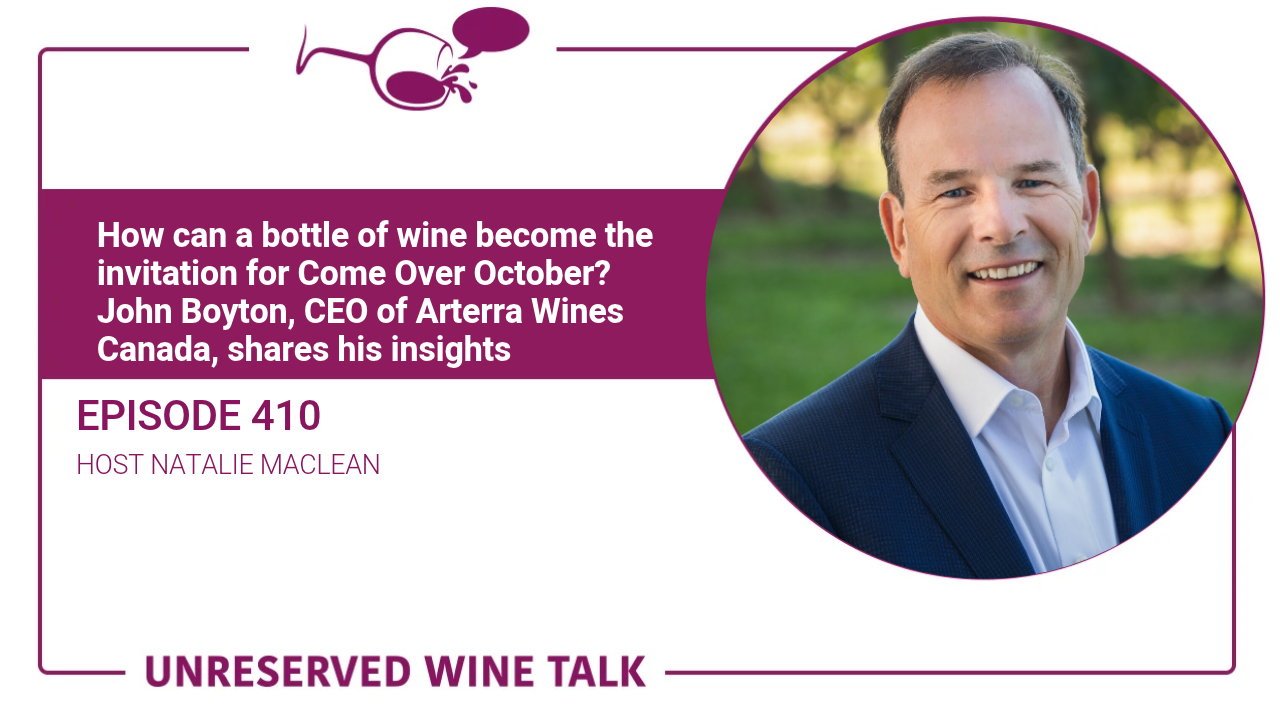
In this episode of the Unreserved Wine Talk podcast, I’m chatting with John Boynton
You can find the wines we discussed here.
Join me on Instagram, Facebook and YouTube Live Video
Join the live-stream video of this conversation on Wednesday at 7 pm eastern on Instagram Live Video, Facebook Live Video or YouTube Live Video.
I’ll be jumping into the comments as we watch it together so that I can answer your questions in real-time.
I want to hear from you! What’s your opinion of what we’re discussing? What takeaways or tips do you love most from this chat? What questions do you have that we didn’t answer?
Want to know when we go live?
Add this to your calendar:

Highlights
- Why does John believe wine can help combat the growing problem of loneliness?
- What makes wine uniquely suited to slowing us down and creating deeper face-to-face connections?
- How can a bottle of wine serve as both the invitation and the excuse to spend time together?
- What did the first year of Come Over October reveal about people’s desire for more meaningful connection?
- Why does John believe wine forces us to be more present in an increasingly digital world?
- How did Come Over October change the way John prioritizes time with his own friends and family?
- Why are younger drinkers consuming less wine?
- What does the wine industry need to understand about the pre-party occasion?
- Why did Arterra create a bold, 16% alcohol flavoured wine?
- How much of wine’s decline is being driven by affordability versus moderation and changing lifestyles?
- Why does John think the wine industry needs to stop looking at other wine brands for inspiration?
- What can trends like zero sugar teach the wine industry about reinventing itself for today’s consumer?
Key Takeaways
- How can a bottle of wine become the invitation, slow down the moment, and create space for real conversation?
- N: So you’ve said that wine isn’t the point of the whole thing, conversation is. So where does the bottle of wine actually do its work? Is it in the glass, in the invitation, both?
- J: Well, this is where I think wine separates itself from everything else. Wine is not only the excuse, but it is also the invitation and it’s also the reason to accept the invitation. It is a signal that I haven’t seen you in a while, and I want to see you. So it’s a message in itself. It is the speed adjudicator. It is a creation of the conversation because it slows things down. Wine sometimes has its own conversation that goes with it and it has the memory creation as well. I don’t think a lot of people remember a lot of text messages and emails that they did last week, but you will remember that bottle of wine you had when you got together for a few hours with someone you haven’t seen in a couple of months. That you’ll remember.
- Why does the wine industry need to look beyond wine itself to win back consumers?
- N: Domestic and premium wine are feeling this (consumption reduction) the most. And that’s, of course, in your backyard. How does this change the sense of urgency for you?
- J: The whole category is behind and so it needs hyper acceleration on trying to be relevant again. Looking at occasions, the size of those occasions and the growth of the occasions and charting your course as to where those occasions are going to be, not where they are now. I think it drives a certain boldness to be different. we have a very big challenge in our category that there is so much sameness. If there are 40,000 different wine SKUs in the world, probably 35,000 look exactly alike. I think we have to be bold to make sure that every brand we have is really different from all of the other brands in order to earn the attention of people, and then the loyalty of people too, assuming the product delivers. We have to look at other categories. We can’t keep looking internally at wine. We’ve got to look not even at alcohol categories. I’m talking about food categories and beverage categories.
- How can wine become more relevant to younger consumers?
- N: Let’s move now to some trends in the industry that you’re seeing. Consumption, of course, is trending down in wine. It’s the younger and millennial drinkers who are pulling back the hardest. Your read, though, is that they haven’t fallen out of love with wine. So what’s actually happening?
- J: Well, first of all, the younger people today have less time and less money. So those are important factors. They’re also living a digital life and so they’re going out less often. That’s a factor. Their friends are generally a wider circle, but they’re more acquaintances versus closer friends. So that all leads to the fact that they have very different occasions and very different needs. And wine’s been really good at filling different occasions, but a lot of the occasions associated with younger drinkers, wine does not become that relevant. And I think that’s the crux of the millennials.
About John Boynton
John Boynton is the President of Arterra Wines Canada. He oversees the domestic and international sales, marketing and operations of Canada’s leading wine company.
John joined the company in 2022 from NordStar (parent company of Torstar) where he held the role of Vice Chair and President of Digital. He was previously the President and CEO of Torstar and Publisher of The Toronto Star.
John is an experienced CEO with a proven track record of helping companies transform and grow – successfully turning strategy into action. He leads his teams in a way that aligns to our purpose and values, focusing on teamwork and collaboration.
Throughout his 35-year career, John has worked in Sales, Marketing and Operations – for many different industries. He has experience in building both customer and direct-to-consumer relationships as well as in mobile, digital, data and ecommerce.
A Canadian, John has lived and worked in Canada, the US and Europe.
Resources
- Mentioned in the Episode
- Unreserved Wine Talk| Episode
- My Books:
- Wine Witch on Fire: Rising from the Ashes of Divorce,Defamation, and Drinking Too Much
- Audiobook:
- Audible/Amazon in the following countries: Canada, US, UK, Australia (includes New Zealand), France (includes Belgium and Switzerland), Germany (includes Austria), Japan, and Brazil.
- Kobo (includes Chapters/Indigo), AudioBooks, Spotify, Google Play, Libro.fm, and other retailers here.
- Wine Witch on Fire Free Companion Guide for Book Clubs
- Audiobook:
- Unquenchable: A Tipsy Quest for the World’s Best Bargain Wines
- Red, White, and Drunk All Over: A Wine-Soaked Journey from Grape to Glass
- Wine Witch on Fire: Rising from the Ashes of Divorce,Defamation, and Drinking Too Much
- My new class, The 5 Wine & Food Pairing Mistakes That Can Ruin Your Dinner And How To Fix Them Forever
Tag Me on Social
Tag me on social media if you enjoyed the episode:
- @nataliemaclean and @natdecants on Facebook
- @nataliemaclean on Twitter
- @nataliemacleanwine on Instagram
- @nataliemaclean on LinkedIn
- Email Me at [email protected]
Thirsty for more?
- Sign up for my free online wine video class where I’ll walk you through The 5 Wine & Food Pairing Mistakes That Can Ruin Your Dinner (and how to fix them forever!)
- You’ll find my books here, including Unquenchable: A Tipsy Quest for the World’s Best Bargain Wines and Red, White and Drunk All Over: A Wine-Soaked Journey from Grape to Glass.
- The new audio edition of Red, White and Drunk All Over: A Wine-Soaked Journey from Grape to Glass is now available on Amazon.ca, Amazon.com and other country-specific Amazon sites; iTunes.ca, iTunes.com and other country-specific iTunes sites; Audible.ca and Audible.com.
Transcript
Natalie MacLean 00:00:00 How can a bottle of wine become the invitation? Slow down the moment and create space for real conversation. How can a bottle of wine become the invitation and slow down the moment to create space for real conversation? Why does the wine industry need to look beyond wine itself to win back consumers? And how can wine become more relevant to younger drinkers? In today’s episode, you’ll hear the stories and tips that answer those questions in our chat with John Boynton, CEO of our Terra Wines Canada. By the end of our conversation, you’ll also discover why John believes wine can help combat the growing problem of loneliness. What makes wine uniquely suited to slowing us down and creating deeper face to face connections? What the first year of the Come Over October movement revealed about people’s desire for a more meaningful connection. Why John believes wine can help us be more present in an increasingly digital world. What the wine industry needs to understand about the pre-party occasion. Why our Tara created a bold flavored wine. How much of wine’s decline is being driven by affordability versus moderation and changing lifestyles, and what trends like Zero Sugar wines can teach the industry about reinventing itself for today’s consumer? Okay, on with the show.
Natalie MacLean 00:01:41 Do you have a thirst to learn about wine? Do you love stories about wonderfully obsessive people, hauntingly beautiful places, and amusingly awkward social situations? Well, that’s the blend here on the Unreserved Wine Talk podcast. I’m your host Natalie MacLean. And each week I share with you unfiltered conversations with celebrities in the wine world, as well as confessions from my own tipsy journey as I write my third book on this subject. I’m so glad you’re here. Now pass me that bottle, please, and let’s get started.
Natalie MacLean 00:02:23 We’ve never been more connected online, and.
Natalie MacLean 00:02:25 Yet we’ve never felt.
Natalie MacLean 00:02:26 More disconnected in person. We can reach anyone in seconds, and.
Natalie MacLean 00:02:30 Yet.
Natalie MacLean 00:02:31 We rarely do. We let months slip by without seeing the people who matter most to us. My guest today decided to do something about that. John Boynton is the CEO of our Terra Wines Canada, the country’s largest wine company. He, along with Winegrowers Canada, are championing Come Over October, a movement created by Karen McNeil, author of The Wine Bible.
Natalie MacLean 00:02:53 It’s now in its second year in Canada and the theme is really simple open your door, open a bottle and reconnect with the people you love. So today we’re talking about why connection has become so difficult. What the wine industry is facing, and how a bottle on the table still brings people together. Don, welcome to the Unreserved Wine Talk podcast.
John Boynton 00:03:14 Thanks for having me. I’m a big fan and I really enjoyed your last podcast on Blended Scotch. That was great.
Natalie MacLean 00:03:20 Oh, good. Yes. Well, if it’s liquid, we’ll talk about it. So what made you decide, John, to take a leadership role in launching come over October here in Canada?
John Boynton 00:03:29 Sure. We came across a really horrific stat and that is that 57% of Canadians feel lonely. Oh, and there’s so much research out there that correlates loneliness to mental health. And so if mental health is the big topic and loneliness is one of the one of the drivers of it, as the largest wine company in Canada, we felt we could do something about it.
Natalie MacLean 00:03:50 So yeah, as you say, more than half of Canadians feel they don’t have a strong sense of belonging where they live. That’s just devastating, actually. And so when you hear a number like that, what does it tell you about what wines role or job is now?
John Boynton 00:04:05 Sure. Yeah. It actually it’s getting worse. It’s not getting better since Covid and you can imagine everybody shut in all that kind of stuff. And today everybody lives so digitally. And in a digital world, everybody gets fooled that they have all these connections. But you don’t really have deep connections. You have affiliations. You have people that swap text messages back and forth. But that’s not a that’s not a deep connection. And how to create more personal connections, again, in a in an increasingly digital world and increasingly isolated world is something that I think only wine can do. No other beverage category anywhere. Alcohol, non alcohol can do something about it in my opinion.
Natalie MacLean 00:04:44 And why is that? What makes wine different from other types of alcohol or non alcohol?
John Boynton 00:04:49 Sure.
John Boynton 00:04:50 Wine is generally not something that speeds things up. It’s generally something that really slows things down. So it’s very conducive to a meal which is very social, or not having a meal, but just before a meal or cocktails, before a meal or whatever, or an after dinner drink. But it very conducive to being face to face first of all, and very conducive to giving people a little bit of time in such a crazy, hectic world to to connect and create a memory.
Natalie MacLean 00:05:16 Sure, absolutely. It is the drink of conversation. I’m biased, of course, but it’s gone back 8000 years now. We certainly don’t do wine like we do shooters and vodka or whatever. And then, I don’t know, there’s something about wine, even though I’m an advocate of those who want to have non-alcoholic drinks for various reasons, I think there’s just something about wine. And yes, it has alcohol in it, but it’s that slow sort of slowing down into the moment, that magical combination. I think that wine gives us so agreed.
Natalie MacLean 00:05:44 77% of people say busy schedules keep them from the people they love. So what barrier is come over October trying to remove.
John Boynton 00:05:54 This and your stat is like really the crux of everything. Think about it. 57% feel lonely, but 77 say they’re too busy. And so it’s not like some deep seated problem that we need. Tons and tons of work to figure out. And it’s going to be complicated. And how to execute. No, it’s really simple. We need to create awareness. We need to create something that is a catalyst that drives away from the inertia, that 77%. And I think that’s the role wine has. Wine can be the catalyst. And while I said it slows down and creates a memory and makes that connection more intimate, it also can play a much bigger role in being a catalyst overall. And come over October. Is the awareness created in general about the issue and that getting a little bit of self-awareness. So yeah, why can’t I get together with people? That doesn’t sound right.
John Boynton 00:06:45 And then again, wins the catalyst?
Natalie MacLean 00:06:47 Absolutely. I mean, that’s why we have occasions and holidays. Otherwise we’d never stop or I know I wouldn’t, but it’s like Christmas. No one’s going to answer your email, so just stop it. Yeah. Come over. October is again creating the occasion. Just the memory hint or whatever that some people need. Well, most of us need, apparently. So you said that wine isn’t the point, though, of the whole thing. Conversation is. So where does the bottle of wine actually do its work? Is it in the glass, in the invitation? Both.
John Boynton 00:07:18 Well, this is where I think, really, wine separates itself from everything else. Wine is not only the excuse, but it is also the invitation. And it’s also the reason to accept the invitation. It is a signal that I haven’t seen you in a while and I want to see you. So it’s a message in itself. It is the speed adjudicator. So as I said, it slows everything down.
John Boynton 00:07:42 It is a creation of the conversation because it slows things down. Wine sometimes has its own conversation that goes with it as well, and it has the memory creation as well. I don’t think a lot of people remember a lot of text messages and emails that they did last week. But you will remember that bottle of wine you had when you got together for a few hours with someone you haven’t seen in a couple of months that you’ll remember.
Natalie MacLean 00:08:04 You will absolutely. And smell and taste. Directly connect to emotion and memory in our brain. It’s the only one that goes directly every. All our other senses have to go through some other neural networks. Some friends used to think I was just a sort of a wine savant. Not in any other regard but wine. Yes, because I remember who I was with, what they were wearing, what I was wearing, who was, you know, what was the. But it’s that that emotional memory sense, the whole thing that comes together. So open your door, open a bottle.
Natalie MacLean 00:08:36 It’s a simple ask. Why does something that simple need a movement behind it?
John Boynton 00:08:41 Yeah, it’s your stat, right? It’s the same reason. It’s the reason. It’s why it’s an issue. People are too busy. Yes. And or they perceive themselves as too busy, or they just need a little bit of a kick. And so if you have awareness now, the next thing you have is your own self-awareness. Is this me? Is this what I’m doing? And therefore, again, it becomes the spark or the catalyst and the reminder that this is actually important. There’s a lot of things in your life important, but if you’re not connecting to the people that matter most to you.
Natalie MacLean 00:09:10 What is the point? Yeah, absolutely. We work so hard. When I first got into this industry, I thought, I’m going to help assist the helpless rich trying to pick the right vintage. I’m not saving someone abroad. But then I thought, you know what? We all work so hard. Why? So that we can spend time with our friends and family in a meaningful way with sensory pleasures.
John Boynton 00:09:30 That’s right.
Natalie MacLean 00:09:31 What else is there on this planet?
John Boynton 00:09:33 And if that’s so, what goes away, then? All you’re doing is working hard.
Natalie MacLean 00:09:37 That’s it. Yeah, that’s pretty simple. Yep. So this is year two now for come over October in Canada. What did year one teach you that’s changing how you approach the whole campaign this year?
John Boynton 00:09:49 I think we were blown away last year. I think we tried it the first year and we thought, okay, we’ll get it out there. We’ll talk a little bit online about it and something really big happen. It hit a chord and it hit a chord because we really went to the center, like the bullseye of the problem, of the inertia and actually the importance on the other side and that feeling of loneliness, etcetera, etcetera. And I think it wasn’t a complicated thing to explain. And I think that’s one of the lessons learned, is we don’t have to really talk too much about the whys about this, because everybody gets it really quickly.
John Boynton 00:10:23 It’s the catalyst and the getting over the inertia and getting people to do something that is going to be important. So we’ve got some awareness. We got a lot of people talking online, an enormous amount of chatter online. But remember it’s online. It’s not really real. Yeah. So I think this year we’re going to take all that good awareness and self-analysis that people did the outside in looking in their own lives. And we’re going to spend a little bit more time catalysing to get them out.
Natalie MacLean 00:10:51 And how are you doing that, catalyzing them?
John Boynton 00:10:53 We’re going to do more examples and make it really simple for people. Of course, people don’t need examples to get together how to get together, but we’re giving them like lots of ideas around different things you can do and different with different types of people and different types of food and that kind of thing. So it could be a little more fun and a little less planned and contrived.
Natalie MacLean 00:11:11 Sure, absolutely. And again, going back to screens do promise us connection.
Natalie MacLean 00:11:16 Then quietly stand between us and the people who are right in front of us often. And wine is one of those few things that only works in person. We can’t text a bottle, that kind of thing. So it’s a must. And you mentioned earlier something interesting that I meant to pick up on. Wine itself often has a story I find that most bottles do. They have someone who struggled or a story of whatever. Is that something you often get into when you’re sharing a bottle?
John Boynton 00:11:42 Everybody’s interested, right? Other products, their products. Right. And people drink them. They know them. But there’s not a big story that goes with them, and nobody really asks about them that much. And so it’s a conversation starter too, because when you put it down, everybody goes, oh, what’s that? And you can talk a little bit about it. It gets things going. A little bit of a conversational lubricant if you like to kick off things. But yeah, they have a they have their story.
John Boynton 00:12:04 But the important thing is that it forces presence. And presence is something that has become more and more important for people as we get super distracted with screens all the time. And the more people have these glued to them, like, and I’m guilty for sure, but the more you have that, the less you’re present. You can be physically there, but you’re not present. That’s true. And and I think what wine does is it really forces presence unlike anything else, any other entertainment or anything. And you’re really super aware when the phone goes down and then you’re looking at the person. So that’s that creates that connection when you’re present and the connection is what creates then the memory.
Natalie MacLean 00:12:44 Absolutely. Yeah. You can be watching Netflix or something and on your screen and someone’s beside you, but you’re not really there with them. But I think that’s another thing with wine. It does bring you back down, like if you live in your head all the time and are thinking and like it actually brings you back down into your physical cells to be more present with somebody.
John Boynton 00:13:06 Yeah, absolutely.
Natalie MacLean 00:13:08 Yeah. I’m not getting emotional over this. I’ve got seasonal allergies. Okay. Just so you know. But so yeah, I think about wine too on the table at dinner, say, and it’s one of the few, if only products on the table that’s still in its often in its original packaging. You see the label, we don’t put avocados or tomatoes in their original packaging, and I think that’s what makes it unique. No one cares where the we do, to a certain extent, care where our food comes from, but not to the extent that we want to know about the wine. It’s just there’s something different about it.
John Boynton 00:13:44 It’s full. It’s fully vertical, right? Like all the grapes are grown locally, and then they’re all picked locally and then they’re all put in a barrel locally. And so everything is really farm to table. And that’s a different kind of. Local conversation as well. It’s not just the product, but it’s your community and your local area as well.
Natalie MacLean 00:14:01 It is. And I you know, I go back to other consumer packaged goods in the food and drink category. I used to work at Procter and Gamble on, like Crisco and Duncan Hines and Pringles. No one cared where those things came from. They cared about, you know, taste and safety. But that was about it. There was no hardened in it like it was just, I don’t know, there’s just something about the people and places behind the bottle with wine.
John Boynton 00:14:25 Yeah. And wines. Different. Even other beverage, alcohol, beverage products. You’re not exactly sure where all the ingredients came from, you know. And why.
Natalie MacLean 00:14:32 Yes. That’s true. The transparency, the authenticity, the soil and the fact it’s going to be different every year. You know, in other packaged goods, you want them to be consistent, the same. But in wine you actually aren’t striving for that. You’re just striving for the best that you can offer. Yeah, I just wanted to share a memory with you because this whole come over October has brought things up for me in a good way.
Natalie MacLean 00:14:53 So a couple of years ago, our We Our Family reunion in Halifax almost didn’t happen because our schedules weren’t lining up. And there you go. Couldn’t agree where to meet.
John Boynton 00:15:02 And yeah, you’re 77% or whatever.
Natalie MacLean 00:15:05 Exactly in that category. But somehow it came together. And so we had more than 30 aunts and uncles and cousins show up, and two of them, an aunt and an uncle, have since passed away. And I am so grateful I have one more chance to be with them. And wine was on the table. It wasn’t the point, but it did slow us all down so that we got to hear their stories about their childhood and part of our story, which is special. So, John, what does coming over mean to you in your own life? Is there a ritual or.
John Boynton 00:15:37 Oh yeah. Yeah, I’ve ramped up since last year, so I had a ton of self-awareness that happened last year. And I’ve got a group of guys I go to get chicken wings and watch an NFL football game.
John Boynton 00:15:48 I’ve got different people that we go over to their house to watch a hockey game, have a family that I meet up with. Up in Northern Ontario, we do a Sunday dinner when we get back into the fall, winter, spring, we do Sunday dinners at our house with our adult children and our significant others and spouses. We go out to restaurants more often now with other couples, and we even are traveling now with other couples. So we went into hyperdrive on trying to connect. You know, it’s it’s all worth it. It’s all great. And yeah, you might be a little tired the next morning, but it’s so worth it than saying, geez, I haven’t seen so-and-so in four months. That’s a terrible thing to say out loud when it’s a good friend or a family member.
Natalie MacLean 00:16:27 Sure. Oh, great. You’re walking the talk. You’re on it. Let’s move now to some trends in the industry that you’re seeing. Consumption, of course, is trending down in wine. It’s the younger and millennial drinkers who are pulling back the hardest.
Natalie MacLean 00:16:42 Your read, though, is that they haven’t fallen out of love with wine. So what’s actually happening?
John Boynton 00:16:47 First of all, the younger people today have less time and less money. So those are important factors. They’re also living a digital life. And so they’re going out less often. That’s a factor. Their friends are generally a wider circle, but they’re more acquaintances versus closer friends. That all leads to the fact that they have very different occasions and very different needs. And Y has been really good at filling different occasions. But a lot of the occasions associated with younger drinkers, wine does not become that relevant. And I think that’s the crux of the millennials.
Natalie MacLean 00:17:21 And how does that change what and how people, younger people want to drink?
John Boynton 00:17:26 It’s a different product. So you have to start over. And that’s the hard part for the wine industry. You have to start over with the occasion and then the need, and then know everything about that need in that occasion. And there’s not a lot of what we do today that that’s that relevant to that group.
John Boynton 00:17:41 So I would encourage folks to not do what they’ve historically done and just almost like doing zero based budgeting. Just start over.
Natalie MacLean 00:17:49 And what was the key insight that came to you in terms of what these consumers are looking for?
John Boynton 00:17:55 You have to understand the different occasions. So for example, one of the occasions for younger people is pre-party. You don’t see a lot of 65 year olds pre-party. But in the 20 year old, in the 30 year old there’s a lot of pre-party.
Natalie MacLean 00:18:08 Is this drinking before they go out or like having a drink at home? Okay.
John Boynton 00:18:12 Yeah. And if you just think about value and time and money and all that kind of stuff, it’s expensive sometimes for sure.
Natalie MacLean 00:18:18 Once they get.
John Boynton 00:18:19 Out of the money so they have drinks first and then they might have 1 or 2 drinks if they go to a bar or a bar or whatever. So pre-party is a very high energy occasion that wine has an incredibly low share in. And that has to be convenient. It has to be bought last minute.
John Boynton 00:18:34 It has to have certain characteristics and packaging and the retail locations they go, everything is everything’s different. So that’s what I mean. You got to start over.
Natalie MacLean 00:18:41 Well I was going to talk about this a little later, but since we’re on it you introduced mix. Yeah. Maybe tell us a bit about maximum. Oh, see, I’m not that generation. I didn’t get it. Maximum. Right. I’m thinking. Oh, Roman numerals. What is it, anyway? Ancient. Tell us a bit about these wines. What they are, the flavors, that sort of thing.
John Boynton 00:19:06 Sure. It’s built for obviously the pre-party occasion that I was talking about. It’s very different flavors for that age group. They want bold flavors. They want intensity. They want smooth drink ability. Shopping wise, they have different retail patterns so that they’re probably not going to certain stores that we would go to, and they’re going generally last minute. And they want something that’s very convenient for that particular time of day. And they want something that’s affordable.
John Boynton 00:19:33 Remember, these are folks in university or in their first job. So their disposable income is quite compressed, right.
Natalie MacLean 00:19:38 Okay. And so these wines I remember correctly do they have about 16% alcohol.
John Boynton 00:19:43 They have 16% alcohol. And again that’s recognizing not what a 62 year old would say. It’s recognizing what a pre-party is and what it commands.
Natalie MacLean 00:19:54 Maybe instead of a spirit or whatever, they would go with more of this kind of product.
John Boynton 00:20:00 That’s correct. Everything we do is different for that particular execution. It’s different ways of doing marketing, different ways of doing advertising. It’s a lot of mostly done through influencers and ambassadors. That’s a very different thing than what wines used to. Yes, even the campaign tagline is nothing you would ever see from wine. So the line is hard launch the night and I think you get it so right goes it goes way upstream into the pre-party occasion, but it’s hard launch. The night is also different from wine in the sense that there’s an energy associated with that particular occasion.
John Boynton 00:20:38 The wine industry never talks about energy, ever. But when you go to other categories food and beverage, they do talk about energy. So this is a high energy occasion, which is why hard Launch of the night gives you that kind of feeling. Of what happens when you show up in the. In the pre-party.
Natalie MacLean 00:20:53 That’s fascinating. Yeah. Yeah. You definitely would not see that as a tagline. It might be like, settle down now, right?
John Boynton 00:21:00 Yeah. That’s right.
Natalie MacLean 00:21:01 And there are flavored wines, right?
John Boynton 00:21:04 That’s right. They come with three flavors and they’re very, again, very bold. Okay. But extremely drinkable, but nothing you would see in wine flavors. These are flavors not associated. Why? They might be flavors more associated with reds, for example.
Natalie MacLean 00:21:16 Ready to drink whiskeys, vodkas and that. So on. So what are the three flavors? Okay. No, I’ve got them here. BlackBerry. Yeah. We’re not the target, John. Let’s see. Lemonade and peach.
Natalie MacLean 00:21:29 Yep. Okay.
John Boynton 00:21:30 You know, they’re right behind me. I could have just looked.
Natalie MacLean 00:21:32 That’s okay. So on the surface, wine engagement looks steady, but there’s a quieter shift underneath. What are you seeing with wine overall? Not just these drinkers here.
John Boynton 00:21:45 Yeah, certainly. penetration is about the same and that hasn’t changed that much. And that might surprise some people. But what has changed is the consumption. Within that penetration, there are fewer occasions and it’s fewer drinks consume per occasion. And it’s the change is much bigger for younger people, and it’s much more muted as you go up in the age category.
Natalie MacLean 00:22:06 Okay, so drinking less but better somewhat.
John Boynton 00:22:11 Yeah. Yeah. And and you know it’s in the younger generation. It’s it’s driven mostly by affordability. Again with we didn’t have the kind of rents that they have to pay. We didn’t have to we didn’t imagine if we had those grocery bills when we were that age. It’s it’s actually really tough. And so part of what’s going on in the category is that the affordability is suppressing consumption.
John Boynton 00:22:32 A lot of that is cyclical because we’re in a hyperinflation recessionary period right now, and people are really pulling back. And you can even feel it this summer more so than any other time. And so 48% of the reduction in the industry is associated purely with affordability. So that’s cyclical. And that will come back okay. But 40% is lifestyle in moderation. And that’s where the wine industry needs to reinvent itself for a multiple occasions. And then the part that come over October is going after 8% of the consumption reduction is actually just less social occasions, therefore less drinking. And that’s another factoid around the ripple effect it has on different categories of people are going out. And of course restaurants and others would also feel some of that.
Natalie MacLean 00:23:21 Sure. And so domestic and premium wine are feeling this the most. And that’s of course in your backyard. How does this change the urgency sense of urgency for you?
John Boynton 00:23:31 I think we’re behind. The whole category is behind. And so it needs hyper acceleration and it needs hyper acceleration.
John Boynton 00:23:38 On trying to be relative again. Looking at again those occasions, the size of those occasions and the growth of the occasions And charting your course as to where those occasions are going to be, not where they are now. I think it drives a certain boldness to be different. We I think we have a very big challenge in our category that there is so much sameness. If there are 40,000 different wine SKUs in the world, probably 35,000 look exactly alike. And and I think we have to be bold to make sure that every brand we have is really different than all of the other brands in order to earn the attention of people, and then the loyalty of people to assuming the product delivers. We have to look at other categories. We can’t keep looking internally at wine. We’ve got to look not even at alcohol categories. I’m talking about food categories and beverage categories. And to go with that. So that’s half of one side. And the other half of that coin is we do have to get rid of some muscle memory.
John Boynton 00:24:39 There are things that we think we have to do because it’s wine and it’s actually it’s a bit of a barrier. It’s a bit of a mental block.
Natalie MacLean 00:24:46 Give us an example of that.
John Boynton 00:24:48 Again, if you’re going to try to like our industry would think about no ALC or low ALC. And we would obsess about that because we looked at beer and when we’re in wine. And so that’s the big that’s the big win. But our Tara, we didn’t think that way. We’ve been watching food and beverage much more than we’ve been watching the alcohol category. And so we went down the road of cliffy salt. But that was about 20 years ago where that was really big. But in the last 20 years, everything in food and beverage has been about sugar.
Natalie MacLean 00:25:19 Yes.
John Boynton 00:25:20 Now there’s a recent protein trend, but that’s still the number one thing. And so that would be a good example of if you just keep looking with the shackle of we have to do this and let’s just take the alcohol or lower the alcohol.
John Boynton 00:25:33 That’s our product you’re missing. You’re missing the bigger trend and point out there trends.
Natalie MacLean 00:25:37 Yes, absolutely. And since you’ve brought it up a natural segue, you’ve got Basque, which is your zero sugar wine. There are also VQA wines. So when. Tell us a little bit more about these wines.
John Boynton 00:25:52 This is for someone who is really paying attention to what’s in their glass, but also what’s in their fridge. Generally is trying to watch sugar for a whole bunch of different reasons. And so if you’re watching what’s going on there and you’re reading all the health studies, the sugar has some immediate issues and that it has some very secondary issues it’s connected to, and it could be as extreme as diabetes, and it could be other things about your current health. And we try to find a formula that answered that and surprised people. And the surprise people is when you come up with something like no alcohol or no cal or locale or etc. etc., etc. in this case, zero sugar added, people are going to assume it’s not going to taste very well, and so we have to find a way to get to them.
John Boynton 00:26:42 And this involved tons and tons of sampling so that the very first taste created the convert. And that was our mission. Every person who tries it needs to convert and repeat. And it’s a brand that has a very high repeat rate and a very high acceptance rate, and it has really taken off.
Natalie MacLean 00:27:00 And I can say personally, I’ve tried them and they are delicious. And people think no sugar, but it’s the natural fruit sweetness that’s in there with no sugar. So you still get those flavours of apricot or. Yeah. So it is surprising, but that’s well done.
John Boynton 00:27:17 It’s still premium right? It’s still locally crafted and it’s still an everyday drinking wine. So it’s not too expensive and so perfect for come over October.
Natalie MacLean 00:27:25 Sure. Absolutely. Well there you have it. I hope you enjoyed our chat with John. Here are my takeaways. Number one, how can a bottle of wine become.
Natalie MacLean 00:27:40 The.
Natalie MacLean 00:27:40 Invitation and a chance to slow down the moment and create real space for conversation. John notes that wine isn’t the point of getting together.
Natalie MacLean 00:27:50 Conversation is. So what is the role of wine? He explains that wine separates itself from everything else. Wine is not only the excuse, but also the invitation, and it’s also a reason to accept the invitation. It’s a signal that I haven’t seen you in a while and I want to see you. So it’s a message in itself. It’s a speed adjudicator, he says. It is a creation of the conversation because it slows things down, and wine sometimes has its own conversation that goes beyond it. There’s a story behind the bottle and it helps, therefore, in memory creation as well as he says. I don’t think a lot of people remember text messages and emails that they did last week, but you will remember that bottle of wine you had when you got together for a few hours with someone you hadn’t seen in a couple of months? Number two, why does the wine industry need to look beyond itself to win back consumers? So domestic and premium wine are experiencing a consumption reduction? How does this change the sense of urgency for John? He explains that the whole wine category is behind and it needs hyper acceleration on trying to be relevant again.
Natalie MacLean 00:29:10 So they need to look at occasions the size of those occasions and the growth of occasions, and charting your course as to where occasions are going to be, not just where they are now. He thinks that should drive a boldness to be different. The wine industry, he observes, has a very big challenge in that there’s a lot of similarity. If there are 40,000 different wine SKUs in the world, probably 35,000, he estimates look almost exactly alike. He believes the wine industry has to be bold, to be sure that every brand is really different from all of the other brands, in order to earn the attention of people and their loyalty. He also believes in looking at other categories, not just internally at wine. So to look at food categories and other beverage categories for inspiration. And finally, how can wine become more relevant to younger consumers? Gen-Z and millennial drinkers are pulling back the hardest. John’s read, though, is that they haven’t fallen out of love with wine. But what’s happening? Well, as he explains, younger people today have less time and less money.
Natalie MacLean 00:30:26 They’re also living a digital life, so they’re going out less often. Their friends are generally from a wider circle, but they’re more acquaintances versus close friends. So that all leads to the fact that they have very different occasions and needs. Wines been great at filling different occasions in the past, but a lot of those associated with younger drinkers are just not where wine is relevant, and that is the challenge for today’s wineries. If you missed episode 17, go back and take a listen. I chat with Ontario’s Best Sommelier, Emily Pierce Barbosa, about tasting wine like a detective. I’ll share a short clip with you now to whet your appetite.
Emily Pierce 00:31:15 So with the idea of deductive tasting and just going down the path and asking yourself questions like, can I see through this one? Is it a thick skin grape? Is it a thin skinned grape? If I can see through it, it’s not going to be stressed or Cabernet. It’s going to be like your Pinot noir, your Grenache, Gamay, things like that.
Emily Pierce 00:31:32 And so very, very, very often I have no idea what’s in the glass. Maybe more often than not, but it’s just moving through all these questions. It’s sort of like a detective sifting through evidence to solve a case, putting all the clues together, and then at the end, just taking a big breath and saying what you think it is.
Natalie MacLean 00:31:56 Do you know someone who’d be interested in learning more about come over October and the wine industry changes and trends? Please let them know about the podcast. Email them or text them now while you’re thinking about it. It’s easy to find the Unreserved Wine Talk podcast. Just tell them to search for that title or my name Natalie MacLean wine on YouTube, Apple Podcasts, Spotify, their favorite podcast app or they can listen to the show on my website at Natalie MacLean. Just email me if you have a tip, question, or if you’d like to win one of six drinks books I have to give away. I’d also love to hear your thoughts on this episode? Or if you’ve read my book or are listening to it.
Natalie MacLean 00:32:42 Email me at Natalie at Natalie MacLean dot com. You won’t want to miss next week when we continue our chat with John. Thank you for taking the time to join me here. I hope something great is in your glass this week. Perhaps a wine you shared with a friend or neighbor whom you asked to come over this October.
Natalie MacLean 00:33:10 You don’t want to miss one juicy episode of this podcast, especially the secret full bodied bonus episodes that I don’t announce on social media. So subscribe for free now at Natalie MacLean. Meet me here next week. Cheers!