By Natalie MacLean
I remember the hum of server rooms at the supercomputer company now the headquarters of Google. When I joined the wine industry twenty-five years ago, I thought I was leaving a binary world for a visceral one. I wanted the harvest heat, the fudgy soil, the cool zip of Riesling on my tongue. Now silicon has caught up to the soil.
Wine writing has always been a strange translation. You taste a changing liquid then try to trap it in words. Critics have spent centuries arguing about whether that translation is possible. AI has shifted the argument. No longer about whether words can capture wine, now it’s about whether writers need to be human at all.
The conversation has been predictable: AI will churn out soulless tasting notes, or democratize wine knowledge, or never replace the gifted palate. These are surface concerns. Here are five deeper ones.
1. The Molecular Ghostwriter
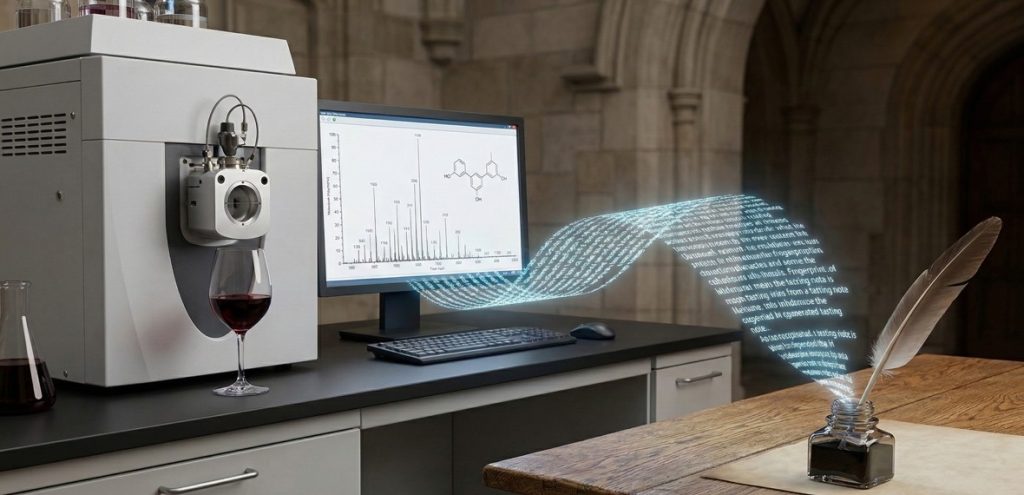
Gas chromatography and mass spectrometry can identify hundreds of volatile aroma compounds in a glass of wine. Scientists at the Australian Wine Research Institute have mapped these compounds for decades. AI can cross-reference those chemical fingerprints against vast libraries of tasting notes and produce descriptors that are not guesses but predictions grounded in molecular data.
A tasting note could soon be written before any human tastes the wine. The winery submits a chemical analysis. An AI returns a note. It will be accurate in ways human notes are not, because humans are fatigued, flawed, and suggestible. What it will not contain is the moment of surprise, the slight bewilderment that makes a great tasting note feel like a discovery rather than a report. That gap, between accurate and alive, will define wine writing for the next generation.
2. The End of the Universal Palate
Robert Parker built an empire on the idea that one palate, rigorously applied, could guide millions of buyers. Wine Spectator extended the model with panels of trained tasters whose scores became a currency. That model depended on scarcity: most people lacked access to expert guidance, so they deferred to whoever had it.
AI collapses that scarcity. Systems trained on purchase histories, flavour preference data, and regional taste patterns can generate personalized recommendations with uncanny precision. The more radical extension is not recommendations; it is prose. Notes calibrated not only to your budget and dinner plans, but also to your biology.
Roughly a quarter of people are supertasters, including yours truly, carrying a genetic variation that makes bitterness hit harder and tannins feel more aggressive. The same Nebbiolo can be a punishment or a revelation depending on the physiology of whoever holds the glass. Adaptive review systems in early development can recalibrate a tasting note in real time: structure shifts, descriptors adjust, the finish is described with or without the astringency the reader’s receptors can register.
The column, the panel score, the 100-point scale: these are broadcast formats. AI is a direct message. When wine writing becomes a one-to-one conversation shaped by your DNA, the universal critic does not just become less relevant. He becomes a category error.
3. The Living Document
A bottle of Barolo bought today will taste different in fifteen years. Wine writers have always known this, and the best have written beautifully about it. The tasting note, however, has remained frozen, a snapshot taken on a particular afternoon, in a specific mood, under unique cellar conditions.
AI combined with Internet of Things (IoT) sensors in wine storage systems will change this. Imagine a tasting note that updates as the wine ages: temperature logged, humidity tracked, drinking windows revised in real time. The note becomes a living document, a relationship rather than a verdict. Cellar management platforms are already trialling it. The authoritative note may give way to a conversation spanning decades.
4. Wines No Living Person Has Ever Tasted
AI trained on ancient texts, archaeological residue analyses, and the genetic sequencing of extinct grape varieties could produce historically grounded tasting notes for wines no person living today has ever tasted. Researchers have sequenced the genome of ancient grape varieties from waterlogged seeds and ceramic residues.
The Romans had strong opinions about Falernian wine. The ancient Georgians were fermenting in qvevri eight thousand years ago. AI can model what those wines likely tasted like based on grape genetics, climate reconstructions, and the flavour chemistry of analogous modern varieties.
This opens an entirely new genre: archaeological wine writing. Speculative, yes, but disciplined speculation rooted in real data. Writers who engage with it will collaborate with chemists, historians, and geneticists. The question “What does this taste like?” will extend across centuries.
5. The Attribution Crisis No One Is Ready For
Wineries are already using AI to generate back-label copy, tech sheets, and press releases. Some use it for tasting notes published under human names. The wine media, under crushing commercial pressure, lacks the infrastructure to detect this or, in many cases, the incentive to even try.
The result is a slow contamination of the written record. When a note generated by an algorithm appears under a critic’s byline, or a winery’s AI-written description gets reprinted in a respected publication, the epistemological foundation of wine writing, the idea that a real person tasted this wine and told you what they found, begins to dissolve.
Unlike debates about AI in journalism or fiction, this one is happening quietly, beneath the prestige layer of the industry, in mid-market communications that move the most wine. By the time there is a forced reckoning, habits will be entrenched.
These five futures are not equally weighted. Some are thrilling, some melancholy, one should keep wine writers up at night. They don’t concern whether AI can describe blackcurrant convincingly. That question is too small. The larger one is about the purpose of wine writing, who it serves, and whether those who have devoted their lives to it will shape these changes or simply be overtaken by them.
I am betting on the writers, but I am watching the algorithms.