Serving Temperatures
June 20, 2008

By Holly Ramer
His friends may call him a snob, and waitresses may give him odd looks, but David Turley isn't about to drink a beer with chunks of ice floating in it.
But that's what can happen at restaurants that insist on serving his favorite beverage in icy mugs. And so Turley has no qualms about insisting upon another, unfrosted, glass.
"I'm pretty passionate about it," says Turley, a 50-year-old information technology worker from Fredericksburg, Va. "The first thing I look at in a restaurant is the beer menu. I consider it a food."
Even casual drinkers of wine know that white wines are served cooler than reds. But few realize the difference a few degrees can make, and not just with wine.
Here's what some beverage experts say about the optimum temperatures for a variety of drinks, and the most common mistakes people make.
BEER
Most beer is served too cold, says Sang Yoon, a beer sommelier, chef and owner of Father's Office, a restaurant in Santa Monica, Calif.
But with most mainstream beers - the stuff produced by the major brand brewers - cold is fine. "Those don't have a huge aroma profile, so you can drink 'em really cold and you're not missing out on anything," Yoon says.
Aromatic beers that are brewed with more ingredients - pale ales for example -should be served around 40 F to 42 F, while beers with big flavor, such as Belgian ales, don't release their aromas until they hit about 50 F.
WINE
Wine often is served at the wrong temperature, says Natalie MacLean, editor of a wine newsletter and author of "Red, White and Drunk All Over," which explores how wine is made, marketed, matched with food and consumed.
"Too cold, and a wine's complexity and aromas are numbed; too hot, and it tastes alcoholic and flabby," she says.
The old advice about serving reds at "room temperature" comes from the days when the "room" in question was a drafty medieval castle, she says, not today's toasty, centrally heated homes.
Red wine should be served at about 60 F, though some light reds, such as Beaujolais, are better served cooler, she says. White wine should be chilled to about 55 F; the glass should feel cool but not ice-cold.
When in doubt, check the label: many bottles indicate the optimal serving temperature.
LIQUOR
There's a bit more leeway when it comes to hard liquor and mixed drinks.
Tricia Crighton of the Gin and Vodka Association of Great Britain says gin- and vodka-based drinks generally are served chilled, usually on ice, to emphasize the fresh taste.
"The dry martini should be very cold and some bartenders keep bottles in the freezer to achieve this," she says. "Usually though, a few good sized ice cubes will chill down cocktails and mixed drinks sufficiently."
Though cocktails historically have been enjoyed well-chilled, a new generation of bar chefs and mixologists are creating more complex cocktails whose flavors are best enjoyed slightly warmer.
COFFEE
The ideal temperature for coffee goes beyond taste, says Ric Rhinehart, executive director of the Specialty Coffee Association of America.
A brewing temperature between 195 F and 205 F is essential to achieve what he calls the appropriate "chemistry in your cup," or the right mix of soluble solids that make coffee look, smell and taste like coffee.
"When you get significantly higher than that, you tend to get some more of the bitter flavor extracted," he says. "When you get lower than that, you leave behind some of the more pleasant, interesting flavors and aromas."
The most common mistake is serving coffee that's not hot enough, he says. Frequently, the culprit is a drip coffee maker that doesn't get the water hot enough and has too long of a brewing cycle.
"And then there are still a few people - though there are very few and they are aging rapidly - who still use percolators," he says. "Percolators are just devastatingly bad for coffee because they circulate already brewed coffee and they drive temperatures over 205 degrees. It's just a terrible way to make coffee."
TEA
There are telltale signs when a cup of black tea is served at below-optimum temperature: the liquid will look clear and there will be a brown ring around the bottom of the cup.
"That's when you know you really made a mistake. If you taste it, it's going to taste like hot water," says Joe Simrany, president of the Tea Association of the USA.
"The problem is you're not extracting all the flavor that tea has to offer," he says.
Near boiling water is required to extract the most flavor from black tea. After 3 minutes of steeping, the tea should be about 185 F, he says.
For white or green tea, cooler temperatures are required, around 165 F to 185 F.
MILK
Milk's optimum temperature - 33 F to 35 F - is a matter of both taste and safety, says Gary Wheelock of the New England Dairy Promotion Board.
A temperature below 39 F is essential to prevent spoilage. His organization came up with a little rhyme for supermarkets to remind them to keep milk cold: "Below 39, it's fine."
"You also want to keep it cold just from a taste standpoint," he says. "Most people absolutely prefer to drink really cold milk, myself included."
SODA
In the Pepsi vs. Coke debate, Pepsi comes out on top (of the temperature scale). A company spokeswoman says Pepsi is best consumed at 42 F, plus or minus 3 degrees. A spokesman for Coca-Cola says Coke's ideal temperature is 38 F.
WATER
With such a basic beverage, there's a lot of room for personal preferences. But there are some common mistakes, says Michael Mascha, author of "Fine Waters: A Connoisseur's Guide to the World's Most Distinctive Bottled Waters."
"Americans drink water way, way too cold," he says, noting that doing so numbs the tastebuds.
Still water is best served at around 55 F - about the temperatue at which it comes out of the ground - rather than straight from the refrigerator, he says.
"Being a natural product, it's a good idea to drink it a natural temperature," he says.
With carbonated water, a slightly higher temperature mitigates the aggressiveness of large bubbles, he says, and lets the mineral content of the water come through.
Reprinted with permission. Please ask permission before copying or using
this material. Comments? Suggestions? If you'd like to receive Natalie's free
e-wine newsletter, sign up at
www.nataliemaclean.com. It's free,
and your e-mail address will be kept confidential.


 Best Books of the Year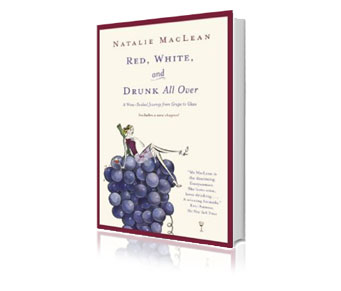


 Best Books of the Year