Chocolate & Wine
February 3, 2008

By Jo and Tom Chesworth
With Valentine’s Day coming, are you wondering which red wine to have with your chocolate? Did you ever wonder which red grape is responsible for the most red wine? Perhaps it’s Cabernet Sauvignon, the major component of most Bordeaux red wines and a mainstay in California vineyards. Wrong. It isn’t Merlot, the major component in the rest of the Bordeaux reds and a darling of California wines. Nor is it Zinfandel. So much for most California reds.
How about Pinot Noir, the great red grape of Burgundy and Oregon? Nope. Well then, it must be Shiraz, also called Syrah, grown in Australia and grown, by law, on the right bank of the Rhone River south of Lyon, France. That’s not it, nor is the Native American Concord grape, a wine that is not even considered to be a grape wine.
In fact, it is none of the “international grapes” nor any of the fashionable “named varietals.” It is difficult to find its name on a wine label for reasons that are political. In France there are four official levels of quality. The two highest levels are based on the area where the grapes are grown and the wine is made. In general, the smaller and more specific the area, the higher the wine’s quality. The rules require that vineyards grow only specified grapes, plant only so many vines per acre and that the wine has a minimum alcohol level. The system is called AOC, (Appellation d’Origine Contrôllèe) and the second level is VDQS, a sort of AOC in waiting. The key rule in the system is that, with very few exceptions, you are not allowed to put a varietal name on the label. No Merlot, no Cabernet Sauvignon, and no Pinot Noir.
The next level is vin du pais on whose label you may put a varietal name, but they don’t bother in Europe. However, if they’re making wine for the American market, they do.
The lowest level in the quality system is vin du table which is seldom exported and is usually found in unlabeled plastic milk bottles in supermarkets in France or delivered by the farmer with the morning milk and eggs. Only in the new world do consumers look for varietal names on their wine labels.
The name of the most widely grown red grape, because little of it is grown outside Europe, almost never appears on a label. In France, the country that produces the most wine, it is called Grenache. In Spain it is Garnacha, and up until the mid-1960s there was more Grenache than Shiraz grown in Australia.
It is grown in Provence, France, across the southern border from Italy, through Chateauneuf du Pape to Marseilles, then along the Mediterranean coast in Languedoc- Roussoillon and on the northern slopes of the Pyrenees to the Atlantic south of Bordeaux. Because the grape grows along the Mediterranean, it does very well in that climate (like Southern California) so that Grenache may be the next California wine of the month.
If you wish to indulge in Grenache with your sweetheart on Valentine’s Day, you might want to get a bottle of 2003 d’Arenberg Grenache from the Derelict Vineyard in McLaren Vale in South Australia at $25 a bottle. Or perhaps try one of the most food-friendly red wines, Chateauneuf -du-Pape. Georges Duboeuf has a range of prices from $9 for the frugal among us to $24 for the profligate.
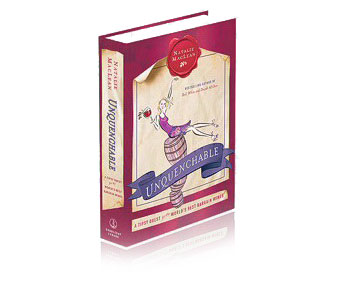
Natalie MacLean, author of the popular book
Red, White and Drunk All Over, calls wine “liquid sensuality and when you pair it with the mouth-coating luxury of chocolate, the combination is impossible to resist.” Some of her matches are chocolate-covered biscotti with Valpolicella (Italy), chocolate- orange cake and Liqueur Muscat (Australia), chocolate with nuts and Tawny Port (Portugal), or milk chocolate and Tokaji (Hungary).
Or you might try the valentine we are giving each other — Barton & Guestier’s Chateauneuf-du-Pape at $22 and Hershey’s Dark Chocolate at 60 cents a bar.
Reprinted with permission. Please ask permission before copying or using
this material. Comments? Suggestions? If you'd like to receive Natalie's free
e-wine newsletter, sign up at
www.nataliemaclean.com. It's free,
and your e-mail address will be kept confidential.


 Best Books of the Year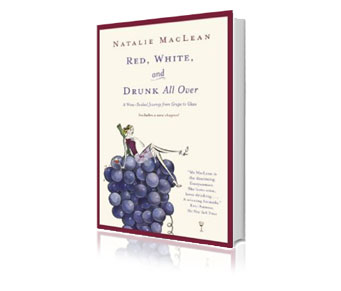


 Best Books of the Year